Elements of Visual Perception
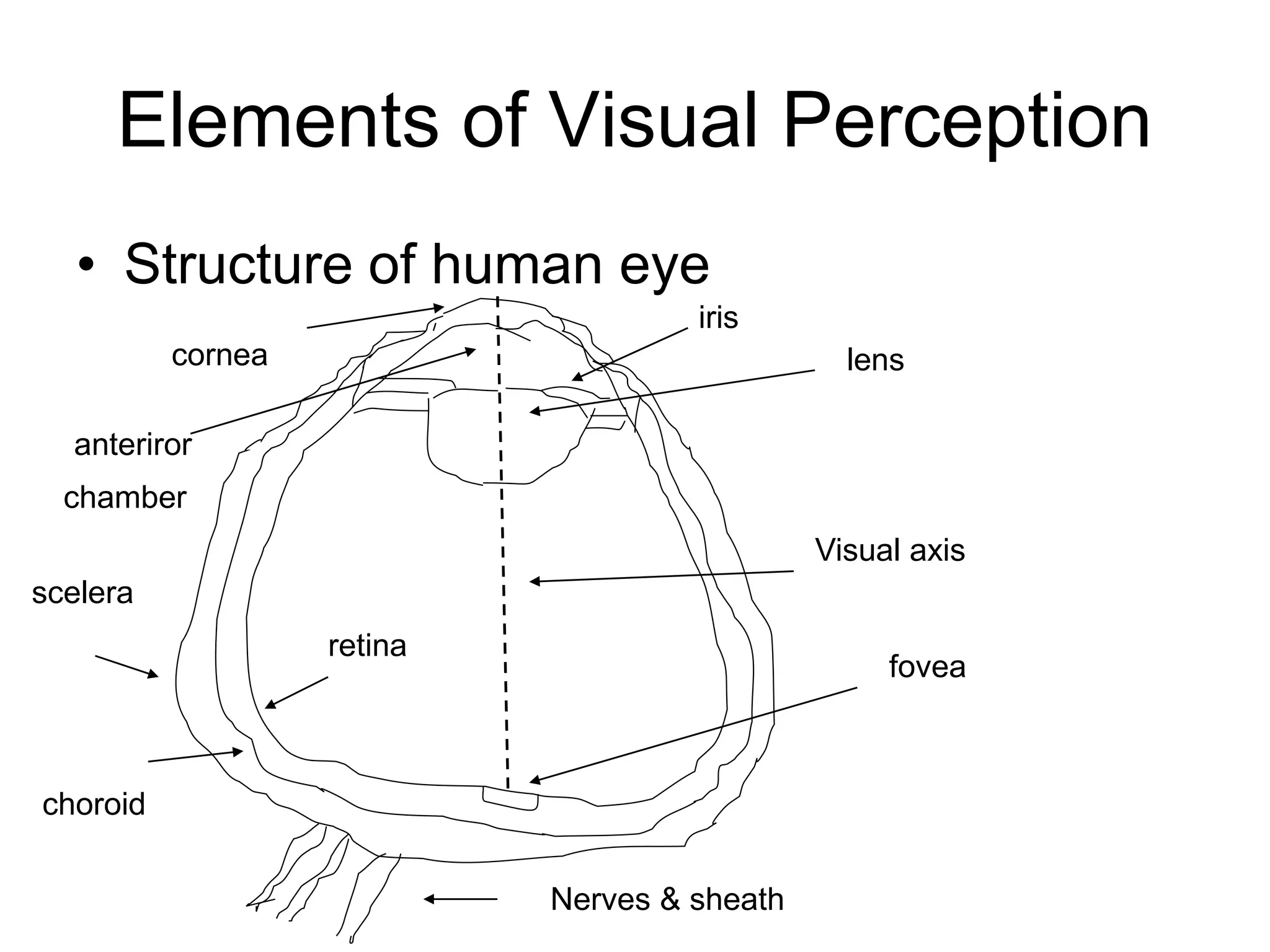
• Structure of human eye
Nerves & sheath
retina
scelera
choroid
Visual axis
lens
iris
cornea
fovea
anteriror
chamber
Structure …
• Figure shows a horizontal cross section of
human eye.
• Eye is nearly a sphere with approximate
dia of 20 mm.
• Three membranes enclose the eye;
cornea and sclera form outer cover ; the
choroid ; and the retina.
• Cornea is a tough transparent tissue that
covers anterior chamber of eye
Structure…
• Choroid is directly below the sclera; the
membrane contains a network of blood vessels
that serve as source of nutrition to the eye.
• The central opening of the iris (the pupil) varies
in diameter from approximately 2 to 8 mm.
• The inner most membrane of the eye is retina;
when eye is properly focused, external object is
imaged on the retina
Structure..
• Two types of light receptors over the surface of
retina: cones and rods.
• Cones numbering between 6 and 7 million are
located near the central portion of retina called
fovea
• Cones are highly sensitive to colour and help to
resolve fine details of image; cone vision is
called photopic.
• The number of rods is about 75million to 150
million; rods are distributed over retinal surface
Structure…
• Rods serve to give a general , overall
picture of the field of view ; rods are not
involved in colour vision and are sensitive
to low levels of illumination; rod vision is
called scotopic.
• The fovea which contains the cones is a
circular indentation of 1.5 mm dia. in the
retina.
Brightness adaptation &
discrimination
Subjective
Brightness
Log of intensity (mL)
Ba
Bb
photopic
scotopic
0-2-4-6 2 4
Brightness…
• Subjective brightness is a logarithmic
function of light intensity
• The range of light intensity to which
human vision can adapt is of the order of
10^ 10.
• In photopic vision alone the range is 10^6.
• But human vision cannot operate over the
above range simultaneously
Brightness…
• The whole range is covered through
brightness adaptation
• At brightness level Ba, the range of
subjective brightness is denoted by Bb
only; Higher levels of brightness are
covered by simply raising the adaptation
level Ba.
Brightness…
• Ratio of change in intensity of an object
over the intensity of the background which
human eye can discriminate 50% of the
time is called Weber ratio
• Larger Weber ratio means poor
discrimination ; smaller ratio means good
discrimination.
• Weber ratio is high for scotopic vision;
smaller for photopic vision
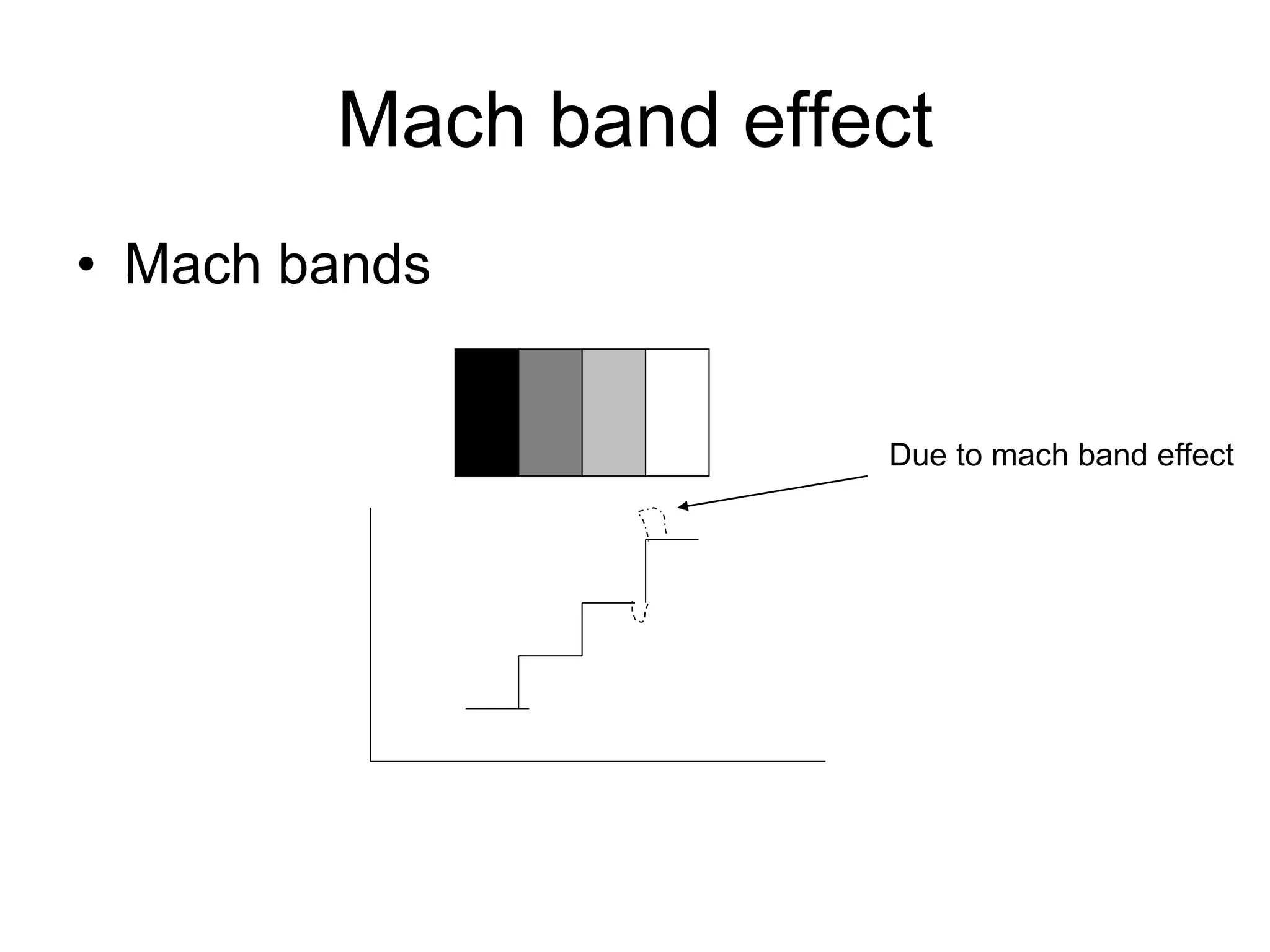
Mach band effect
• Mach bands
Due to mach band effect
Simultaneous contrast
• Perceived brightness of a region does not
depend simply on its intensity alone
• Squares of same intensity appear darker
as the background gets lighter.
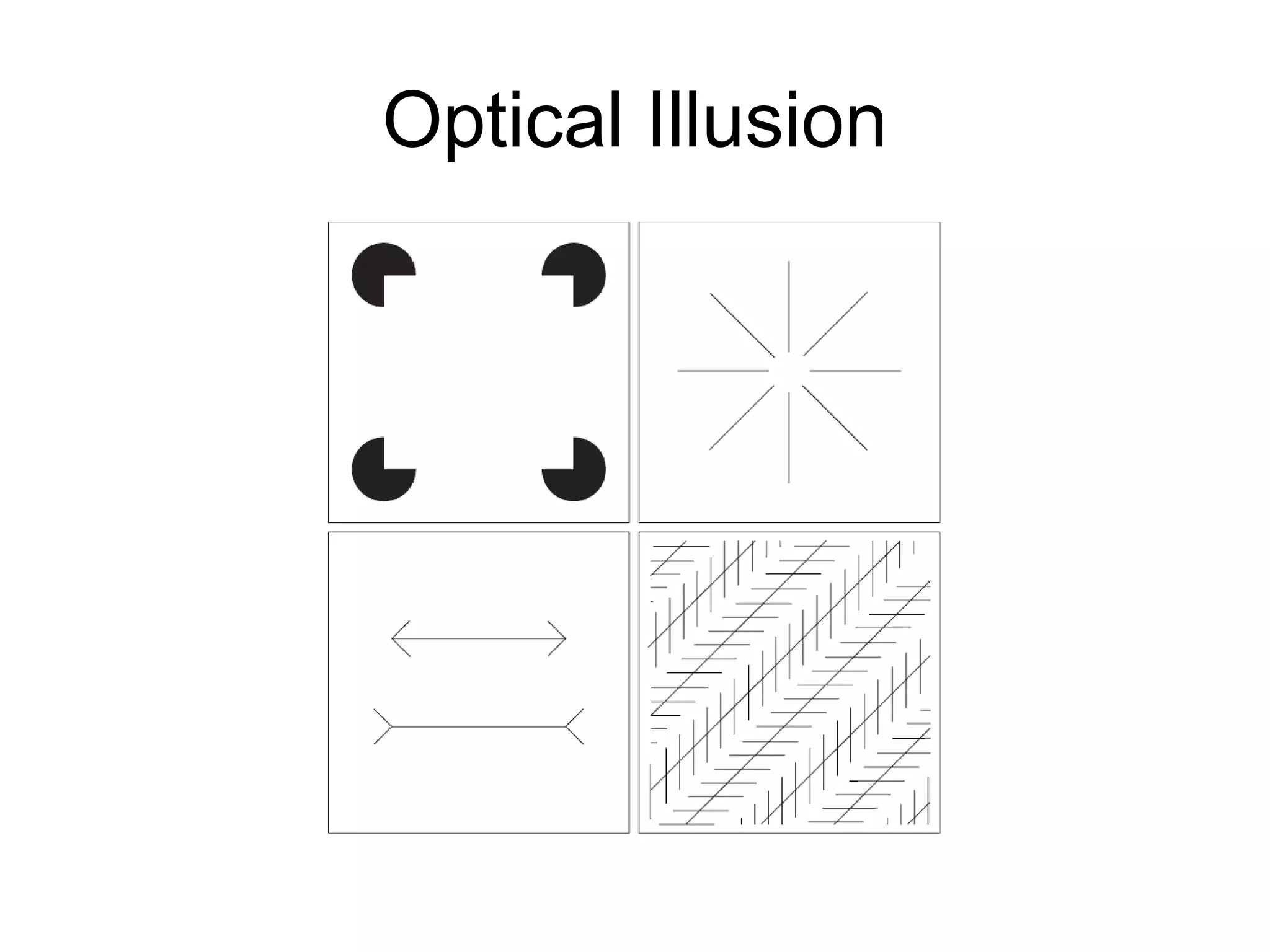
• Optical illusion patterns are also well
known
Simultaneous Contrast
Optical Illusion

Dip 1.2 12

  • 1.
    Elements of VisualPerception • Structure of human eye Nerves & sheath retina scelera choroid Visual axis lens iris cornea fovea anteriror chamber
  • 2.
    Structure … • Figureshows a horizontal cross section of human eye. • Eye is nearly a sphere with approximate dia of 20 mm. • Three membranes enclose the eye; cornea and sclera form outer cover ; the choroid ; and the retina. • Cornea is a tough transparent tissue that covers anterior chamber of eye
  • 3.
    Structure… • Choroid isdirectly below the sclera; the membrane contains a network of blood vessels that serve as source of nutrition to the eye. • The central opening of the iris (the pupil) varies in diameter from approximately 2 to 8 mm. • The inner most membrane of the eye is retina; when eye is properly focused, external object is imaged on the retina
  • 4.
    Structure.. • Two typesof light receptors over the surface of retina: cones and rods. • Cones numbering between 6 and 7 million are located near the central portion of retina called fovea • Cones are highly sensitive to colour and help to resolve fine details of image; cone vision is called photopic. • The number of rods is about 75million to 150 million; rods are distributed over retinal surface
  • 5.
    Structure… • Rods serveto give a general , overall picture of the field of view ; rods are not involved in colour vision and are sensitive to low levels of illumination; rod vision is called scotopic. • The fovea which contains the cones is a circular indentation of 1.5 mm dia. in the retina.
  • 6.
    Brightness adaptation & discrimination Subjective Brightness Logof intensity (mL) Ba Bb photopic scotopic 0-2-4-6 2 4
  • 7.
    Brightness… • Subjective brightnessis a logarithmic function of light intensity • The range of light intensity to which human vision can adapt is of the order of 10^ 10. • In photopic vision alone the range is 10^6. • But human vision cannot operate over the above range simultaneously
  • 8.
    Brightness… • The wholerange is covered through brightness adaptation • At brightness level Ba, the range of subjective brightness is denoted by Bb only; Higher levels of brightness are covered by simply raising the adaptation level Ba.
  • 9.
    Brightness… • Ratio ofchange in intensity of an object over the intensity of the background which human eye can discriminate 50% of the time is called Weber ratio • Larger Weber ratio means poor discrimination ; smaller ratio means good discrimination. • Weber ratio is high for scotopic vision; smaller for photopic vision
  • 10.
    Mach band effect •Mach bands Due to mach band effect
  • 11.
    Simultaneous contrast • Perceivedbrightness of a region does not depend simply on its intensity alone • Squares of same intensity appear darker as the background gets lighter. • Optical illusion patterns are also well known
  • 12.
  • 13.