


Essbase Calculations:
Elements of Style
Ron Moore
Principal Architect, Alithya
ABOUT THE SPEAKER
Ron Moore
> Principal Architect at Alithya
> Over 20 years Essbase consulting and training
experience
> Certified in Essbase, Planning and R programming
> Many webcasts and KScope sessions
> 19 Oracle University Quality Awards
Ron.Moore@Alithya.com
2
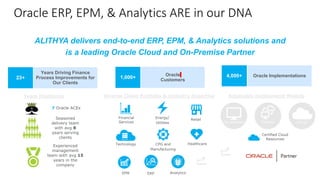
Oracle ERP, EPM, & Analytics ARE in our DNA
ALITHYA delivers end-to-end ERP, EPM, & Analytics solutions and
is a leading Oracle Cloud and On-Premise Partner
4,000+ Oracle Implementations1,000+
Oracle
Customers23+
Years Driving Finance
Process Improvements for
Our Clients
7 Oracle ACEs
Seasoned
delivery team
with avg 8
years serving
clients
Adaptable Deployment Models
Experienced
management
team with avg 15
years in the
company
Certified Cloud
Resources
Diverse Client Portfolio & Industry ExpertiseTeam Highlights
Retail
Technology CPG and
Manufacturing
Healthcare
AnalyticsEPM
Energy/
Utilities
Financial
Services Hybrid CloudOn-premise
ERP
SESSION OBJECTIVES
> MEANINGFUL soft/stylistic techniques that contribute to BETTER calc
scripts/business rules
> Targeted to Essbase CALC, but parts are relevant outside that domain
> NOT about optimization
> NOT about “content” best practices
> NOT a rigid mandate
BETTER CALC SCRIPTS: DOES STYLE MATTER AND WHY
> Objectives
> First, make it correct
> Then, make it fast
> Then, make it clear
> Costs
> Development cost
> Maintenance cost
> Clear, easily understandable code reduces maintenance costs and promotes reusability. That’s
an enormous improvement in ROI.
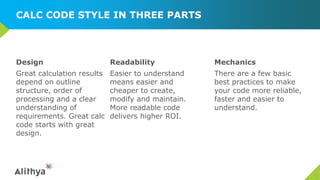
CALC CODE STYLE IN THREE PARTS
Design
Great calculation results
depend on outline
structure, order of
processing and a clear
understanding of
requirements. Great calc
code starts with great
design.
Readability
Easier to understand
means easier and
cheaper to create,
modify and maintain.
More readable code
delivers higher ROI.
Mechanics
There are a few basic
best practices to make
your code more reliable,
faster and easier to
understand.
6
7
Design
GREAT CODE STARTS WITH GREAT DESIGN
If you think good architecture is expensive, try bad architecture.“
- Brian Foote
> Lay it out in Excel
> Control data
> Who can run it, how and why?
> Specify the treatment of every dimension
> Think about processing from a dimensional and block structure point
of view
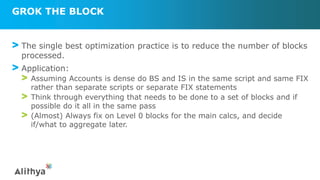
GROK THE BLOCK
> The single best optimization practice is to reduce the number of blocks
processed.
> Application:
> Assuming Accounts is dense do BS and IS in the same script and same FIX
rather than separate scripts or separate FIX statements
> Think through everything that needs to be done to a set of blocks and if
possible do it all in the same pass
> (Almost) Always fix on Level 0 blocks for the main calcs, and decide
if/what to aggregate later.
STAY DRY
> Don’t Repeat Yourself v Write Every Time
> Wet requires multiple points of maintenance which takes more time
and increases errors
Hunt and Thomas, The Pragmatic Programmer,
https://en.wikipedia.org/wiki/Don%27t_repeat_yourself
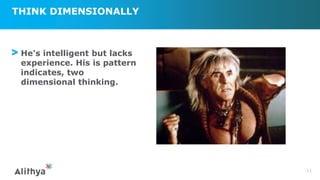
THINK DIMENSIONALLY
11
> He's intelligent but lacks
experience. His is pattern
indicates, two
dimensional thinking.
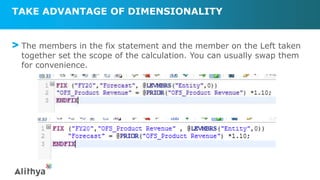
TAKE ADVANTAGE OF DIMENSIONALITY
> The members in the fix statement and the member on the Left taken
together set the scope of the calculation. You can usually swap them
for convenience.
TAKE ADVANTAGE OF DIMENSIONALITY:
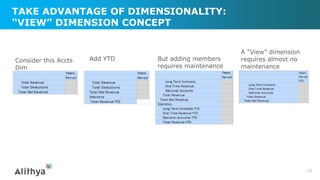
“VIEW” DIMENSION CONCEPT
13
Consider this Accts
Dim
Add YTD But adding members
requires maintenance
A “View” dimension
requires almost no
maintenance
TAKE ADVANTAGE OF DIMENSIONALITY:
WHERE SHOULD I PUT THIS CALCULATION?
> Principle: Every member intersects with all members of every other
dimension
> Application: If you want a member to intersect with specific members
you have to locate it on a different dimension than the members it
should intersect
> Q:Should “CurrMonth v PriorMonth” go on the Scenario or the Period
dimension?
> A: If you want to see it for Actual, Plan and Forecast it can’t go on the
Scenario dimension, so it would have to be Period
> Twist: What if you wanted to see “CurrMonth v PriorMonth” for every
month?
> A: Use a View dimension
14
15
Readability
STANDARDIZE AND USE NAMING CONVENTIONS
> What might be ambiguous or cause
errors? How can I communicate
purpose and requirements?
> verb/Noun
> Data Type
> Case
> Abbreviations
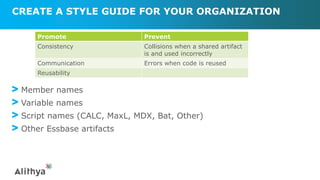
CREATE A STYLE GUIDE FOR YOUR ORGANIZATION
> Member names
> Variable names
> Script names (CALC, MaxL, MDX, Bat, Other)
> Other Essbase artifacts
Promote Prevent
Consistency Collisions when a shared artifact
is and used incorrectly
Communication Errors when code is reused
Reusability
DATA LOAD RULE NAMING CONVENTION EXAMPLE
18
File File Name
Data Load Source file FY20Acutals.txt
Data Load Rule lFY20Act.rul
MaxL procedure lFY20Act.mxl
Batch file to launch Maxl lFY20Act.bat
Err file lFY20Act.err
• Dimension Build rules start with b and then include 7 characters of the filename
• Data Load rules start with l and then include 7 characters of the filename
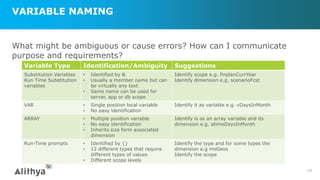
VARIABLE NAMING
19
Variable Type Identification/Ambiguity Suggestions
Substitution Variables
Run Time Substitution
variables
• Identified by &
• Usually a member name but can
be virtually any text
• Same name can be used for
server, app or db scope
Identify scope e.g. finplanCurrYear
Identify dimension e.g. scenarioFcst
VAR • Single position local variable
• No easy identification
Identify it as variable e.g. vDaysInMonth
ARRAY • Multiple position variable
• No easy identification
• Inherits size form associated
dimension
Identify is as an array variable and its
dimension e.g. atimeDaysInMonth
Run-Time prompts • Identified by {}
• 12 different types that require
different types of values
• Different scope levels
Identify the type and for some types the
dimension e.g msGeos
Identify the scope
What might be ambiguous or cause errors? How can I communicate
purpose and requirements?
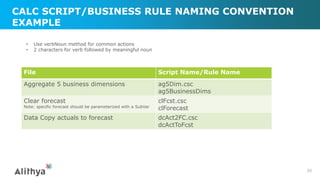
CALC SCRIPT/BUSINESS RULE NAMING CONVENTION
EXAMPLE
20
File Script Name/Rule Name
Aggregate 5 business dimensions ag5Dim.csc
ag5BusinessDims
Clear forecast
Note: specific forecast should be parameterized with a SubVar
clFcst.csc
clForecast
Data Copy actuals to forecast dcAct2FC.csc
dcActToFcst
• Use verbNoun method for common actions
• 2 characters for verb followed by meaningful noun
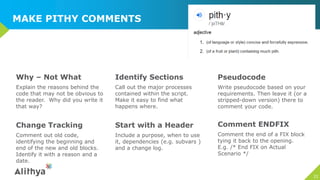
MAKE PITHY COMMENTS
Why – Not What
Explain the reasons behind the
code that may not be obvious to
the reader. Why did you write it
that way?
Identify Sections
Call out the major processes
contained within the script.
Make it easy to find what
happens where.
Pseudocode
Write pseudocode based on your
requirements. Then leave it (or a
stripped-down version) there to
comment your code.
21
Change Tracking
Comment out old code,
identifying the beginning and
end of the new and old blocks.
Identify it with a reason and a
date.
Start with a Header
Include a purpose, when to use
it, dependencies (e.g. subvars )
and a change log.
Comment ENDFIX
Comment the end of a FIX block
tying it back to the opening.
E.g. /* End FIX on Actual
Scenario */
MAKE SETTINGS EXPLICIT
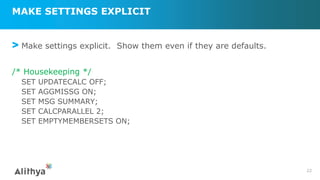
> Make settings explicit. Show them even if they are defaults.
/* Housekeeping */
SET UPDATECALC OFF;
SET AGGMISSG ON;
SET MSG SUMMARY;
SET CALCPARALLEL 2;
SET EMPTYMEMBERSETS ON;
22
23
Mechanics
MECHANICS BASICS
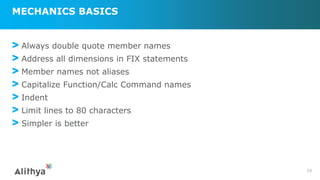
> Always double quote member names
> Address all dimensions in FIX statements
> Member names not aliases
> Capitalize Function/Calc Command names
> Indent
> Limit lines to 80 characters
> Simpler is better
24
BE DELIBERATE WITH FIX STATEMENT SCOPE
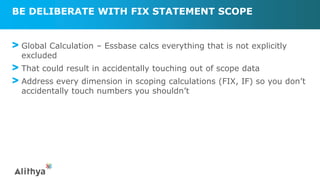
> Global Calculation – Essbase calcs everything that is not explicitly
excluded
> That could result in accidentally touching out of scope data
> Address every dimension in scoping calculations (FIX, IF) so you don’t
accidentally touch numbers you shouldn’t
ORGANIZE FIX STATEMENTS BY DIMENSION CATEGORY
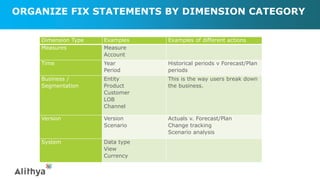
Dimension Type Examples Examples of different actions
Measures Measure
Account
Time Year
Period
Historical periods v Forecast/Plan
periods
Business /
Segmentation
Entity
Product
Customer
LOB
Channel
This is the way users break down
the business.
Version Version
Scenario
Actuals v. Forecast/Plan
Change tracking
Scenario analysis
System Data type
View
Currency
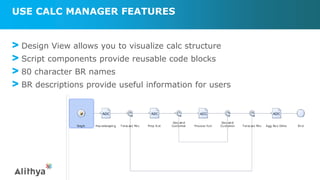
USE CALC MANAGER FEATURES
> Design View allows you to visualize calc structure
> Script components provide reusable code blocks
> 80 character BR names
> BR descriptions provide useful information for users
REDUCE CLUTTER AND ERRORS WITH VARIABLES AND
PARAMETERIZATION
> Substitution variables
> RTSV
> RTPs
> Var and Array
> Global Variables
ADDITIONAL READING
29
Description Link
Story, Oracle CEAL blog, EPM 11.1.2.x
Planning/PBCSBest Practices for BSO Business
Rule Optimization
https://blogs.oracle.com/cealteam/epm-1112x-
planningpbcs-best-practices-for-bso-business-
rule-optimisation
Pattis, CMU Coding Style notes https://www.cs.cmu.edu/~pattis/15-1XX/15-
200/lectures/style/index.html
Wikipedia, Elements Of Programming Style https://en.wikipedia.org/wiki/The_Elements_of_P
rogramming_Style
Essbase Calculations: Elements of Style

Essbase Calculations: Elements of Style

  • 1.
    Essbase Calculations: Elements ofStyle Ron Moore Principal Architect, Alithya
  • 2.
    ABOUT THE SPEAKER RonMoore > Principal Architect at Alithya > Over 20 years Essbase consulting and training experience > Certified in Essbase, Planning and R programming > Many webcasts and KScope sessions > 19 Oracle University Quality Awards Ron.Moore@Alithya.com 2
  • 3.
    Oracle ERP, EPM,& Analytics ARE in our DNA ALITHYA delivers end-to-end ERP, EPM, & Analytics solutions and is a leading Oracle Cloud and On-Premise Partner 4,000+ Oracle Implementations1,000+ Oracle Customers23+ Years Driving Finance Process Improvements for Our Clients 7 Oracle ACEs Seasoned delivery team with avg 8 years serving clients Adaptable Deployment Models Experienced management team with avg 15 years in the company Certified Cloud Resources Diverse Client Portfolio & Industry ExpertiseTeam Highlights Retail Technology CPG and Manufacturing Healthcare AnalyticsEPM Energy/ Utilities Financial Services Hybrid CloudOn-premise ERP
  • 4.
    SESSION OBJECTIVES > MEANINGFULsoft/stylistic techniques that contribute to BETTER calc scripts/business rules > Targeted to Essbase CALC, but parts are relevant outside that domain > NOT about optimization > NOT about “content” best practices > NOT a rigid mandate
  • 5.
    BETTER CALC SCRIPTS:DOES STYLE MATTER AND WHY > Objectives > First, make it correct > Then, make it fast > Then, make it clear > Costs > Development cost > Maintenance cost > Clear, easily understandable code reduces maintenance costs and promotes reusability. That’s an enormous improvement in ROI.
  • 6.
    CALC CODE STYLEIN THREE PARTS Design Great calculation results depend on outline structure, order of processing and a clear understanding of requirements. Great calc code starts with great design. Readability Easier to understand means easier and cheaper to create, modify and maintain. More readable code delivers higher ROI. Mechanics There are a few basic best practices to make your code more reliable, faster and easier to understand. 6
  • 7.
  • 8.
    GREAT CODE STARTSWITH GREAT DESIGN If you think good architecture is expensive, try bad architecture.“ - Brian Foote > Lay it out in Excel > Control data > Who can run it, how and why? > Specify the treatment of every dimension > Think about processing from a dimensional and block structure point of view
  • 9.
    GROK THE BLOCK >The single best optimization practice is to reduce the number of blocks processed. > Application: > Assuming Accounts is dense do BS and IS in the same script and same FIX rather than separate scripts or separate FIX statements > Think through everything that needs to be done to a set of blocks and if possible do it all in the same pass > (Almost) Always fix on Level 0 blocks for the main calcs, and decide if/what to aggregate later.
  • 10.
    STAY DRY > Don’tRepeat Yourself v Write Every Time > Wet requires multiple points of maintenance which takes more time and increases errors Hunt and Thomas, The Pragmatic Programmer, https://en.wikipedia.org/wiki/Don%27t_repeat_yourself
  • 11.
    THINK DIMENSIONALLY 11 > He'sintelligent but lacks experience. His is pattern indicates, two dimensional thinking.
  • 12.
    TAKE ADVANTAGE OFDIMENSIONALITY > The members in the fix statement and the member on the Left taken together set the scope of the calculation. You can usually swap them for convenience.
  • 13.
    TAKE ADVANTAGE OFDIMENSIONALITY: “VIEW” DIMENSION CONCEPT 13 Consider this Accts Dim Add YTD But adding members requires maintenance A “View” dimension requires almost no maintenance
  • 14.
    TAKE ADVANTAGE OFDIMENSIONALITY: WHERE SHOULD I PUT THIS CALCULATION? > Principle: Every member intersects with all members of every other dimension > Application: If you want a member to intersect with specific members you have to locate it on a different dimension than the members it should intersect > Q:Should “CurrMonth v PriorMonth” go on the Scenario or the Period dimension? > A: If you want to see it for Actual, Plan and Forecast it can’t go on the Scenario dimension, so it would have to be Period > Twist: What if you wanted to see “CurrMonth v PriorMonth” for every month? > A: Use a View dimension 14
  • 15.
  • 16.
    STANDARDIZE AND USENAMING CONVENTIONS > What might be ambiguous or cause errors? How can I communicate purpose and requirements? > verb/Noun > Data Type > Case > Abbreviations
  • 17.
    CREATE A STYLEGUIDE FOR YOUR ORGANIZATION > Member names > Variable names > Script names (CALC, MaxL, MDX, Bat, Other) > Other Essbase artifacts Promote Prevent Consistency Collisions when a shared artifact is and used incorrectly Communication Errors when code is reused Reusability
  • 18.
    DATA LOAD RULENAMING CONVENTION EXAMPLE 18 File File Name Data Load Source file FY20Acutals.txt Data Load Rule lFY20Act.rul MaxL procedure lFY20Act.mxl Batch file to launch Maxl lFY20Act.bat Err file lFY20Act.err • Dimension Build rules start with b and then include 7 characters of the filename • Data Load rules start with l and then include 7 characters of the filename
  • 19.
    VARIABLE NAMING 19 Variable TypeIdentification/Ambiguity Suggestions Substitution Variables Run Time Substitution variables • Identified by & • Usually a member name but can be virtually any text • Same name can be used for server, app or db scope Identify scope e.g. finplanCurrYear Identify dimension e.g. scenarioFcst VAR • Single position local variable • No easy identification Identify it as variable e.g. vDaysInMonth ARRAY • Multiple position variable • No easy identification • Inherits size form associated dimension Identify is as an array variable and its dimension e.g. atimeDaysInMonth Run-Time prompts • Identified by {} • 12 different types that require different types of values • Different scope levels Identify the type and for some types the dimension e.g msGeos Identify the scope What might be ambiguous or cause errors? How can I communicate purpose and requirements?
  • 20.
    CALC SCRIPT/BUSINESS RULENAMING CONVENTION EXAMPLE 20 File Script Name/Rule Name Aggregate 5 business dimensions ag5Dim.csc ag5BusinessDims Clear forecast Note: specific forecast should be parameterized with a SubVar clFcst.csc clForecast Data Copy actuals to forecast dcAct2FC.csc dcActToFcst • Use verbNoun method for common actions • 2 characters for verb followed by meaningful noun
  • 21.
    MAKE PITHY COMMENTS Why– Not What Explain the reasons behind the code that may not be obvious to the reader. Why did you write it that way? Identify Sections Call out the major processes contained within the script. Make it easy to find what happens where. Pseudocode Write pseudocode based on your requirements. Then leave it (or a stripped-down version) there to comment your code. 21 Change Tracking Comment out old code, identifying the beginning and end of the new and old blocks. Identify it with a reason and a date. Start with a Header Include a purpose, when to use it, dependencies (e.g. subvars ) and a change log. Comment ENDFIX Comment the end of a FIX block tying it back to the opening. E.g. /* End FIX on Actual Scenario */
  • 22.
    MAKE SETTINGS EXPLICIT >Make settings explicit. Show them even if they are defaults. /* Housekeeping */ SET UPDATECALC OFF; SET AGGMISSG ON; SET MSG SUMMARY; SET CALCPARALLEL 2; SET EMPTYMEMBERSETS ON; 22
  • 23.
  • 24.
    MECHANICS BASICS > Alwaysdouble quote member names > Address all dimensions in FIX statements > Member names not aliases > Capitalize Function/Calc Command names > Indent > Limit lines to 80 characters > Simpler is better 24
  • 25.
    BE DELIBERATE WITHFIX STATEMENT SCOPE > Global Calculation – Essbase calcs everything that is not explicitly excluded > That could result in accidentally touching out of scope data > Address every dimension in scoping calculations (FIX, IF) so you don’t accidentally touch numbers you shouldn’t
  • 26.
    ORGANIZE FIX STATEMENTSBY DIMENSION CATEGORY Dimension Type Examples Examples of different actions Measures Measure Account Time Year Period Historical periods v Forecast/Plan periods Business / Segmentation Entity Product Customer LOB Channel This is the way users break down the business. Version Version Scenario Actuals v. Forecast/Plan Change tracking Scenario analysis System Data type View Currency
  • 27.
    USE CALC MANAGERFEATURES > Design View allows you to visualize calc structure > Script components provide reusable code blocks > 80 character BR names > BR descriptions provide useful information for users
  • 28.
    REDUCE CLUTTER ANDERRORS WITH VARIABLES AND PARAMETERIZATION > Substitution variables > RTSV > RTPs > Var and Array > Global Variables
  • 29.
    ADDITIONAL READING 29 Description Link Story,Oracle CEAL blog, EPM 11.1.2.x Planning/PBCSBest Practices for BSO Business Rule Optimization https://blogs.oracle.com/cealteam/epm-1112x- planningpbcs-best-practices-for-bso-business- rule-optimisation Pattis, CMU Coding Style notes https://www.cs.cmu.edu/~pattis/15-1XX/15- 200/lectures/style/index.html Wikipedia, Elements Of Programming Style https://en.wikipedia.org/wiki/The_Elements_of_P rogramming_Style

Editor's Notes

  • #4 Organizational Experience Over 1,000 clients and over 2,000 successful implementations throughout our 23+ year history As of June 2019, Alithya has engaged in over 150 cloud projects with over 20 ground to cloud projects. Resources Core senior management has been together for many years – most for over 15 years Alithya has approximately 160 full-time resources making us one of the largest Hyperion specialized EPM organizations globally Over 95% of Ranzal consultants are Certified Product experts by Oracle Alithya is proud to acknowledge six (6) Oracle Ace Consultants on staff Thought Leadership Alithya is highly active in the Oracle EPM community advancing concepts, sharing knowledge, and developing intellectual property to aid in future engagements. One of our six Oracle ACE consultants has written three books on Financial Data Quality Management Enterprise Edition (FDMEE).