Dimension Decisions: 
A Guide to Defining Dimensions for Your 
Oracle EPM Solution 
November 16th, 2011 
RJ Linehan 
rj@innovuspartners.com
Presentation Agenda 
 Presenter Biography 
 Dimensional Modeling Concepts 
 Oracle EPM Dimensional Requirements 
 Financial Management (HFM) 
 Planning 
 Essbase 
 Common Design Scenarios 
 Questions
Presenter Biography 
 RJ Linehan, Innovus Partners 
 Eleven Years experience consulting in the EPM/BI Space 
 Expertise in functional and technical requirements gathering 
 Deployed over 30 EPM/BI solutions 
 Key Industry experience 
 Consumer Packaged Goods 
 Retail 
 Insurance and Financial Services 
 Primary Application Experience 
 Management Reporting Applications 
 Budget & Forecasting Solutions 
 Workforce and Capital Asset Planning Models 
 Customer/Product Profitability Models 
 Executive Dashboards
Dimensional Modeling Concepts 
What is a dimensional model? 
(Borrowed from "The Data Warehouse Toolkit" by Ralph Kimball and Margy Ross) 
 A single set of common data that satisfies the following user 
requirements 
 Ability to make informed business decisions based on the right 
data 
 Expectation of accurate data provided at the correct grain 
 Delivery of the data in a secure and timely fashion 
 Capacity to change with business requirements
Dimensional Modeling Concepts 
What is a Fact? 
(Borrowed from "The Data Warehouse Toolkit" by Ralph Kimball and Margy Ross) 
• A fact is a business measure that is typically numeric 
• A fact is the numerical data stored in an EPM application 
• A fact can be additive or non-additive 
• The list of dimensions that encompass an EPM application 
defines the grain of the fact and the scope of measurement
Dimensional Modeling Concepts 
What is a Dimension? 
(Borrowed from "The Data Warehouse Toolkit" by Ralph Kimball and Margy Ross) 
• A dimension and its attributes describe the facts 
stored in an EPM application 
• Dimension attributes define the 'By' in a report 
(Revenue by Quarter by Region) 
• A dimension is a type of Metadata
Dimensional Modeling Concepts 
Successfully Defining Dimensions During Design 
• Insist on complete functional/business requirements 
• Know the data that will encompass the subject area 
• Engage and learn from the business users 
• Provide detailed pre-design questions for the business 
and IT 
• Request sample dimensions from legacy applications
Dimensional Modeling Concepts 
Design Tools Used to Define Dimensions 
 Existing User Reports 
 Leverage existing user reports to ensure the design supports 
reporting requirements 
 MS Excel 
 Employ MS Excel to illustrate sample report layouts 
 Outline Editor 
 Utilize an outline editor and the MS Excel Add-in / Smart View 
 The business user 
 Your ears
Dimensional Modeling Concepts 
Successfully Defining Dimensions During Design 
DEMONSTRATION
Oracle EPM Dimensional Requirements 
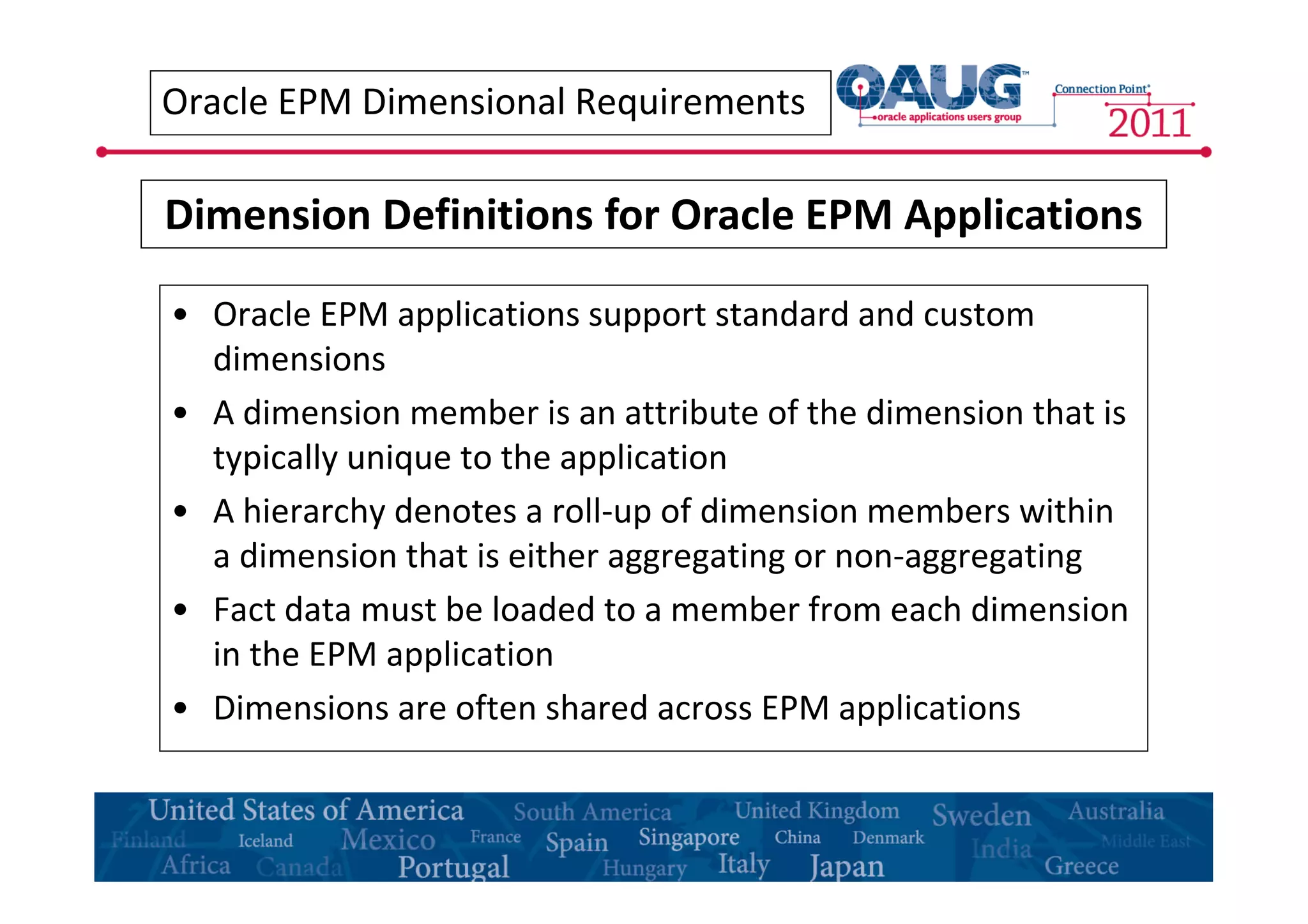
Dimension Definitions for Oracle EPM Applications 
• Oracle EPM applications support standard and custom 
dimensions 
• A dimension member is an attribute of the dimension that is 
typically unique to the application 
• A hierarchy denotes a roll-up of dimension members within 
a dimension that is either aggregating or non-aggregating 
• Fact data must be loaded to a member from each dimension 
in the EPM application 
• Dimensions are often shared across EPM applications
Oracle EPM Dimensional Requirements 
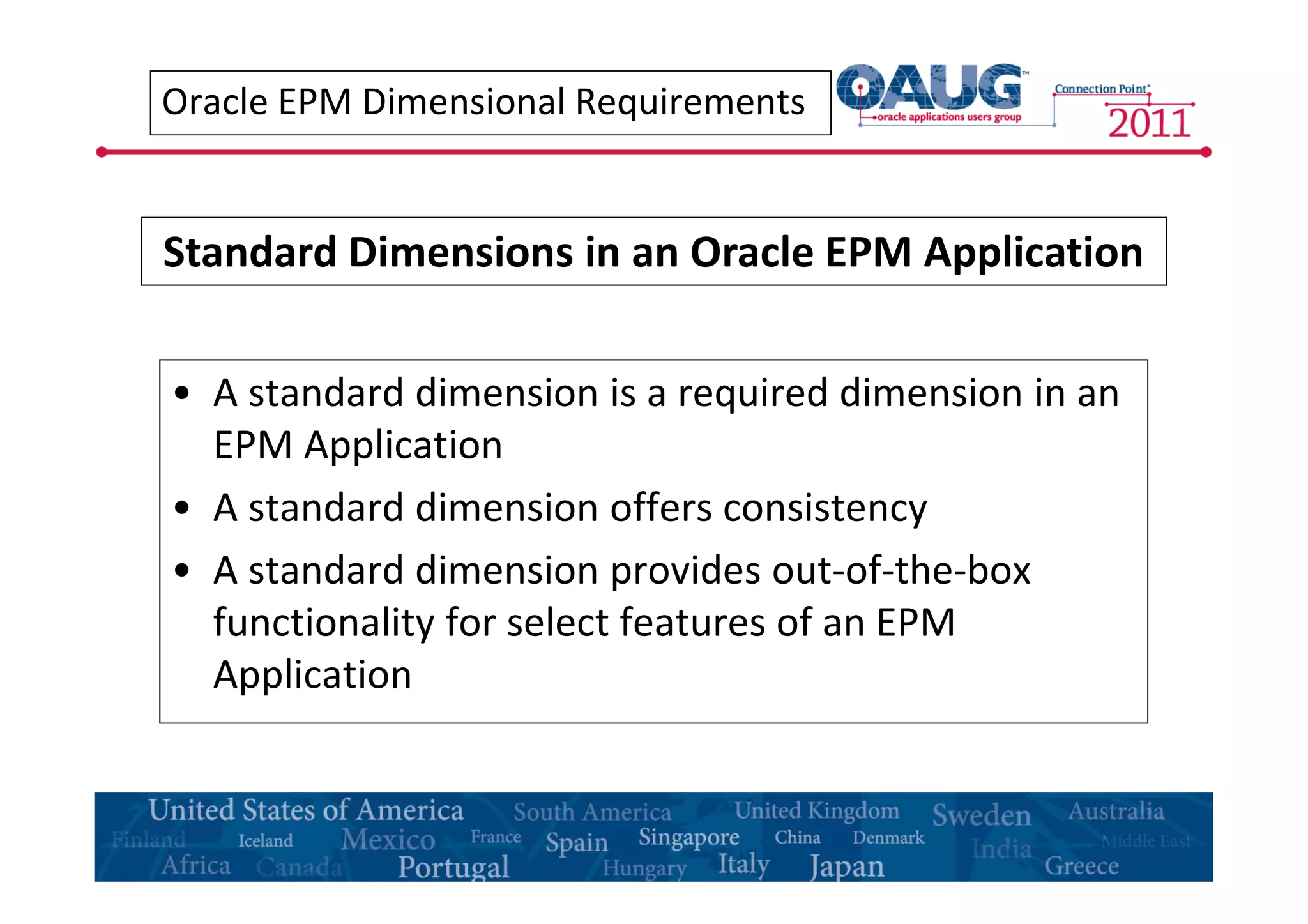
Standard Dimensions in an Oracle EPM Application 
• A standard dimension is a required dimension in an 
EPM Application 
• A standard dimension offers consistency 
• A standard dimension provides out-of-the-box 
functionality for select features of an EPM 
Application
Oracle EPM Dimensional Requirements 
Custom Dimensions in an Oracle EPM Application 
• A custom dimension is typically not a required 
dimension in an EPM Application 
• A custom dimension provides for customization to 
satisfy reporting requirements 
• A custom dimension expands the perspective of 
data stored in an EPM Application
Oracle EPM Dimensional Requirements 
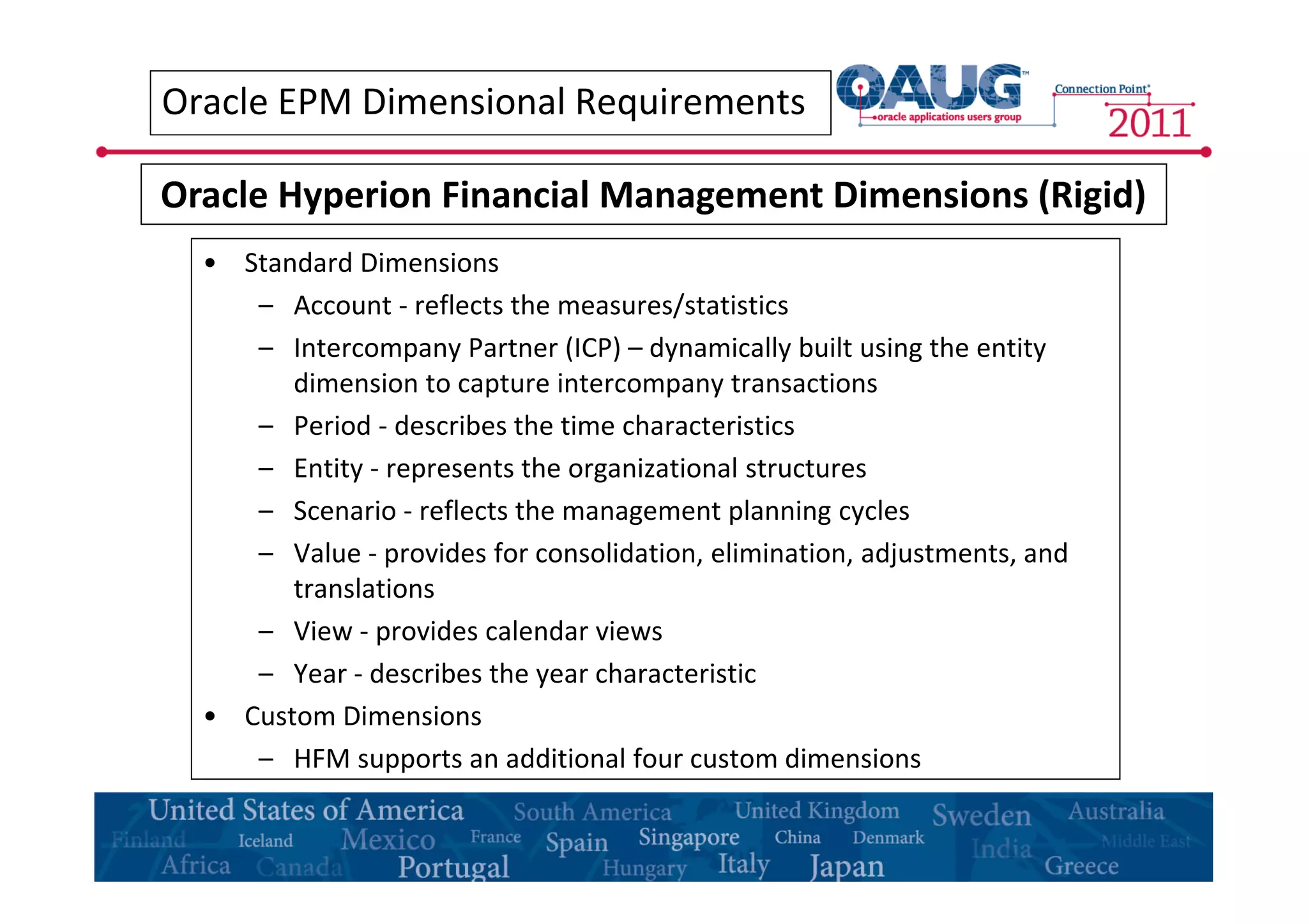
Oracle Hyperion Financial Management Dimensions (Rigid) 
• Standard Dimensions 
– Account - reflects the measures/statistics 
– Intercompany Partner (ICP) – dynamically built using the entity 
dimension to capture intercompany transactions 
– Period - describes the time characteristics 
– Entity - represents the organizational structures 
– Scenario - reflects the management planning cycles 
– Value - provides for consolidation, elimination, adjustments, and 
translations 
– View - provides calendar views 
– Year - describes the year characteristic 
• Custom Dimensions 
– HFM supports an additional four custom dimensions
Oracle EPM Dimensional Requirements 
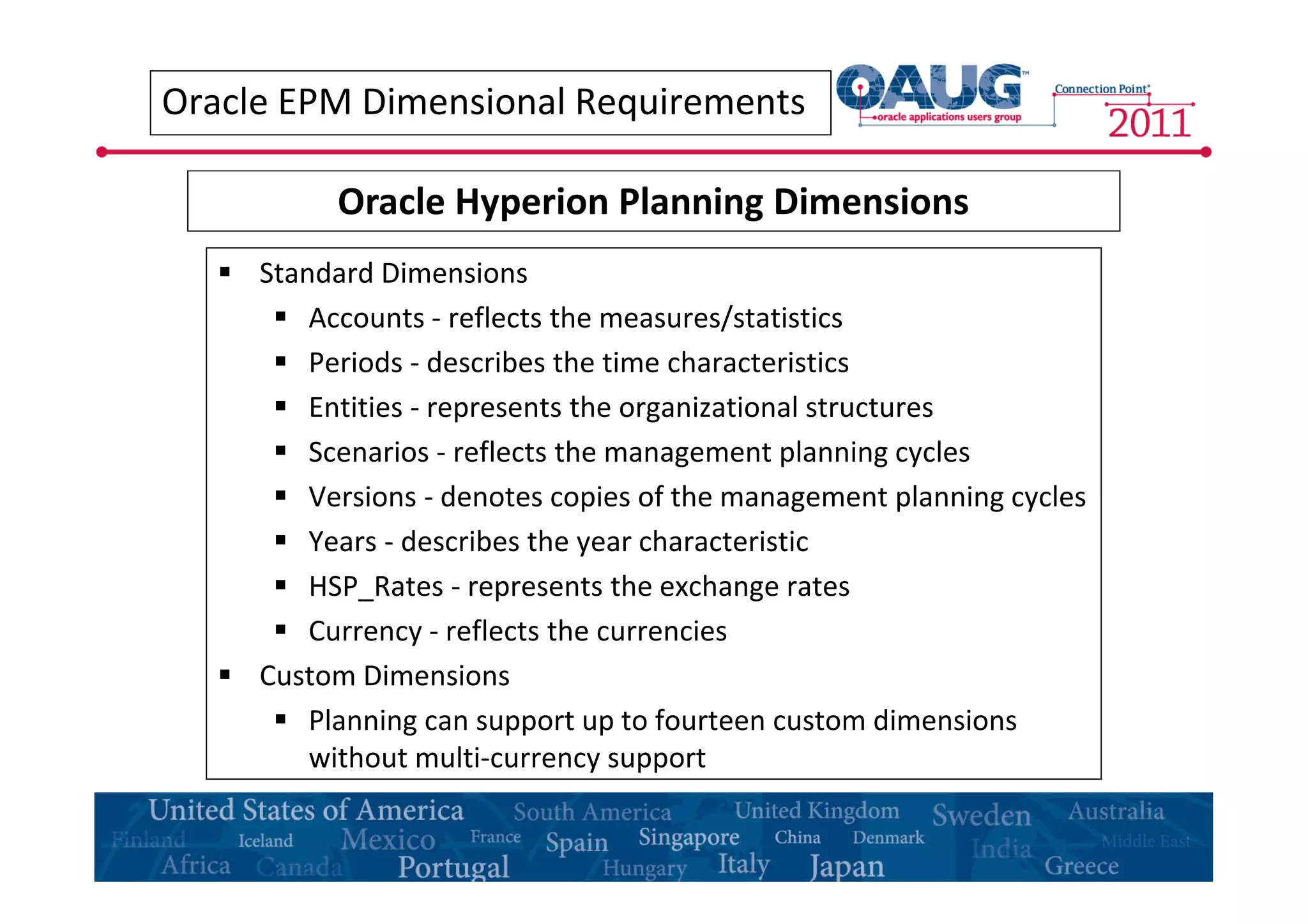
Oracle Hyperion Planning Dimensions 
 Standard Dimensions 
 Accounts - reflects the measures/statistics 
 Periods - describes the time characteristics 
 Entities - represents the organizational structures 
 Scenarios - reflects the management planning cycles 
 Versions - denotes copies of the management planning cycles 
 Years - describes the year characteristic 
 HSP_Rates - represents the exchange rates 
 Currency - reflects the currencies 
 Custom Dimensions 
 Planning can support up to fourteen custom dimensions 
without multi-currency support
Oracle EPM Dimensional Requirements 
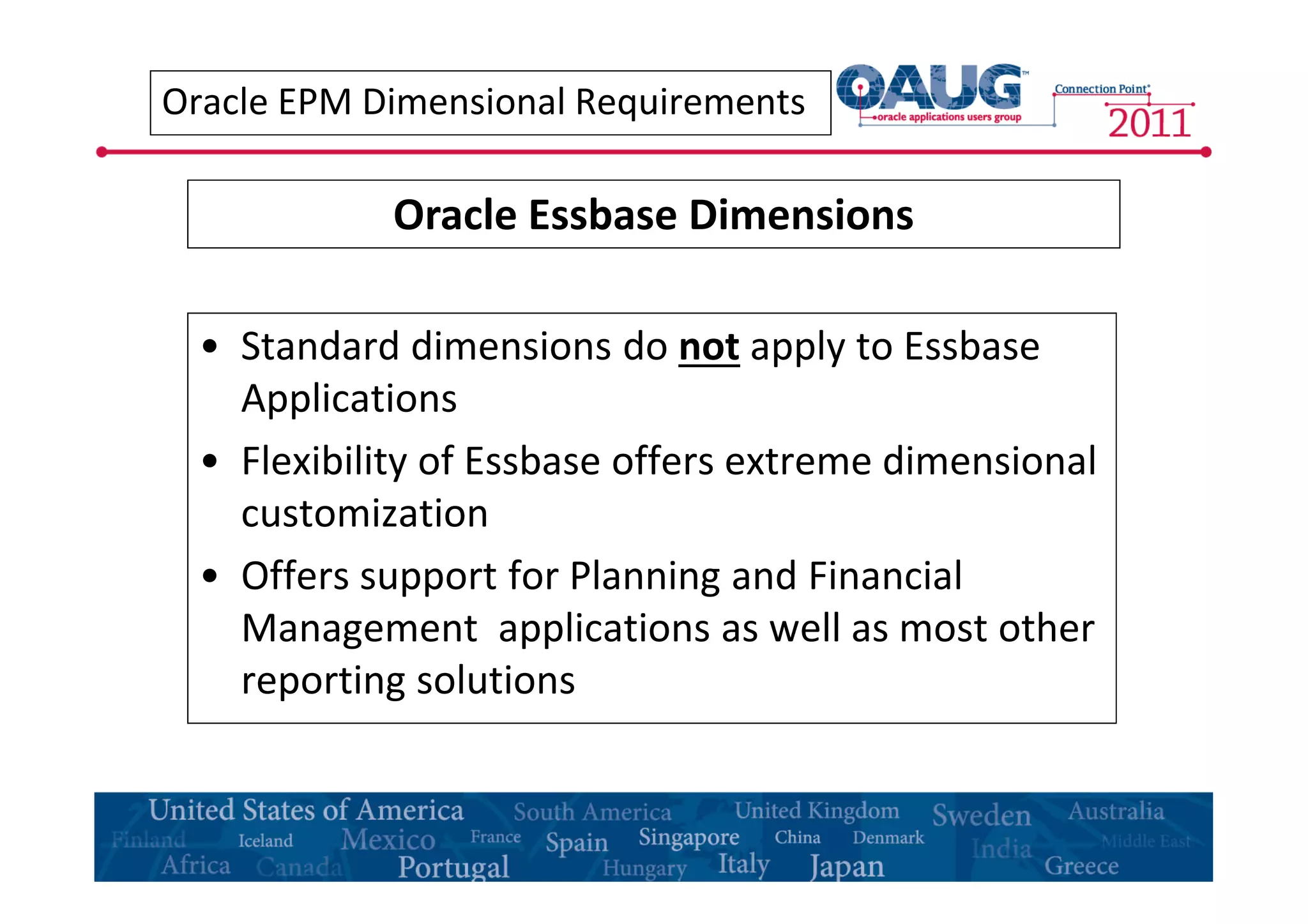
Oracle Essbase Dimensions 
• Standard dimensions do not apply to Essbase 
Applications 
• Flexibility of Essbase offers extreme dimensional 
customization 
• Offers support for Planning and Financial 
Management applications as well as most other 
reporting solutions
Common Design Scenarios 
Dimensional Design for Budget & Forecasting Applications 
• Organize data sets that will be planned into 
groups of common dimensionality 
• Avoid building one application with many 
dimensions to support all planned data 
• Leverage a separate application to support 
consolidated reporting 
• Consider loading data instead of deriving it 
when calc inputs are not dimensionally relevant
Common Design Scenarios 
Dimensional Design for Budget & Forecasting Applications 
DEMONSTRATION
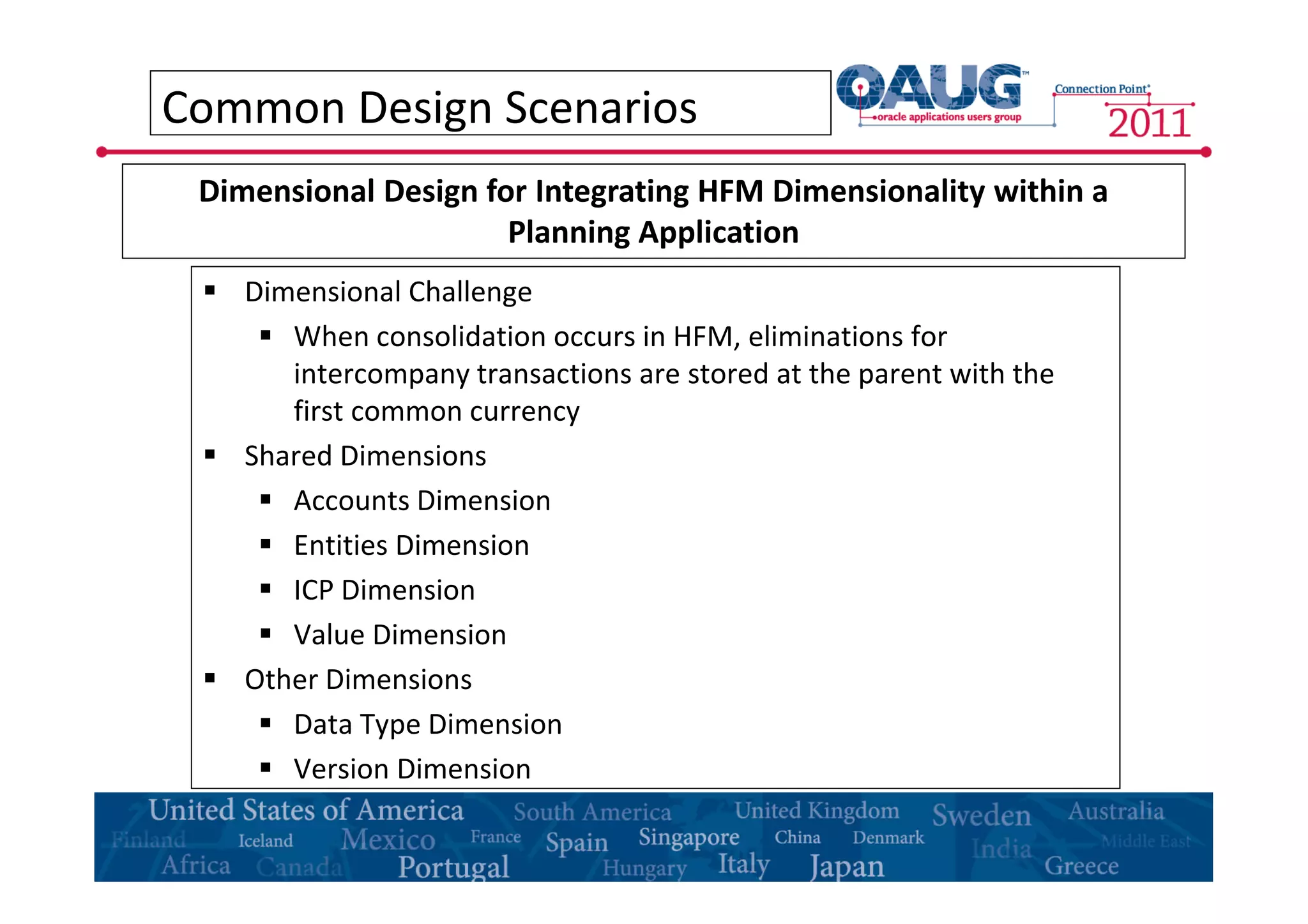
Common Design Scenarios 
Dimensional Design for Integrating HFM Dimensionality within a 
Planning Application 
 Dimensional Challenge 
 When consolidation occurs in HFM, eliminations for 
intercompany transactions are stored at the parent with the 
first common currency 
 Shared Dimensions 
 Accounts Dimension 
 Entities Dimension 
 ICP Dimension 
 Value Dimension 
 Other Dimensions 
 Data Type Dimension 
 Version Dimension
Common Design Scenarios 
Dimensional Design for Integrating HFMDimensionality 
within a Planning Application 
DEMONSTRATION
Common Design Scenarios 
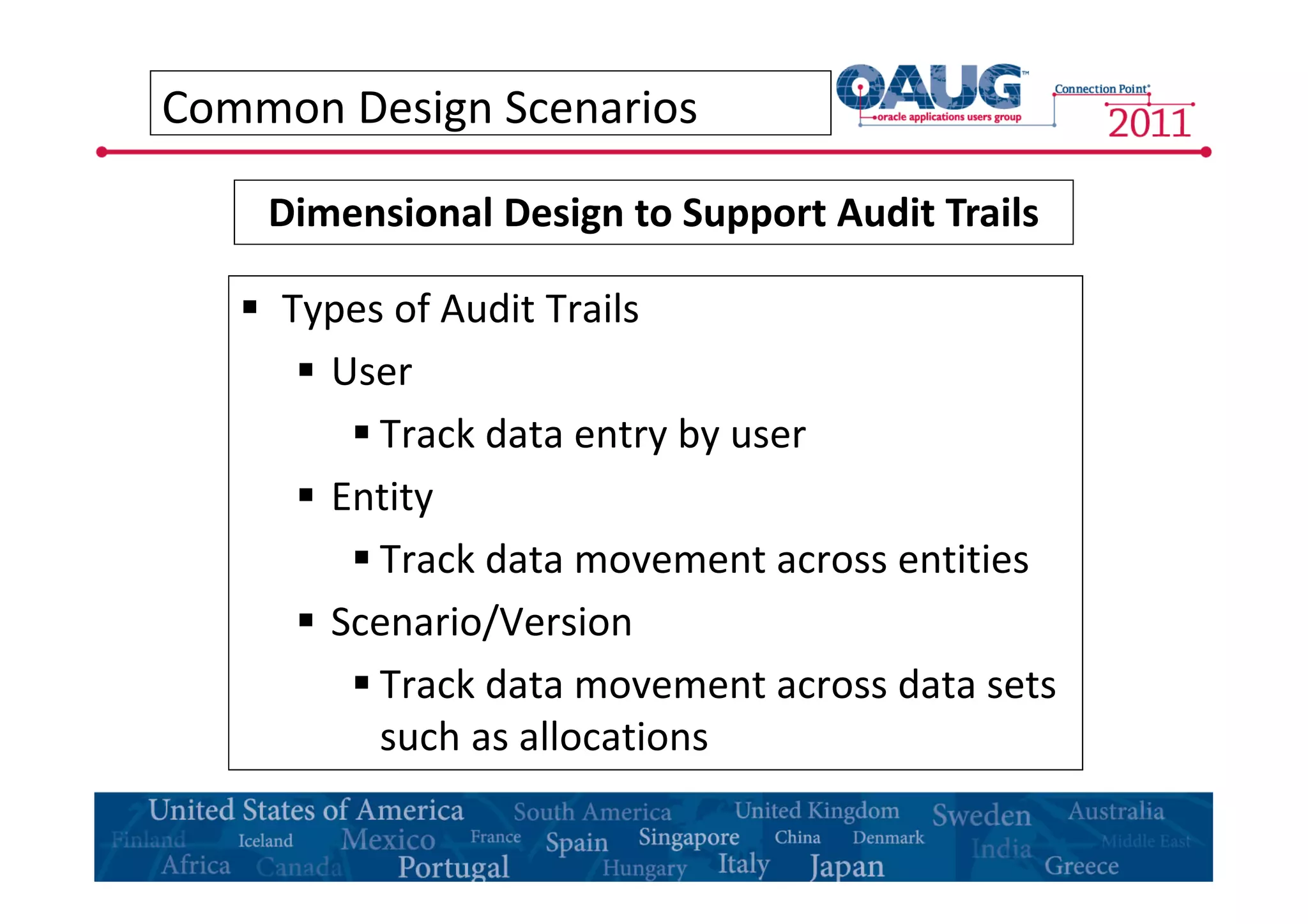
Dimensional Design to Support Audit Trails 
 Types of Audit Trails 
 User 
 Track data entry by user 
 Entity 
 Track data movement across entities 
 Scenario/Version 
 Track data movement across data sets 
such as allocations
Common Design Scenarios 
Dimensional Design to Support Audit Trails 
DEMONSTRATION
Common Design Scenarios 
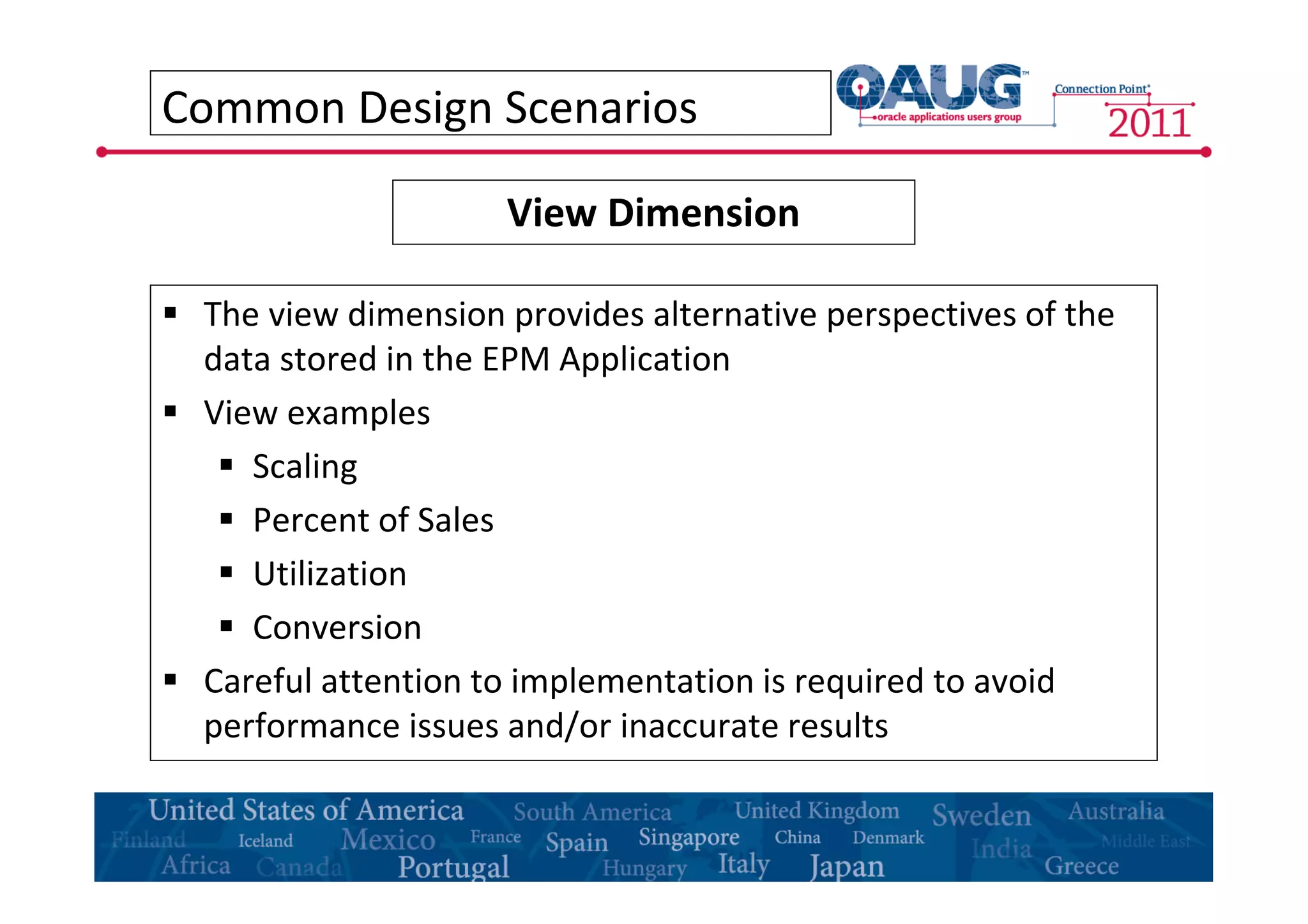
View Dimension 
 The view dimension provides alternative perspectives of the 
data stored in the EPM Application 
 View examples 
 Scaling 
 Percent of Sales 
 Utilization 
 Conversion 
 Careful attention to implementation is required to avoid 
performance issues and/or inaccurate results
Common Design Scenarios 
View Dimension 
DEMONSTRATION
Common Design Scenarios 
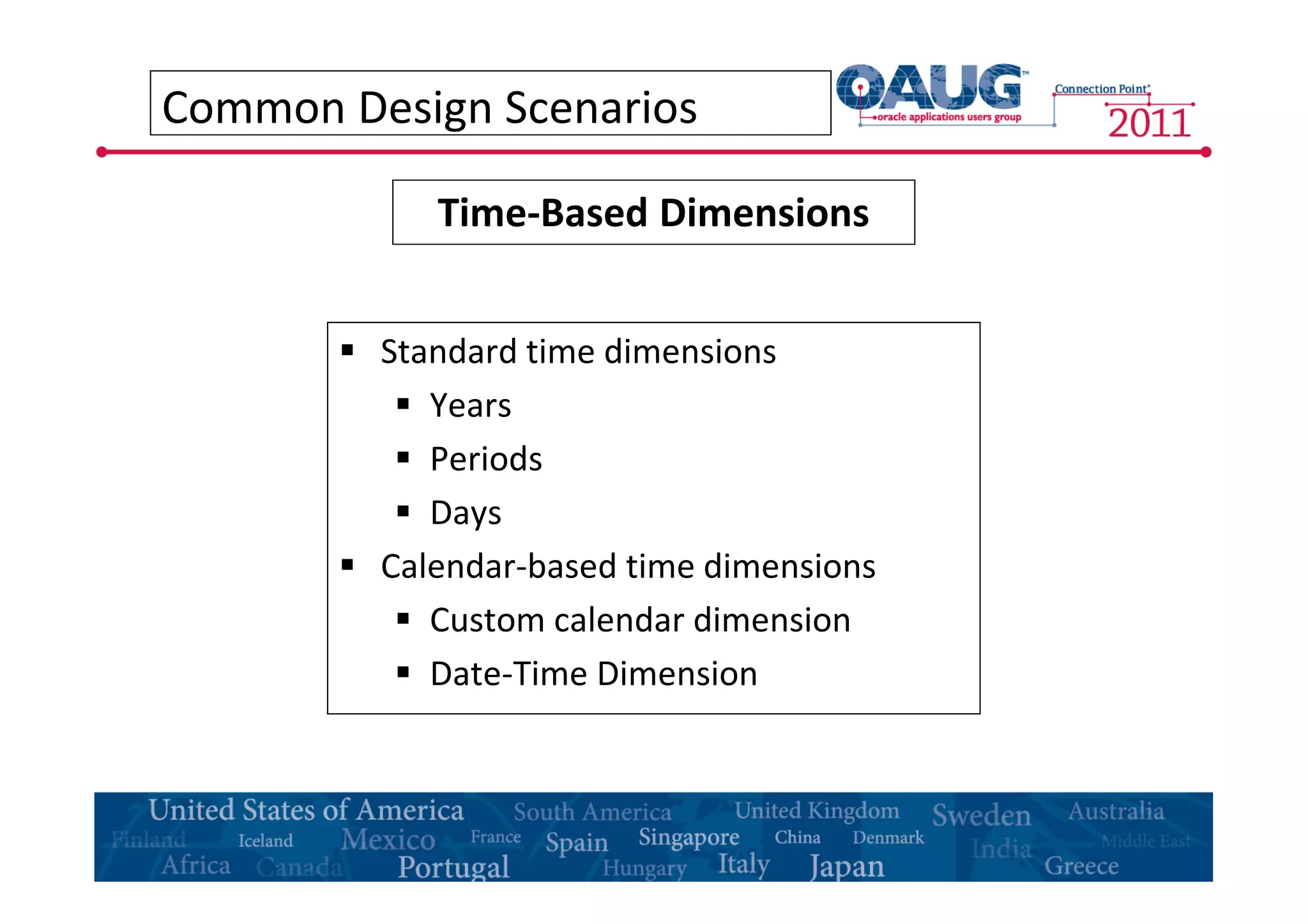
Time-Based Dimensions 
 Standard time dimensions 
 Years 
 Periods 
 Days 
 Calendar-based time dimensions 
 Custom calendar dimension 
 Date-Time Dimension
Common Design Scenarios 
Time-Based Dimensions 
DEMONSTRATION
Common Design Scenarios 
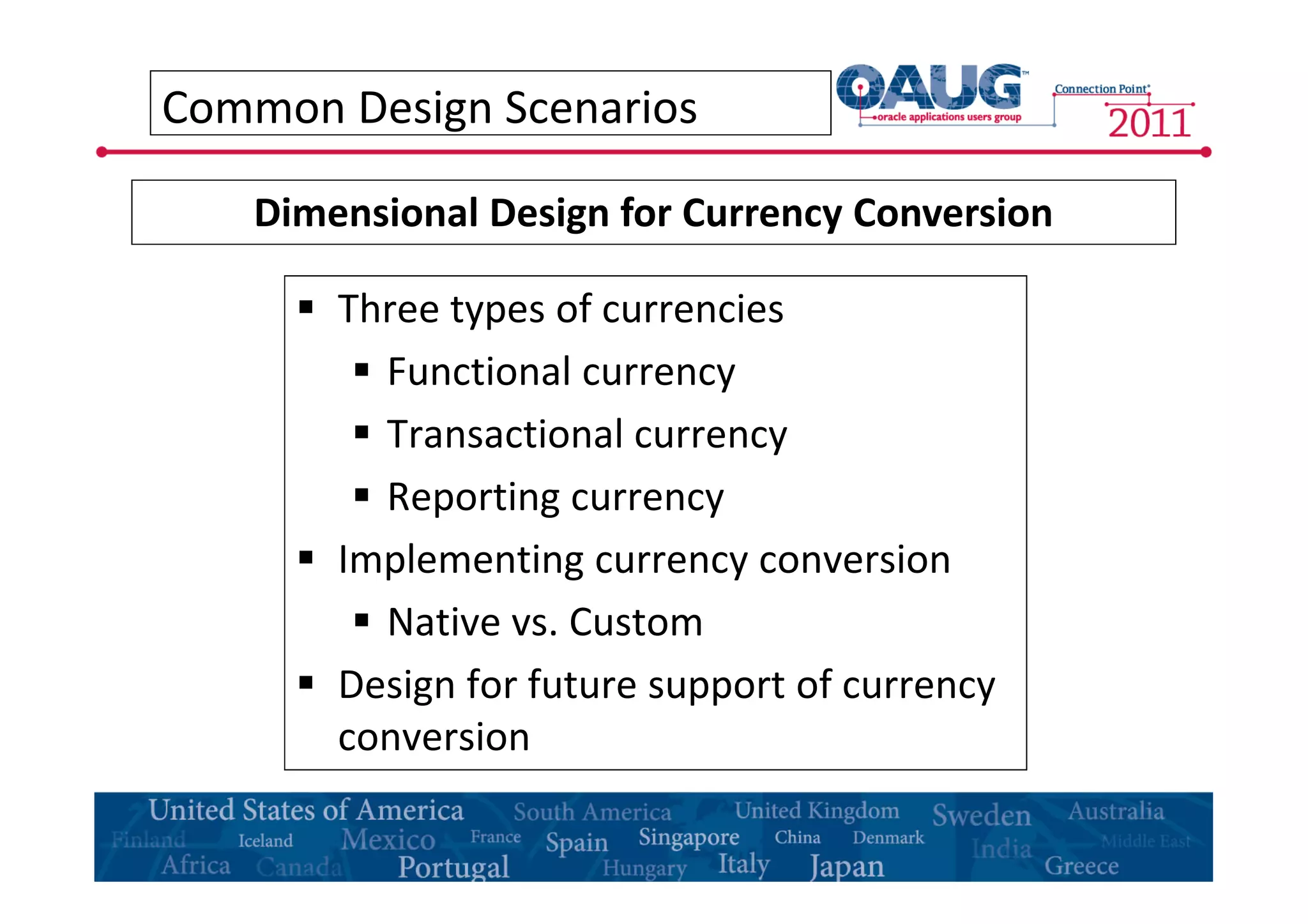
Dimensional Design for Currency Conversion 
 Three types of currencies 
 Functional currency 
 Transactional currency 
 Reporting currency 
 Implementing currency conversion 
 Native vs. Custom 
 Design for future support of currency 
conversion
Common Design Scenarios 
Dimensional Design for Currency Conversion 
DEMONSTRATION
Common Design Scenarios 
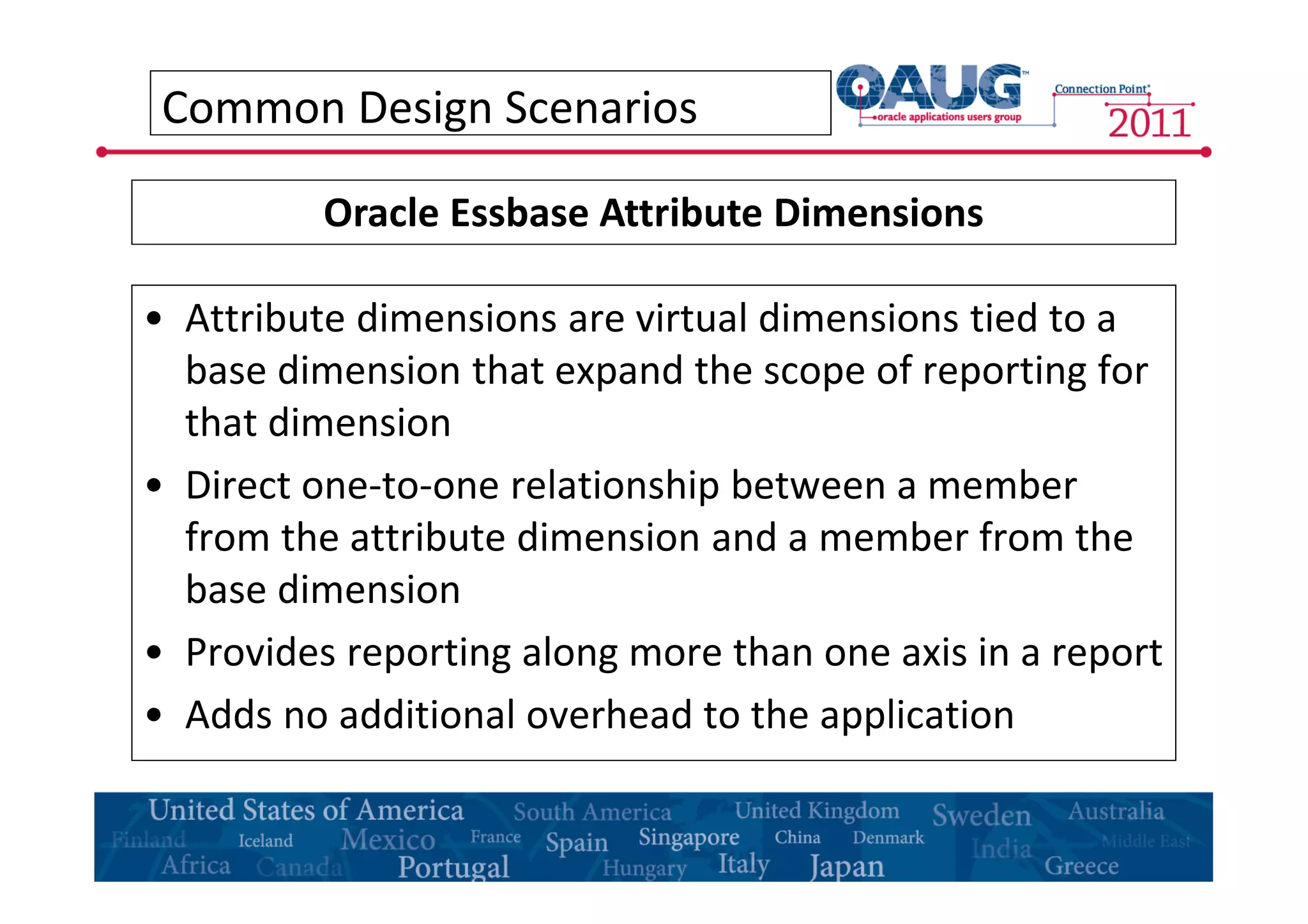
Oracle Essbase Attribute Dimensions 
• Attribute dimensions are virtual dimensions tied to a 
base dimension that expand the scope of reporting for 
that dimension 
• Direct one-to-one relationship between a member 
from the attribute dimension and a member from the 
base dimension 
• Provides reporting along more than one axis in a report 
• Adds no additional overhead to the application
Dimension Decisions: 
A Guide to Defining Dimensions for Your 
Oracle EPM Solution 
November 16th, 2011 
RJ Linehan 
rj@innovuspartners.com

Connection Point 2011, Dimension Decisions: A Guide to Selecting Dimensions for Your Oracle EPM Solution

  • 1.
    Dimension Decisions: AGuide to Defining Dimensions for Your Oracle EPM Solution November 16th, 2011 RJ Linehan rj@innovuspartners.com
  • 2.
    Presentation Agenda Presenter Biography  Dimensional Modeling Concepts  Oracle EPM Dimensional Requirements  Financial Management (HFM)  Planning  Essbase  Common Design Scenarios  Questions
  • 3.
    Presenter Biography RJ Linehan, Innovus Partners  Eleven Years experience consulting in the EPM/BI Space  Expertise in functional and technical requirements gathering  Deployed over 30 EPM/BI solutions  Key Industry experience  Consumer Packaged Goods  Retail  Insurance and Financial Services  Primary Application Experience  Management Reporting Applications  Budget & Forecasting Solutions  Workforce and Capital Asset Planning Models  Customer/Product Profitability Models  Executive Dashboards
  • 4.
    Dimensional Modeling Concepts What is a dimensional model? (Borrowed from "The Data Warehouse Toolkit" by Ralph Kimball and Margy Ross)  A single set of common data that satisfies the following user requirements  Ability to make informed business decisions based on the right data  Expectation of accurate data provided at the correct grain  Delivery of the data in a secure and timely fashion  Capacity to change with business requirements
  • 5.
    Dimensional Modeling Concepts What is a Fact? (Borrowed from "The Data Warehouse Toolkit" by Ralph Kimball and Margy Ross) • A fact is a business measure that is typically numeric • A fact is the numerical data stored in an EPM application • A fact can be additive or non-additive • The list of dimensions that encompass an EPM application defines the grain of the fact and the scope of measurement
  • 6.
    Dimensional Modeling Concepts What is a Dimension? (Borrowed from "The Data Warehouse Toolkit" by Ralph Kimball and Margy Ross) • A dimension and its attributes describe the facts stored in an EPM application • Dimension attributes define the 'By' in a report (Revenue by Quarter by Region) • A dimension is a type of Metadata
  • 7.
    Dimensional Modeling Concepts Successfully Defining Dimensions During Design • Insist on complete functional/business requirements • Know the data that will encompass the subject area • Engage and learn from the business users • Provide detailed pre-design questions for the business and IT • Request sample dimensions from legacy applications
  • 8.
    Dimensional Modeling Concepts Design Tools Used to Define Dimensions  Existing User Reports  Leverage existing user reports to ensure the design supports reporting requirements  MS Excel  Employ MS Excel to illustrate sample report layouts  Outline Editor  Utilize an outline editor and the MS Excel Add-in / Smart View  The business user  Your ears
  • 9.
    Dimensional Modeling Concepts Successfully Defining Dimensions During Design DEMONSTRATION
  • 10.
    Oracle EPM DimensionalRequirements Dimension Definitions for Oracle EPM Applications • Oracle EPM applications support standard and custom dimensions • A dimension member is an attribute of the dimension that is typically unique to the application • A hierarchy denotes a roll-up of dimension members within a dimension that is either aggregating or non-aggregating • Fact data must be loaded to a member from each dimension in the EPM application • Dimensions are often shared across EPM applications
  • 11.
    Oracle EPM DimensionalRequirements Standard Dimensions in an Oracle EPM Application • A standard dimension is a required dimension in an EPM Application • A standard dimension offers consistency • A standard dimension provides out-of-the-box functionality for select features of an EPM Application
  • 12.
    Oracle EPM DimensionalRequirements Custom Dimensions in an Oracle EPM Application • A custom dimension is typically not a required dimension in an EPM Application • A custom dimension provides for customization to satisfy reporting requirements • A custom dimension expands the perspective of data stored in an EPM Application
  • 13.
    Oracle EPM DimensionalRequirements Oracle Hyperion Financial Management Dimensions (Rigid) • Standard Dimensions – Account - reflects the measures/statistics – Intercompany Partner (ICP) – dynamically built using the entity dimension to capture intercompany transactions – Period - describes the time characteristics – Entity - represents the organizational structures – Scenario - reflects the management planning cycles – Value - provides for consolidation, elimination, adjustments, and translations – View - provides calendar views – Year - describes the year characteristic • Custom Dimensions – HFM supports an additional four custom dimensions
  • 14.
    Oracle EPM DimensionalRequirements Oracle Hyperion Planning Dimensions  Standard Dimensions  Accounts - reflects the measures/statistics  Periods - describes the time characteristics  Entities - represents the organizational structures  Scenarios - reflects the management planning cycles  Versions - denotes copies of the management planning cycles  Years - describes the year characteristic  HSP_Rates - represents the exchange rates  Currency - reflects the currencies  Custom Dimensions  Planning can support up to fourteen custom dimensions without multi-currency support
  • 15.
    Oracle EPM DimensionalRequirements Oracle Essbase Dimensions • Standard dimensions do not apply to Essbase Applications • Flexibility of Essbase offers extreme dimensional customization • Offers support for Planning and Financial Management applications as well as most other reporting solutions
  • 16.
    Common Design Scenarios Dimensional Design for Budget & Forecasting Applications • Organize data sets that will be planned into groups of common dimensionality • Avoid building one application with many dimensions to support all planned data • Leverage a separate application to support consolidated reporting • Consider loading data instead of deriving it when calc inputs are not dimensionally relevant
  • 17.
    Common Design Scenarios Dimensional Design for Budget & Forecasting Applications DEMONSTRATION
  • 18.
    Common Design Scenarios Dimensional Design for Integrating HFM Dimensionality within a Planning Application  Dimensional Challenge  When consolidation occurs in HFM, eliminations for intercompany transactions are stored at the parent with the first common currency  Shared Dimensions  Accounts Dimension  Entities Dimension  ICP Dimension  Value Dimension  Other Dimensions  Data Type Dimension  Version Dimension
  • 19.
    Common Design Scenarios Dimensional Design for Integrating HFMDimensionality within a Planning Application DEMONSTRATION
  • 20.
    Common Design Scenarios Dimensional Design to Support Audit Trails  Types of Audit Trails  User  Track data entry by user  Entity  Track data movement across entities  Scenario/Version  Track data movement across data sets such as allocations
  • 21.
    Common Design Scenarios Dimensional Design to Support Audit Trails DEMONSTRATION
  • 22.
    Common Design Scenarios View Dimension  The view dimension provides alternative perspectives of the data stored in the EPM Application  View examples  Scaling  Percent of Sales  Utilization  Conversion  Careful attention to implementation is required to avoid performance issues and/or inaccurate results
  • 23.
    Common Design Scenarios View Dimension DEMONSTRATION
  • 24.
    Common Design Scenarios Time-Based Dimensions  Standard time dimensions  Years  Periods  Days  Calendar-based time dimensions  Custom calendar dimension  Date-Time Dimension
  • 25.
    Common Design Scenarios Time-Based Dimensions DEMONSTRATION
  • 26.
    Common Design Scenarios Dimensional Design for Currency Conversion  Three types of currencies  Functional currency  Transactional currency  Reporting currency  Implementing currency conversion  Native vs. Custom  Design for future support of currency conversion
  • 27.
    Common Design Scenarios Dimensional Design for Currency Conversion DEMONSTRATION
  • 28.
    Common Design Scenarios Oracle Essbase Attribute Dimensions • Attribute dimensions are virtual dimensions tied to a base dimension that expand the scope of reporting for that dimension • Direct one-to-one relationship between a member from the attribute dimension and a member from the base dimension • Provides reporting along more than one axis in a report • Adds no additional overhead to the application
  • 29.
    Dimension Decisions: AGuide to Defining Dimensions for Your Oracle EPM Solution November 16th, 2011 RJ Linehan rj@innovuspartners.com