Hyperion Demo
Presentation
www.click4learning.com
info@leadinnovativetechnologies.com
Raw Data
3
Raw Data will be no use until it will become information
Raw Data -> Information
4
How do you
find out the
profit of
Product
“Electronics”
from 100’ s of
Excel sheets
Metadata
Then what is OLTP
In general, All Database Systems are OLTP
 Most RDBMS systems are OLTP
 Detailed, Up to Date Data
 Read/Update of few records
 Run the business in real time
 Historical Data will be archived for performance reasons
Eg: Walk into Reliance Store you will find OLTP
Walk into ATM you will find OLTP
Buy TV in electronic shops
Buy Stocks in Broker like Etrade -> OLTP
5
Current Challenges
• I can’t find the data I need
– data is scattered over the network
– many versions, subtle differences
– No Single source for Information
• I cant understand the data I found
– available data poorly documented
• I can’t use the data I found
– results are unexpected
– data needs to be transformed from one form to other
What's certain about today's business climate is
uncertainty
6
What is Data Warehouse
 A single, complete and consistent store of data
obtained from a variety of different sources
made available to end users in a what they
can understand and use in a business context.
- Barry Delvin
7
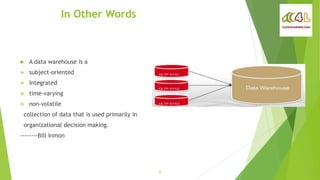
In Other Words
 A data warehouse is a
 subject-oriented
 Integrated
 time-varying
 non-volatile
collection of data that is used primarily in
organizational decision making.
--------Bill Inmon
8
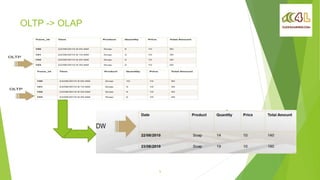
OLTP -> OLAP
9
Why do you need the history
10
 Study the past if you define the future
11
Data Warehouse
Relational Detail Star Schemas
Common Dimensions Common Transformations
Data Models
GL Excel Sheets/Flat FilesHR
Dashboard Reporting
Data Mart
12
Marketing
Mart
HR Data Mart
Sales Data Mart
Data Marts
DataWarehouse
Data grouped for a specific subject area and considered as subset of
data warehouse
Can contain atomic data and summarized data.
Generally Each data mart is designed for each department like
Marketing, Sales etc.
Dimension Tables
 Dimension tables establish the context of the facts
 In other words, Dimensional tables store fields that describe the facts
 Eg: Time Periods, Products, Customers etc
13
Fact Table
Fact tables are used to record actual facts or measures
in the business.
Facts are the numeric data items that are of interest to
the business Access via dimensions
Types of Measures-Facts
 Additive: Valid to SUM up to any Dimensional level
-SUM(Sales_Amount)
 Semi-Additive: Semi-Additive measures are measures that can be added
across some, but not all dimensions. For example the bank account balance
is simply a snapshot in time and cannot be summed over time.
-Sum(balance) where month=2011-12-12
 Non-Additive=never used in a Sum
 Eg: Gross-Margin , Ratios etc...;
14
Slowly Changing Dimensions
 Type-I SCD (Over write)
 Type-II SCD (Maintain History)
 Type-III SCD(Alternate Realities)
info@leadinnovativetechnologies.com 15
Cust ID Cust Name Cust City
10 XYZ New York
Cust ID Cust Name Cust City
10 XYZ Seattle
Change of Attributes
No History Maintained
Cust ID Cust Name Cust City Date
10 XYZ New York 1-Jan-2000
Change of Attributes
ALL History
Maintained
Cust ID Cust Name Cust City Date
10 XYZ New York 1-Jan-2000
10 XYZ Seattle 1-Jan-2005
Cust ID Cust Name Cust City
10 XYZ New York
Cust ID Cust Name Cust City1 Cust City 2
10 XYZ New York Seattle
Change of Attributes
History In Separate
columns
Schema Design
Schema Types
 Star Schema
 Snow-Flake Schema
 Fact Constellation schema or Galaxy Schema
16
Star Schema
 A single fact table and for each dimension one dimension table
17
Fact Table
(or)
Measures
Time
Product Scenario
Customers
Snow Flake Schema
 Represent dimensional hierarchy directly
by normalizing tables.
 Gives more Detailed Information
info@leadinnovativetechnologies.com
18
Fact Table
(or)
Measures
Time
Product Scenario
Countries Cities
Fact Constellation
 Multiple Fact Tables that share multiple dimensional tables
19
Fact Table
(or)
Measures
Time
Product Scenario
Customers
Revenue
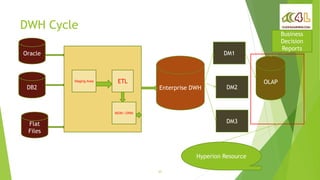
DWH Cycle
20
Oracle
Flat
Files
DB2
Staging Area ETL
Enterprise DWH
DM1
DM3
DM2
OLAP
Business
Decision
Reports
Hyperion Resource
MDM / DRM
Dimensional Modeling Design Process
 Choose a business process to model
- Business activity that is valuable to analyze
-Set of transactions that can be collected in a fact table
 Declare the Grain of the fact table
-level of detail that you will record in the fact table
 Choose the Dimensions
-Descriptive information about transactions
-Usually want to limit number of dimensions
 Choose the Metrics
-Numeric fields tagged to each fact table row
21
EPM
Enterprise Performance Management
A set of processes that help organizations optimize their business
performance. It is a framework for organizing, automating and
analyzing business methodologies , metrics, processes and
systems that drive business performance
The products formerly known as Hyperion provide Enterprise
Performance Management ("EPM") capabilities
22
23
Multi Dimensional Analysis
 Query tool caches pre-computed aggregates in memory or on
mid-tier server for extra-fast response time.
 Used to Analyze the future business based on past and present
sales
Eg: Sales Analysis
 Avoid spending time in analyzing huge numbers of daily
transactions data
 Essbase stands for Extended Spreadsheet Analysis
 Used to Analyze data in multiple view of perspective so that
business users can take decision for forecast analysis
24
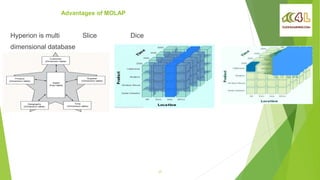
Advantages of MOLAP
Hyperion is multi Slice Dice
dimensional database
25
Drill-Down/Up
26
Rollup
Essbase History
27
Arbor Corporation Essbase
1992
Hyperion Solutions
1998
Essbase
Hyperion
Enterprise
Hyperion
Reporting
Planning and
Budgeting
Oracle Corporation Oracle EPM System
BI Foundation
Essbase
2007
Cube means
28
Intersecting Dimensions
-- Form Data Cells
OLAP Storage Paradigm
-- Multidimensional
databases are
array structures , not
related tables
-- Will concentrate about
cells not fields
Essbase is tuned for Analysis
 Which customers are most profitable
 What is the customer likely to buy next
 What if demand falls short of forecast
29
Why Essbase
• Richest business users experience
• Highly Advanced Calculation Engine
• Write-Back Capability Feature
Essbase Introduction
 Part of Business Intelligence Foundation in Oracle EPM System widely considered to be the industry
leading OLAP (On-Line Analytical Processing) server
 It is a multidimensional database that enables Business Users to analyze business data in multiple
views/prospective and at different consolidation levels. It stores the data in a multi dimensional array
30
Essbase
Planning &
Budgeting
Forecasti
ng
Product
Analysis
Customer
Analysis
Essbase Usage
Minute->Day->Week->Month->Qtr->Year
Product Line->Product Family->Product Cat->Product sub Cat
Essbase Architecture
31
Essbase
Server
Essbase
Database
Provider
Services
Smart-View
Essbase Excel-Add-in,
MaxL , MDX
TCP/IP
TCP/IP HTTP
Administration
Services
Essbase
Studio ServicesRDMS
ODBC
A
B
D E
C
F
A
B
D E
C
F
TCP/IP
HTTP
EAS Console
Essbase Studio
Console
Database
Tier
Middle
Tier
Client
Tier
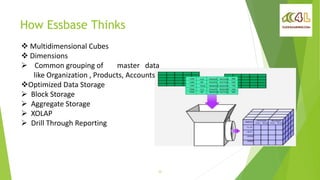
How Essbase Thinks
32
 Multidimensional Cubes
 Dimensions
 Common grouping of master data
like Organization , Products, Accounts
Optimized Data Storage
 Block Storage
 Aggregate Storage
 XOLAP
 Drill Through Reporting
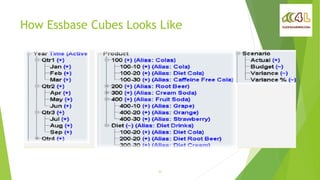
How Essbase Cubes Looks Like
33
ESSBASE STUDIO
 Single graphical modeling environment and single setup for Essbase app
building and administration
info@leadinnovativetechnologies.com
34
How business users Analyze Data
35
Oracle EPM Workspace
 Single thin client environment bringing all of the EPM system and
BI tools together in one access point
info@leadinnovativetechnologies.com
36
Integration with BI Tools – Smart View Addin
 Common add-in to provide integration with Microsoft office for oracle EPM
system and BI tools like Essbase, Planning, OBIEE, HFR
37
User Security – Shared Services Console
info@leadinnovativetechnologies.com
38
Life Cycle Management – Migration Tool
info@leadinnovativetechnologies.com
39
Complete EPM System
info@leadinnovativetechnologies.com
40
Life Cycle of Essbase
Database Objects
- Outline File
- Rule Files
- Calculation Scripts
41
 Create an Application(ASO or BSO)
 Create an Database
Dimension Modeling
Data Loading
Report Generation
Hyperion Daily Maintenance Activities
Continuation
 Hyperion Essbase Installation
 Hyperion Services Order
 Essbase Log Files
 Essbase Applications Path
42
43
Thankyou

Oracle Hyperion overview

  • 1.
  • 2.
  • 3.
    Raw Data 3 Raw Datawill be no use until it will become information
  • 4.
    Raw Data ->Information 4 How do you find out the profit of Product “Electronics” from 100’ s of Excel sheets Metadata
  • 5.
    Then what isOLTP In general, All Database Systems are OLTP  Most RDBMS systems are OLTP  Detailed, Up to Date Data  Read/Update of few records  Run the business in real time  Historical Data will be archived for performance reasons Eg: Walk into Reliance Store you will find OLTP Walk into ATM you will find OLTP Buy TV in electronic shops Buy Stocks in Broker like Etrade -> OLTP 5
  • 6.
    Current Challenges • Ican’t find the data I need – data is scattered over the network – many versions, subtle differences – No Single source for Information • I cant understand the data I found – available data poorly documented • I can’t use the data I found – results are unexpected – data needs to be transformed from one form to other What's certain about today's business climate is uncertainty 6
  • 7.
    What is DataWarehouse  A single, complete and consistent store of data obtained from a variety of different sources made available to end users in a what they can understand and use in a business context. - Barry Delvin 7
  • 8.
    In Other Words A data warehouse is a  subject-oriented  Integrated  time-varying  non-volatile collection of data that is used primarily in organizational decision making. --------Bill Inmon 8
  • 9.
  • 10.
    Why do youneed the history 10  Study the past if you define the future
  • 11.
    11 Data Warehouse Relational DetailStar Schemas Common Dimensions Common Transformations Data Models GL Excel Sheets/Flat FilesHR Dashboard Reporting
  • 12.
    Data Mart 12 Marketing Mart HR DataMart Sales Data Mart Data Marts DataWarehouse Data grouped for a specific subject area and considered as subset of data warehouse Can contain atomic data and summarized data. Generally Each data mart is designed for each department like Marketing, Sales etc.
  • 13.
    Dimension Tables  Dimensiontables establish the context of the facts  In other words, Dimensional tables store fields that describe the facts  Eg: Time Periods, Products, Customers etc 13 Fact Table Fact tables are used to record actual facts or measures in the business. Facts are the numeric data items that are of interest to the business Access via dimensions
  • 14.
    Types of Measures-Facts Additive: Valid to SUM up to any Dimensional level -SUM(Sales_Amount)  Semi-Additive: Semi-Additive measures are measures that can be added across some, but not all dimensions. For example the bank account balance is simply a snapshot in time and cannot be summed over time. -Sum(balance) where month=2011-12-12  Non-Additive=never used in a Sum  Eg: Gross-Margin , Ratios etc...; 14
  • 15.
    Slowly Changing Dimensions Type-I SCD (Over write)  Type-II SCD (Maintain History)  Type-III SCD(Alternate Realities) info@leadinnovativetechnologies.com 15 Cust ID Cust Name Cust City 10 XYZ New York Cust ID Cust Name Cust City 10 XYZ Seattle Change of Attributes No History Maintained Cust ID Cust Name Cust City Date 10 XYZ New York 1-Jan-2000 Change of Attributes ALL History Maintained Cust ID Cust Name Cust City Date 10 XYZ New York 1-Jan-2000 10 XYZ Seattle 1-Jan-2005 Cust ID Cust Name Cust City 10 XYZ New York Cust ID Cust Name Cust City1 Cust City 2 10 XYZ New York Seattle Change of Attributes History In Separate columns
  • 16.
    Schema Design Schema Types Star Schema  Snow-Flake Schema  Fact Constellation schema or Galaxy Schema 16
  • 17.
    Star Schema  Asingle fact table and for each dimension one dimension table 17 Fact Table (or) Measures Time Product Scenario Customers
  • 18.
    Snow Flake Schema Represent dimensional hierarchy directly by normalizing tables.  Gives more Detailed Information info@leadinnovativetechnologies.com 18 Fact Table (or) Measures Time Product Scenario Countries Cities
  • 19.
    Fact Constellation  MultipleFact Tables that share multiple dimensional tables 19 Fact Table (or) Measures Time Product Scenario Customers Revenue
  • 20.
    DWH Cycle 20 Oracle Flat Files DB2 Staging AreaETL Enterprise DWH DM1 DM3 DM2 OLAP Business Decision Reports Hyperion Resource MDM / DRM
  • 21.
    Dimensional Modeling DesignProcess  Choose a business process to model - Business activity that is valuable to analyze -Set of transactions that can be collected in a fact table  Declare the Grain of the fact table -level of detail that you will record in the fact table  Choose the Dimensions -Descriptive information about transactions -Usually want to limit number of dimensions  Choose the Metrics -Numeric fields tagged to each fact table row 21
  • 22.
    EPM Enterprise Performance Management Aset of processes that help organizations optimize their business performance. It is a framework for organizing, automating and analyzing business methodologies , metrics, processes and systems that drive business performance The products formerly known as Hyperion provide Enterprise Performance Management ("EPM") capabilities 22
  • 23.
  • 24.
    Multi Dimensional Analysis Query tool caches pre-computed aggregates in memory or on mid-tier server for extra-fast response time.  Used to Analyze the future business based on past and present sales Eg: Sales Analysis  Avoid spending time in analyzing huge numbers of daily transactions data  Essbase stands for Extended Spreadsheet Analysis  Used to Analyze data in multiple view of perspective so that business users can take decision for forecast analysis 24
  • 25.
    Advantages of MOLAP Hyperionis multi Slice Dice dimensional database 25
  • 26.
  • 27.
    Essbase History 27 Arbor CorporationEssbase 1992 Hyperion Solutions 1998 Essbase Hyperion Enterprise Hyperion Reporting Planning and Budgeting Oracle Corporation Oracle EPM System BI Foundation Essbase 2007
  • 28.
    Cube means 28 Intersecting Dimensions --Form Data Cells OLAP Storage Paradigm -- Multidimensional databases are array structures , not related tables -- Will concentrate about cells not fields
  • 29.
    Essbase is tunedfor Analysis  Which customers are most profitable  What is the customer likely to buy next  What if demand falls short of forecast 29 Why Essbase • Richest business users experience • Highly Advanced Calculation Engine • Write-Back Capability Feature
  • 30.
    Essbase Introduction  Partof Business Intelligence Foundation in Oracle EPM System widely considered to be the industry leading OLAP (On-Line Analytical Processing) server  It is a multidimensional database that enables Business Users to analyze business data in multiple views/prospective and at different consolidation levels. It stores the data in a multi dimensional array 30 Essbase Planning & Budgeting Forecasti ng Product Analysis Customer Analysis Essbase Usage Minute->Day->Week->Month->Qtr->Year Product Line->Product Family->Product Cat->Product sub Cat
  • 31.
    Essbase Architecture 31 Essbase Server Essbase Database Provider Services Smart-View Essbase Excel-Add-in, MaxL, MDX TCP/IP TCP/IP HTTP Administration Services Essbase Studio ServicesRDMS ODBC A B D E C F A B D E C F TCP/IP HTTP EAS Console Essbase Studio Console Database Tier Middle Tier Client Tier
  • 32.
    How Essbase Thinks 32 Multidimensional Cubes  Dimensions  Common grouping of master data like Organization , Products, Accounts Optimized Data Storage  Block Storage  Aggregate Storage  XOLAP  Drill Through Reporting
  • 33.
    How Essbase CubesLooks Like 33
  • 34.
    ESSBASE STUDIO  Singlegraphical modeling environment and single setup for Essbase app building and administration info@leadinnovativetechnologies.com 34
  • 35.
    How business usersAnalyze Data 35
  • 36.
    Oracle EPM Workspace Single thin client environment bringing all of the EPM system and BI tools together in one access point info@leadinnovativetechnologies.com 36
  • 37.
    Integration with BITools – Smart View Addin  Common add-in to provide integration with Microsoft office for oracle EPM system and BI tools like Essbase, Planning, OBIEE, HFR 37
  • 38.
    User Security –Shared Services Console info@leadinnovativetechnologies.com 38
  • 39.
    Life Cycle Management– Migration Tool info@leadinnovativetechnologies.com 39
  • 40.
  • 41.
    Life Cycle ofEssbase Database Objects - Outline File - Rule Files - Calculation Scripts 41  Create an Application(ASO or BSO)  Create an Database Dimension Modeling Data Loading Report Generation Hyperion Daily Maintenance Activities
  • 42.
    Continuation  Hyperion EssbaseInstallation  Hyperion Services Order  Essbase Log Files  Essbase Applications Path 42
  • 43.