LITERATURE STUDY
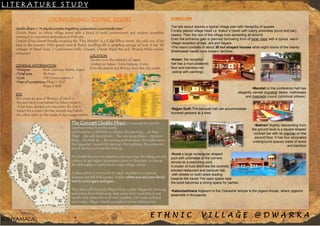
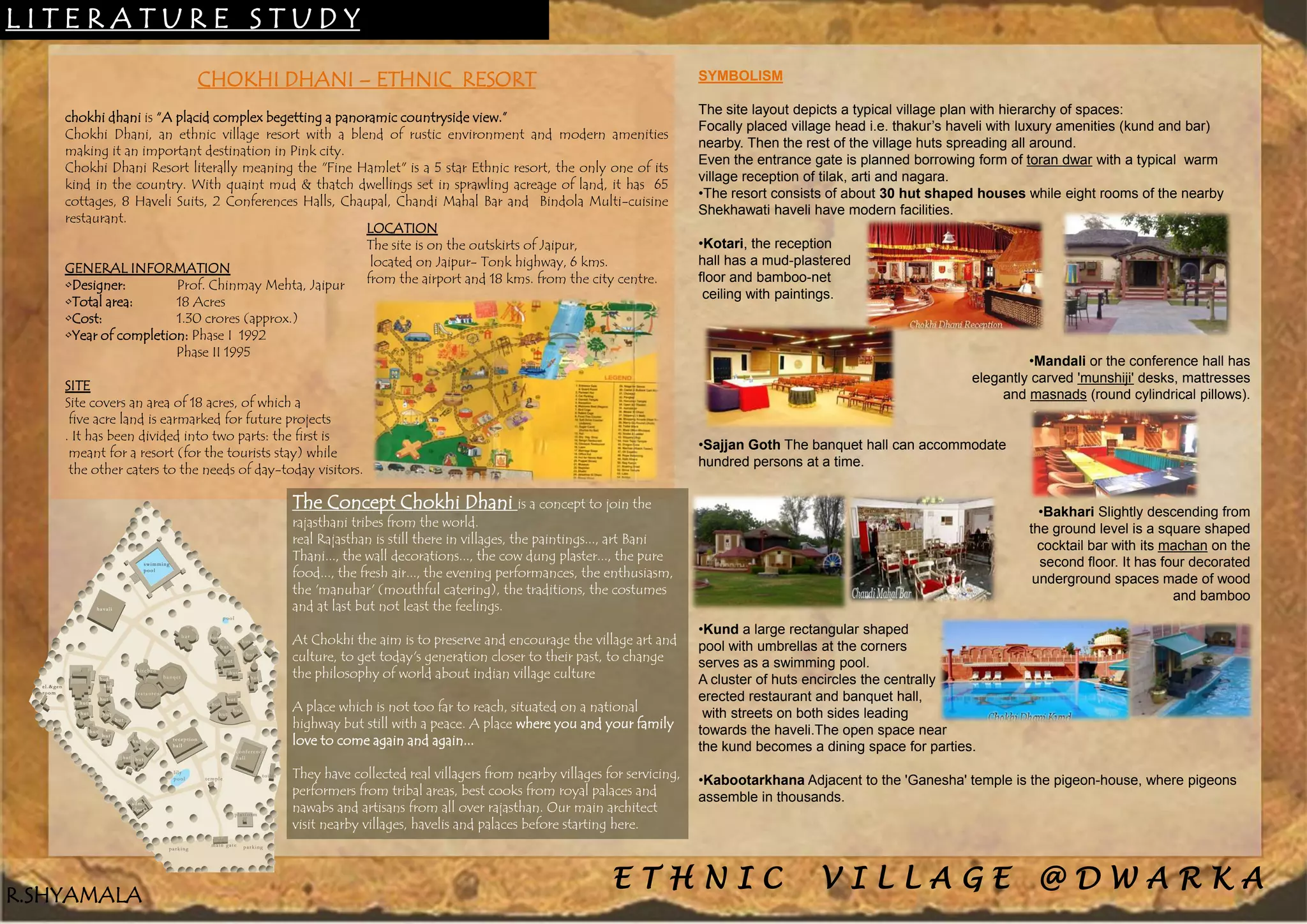
CHOKHI DHANI – ETHNIC RESORT

SYMBOLISM

chokhi dhani is “A placid complex begetting a panoramic countryside view.”
Chokhi Dhani, an ethnic village resort with a blend of rustic environment and modern amenities
making it an important destination in Pink city.
Chokhi Dhani Resort literally meaning the "Fine Hamlet" is a 5 star Ethnic resort, the only one of its
kind in the country. With quaint mud & thatch dwellings set in sprawling acreage of land, it has 65
cottages, 8 Haveli Suits, 2 Conferences Halls, Chaupal, Chandi Mahal Bar and Bindola Multi-cuisine
restaurant.
LOCATION
The site is on the outskirts of Jaipur,
located on Jaipur- Tonk highway, 6 kms.
GENERAL INFORMATION
from the airport and 18 kms. from the city centre.
•Designer:
Prof. Chinmay Mehta, Jaipur
•Total area:
18 Acres
•Cost:
1.30 crores (approx.)
•Year of completion: Phase I 1992
Phase II 1995

The site layout depicts a typical village plan with hierarchy of spaces:
Focally placed village head i.e. thakur’s haveli with luxury amenities (kund and bar)
nearby. Then the rest of the village huts spreading all around.
Even the entrance gate is planned borrowing form of toran dwar with a typical warm
village reception of tilak, arti and nagara.
•The resort consists of about 30 hut shaped houses while eight rooms of the nearby
Shekhawati haveli have modern facilities.
•Kotari, the reception
hall has a mud-plastered
floor and bamboo-net
ceiling with paintings.

•Mandali or the conference hall has
elegantly carved 'munshiji' desks, mattresses
and masnads (round cylindrical pillows).

SITE
Site covers an area of 18 acres, of which a
five acre land is earmarked for future projects
. It has been divided into two parts: the first is
meant for a resort (for the tourists stay) while
the other caters to the needs of day-today visitors.

•Sajjan Goth The banquet hall can accommodate
hundred persons at a time.

The Concept Chokhi Dhani is a concept to join the

•Bakhari Slightly descending from
the ground level is a square shaped
cocktail bar with its machan on the
second floor. It has four decorated
underground spaces made of wood
and bamboo

rajasthani tribes from the world.
real Rajasthan is still there in villages, the paintings..., art Bani
Thani..., the wall decorations..., the cow dung plaster..., the pure
food..., the fresh air..., the evening performances, the enthusiasm,
the 'manuhar' (mouthful catering), the traditions, the costumes
and at last but not least the feelings.
At Chokhi the aim is to preserve and encourage the village art and
culture, to get today's generation closer to their past, to change
the philosophy of world about indian village culture
A place which is not too far to reach, situated on a national
highway but still with a peace. A place where you and your family
love to come again and again...
They have collected real villagers from nearby villages for servicing,
performers from tribal areas, best cooks from royal palaces and
nawabs and artisans from all over rajasthan. Our main architect
visit nearby villages, havelis and palaces before starting here.

R.SHYAMALA

•Kund a large rectangular shaped
pool with umbrellas at the corners
serves as a swimming pool.
A cluster of huts encircles the centrally
erected restaurant and banquet hall,
with streets on both sides leading
towards the haveli.The open space near
the kund becomes a dining space for parties.
•Kabootarkhana Adjacent to the 'Ganesha' temple is the pigeon-house, where pigeons
assemble in thousands.

ETHNIC

VILLAGE

@DWARKA
LITERATURE STUDY
COMPONENTS
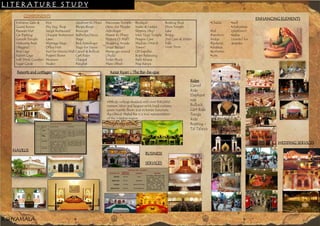
Entrance Gate &
Guard Room
Panwari Hut
Car Parking
Ganesh Temple
Welcome Beat
(Nagara)
Bird Cage
Rabbit Cage
Soft Drink Counter
Sugar Candi

Hut
Jaisalmer Ki Dhani
Dry Veg. Shop
Bhopa Bhopi
Sangri Restaurant Bioscope
Chaupar Restaurant Kalbeliya Dance
Lawn
Stage
Marriage Stage
Bird Astrologer
Office Hut
Stage for Dance
Hut for Henna Wali Camel & Bullock
Puppet Shows
Cart Rides
Museum
Chaupal
Studio
Panghat

Resorts and cottages

Hanuman Temple
Open Air Theater
Astrologer
Mewar Ki Dhani
Slippery (5 Mall)
Shopping Arcade
(Haat Bazaar)
Merry-go-round
(Jhula)
Toilet Block
Maze (Bhul-

Bhulaya)
Snake & Ladder
Slippery (Big)
Veer Tejaji Temple
Dragon Cave
Machan (Watch
Tower)
Oil Expeller
Rope Balancing
Rath Khana
Nag Kanya

Boating Shed
Shiva Temple
Lake
Bridge
2nd Cave & Water
Falls
Jungle Theme

•Chakki
•hal
•bamboo
bridge
•lanterns
•chakkas
•potteries
•cots

•well
•chabutaras
(platform)
•aalias
(nooks) for
deepaks.

ENHANCING ELEMENTS

Kesar Kyari :: The Bar-be-que

With its ceilings studded with over 100,000
mirrors, silver and lacquer work bead curtains,
green marble floors and victorian furniture,
the Chandi Mahal Bar is a true representative
of the Udaipur region

Rides
Camel
Ride
Elephant
ride
Bullock
Cart Ride
Tonga
Ride
Boating Tal Talaiya
WEDDING SERVICES

HAVELIS

BUSINESS
SERVICES

R.SHYAMALA
LITERATURE STUDY
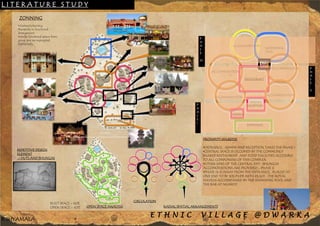
ZONNING
•clustered planning
•hierarchy in functional
arrangement
•similar functional spaces form
group and are segregated
haphazardly.

P
H
A
S
E

ACCOMMODATION

III

SWIMMIMNG
POO;

BAR
ACCOMMODATION

ACCOMMODATION

RESTAURANT

P
H
A
S
E
II

ACCOMMODATION

ACCOMMODATION
P
H
A
S
E
I

RECEPTION

ADMIN
ENTRANCE

PROXIMITY ANALYSIS
•ENTRANCE , ADMIN AND RECEPTION TAKES THE PHASE I
•CENTRAL SPACE IS OCCUPIED BY THE COMMONLY
SHARED RESTAURENT AND FOOD FACILITIES ACCESSIBLE
TO ALL COMPONENS OF THIS COMPLEX.
•EITHER SIDES OF THE CENTRAL PAT , BHUNGAS
ACCOMODATIONS ARE PROVIDED.- PHASE II
•PHASE III IS AWAY FROM THE ENTRANCE , PLACED AT
ONE END TO BE SOLITUDE WITH PEACE . THE ROYAL
HAVELIS ACCOMPANIED BY THE SWIMMIMG POOL AND
THE BAR AT NEAREST.

REPETITIVE DESIGN
ELEMENT
– HUTS AND BHUNGAS

BUILT SPACE – 60%
OPEN SPACE – 40%

R.SHYAMALA

CIRCULATION
OPEN SPACE ANALYSIS

RADIAL SPATIAL ARRANGEMENTS

ETHNIC

VILLAGE

@DWARKA
LITERATURE STUDY
MY STUDY
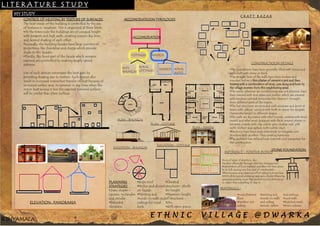
CONTROL OF HEATING BY TEXTURE OF SURFACES:
The heat inside of the building is controlled by the use
of textures in Jaisalmer. This is organized at three levels.
•At the town scale the buildings are of unequal height
with parapets and high walls, creating uneven sky lines
and desired shading of each other.
•Secondly, the building facades have large number of
projections like jharokhas and chajjas which provide
shade to the facades.
•Thirdly, the front part of the facade which remains
exposed are controlled by creating deeply carved
patterns.
Use of such devices minimizes the heat gain by
providing shading due to texture. Such devices also
result in increased convective transfer of heat because of
increased surface area. In summer in day time when the
major heat source is Sun the exposed textured surfaces
will be cooler than plain surfaces.
.

CRAFT BAZAR

ACCOMODATIOON TYPOLOGIES

ACCOMODATION

COTTAGES

HAVELIS

ROYAL
HUTS
BHUNGAS COTTAGES

CONSTRUCTIOON DETAILS
HAVELIS

ROYAL
SUITES

PLAN - BHUNGAS
PLAN - COTTAGE

ELEVATION - BHUNGAS

ELEVATION- PANORAMA

R.SHYAMALA

PLANNING
STRATEGIES
• basic shapes –
squares, rectangles
and circular .
•Extruded
elevation.

ELEVATION - COTTAGE

PLAN - HAVELI

•The foundations have been generally filled with stones and
walls built with stone or brick.
•The straight lines of the walls have been broken and
rounded before a thin plaster of cement is put and then
treated with a combination of mud, cow dung and husk by
the village women from the neighboring areas.
•The roofs, wherever air-conditioning was not planned, have
been erected with iron pipes and purlins, which are covered
with bamboo net and terracotta tiles (keloos), brought
from different parts of the region.
•The hut structures are provided with windows and doors at
times with „aaliyas‟ covered with built-in spaces for deepaks
(terracotta lamps) in different shapes.
•The walls are decorated with relief murals, created with brick
motifs and relief work designed with thick cement plaster in
tempera, mainly with clay colors geru (Indian red), pilli
rnitti (ochre) and saphed rnitti (white clay).
•Bamboos have been used extensively to integrate one
structure with another. Thus creating harmony.
•The architect has utilized local materials and manpower for
the construction.

STONE FOUNDATION
INFERENCE - POSITIVE POINTS

•Slope roof
•Elevated
•Niches and alcoves structures- plinth
on façade.
1m height
•Painting and
•Maximim height
murals on walls and of structures –
ceilings for royal 10m.
look
•40% open spaces.

ETHNIC

•Loss of sense of direction, also
handled efficiently through attentive management.
•Exploitation of local material and labor has been done
in its full causing very low cost of construction.
•Maintenance and repairs are effort taking but cost low.
•With all its typical ambiance and aura Chokhi Dhani has
gained popularity more like another tourist destination
in Jaipur than a dwelling to stay in.

MATERIALS:•mud plastered
floor
•bamboo net
ceiling

VILLAGE

•painting and
murals on walls
and ceiling
•wood- rafters

and seatings
•mud walls
•thatched roofs
•stone colums

@DWARKA

Chowki dhanni - -JAIPUR

  • 1.
    LITERATURE STUDY CHOKHI DHANI– ETHNIC RESORT SYMBOLISM chokhi dhani is “A placid complex begetting a panoramic countryside view.” Chokhi Dhani, an ethnic village resort with a blend of rustic environment and modern amenities making it an important destination in Pink city. Chokhi Dhani Resort literally meaning the "Fine Hamlet" is a 5 star Ethnic resort, the only one of its kind in the country. With quaint mud & thatch dwellings set in sprawling acreage of land, it has 65 cottages, 8 Haveli Suits, 2 Conferences Halls, Chaupal, Chandi Mahal Bar and Bindola Multi-cuisine restaurant. LOCATION The site is on the outskirts of Jaipur, located on Jaipur- Tonk highway, 6 kms. GENERAL INFORMATION from the airport and 18 kms. from the city centre. •Designer: Prof. Chinmay Mehta, Jaipur •Total area: 18 Acres •Cost: 1.30 crores (approx.) •Year of completion: Phase I 1992 Phase II 1995 The site layout depicts a typical village plan with hierarchy of spaces: Focally placed village head i.e. thakur’s haveli with luxury amenities (kund and bar) nearby. Then the rest of the village huts spreading all around. Even the entrance gate is planned borrowing form of toran dwar with a typical warm village reception of tilak, arti and nagara. •The resort consists of about 30 hut shaped houses while eight rooms of the nearby Shekhawati haveli have modern facilities. •Kotari, the reception hall has a mud-plastered floor and bamboo-net ceiling with paintings. •Mandali or the conference hall has elegantly carved 'munshiji' desks, mattresses and masnads (round cylindrical pillows). SITE Site covers an area of 18 acres, of which a five acre land is earmarked for future projects . It has been divided into two parts: the first is meant for a resort (for the tourists stay) while the other caters to the needs of day-today visitors. •Sajjan Goth The banquet hall can accommodate hundred persons at a time. The Concept Chokhi Dhani is a concept to join the •Bakhari Slightly descending from the ground level is a square shaped cocktail bar with its machan on the second floor. It has four decorated underground spaces made of wood and bamboo rajasthani tribes from the world. real Rajasthan is still there in villages, the paintings..., art Bani Thani..., the wall decorations..., the cow dung plaster..., the pure food..., the fresh air..., the evening performances, the enthusiasm, the 'manuhar' (mouthful catering), the traditions, the costumes and at last but not least the feelings. At Chokhi the aim is to preserve and encourage the village art and culture, to get today's generation closer to their past, to change the philosophy of world about indian village culture A place which is not too far to reach, situated on a national highway but still with a peace. A place where you and your family love to come again and again... They have collected real villagers from nearby villages for servicing, performers from tribal areas, best cooks from royal palaces and nawabs and artisans from all over rajasthan. Our main architect visit nearby villages, havelis and palaces before starting here. R.SHYAMALA •Kund a large rectangular shaped pool with umbrellas at the corners serves as a swimming pool. A cluster of huts encircles the centrally erected restaurant and banquet hall, with streets on both sides leading towards the haveli.The open space near the kund becomes a dining space for parties. •Kabootarkhana Adjacent to the 'Ganesha' temple is the pigeon-house, where pigeons assemble in thousands. ETHNIC VILLAGE @DWARKA
  • 2.
    LITERATURE STUDY COMPONENTS Entrance Gate& Guard Room Panwari Hut Car Parking Ganesh Temple Welcome Beat (Nagara) Bird Cage Rabbit Cage Soft Drink Counter Sugar Candi Hut Jaisalmer Ki Dhani Dry Veg. Shop Bhopa Bhopi Sangri Restaurant Bioscope Chaupar Restaurant Kalbeliya Dance Lawn Stage Marriage Stage Bird Astrologer Office Hut Stage for Dance Hut for Henna Wali Camel & Bullock Puppet Shows Cart Rides Museum Chaupal Studio Panghat Resorts and cottages Hanuman Temple Open Air Theater Astrologer Mewar Ki Dhani Slippery (5 Mall) Shopping Arcade (Haat Bazaar) Merry-go-round (Jhula) Toilet Block Maze (Bhul- Bhulaya) Snake & Ladder Slippery (Big) Veer Tejaji Temple Dragon Cave Machan (Watch Tower) Oil Expeller Rope Balancing Rath Khana Nag Kanya Boating Shed Shiva Temple Lake Bridge 2nd Cave & Water Falls Jungle Theme •Chakki •hal •bamboo bridge •lanterns •chakkas •potteries •cots •well •chabutaras (platform) •aalias (nooks) for deepaks. ENHANCING ELEMENTS Kesar Kyari :: The Bar-be-que With its ceilings studded with over 100,000 mirrors, silver and lacquer work bead curtains, green marble floors and victorian furniture, the Chandi Mahal Bar is a true representative of the Udaipur region Rides Camel Ride Elephant ride Bullock Cart Ride Tonga Ride Boating Tal Talaiya WEDDING SERVICES HAVELIS BUSINESS SERVICES R.SHYAMALA
  • 3.
    LITERATURE STUDY ZONNING •clustered planning •hierarchyin functional arrangement •similar functional spaces form group and are segregated haphazardly. P H A S E ACCOMMODATION III SWIMMIMNG POO; BAR ACCOMMODATION ACCOMMODATION RESTAURANT P H A S E II ACCOMMODATION ACCOMMODATION P H A S E I RECEPTION ADMIN ENTRANCE PROXIMITY ANALYSIS •ENTRANCE , ADMIN AND RECEPTION TAKES THE PHASE I •CENTRAL SPACE IS OCCUPIED BY THE COMMONLY SHARED RESTAURENT AND FOOD FACILITIES ACCESSIBLE TO ALL COMPONENS OF THIS COMPLEX. •EITHER SIDES OF THE CENTRAL PAT , BHUNGAS ACCOMODATIONS ARE PROVIDED.- PHASE II •PHASE III IS AWAY FROM THE ENTRANCE , PLACED AT ONE END TO BE SOLITUDE WITH PEACE . THE ROYAL HAVELIS ACCOMPANIED BY THE SWIMMIMG POOL AND THE BAR AT NEAREST. REPETITIVE DESIGN ELEMENT – HUTS AND BHUNGAS BUILT SPACE – 60% OPEN SPACE – 40% R.SHYAMALA CIRCULATION OPEN SPACE ANALYSIS RADIAL SPATIAL ARRANGEMENTS ETHNIC VILLAGE @DWARKA
  • 4.
    LITERATURE STUDY MY STUDY CONTROLOF HEATING BY TEXTURE OF SURFACES: The heat inside of the building is controlled by the use of textures in Jaisalmer. This is organized at three levels. •At the town scale the buildings are of unequal height with parapets and high walls, creating uneven sky lines and desired shading of each other. •Secondly, the building facades have large number of projections like jharokhas and chajjas which provide shade to the facades. •Thirdly, the front part of the facade which remains exposed are controlled by creating deeply carved patterns. Use of such devices minimizes the heat gain by providing shading due to texture. Such devices also result in increased convective transfer of heat because of increased surface area. In summer in day time when the major heat source is Sun the exposed textured surfaces will be cooler than plain surfaces. . CRAFT BAZAR ACCOMODATIOON TYPOLOGIES ACCOMODATION COTTAGES HAVELIS ROYAL HUTS BHUNGAS COTTAGES CONSTRUCTIOON DETAILS HAVELIS ROYAL SUITES PLAN - BHUNGAS PLAN - COTTAGE ELEVATION - BHUNGAS ELEVATION- PANORAMA R.SHYAMALA PLANNING STRATEGIES • basic shapes – squares, rectangles and circular . •Extruded elevation. ELEVATION - COTTAGE PLAN - HAVELI •The foundations have been generally filled with stones and walls built with stone or brick. •The straight lines of the walls have been broken and rounded before a thin plaster of cement is put and then treated with a combination of mud, cow dung and husk by the village women from the neighboring areas. •The roofs, wherever air-conditioning was not planned, have been erected with iron pipes and purlins, which are covered with bamboo net and terracotta tiles (keloos), brought from different parts of the region. •The hut structures are provided with windows and doors at times with „aaliyas‟ covered with built-in spaces for deepaks (terracotta lamps) in different shapes. •The walls are decorated with relief murals, created with brick motifs and relief work designed with thick cement plaster in tempera, mainly with clay colors geru (Indian red), pilli rnitti (ochre) and saphed rnitti (white clay). •Bamboos have been used extensively to integrate one structure with another. Thus creating harmony. •The architect has utilized local materials and manpower for the construction. STONE FOUNDATION INFERENCE - POSITIVE POINTS •Slope roof •Elevated •Niches and alcoves structures- plinth on façade. 1m height •Painting and •Maximim height murals on walls and of structures – ceilings for royal 10m. look •40% open spaces. ETHNIC •Loss of sense of direction, also handled efficiently through attentive management. •Exploitation of local material and labor has been done in its full causing very low cost of construction. •Maintenance and repairs are effort taking but cost low. •With all its typical ambiance and aura Chokhi Dhani has gained popularity more like another tourist destination in Jaipur than a dwelling to stay in. MATERIALS:•mud plastered floor •bamboo net ceiling VILLAGE •painting and murals on walls and ceiling •wood- rafters and seatings •mud walls •thatched roofs •stone colums @DWARKA