Dilatant fluids are basically shear
thickening fluids and vice versa…
Presented by-
Vedant sawant
1
• DILATANCY-
a phenomenon caused by the nature of
the stacking or fitting together of particles
or granules in a heterogeneous system, such as the
solidification of certain sols under pressure.
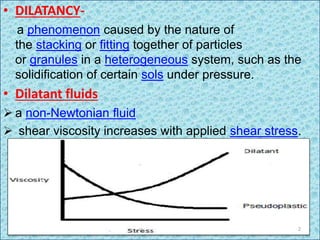
• Dilatant fluids
 a non-Newtonian fluid
 shear viscosity increases with applied shear stress.
2
• Dilatant fluids(contd)
• This behaviour usually occur
in suspensions.
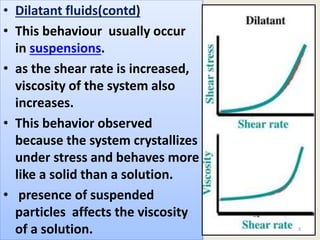
• as the shear rate is increased,
viscosity of the system also
increases.
• This behavior observed
because the system crystallizes
under stress and behaves more
like a solid than a solution.
• presence of suspended
particles affects the viscosity
of a solution. 3
•Non newtonian behaviour- deviation from newton’s law
of viscosity.
•Newton’s law of viscosity-ratio of shear stress to shear
rate is a constant.
4
Shear thickening behavior of dilatant fluids
• Dilatancy in a colloid , dependent on the ratio of
interparticle forces.
• As long as interparticle forces like Van der Waals
forces dominate, the suspended particles
remain in ordered layers.
• Once shear forces dominate, particles enter a
state of flocculation ; they begin to behave like a
solid.
• When shear forces are removed, the particles
spread apart and once again.
5
• Shear thickening behavior occurs when
colloidal suspension transitions from a
stable state to a state of flocculation.
• highly dependent on the volume fraction
of solid particulate suspended in the
liquid.
• higher the volume fraction, less shear
required to initiate the shear thickening
behavior.
6
Theories behind shear thickening
behavior of dilatant fluids
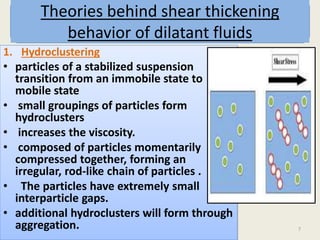
1. Hydroclustering
• particles of a stabilized suspension
transition from an immobile state to
mobile state
• small groupings of particles form
hydroclusters
• increases the viscosity.
• composed of particles momentarily
compressed together, forming an
irregular, rod-like chain of particles .
• The particles have extremely small
interparticle gaps.
• additional hydroclusters will form through
aggregation. 7
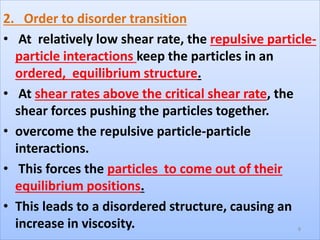
2. Order to disorder transition
• At relatively low shear rate, the repulsive particle-
particle interactions keep the particles in an
ordered, equilibrium structure.
• At shear rates above the critical shear rate, the
shear forces pushing the particles together.
• overcome the repulsive particle-particle
interactions.
• This forces the particles to come out of their
equilibrium positions.
• This leads to a disordered structure, causing an
increase in viscosity. 8
Dilatant fluid examples
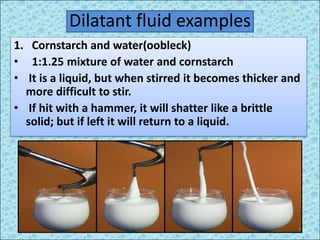
1. Cornstarch and water(oobleck)
• 1:1.25 mixture of water and cornstarch
• It is a liquid, but when stirred it becomes thicker and
more difficult to stir.
• If hit with a hammer, it will shatter like a brittle
solid; but if left it will return to a liquid.
9
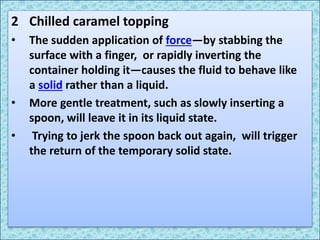
2 Chilled caramel topping
• The sudden application of force—by stabbing the
surface with a finger, or rapidly inverting the
container holding it—causes the fluid to behave like
a solid rather than a liquid.
• More gentle treatment, such as slowly inserting a
spoon, will leave it in its liquid state.
• Trying to jerk the spoon back out again, will trigger
the return of the temporary solid state.
10
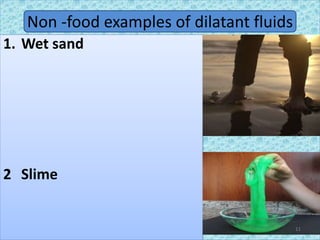
Non -food examples of dilatant fluids
1. Wet sand
2 Slime
11
12

DILATANT FLUIDS.pptx

  • 1.
    Dilatant fluids arebasically shear thickening fluids and vice versa… Presented by- Vedant sawant 1
  • 2.
    • DILATANCY- a phenomenoncaused by the nature of the stacking or fitting together of particles or granules in a heterogeneous system, such as the solidification of certain sols under pressure. • Dilatant fluids  a non-Newtonian fluid  shear viscosity increases with applied shear stress. 2
  • 3.
    • Dilatant fluids(contd) •This behaviour usually occur in suspensions. • as the shear rate is increased, viscosity of the system also increases. • This behavior observed because the system crystallizes under stress and behaves more like a solid than a solution. • presence of suspended particles affects the viscosity of a solution. 3
  • 4.
    •Non newtonian behaviour-deviation from newton’s law of viscosity. •Newton’s law of viscosity-ratio of shear stress to shear rate is a constant. 4
  • 5.
    Shear thickening behaviorof dilatant fluids • Dilatancy in a colloid , dependent on the ratio of interparticle forces. • As long as interparticle forces like Van der Waals forces dominate, the suspended particles remain in ordered layers. • Once shear forces dominate, particles enter a state of flocculation ; they begin to behave like a solid. • When shear forces are removed, the particles spread apart and once again. 5
  • 6.
    • Shear thickeningbehavior occurs when colloidal suspension transitions from a stable state to a state of flocculation. • highly dependent on the volume fraction of solid particulate suspended in the liquid. • higher the volume fraction, less shear required to initiate the shear thickening behavior. 6
  • 7.
    Theories behind shearthickening behavior of dilatant fluids 1. Hydroclustering • particles of a stabilized suspension transition from an immobile state to mobile state • small groupings of particles form hydroclusters • increases the viscosity. • composed of particles momentarily compressed together, forming an irregular, rod-like chain of particles . • The particles have extremely small interparticle gaps. • additional hydroclusters will form through aggregation. 7
  • 8.
    2. Order todisorder transition • At relatively low shear rate, the repulsive particle- particle interactions keep the particles in an ordered, equilibrium structure. • At shear rates above the critical shear rate, the shear forces pushing the particles together. • overcome the repulsive particle-particle interactions. • This forces the particles to come out of their equilibrium positions. • This leads to a disordered structure, causing an increase in viscosity. 8
  • 9.
    Dilatant fluid examples 1.Cornstarch and water(oobleck) • 1:1.25 mixture of water and cornstarch • It is a liquid, but when stirred it becomes thicker and more difficult to stir. • If hit with a hammer, it will shatter like a brittle solid; but if left it will return to a liquid. 9
  • 10.
    2 Chilled carameltopping • The sudden application of force—by stabbing the surface with a finger, or rapidly inverting the container holding it—causes the fluid to behave like a solid rather than a liquid. • More gentle treatment, such as slowly inserting a spoon, will leave it in its liquid state. • Trying to jerk the spoon back out again, will trigger the return of the temporary solid state. 10
  • 11.
    Non -food examplesof dilatant fluids 1. Wet sand 2 Slime 11
  • 12.