BOOLEAN ALGEBRA
Compiled By: Afaq Alam Khan
Index
 Introduction
 Boolean Algebra Laws
 Boolean functions
 Operation Precedence
 Boolean Algebra Function
 Canonical Forms
 SOP
 POS
 Simplification of Boolean Functions
 Algebric simplification
 K-Map
 Quine –McCluskey Method (Tabular Method)
Introduction
 Boolean Algebra is used to analyze
and simplify the digital (logic)
circuits.
 It uses only the binary numbers i.e.
0 and 1. It is also called as Binary
Algebra or logical Algebra.
 It is a convenient way and
systematic way of expressing and
analyzing the operation of logic
circuits
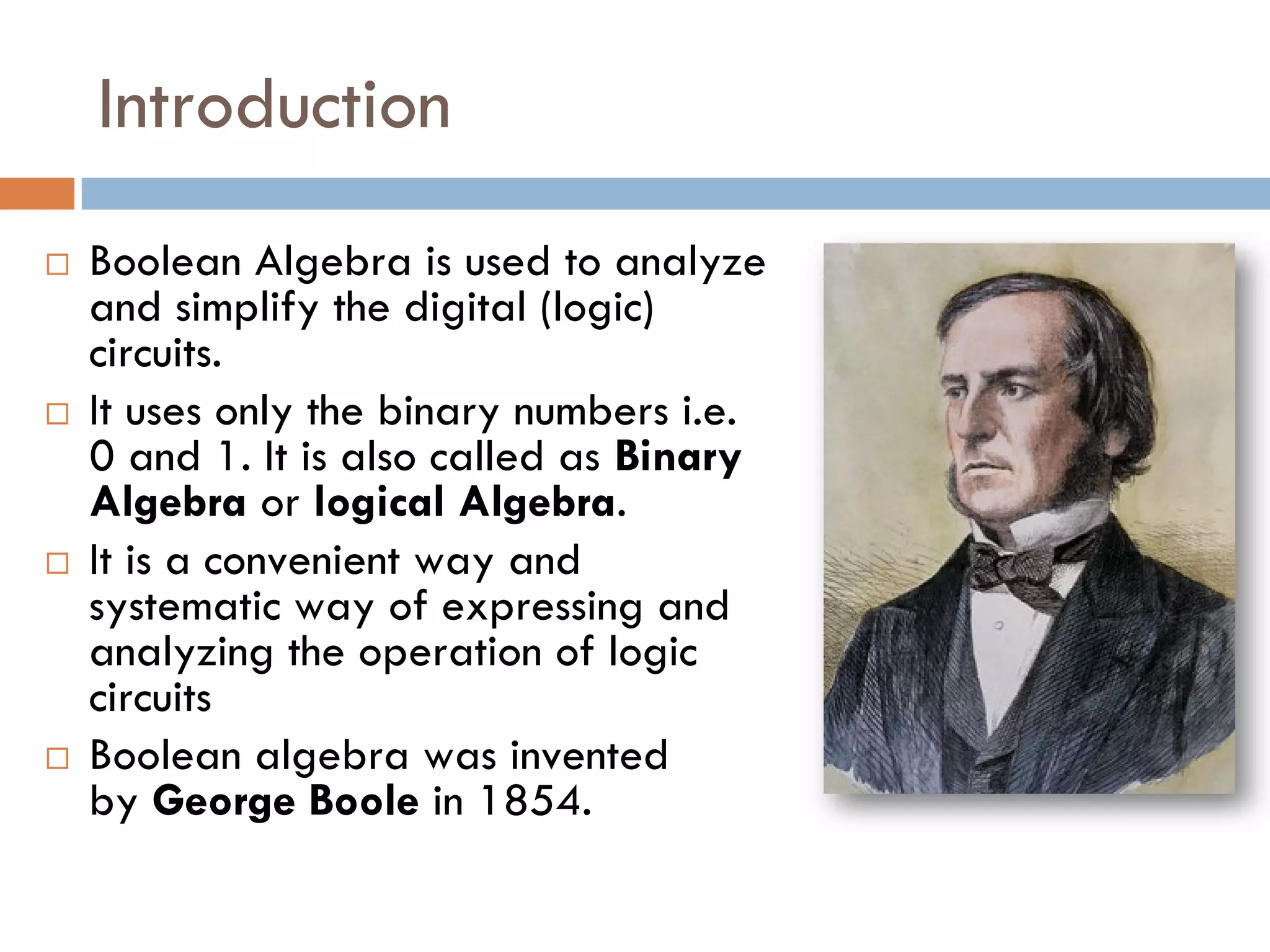
 Boolean algebra was invented
by George Boole in 1854.
Introduction
 Variable used in Boolean algebra can have only two
values. Binary 1 for HIGH and Binary 0 for LOW.
 Complement of a variable is represented by an
overbar (-). Thus, complement of variable B is
represented as B’ . Thus if B = 0 then B’= 1 and if B =
1 then B’= 0.
 ORing of the variables is represented by a plus (+) sign
between them. For example ORing of A, B, C is
represented as A + B + C.
 Logical ANDing of the two or more variable is
represented by writing a dot between them such as
A.B.C. Sometime the dot may be omitted like ABC.
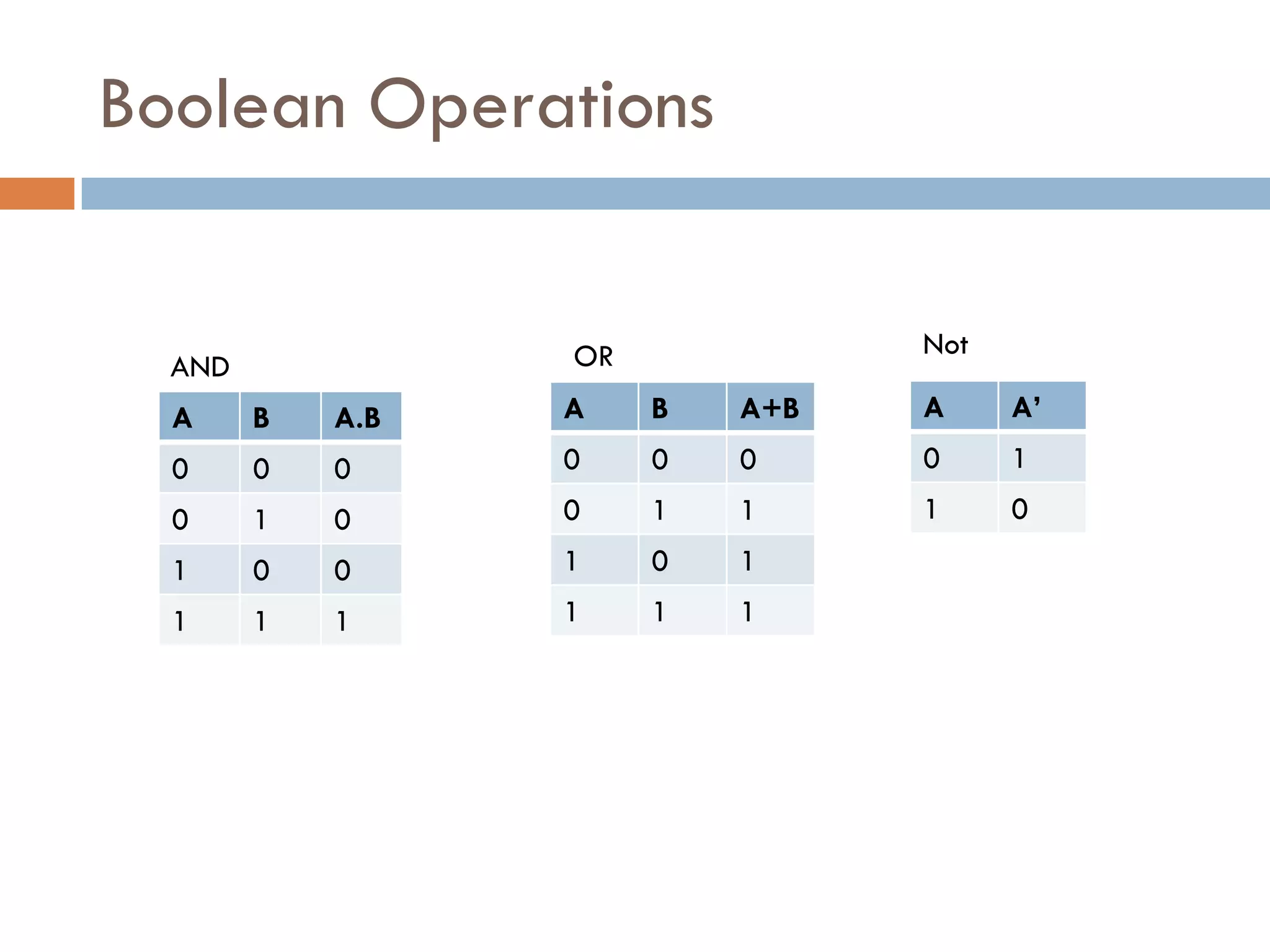
Boolean Operations
A B A.B
0 0 0
0 1 0
1 0 0
1 1 1
A B A+B
0 0 0
0 1 1
1 0 1
1 1 1
A A’
0 1
1 0
AND OR Not
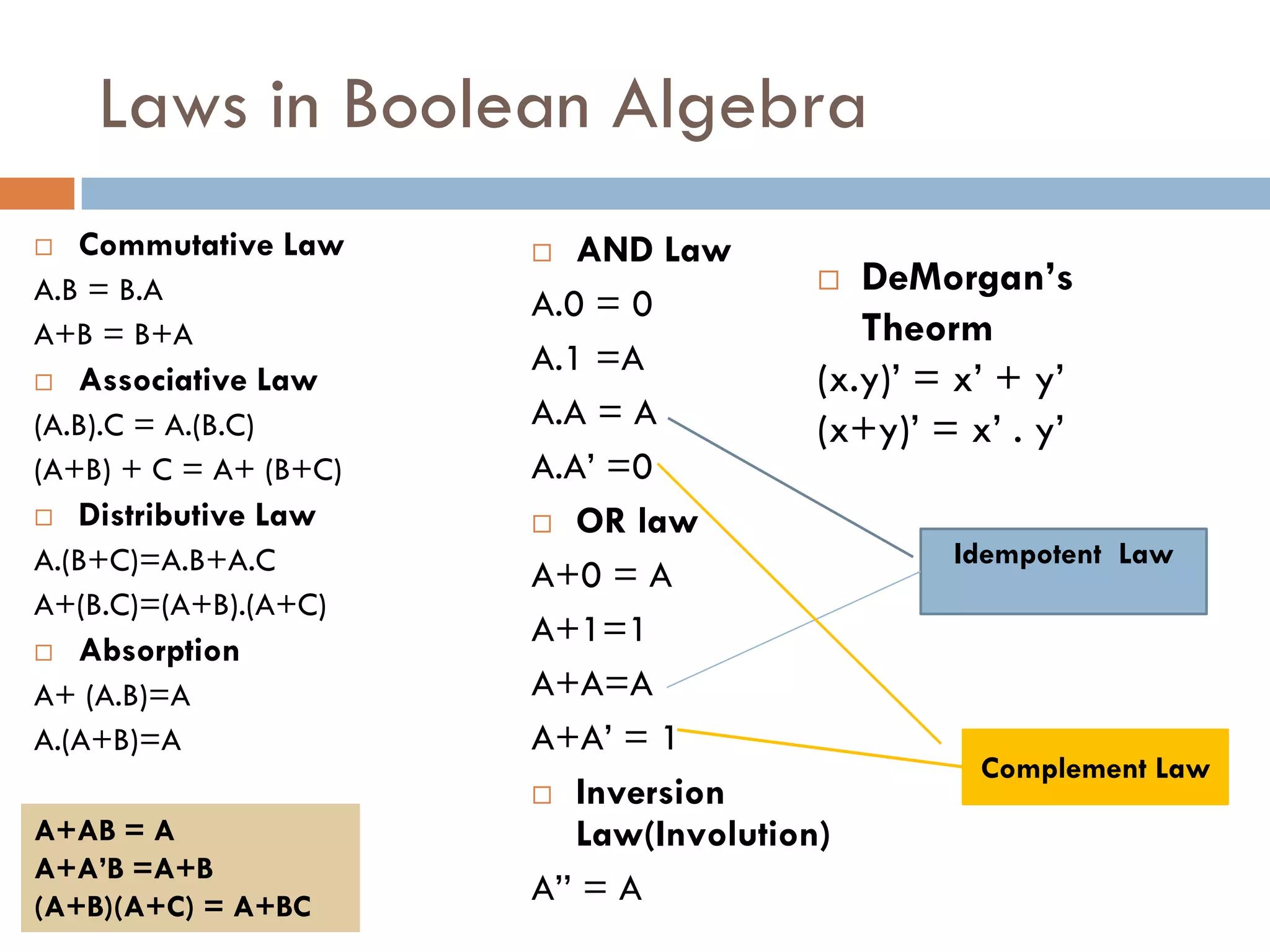
Laws in Boolean Algebra
 Commutative Law
A.B = B.A
A+B = B+A
 Associative Law
(A.B).C = A.(B.C)
(A+B) + C = A+ (B+C)
 Distributive Law
A.(B+C)=A.B+A.C
A+(B.C)=(A+B).(A+C)
 Absorption
A+ (A.B)=A
A.(A+B)=A
 AND Law
A.0 = 0
A.1 =A
A.A = A
A.A’ =0
 OR law
A+0 = A
A+1=1
A+A=A
A+A’ = 1
 Inversion
Law(Involution)
A’’ = A
 DeMorgan’s
Theorm
(x.y)’ = x’ + y’
(x+y)’ = x’ . y’
A+AB = A
A+A’B =A+B
(A+B)(A+C) = A+BC
Idempotent Law
Complement Law
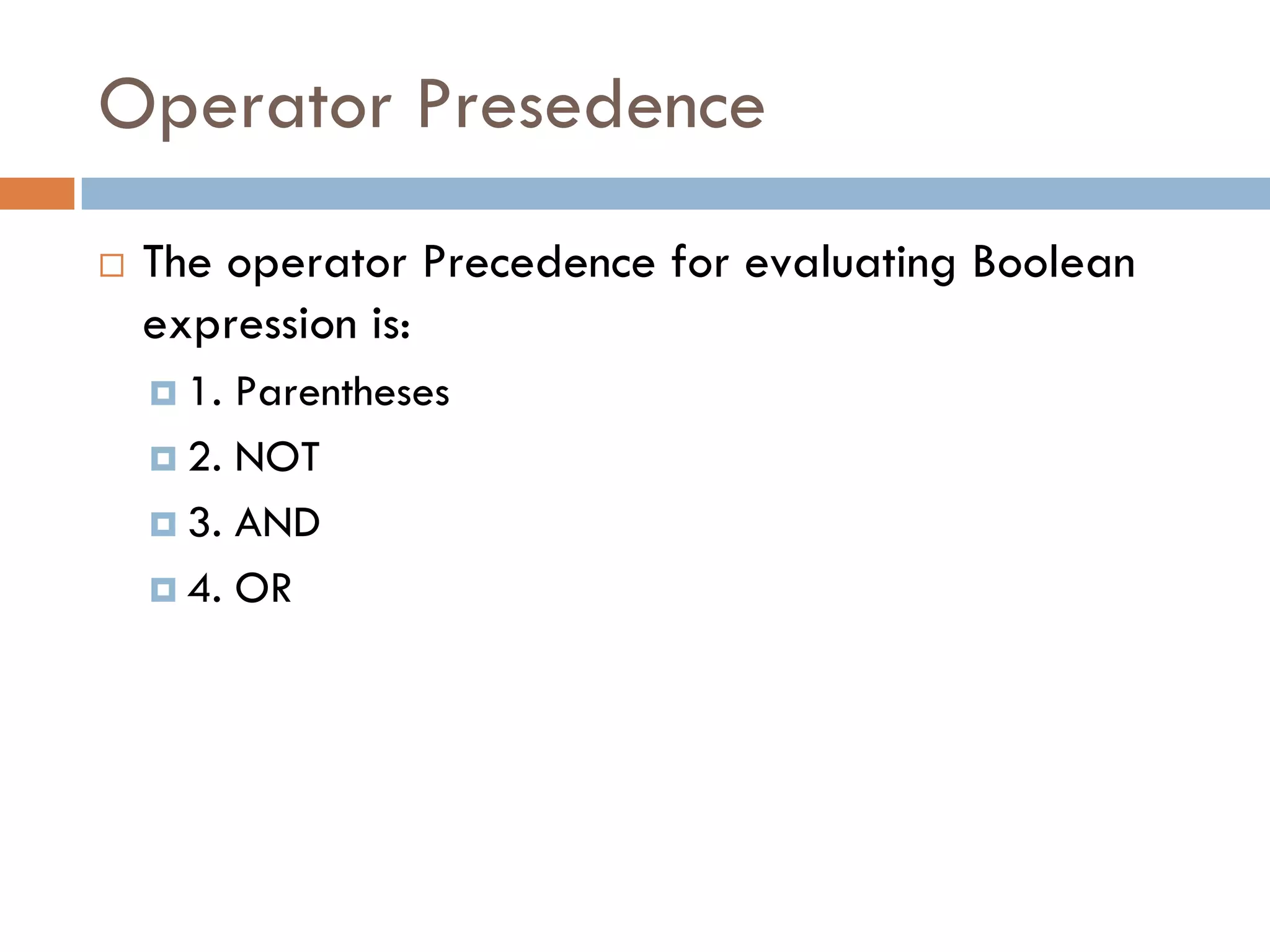
Operator Presedence
 The operator Precedence for evaluating Boolean
expression is:
 1. Parentheses
 2. NOT
 3. AND
 4. OR
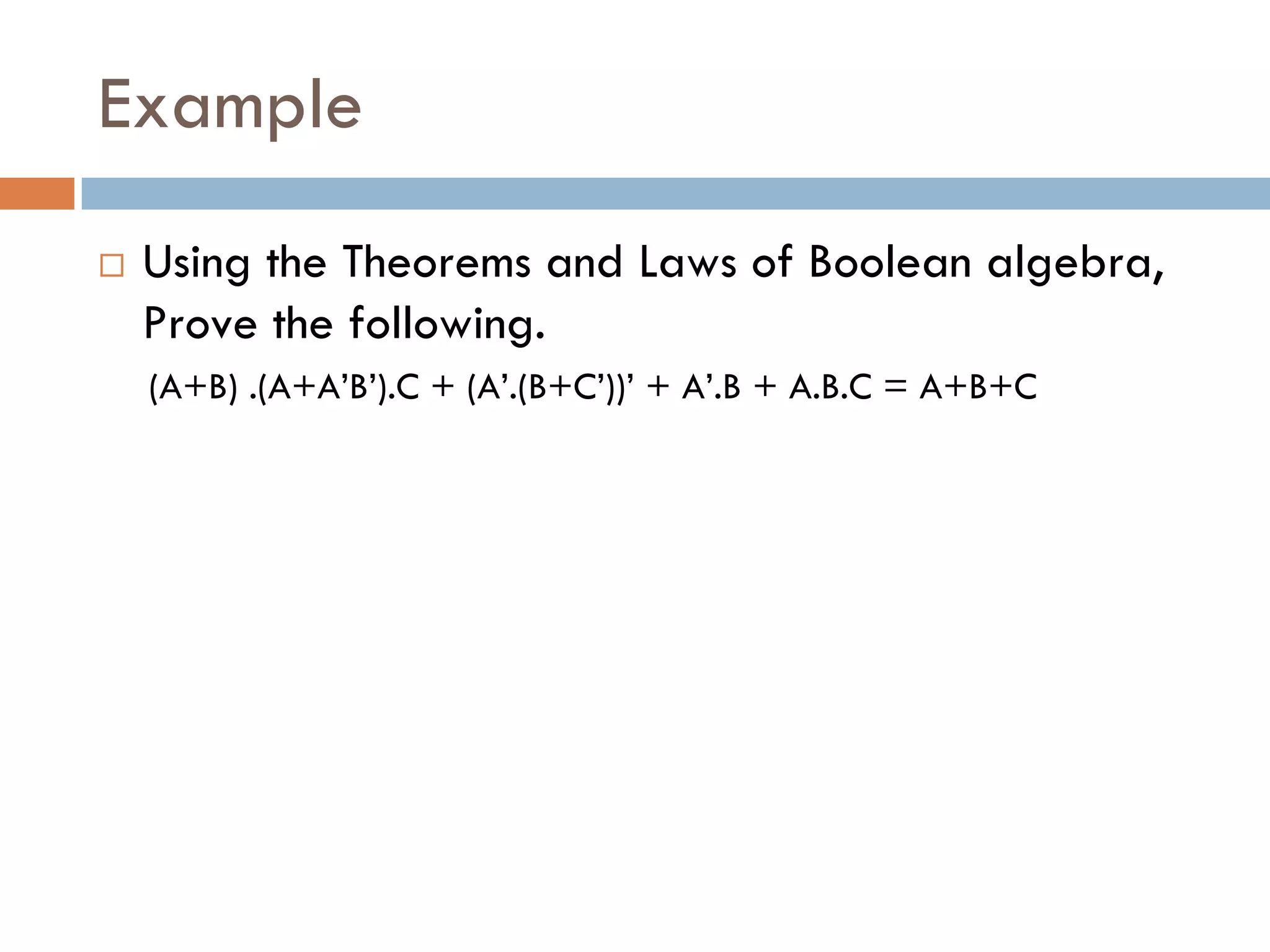
Example
 Using the Theorems and Laws of Boolean algebra,
Prove the following.
(A+B) .(A+A’B’).C + (A’.(B+C’))’ + A’.B + A.B.C = A+B+C
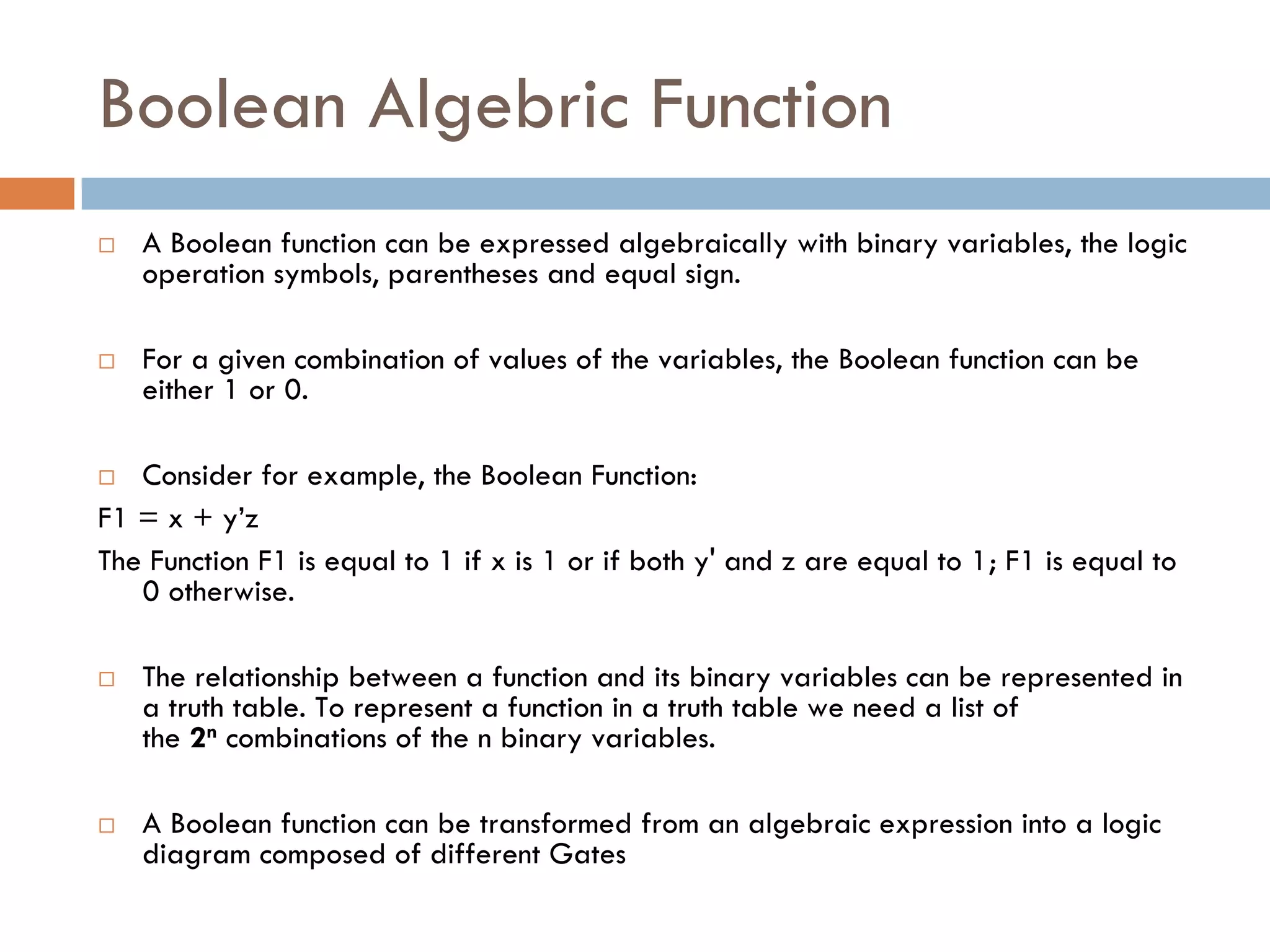
Boolean Algebric Function
 A Boolean function can be expressed algebraically with binary variables, the logic
operation symbols, parentheses and equal sign.
 For a given combination of values of the variables, the Boolean function can be
either 1 or 0.
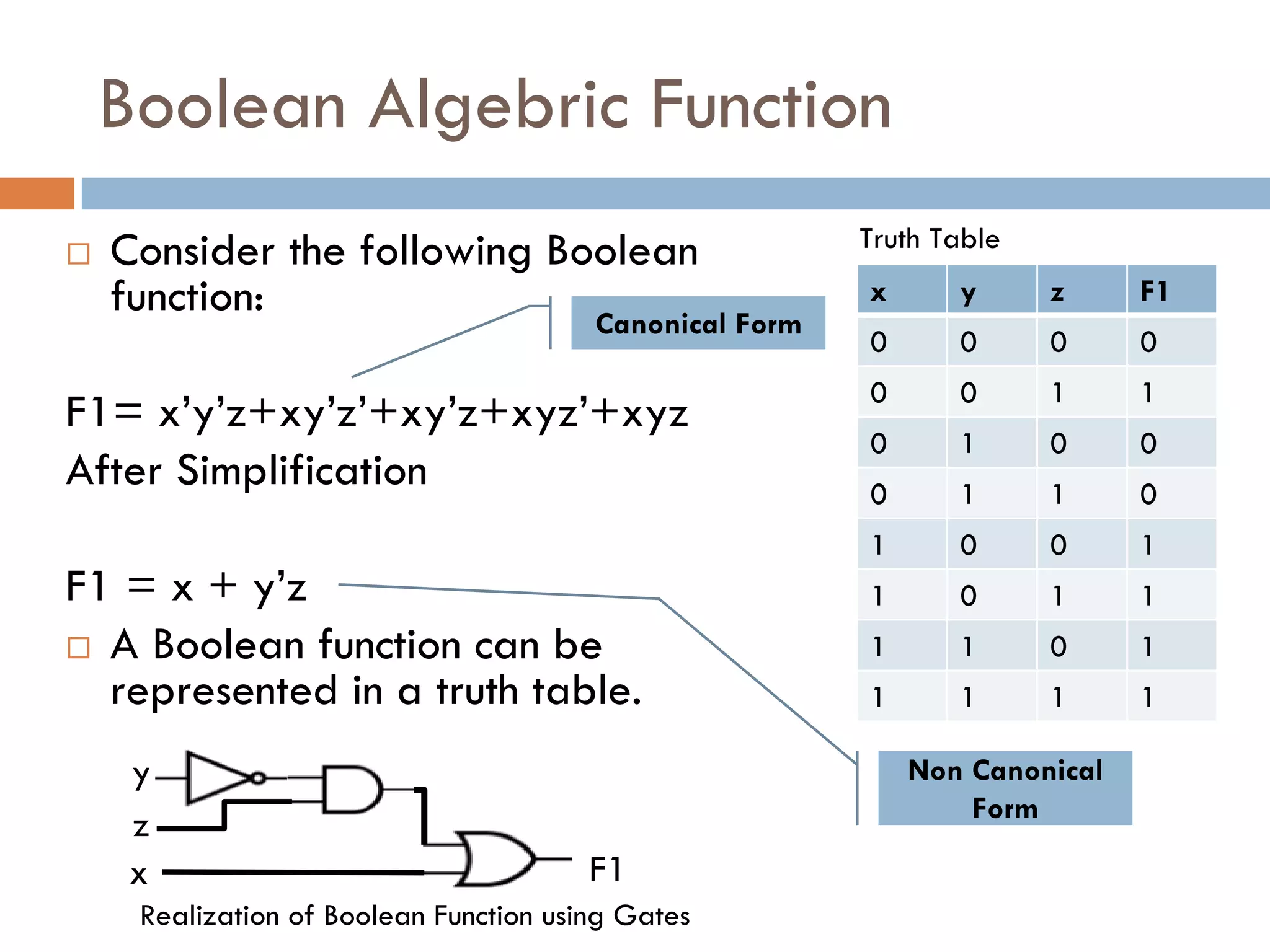
 Consider for example, the Boolean Function:
F1 = x + y’z
The Function F1 is equal to 1 if x is 1 or if both y' and z are equal to 1; F1 is equal to
0 otherwise.
 The relationship between a function and its binary variables can be represented in
a truth table. To represent a function in a truth table we need a list of
the 2n combinations of the n binary variables.
 A Boolean function can be transformed from an algebraic expression into a logic
diagram composed of different Gates
Boolean Algebric Function
 Consider the following Boolean
function:
F1= x’y’z+xy’z’+xy’z+xyz’+xyz
After Simplification
F1 = x + y’z
 A Boolean function can be
represented in a truth table.
x y z F1
0 0 0 0
0 0 1 1
0 1 0 0
0 1 1 0
1 0 0 1
1 0 1 1
1 1 0 1
1 1 1 1
Truth Table
y
z
x F1
Realization of Boolean Function using Gates
Canonical Form
Non Canonical
Form
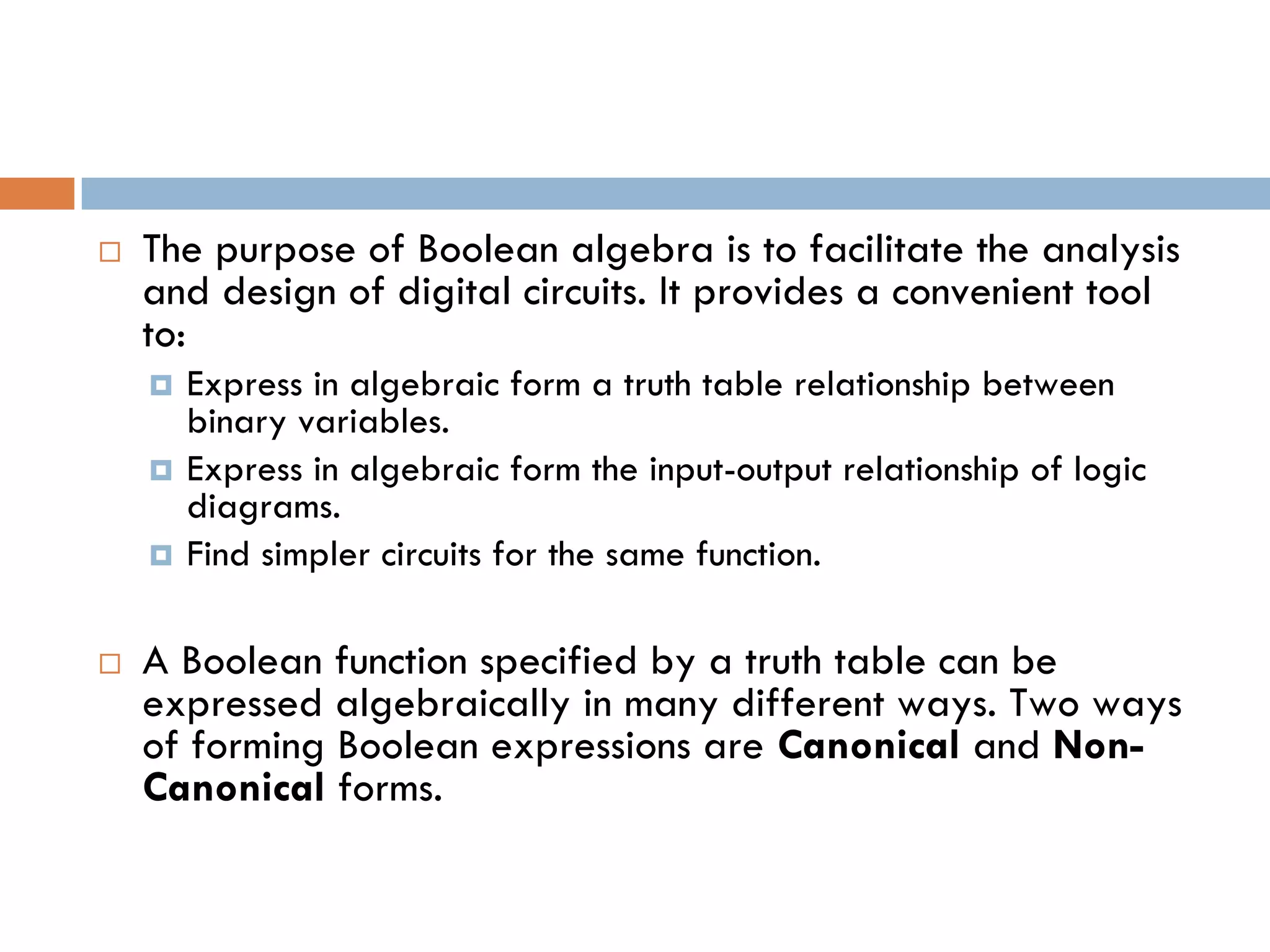
 The purpose of Boolean algebra is to facilitate the analysis
and design of digital circuits. It provides a convenient tool
to:
 Express in algebraic form a truth table relationship between
binary variables.
 Express in algebraic form the input-output relationship of logic
diagrams.
 Find simpler circuits for the same function.
 A Boolean function specified by a truth table can be
expressed algebraically in many different ways. Two ways
of forming Boolean expressions are Canonical and Non-
Canonical forms.
Canonical Forms For Boolean Function
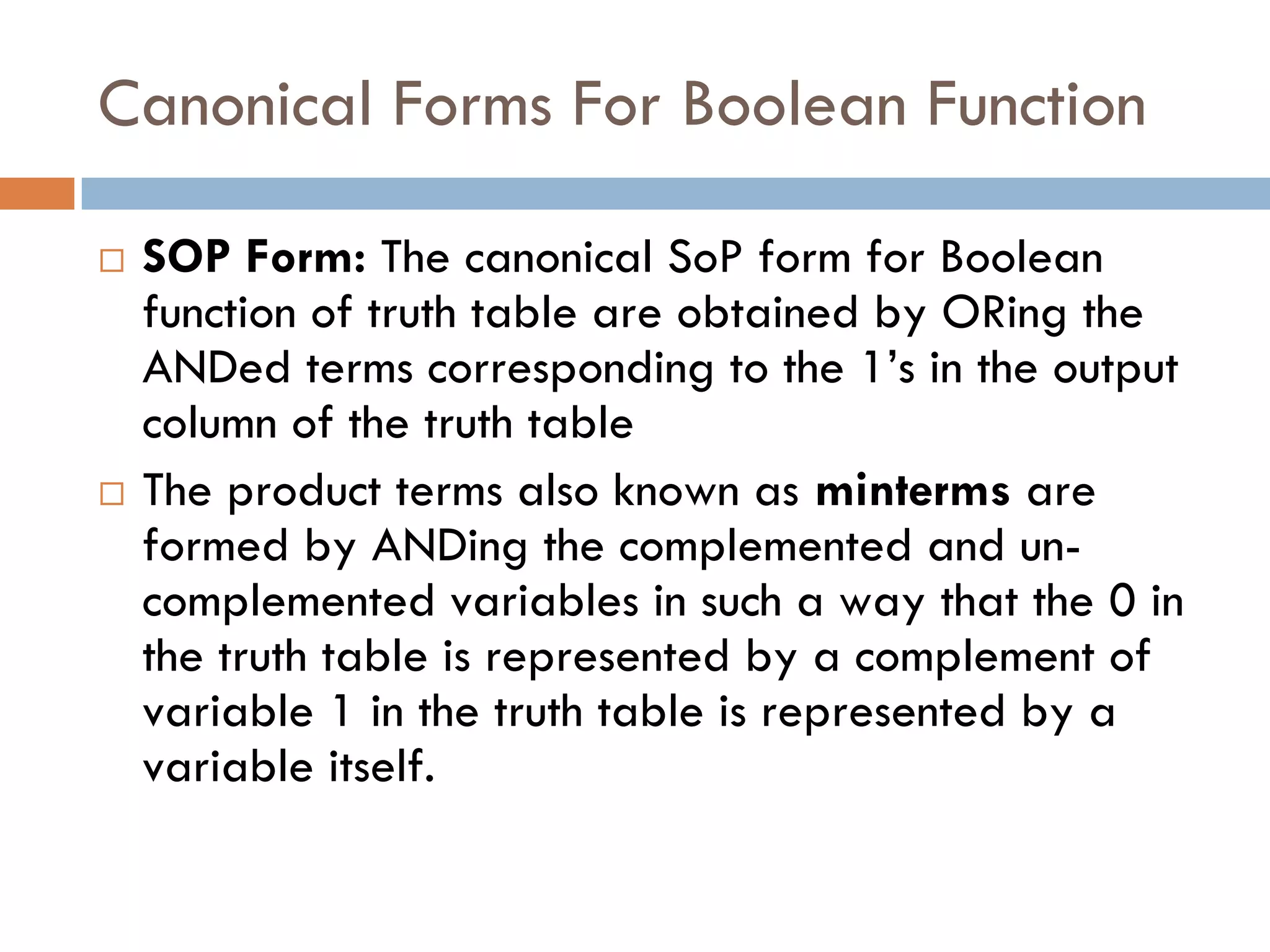
 SOP Form: The canonical SoP form for Boolean
function of truth table are obtained by ORing the
ANDed terms corresponding to the 1’s in the output
column of the truth table
 The product terms also known as minterms are
formed by ANDing the complemented and un-
complemented variables in such a way that the 0 in
the truth table is represented by a complement of
variable 1 in the truth table is represented by a
variable itself.
Canonical Forms For Boolean Function
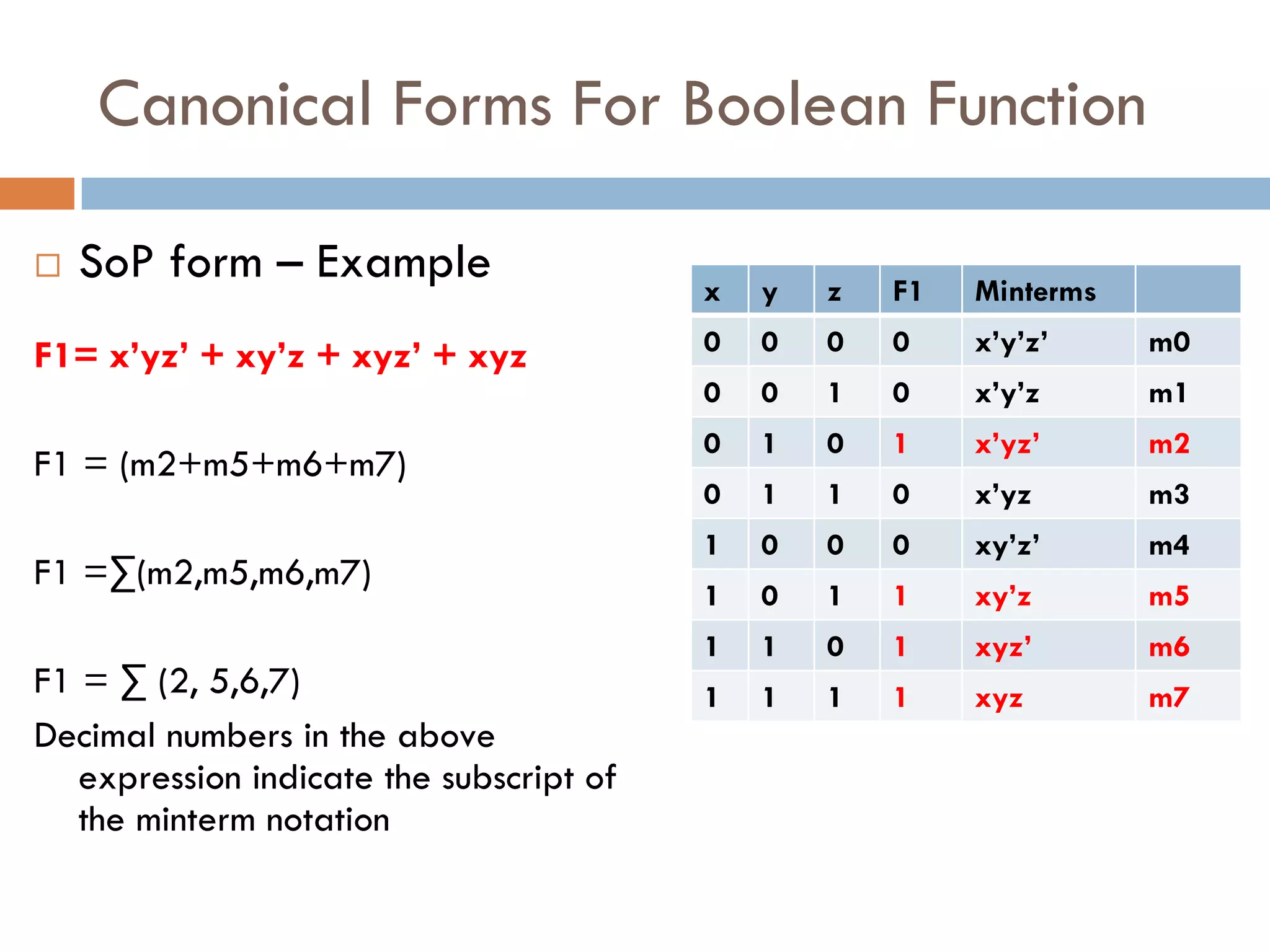
 SoP form – Example x y z F1 Minterms
0 0 0 0 x’y’z’ m0
0 0 1 0 x’y’z m1
0 1 0 1 x’yz’ m2
0 1 1 0 x’yz m3
1 0 0 0 xy’z’ m4
1 0 1 1 xy’z m5
1 1 0 1 xyz’ m6
1 1 1 1 xyz m7
F1= x’yz’ + xy’z + xyz’ + xyz
F1 = (m2+m5+m6+m7)
F1 =∑(m2,m5,m6,m7)
F1 = ∑ (2, 5,6,7)
Decimal numbers in the above
expression indicate the subscript of
the minterm notation
Canonical Forms For Boolean Function
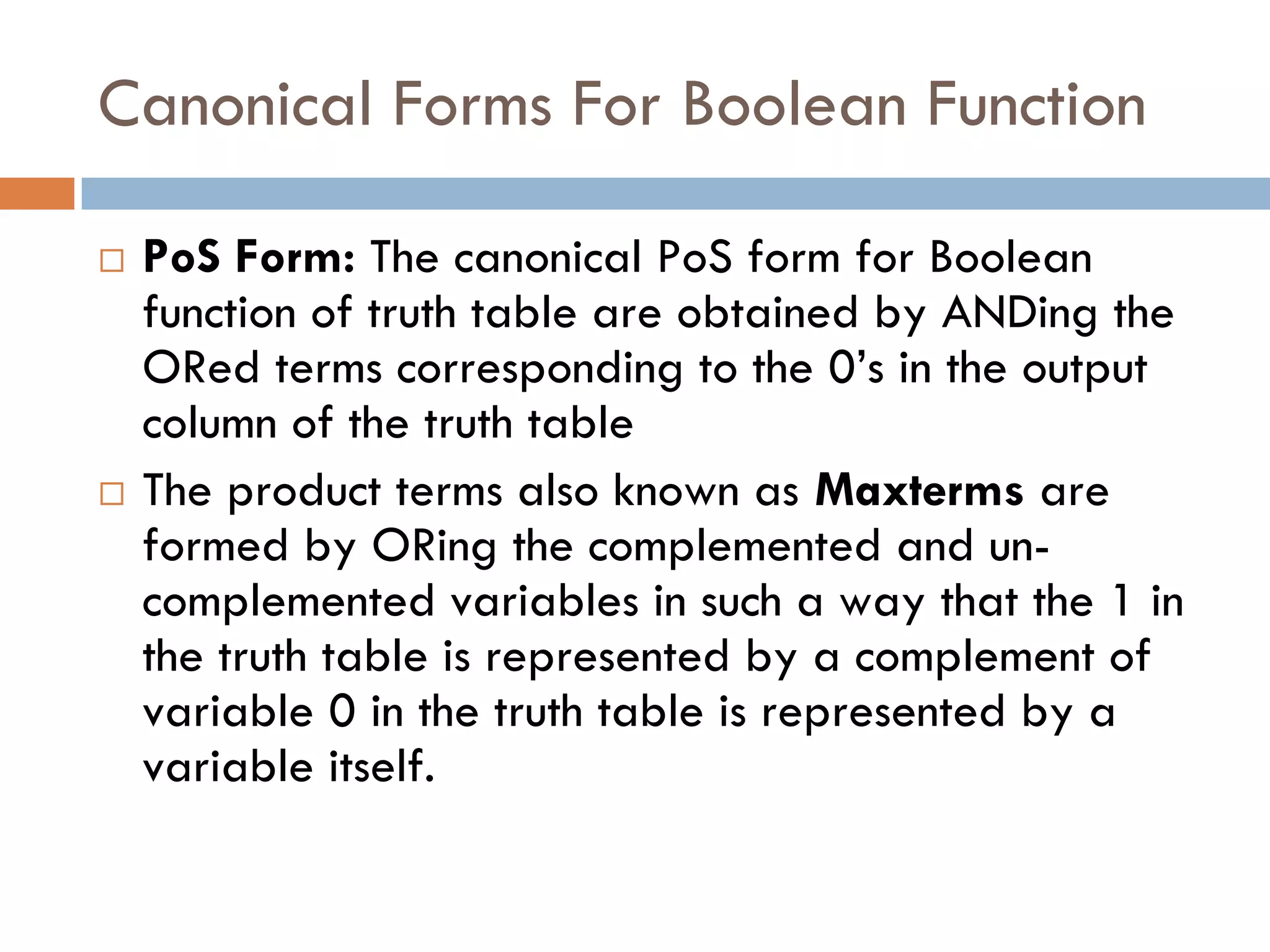
 PoS Form: The canonical PoS form for Boolean
function of truth table are obtained by ANDing the
ORed terms corresponding to the 0’s in the output
column of the truth table
 The product terms also known as Maxterms are
formed by ORing the complemented and un-
complemented variables in such a way that the 1 in
the truth table is represented by a complement of
variable 0 in the truth table is represented by a
variable itself.
Canonical Forms For Boolean Function
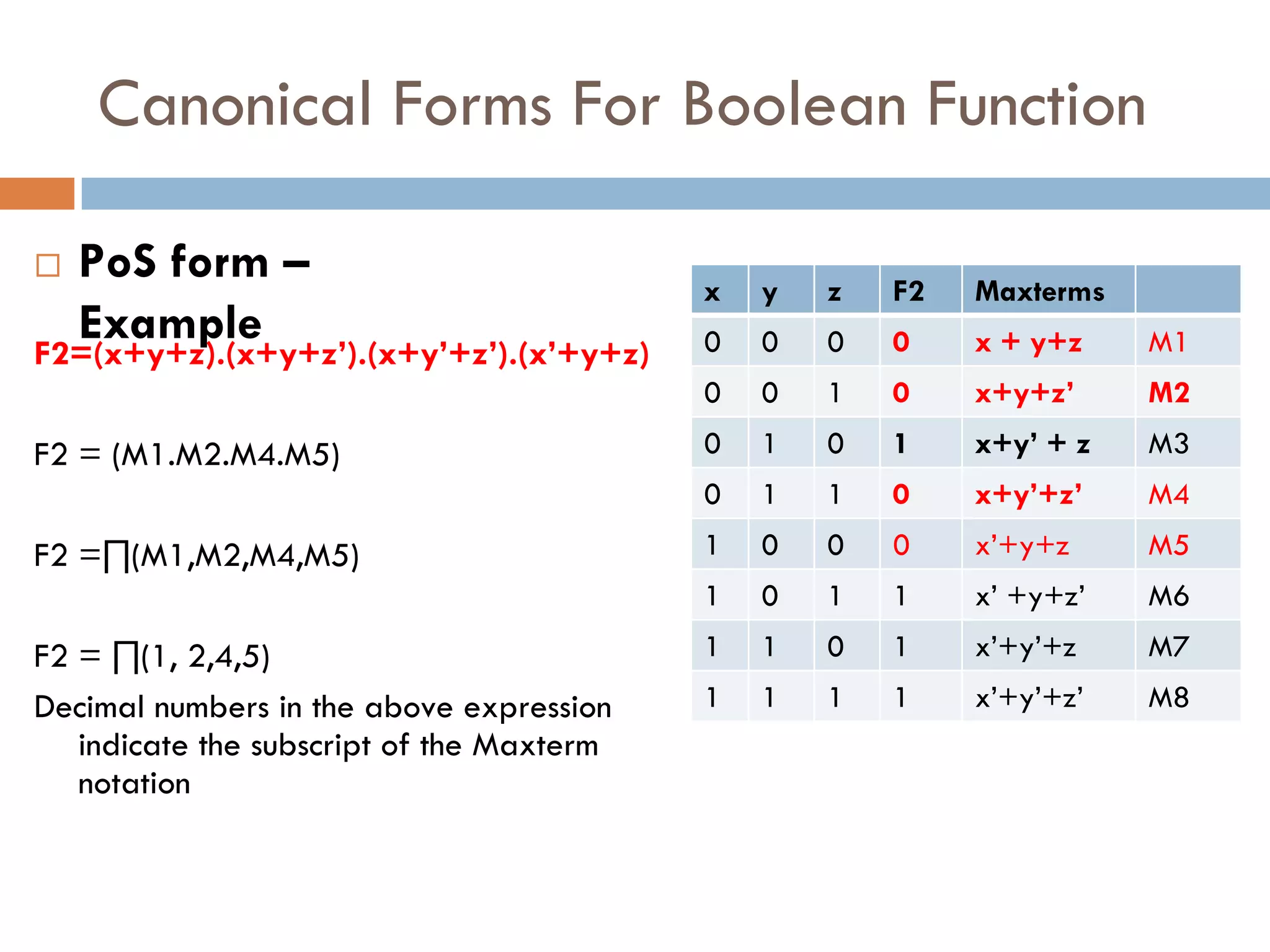
 PoS form –
Example
x y z F2 Maxterms
0 0 0 0 x + y+z M1
0 0 1 0 x+y+z’ M2
0 1 0 1 x+y’ + z M3
0 1 1 0 x+y’+z’ M4
1 0 0 0 x’+y+z M5
1 0 1 1 x’ +y+z’ M6
1 1 0 1 x’+y’+z M7
1 1 1 1 x’+y’+z’ M8
F2=(x+y+z).(x+y+z’).(x+y’+z’).(x’+y+z)
F2 = (M1.M2.M4.M5)
F2 =∏(M1,M2,M4,M5)
F2 = ∏(1, 2,4,5)
Decimal numbers in the above expression
indicate the subscript of the Maxterm
notation
Canonical Forms For Boolean Function
 Example: Express the following in SoP form
F1 = x + y’z
 Solution:
=(y+y’)x + y’z(x+x’) [because x+x’=1]
=xy + xy’ + xy’z + x’y’z
=xy(z+z’) + xy’(z+z’) + xy’z + x’y’z
=xyz + xyz’ + xy’z + xy’z’ + xy’z + x’y’z
=xyz + xyz’ + (xy’z + xy’z) + xy’z’ + x’y’z
= xyz + xyz’ + xy’z + xy’z’ + x’y’z [because x+x =x]
= m7 + m6 + m5 + m4 + m1
= ∑(m7, m6, m5, m4, m1)
= ∑(1,4,5,6,7)
Canonical Forms - Exercises
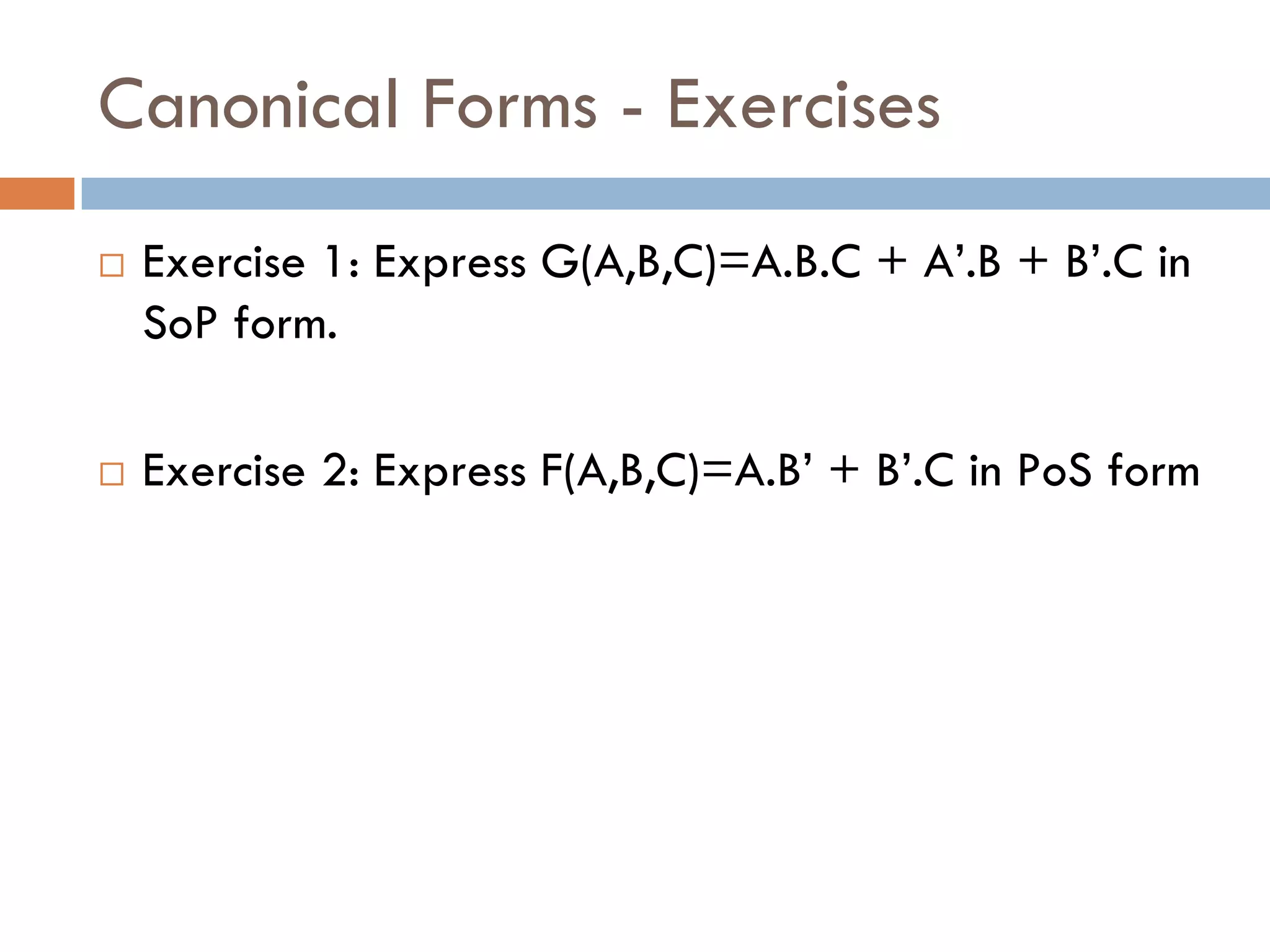
 Exercise 1: Express G(A,B,C)=A.B.C + A’.B + B’.C in
SoP form.
 Exercise 2: Express F(A,B,C)=A.B’ + B’.C in PoS form
Simplification of Boolean functions
 Algebric simplification
 K-Map simplification
 Quine-McLusky Method of simplification
Algebraic Simplification
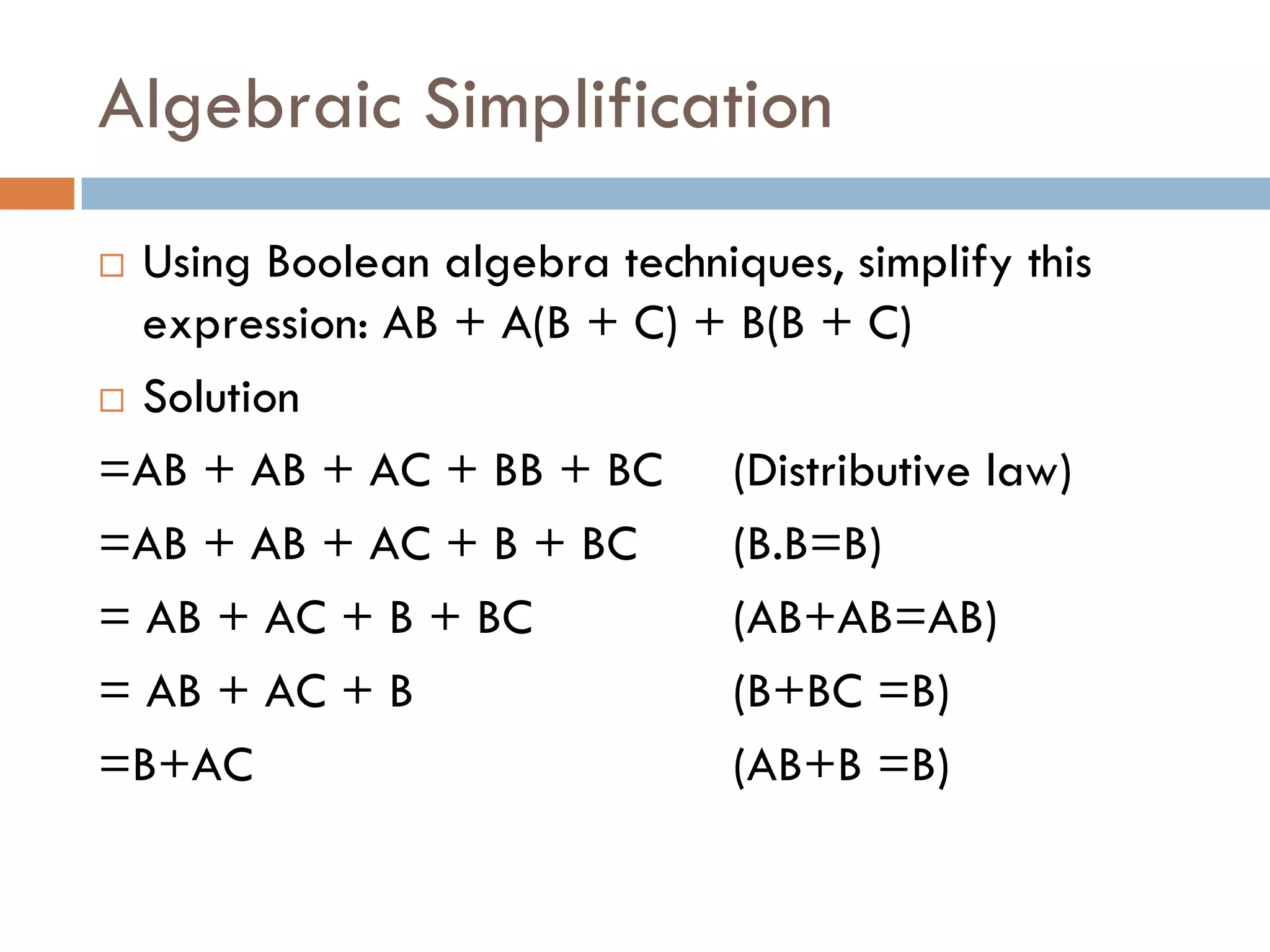
 Using Boolean algebra techniques, simplify this
expression: AB + A(B + C) + B(B + C)
 Solution
=AB + AB + AC + BB + BC (Distributive law)
=AB + AB + AC + B + BC (B.B=B)
= AB + AC + B + BC (AB+AB=AB)
= AB + AC + B (B+BC =B)
=B+AC (AB+B =B)
Algebric Simplification
 Minimize the following Boolean expression using Algebric
Simplification
F(A,B,C)=A′B+BC′+BC+AB′C′
 Solution
=A′B+(BC′+BC′)+BC+AB′C′ [indeponent law]
= A′B+(BC′+BC)+(BC’+AB′C′)
= A′B+B(C′+C)+C’(B+AB′)
=A’B + B.1+ c’ (B+A)
= B(A′+1)+C′(B+A)
=B + C′(B+A) [A’+1=1]
= B+BC′+AC′
= B(1+C′)+AC′
= B+AC′ [1+C’ = 1]
Algebric Simplification
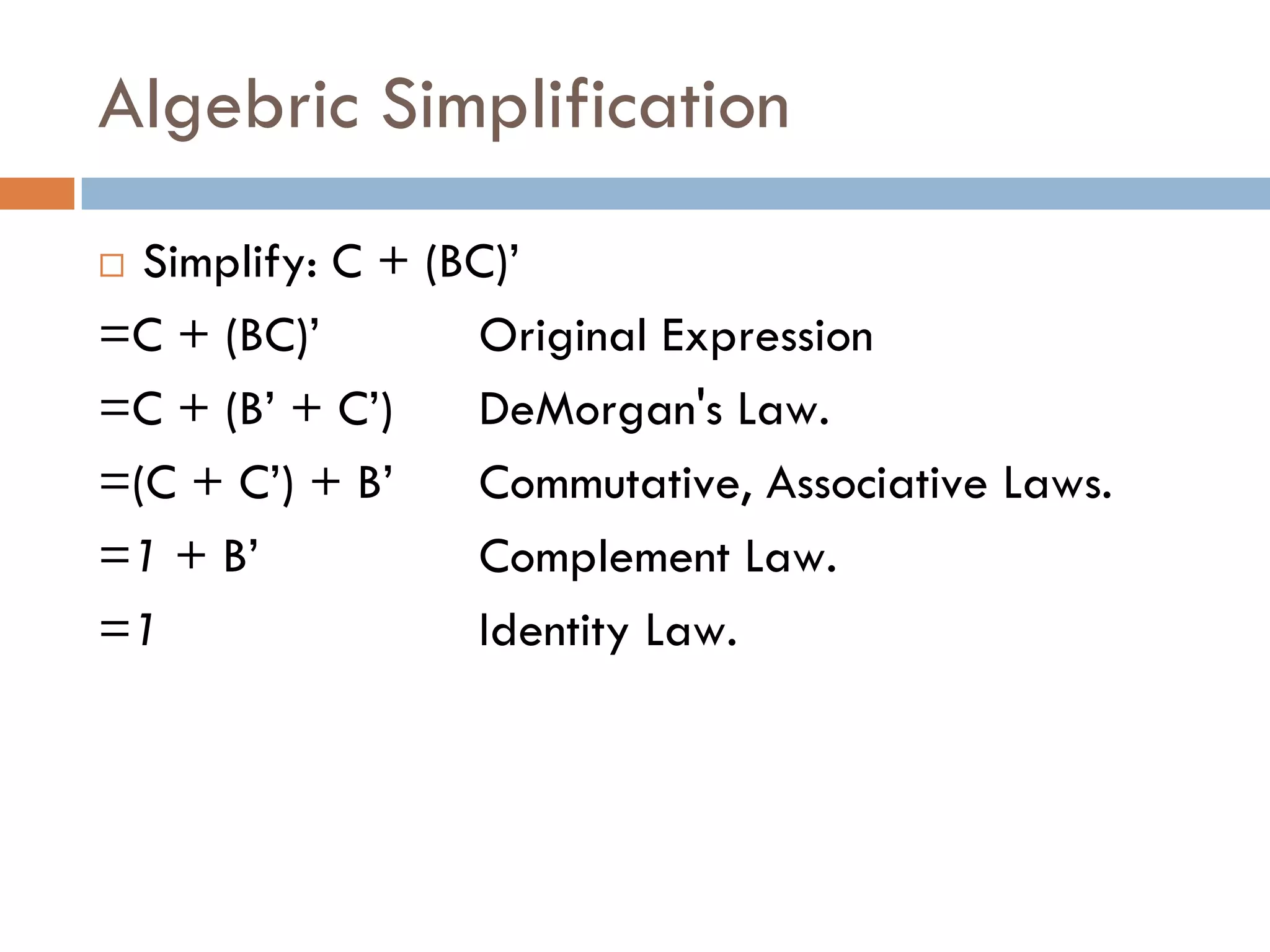
 Simplify: C + (BC)’
=C + (BC)’ Original Expression
=C + (B’ + C’) DeMorgan's Law.
=(C + C’) + B’ Commutative, Associative Laws.
=1 + B’ Complement Law.
=1 Identity Law.
Algebric Simplification
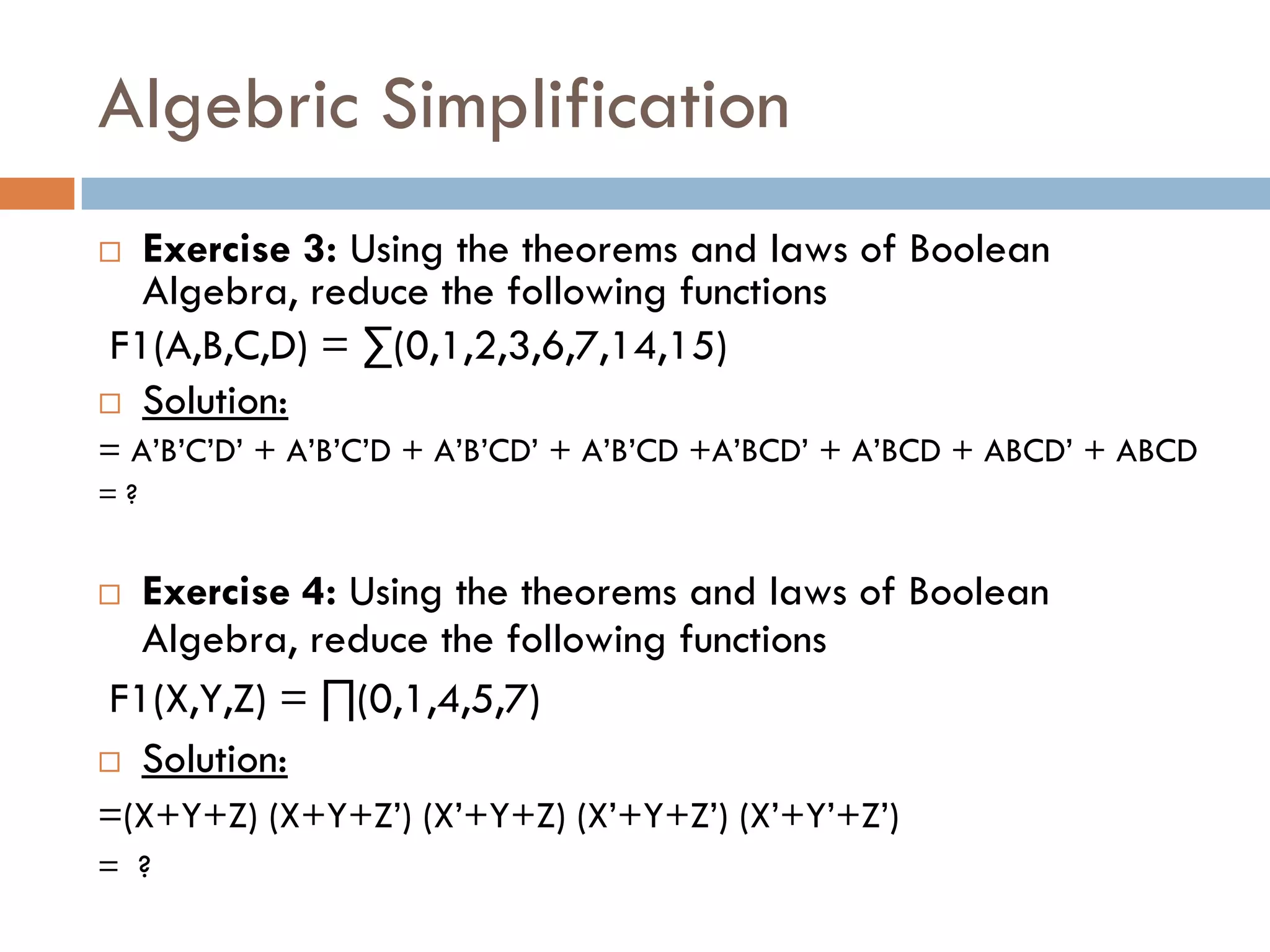
 Exercise 3: Using the theorems and laws of Boolean
Algebra, reduce the following functions
F1(A,B,C,D) = ∑(0,1,2,3,6,7,14,15)
 Solution:
= A’B’C’D’ + A’B’C’D + A’B’CD’ + A’B’CD +A’BCD’ + A’BCD + ABCD’ + ABCD
= ?
 Exercise 4: Using the theorems and laws of Boolean
Algebra, reduce the following functions
F1(X,Y,Z) = ∏(0,1,4,5,7)
 Solution:
=(X+Y+Z) (X+Y+Z’) (X’+Y+Z) (X’+Y+Z’) (X’+Y’+Z’)
= ?
Simplification Using K-Map
 Karnaugh Maps
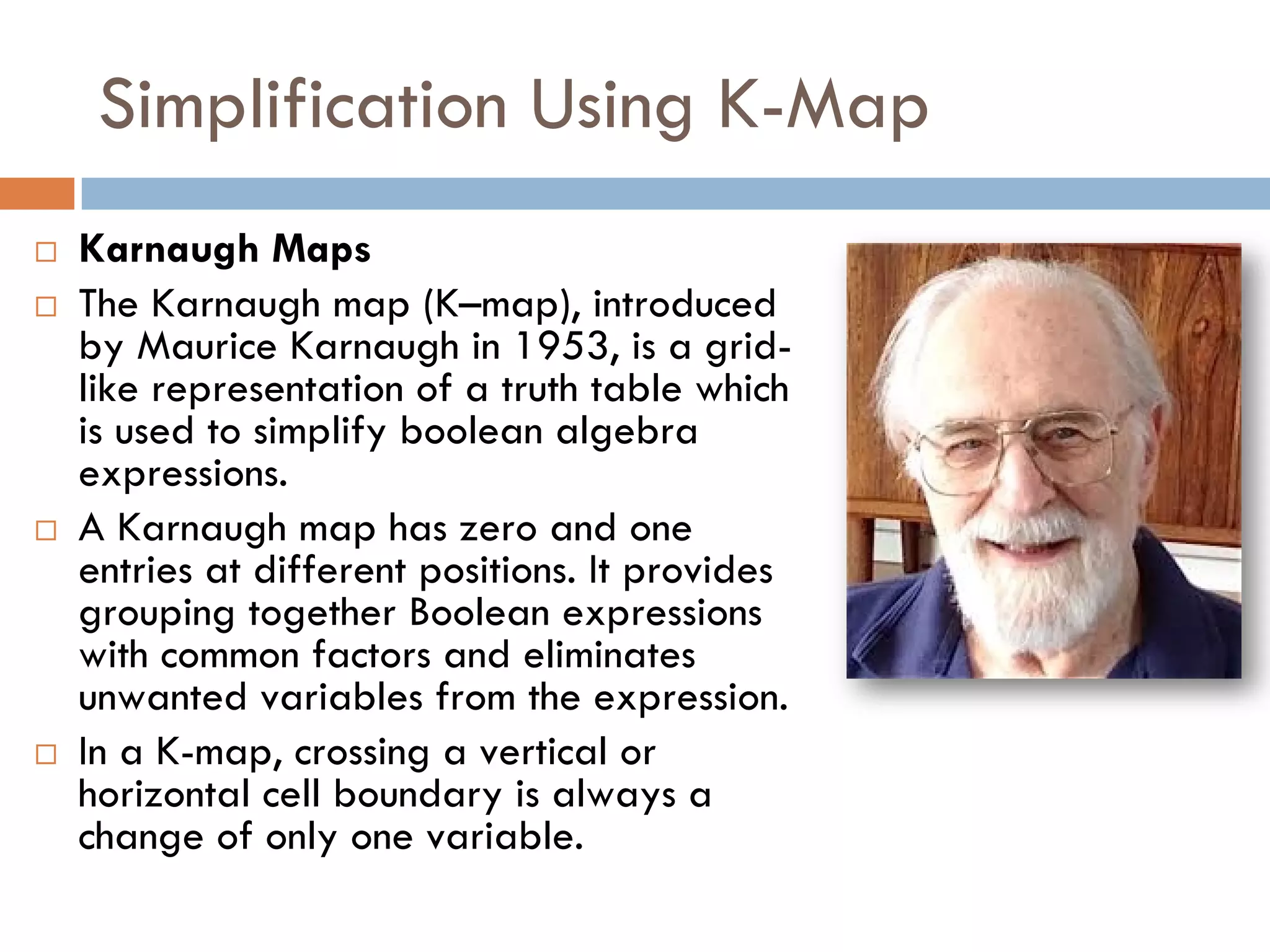
 The Karnaugh map (K–map), introduced
by Maurice Karnaugh in 1953, is a grid-
like representation of a truth table which
is used to simplify boolean algebra
expressions.
 A Karnaugh map has zero and one
entries at different positions. It provides
grouping together Boolean expressions
with common factors and eliminates
unwanted variables from the expression.
 In a K-map, crossing a vertical or
horizontal cell boundary is always a
change of only one variable.
K-Map Simplification
 A Karnaugh map provides a systematic method for
simplifying Boolean expressions and, if properly used, will
produce the simplest expression possible, known as the
minimum expression.
 Karnaugh maps can be used for expressions with two, three,
four. and five variables. Another method, called the Quine-
McClusky method can be used for higher numbers of
variables.
 The number of cells in a Karnaugh map is equal to the total
number of possible input variable combinations as is the
number of rows in a truth table. For three variables, the
number of cells is 23 = 8. For four variables, the number of
cells is 24 = 16.
K-Map Simplification
 The 4-Variable Karnaugh Map
 The 4-variable Karnaugh map is an array of sixteen
cells,
 Binary values of A and B are along the left side and
the values of C and D are across the top.
 The value of a given cell is the binary values of A and
B at the left in the same row combined with the binary
values of C and D at the top in the same column.
 For example, the cell in the upper right corner has a
binary value of 0010 and the cell in the lower right
corner has a binary value of 1010.
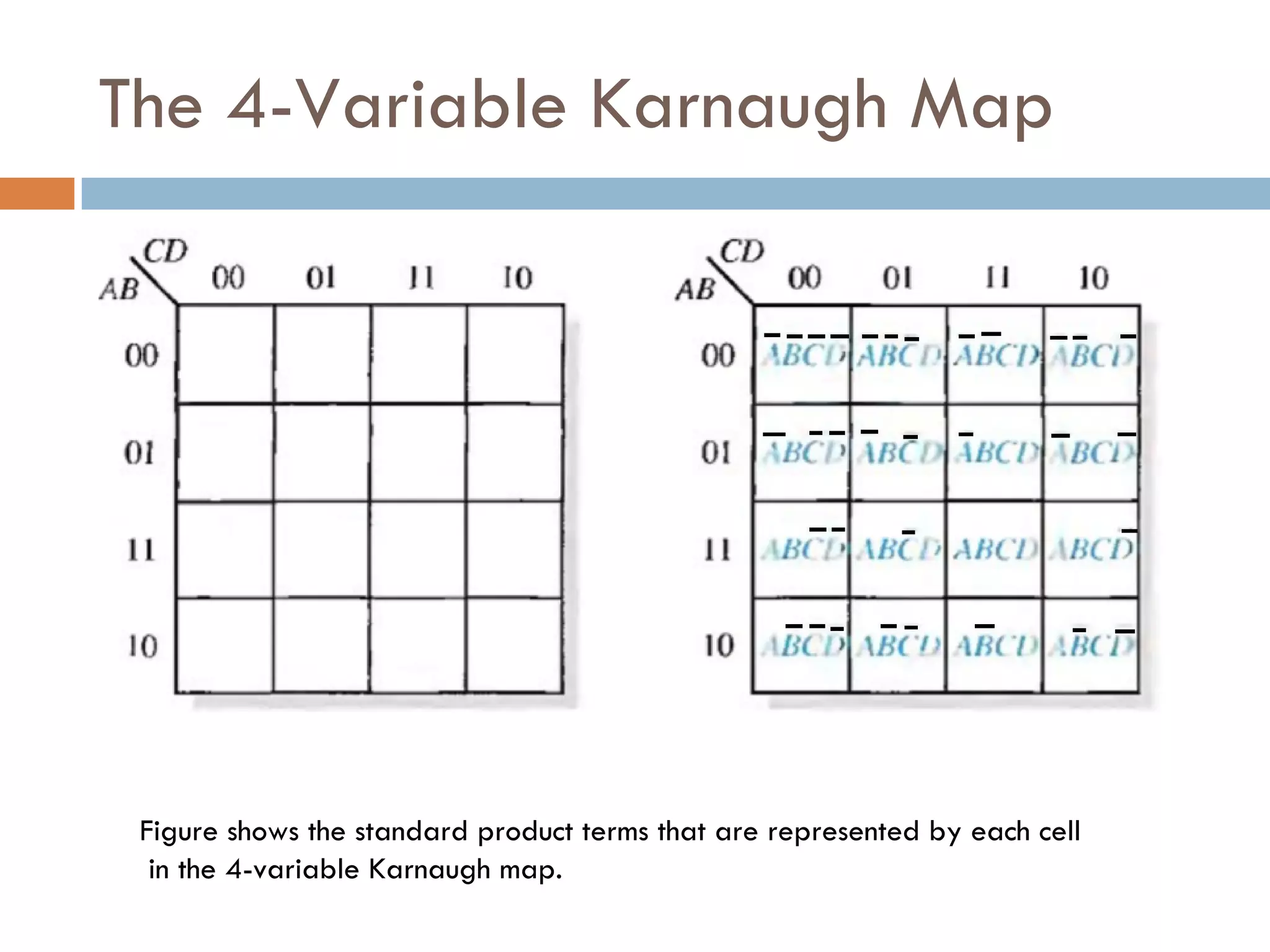
The 4-Variable Karnaugh Map
Figure shows the standard product terms that are represented by each cell
in the 4-variable Karnaugh map.
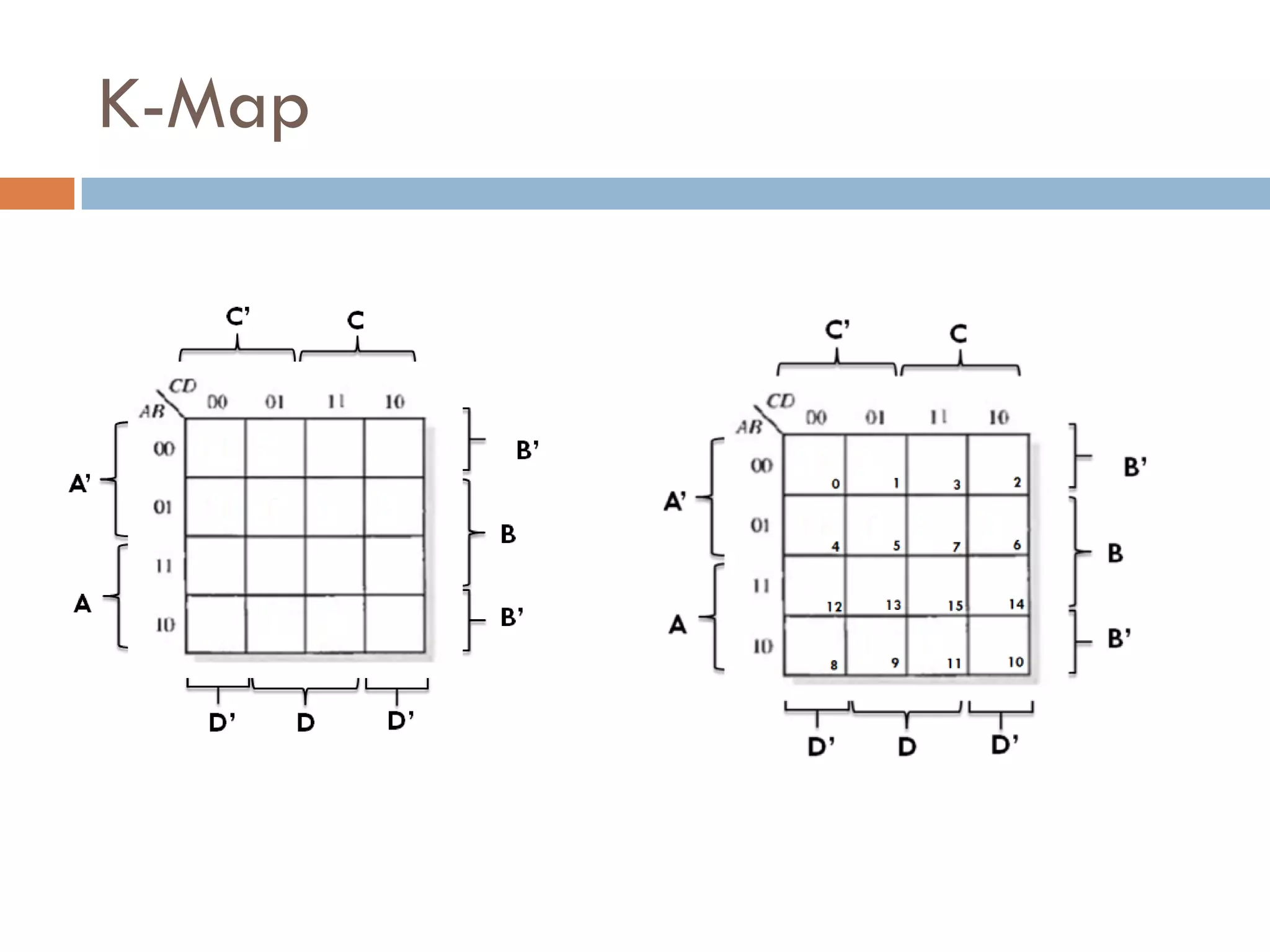
K-Map
The 3-Variable Karnaugh Map
 A 3-variable Karnaugh map showing product terms
K-Map Simplification
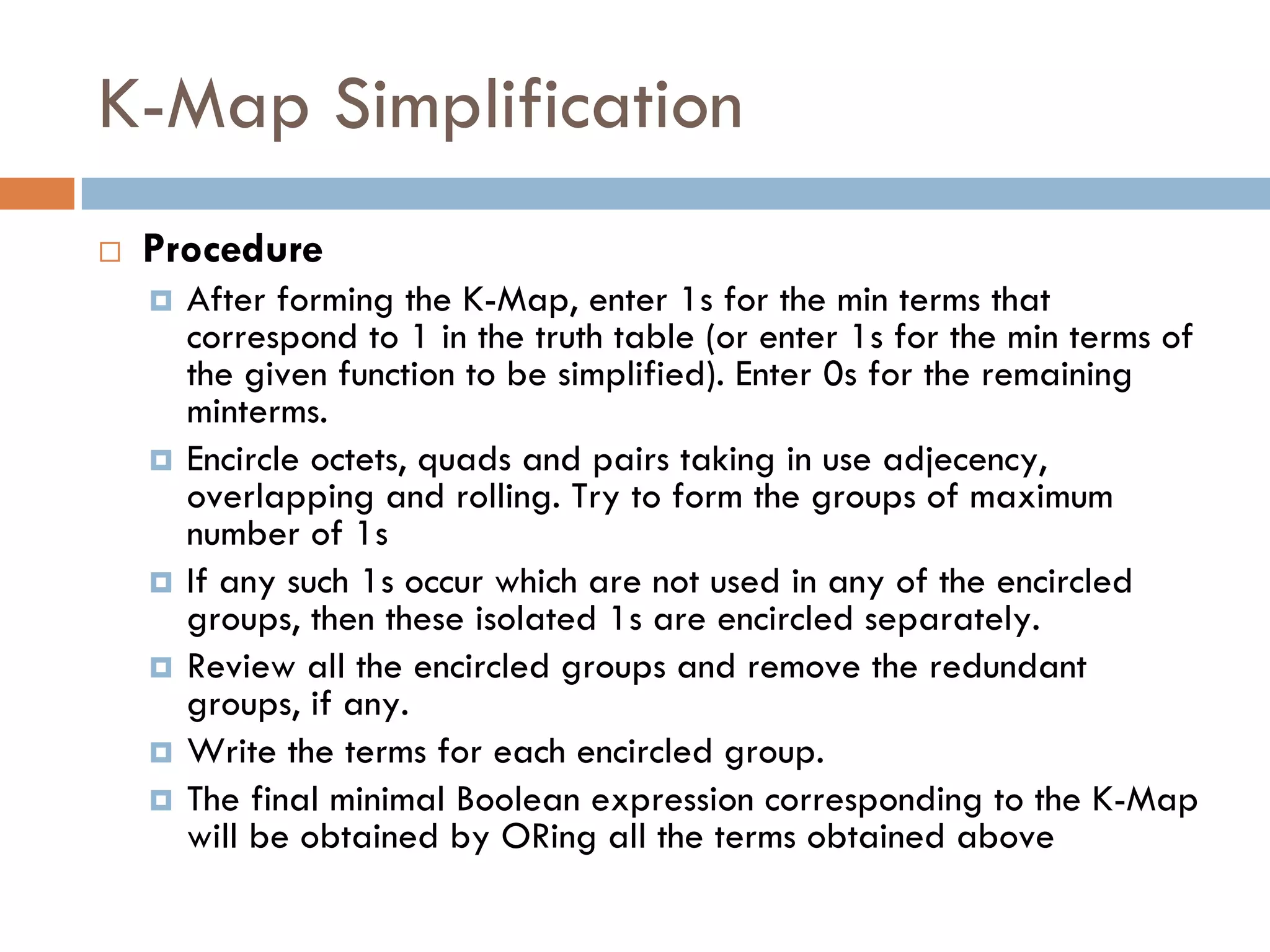
 Procedure
 After forming the K-Map, enter 1s for the min terms that
correspond to 1 in the truth table (or enter 1s for the min terms of
the given function to be simplified). Enter 0s for the remaining
minterms.
 Encircle octets, quads and pairs taking in use adjecency,
overlapping and rolling. Try to form the groups of maximum
number of 1s
 If any such 1s occur which are not used in any of the encircled
groups, then these isolated 1s are encircled separately.
 Review all the encircled groups and remove the redundant
groups, if any.
 Write the terms for each encircled group.
 The final minimal Boolean expression corresponding to the K-Map
will be obtained by ORing all the terms obtained above
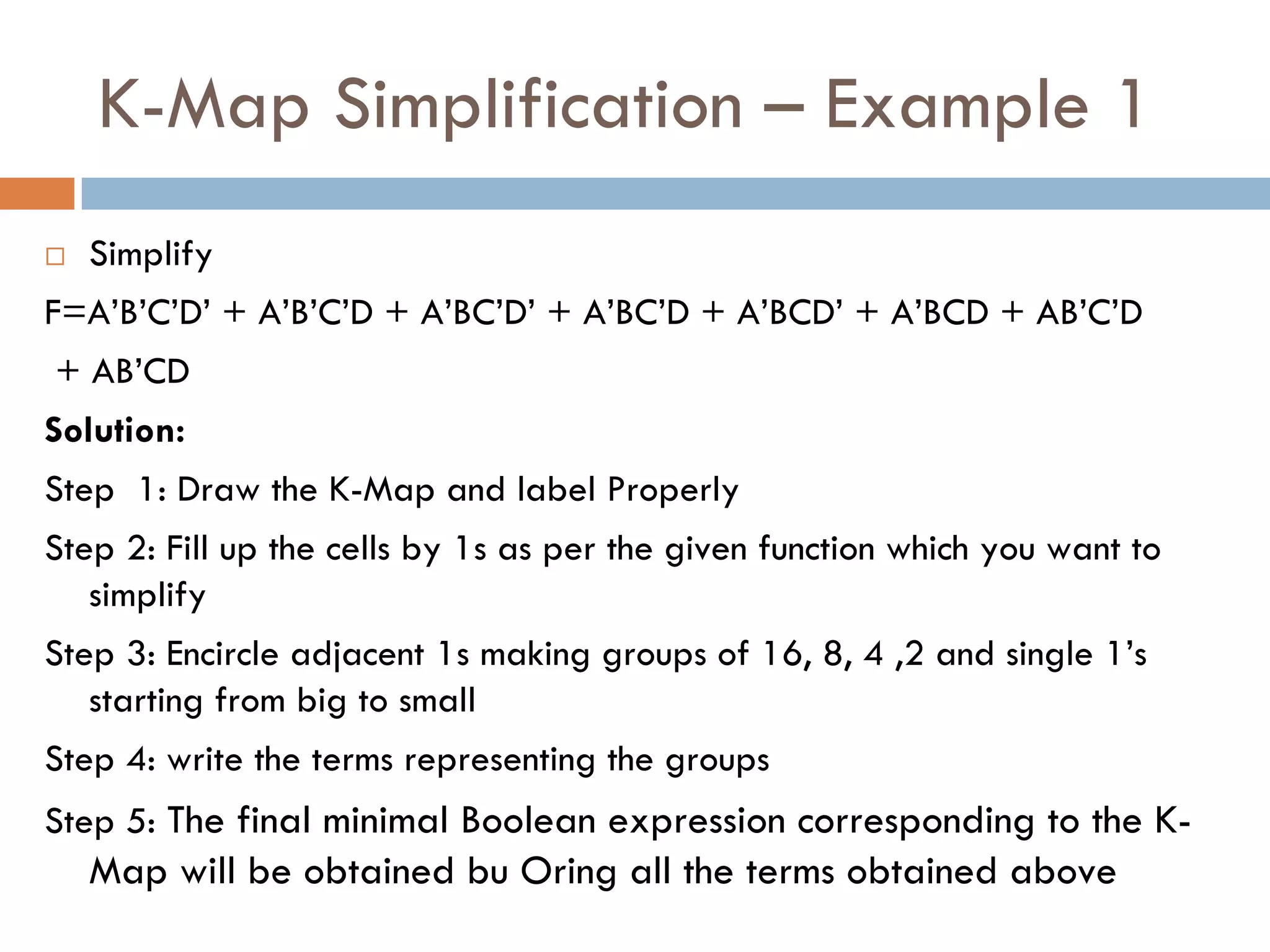
K-Map Simplification – Example 1
 Simplify
F=A’B’C’D’ + A’B’C’D + A’BC’D’ + A’BC’D + A’BCD’ + A’BCD + AB’C’D
+ AB’CD
Solution:
Step 1: Draw the K-Map and label Properly
Step 2: Fill up the cells by 1s as per the given function which you want to
simplify
Step 3: Encircle adjacent 1s making groups of 16, 8, 4 ,2 and single 1’s
starting from big to small
Step 4: write the terms representing the groups
Step 5: The final minimal Boolean expression corresponding to the K-
Map will be obtained bu Oring all the terms obtained above
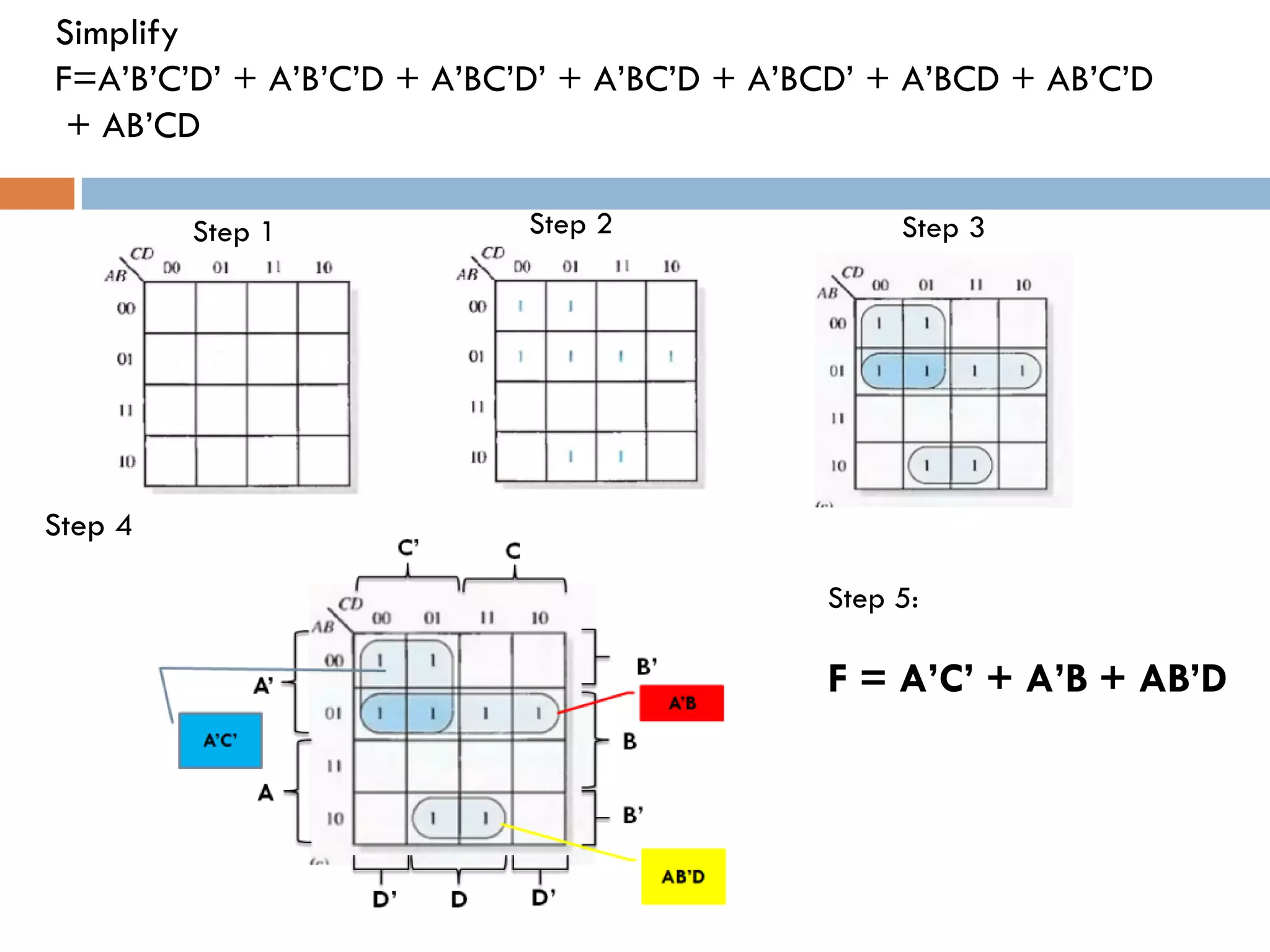
Simplify
F=A’B’C’D’ + A’B’C’D + A’BC’D’ + A’BC’D + A’BCD’ + A’BCD + AB’C’D
+ AB’CD
Step 4
Step 1 Step 2 Step 3
Step 5:
F = A’C’ + A’B + AB’D
K-Map Example 2
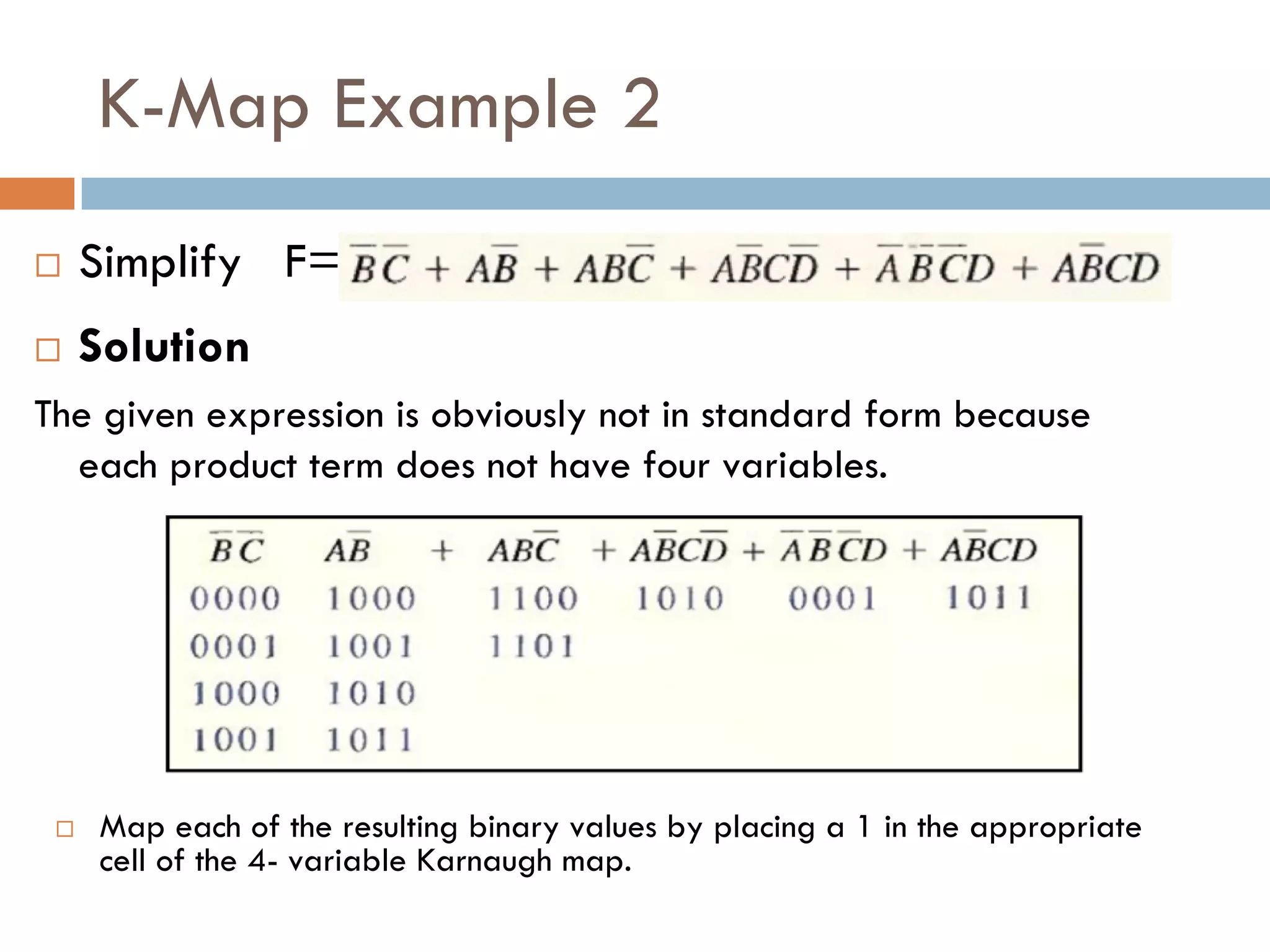
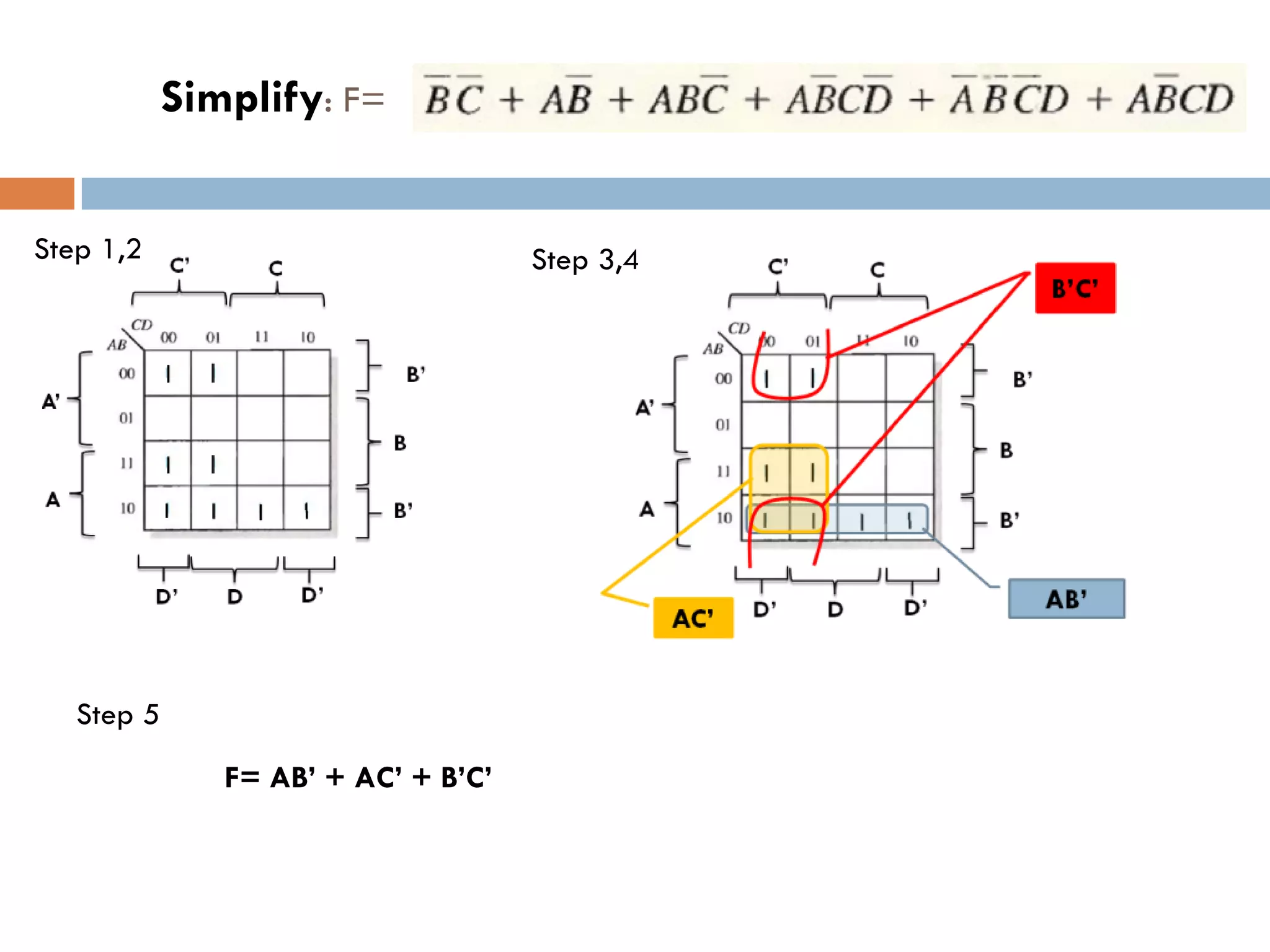
 Simplify F=
 Solution
The given expression is obviously not in standard form because
each product term does not have four variables.
 Map each of the resulting binary values by placing a 1 in the appropriate
cell of the 4- variable Karnaugh map.
Simplify: F=
Step 1,2 Step 3,4
Step 5
F= AB’ + AC’ + B’C’
K-Map
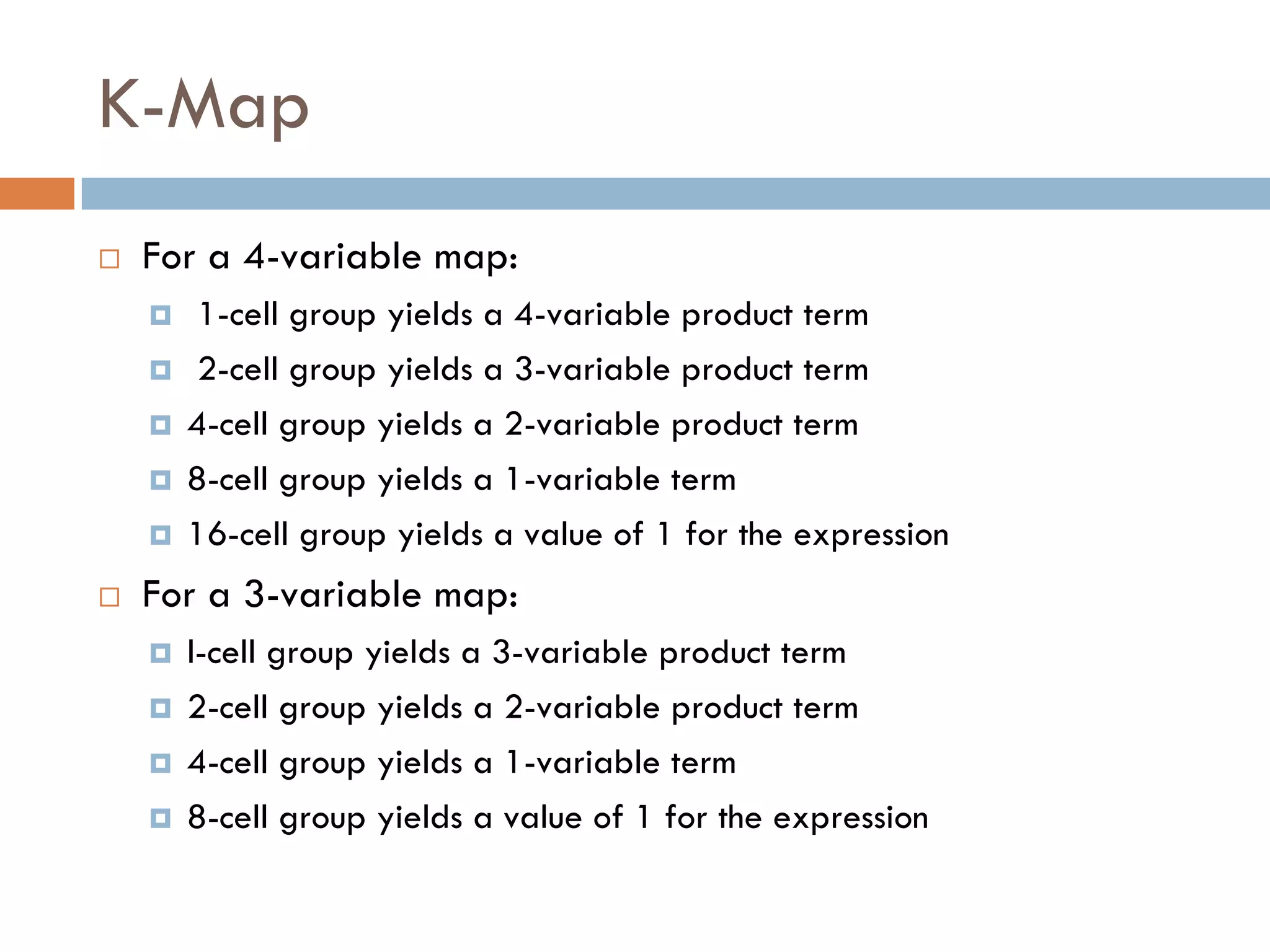
 For a 4-variable map:
 1-cell group yields a 4-variable product term
 2-cell group yields a 3-variable product term
 4-cell group yields a 2-variable product term
 8-cell group yields a 1-variable term
 16-cell group yields a value of 1 for the expression
 For a 3-variable map:
 l-cell group yields a 3-variable product term
 2-cell group yields a 2-variable product term
 4-cell group yields a 1-variable term
 8-cell group yields a value of 1 for the expression
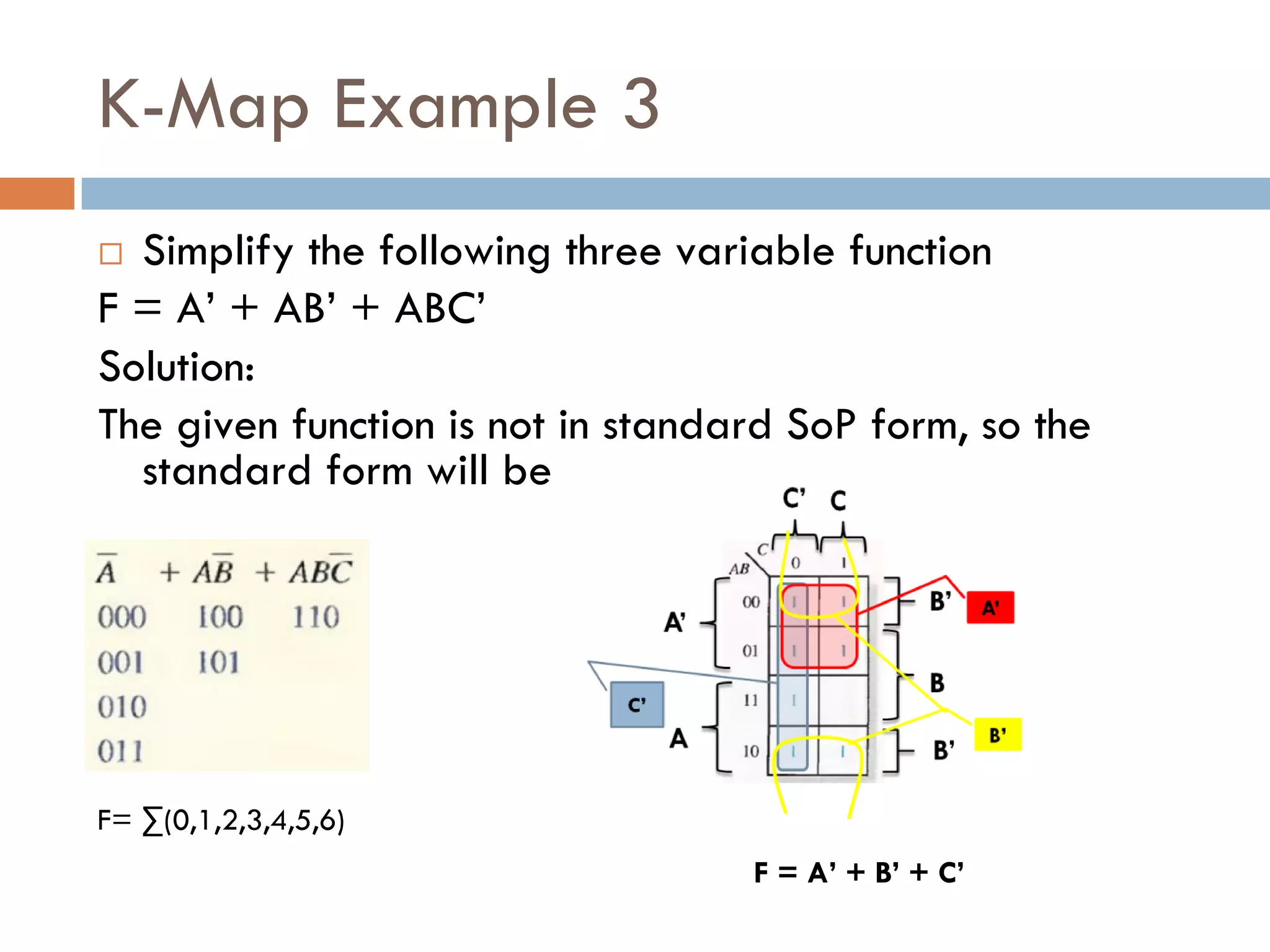
K-Map Example 3
 Simplify the following three variable function
F = A’ + AB’ + ABC’
Solution:
The given function is not in standard SoP form, so the
standard form will be
F= ∑(0,1,2,3,4,5,6)
F = A’ + B’ + C’
K-Map Simplification - Exercise
 Minimize the following function using K-Map
i) P(A,B,C,D) = ∑(0,1,2,5,8,10,11,14,15)
ii) F(x,y,z)=x’y’z’ + x’y’z + xyz’ + xyz
iii) S(a,b,c,d) = a’b’c’ + b’cd’ + a’bc’d +ab’c’d’ + ab’cd + acbd’ + abcd
Quine- McCluskey Method
 K-Map Method is a useful tool for the simplification of
Boolean function up to four variables. Although this
method can be used for 5 or 6 variables but it is not
simple to use.
 Another method developed by Quine and improved by
McCluskey was found to be good for simplification of
Boolean functions of any number of variables.
Self Study
Thankyou

DigitalLogic_BooleanAlgebra_P.pdf

  • 1.
  • 2.
    Index  Introduction  BooleanAlgebra Laws  Boolean functions  Operation Precedence  Boolean Algebra Function  Canonical Forms  SOP  POS  Simplification of Boolean Functions  Algebric simplification  K-Map  Quine –McCluskey Method (Tabular Method)
  • 3.
    Introduction  Boolean Algebrais used to analyze and simplify the digital (logic) circuits.  It uses only the binary numbers i.e. 0 and 1. It is also called as Binary Algebra or logical Algebra.  It is a convenient way and systematic way of expressing and analyzing the operation of logic circuits  Boolean algebra was invented by George Boole in 1854.
  • 4.
    Introduction  Variable usedin Boolean algebra can have only two values. Binary 1 for HIGH and Binary 0 for LOW.  Complement of a variable is represented by an overbar (-). Thus, complement of variable B is represented as B’ . Thus if B = 0 then B’= 1 and if B = 1 then B’= 0.  ORing of the variables is represented by a plus (+) sign between them. For example ORing of A, B, C is represented as A + B + C.  Logical ANDing of the two or more variable is represented by writing a dot between them such as A.B.C. Sometime the dot may be omitted like ABC.
  • 5.
    Boolean Operations A BA.B 0 0 0 0 1 0 1 0 0 1 1 1 A B A+B 0 0 0 0 1 1 1 0 1 1 1 1 A A’ 0 1 1 0 AND OR Not
  • 6.
    Laws in BooleanAlgebra  Commutative Law A.B = B.A A+B = B+A  Associative Law (A.B).C = A.(B.C) (A+B) + C = A+ (B+C)  Distributive Law A.(B+C)=A.B+A.C A+(B.C)=(A+B).(A+C)  Absorption A+ (A.B)=A A.(A+B)=A  AND Law A.0 = 0 A.1 =A A.A = A A.A’ =0  OR law A+0 = A A+1=1 A+A=A A+A’ = 1  Inversion Law(Involution) A’’ = A  DeMorgan’s Theorm (x.y)’ = x’ + y’ (x+y)’ = x’ . y’ A+AB = A A+A’B =A+B (A+B)(A+C) = A+BC Idempotent Law Complement Law
  • 7.
    Operator Presedence  Theoperator Precedence for evaluating Boolean expression is:  1. Parentheses  2. NOT  3. AND  4. OR
  • 8.
    Example  Using theTheorems and Laws of Boolean algebra, Prove the following. (A+B) .(A+A’B’).C + (A’.(B+C’))’ + A’.B + A.B.C = A+B+C
  • 9.
    Boolean Algebric Function A Boolean function can be expressed algebraically with binary variables, the logic operation symbols, parentheses and equal sign.  For a given combination of values of the variables, the Boolean function can be either 1 or 0.  Consider for example, the Boolean Function: F1 = x + y’z The Function F1 is equal to 1 if x is 1 or if both y' and z are equal to 1; F1 is equal to 0 otherwise.  The relationship between a function and its binary variables can be represented in a truth table. To represent a function in a truth table we need a list of the 2n combinations of the n binary variables.  A Boolean function can be transformed from an algebraic expression into a logic diagram composed of different Gates
  • 10.
    Boolean Algebric Function Consider the following Boolean function: F1= x’y’z+xy’z’+xy’z+xyz’+xyz After Simplification F1 = x + y’z  A Boolean function can be represented in a truth table. x y z F1 0 0 0 0 0 0 1 1 0 1 0 0 0 1 1 0 1 0 0 1 1 0 1 1 1 1 0 1 1 1 1 1 Truth Table y z x F1 Realization of Boolean Function using Gates Canonical Form Non Canonical Form
  • 11.
     The purposeof Boolean algebra is to facilitate the analysis and design of digital circuits. It provides a convenient tool to:  Express in algebraic form a truth table relationship between binary variables.  Express in algebraic form the input-output relationship of logic diagrams.  Find simpler circuits for the same function.  A Boolean function specified by a truth table can be expressed algebraically in many different ways. Two ways of forming Boolean expressions are Canonical and Non- Canonical forms.
  • 12.
    Canonical Forms ForBoolean Function  SOP Form: The canonical SoP form for Boolean function of truth table are obtained by ORing the ANDed terms corresponding to the 1’s in the output column of the truth table  The product terms also known as minterms are formed by ANDing the complemented and un- complemented variables in such a way that the 0 in the truth table is represented by a complement of variable 1 in the truth table is represented by a variable itself.
  • 13.
    Canonical Forms ForBoolean Function  SoP form – Example x y z F1 Minterms 0 0 0 0 x’y’z’ m0 0 0 1 0 x’y’z m1 0 1 0 1 x’yz’ m2 0 1 1 0 x’yz m3 1 0 0 0 xy’z’ m4 1 0 1 1 xy’z m5 1 1 0 1 xyz’ m6 1 1 1 1 xyz m7 F1= x’yz’ + xy’z + xyz’ + xyz F1 = (m2+m5+m6+m7) F1 =∑(m2,m5,m6,m7) F1 = ∑ (2, 5,6,7) Decimal numbers in the above expression indicate the subscript of the minterm notation
  • 14.
    Canonical Forms ForBoolean Function  PoS Form: The canonical PoS form for Boolean function of truth table are obtained by ANDing the ORed terms corresponding to the 0’s in the output column of the truth table  The product terms also known as Maxterms are formed by ORing the complemented and un- complemented variables in such a way that the 1 in the truth table is represented by a complement of variable 0 in the truth table is represented by a variable itself.
  • 15.
    Canonical Forms ForBoolean Function  PoS form – Example x y z F2 Maxterms 0 0 0 0 x + y+z M1 0 0 1 0 x+y+z’ M2 0 1 0 1 x+y’ + z M3 0 1 1 0 x+y’+z’ M4 1 0 0 0 x’+y+z M5 1 0 1 1 x’ +y+z’ M6 1 1 0 1 x’+y’+z M7 1 1 1 1 x’+y’+z’ M8 F2=(x+y+z).(x+y+z’).(x+y’+z’).(x’+y+z) F2 = (M1.M2.M4.M5) F2 =∏(M1,M2,M4,M5) F2 = ∏(1, 2,4,5) Decimal numbers in the above expression indicate the subscript of the Maxterm notation
  • 16.
    Canonical Forms ForBoolean Function  Example: Express the following in SoP form F1 = x + y’z  Solution: =(y+y’)x + y’z(x+x’) [because x+x’=1] =xy + xy’ + xy’z + x’y’z =xy(z+z’) + xy’(z+z’) + xy’z + x’y’z =xyz + xyz’ + xy’z + xy’z’ + xy’z + x’y’z =xyz + xyz’ + (xy’z + xy’z) + xy’z’ + x’y’z = xyz + xyz’ + xy’z + xy’z’ + x’y’z [because x+x =x] = m7 + m6 + m5 + m4 + m1 = ∑(m7, m6, m5, m4, m1) = ∑(1,4,5,6,7)
  • 17.
    Canonical Forms -Exercises  Exercise 1: Express G(A,B,C)=A.B.C + A’.B + B’.C in SoP form.  Exercise 2: Express F(A,B,C)=A.B’ + B’.C in PoS form
  • 18.
    Simplification of Booleanfunctions  Algebric simplification  K-Map simplification  Quine-McLusky Method of simplification
  • 19.
    Algebraic Simplification  UsingBoolean algebra techniques, simplify this expression: AB + A(B + C) + B(B + C)  Solution =AB + AB + AC + BB + BC (Distributive law) =AB + AB + AC + B + BC (B.B=B) = AB + AC + B + BC (AB+AB=AB) = AB + AC + B (B+BC =B) =B+AC (AB+B =B)
  • 20.
    Algebric Simplification  Minimizethe following Boolean expression using Algebric Simplification F(A,B,C)=A′B+BC′+BC+AB′C′  Solution =A′B+(BC′+BC′)+BC+AB′C′ [indeponent law] = A′B+(BC′+BC)+(BC’+AB′C′) = A′B+B(C′+C)+C’(B+AB′) =A’B + B.1+ c’ (B+A) = B(A′+1)+C′(B+A) =B + C′(B+A) [A’+1=1] = B+BC′+AC′ = B(1+C′)+AC′ = B+AC′ [1+C’ = 1]
  • 21.
    Algebric Simplification  Simplify:C + (BC)’ =C + (BC)’ Original Expression =C + (B’ + C’) DeMorgan's Law. =(C + C’) + B’ Commutative, Associative Laws. =1 + B’ Complement Law. =1 Identity Law.
  • 22.
    Algebric Simplification  Exercise3: Using the theorems and laws of Boolean Algebra, reduce the following functions F1(A,B,C,D) = ∑(0,1,2,3,6,7,14,15)  Solution: = A’B’C’D’ + A’B’C’D + A’B’CD’ + A’B’CD +A’BCD’ + A’BCD + ABCD’ + ABCD = ?  Exercise 4: Using the theorems and laws of Boolean Algebra, reduce the following functions F1(X,Y,Z) = ∏(0,1,4,5,7)  Solution: =(X+Y+Z) (X+Y+Z’) (X’+Y+Z) (X’+Y+Z’) (X’+Y’+Z’) = ?
  • 23.
    Simplification Using K-Map Karnaugh Maps  The Karnaugh map (K–map), introduced by Maurice Karnaugh in 1953, is a grid- like representation of a truth table which is used to simplify boolean algebra expressions.  A Karnaugh map has zero and one entries at different positions. It provides grouping together Boolean expressions with common factors and eliminates unwanted variables from the expression.  In a K-map, crossing a vertical or horizontal cell boundary is always a change of only one variable.
  • 24.
    K-Map Simplification  AKarnaugh map provides a systematic method for simplifying Boolean expressions and, if properly used, will produce the simplest expression possible, known as the minimum expression.  Karnaugh maps can be used for expressions with two, three, four. and five variables. Another method, called the Quine- McClusky method can be used for higher numbers of variables.  The number of cells in a Karnaugh map is equal to the total number of possible input variable combinations as is the number of rows in a truth table. For three variables, the number of cells is 23 = 8. For four variables, the number of cells is 24 = 16.
  • 25.
    K-Map Simplification  The4-Variable Karnaugh Map  The 4-variable Karnaugh map is an array of sixteen cells,  Binary values of A and B are along the left side and the values of C and D are across the top.  The value of a given cell is the binary values of A and B at the left in the same row combined with the binary values of C and D at the top in the same column.  For example, the cell in the upper right corner has a binary value of 0010 and the cell in the lower right corner has a binary value of 1010.
  • 26.
    The 4-Variable KarnaughMap Figure shows the standard product terms that are represented by each cell in the 4-variable Karnaugh map.
  • 27.
  • 28.
    The 3-Variable KarnaughMap  A 3-variable Karnaugh map showing product terms
  • 29.
    K-Map Simplification  Procedure After forming the K-Map, enter 1s for the min terms that correspond to 1 in the truth table (or enter 1s for the min terms of the given function to be simplified). Enter 0s for the remaining minterms.  Encircle octets, quads and pairs taking in use adjecency, overlapping and rolling. Try to form the groups of maximum number of 1s  If any such 1s occur which are not used in any of the encircled groups, then these isolated 1s are encircled separately.  Review all the encircled groups and remove the redundant groups, if any.  Write the terms for each encircled group.  The final minimal Boolean expression corresponding to the K-Map will be obtained by ORing all the terms obtained above
  • 30.
    K-Map Simplification –Example 1  Simplify F=A’B’C’D’ + A’B’C’D + A’BC’D’ + A’BC’D + A’BCD’ + A’BCD + AB’C’D + AB’CD Solution: Step 1: Draw the K-Map and label Properly Step 2: Fill up the cells by 1s as per the given function which you want to simplify Step 3: Encircle adjacent 1s making groups of 16, 8, 4 ,2 and single 1’s starting from big to small Step 4: write the terms representing the groups Step 5: The final minimal Boolean expression corresponding to the K- Map will be obtained bu Oring all the terms obtained above
  • 31.
    Simplify F=A’B’C’D’ + A’B’C’D+ A’BC’D’ + A’BC’D + A’BCD’ + A’BCD + AB’C’D + AB’CD Step 4 Step 1 Step 2 Step 3 Step 5: F = A’C’ + A’B + AB’D
  • 32.
    K-Map Example 2 Simplify F=  Solution The given expression is obviously not in standard form because each product term does not have four variables.  Map each of the resulting binary values by placing a 1 in the appropriate cell of the 4- variable Karnaugh map.
  • 33.
    Simplify: F= Step 1,2Step 3,4 Step 5 F= AB’ + AC’ + B’C’
  • 34.
    K-Map  For a4-variable map:  1-cell group yields a 4-variable product term  2-cell group yields a 3-variable product term  4-cell group yields a 2-variable product term  8-cell group yields a 1-variable term  16-cell group yields a value of 1 for the expression  For a 3-variable map:  l-cell group yields a 3-variable product term  2-cell group yields a 2-variable product term  4-cell group yields a 1-variable term  8-cell group yields a value of 1 for the expression
  • 35.
    K-Map Example 3 Simplify the following three variable function F = A’ + AB’ + ABC’ Solution: The given function is not in standard SoP form, so the standard form will be F= ∑(0,1,2,3,4,5,6) F = A’ + B’ + C’
  • 36.
    K-Map Simplification -Exercise  Minimize the following function using K-Map i) P(A,B,C,D) = ∑(0,1,2,5,8,10,11,14,15) ii) F(x,y,z)=x’y’z’ + x’y’z + xyz’ + xyz iii) S(a,b,c,d) = a’b’c’ + b’cd’ + a’bc’d +ab’c’d’ + ab’cd + acbd’ + abcd
  • 37.
    Quine- McCluskey Method K-Map Method is a useful tool for the simplification of Boolean function up to four variables. Although this method can be used for 5 or 6 variables but it is not simple to use.  Another method developed by Quine and improved by McCluskey was found to be good for simplification of Boolean functions of any number of variables. Self Study
  • 38.