DKT 122 / 3
DIGITAL SYSTEMS 1
CHAPTER 4 :
BOOLEAN ALGEBRA AND LOGIC
SIMPLIFICATION
m.rizal@unimap.edu.my
sitizarina@unimap.edu.my
4.0 BOOLEAN ALGEBRA
 Boolean Operations & expression
 Laws & rules of Boolean algebra
 DeMorgan’s Theorems
 Boolean analysis of logic circuits
 Simplification using Boolean Algebra
 Standard forms of Boolean Expressions
 Boolean Expressions & truth tables
 The Karnaugh Map
 Karnaugh Map SOP minimization
 Karnaugh Map POS minimization
 5 Variable K-Map
 Programmable Logic
•Boolean Operations & expression
 Expression :
 Variable – a symbol used to represent logical
quantities (1 or 0)
ex : A, B,..used as variable
 Complement – inverse of variable and is indicated by
bar over variable
ex : Ā
 Operation :
 Boolean Addition – equivalent to the OR operation
 X = A + B
- Boolean Multiplication – equivalent to the AND operation
 X = A∙B
A
B
X
A
B
X
Laws & rules of Boolean
algebra
Commutative law of addition
Commutative law of addition,
A+B = B+A
the order of ORing does not matter.
Commutative law of Multiplication
AB = BA
the order of ANDing does not matter.
Associative law of addition
A + (B + C) = (A + B) + C
The grouping of ORed variables does not
matter
Associative law of multiplication
A(BC) = (AB)C
The grouping of ANDed variables does not
matter
Distributive Law
A(B + C) = AB + AC
(A+B)(C+D) = AC + AD + BC + BD
Boolean Rules
1) A + 0 = A
 In math if you add 0 you have changed nothing
 In Boolean Algebra ORing with 0 changes nothing
Boolean Rules
2) A + 1 = 1
 ORing with 1 must give a 1 since if any input
is 1 an OR gate will give a 1
Boolean Rules
3) A • 0 = 0
 In math if 0 is multiplied with anything you
get 0. If you AND anything with 0 you get 0
Boolean Rules
4) A • 1 = A
 ANDing anything with 1 will yield the anything
Boolean Rules
5) A + A = A
 ORing with itself will give the same result
Boolean Rules
6) A + A = 1
 Either A or A must be 1 so A + A =1
Boolean Rules
7) A • A = A
 ANDing with itself will give the same result
Boolean Rules
8) A • A = 0
 In digital Logic 1 =0 and 0 =1, so AA=0 since one of
the inputs must be 0.
Boolean Rules
9) A = A
 If you not something twice you are back to the
beginning
Boolean Rules
10) A + AB = A
Proof:
A + AB = A(1 +B) DISTRIBUTIVE LAW
= A∙1 RULE 2: (1+B)=1
= A RULE 4: A∙1 = A
Boolean Rules
11) A + AB = A + B
 If A is 1 the output is 1 , If A is 0 the output is B
Proof:
A + AB = (A + AB) + AB RULE 10
= (AA +AB) + AB RULE 7
= AA + AB + AA +AB RULE 8
= (A + A)(A + B) FACTORING
= 1∙(A + B) RULE 6
= A + B RULE 4
Boolean Rules
12) (A + B)(A + C) = A + BC
PROOF
(A + B)(A +C) = AA + AC +AB +BC DISTRIBUTIVE LAW
= A + AC + AB + BC RULE 7
= A(1 + C) +AB + BC FACTORING
= A.1 + AB + BC RULE 2
= A(1 + B) + BC FACTORING
= A.1 + BC RULE 2
= A + BC RULE 4
De Morgan’s Theorem,
Theorems of Boolean Algebra
1) A + 0 = A
2) A + 1 = 1
3) A • 0 = 0
4) A • 1 = A
5) A + A = A
6) A + A = 1
7) A • A = A
8) A • A = 0
Theorems of Boolean Algebra
9) A = A
10) A + AB = A
11) A + AB = A + B
12) (A + B)(A + C) = A + BC
13) Commutative : A + B = B + A
AB = BA
14) Associative : A+(B+C) =(A+B) + C
A(BC) = (AB)C
15) Distributive : A(B+C) = AB +AC
(A+B)(C+D)=AC + AD + BC + BD
De Morgan’s Theorems
16) (X+Y) = X . Y
17) (X.Y) = X + Y
• Two most important theorems of Boolean
Algebra were contributed by De Morgan.
• Extremely useful in simplifying expression in
which product or sum of variables is inverted.
• The TWO theorems are :
Implications of De Morgan’s Theorem
(a) Equivalent circuit implied by theorem (16)
(b) Alternative symbol for the NOR function
(c) Truth table that illustrates DeMorgan’s Theorem
(a)
(b)
Input Output
X Y X+Y XY
0 0 1 1
0 1 0 0
1 0 0 0
1 1 0 0
(c)
Implications of De Morgan’s Theorem
(a) Equivalent circuit implied by theorem (17)
(b) Alternative symbol for the NAND function
(c) Truth table that illustrates DeMorgan’s Theorem
(a)
(b)
Input Output
X Y XY X+Y
0 0 1 1
0 1 1 1
1 0 1 1
1 1 0 0
(c)
De Morgan’s Theorem Conversion
Step 1: Change all ORs to ANDs and all ANDs to Ors
Step 2: Complement each individual variable
(short overbar)
Step 3: Complement the entire function (long overbars)
Step 4: Eliminate all groups of double overbars
Example : A . B A .B. C
= A + B = A + B + C
= A + B = A + B + C
= A + B = A + B + C
= A + B
ABC + ABC (A + B +C)D
= (A+B+C).(A+B+C) = (A.B.C)+D
De Morgan’s Theorem Conversion
Examples: Analyze the circuit below
Y
1. Y=???
2. Simplify the Boolean expression found in 1
 Follow the steps list below (constructing truth
table)
 List all the input variable combinations of 1 and 0
in binary sequentially
 Place the output logic for each combination of
input
 Base on the result found write out the boolean
expression.
Standard Forms of Boolean Expressions
Sum of Products (SOP) Products of Sum (POS)
Notes:
 SOP and POS expression cannot have more than
one variable combined in a term with an inversion bar
 There’s no parentheses in the expression
Standard Forms of Boolean Expressions
Converting SOP to Truth Table
 Examine each of the products to determine where
the product is equal to a 1.
 Set the remaining row outputs to 0.
Standard Forms of Boolean Expressions
Converting POS to Truth Table
 Opposite process from the SOP expressions.
 Each sum term results in a 0.
 Set the remaining row outputs to 1.
Standard Forms of Boolean Expressions
BC
A
C
AB
C
B
A
C
B
A
f 


)
,
,
(
6
3
2
)
,
,
( m
m
m
C
B
A
f 


)
6
,
3
,
2
(
)
,
,
( m
C
B
A
f 

The standard SOP Expression
 All variables appear in each product term.
 Each of the product term in the expression is called
as minterm.
 Example:
 In compact form, f(A,B,C) may be written as
Standard Forms of Boolean Expressions
)
(
)
(
)
(
)
,
,
( C
B
A
C
B
A
C
B
A
C
B
A
f 








The standard POS Expression
 All variables appear in each product term.
 Each of the product term in the expression is called as
maxterm.
 Example:
5
4
1
)
,
,
( M
M
M
C
B
A
f 
 In compact form, f(A,B,C) may be written as
)
5
,
4
,
1
(
)
,
,
( M
C
B
A
f 

Standard Forms of Boolean Expressions
)
(
)
(
)
(
)
(
)
,
,
( C
B
A
C
B
A
C
B
A
C
B
A
C
B
A
f 











C
B
A
C
B
A
C
AB
ABC
C
B
A
f 



)
,
,
(
Example:
Convert the following SOP expression to an equivalent
POS expression:
Example:
Develop a truth table for the expression:
THE K-MAP
Karnaugh Map (K-Map)
 Karnaugh Mapping is used to minimize the number
of logic gates that are required in a digital circuit.
 This will replace Boolean reduction when the
circuit is large.
 Write the Boolean equation in a SOP form first and
then place each term on a map.
• The map is made up of a table of every possible
SOP using the number of variables that are being
used.
• If 2 variables are used then a 2X2 map is used
• If 3 variables are used then a 4X2 map is used
• If 4 variables are used then a 4X4 map is used
• If 5 Variables are used then a 8X4 map is used
Karnaugh Map (K-Map)
K-Map SOP Minimization
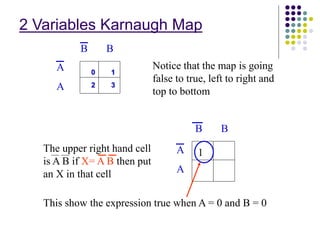
A
A
B B
Notice that the map is going
false to true, left to right and
top to bottom
The upper right hand cell
is A B if X= A B then put
an X in that cell
A
A
B B
1
This show the expression true when A = 0 and B = 0
0 1
2 3
2 Variables Karnaugh Map
If X=AB + AB then
put an X in both of
these cells
A
A
B B
1
1
From Boolean reduction we know that A B + A B = B
From the Karnaugh map we
can circle adjacent cell and
find that X = B
A
A
B B
1
1
2 Variables Karnaugh Map
3 Variables Karnaugh Map
Gray Code
00 A B
01 A B
11 A B
10 A B
0 1
C C
0 1
2 3
6 7
4 5
X = A B C + A B C + A B C + A B C
Gray Code
00 A B
01 A B
11 A B
10 A B
0 1
C C
One
simplification
could be
X = A B + A B
1 1
1 1
3 Variables Karnaugh Map (cont’d)
X = A B C + A B C + A B C + A B C
Gray Code
00 A B
01 A B
11 A B
10 A B
0 1
C C
Another
simplification
could be
X = B C + B C
A Karnaugh
Map does wrap
around
1 1
1 1
3 Variables Karnaugh Map (cont’d)
X = A B C + A B C + A B C + A B C
Gray Code
00 A B
01 A B
11 A B
10 A B
0 1
C C
The Best
simplification
would be
X = B
1 1
1 1
3 Variables Karnaugh Map (cont’d)
On a 3 Variables Karnaugh Map
• One cell requires 3 Variables
• Two adjacent cells require 2 variables
• Four adjacent cells require 1 variable
• Eight adjacent cells is a 1
4 Variables Karnaugh Map
Gray Code
00 A B
01 A B
11 A B
10 A B
0 0 0 1 1 1 1 0
C D C D C D C D
0 1 3 2
4 5 7 6
12 13 15 14
8 9 11 10
Gray Code
00 A B
01 A B
11 A B
10 A B
0 0 0 1 1 1 1 0
C D C D C D C D
1
1
1
1
1
1
X = ABD + ABC + CD
Now try it
with Boolean
reductions
Simplify :
X = A B C D + A B C D + A B C D + A B C D +
A B C D + A B C D
On a 4 Variables Karnaugh map
• One Cell requires 4 variables
• Two adjacent cells require 3 variables
• Four adjacent cells require 2 variables
• Eight adjacent cells require 1 variable
• Sixteen adjacent cells give a 1 or true
Simplify using Karnaugh map
First, we need to change the circuit to an SOP expression
Y= A + B + B C + ( A + B ) ( C + D)
Y = A B + B C + A B ( C + D )
Y = A B + B C + A B C + A B D
Y = A B + B C + A B C A B D
Y = A B + B C + (A + B + C ) ( A + B + D)
Y = A B + B C + A + A B + A D + B + B D + AC + C D
Simplify using Karnaugh map (cont’d)
comfirm back (the right answer)
SOP expression
Gray Code
00 A B
01 A B
11 A B
10 A B
00 01 11 10
C D C D C D C D
1 1
1 1
1 1 1 1
Y = 1
1 1 1 1
1 1
1 1
Simplify using Karnaugh map (cont’d)
K-Map POS Minimization
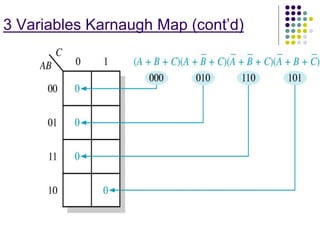
3 Variables Karnaugh Map
Gray Code
0 0
0 1
1 1
1 0
0 1
AB
C
0 1
2 3
6 7
4 5
3 Variables Karnaugh Map (cont’d)
4 Variables Karnaugh Map
0 0
0 1
1 1
1 0
0 0 0 1 1 1 1 0
A B
C D
0 1 3 2
4 5 7 6
12 13 15 14
8 9 11 10
4 Variables Karnaugh Map (cont’d)
Mapping a Standard SOP expression
 Example:
Answer:
Mapping a Standard POS expression
 Example:
Using K-Map, convert the following standard POS
expression into a minimum SOP expression
Answer:
Y = AB + AC or standard SOP :
Karnaugh Map - Example
D
C
B
A
D
C
B
A
BCD
A
CD
B
A
D
C
B
A
D
C
B
A
Y 





CD
A
D
B
Y 

ABC
C
B
A
C
B
A
Y 


)
( C
B
A
Y 

K-Map with “Don’t Care” Conditions
Input Output
Example :
3 variables with output “don’t care (X)”
K-Map with “Don’t Care” Conditions (cont’d)
4 variables with output “don’t care (X)”
“Don’t Care” Conditions
 Example:
Determine the minimal SOP using K-Map:
Answer:
D
A
C
B
CD
D
C
B
A
F 


)
,
,
,
(
14,15)
D(5,12,13,
9,10)
M(0,2,6,8,
D)
C,
B,
F(A, 

K-Map with “Don’t Care” Conditions (cont’d)
Solution : 14,15)
D(5,12,13,
9,10)
M(0,2,6,8,
D)
C,
B,
F(A, 

D
A
C
B
CD
D
C
B
A
F 


)
,
,
,
(
AB
CD
00
01
11
10
00 01 11 10
0 1 1 0
1 X 1 0
X X X X
0 0 1 0
0 1 3 2
4 5 7 6
12 13 15 14
8 9 11 10
Minimum SOP expression is
CD
AD
BC
K-map Product of Sums simplification
Example: Simplify the Boolean function F(ABCD)=(0,1,2,5,8,9,10) in
(a) S-of-p (b) P-of-s
Using the minterms (1’s)
F(ABCD)= B’D’+B’C’+A’C’D
Using the maxterms (0’s) and complimenting F
Grouping as if they were minterms, then using De
Morgen’s theorem to get F.
F’(ABCD)= BD’+CD+AB
F(ABCD)= (B’+D)(C’+D’)(A’+B’)

9402730.ppt

  • 1.
    DKT 122 /3 DIGITAL SYSTEMS 1 CHAPTER 4 : BOOLEAN ALGEBRA AND LOGIC SIMPLIFICATION m.rizal@unimap.edu.my sitizarina@unimap.edu.my
  • 2.
    4.0 BOOLEAN ALGEBRA Boolean Operations & expression  Laws & rules of Boolean algebra  DeMorgan’s Theorems  Boolean analysis of logic circuits  Simplification using Boolean Algebra  Standard forms of Boolean Expressions  Boolean Expressions & truth tables  The Karnaugh Map
  • 3.
     Karnaugh MapSOP minimization  Karnaugh Map POS minimization  5 Variable K-Map  Programmable Logic
  • 4.
    •Boolean Operations &expression  Expression :  Variable – a symbol used to represent logical quantities (1 or 0) ex : A, B,..used as variable  Complement – inverse of variable and is indicated by bar over variable ex : Ā
  • 5.
     Operation : Boolean Addition – equivalent to the OR operation  X = A + B - Boolean Multiplication – equivalent to the AND operation  X = A∙B A B X A B X
  • 6.
    Laws & rulesof Boolean algebra
  • 7.
    Commutative law ofaddition Commutative law of addition, A+B = B+A the order of ORing does not matter.
  • 8.
    Commutative law ofMultiplication Commutative law of Multiplication AB = BA the order of ANDing does not matter.
  • 9.
    Associative law ofaddition Associative law of addition A + (B + C) = (A + B) + C The grouping of ORed variables does not matter
  • 10.
    Associative law ofmultiplication Associative law of multiplication A(BC) = (AB)C The grouping of ANDed variables does not matter
  • 11.
    Distributive Law A(B +C) = AB + AC (A+B)(C+D) = AC + AD + BC + BD
  • 12.
    Boolean Rules 1) A+ 0 = A  In math if you add 0 you have changed nothing  In Boolean Algebra ORing with 0 changes nothing
  • 13.
    Boolean Rules 2) A+ 1 = 1  ORing with 1 must give a 1 since if any input is 1 an OR gate will give a 1
  • 14.
    Boolean Rules 3) A• 0 = 0  In math if 0 is multiplied with anything you get 0. If you AND anything with 0 you get 0
  • 15.
    Boolean Rules 4) A• 1 = A  ANDing anything with 1 will yield the anything
  • 16.
    Boolean Rules 5) A+ A = A  ORing with itself will give the same result
  • 17.
    Boolean Rules 6) A+ A = 1  Either A or A must be 1 so A + A =1
  • 18.
    Boolean Rules 7) A• A = A  ANDing with itself will give the same result
  • 19.
    Boolean Rules 8) A• A = 0  In digital Logic 1 =0 and 0 =1, so AA=0 since one of the inputs must be 0.
  • 20.
    Boolean Rules 9) A= A  If you not something twice you are back to the beginning
  • 21.
    Boolean Rules 10) A+ AB = A Proof: A + AB = A(1 +B) DISTRIBUTIVE LAW = A∙1 RULE 2: (1+B)=1 = A RULE 4: A∙1 = A
  • 22.
    Boolean Rules 11) A+ AB = A + B  If A is 1 the output is 1 , If A is 0 the output is B Proof: A + AB = (A + AB) + AB RULE 10 = (AA +AB) + AB RULE 7 = AA + AB + AA +AB RULE 8 = (A + A)(A + B) FACTORING = 1∙(A + B) RULE 6 = A + B RULE 4
  • 23.
    Boolean Rules 12) (A+ B)(A + C) = A + BC PROOF (A + B)(A +C) = AA + AC +AB +BC DISTRIBUTIVE LAW = A + AC + AB + BC RULE 7 = A(1 + C) +AB + BC FACTORING = A.1 + AB + BC RULE 2 = A(1 + B) + BC FACTORING = A.1 + BC RULE 2 = A + BC RULE 4
  • 24.
  • 25.
    Theorems of BooleanAlgebra 1) A + 0 = A 2) A + 1 = 1 3) A • 0 = 0 4) A • 1 = A 5) A + A = A 6) A + A = 1 7) A • A = A 8) A • A = 0
  • 26.
    Theorems of BooleanAlgebra 9) A = A 10) A + AB = A 11) A + AB = A + B 12) (A + B)(A + C) = A + BC 13) Commutative : A + B = B + A AB = BA 14) Associative : A+(B+C) =(A+B) + C A(BC) = (AB)C 15) Distributive : A(B+C) = AB +AC (A+B)(C+D)=AC + AD + BC + BD
  • 27.
    De Morgan’s Theorems 16)(X+Y) = X . Y 17) (X.Y) = X + Y • Two most important theorems of Boolean Algebra were contributed by De Morgan. • Extremely useful in simplifying expression in which product or sum of variables is inverted. • The TWO theorems are :
  • 28.
    Implications of DeMorgan’s Theorem (a) Equivalent circuit implied by theorem (16) (b) Alternative symbol for the NOR function (c) Truth table that illustrates DeMorgan’s Theorem (a) (b) Input Output X Y X+Y XY 0 0 1 1 0 1 0 0 1 0 0 0 1 1 0 0 (c)
  • 29.
    Implications of DeMorgan’s Theorem (a) Equivalent circuit implied by theorem (17) (b) Alternative symbol for the NAND function (c) Truth table that illustrates DeMorgan’s Theorem (a) (b) Input Output X Y XY X+Y 0 0 1 1 0 1 1 1 1 0 1 1 1 1 0 0 (c)
  • 30.
    De Morgan’s TheoremConversion Step 1: Change all ORs to ANDs and all ANDs to Ors Step 2: Complement each individual variable (short overbar) Step 3: Complement the entire function (long overbars) Step 4: Eliminate all groups of double overbars Example : A . B A .B. C = A + B = A + B + C = A + B = A + B + C = A + B = A + B + C = A + B
  • 31.
    ABC + ABC(A + B +C)D = (A+B+C).(A+B+C) = (A.B.C)+D = (A+B+C).(A+B+C) = (A.B.C)+D = (A+B+C).(A+B+C) = (A.B.C)+D = (A+B+C).(A+B+C) = (A.B.C)+D De Morgan’s Theorem Conversion
  • 32.
    Examples: Analyze thecircuit below Y 1. Y=??? 2. Simplify the Boolean expression found in 1
  • 33.
     Follow thesteps list below (constructing truth table)  List all the input variable combinations of 1 and 0 in binary sequentially  Place the output logic for each combination of input  Base on the result found write out the boolean expression.
  • 34.
    Standard Forms ofBoolean Expressions Sum of Products (SOP) Products of Sum (POS) Notes:  SOP and POS expression cannot have more than one variable combined in a term with an inversion bar  There’s no parentheses in the expression
  • 35.
    Standard Forms ofBoolean Expressions Converting SOP to Truth Table  Examine each of the products to determine where the product is equal to a 1.  Set the remaining row outputs to 0.
  • 36.
    Standard Forms ofBoolean Expressions Converting POS to Truth Table  Opposite process from the SOP expressions.  Each sum term results in a 0.  Set the remaining row outputs to 1.
  • 37.
    Standard Forms ofBoolean Expressions BC A C AB C B A C B A f    ) , , ( 6 3 2 ) , , ( m m m C B A f    ) 6 , 3 , 2 ( ) , , ( m C B A f   The standard SOP Expression  All variables appear in each product term.  Each of the product term in the expression is called as minterm.  Example:  In compact form, f(A,B,C) may be written as
  • 38.
    Standard Forms ofBoolean Expressions ) ( ) ( ) ( ) , , ( C B A C B A C B A C B A f          The standard POS Expression  All variables appear in each product term.  Each of the product term in the expression is called as maxterm.  Example: 5 4 1 ) , , ( M M M C B A f   In compact form, f(A,B,C) may be written as ) 5 , 4 , 1 ( ) , , ( M C B A f  
  • 39.
    Standard Forms ofBoolean Expressions ) ( ) ( ) ( ) ( ) , , ( C B A C B A C B A C B A C B A f             C B A C B A C AB ABC C B A f     ) , , ( Example: Convert the following SOP expression to an equivalent POS expression: Example: Develop a truth table for the expression:
  • 40.
  • 41.
    Karnaugh Map (K-Map) Karnaugh Mapping is used to minimize the number of logic gates that are required in a digital circuit.  This will replace Boolean reduction when the circuit is large.  Write the Boolean equation in a SOP form first and then place each term on a map.
  • 42.
    • The mapis made up of a table of every possible SOP using the number of variables that are being used. • If 2 variables are used then a 2X2 map is used • If 3 variables are used then a 4X2 map is used • If 4 variables are used then a 4X4 map is used • If 5 Variables are used then a 8X4 map is used Karnaugh Map (K-Map)
  • 43.
  • 44.
    A A B B Notice thatthe map is going false to true, left to right and top to bottom The upper right hand cell is A B if X= A B then put an X in that cell A A B B 1 This show the expression true when A = 0 and B = 0 0 1 2 3 2 Variables Karnaugh Map
  • 45.
    If X=AB +AB then put an X in both of these cells A A B B 1 1 From Boolean reduction we know that A B + A B = B From the Karnaugh map we can circle adjacent cell and find that X = B A A B B 1 1 2 Variables Karnaugh Map
  • 46.
    3 Variables KarnaughMap Gray Code 00 A B 01 A B 11 A B 10 A B 0 1 C C 0 1 2 3 6 7 4 5
  • 47.
    X = AB C + A B C + A B C + A B C Gray Code 00 A B 01 A B 11 A B 10 A B 0 1 C C One simplification could be X = A B + A B 1 1 1 1 3 Variables Karnaugh Map (cont’d)
  • 48.
    X = AB C + A B C + A B C + A B C Gray Code 00 A B 01 A B 11 A B 10 A B 0 1 C C Another simplification could be X = B C + B C A Karnaugh Map does wrap around 1 1 1 1 3 Variables Karnaugh Map (cont’d)
  • 49.
    X = AB C + A B C + A B C + A B C Gray Code 00 A B 01 A B 11 A B 10 A B 0 1 C C The Best simplification would be X = B 1 1 1 1 3 Variables Karnaugh Map (cont’d)
  • 50.
    On a 3Variables Karnaugh Map • One cell requires 3 Variables • Two adjacent cells require 2 variables • Four adjacent cells require 1 variable • Eight adjacent cells is a 1
  • 51.
    4 Variables KarnaughMap Gray Code 00 A B 01 A B 11 A B 10 A B 0 0 0 1 1 1 1 0 C D C D C D C D 0 1 3 2 4 5 7 6 12 13 15 14 8 9 11 10
  • 52.
    Gray Code 00 AB 01 A B 11 A B 10 A B 0 0 0 1 1 1 1 0 C D C D C D C D 1 1 1 1 1 1 X = ABD + ABC + CD Now try it with Boolean reductions Simplify : X = A B C D + A B C D + A B C D + A B C D + A B C D + A B C D
  • 53.
    On a 4Variables Karnaugh map • One Cell requires 4 variables • Two adjacent cells require 3 variables • Four adjacent cells require 2 variables • Eight adjacent cells require 1 variable • Sixteen adjacent cells give a 1 or true
  • 54.
    Simplify using Karnaughmap First, we need to change the circuit to an SOP expression
  • 55.
    Y= A +B + B C + ( A + B ) ( C + D) Y = A B + B C + A B ( C + D ) Y = A B + B C + A B C + A B D Y = A B + B C + A B C A B D Y = A B + B C + (A + B + C ) ( A + B + D) Y = A B + B C + A + A B + A D + B + B D + AC + C D Simplify using Karnaugh map (cont’d) comfirm back (the right answer) SOP expression
  • 56.
    Gray Code 00 AB 01 A B 11 A B 10 A B 00 01 11 10 C D C D C D C D 1 1 1 1 1 1 1 1 Y = 1 1 1 1 1 1 1 1 1 Simplify using Karnaugh map (cont’d)
  • 57.
  • 58.
    3 Variables KarnaughMap Gray Code 0 0 0 1 1 1 1 0 0 1 AB C 0 1 2 3 6 7 4 5
  • 59.
    3 Variables KarnaughMap (cont’d)
  • 60.
    4 Variables KarnaughMap 0 0 0 1 1 1 1 0 0 0 0 1 1 1 1 0 A B C D 0 1 3 2 4 5 7 6 12 13 15 14 8 9 11 10
  • 61.
    4 Variables KarnaughMap (cont’d)
  • 62.
    4 Variables KarnaughMap (cont’d)
  • 63.
    Mapping a StandardSOP expression  Example: Answer: Mapping a Standard POS expression  Example: Using K-Map, convert the following standard POS expression into a minimum SOP expression Answer: Y = AB + AC or standard SOP : Karnaugh Map - Example D C B A D C B A BCD A CD B A D C B A D C B A Y       CD A D B Y   ABC C B A C B A Y    ) ( C B A Y  
  • 64.
    K-Map with “Don’tCare” Conditions Input Output Example : 3 variables with output “don’t care (X)”
  • 65.
    K-Map with “Don’tCare” Conditions (cont’d) 4 variables with output “don’t care (X)”
  • 66.
    “Don’t Care” Conditions Example: Determine the minimal SOP using K-Map: Answer: D A C B CD D C B A F    ) , , , ( 14,15) D(5,12,13, 9,10) M(0,2,6,8, D) C, B, F(A,   K-Map with “Don’t Care” Conditions (cont’d)
  • 67.
    Solution : 14,15) D(5,12,13, 9,10) M(0,2,6,8, D) C, B, F(A,  D A C B CD D C B A F    ) , , , ( AB CD 00 01 11 10 00 01 11 10 0 1 1 0 1 X 1 0 X X X X 0 0 1 0 0 1 3 2 4 5 7 6 12 13 15 14 8 9 11 10 Minimum SOP expression is CD AD BC
  • 68.
    K-map Product ofSums simplification Example: Simplify the Boolean function F(ABCD)=(0,1,2,5,8,9,10) in (a) S-of-p (b) P-of-s Using the minterms (1’s) F(ABCD)= B’D’+B’C’+A’C’D Using the maxterms (0’s) and complimenting F Grouping as if they were minterms, then using De Morgen’s theorem to get F. F’(ABCD)= BD’+CD+AB F(ABCD)= (B’+D)(C’+D’)(A’+B’)