Inside:
                      How to achieve
                      Digital Literacy
                      within your
                      organisation


scalability


© Digital Chameleon
Digital Marketing Ascendancy
    Over the course of this decade, digital marketing will assume
    a dominant role in most marketing strategy formulation.
    After playing an ever-growing supporting role to legacy
    offline media and marketing channels, digital will take point
    position as the centre of the spokes for all brand messaging.
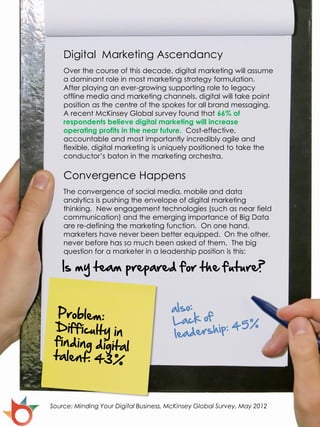
    A recent McKinsey Global survey found that 66% of
    respondents believe digital marketing will increase
    operating profits in the near future. Cost-effective,
    accountable and most importantly incredibly agile and
    flexible, digital marketing is uniquely positioned to take the
    conductor’s baton in the marketing orchestra.

    Convergence Happens
    The convergence of social media, mobile and data
    analytics is pushing the envelope of digital marketing
    thinking. New engagement technologies (such as near field
    communication) and the emerging importance of Big Data
    are re-defining the marketing function. On one hand,
    marketers have never been better equipped. On the other,
    never before has so much been asked of them. The big
    question for a marketer in a leadership position is this:

   Is my team prepared for the future?


Source: Minding Your Digital Business, McKinsey Global Survey, May 2012
Mind the Gap….
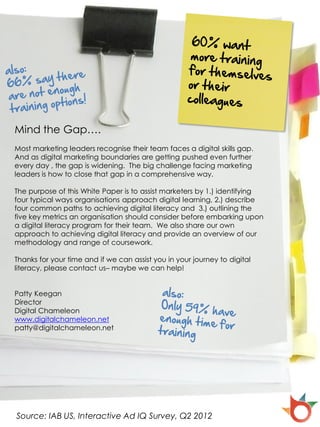
Most marketing leaders recognise their team faces a digital skills gap.
And as digital marketing boundaries are getting pushed even further
every day , the gap is widening. The big challenge facing marketing
leaders is how to close that gap in a comprehensive way.

The purpose of this White Paper is to assist marketers by 1.) identifying
four typical ways organisations approach digital learning, 2.) describe
four common paths to achieving digital literacy and 3.) outlining the
five key metrics an organisation should consider before embarking upon
a digital literacy program for their team. We also share our own
approach to achieving digital literacy and provide an overview of our
methodology and range of coursework.

Thanks for your time and if we can assist you in your journey to digital
literacy, please contact us– maybe we can help!


Patty Keegan
Director
Digital Chameleon
www.digitalchameleon.net
patty@digitalchameleon.net


Source: IAB US, Interactive Ad IQ Survey, Q2 2012
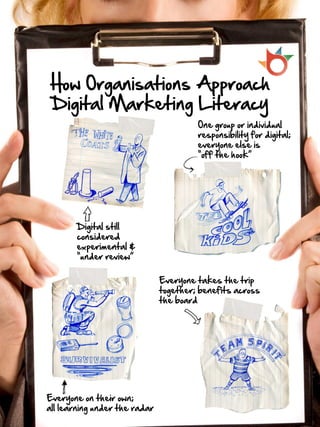
How Organisations Approach
Digital Marketing Literacy
                                        One group or individual
                                        responsibility for digital;
                                        everyone else is
                                        “off the hook”


       Digital still
       considered
       experimental &
       “under review”

                               Everyone takes the trip
                               together; benefits across
                               the board


Everyone on their own;
all learning under the radar
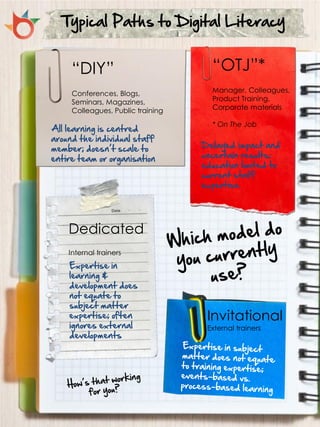
Typical Paths to Digital Literacy


     “DIY”                           “OTJ”*
     Conferences, Blogs,             Manager, Colleagues,
     Seminars, Magazines,            Product Training,
     Colleagues, Public training     Corporate materials

                                     * On The Job
All learning is centred
around the individual staff
member; doesn’t scale to           Delayed impact and
entire team or organisation        uncertain results;
                                   education limited to
                                   current staff
                                   expertise


    Dedicated
    Internal trainers
    Expertise in
    learning &
    development does
    not equate to
    subject matter
    expertise; often                Invitational
    ignores external                External trainers
    developments
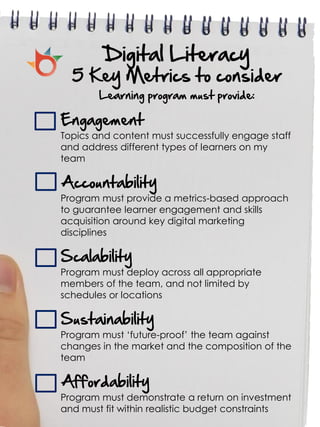
Digital Literacy
  5 Key Metrics to consider
        Learning program must provide:

Engagement
Topics and content must successfully engage staff
and address different types of learners on my
team

Accountability
Program must provide a metrics-based approach
to guarantee learner engagement and skills
acquisition around key digital marketing
disciplines

Scalability
Program must deploy across all appropriate
members of the team, and not limited by
schedules or locations

Sustainability
Program must ‘future-proof’ the team against
changes in the market and the composition of the
team

Affordability
Program must demonstrate a return on investment
and must fit within realistic budget constraints
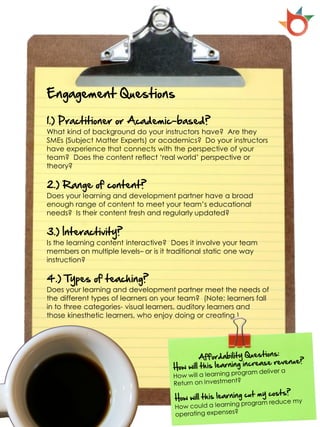
Engagement Questions

1.) Practitioner or Academic-based?
What kind of background do your instructors have? Are they
SMEs (Subject Matter Experts) or academics? Do your instructors
have experience that connects with the perspective of your
team? Does the content reflect ‘real world’ perspective or
theory?

2.) Range of content?
Does your learning and development partner have a broad
enough range of content to meet your team’s educational
needs? Is their content fresh and regularly updated?

3.) Interactivity?
Is the learning content interactive? Does it involve your team
members on multiple levels– or is it traditional static one way
instruction?

4.) Types of teaching?
Does your learning and development partner meet the needs of
the different types of learners on your team? (Note: learners fall
in to three categories- visual learners, auditory learners and
those kinesthetic learners, who enjoy doing or creating.)
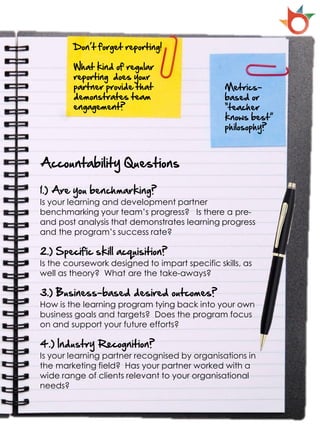
Don’t forget reporting!

        What kind of regular
        reporting does your
        partner provide that                    Metrics-
        demonstrates team                       based or
        engagement?                             “teacher
                                                knows best”
                                                philosophy?


Accountability Questions

1.) Are you benchmarking?
Is your learning and development partner
benchmarking your team’s progress? Is there a pre-
and post analysis that demonstrates learning progress
and the program’s success rate?

2.) Specific skill acquisition?
Is the coursework designed to impart specific skills, as
well as theory? What are the take-aways?

3.) Business-based desired outcomes?
How is the learning program tying back into your own
business goals and targets? Does the program focus
on and support your future efforts?

4.) Industry Recognition?
Is your learning partner recognised by organisations in
the marketing field? Has your partner worked with a
wide range of clients relevant to your organisational
needs?
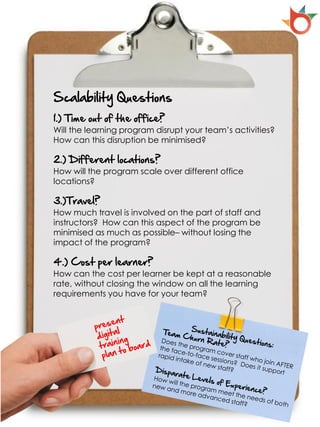
Scalability Questions
1.) Time out of the office?
Will the learning program disrupt your team’s activities?
How can this disruption be minimised?

2.) Different locations?
How will the program scale over different office
locations?

3.)Travel?
How much travel is involved on the part of staff and
instructors? How can this aspect of the program be
minimised as much as possible– without losing the
impact of the program?

4.) Cost per learner?
How can the cost per learner be kept at a reasonable
rate, without closing the window on all the learning
requirements you have for your team?
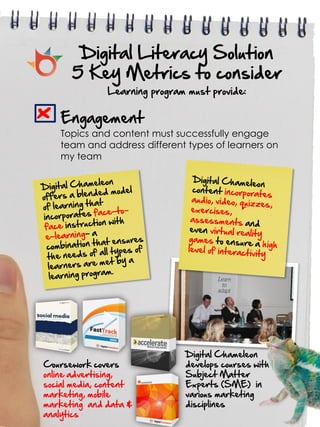
Digital Literacy Solution
      5 Key Metrics to consider
               Learning program must provide:

x   Engagement
    Topics and content must successfully engage
    team and address different types of learners on
    my team


                               Digital Chameleon
Coursework covers              develops courses with
online advertising,            Subject Matter
social media, content          Experts (SME) in
marketing, mobile              various marketing
marketing and data &           disciplines
analytics
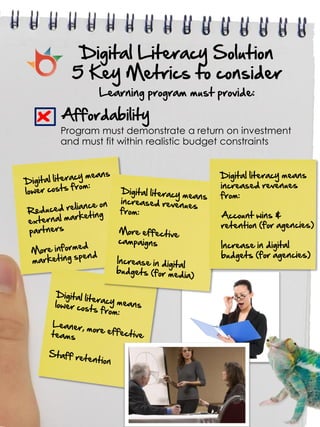
Digital Literacy Solution
      5 Key Metrics to consider
            Learning program must provide:

x   Affordability
    Program must demonstrate a return on investment
    and must fit within realistic budget constraints
Digital Literacy Solution
      5 Key Metrics to consider
           Learning program must provide:

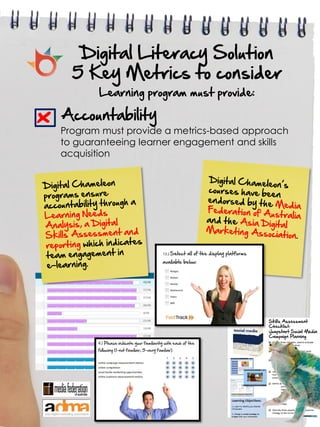
x   Accountability
    Program must provide a metrics-based approach
    to guaranteeing learner engagement and skills
    acquisition
Digital Literacy Solution
      5 Key Metrics to consider
            Learning program must provide:

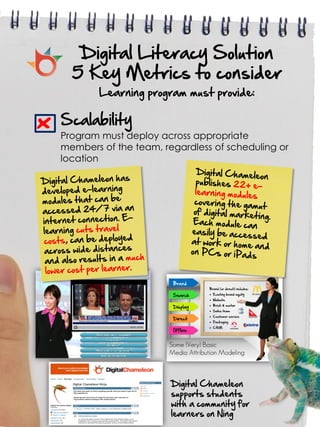
x   Scalability
    Program must deploy across appropriate
    members of the team, regardless of scheduling or
    location


                           Digital Chameleon
                           supports students
                           with a community for
                           learners on Ning
Digital Literacy Solution
      5 Key Metrics to consider
           Learning program must provide:

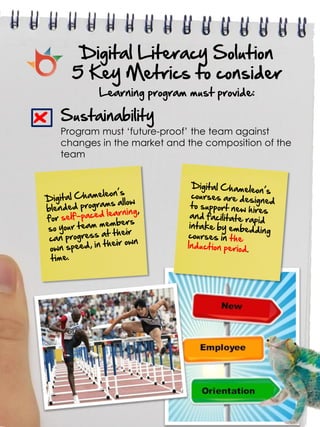
x   Sustainability
    Program must ‘future-proof’ the team against
    changes in the market and the composition of the
    team
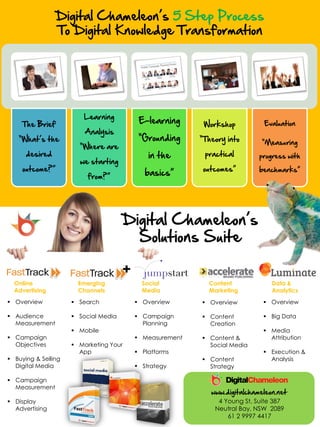
Digital Chameleon’s 5 Step Process
                 To Digital Knowledge Transformation


                        Learning
     The Brief                             E-learning      Workshop          Evaluation
                         Analysis
   “What’s the                             “Grounding     “Theory into       “Measuring
                       “Where are
      desired                                 in the       practical        progress with
                       we starting
     outcome?”                                             outcomes”        benchmarks”
                          from?”             basics”


                                      Digital Chameleon’s
                                        Solutions Suite


  Online               Emerging
                                      +     Social          Content             Data &
  Advertising          Channels             Media           Marketing           Analytics
 Overview            Search              Overview       Overview          Overview

 Audience            Social Media        Campaign       Content           Big Data
  Measurement                               Planning        Creation
                      Mobile                                                 Media
 Campaign                                 Measurement    Content &          Attribution
  Objectives          Marketing Your                       Social Media
                       App                 Platforms                         Execution &
 Buying & Selling                                         Content            Analysis
  Digital Media                            Strategy        Strategy

 Campaign
  Measurement
                                                             www.digitalchameleon.net
 Display                                                      4 Young St, Suite 387
  Advertising                                                 Neutral Bay, NSW 2089
                                                                  61 2 9997 4417

Digital Transformation Guide

  • 1.
    Inside: How to achieve Digital Literacy within your organisation scalability © Digital Chameleon
  • 2.
    Digital Marketing Ascendancy Over the course of this decade, digital marketing will assume a dominant role in most marketing strategy formulation. After playing an ever-growing supporting role to legacy offline media and marketing channels, digital will take point position as the centre of the spokes for all brand messaging. A recent McKinsey Global survey found that 66% of respondents believe digital marketing will increase operating profits in the near future. Cost-effective, accountable and most importantly incredibly agile and flexible, digital marketing is uniquely positioned to take the conductor’s baton in the marketing orchestra. Convergence Happens The convergence of social media, mobile and data analytics is pushing the envelope of digital marketing thinking. New engagement technologies (such as near field communication) and the emerging importance of Big Data are re-defining the marketing function. On one hand, marketers have never been better equipped. On the other, never before has so much been asked of them. The big question for a marketer in a leadership position is this: Is my team prepared for the future? Source: Minding Your Digital Business, McKinsey Global Survey, May 2012
  • 3.
    Mind the Gap…. Mostmarketing leaders recognise their team faces a digital skills gap. And as digital marketing boundaries are getting pushed even further every day , the gap is widening. The big challenge facing marketing leaders is how to close that gap in a comprehensive way. The purpose of this White Paper is to assist marketers by 1.) identifying four typical ways organisations approach digital learning, 2.) describe four common paths to achieving digital literacy and 3.) outlining the five key metrics an organisation should consider before embarking upon a digital literacy program for their team. We also share our own approach to achieving digital literacy and provide an overview of our methodology and range of coursework. Thanks for your time and if we can assist you in your journey to digital literacy, please contact us– maybe we can help! Patty Keegan Director Digital Chameleon www.digitalchameleon.net patty@digitalchameleon.net Source: IAB US, Interactive Ad IQ Survey, Q2 2012
  • 4.
    How Organisations Approach DigitalMarketing Literacy One group or individual responsibility for digital; everyone else is “off the hook” Digital still considered experimental & “under review” Everyone takes the trip together; benefits across the board Everyone on their own; all learning under the radar
  • 5.
    Typical Paths toDigital Literacy “DIY” “OTJ”* Conferences, Blogs, Manager, Colleagues, Seminars, Magazines, Product Training, Colleagues, Public training Corporate materials * On The Job All learning is centred around the individual staff member; doesn’t scale to Delayed impact and entire team or organisation uncertain results; education limited to current staff expertise Dedicated Internal trainers Expertise in learning & development does not equate to subject matter expertise; often Invitational ignores external External trainers developments
  • 6.
    Digital Literacy 5 Key Metrics to consider Learning program must provide: Engagement Topics and content must successfully engage staff and address different types of learners on my team Accountability Program must provide a metrics-based approach to guarantee learner engagement and skills acquisition around key digital marketing disciplines Scalability Program must deploy across all appropriate members of the team, and not limited by schedules or locations Sustainability Program must ‘future-proof’ the team against changes in the market and the composition of the team Affordability Program must demonstrate a return on investment and must fit within realistic budget constraints
  • 7.
    Engagement Questions 1.) Practitioneror Academic-based? What kind of background do your instructors have? Are they SMEs (Subject Matter Experts) or academics? Do your instructors have experience that connects with the perspective of your team? Does the content reflect ‘real world’ perspective or theory? 2.) Range of content? Does your learning and development partner have a broad enough range of content to meet your team’s educational needs? Is their content fresh and regularly updated? 3.) Interactivity? Is the learning content interactive? Does it involve your team members on multiple levels– or is it traditional static one way instruction? 4.) Types of teaching? Does your learning and development partner meet the needs of the different types of learners on your team? (Note: learners fall in to three categories- visual learners, auditory learners and those kinesthetic learners, who enjoy doing or creating.)
  • 8.
    Don’t forget reporting! What kind of regular reporting does your partner provide that Metrics- demonstrates team based or engagement? “teacher knows best” philosophy? Accountability Questions 1.) Are you benchmarking? Is your learning and development partner benchmarking your team’s progress? Is there a pre- and post analysis that demonstrates learning progress and the program’s success rate? 2.) Specific skill acquisition? Is the coursework designed to impart specific skills, as well as theory? What are the take-aways? 3.) Business-based desired outcomes? How is the learning program tying back into your own business goals and targets? Does the program focus on and support your future efforts? 4.) Industry Recognition? Is your learning partner recognised by organisations in the marketing field? Has your partner worked with a wide range of clients relevant to your organisational needs?
  • 9.
    Scalability Questions 1.) Timeout of the office? Will the learning program disrupt your team’s activities? How can this disruption be minimised? 2.) Different locations? How will the program scale over different office locations? 3.)Travel? How much travel is involved on the part of staff and instructors? How can this aspect of the program be minimised as much as possible– without losing the impact of the program? 4.) Cost per learner? How can the cost per learner be kept at a reasonable rate, without closing the window on all the learning requirements you have for your team?
  • 10.
    Digital Literacy Solution 5 Key Metrics to consider Learning program must provide: x Engagement Topics and content must successfully engage team and address different types of learners on my team Digital Chameleon Coursework covers develops courses with online advertising, Subject Matter social media, content Experts (SME) in marketing, mobile various marketing marketing and data & disciplines analytics
  • 11.
    Digital Literacy Solution 5 Key Metrics to consider Learning program must provide: x Affordability Program must demonstrate a return on investment and must fit within realistic budget constraints
  • 12.
    Digital Literacy Solution 5 Key Metrics to consider Learning program must provide: x Accountability Program must provide a metrics-based approach to guaranteeing learner engagement and skills acquisition
  • 13.
    Digital Literacy Solution 5 Key Metrics to consider Learning program must provide: x Scalability Program must deploy across appropriate members of the team, regardless of scheduling or location Digital Chameleon supports students with a community for learners on Ning
  • 14.
    Digital Literacy Solution 5 Key Metrics to consider Learning program must provide: x Sustainability Program must ‘future-proof’ the team against changes in the market and the composition of the team
  • 15.
    Digital Chameleon’s 5Step Process To Digital Knowledge Transformation Learning The Brief E-learning Workshop Evaluation Analysis “What’s the “Grounding “Theory into “Measuring “Where are desired in the practical progress with we starting outcome?” outcomes” benchmarks” from?” basics” Digital Chameleon’s Solutions Suite Online Emerging + Social Content Data & Advertising Channels Media Marketing Analytics  Overview  Search  Overview  Overview  Overview  Audience  Social Media  Campaign  Content  Big Data Measurement Planning Creation  Mobile  Media  Campaign  Measurement  Content & Attribution Objectives  Marketing Your Social Media App  Platforms  Execution &  Buying & Selling  Content Analysis Digital Media  Strategy Strategy  Campaign Measurement www.digitalchameleon.net  Display 4 Young St, Suite 387 Advertising Neutral Bay, NSW 2089 61 2 9997 4417