

Digital Transformation –
a paradigme shift
Microsoft Partner Day
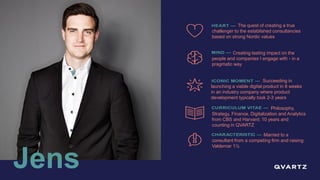
Jens
Philosophy,
Strategy, Finance, Digitalization and Analytics
from CBS and Harvard; 10 years and
counting in QVARTZ
Married to a
consultant from a competing firm and raising
Valdemar 1½
Succeeding in
launching a viable digital product in 8 weeks
in an industry company where product
development typically took 2-3 years
Creating lasting impact on the
people and companies I engage with - in a
pragmatic way
The quest of creating a true
challenger to the established consultancies
based on strong Nordic values
3
The agenda for the next hour….
• Digital transformation and what it means
• Learnings on digital transformation in Danish companies
• What to do differently
4
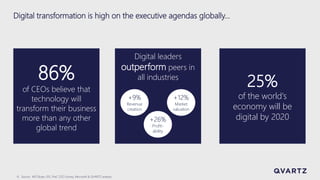
Digital transformation is high on the executive agendas globally…
86%
of CEOs believe that
technology will
transform their business
more than any other
global trend
Digital leaders
outperform peers in
all industries
+9%
Revenue
creation
+26%
Profit-
ability
+12%
Market
valuation
Source: MIT/Sloan; IDC; PwC CEO Survey; Microsoft & QVARTZ analysis
25%
of the world's
economy will be
digital by 2020
5
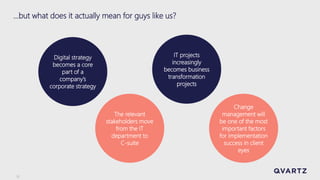
…but what does it actually mean for guys like us?
The relevant
stakeholders move
from the IT
department to
C-suite
Digital strategy
becomes a core
part of a
company’s
corporate strategy
IT projects
increasingly
becomes business
transformation
projects
Change
management will
be one of the most
important factors
for implementation
success in client
eyes
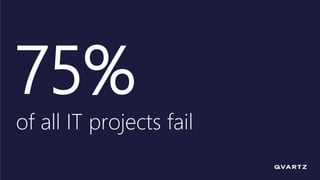
75%
of all IT projects fail
7
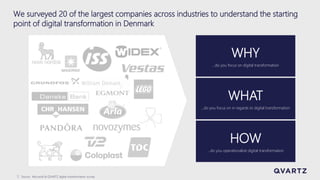
We surveyed 20 of the largest companies across industries to understand the starting
point of digital transformation in Denmark
WHY
…do you focus on digital transformation
WHAT
…do you focus on in regards to digital transformation
HOW
…do you operationalize digital transformation
Source: Microsoft & QVARTZ digital transformation survey
8
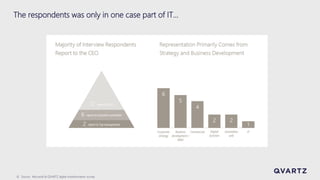
The respondents was only in one case part of IT…
Source: Microsoft & QVARTZ digital transformation survey
9
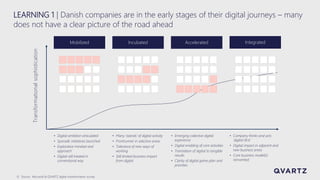
LEARNING 1 | Danish companies are in the early stages of their digital journeys – many
does not have a clear picture of the road ahead
Mobilized Incubated Accelerated Integrated
Transformationalsophistication
• Digital ambition articulated
• Sporadic initiatives launched
• Explorative mindset and
approach
• Digital still treated in
conventional way
• Many ‘islands’ of digital activity
• Frontrunner in selective areas
• Tolerance of new ways of
working
• Still limited business impact
from digital
• Emerging collective digital
experience
• Digital enabling of core activities
• Translation of digital to tangible
results
• Clarity of digital game plan and
priorities
• Company thinks and acts
‘digital-first’
• Digital impact in adjacent and
new business areas
• Core business model(s)
reinvented
Source: Microsoft & QVARTZ digital transformation survey
10
Very low
degree
Very high
degree
Very low
degree
Very high
degree
Very low
degree
Very high
degree
Very low
degree
Very high
degree
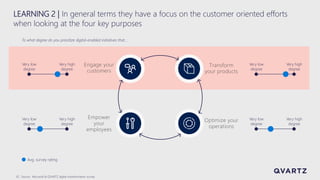
To what degree do you prioritize digital-enabled initiatives that…
Avg. survey rating
Source: Microsoft & QVARTZ digital transformation survey
LEARNING 2 | In general terms they have a focus on the customer oriented efforts
when looking at the four key purposes
11
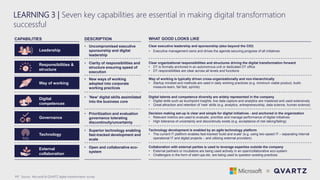
LEARNING 3 | Seven key capabilities are essential in making digital transformation
successful
• Uncompromised executive
sponsorship and digital
leadership
• Clarity of responsibilities and
structure ensuring speed of
execution
• Prioritization and evaluation
governance tolerating
discontinuity/uncertainty
• Superior technology enabling
fast-tracked development and
scale
• Open and collaborative eco-
system
DESCRIPTION WHAT GOOD LOOKS LIKE
Clear executive leadership and sponsorship (also beyond the CIO)
• Executive management owns and drives the agenda securing progress of all initiatives
Clear organizational responsibilities and structures driving the digital transformation forward
• DT is formally anchored in an autonomous unit or dedicated DT office
• DT responsibilities are clear across all levels and functions
Decision making set-up is clear and simple for digital initiatives - and anchored in the organization
• Relevant metrics are used to evaluate, prioritize and manage performance of digital initiatives
• High tolerance of uncertainty and discontinuity exists (e.g. acceptance of risk-taking/failing)
Technology development is enabled by an agile technology platform
• The current IT platform enables fast-tracked 'build and scale' (e.g. using two-speed IT – separating internal
operational IT and digital projects – and utilizing external providers)
Collaboration with external parties is used to leverage expertise outside the company
• External partners or incubators are being used actively in an open/collaborative eco-system
• Challengers in the form of start-ups etc. are being used to question existing practices
Leadership
Responsibilities &
structure
Governance
Technology
External
collaboration
CAPABILITIES
• New ways of working
adopted into corporate
working practices
Way of working is typically driven cross-organizationally and non-hierarchically
• Startup mindset and methods are used in daily working practices (e.g. minimum viable product, build-
measure-learn, fail fast, sprints)
Way of working
• 'New' digital skills assimilated
into the business core
Digital talents and competence diversity are widely represented in the company
• Digital skills such as touchpoint insights, live data capture and analytics are mastered and used extensively
• Great attraction and retention of 'new' skills (e.g. analytics, entrepreneurship, data science, human science)
Digital
competences
Source: Microsoft & QVARTZ digital transformation survey
12
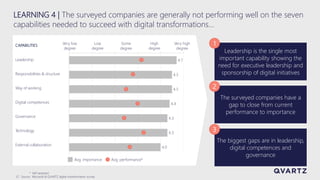
Leadership is the single most
important capability showing the
need for executive leadership and
sponsorship of digital initiatives
1
The surveyed companies have a
gap to close from current
performance to importance
2
LEARNING 4 | The surveyed companies are generally not performing well on the seven
capabilities needed to succeed with digital transformations…
Very high
degree
High
degree
Some
degree
Low
degree
Very low
degree
Avg. importance Avg. performance*
CAPABILITIES
Leadership
Responsibilities & structure
Digital competences
Technology
Governance
Way of working
External collaboration
The biggest gaps are in leadership,
digital competences and
governance
3
* Self-assessed
Source: Microsoft & QVARTZ digital transformation survey
13
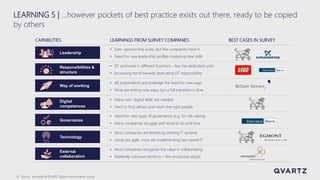
CAPABILITIES LEARNINGS FROM SURVEY COMPANIES
• Exec. sponsorship is key, but few companies have it
• Need for new leadership profiles mastering new skills
• DT anchored in different functions - few has dedicated units
• Increasing trend towards dedicating DT responsibility
• Many new 'digital skills' are needed
• Hard to find, attract and retain the right people
• All respondents acknowledge the need for new ways
• Most are testing new ways, but a full transition is slow
• Need for new types of governance (e.g. for risk-taking)
• Many companies struggle with what to do and how
• Most companies are limited by existing IT systems
• Some are agile, most are implementing two-speed IT
• Most companies recognize the value in collaborating
• Relatively unknown territory – few structured setups
BEST CASES IN SURVEY
Source: Microsoft & QVARTZ digital transformation survey
LEARNING 5 | …however pockets of best practice exists out there, ready to be copied
by others
Leadership
Responsibilities &
structure
Governance
Technology
External
collaboration
Way of working
Digital
competences
14
Interested in more?
The report is online at
www.qvartz.com
15
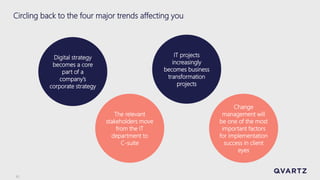
Circling back to the four major trends affecting you
The relevant
stakeholders move
from the IT
department to
C-suite
Digital strategy
becomes a core
part of a
company’s
corporate strategy
IT projects
increasingly
becomes business
transformation
projects
Change
management will
be one of the most
important factors
for implementation
success in client
eyes
16
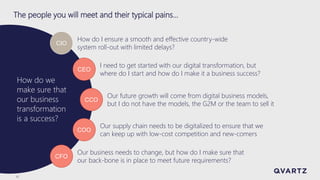
The people you will meet and their typical pains…
How do we
make sure that
our business
transformation
is a success?
CIO
How do I ensure a smooth and effective country-wide
system roll-out with limited delays?
CEO
I need to get started with our digital transformation, but
where do I start and how do I make it a business success?
CFO
Our business needs to change, but how do I make sure that
our back-bone is in place to meet future requirements?
CCO
Our future growth will come from digital business models,
but I do not have the models, the G2M or the team to sell it
COO
Our supply chain needs to be digitalized to ensure that we
can keep up with low-cost competition and new-comers
17
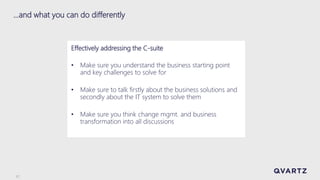
…and what you can do differently
Effectively addressing the C-suite
• Make sure you understand the business starting point
and key challenges to solve for
• Make sure to talk firstly about the business solutions and
secondly about the IT system to solve them
• Make sure you think change mgmt. and business
transformation into all discussions
18
- Thank You -

Digital transformation: Envision the future

  • 1.
    Digital Transformation – aparadigme shift Microsoft Partner Day
  • 2.
    Jens Philosophy, Strategy, Finance, Digitalizationand Analytics from CBS and Harvard; 10 years and counting in QVARTZ Married to a consultant from a competing firm and raising Valdemar 1½ Succeeding in launching a viable digital product in 8 weeks in an industry company where product development typically took 2-3 years Creating lasting impact on the people and companies I engage with - in a pragmatic way The quest of creating a true challenger to the established consultancies based on strong Nordic values
  • 3.
    3 The agenda forthe next hour…. • Digital transformation and what it means • Learnings on digital transformation in Danish companies • What to do differently
  • 4.
    4 Digital transformation ishigh on the executive agendas globally… 86% of CEOs believe that technology will transform their business more than any other global trend Digital leaders outperform peers in all industries +9% Revenue creation +26% Profit- ability +12% Market valuation Source: MIT/Sloan; IDC; PwC CEO Survey; Microsoft & QVARTZ analysis 25% of the world's economy will be digital by 2020
  • 5.
    5 …but what doesit actually mean for guys like us? The relevant stakeholders move from the IT department to C-suite Digital strategy becomes a core part of a company’s corporate strategy IT projects increasingly becomes business transformation projects Change management will be one of the most important factors for implementation success in client eyes
  • 6.
    75% of all ITprojects fail
  • 7.
    7 We surveyed 20of the largest companies across industries to understand the starting point of digital transformation in Denmark WHY …do you focus on digital transformation WHAT …do you focus on in regards to digital transformation HOW …do you operationalize digital transformation Source: Microsoft & QVARTZ digital transformation survey
  • 8.
    8 The respondents wasonly in one case part of IT… Source: Microsoft & QVARTZ digital transformation survey
  • 9.
    9 LEARNING 1 |Danish companies are in the early stages of their digital journeys – many does not have a clear picture of the road ahead Mobilized Incubated Accelerated Integrated Transformationalsophistication • Digital ambition articulated • Sporadic initiatives launched • Explorative mindset and approach • Digital still treated in conventional way • Many ‘islands’ of digital activity • Frontrunner in selective areas • Tolerance of new ways of working • Still limited business impact from digital • Emerging collective digital experience • Digital enabling of core activities • Translation of digital to tangible results • Clarity of digital game plan and priorities • Company thinks and acts ‘digital-first’ • Digital impact in adjacent and new business areas • Core business model(s) reinvented Source: Microsoft & QVARTZ digital transformation survey
  • 10.
    10 Very low degree Very high degree Verylow degree Very high degree Very low degree Very high degree Very low degree Very high degree To what degree do you prioritize digital-enabled initiatives that… Avg. survey rating Source: Microsoft & QVARTZ digital transformation survey LEARNING 2 | In general terms they have a focus on the customer oriented efforts when looking at the four key purposes
  • 11.
    11 LEARNING 3 |Seven key capabilities are essential in making digital transformation successful • Uncompromised executive sponsorship and digital leadership • Clarity of responsibilities and structure ensuring speed of execution • Prioritization and evaluation governance tolerating discontinuity/uncertainty • Superior technology enabling fast-tracked development and scale • Open and collaborative eco- system DESCRIPTION WHAT GOOD LOOKS LIKE Clear executive leadership and sponsorship (also beyond the CIO) • Executive management owns and drives the agenda securing progress of all initiatives Clear organizational responsibilities and structures driving the digital transformation forward • DT is formally anchored in an autonomous unit or dedicated DT office • DT responsibilities are clear across all levels and functions Decision making set-up is clear and simple for digital initiatives - and anchored in the organization • Relevant metrics are used to evaluate, prioritize and manage performance of digital initiatives • High tolerance of uncertainty and discontinuity exists (e.g. acceptance of risk-taking/failing) Technology development is enabled by an agile technology platform • The current IT platform enables fast-tracked 'build and scale' (e.g. using two-speed IT – separating internal operational IT and digital projects – and utilizing external providers) Collaboration with external parties is used to leverage expertise outside the company • External partners or incubators are being used actively in an open/collaborative eco-system • Challengers in the form of start-ups etc. are being used to question existing practices Leadership Responsibilities & structure Governance Technology External collaboration CAPABILITIES • New ways of working adopted into corporate working practices Way of working is typically driven cross-organizationally and non-hierarchically • Startup mindset and methods are used in daily working practices (e.g. minimum viable product, build- measure-learn, fail fast, sprints) Way of working • 'New' digital skills assimilated into the business core Digital talents and competence diversity are widely represented in the company • Digital skills such as touchpoint insights, live data capture and analytics are mastered and used extensively • Great attraction and retention of 'new' skills (e.g. analytics, entrepreneurship, data science, human science) Digital competences Source: Microsoft & QVARTZ digital transformation survey
  • 12.
    12 Leadership is thesingle most important capability showing the need for executive leadership and sponsorship of digital initiatives 1 The surveyed companies have a gap to close from current performance to importance 2 LEARNING 4 | The surveyed companies are generally not performing well on the seven capabilities needed to succeed with digital transformations… Very high degree High degree Some degree Low degree Very low degree Avg. importance Avg. performance* CAPABILITIES Leadership Responsibilities & structure Digital competences Technology Governance Way of working External collaboration The biggest gaps are in leadership, digital competences and governance 3 * Self-assessed Source: Microsoft & QVARTZ digital transformation survey
  • 13.
    13 CAPABILITIES LEARNINGS FROMSURVEY COMPANIES • Exec. sponsorship is key, but few companies have it • Need for new leadership profiles mastering new skills • DT anchored in different functions - few has dedicated units • Increasing trend towards dedicating DT responsibility • Many new 'digital skills' are needed • Hard to find, attract and retain the right people • All respondents acknowledge the need for new ways • Most are testing new ways, but a full transition is slow • Need for new types of governance (e.g. for risk-taking) • Many companies struggle with what to do and how • Most companies are limited by existing IT systems • Some are agile, most are implementing two-speed IT • Most companies recognize the value in collaborating • Relatively unknown territory – few structured setups BEST CASES IN SURVEY Source: Microsoft & QVARTZ digital transformation survey LEARNING 5 | …however pockets of best practice exists out there, ready to be copied by others Leadership Responsibilities & structure Governance Technology External collaboration Way of working Digital competences
  • 14.
    14 Interested in more? Thereport is online at www.qvartz.com
  • 15.
    15 Circling back tothe four major trends affecting you The relevant stakeholders move from the IT department to C-suite Digital strategy becomes a core part of a company’s corporate strategy IT projects increasingly becomes business transformation projects Change management will be one of the most important factors for implementation success in client eyes
  • 16.
    16 The people youwill meet and their typical pains… How do we make sure that our business transformation is a success? CIO How do I ensure a smooth and effective country-wide system roll-out with limited delays? CEO I need to get started with our digital transformation, but where do I start and how do I make it a business success? CFO Our business needs to change, but how do I make sure that our back-bone is in place to meet future requirements? CCO Our future growth will come from digital business models, but I do not have the models, the G2M or the team to sell it COO Our supply chain needs to be digitalized to ensure that we can keep up with low-cost competition and new-comers
  • 17.
    17 …and what youcan do differently Effectively addressing the C-suite • Make sure you understand the business starting point and key challenges to solve for • Make sure to talk firstly about the business solutions and secondly about the IT system to solve them • Make sure you think change mgmt. and business transformation into all discussions
  • 18.