Michael Nantais (nantaism@brandonu.ca)
EDUC 7050: CRITICAL THEORIZING ABOUT EDUCATION
internet?
            “computer” skills
Indeed, the term ICT more accurately refers to an updating of the
conventional ‘information technology’ to encompass the rapid
convergence of technologies such as computers, telecommunications and
broadcasting technologies, as well as stressing the communicative and
networking capacity of modern-day information technologies. Thus, the
term ICT is best seen as an umbrella term for a range of technological
applications such as computer hardware and software, digital broadcast
technologies, telecommunications technologies such as mobile phones,
as well as electronic information resources such as the world wide web
and CDRoms.

Thus, it is clear that beneath the umbrella term of ICT we are concerned
with a heterogeneous range of technologies, types of information
and resources.

(Selwyn, 2004, pp. 346-347)
Travers & Decker (1999)


    Ignore it!

    Jump on the bandwagon!

    Be fatalistic (accept inevitability)!

    Engage it critically!
Weaver & Grindall (1998)


       Techno-maniacs

       Techno-phobes

        Critical techno-mania
“This is not simply a technological
revolution; this is a cultural revolution.”

-- Michael Wesch
Inequity
?
ICT … is rightly seen as having the potential to help
individuals, groups, and even nations … Yet, at the same
time, infusions of ICT can also amplify existing
inequalities.

The notion of a digital divide has focused the attention of
the public and policy makers on the important intersection
between technology and inequality. … By focusing on the
diverse range of resources that enable meaningful use of
technology, and seeking long-term solutions that
strengthen marginalized groups’ agency, we can best
make sure that ICT is used to further a process of social
reform, equity, and inclusion.
(Warschauer, 2008, p. 149-150)
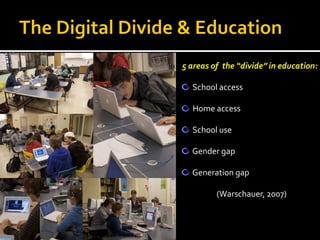
5 areas of the “divide” in education:

  School access

  Home access

  School use

  Gender gap

  Generation gap

         (Warschauer, 2007)
3 themes related to technology use in schools:

    Workability

    Complexity

    Performativity

(Warschauer, 2007)
It is neither …

                  and it is both…
What is needed?


    A “critical techno-mania”*.
           •Weaver & Grindall (1998)
Image Credits
                  Slide #                                     Source
   3: iPod, camera, computer, Wii        M. Nantais,
   3: DVD player                         http://www.flickr.com/photos/williamhook/12404848
                                         81/ (Creative Commons license)
   3: Interactive Whiteboard             http://www.flickr.com/photos/chanbliss/3423732675/
                                         (Creative Commons license)

   5: iPod screen                        M. Nantais

   6: computer lab (Boissevain School)   M. Nantais

   7: computer, cable                    Microsoft ClipArt

   8: students in lecture hall           http://www.flickr.com/photos/yilka/1829139871/
                                         (Creative Commons license)
   9 & 10: computer                      M. Nantais

   11: computer                          M. Nantais

   12: kids & computers                  http://www.flickr.com/photos/gibsonsgolfer/40568674
                                         45/ (Creative Commons license)
   13: iPod screen                       M. Nantais

   14: Access quote poster               http://www.flickr.com/photos/wrichard/3743686850/
                                         (Creative Commons license)
   1 & 17: McLuhan quote poster          http://www.flickr.com/photos/shareski/2917156969/in
                                         /pool-858082@N25 (Creative Commons license)
References
   Burgeja, M. (2007). The cost of accommodating classroom technology. Teachers College
             Record. ID Number: 14858. Retrieved on October 4, 2009 from www.tcrecord.org.

   Ching, C. C., Basham, J. D., and Jang, E. (2005). The legacy of the digital divide: Gender,
              socioeconomic status, and early exposure as predictors of full-spectrum technology
              use among young adults. Urban Education, 40(4):394–411.

   Cookson, P. (2009). What would Socrates say?. Educational Leadership. 67(1): 8-14.

   Jung, J.-Y., Linchuan Qiu, J., and Kim, Y.-C. (2001). Internet connectedness and inequality:
              Beyond the ”divide”. Communication Research. 28(4):507–535.

   Larson, N., Servage, L. and Parsons, J. ( 2007 ). The Google-ization of knowledge. Retrieved
             from the ERIC database. (ED495676)

   Rodino-Colocino, M. (2006). Laboring under the digital divide. New Media Society. 8(3):487–511.

   Selwyn, N. (2004). Reconsidering political and popular understandings of the digital divide. New
            Media Society. 6(3):341–362.

   Shelley, M., Thrane, L., Shulman, S., Lang, E., Beisser, S., Larson, T., and Mutiti, J. (2004). Digital
             citizenship: Parameters of the digital divide. Social Science Computer
             Review.22(2):256–269.
References (continued)
    Sutton, L. (2005). Blocked: Experiences of high school students conducting term paper
               research using filtered internet access. Teachers College Record. ID Number:12248.
               Retrieved on October 4, 2009 from www.tcrecord.org

    Travers, A. and Decker, E. (1999). New technology and critical pedagogy. Radical Pedagogy.
               1(2). Retrieved on November 11, 2009 from:
               http://radicalpedagogy.icaap.org/content/issue1_2/01travers1_2.html

    Warschauer, M. (2008). Whither the digital divide? In D. L. Kleinman, K. A. Cloud-Hansen, C.
            Matta, and J. Handesman (Eds.) Controversies in Science & Technology: From climate
            to chromosomes. (pp 140-151). New Rochelle, NY: Liebert.

    Warschauer, M. (2007). A teacher’s place in the digital divide. Yearbook of the National Society
            for the Study of Education Annual Yearbook 106(2), 147-166.

    Warschauer, M., Knobel, M., and Stone, L. (2004). Technology and equity in schooling:
            Deconstructing the digital divide. Educational Policy. 18(4):562–588.

    Weaver, J. and Grindall, K. (1998). Surfing and getting wired in a fifth grade classroom: critical
              pedagogical methods and techno-culture. In Kincheloe, J. and Steinberg S. (Eds.)
              Unauthorized Methods: Strategies for Critical Teaching. (pp 231-251) New York:
              Routledge.

Digital Technology in Education

  • 2.
    Michael Nantais (nantaism@brandonu.ca) EDUC7050: CRITICAL THEORIZING ABOUT EDUCATION
  • 4.
    internet? “computer” skills
  • 5.
    Indeed, the termICT more accurately refers to an updating of the conventional ‘information technology’ to encompass the rapid convergence of technologies such as computers, telecommunications and broadcasting technologies, as well as stressing the communicative and networking capacity of modern-day information technologies. Thus, the term ICT is best seen as an umbrella term for a range of technological applications such as computer hardware and software, digital broadcast technologies, telecommunications technologies such as mobile phones, as well as electronic information resources such as the world wide web and CDRoms. Thus, it is clear that beneath the umbrella term of ICT we are concerned with a heterogeneous range of technologies, types of information and resources. (Selwyn, 2004, pp. 346-347)
  • 6.
    Travers & Decker(1999) Ignore it! Jump on the bandwagon! Be fatalistic (accept inevitability)! Engage it critically!
  • 7.
    Weaver & Grindall(1998) Techno-maniacs Techno-phobes  Critical techno-mania
  • 8.
    “This is notsimply a technological revolution; this is a cultural revolution.” -- Michael Wesch
  • 9.
  • 10.
  • 11.
    ICT … isrightly seen as having the potential to help individuals, groups, and even nations … Yet, at the same time, infusions of ICT can also amplify existing inequalities. The notion of a digital divide has focused the attention of the public and policy makers on the important intersection between technology and inequality. … By focusing on the diverse range of resources that enable meaningful use of technology, and seeking long-term solutions that strengthen marginalized groups’ agency, we can best make sure that ICT is used to further a process of social reform, equity, and inclusion. (Warschauer, 2008, p. 149-150)
  • 12.
    5 areas ofthe “divide” in education: School access Home access School use Gender gap Generation gap (Warschauer, 2007)
  • 13.
    3 themes relatedto technology use in schools: Workability Complexity Performativity (Warschauer, 2007)
  • 15.
    It is neither… and it is both…
  • 16.
    What is needed? A “critical techno-mania”*. •Weaver & Grindall (1998)
  • 18.
    Image Credits Slide # Source 3: iPod, camera, computer, Wii M. Nantais, 3: DVD player http://www.flickr.com/photos/williamhook/12404848 81/ (Creative Commons license) 3: Interactive Whiteboard http://www.flickr.com/photos/chanbliss/3423732675/ (Creative Commons license) 5: iPod screen M. Nantais 6: computer lab (Boissevain School) M. Nantais 7: computer, cable Microsoft ClipArt 8: students in lecture hall http://www.flickr.com/photos/yilka/1829139871/ (Creative Commons license) 9 & 10: computer M. Nantais 11: computer M. Nantais 12: kids & computers http://www.flickr.com/photos/gibsonsgolfer/40568674 45/ (Creative Commons license) 13: iPod screen M. Nantais 14: Access quote poster http://www.flickr.com/photos/wrichard/3743686850/ (Creative Commons license) 1 & 17: McLuhan quote poster http://www.flickr.com/photos/shareski/2917156969/in /pool-858082@N25 (Creative Commons license)
  • 19.
    References Burgeja, M. (2007). The cost of accommodating classroom technology. Teachers College Record. ID Number: 14858. Retrieved on October 4, 2009 from www.tcrecord.org. Ching, C. C., Basham, J. D., and Jang, E. (2005). The legacy of the digital divide: Gender, socioeconomic status, and early exposure as predictors of full-spectrum technology use among young adults. Urban Education, 40(4):394–411. Cookson, P. (2009). What would Socrates say?. Educational Leadership. 67(1): 8-14. Jung, J.-Y., Linchuan Qiu, J., and Kim, Y.-C. (2001). Internet connectedness and inequality: Beyond the ”divide”. Communication Research. 28(4):507–535. Larson, N., Servage, L. and Parsons, J. ( 2007 ). The Google-ization of knowledge. Retrieved from the ERIC database. (ED495676) Rodino-Colocino, M. (2006). Laboring under the digital divide. New Media Society. 8(3):487–511. Selwyn, N. (2004). Reconsidering political and popular understandings of the digital divide. New Media Society. 6(3):341–362. Shelley, M., Thrane, L., Shulman, S., Lang, E., Beisser, S., Larson, T., and Mutiti, J. (2004). Digital citizenship: Parameters of the digital divide. Social Science Computer Review.22(2):256–269.
  • 20.
    References (continued) Sutton, L. (2005). Blocked: Experiences of high school students conducting term paper research using filtered internet access. Teachers College Record. ID Number:12248. Retrieved on October 4, 2009 from www.tcrecord.org Travers, A. and Decker, E. (1999). New technology and critical pedagogy. Radical Pedagogy. 1(2). Retrieved on November 11, 2009 from: http://radicalpedagogy.icaap.org/content/issue1_2/01travers1_2.html Warschauer, M. (2008). Whither the digital divide? In D. L. Kleinman, K. A. Cloud-Hansen, C. Matta, and J. Handesman (Eds.) Controversies in Science & Technology: From climate to chromosomes. (pp 140-151). New Rochelle, NY: Liebert. Warschauer, M. (2007). A teacher’s place in the digital divide. Yearbook of the National Society for the Study of Education Annual Yearbook 106(2), 147-166. Warschauer, M., Knobel, M., and Stone, L. (2004). Technology and equity in schooling: Deconstructing the digital divide. Educational Policy. 18(4):562–588. Weaver, J. and Grindall, K. (1998). Surfing and getting wired in a fifth grade classroom: critical pedagogical methods and techno-culture. In Kincheloe, J. and Steinberg S. (Eds.) Unauthorized Methods: Strategies for Critical Teaching. (pp 231-251) New York: Routledge.