
Digital Storytelling Workshop
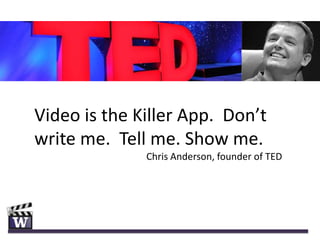
Video is the Killer App. Don’t
write me. Tell me. Show me.
              Chris Anderson, founder of TED
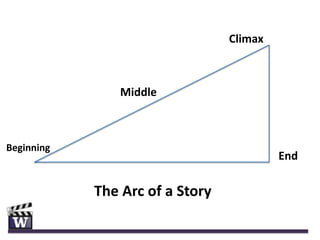
Climax


               Middle


Beginning
                                          End

            The Arc of a Story
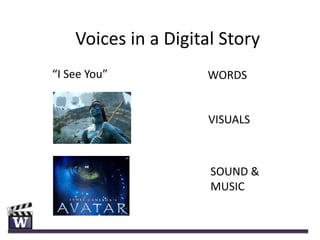
Voices in a Digital Story
“I See You”          WORDS


                     VISUALS


                      SOUND &
                      MUSIC
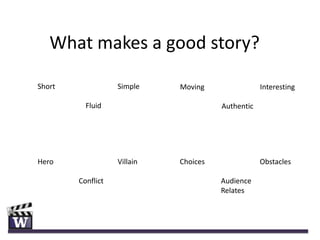
What makes a good story?

Short              Simple    Moving                Interesting

          Fluid                        Authentic


Hero               Villain   Choices               Obstacles

        Conflict                       Audience
                                       Relates
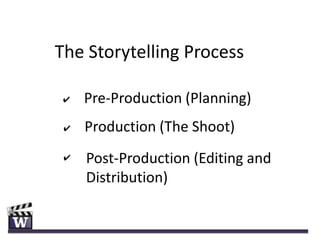
The Storytelling Process

✔    Pre-Production (Planning)
 ✔   Production (The Shoot)
 ✔   Post-Production (Editing and
     Distribution)
Pre-Production
Talk it over


               What’s the Story?

               Who speaks on camera?
               Script or Storyboard?

               Is the location a character?
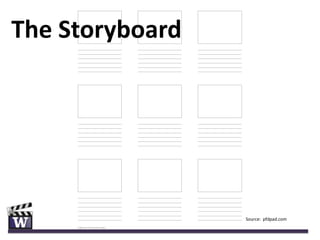
The Storyboard


                 Source: pfdpad.com
Interviewing Techniques

Plan your location in advance

Do your research – what do you want to
know?
Write out your questions

Listen for cues to feelings – link the head
and heart
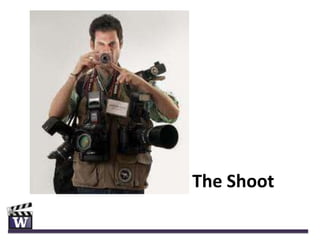
The Shoot
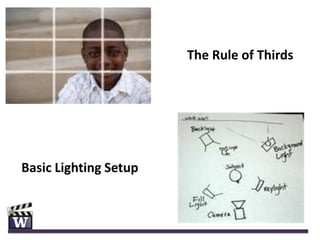
The Rule of Thirds


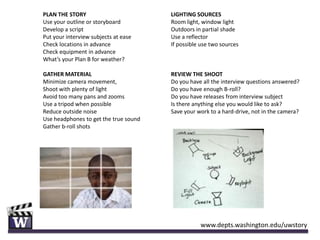
Basic Lighting Setup
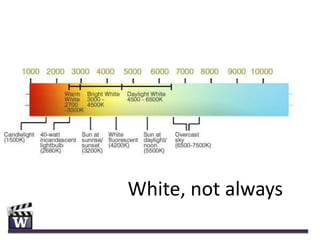
White, not always
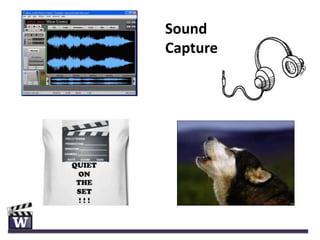
Sound
Capture
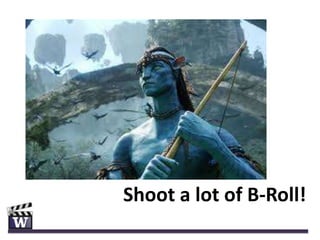
Shoot a lot of B-Roll!
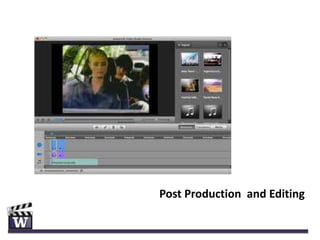
Post Production and Editing
Let’s hear from the Iron Chef of Video Editing
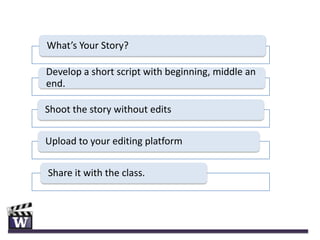
What’s Your Story?

Develop a short script with beginning, middle an
end.

Shoot the story without edits

Upload to your editing platform

Share it with the class.
PLAN THE STORY                         LIGHTING SOURCES
Use your outline or storyboard         Room light, window light
Develop a script                       Outdoors in partial shade
Put your interview subjects at ease    Use a reflector
Check locations in advance             If possible use two sources
Check equipment in advance
What’s your Plan B for weather?

GATHER MATERIAL                        REVIEW THE SHOOT
Minimize camera movement,              Do you have all the interview questions answered?
Shoot with plenty of light             Do you have enough B-roll?
Avoid too many pans and zooms          Do you have releases from interview subject
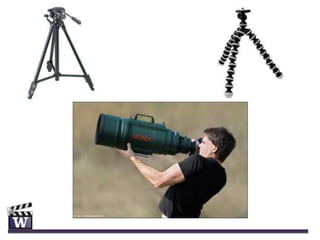
Use a tripod when possible             Is there anything else you would like to ask?
Reduce outside noise                   Save your work to a hard-drive, not in the camera?
Use headphones to get the true sound
Gather b-roll shots


                                                  www.depts.washington.edu/uwstory
Thank You!
Harry Hayward
UW Media Relations and Communications
206-685-2647
hhayward@uw.edu
@harryhay

Digital storytelling - AMA Highered

  • 1.
  • 2.
    Video is theKiller App. Don’t write me. Tell me. Show me. Chris Anderson, founder of TED
  • 4.
    Climax Middle Beginning End The Arc of a Story
  • 5.
    Voices in aDigital Story “I See You” WORDS VISUALS SOUND & MUSIC
  • 6.
    What makes agood story? Short Simple Moving Interesting Fluid Authentic Hero Villain Choices Obstacles Conflict Audience Relates
  • 7.
    The Storytelling Process ✔ Pre-Production (Planning) ✔ Production (The Shoot) ✔ Post-Production (Editing and Distribution)
  • 8.
  • 9.
    Talk it over What’s the Story? Who speaks on camera? Script or Storyboard? Is the location a character?
  • 10.
    The Storyboard Source: pfdpad.com
  • 11.
    Interviewing Techniques Plan yourlocation in advance Do your research – what do you want to know? Write out your questions Listen for cues to feelings – link the head and heart
  • 12.
  • 13.
    The Rule ofThirds Basic Lighting Setup
  • 14.
  • 16.
  • 17.
    Shoot a lotof B-Roll!
  • 18.
  • 19.
    Let’s hear fromthe Iron Chef of Video Editing
  • 22.
    What’s Your Story? Developa short script with beginning, middle an end. Shoot the story without edits Upload to your editing platform Share it with the class.
  • 24.
    PLAN THE STORY LIGHTING SOURCES Use your outline or storyboard Room light, window light Develop a script Outdoors in partial shade Put your interview subjects at ease Use a reflector Check locations in advance If possible use two sources Check equipment in advance What’s your Plan B for weather? GATHER MATERIAL REVIEW THE SHOOT Minimize camera movement, Do you have all the interview questions answered? Shoot with plenty of light Do you have enough B-roll? Avoid too many pans and zooms Do you have releases from interview subject Use a tripod when possible Is there anything else you would like to ask? Reduce outside noise Save your work to a hard-drive, not in the camera? Use headphones to get the true sound Gather b-roll shots www.depts.washington.edu/uwstory
  • 25.
    Thank You! Harry Hayward UWMedia Relations and Communications 206-685-2647 hhayward@uw.edu @harryhay

Editor's Notes

  • #4 Digital story ( dig-i-tal story)A short, first person video-narrative created by combining recorded voice, still and moving images, and music or other sounds.
digital storyteller (dig·i·talsto·ry·tell·er) 
Anyone who has a desire to document life experience, ideas, or feelings through the use of story and digital media. -Center for Digital StorytellingYour units have a great number of stories to tell, and a large number of storytellers. At the UW we have tried to make training available to all types of storytellers – students studying abroad, units telling about their discoveries, admissions and housing.Truth is, everyone can be a digital storyteller these days. You just need a camera and an idea. We’re going to spend the next several hours together – that’s a story in itself. By the end, you’ll have a digtal story ready for publication with a minimal use of resources.
  • #12 Ira Glass on Stoytelling and interviewingStorytelling -- http://www.youtube.com/watch?v=loxJ3FtCJJA
  • #20 http://www.youtube.com/watch?v=V3EefLZSsE8 Lunch Box Talks excerpt.