The New Bricolage: Assembling
and Remixing Images in an
Argumentative Text
Joel Bloch (jbloch10@gmail.com)
In memory of Mike Rose
In the Jewish tradition, we say, “May his
memory be a blessing.” Mike, thank you for
the blessing you have given to everyone who
knew you.
- Elaine Mamon Inside Higher Education
Introduction
Contextualizing Multimodality as a form of
argumentation
➔ Attempt for alternative forms of
literacy with greater emphasis on
visual
➔ See storytelling inside student writing
➔ Bring form of literacy outside the
classroom to inside
➔ Contextualize with print form of
argumentative both similarities and
differences
➔ Provide greater autonomy to students
My interest in digital
storytelling
ing
Search for forms of literary
help students with
academic writing
Web pages
Blogs
Digital Stories
Digital
Storytelling
incorporates
story telling with
writing
Quotes for illustration purposes only
The Context of Digital Storytelling in Argumentative
Pedagogy
➔ The history of the academic essayie andfr omhlight what’s new, unusual, or
surprising
➔ The role of technology ( is
➔ The emergence of argumentation as a paradigm shift in academic writing
➔ Relationship between text and image rhetorically and legally
➔ The role of digital storytelling: Story center uses digital stories “as part of
trainings for health, law enforcement, and criminal justice agencies, on how best to
support diverse Asian-Pacific Islander communities struggling
with legacies of gender-based violence” (Lambert, 2022)
Re
Provide a simple unifying message for what is to come
https://ineducationonline.org/2021/11/02/tea
ching-science-through-argumentation/
Digital storytelling in parallel to print texts.
● Parallel assignment with print text on plagiarism
● Choosing a personal experience
● No restrictions for choosing an argument
● Threshold concepts - important but difficult issues
● Use of texts, mixing stories and texts, author identity
● Bricolage, assemblage, rhizomatics (Canagarajah, 2018).
Choice of texts, mixed with images, broad audience
● Borrowed from Internet or create one’s own
● Intellectual Property Law
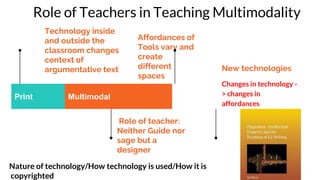
Print Multimodal
Technology inside
and outside the
classroom changes
context of
argumentative text
Role of teacher:
Neither Guide nor
sage but a
designer
Affordances of
Tools vary and
create
different
spaces
New technologies
Changes in technology -
> changes in
affordances
Role of Teachers in Teaching Multimodality
Nature of technology/How technology is used/How it is
copyrighted
Adapting Digital Storytelling
o Course Goals
1. Choice of images from
Internet (intellectual
property)
2. Choose tools to facilitate
goals
3. Focus on writing
4. Storytelling in argumentative
writing
5. Mixing story and images
6. Collaborative Storytelling
(creation/story circle)
7. Rhizomatic audience
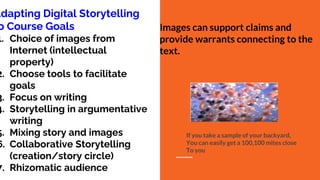
Images can support claims and
provide warrants connecting to the
text.
If you take a sample of your backyard,
You can easily get a 100,100 mites close
To you
Differences between print
and multimodal arguments
A. bricolage vs. engineering
◆ Greater freedom in choosing
texts
◆ No ability to assimilate texts
◆ Greater ability to tell a story
B. Remixing
Relationships between texts
and images
Role of textual authors
Creating new forms of textual
relationship
C. Rhizomatic
Change in the nature and role of audiences
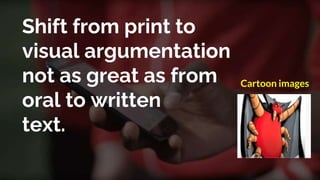
Shift from print to
visual argumentation
not as great as from
oral to written
text.
Cartoon images
One genre or multiple
genres
Given these differences, how do we view
multimodality as an alternative form of
argumentative genre
➔ Bricolage
What has been accomplished and
what might be left to tackle?
➔ Assmblage
Who supports your idea (or doesn’t)?
➔ Rhizomatics
How can the audience get involved or
find out more?
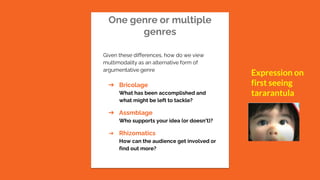
Expression on
first seeing
tararantula
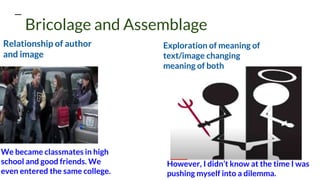
Relationship of author
and image
Exploration of meaning of
text/image changing
meaning of both
Bricolage and Assemblage
However, I didn’t know at the time I was
pushing myself into a dilemma.
We became classmates in high
school and good friends. We
even entered the same college.
Differences in the rhetorical
spaces between print and
multimodal
➔ Roles of teacher and student
➔ Differences in intellectual property
➔ How texts are incorporated
➔ Role of instructor as visual
commuicator
➔ Differences in threshold concepts
➔ Relationships between student text
and borrowed texts
➔ Nature of audience
Potential for Transfer
Creation of Reflective
Spaces using existing
technologies
1. Use of storyboards and blogs
for thinking about macro and
micro issues related to transfer
2. No evidence for transfer
3. Contributes to the active role
of teacher
.
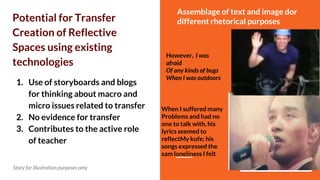
Story for illustration purposes only
When I suffered many
Problems and had no
one to talk with, his
lyrics seemed to
reflectMy kufe; his
songs expressed the
sam loneliness I felt
Assemblage of text and image dor
different rhetorical purposes
However, I was
afraid
Of any kinds of bugs
When I was outdoors
● Addressing similar problems as do
traditional argumentative essays
● Not a new form of genre but rather an
extension of traditional forms of
argumentation.
● Each threshold concept is different but
shares similar rhetorical goals
● Differences in telling story
● Not a collection of tools but creation of a
space similar to spaces for print forms
● Creates a space between print and image
that is neither one nor the other
● Determinism of design dependent on
goals. e.g. intellectual property, citation
process
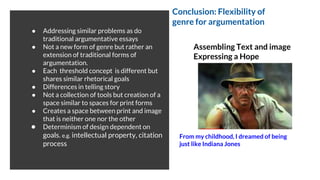
Assembling Text and image
Expressing a Hope
From my childhood, I dreamed of being
just like Indiana Jones
Conclusion: Flexibility of
genre for argumentation
multimodality
● Theories of assessment,
pedagogy, and
distribution
● Possibility of Transfer
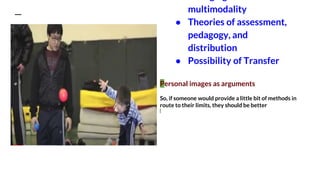
Personal images as arguments
So, if someone would provide a little bit of methods in
route to their limits, they should be better
Inspire your audience to act on the information they just learned.
Depending on your idea, this can be anything from downloading
an app to joining
an organization.
Digital Stories
Special Education
https://www.youtube.com/watch?v=XO8heqVzO9Y&t=335s
Digital Story Jose
https://www.youtube.com/watch?v=_aTFfI05cJU&t=290s
The Thing I most regret
https://www.youtube.com/watch?v=cD1pdzmG3BY&t=114s
Leslie Chung
https://www.youtube.com/watch?v=36YWhyyz3e4&t=7s
Videos
discussed
here
2022). The New Bricolage: Assembling and Remixing Voice and Images in a Multimodal Argumentative Text:
In A. Hirvela & D. Belcher (Eds.) Argumentative Writing in a Second Language, 135-151. Ann Arbor MI: The
University of Michigan Press.
(2019). Digital Storytelling in the L2 Graduate Writing Classroom: Expanding the Possibility of Personal
Expression and Textual Borrowing. In S. Khadka & J.C. Lee (Eds.) Bridging the Multimodal Gap: From Theory
to Practice, 182-200. Logan, UT: Utah State University Press.
(2018). Digital Storytelling in The L2 Academic Writing Classroom: Expanding the Possibilities. Dialogues.
Available at https://dialogues.ojs.chass.ncsu.edu/index.php/dialogues/article/view/30/16.
(2015). The Use of Digital Storytelling in an Academic Writing Course: The Story of an Immigrant.
In Teaching U.S-Educated Multilingual Writers: Practices from and for the Classroom. Edited by
Mark Roberge, Kay M. Losey, and Margi Wald. Ann Arbor: University of Michigan Press.
(2008). Blogging as a Bridge between Multiple Forms of Literacy: The Use of Blogs in an Academic Writing Class. In
D. Belcher & A. Hirvela (Eds.) Oral/Written Connections (288-309). Ann Arbor: University of Michigan Press.
My Previous
Books and
Articles on
Multimodality
Previous Research
(2021). Creating Digital Literacy Spaces for Multilingual Writers. Multilingual Matters
(2012). Plagiarism, Intellectual Property and the L2 Writing Classroom. Multilingual Matters
(2014) Teaching Digital Literacies. Alexandria, VA: TESOL Press.
Fuller, S. (2003). Kuhn vs Popper. Icon Books,
Lambert, J. (2020). Digital Storytelling: Story
Work for Urgent Times.
Sale, K. Rebels against the future:The Luddites
and their war on the Industrial Revolution:
Lessons for the computer age. Addison-
Wesley.
Shapin, S. (1998). The Scientific Revolution.
University of Chicago Press
Willinsky, J. (2017).The Intellectual Processes of
Learning. University of Chicago PressB
Books
consulted in
preparing this
presentation
Slides Available
at
https://www.slideshare.net/cher
epaha/digital-storytelling-1-
251377910

Digital storytelling

  • 1.
    The New Bricolage:Assembling and Remixing Images in an Argumentative Text Joel Bloch (jbloch10@gmail.com)
  • 2.
    In memory ofMike Rose In the Jewish tradition, we say, “May his memory be a blessing.” Mike, thank you for the blessing you have given to everyone who knew you. - Elaine Mamon Inside Higher Education
  • 3.
    Introduction Contextualizing Multimodality asa form of argumentation ➔ Attempt for alternative forms of literacy with greater emphasis on visual ➔ See storytelling inside student writing ➔ Bring form of literacy outside the classroom to inside ➔ Contextualize with print form of argumentative both similarities and differences ➔ Provide greater autonomy to students
  • 4.
    My interest indigital storytelling ing Search for forms of literary help students with academic writing Web pages Blogs Digital Stories Digital Storytelling incorporates story telling with writing Quotes for illustration purposes only
  • 5.
    The Context ofDigital Storytelling in Argumentative Pedagogy ➔ The history of the academic essayie andfr omhlight what’s new, unusual, or surprising ➔ The role of technology ( is ➔ The emergence of argumentation as a paradigm shift in academic writing ➔ Relationship between text and image rhetorically and legally ➔ The role of digital storytelling: Story center uses digital stories “as part of trainings for health, law enforcement, and criminal justice agencies, on how best to support diverse Asian-Pacific Islander communities struggling with legacies of gender-based violence” (Lambert, 2022) Re Provide a simple unifying message for what is to come https://ineducationonline.org/2021/11/02/tea ching-science-through-argumentation/
  • 6.
    Digital storytelling inparallel to print texts. ● Parallel assignment with print text on plagiarism ● Choosing a personal experience ● No restrictions for choosing an argument ● Threshold concepts - important but difficult issues ● Use of texts, mixing stories and texts, author identity ● Bricolage, assemblage, rhizomatics (Canagarajah, 2018). Choice of texts, mixed with images, broad audience ● Borrowed from Internet or create one’s own ● Intellectual Property Law
  • 7.
    Print Multimodal Technology inside andoutside the classroom changes context of argumentative text Role of teacher: Neither Guide nor sage but a designer Affordances of Tools vary and create different spaces New technologies Changes in technology - > changes in affordances Role of Teachers in Teaching Multimodality Nature of technology/How technology is used/How it is copyrighted
  • 8.
    Adapting Digital Storytelling oCourse Goals 1. Choice of images from Internet (intellectual property) 2. Choose tools to facilitate goals 3. Focus on writing 4. Storytelling in argumentative writing 5. Mixing story and images 6. Collaborative Storytelling (creation/story circle) 7. Rhizomatic audience Images can support claims and provide warrants connecting to the text. If you take a sample of your backyard, You can easily get a 100,100 mites close To you
  • 9.
    Differences between print andmultimodal arguments A. bricolage vs. engineering ◆ Greater freedom in choosing texts ◆ No ability to assimilate texts ◆ Greater ability to tell a story B. Remixing Relationships between texts and images Role of textual authors Creating new forms of textual relationship C. Rhizomatic Change in the nature and role of audiences
  • 10.
    Shift from printto visual argumentation not as great as from oral to written text. Cartoon images
  • 11.
    One genre ormultiple genres Given these differences, how do we view multimodality as an alternative form of argumentative genre ➔ Bricolage What has been accomplished and what might be left to tackle? ➔ Assmblage Who supports your idea (or doesn’t)? ➔ Rhizomatics How can the audience get involved or find out more? Expression on first seeing tararantula
  • 12.
    Relationship of author andimage Exploration of meaning of text/image changing meaning of both Bricolage and Assemblage However, I didn’t know at the time I was pushing myself into a dilemma. We became classmates in high school and good friends. We even entered the same college.
  • 13.
    Differences in therhetorical spaces between print and multimodal ➔ Roles of teacher and student ➔ Differences in intellectual property ➔ How texts are incorporated ➔ Role of instructor as visual commuicator ➔ Differences in threshold concepts ➔ Relationships between student text and borrowed texts ➔ Nature of audience
  • 14.
    Potential for Transfer Creationof Reflective Spaces using existing technologies 1. Use of storyboards and blogs for thinking about macro and micro issues related to transfer 2. No evidence for transfer 3. Contributes to the active role of teacher . Story for illustration purposes only When I suffered many Problems and had no one to talk with, his lyrics seemed to reflectMy kufe; his songs expressed the sam loneliness I felt Assemblage of text and image dor different rhetorical purposes However, I was afraid Of any kinds of bugs When I was outdoors
  • 15.
    ● Addressing similarproblems as do traditional argumentative essays ● Not a new form of genre but rather an extension of traditional forms of argumentation. ● Each threshold concept is different but shares similar rhetorical goals ● Differences in telling story ● Not a collection of tools but creation of a space similar to spaces for print forms ● Creates a space between print and image that is neither one nor the other ● Determinism of design dependent on goals. e.g. intellectual property, citation process Assembling Text and image Expressing a Hope From my childhood, I dreamed of being just like Indiana Jones Conclusion: Flexibility of genre for argumentation
  • 16.
    multimodality ● Theories ofassessment, pedagogy, and distribution ● Possibility of Transfer Personal images as arguments So, if someone would provide a little bit of methods in route to their limits, they should be better
  • 17.
    Inspire your audienceto act on the information they just learned. Depending on your idea, this can be anything from downloading an app to joining an organization. Digital Stories Special Education https://www.youtube.com/watch?v=XO8heqVzO9Y&t=335s Digital Story Jose https://www.youtube.com/watch?v=_aTFfI05cJU&t=290s The Thing I most regret https://www.youtube.com/watch?v=cD1pdzmG3BY&t=114s Leslie Chung https://www.youtube.com/watch?v=36YWhyyz3e4&t=7s Videos discussed here
  • 18.
    2022). The NewBricolage: Assembling and Remixing Voice and Images in a Multimodal Argumentative Text: In A. Hirvela & D. Belcher (Eds.) Argumentative Writing in a Second Language, 135-151. Ann Arbor MI: The University of Michigan Press. (2019). Digital Storytelling in the L2 Graduate Writing Classroom: Expanding the Possibility of Personal Expression and Textual Borrowing. In S. Khadka & J.C. Lee (Eds.) Bridging the Multimodal Gap: From Theory to Practice, 182-200. Logan, UT: Utah State University Press. (2018). Digital Storytelling in The L2 Academic Writing Classroom: Expanding the Possibilities. Dialogues. Available at https://dialogues.ojs.chass.ncsu.edu/index.php/dialogues/article/view/30/16. (2015). The Use of Digital Storytelling in an Academic Writing Course: The Story of an Immigrant. In Teaching U.S-Educated Multilingual Writers: Practices from and for the Classroom. Edited by Mark Roberge, Kay M. Losey, and Margi Wald. Ann Arbor: University of Michigan Press. (2008). Blogging as a Bridge between Multiple Forms of Literacy: The Use of Blogs in an Academic Writing Class. In D. Belcher & A. Hirvela (Eds.) Oral/Written Connections (288-309). Ann Arbor: University of Michigan Press. My Previous Books and Articles on Multimodality Previous Research (2021). Creating Digital Literacy Spaces for Multilingual Writers. Multilingual Matters (2012). Plagiarism, Intellectual Property and the L2 Writing Classroom. Multilingual Matters (2014) Teaching Digital Literacies. Alexandria, VA: TESOL Press.
  • 19.
    Fuller, S. (2003).Kuhn vs Popper. Icon Books, Lambert, J. (2020). Digital Storytelling: Story Work for Urgent Times. Sale, K. Rebels against the future:The Luddites and their war on the Industrial Revolution: Lessons for the computer age. Addison- Wesley. Shapin, S. (1998). The Scientific Revolution. University of Chicago Press Willinsky, J. (2017).The Intellectual Processes of Learning. University of Chicago PressB Books consulted in preparing this presentation
  • 20.