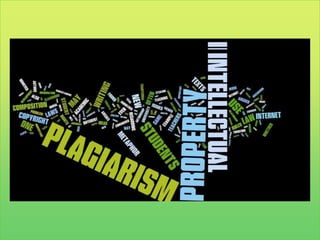
Plagiarism and Intellectual Property across CulturesJoel Bloch jbloch10@gmail.comIvan Stefanostefano.4@osu.eduThe Ohio State University
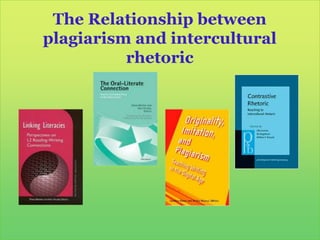
The Relationship between plagiarism and intercultural rhetoric
The “Otherness” of the International StudentGetty Images
Involves subtle differences between what is the relationship between imitation and creativity that can be transmitted by culture and can positively or negatively affect L2 writingGetty Images
Creating a Pedagogy for Teaching about PlagiarismGetty Images
The Relationship between Intellectual Property Law and PlagiarismGetty Images
Extend the research and get students involved in this debateGetty Images
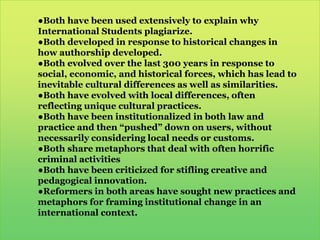
Both have been used extensively to explain why International Students plagiarize.
Both developed in response to historical changes in how authorship developed.
Both evolved over the last 300 years in response to social, economic, and historical forces, which has lead to inevitable cultural differences as well as similarities.
Both have evolved with local differences, often reflecting unique cultural practices.
Both have been institutionalized in both law and practice and then “pushed” down on users, without necessarily considering local needs or customs.
Both share metaphors that deal with often horrific criminal activities
Both have been criticized for stifling creative and pedagogical innovation.
Reformers in both areas have sought new practices and metaphors for framing institutional change in an international context.This research examines the attitudes towards plagiarism and intellectual property of international students and teachers at a large Midwestern university.
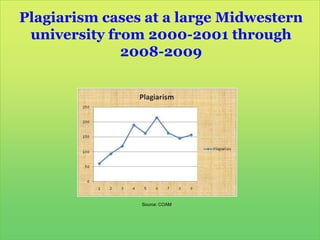
Plagiarism cases at a large Midwestern university from 2000-2001 through 2008-2009Source: COAM
Getty ImagesData on Attitudes towards students on plagiarism and intellectual property
Attitudes of L2 Students Towards  Intellectual Property and Plagiarism
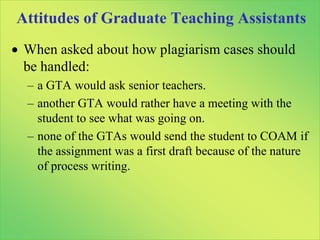
Attitudes of Graduate Teaching Assistants towards Intellectual Property and Plagiarism
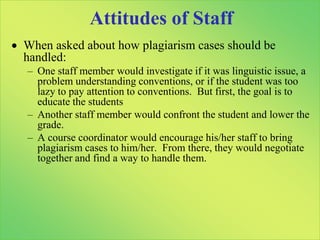
Attitudes of Staff towards Intellectual Property and Plagiarism
Attitudes of the Institution towards Intellectual Property and PlagiarismWhat are the problems teachers and students with the issue of plagiarism?Getty ImagesWhere are there agreements and disagreements among students and teachers?
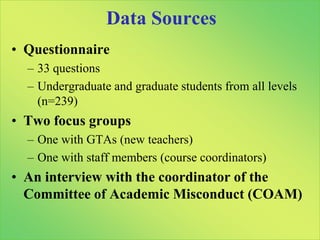
Data SourcesQuestionnaire33 questionsUndergraduate and graduate students from all levels (n=239)Two focus groupsOne with GTAs (new teachers)One with staff members (course coordinators)An interview with the coordinator of the Committee of Academic Misconduct (COAM)
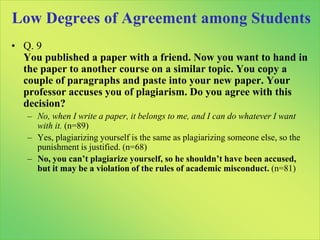
Low Degrees of Agreement among StudentsQ. 9You published a paper with a friend. Now you want to hand in the paper to another course on a similar topic. You copy a couple of paragraphs and paste into your new paper. Your professor accuses you of plagiarism. Do you agree with this decision?No, when I write a paper, it belongs to me, and I can do whatever I want with it. (n=89)Yes, plagiarizing yourself is the same as plagiarizing someone else, so the punishment is justified. (n=68)No, you can’t plagiarize yourself, so he shouldn’t have been accused, but it may be a violation of the rules of academic misconduct. (n=81)
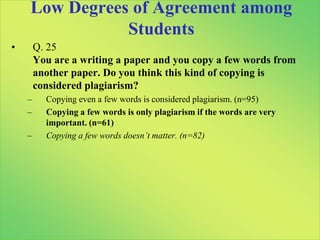
Low Degrees of Agreement among StudentsQ. 25You are a writing a paper and you copy a few words from another paper. Do you think this kind of copying is considered plagiarism?Copying even a few words is considered plagiarism. (n=95)Copying a few words is only plagiarism if the words are very important. (n=61)Copying a few words doesn’t matter. (n=82)
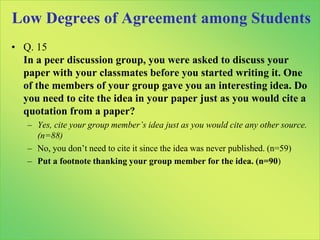
Low Degrees of Agreement among StudentsQ. 15In a peer discussion group, you were asked to discuss your paper with your classmates before you started writing it. One of the members of your group gave you an interesting idea. Do you need to cite the idea in your paper just as you would cite a quotation from a paper?Yes, cite your group member’s idea just as you would cite any other source. (n=88)No, you don’t need to cite it since the idea was never published. (n=59)Put a footnote thanking your group member for the idea. (n=90)
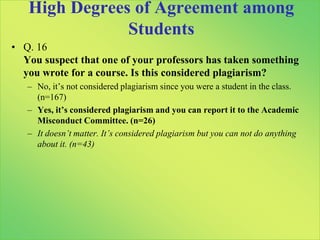
High Degrees of Agreement among StudentsQ. 16You suspect that one of your professors has taken something you wrote for a course. Is this considered plagiarism?No, it’s not considered plagiarism since you were a student in the class. (n=167)Yes, it’s considered plagiarism and you can report it to the Academic Misconduct Committee. (n=26)It doesn’t matter. It’s considered plagiarism but you can not do anything about it. (n=43)
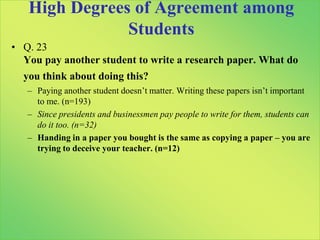
High Degrees of Agreement among StudentsQ. 23You pay another student to write a research paper. What do you think about doing this? Paying another student doesn’t matter. Writing these papers isn’t important to me. (n=193)Since presidents and businessmen pay people to write for them, students can do it too. (n=32)Handing in a paper you bought is the same as copying a paper – you are trying to deceive your teacher. (n=12)
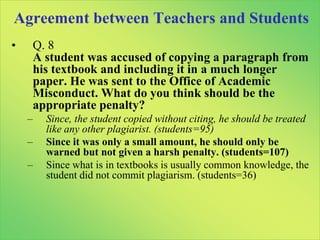
Agreement between Teachers and StudentsQ. 8A student was accused of copying a paragraph from his textbook and including it in a much longer paper. He was sent to the Office of Academic Misconduct. What do you think should be the appropriate penalty?Since, the student copied without citing, he should be treated like any other plagiarist. (students=95)Since it was only a small amount, he should only be warned but not given a harsh penalty. (students=107)Since what is in textbooks is usually common knowledge, the student did not commit plagiarism. (students=36)
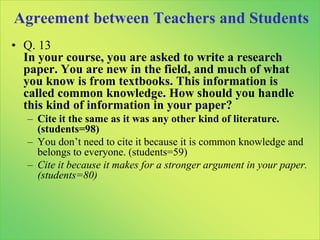
Agreement between Teachers and StudentsQ. 13In your course, you are asked to write a research paper. You are new in the field, and much of what you know is from textbooks. This information is called common knowledge. How should you handle this kind of information in your paper?Cite it the same as it was any other kind of literature. (students=98)You don’t need to cite it because it is common knowledge and belongs to everyone. (students=59)Cite it because it makes for a stronger argument in your paper. (students=80)

Tesol Presentation

  • 1.
    Plagiarism and IntellectualProperty across CulturesJoel Bloch jbloch10@gmail.comIvan Stefanostefano.4@osu.eduThe Ohio State University
  • 3.
    The Relationship betweenplagiarism and intercultural rhetoric
  • 4.
    The “Otherness” ofthe International StudentGetty Images
  • 5.
    Involves subtle differencesbetween what is the relationship between imitation and creativity that can be transmitted by culture and can positively or negatively affect L2 writingGetty Images
  • 6.
    Creating a Pedagogyfor Teaching about PlagiarismGetty Images
  • 7.
    The Relationship betweenIntellectual Property Law and PlagiarismGetty Images
  • 8.
    Extend the researchand get students involved in this debateGetty Images
  • 9.
    Both have beenused extensively to explain why International Students plagiarize.
  • 10.
    Both developed inresponse to historical changes in how authorship developed.
  • 11.
    Both evolved overthe last 300 years in response to social, economic, and historical forces, which has lead to inevitable cultural differences as well as similarities.
  • 12.
    Both have evolvedwith local differences, often reflecting unique cultural practices.
  • 13.
    Both have beeninstitutionalized in both law and practice and then “pushed” down on users, without necessarily considering local needs or customs.
  • 14.
    Both share metaphorsthat deal with often horrific criminal activities
  • 15.
    Both have beencriticized for stifling creative and pedagogical innovation.
  • 16.
    Reformers in bothareas have sought new practices and metaphors for framing institutional change in an international context.This research examines the attitudes towards plagiarism and intellectual property of international students and teachers at a large Midwestern university.
  • 17.
    Plagiarism cases ata large Midwestern university from 2000-2001 through 2008-2009Source: COAM
  • 18.
    Getty ImagesData onAttitudes towards students on plagiarism and intellectual property
  • 19.
    Attitudes of L2Students Towards Intellectual Property and Plagiarism
  • 20.
    Attitudes of GraduateTeaching Assistants towards Intellectual Property and Plagiarism
  • 21.
    Attitudes of Stafftowards Intellectual Property and Plagiarism
  • 22.
    Attitudes of theInstitution towards Intellectual Property and PlagiarismWhat are the problems teachers and students with the issue of plagiarism?Getty ImagesWhere are there agreements and disagreements among students and teachers?
  • 23.
    Data SourcesQuestionnaire33 questionsUndergraduateand graduate students from all levels (n=239)Two focus groupsOne with GTAs (new teachers)One with staff members (course coordinators)An interview with the coordinator of the Committee of Academic Misconduct (COAM)
  • 24.
    Low Degrees ofAgreement among StudentsQ. 9You published a paper with a friend. Now you want to hand in the paper to another course on a similar topic. You copy a couple of paragraphs and paste into your new paper. Your professor accuses you of plagiarism. Do you agree with this decision?No, when I write a paper, it belongs to me, and I can do whatever I want with it. (n=89)Yes, plagiarizing yourself is the same as plagiarizing someone else, so the punishment is justified. (n=68)No, you can’t plagiarize yourself, so he shouldn’t have been accused, but it may be a violation of the rules of academic misconduct. (n=81)
  • 25.
    Low Degrees ofAgreement among StudentsQ. 25You are a writing a paper and you copy a few words from another paper. Do you think this kind of copying is considered plagiarism?Copying even a few words is considered plagiarism. (n=95)Copying a few words is only plagiarism if the words are very important. (n=61)Copying a few words doesn’t matter. (n=82)
  • 26.
    Low Degrees ofAgreement among StudentsQ. 15In a peer discussion group, you were asked to discuss your paper with your classmates before you started writing it. One of the members of your group gave you an interesting idea. Do you need to cite the idea in your paper just as you would cite a quotation from a paper?Yes, cite your group member’s idea just as you would cite any other source. (n=88)No, you don’t need to cite it since the idea was never published. (n=59)Put a footnote thanking your group member for the idea. (n=90)
  • 27.
    High Degrees ofAgreement among StudentsQ. 16You suspect that one of your professors has taken something you wrote for a course. Is this considered plagiarism?No, it’s not considered plagiarism since you were a student in the class. (n=167)Yes, it’s considered plagiarism and you can report it to the Academic Misconduct Committee. (n=26)It doesn’t matter. It’s considered plagiarism but you can not do anything about it. (n=43)
  • 28.
    High Degrees ofAgreement among StudentsQ. 23You pay another student to write a research paper. What do you think about doing this? Paying another student doesn’t matter. Writing these papers isn’t important to me. (n=193)Since presidents and businessmen pay people to write for them, students can do it too. (n=32)Handing in a paper you bought is the same as copying a paper – you are trying to deceive your teacher. (n=12)
  • 29.
    Agreement between Teachersand StudentsQ. 8A student was accused of copying a paragraph from his textbook and including it in a much longer paper. He was sent to the Office of Academic Misconduct. What do you think should be the appropriate penalty?Since, the student copied without citing, he should be treated like any other plagiarist. (students=95)Since it was only a small amount, he should only be warned but not given a harsh penalty. (students=107)Since what is in textbooks is usually common knowledge, the student did not commit plagiarism. (students=36)
  • 30.
    Agreement between Teachersand StudentsQ. 13In your course, you are asked to write a research paper. You are new in the field, and much of what you know is from textbooks. This information is called common knowledge. How should you handle this kind of information in your paper?Cite it the same as it was any other kind of literature. (students=98)You don’t need to cite it because it is common knowledge and belongs to everyone. (students=59)Cite it because it makes for a stronger argument in your paper. (students=80)