The New Bricolage: Assembling
and Remixing Images in an
Argumentative Text
Joel Bloch (jbloch10@gmail.com)
In memory of Mike Rose
In the Jewish tradition, we say, “May his
memory be a blessing.” Mike, thank you for
the blessing you have given to everyone
who knew you.
- Elaine Mamon Inside Higher Education
1. Intro
Contextualiing Multimodality as a form of
argumentation
➔ Attempt for alternative forms of literacy
with greater emphasis on visual
➔ See storytelling inside student writing
➔ Bring form of literacy outside the
classroom to inside
➔ Contextualize with print form of
argumentative both similarities and
differences
➔ Provide greater autonomy to students
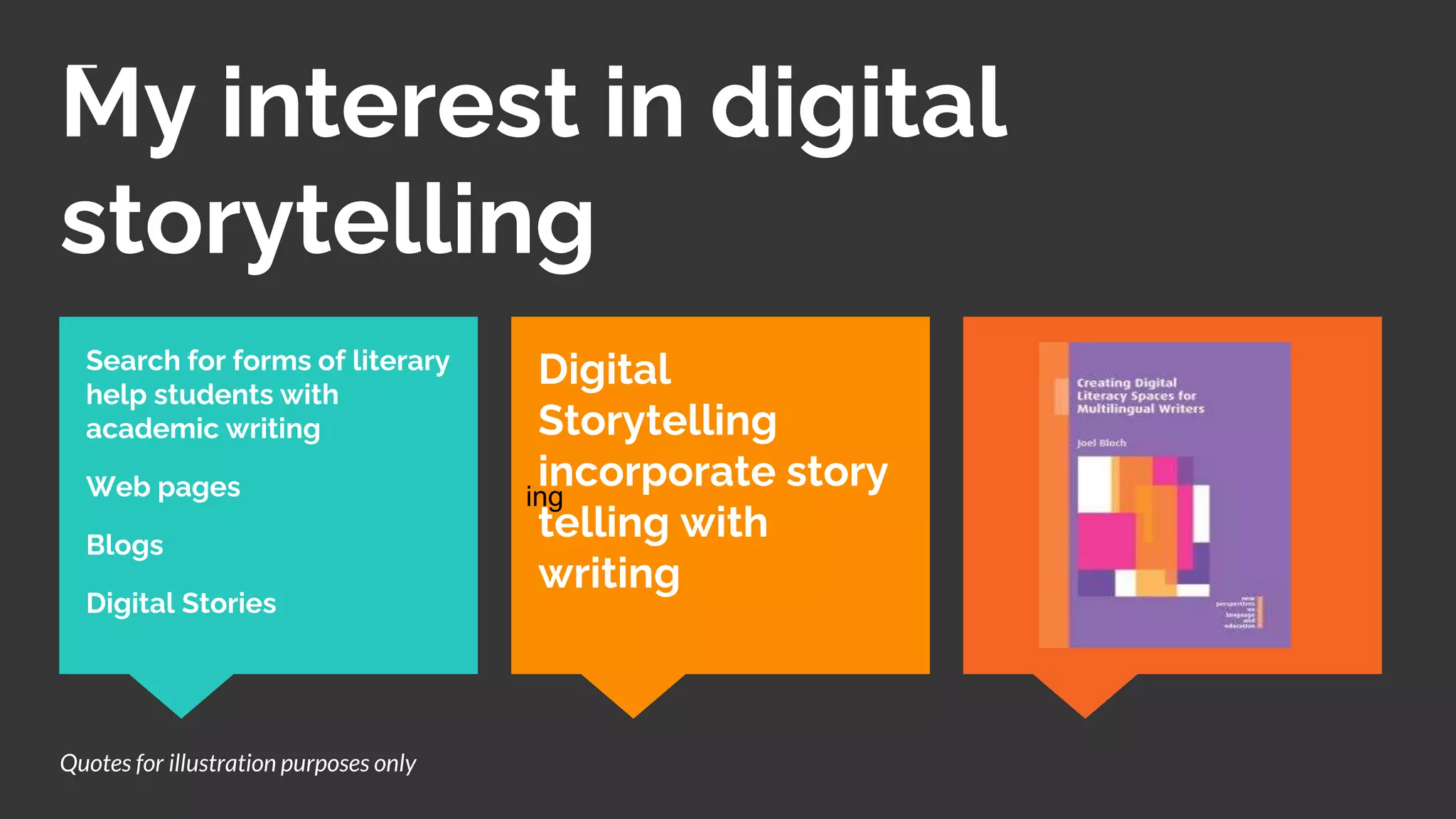
My interest in digital
storytelling
ing
Search for forms of literary
help students with
academic writing
Web pages
Blogs
Digital Stories
Digital
Storytelling
incorporate story
telling with
writing
Quotes for illustration purposes only
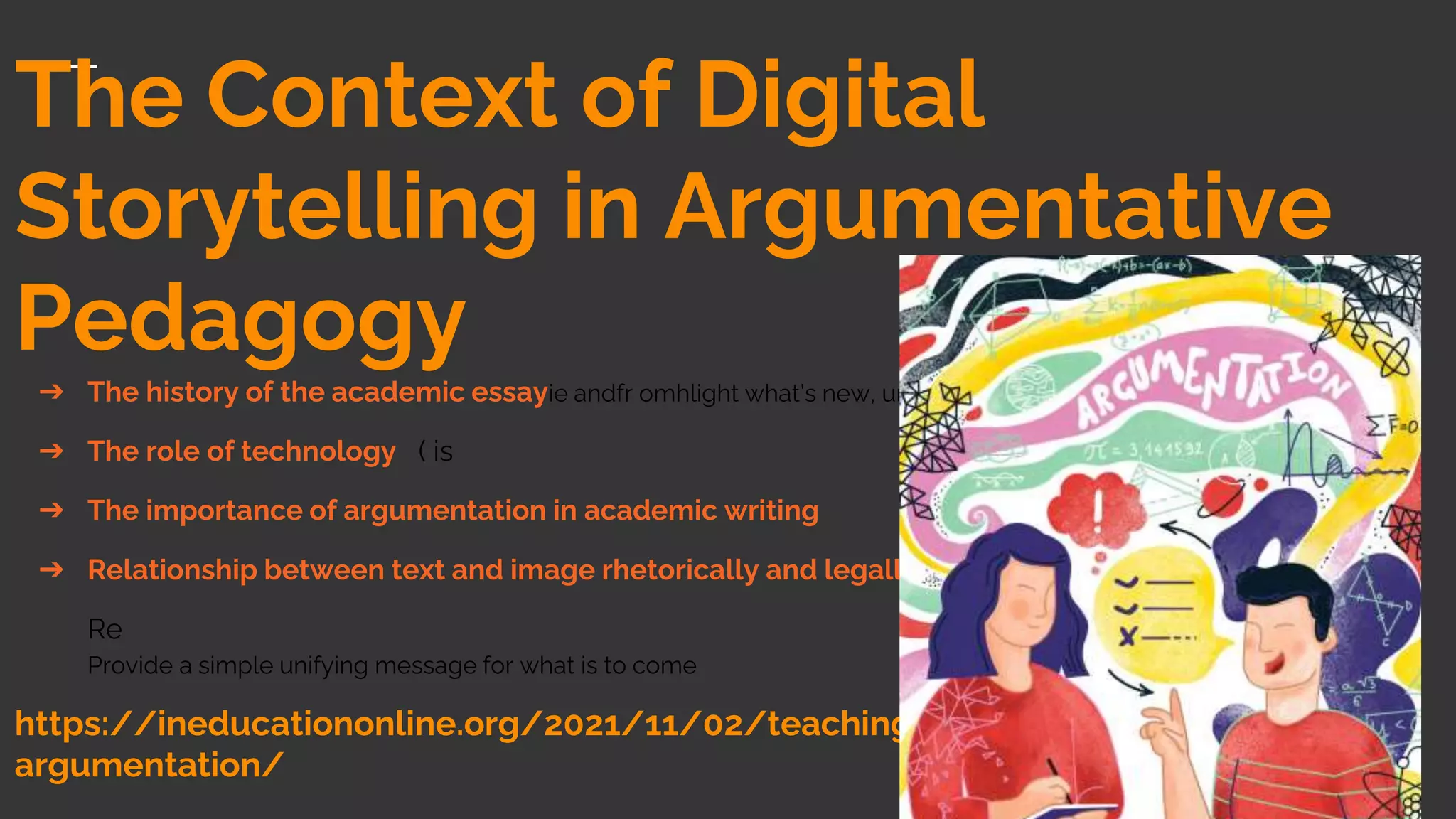
The Context of Digital
Storytelling in Argumentative
Pedagogy
➔ The history of the academic essayie andfr omhlight what’s new, unusual, or surprising
➔ The role of technology ( is
➔ The importance of argumentation in academic writing
➔ Relationship between text and image rhetorically and legally
Re
Provide a simple unifying message for what is to come
https://ineducationonline.org/2021/11/02/teaching-science-through-
argumentation/
Digital Storytelling in
parallel to print text.
Parallel assignment with print text on plagiarism
No restrictions for choosing an argument
Threshold concepts - use of texts, mixing stories and texts,
author identity
Bricolage, assemblage, rhizomatics
Choice of texts, mixed with images, audience
Borrowed from Canagarajah (2018)
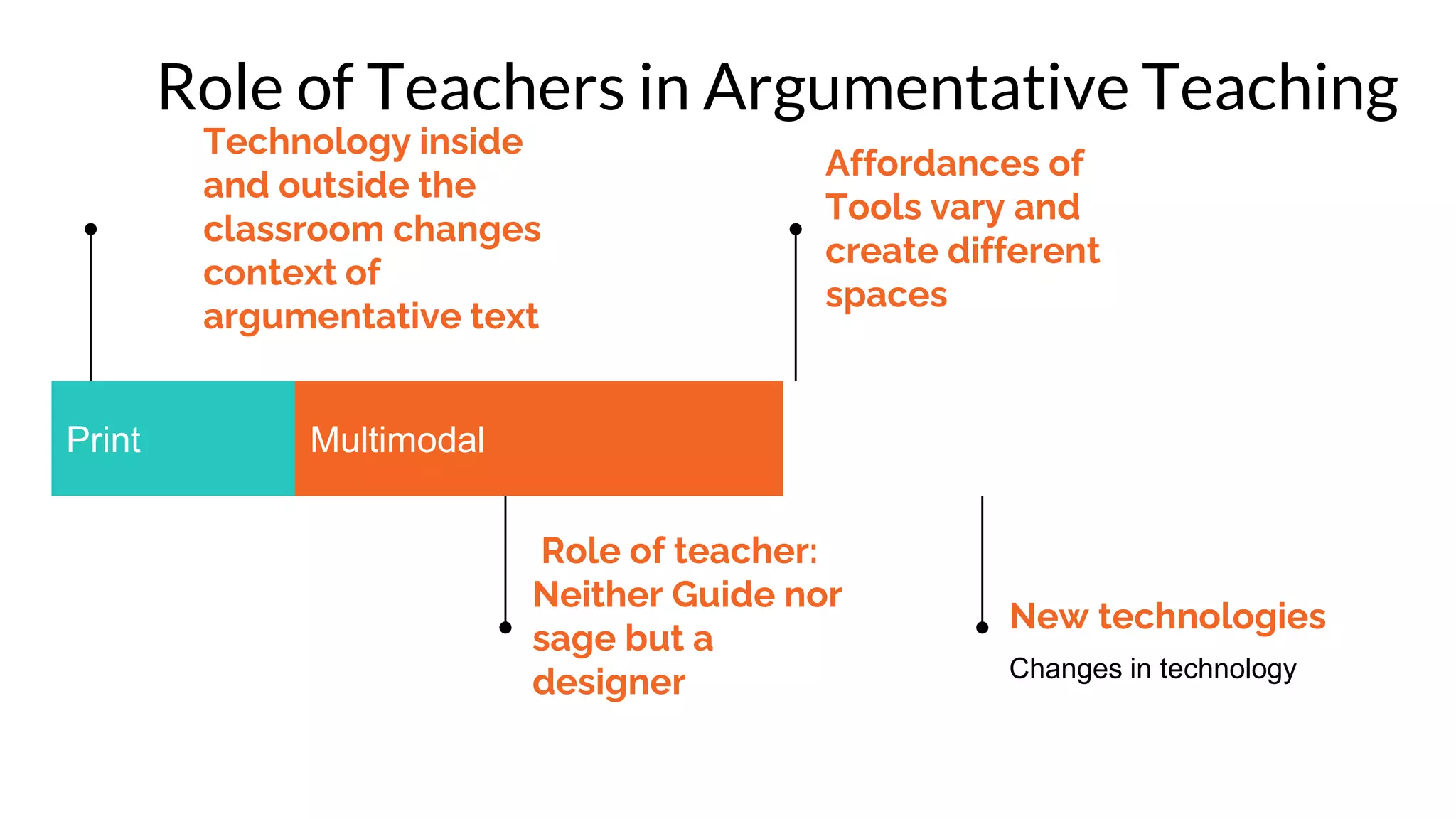
Print Multimodal
Technology inside
and outside the
classroom changes
context of
argumentative text
Role of teacher:
Neither Guide nor
sage but a
designer
Affordances of
Tools vary and
create different
spaces
New technologies
Changes in technology
Role of Teachers in Argumentative Teaching
Adapting Digital
Storytelling to Course Goals
1. Choice of images by
students from Internet
(intellectual property)
2. Focus on writing
3. Mixing story and images
4. Collaborative
Storytelling (story circle)
5. Rhizomatic audience
Tip
Don’t wait till the end of
the presentation to give
the bottom line.
Reveal your product or
idea (in this case a
translation app) up front.
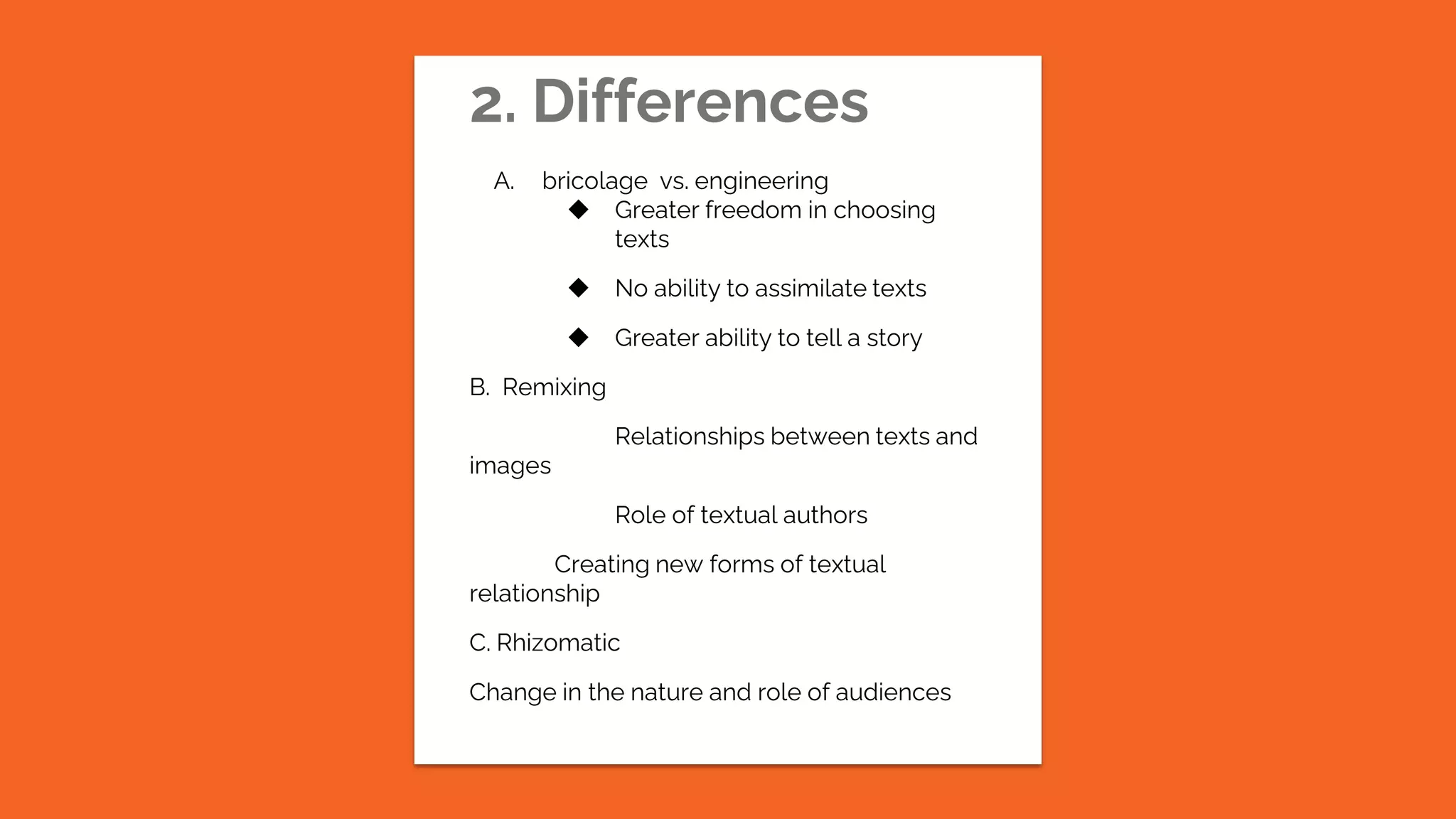
2. Differences
A. bricolage vs. engineering
◆ Greater freedom in choosing
texts
◆ No ability to assimilate texts
◆ Greater ability to tell a story
B. Remixing
Relationships between texts and
images
Role of textual authors
Creating new forms of textual
relationship
C. Rhizomatic
Change in the nature and role of audiences
Shift from print to
visual argumentation
not as great as from
oral to written
text.
Tip
Ideally, speak of people
in very different
situations, but where
each could benefit from
your solution.
4. One or multiple
genres
Given these differences, how do we view
multimodality as an alternative form of
argumentative genre
➔ Bricolage
What has been accomplished and
what might be left to tackle?
➔ Assmblage
Who supports your idea (or doesn’t)?
➔ Rhizomatics
How can the audience get involved or
find out more?
Tip
Tell the audience about
the problem through a
story, ideally a person.
• Nature of literacy space - implementation of argumentation
• Choice and Relationship of tools for remediating problems- blogs and
worksheets
• Costs in money, time and energy by teachers and students
• Evaluation of end states
Technology, digital
stories, and
argumentation
3. Differences
➔ Roles of teacher and student
➔ Differences in intellectual property
➔ How texts are incorporated
➔ Role of instructor visual commuicator
➔ Differences in threshold concepts
➔ Relationships between student text and
borrowed texts
➔ Nature of audience
Conclusion: Flexibility
of academic genre
Not a new form of genre but rather an extension of
traditional forms of argumentation.
Addressing similar problems as do traditional
argumentative essays
Determinism of design. E.g. intellectual property,
citation process
Argumentation:
Potential for
Transfer
1. Use of storyboards and blogs
for reflection on threshold
concepts
2. No evidence for transfer
3. Story itself or process of
creation
Tip
If one example isn’t
sufficient to help people
understand the breadth
of your idea, pick a
couple of examples.
Story for illustration purposes only
New Technologies in sharing and
distributing texts and debates over their
implementation
New Theories of Creating Digital Stories
Design of literacy spaces for collaborative
work
The role of argumenation in academic
literacy
Changing role of multimodality
Possibility of Transfer
Future
Directions for
Research and
Discussion
Books I wrote
in about digital
storytelling and
literacy.
Source: travel.trade.gov
(2021). Creating Digital Literacy Spaces for
Multilingual Writers. Multilingual Matters.
London: England.
(2012). Plagiarism, Intellectual Property and the
L2 Writing Classroom.Multilingual Matters.
London: England.
(2014) Teaching Digital Literacies. Alexandria,
VA: TESOL Press.
(2022). The New Bricolage: Assembling and Remixing Voice and Images in a
Multimodal Argumentative Text: In A. Hirvela & D. Belcher (Eds.)
Argumentative Writing in a Second Language, 135-151. Ann Arbor MI: The
University of Michigan Press.
(2019). Digital Storytelling in the L2 Graduate Writing Classroom: Expanding the
Possibility of Personal Expression and Textual Borrowing. In S. Khadka & J.C.
Lee (Eds.) Bridging the Multimodal Gap: From Theory to Practice, 182-200.
Logan, UT: Utah State University Press.
(2018). Digital Storytelling in The L2 Academic Writing Classroom: Expanding
the Possibilities. Dialogues. Available at
https://dialogues.ojs.chass.ncsu.edu/index.php/dialogues/article/view/30/16.
(2015). The Use of Digital Storytelling in an Academic Writing Course:
The Story of an Immigrant. In Teaching U.S-Educated Multilingual
Writers: Practices from and for the Classroom. Edited by Mark
Roberge, Kay M. Losey, and Margi Wald. Ann Arbor: University of
Michigan Press.
( 2008). Blogging as a Bridge between Multiple Forms of Literacy: The Use of
Blogs in an Academic Writing Class. In D. Belcher & A. Hirvela (Eds.)
Previous Research
on Multimodality
Books I consulted for
this discussion
FullerFFullerFuller, s
Fuller, S. (2003). Kuhn vs. Popper. Icon Books
Lambert, J. (2020). Digital Storytelling. 6th Ed. Digital Diner Press.
Sale, K. (1996), Rebels Against the Future: The Luddites and Their
War on the Industrial Revolution: Lessons for the Computer Age.
Addison-Wesley.
Shapin, (1996). The Scientific Revolution. The University of Chicago
Press.

Digital storytelling

  • 1.
    The New Bricolage:Assembling and Remixing Images in an Argumentative Text Joel Bloch (jbloch10@gmail.com)
  • 2.
    In memory ofMike Rose In the Jewish tradition, we say, “May his memory be a blessing.” Mike, thank you for the blessing you have given to everyone who knew you. - Elaine Mamon Inside Higher Education
  • 3.
    1. Intro Contextualiing Multimodalityas a form of argumentation ➔ Attempt for alternative forms of literacy with greater emphasis on visual ➔ See storytelling inside student writing ➔ Bring form of literacy outside the classroom to inside ➔ Contextualize with print form of argumentative both similarities and differences ➔ Provide greater autonomy to students
  • 4.
    My interest indigital storytelling ing Search for forms of literary help students with academic writing Web pages Blogs Digital Stories Digital Storytelling incorporate story telling with writing Quotes for illustration purposes only
  • 5.
    The Context ofDigital Storytelling in Argumentative Pedagogy ➔ The history of the academic essayie andfr omhlight what’s new, unusual, or surprising ➔ The role of technology ( is ➔ The importance of argumentation in academic writing ➔ Relationship between text and image rhetorically and legally Re Provide a simple unifying message for what is to come https://ineducationonline.org/2021/11/02/teaching-science-through- argumentation/
  • 6.
    Digital Storytelling in parallelto print text. Parallel assignment with print text on plagiarism No restrictions for choosing an argument Threshold concepts - use of texts, mixing stories and texts, author identity Bricolage, assemblage, rhizomatics Choice of texts, mixed with images, audience Borrowed from Canagarajah (2018)
  • 7.
    Print Multimodal Technology inside andoutside the classroom changes context of argumentative text Role of teacher: Neither Guide nor sage but a designer Affordances of Tools vary and create different spaces New technologies Changes in technology Role of Teachers in Argumentative Teaching
  • 8.
    Adapting Digital Storytelling toCourse Goals 1. Choice of images by students from Internet (intellectual property) 2. Focus on writing 3. Mixing story and images 4. Collaborative Storytelling (story circle) 5. Rhizomatic audience Tip Don’t wait till the end of the presentation to give the bottom line. Reveal your product or idea (in this case a translation app) up front.
  • 9.
    2. Differences A. bricolagevs. engineering ◆ Greater freedom in choosing texts ◆ No ability to assimilate texts ◆ Greater ability to tell a story B. Remixing Relationships between texts and images Role of textual authors Creating new forms of textual relationship C. Rhizomatic Change in the nature and role of audiences
  • 10.
    Shift from printto visual argumentation not as great as from oral to written text. Tip Ideally, speak of people in very different situations, but where each could benefit from your solution.
  • 11.
    4. One ormultiple genres Given these differences, how do we view multimodality as an alternative form of argumentative genre ➔ Bricolage What has been accomplished and what might be left to tackle? ➔ Assmblage Who supports your idea (or doesn’t)? ➔ Rhizomatics How can the audience get involved or find out more?
  • 12.
    Tip Tell the audienceabout the problem through a story, ideally a person. • Nature of literacy space - implementation of argumentation • Choice and Relationship of tools for remediating problems- blogs and worksheets • Costs in money, time and energy by teachers and students • Evaluation of end states Technology, digital stories, and argumentation
  • 13.
    3. Differences ➔ Rolesof teacher and student ➔ Differences in intellectual property ➔ How texts are incorporated ➔ Role of instructor visual commuicator ➔ Differences in threshold concepts ➔ Relationships between student text and borrowed texts ➔ Nature of audience
  • 14.
    Conclusion: Flexibility of academicgenre Not a new form of genre but rather an extension of traditional forms of argumentation. Addressing similar problems as do traditional argumentative essays Determinism of design. E.g. intellectual property, citation process
  • 15.
    Argumentation: Potential for Transfer 1. Useof storyboards and blogs for reflection on threshold concepts 2. No evidence for transfer 3. Story itself or process of creation Tip If one example isn’t sufficient to help people understand the breadth of your idea, pick a couple of examples. Story for illustration purposes only
  • 16.
    New Technologies insharing and distributing texts and debates over their implementation New Theories of Creating Digital Stories Design of literacy spaces for collaborative work The role of argumenation in academic literacy Changing role of multimodality Possibility of Transfer Future Directions for Research and Discussion
  • 17.
    Books I wrote inabout digital storytelling and literacy. Source: travel.trade.gov (2021). Creating Digital Literacy Spaces for Multilingual Writers. Multilingual Matters. London: England. (2012). Plagiarism, Intellectual Property and the L2 Writing Classroom.Multilingual Matters. London: England. (2014) Teaching Digital Literacies. Alexandria, VA: TESOL Press.
  • 18.
    (2022). The NewBricolage: Assembling and Remixing Voice and Images in a Multimodal Argumentative Text: In A. Hirvela & D. Belcher (Eds.) Argumentative Writing in a Second Language, 135-151. Ann Arbor MI: The University of Michigan Press. (2019). Digital Storytelling in the L2 Graduate Writing Classroom: Expanding the Possibility of Personal Expression and Textual Borrowing. In S. Khadka & J.C. Lee (Eds.) Bridging the Multimodal Gap: From Theory to Practice, 182-200. Logan, UT: Utah State University Press. (2018). Digital Storytelling in The L2 Academic Writing Classroom: Expanding the Possibilities. Dialogues. Available at https://dialogues.ojs.chass.ncsu.edu/index.php/dialogues/article/view/30/16. (2015). The Use of Digital Storytelling in an Academic Writing Course: The Story of an Immigrant. In Teaching U.S-Educated Multilingual Writers: Practices from and for the Classroom. Edited by Mark Roberge, Kay M. Losey, and Margi Wald. Ann Arbor: University of Michigan Press. ( 2008). Blogging as a Bridge between Multiple Forms of Literacy: The Use of Blogs in an Academic Writing Class. In D. Belcher & A. Hirvela (Eds.) Previous Research on Multimodality
  • 19.
    Books I consultedfor this discussion FullerFFullerFuller, s Fuller, S. (2003). Kuhn vs. Popper. Icon Books Lambert, J. (2020). Digital Storytelling. 6th Ed. Digital Diner Press. Sale, K. (1996), Rebels Against the Future: The Luddites and Their War on the Industrial Revolution: Lessons for the Computer Age. Addison-Wesley. Shapin, (1996). The Scientific Revolution. The University of Chicago Press.