The	
  End	
  of	
  Compe--ve	
  Advantage:	
  How	
  to	
  Keep	
  
Your	
  Strategy	
  Moving	
  as	
  Fast	
  as	
  Your	
  Business	
  By	
  
Rita	
  McGrath	
  
Key	
  Ques-ons,	
  Useful	
  Resources	
  &	
  Session	
  Slides	


May	
  20,	
  2014	


Moderator:	
  Tom	
  Hood,	
  CPA,CITP.CGMA,	
  	
  CEO	
  &	
  Chief	
  Strategist,	


Maryland	
  Associa-on	
  of	
  CPAs/Business	
  Learning	
  Ins-tute	


Mary	
  Lynn	
  Fayoumi,	
  CAE,	
  GPHR,	
  President	
  &	
  CEO	
  
Management	
  Associa-on	


Greg	
  Fine,	
  CAE,	
  Global	
  Chief	
  Execu-ve	
  Officer	
  
Turnaround	
  Management	
  Associa-on	


R.	
  Norris	
  Orms,	
  CAE,	
  FACHE,	
  Execu-ve	
  Vice	
  President	
  &	
  COO	
  
HIMSS	


The	
  End	
  of	
  Compe--ve	
  Advantage:	
  How	
  to	
  Keep	
  
Your	
  Strategy	
  Moving	
  as	
  Fast	
  as	
  Your	
  Business	
  By	
  
Rita	
  McGrath	
  
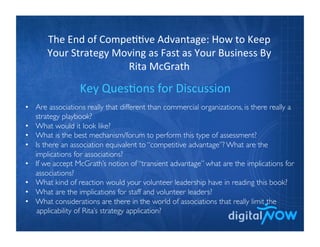
Key	
  Ques-ons	
  for	
  Discussion	


•  Are associations really that different than commercial organizations, is there really a
strategy playbook? 	

•  What would it look like?	

•  What is the best mechanism/forum to perform this type of assessment?	

•  Is there an association equivalent to “competitive advantage”? What are the
implications for associations?	

•  If we accept McGrath’s notion of “transient advantage” what are the implications for
associations? 	

•  What kind of reaction would your volunteer leadership have in reading this book?	

•  What are the implications for staff and volunteer leaders?	

•  What considerations are there in the world of associations that really limit the	

applicability of Rita’s strategy application?
Can	
  your	
  career	
  survive	
  the	
  transient	
  
compe--ve	
  advantage	
  economy?	
  
1.  If my current employer let me go, it would be relatively easy to find a similar role in
another organization for equivalent compensation.	

2.  If I lost my job today, I am well prepared and know immediately what I will do next.	

3.  I’ve worked in some meaningful capacity (employment, consulting, volunteering, partnering)
with at least five different organizations within the last two years.	

4.  I’ve learned a meaningful new skill that I didn’t have before in the last two years, whether it
is work-related or not.	

5.  I’ve attended a course or training program within the last two years, either in person or
virtually.	

6.  I could name, off the top of my head, at least 10 people who would be good leads for new
opportunities.	

7.  I actively engage with at least two professional or personal networks.	

8.  I have enough resources (savings or other) that I could take the time to retrain, work for a
small salary, or volunteer in order to get access to a new opportunity.	

9.  I can make income from a variety of activities, not just my salary.	

10.  I am able to relocate or travel to find new opportunities.	

Source: End of Competitive Advantage by Rita McGrath
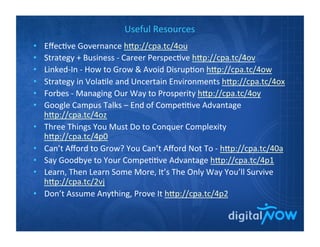
Useful	
  Resources	
  
•  Effec-ve	
  Governance	
  h[p://cpa.tc/4ou	
  
•  Strategy	
  +	
  Business	
  -­‐	
  Career	
  Perspec-ve	
  h[p://cpa.tc/4ov	
  
•  Linked-­‐In	
  -­‐	
  How	
  to	
  Grow	
  &	
  Avoid	
  Disrup-on	
  h[p://cpa.tc/4ow	
  
•  Strategy	
  in	
  Vola-le	
  and	
  Uncertain	
  Environments	
  h[p://cpa.tc/4ox	
  
•  Forbes	
  -­‐	
  Managing	
  Our	
  Way	
  to	
  Prosperity	
  h[p://cpa.tc/4oy	
  
•  Google	
  Campus	
  Talks	
  –	
  End	
  of	
  Compe--ve	
  Advantage	
  
h[p://cpa.tc/4oz	
  
•  Three	
  Things	
  You	
  Must	
  Do	
  to	
  Conquer	
  Complexity	
  
h[p://cpa.tc/4p0	
  
•  Can’t	
  Afford	
  to	
  Grow?	
  You	
  Can’t	
  Afford	
  Not	
  To	
  -­‐	
  h[p://cpa.tc/40a	
  
•  Say	
  Goodbye	
  to	
  Your	
  Compe--ve	
  Advantage	
  h[p://cpa.tc/4p1	
  
•  Learn,	
  Then	
  Learn	
  Some	
  More,	
  It’s	
  The	
  Only	
  Way	
  You’ll	
  Survive	
  
h[p://cpa.tc/2vj	
  
•  Don’t	
  Assume	
  Anything,	
  Prove	
  It	
  h[p://cpa.tc/4p2	


Session	
  PowerPoint	
  Slides	
  
Rita	
  McGrath	
  
Photo:Tom Hood & Rita McGrath at BLIThought Leader Symposium in Baltimore, MD	

“How	
  would	
  you	
  think	
  differently	
  about	
  your	
  strategy	
  if	
  
you	
  knew	
  your	
  advantage	
  might	
  not	
  last?”	
  
Are you at risk for disruption?
The Warning Signs	

•  I don’t buy my own company’s products or services 	

•  We are investing at the same levels or even more and
not getting margins or growth in return 	

•  Customers are finding cheaper or simpler solutions to be
“good enough” 	

•  Competition is emerging from places we didn’t expect 	

•  Customers are no longer excited with what we have to
offer 	

•  We are not considered a top place to work by the
people we would like to hire 	

•  Some of our very best people are leaving 	

•  The growth trajectory has slowed or reversed	

www.blionline.org/rita
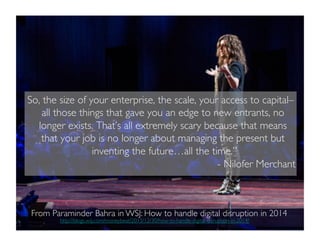
So, the size of your enterprise, the scale, your access to capital–
all those things that gave you an edge to new entrants, no
longer exists. That’s all extremely scary because that means
that your job is no longer about managing the present but
inventing the future…all the time.”	


- Nilofer Merchant	

http://blogs.wsj.com/moneybeat/2013/12/30/how-to-handle-digital-disruption-in-2014/	


From Paraminder Bahra in WSJ: How to handle digital disruption in 2014
Now what: The New Strategy
Playbook	

www.blionline.org/rita
•  Continuous Reconfiguration	

•  Healthy Disengagement	

•  Deft Resource Allocation	

•  Innovation Proficiency	

•  Discovery Driven Mindset	

•  Entrepreneurial Career Management	

The New Strategy Playbook
www.blionline.org/rita
Take the test and add up your score	

Source: Rita McGrath,
End of Competitive
Advantage
www.blionline.org/rita
How do you measure up?	

Score Band	

 Diagnosis	

 Action Implication	

14-28	

 Danger! Extreme
exploitation orientation	

Urgent issue for senior team;
major risk of being disrupted 	

19-42	

 Exploitation bias	

 At risk of being trapped; urgently
review business health 	

43-56	

 Most common; Pockets of
agility but fighting with
established businesses	

Innovation and disengagement
need to be strengthened and
made systematic; senior team
needs to get involved	

57-70	

 Moving faster, getting into a
rhythm	

Support those working in new
way; focus on resource allocation	

71+	

 Learning to compete with
transient advantage	

Remain watchful! Rita wants to
meet you.
If there is a conversation about the future
of the profession, you're bound to hear
Hood's name mentioned as one of the
people leading the way.
– Accounting Today
Tom Hood, CPA, CITP, CGMA
" Named the Second Most Influential in Accounting
by Accounting Today Magazine 2013
" Top 150 Influencer by Linked-In
" Top 25 Influencers in Learning & HR by HR
Examiner
" Top 25 Public Accounting Thought Leaders by
CPA Practice Adviser
" Working on Learning Management with AICPA/
CPA2Biz, Cloud Curriculum, Performance
Management /XBRL, Leadership & Generations
CEO
Maryland Association of CPAs
(MACPA) www.macpa.org
Business Learning Institute
(BLI) www.blionline.org
http://www.linkedin.com/in/tomhood/

Digital Now - End of Competitive Advantage - Reader Roundtable

  • 2.
    The  End  of  Compe--ve  Advantage:  How  to  Keep   Your  Strategy  Moving  as  Fast  as  Your  Business  By   Rita  McGrath   Key  Ques-ons,  Useful  Resources  &  Session  Slides       May  20,  2014         Moderator:  Tom  Hood,  CPA,CITP.CGMA,    CEO  &  Chief  Strategist,       Maryland  Associa-on  of  CPAs/Business  Learning  Ins-tute     Mary  Lynn  Fayoumi,  CAE,  GPHR,  President  &  CEO   Management  Associa-on     Greg  Fine,  CAE,  Global  Chief  Execu-ve  Officer   Turnaround  Management  Associa-on     R.  Norris  Orms,  CAE,  FACHE,  Execu-ve  Vice  President  &  COO   HIMSS    
  • 3.
    The  End  of  Compe--ve  Advantage:  How  to  Keep   Your  Strategy  Moving  as  Fast  as  Your  Business  By   Rita  McGrath   Key  Ques-ons  for  Discussion       •  Are associations really that different than commercial organizations, is there really a strategy playbook? •  What would it look like? •  What is the best mechanism/forum to perform this type of assessment? •  Is there an association equivalent to “competitive advantage”? What are the implications for associations? •  If we accept McGrath’s notion of “transient advantage” what are the implications for associations? •  What kind of reaction would your volunteer leadership have in reading this book? •  What are the implications for staff and volunteer leaders? •  What considerations are there in the world of associations that really limit the applicability of Rita’s strategy application?
  • 4.
    Can  your  career  survive  the  transient   compe--ve  advantage  economy?   1.  If my current employer let me go, it would be relatively easy to find a similar role in another organization for equivalent compensation. 2.  If I lost my job today, I am well prepared and know immediately what I will do next. 3.  I’ve worked in some meaningful capacity (employment, consulting, volunteering, partnering) with at least five different organizations within the last two years. 4.  I’ve learned a meaningful new skill that I didn’t have before in the last two years, whether it is work-related or not. 5.  I’ve attended a course or training program within the last two years, either in person or virtually. 6.  I could name, off the top of my head, at least 10 people who would be good leads for new opportunities. 7.  I actively engage with at least two professional or personal networks. 8.  I have enough resources (savings or other) that I could take the time to retrain, work for a small salary, or volunteer in order to get access to a new opportunity. 9.  I can make income from a variety of activities, not just my salary. 10.  I am able to relocate or travel to find new opportunities. Source: End of Competitive Advantage by Rita McGrath
  • 5.
    Useful  Resources   • Effec-ve  Governance  h[p://cpa.tc/4ou   •  Strategy  +  Business  -­‐  Career  Perspec-ve  h[p://cpa.tc/4ov   •  Linked-­‐In  -­‐  How  to  Grow  &  Avoid  Disrup-on  h[p://cpa.tc/4ow   •  Strategy  in  Vola-le  and  Uncertain  Environments  h[p://cpa.tc/4ox   •  Forbes  -­‐  Managing  Our  Way  to  Prosperity  h[p://cpa.tc/4oy   •  Google  Campus  Talks  –  End  of  Compe--ve  Advantage   h[p://cpa.tc/4oz   •  Three  Things  You  Must  Do  to  Conquer  Complexity   h[p://cpa.tc/4p0   •  Can’t  Afford  to  Grow?  You  Can’t  Afford  Not  To  -­‐  h[p://cpa.tc/40a   •  Say  Goodbye  to  Your  Compe--ve  Advantage  h[p://cpa.tc/4p1   •  Learn,  Then  Learn  Some  More,  It’s  The  Only  Way  You’ll  Survive   h[p://cpa.tc/2vj   •  Don’t  Assume  Anything,  Prove  It  h[p://cpa.tc/4p2    
  • 6.
  • 8.
  • 9.
    Rita  McGrath   Photo:TomHood & Rita McGrath at BLIThought Leader Symposium in Baltimore, MD “How  would  you  think  differently  about  your  strategy  if   you  knew  your  advantage  might  not  last?”  
  • 10.
    Are you atrisk for disruption?
  • 11.
    The Warning Signs • I don’t buy my own company’s products or services •  We are investing at the same levels or even more and not getting margins or growth in return •  Customers are finding cheaper or simpler solutions to be “good enough” •  Competition is emerging from places we didn’t expect •  Customers are no longer excited with what we have to offer •  We are not considered a top place to work by the people we would like to hire •  Some of our very best people are leaving •  The growth trajectory has slowed or reversed www.blionline.org/rita
  • 12.
    So, the sizeof your enterprise, the scale, your access to capital– all those things that gave you an edge to new entrants, no longer exists. That’s all extremely scary because that means that your job is no longer about managing the present but inventing the future…all the time.” - Nilofer Merchant http://blogs.wsj.com/moneybeat/2013/12/30/how-to-handle-digital-disruption-in-2014/ From Paraminder Bahra in WSJ: How to handle digital disruption in 2014
  • 13.
    Now what: TheNew Strategy Playbook www.blionline.org/rita •  Continuous Reconfiguration •  Healthy Disengagement •  Deft Resource Allocation •  Innovation Proficiency •  Discovery Driven Mindset •  Entrepreneurial Career Management The New Strategy Playbook
  • 14.
    www.blionline.org/rita Take the testand add up your score Source: Rita McGrath, End of Competitive Advantage
  • 15.
    www.blionline.org/rita How do youmeasure up? Score Band Diagnosis Action Implication 14-28 Danger! Extreme exploitation orientation Urgent issue for senior team; major risk of being disrupted 19-42 Exploitation bias At risk of being trapped; urgently review business health 43-56 Most common; Pockets of agility but fighting with established businesses Innovation and disengagement need to be strengthened and made systematic; senior team needs to get involved 57-70 Moving faster, getting into a rhythm Support those working in new way; focus on resource allocation 71+ Learning to compete with transient advantage Remain watchful! Rita wants to meet you.
  • 16.
    If there isa conversation about the future of the profession, you're bound to hear Hood's name mentioned as one of the people leading the way. – Accounting Today Tom Hood, CPA, CITP, CGMA " Named the Second Most Influential in Accounting by Accounting Today Magazine 2013 " Top 150 Influencer by Linked-In " Top 25 Influencers in Learning & HR by HR Examiner " Top 25 Public Accounting Thought Leaders by CPA Practice Adviser " Working on Learning Management with AICPA/ CPA2Biz, Cloud Curriculum, Performance Management /XBRL, Leadership & Generations CEO Maryland Association of CPAs (MACPA) www.macpa.org Business Learning Institute (BLI) www.blionline.org http://www.linkedin.com/in/tomhood/