SageBusinessNavigators
GuidetoMentoring
navBus
01 Foreword	 04
02 The mentoring gap 	 08
03 What to look for in a mentor?	 11
Who can help you to find a mentor?			 12
Reverse mentoring				 13
Finding a reverse mentor				 14
04 What sort of mentor is right foryou? 	 19
	
Introduction				 19
Idea				 19
Starting up				 20
Small business				 22
Mid-market				 25
05 Why mentoring matters 			 26
Introduction	 				 26
What does mentoring mean to me?
- John Webb, Marketing Director - Startups, 		 26
Developers  Investors, Rackspace			
- Michael Mercieca, CEO, Young Enterprise	 29
- Matthew Stafford, Co-Founder, 			 29
@Studentupstarts, @9others
00
Contents
We all get prettystuckinwhat I
call the inside out mentality.We
can be quite buried in the detail
ofrunning ourbusinesses. This is
where mentors come in. A mentor
is someonewho canviewyour
business from the perspective of
the market orthe customer, from
the outside in, and can giveyou
a more objective opinion and see
things thatyou can't.
Brendan Flattery, Sage CEO UK  Ireland
01
Mentoring has always been a part
of the workplace, even back before
the business of business got going.
Craftsmen and women learned their
trade at the feet of older, wiser experts
through apprenticeships.
In today’s complex entrepreneurial
environment, mentoring is more
important than ever. Around the world,
business confidence is returning and as
trading conditions improve, high growth
is the target for small and medium
sized businesses.
If SMBs are to thrive, they need to
look outside their business to get
advice to make the next leap. Research
has shown that 70 per cent of small
businesses that receive mentoring
survive for five years or more, which is
double the rate compared with non-
mentored entrepreneurs.
Mentors can help businesses to make
the right changes at the right times
- it’s an extremely effective way for
people to develop new skills, navigate
diverse company growth decisions and
understand how to deal with people
and problems.
A recent survey by the UK’s Department
for Business, Innovation and Skills found
that 94 per cent of SMEs using external
support have seen benefits. These firms
are more ambitious and have higher
relative turnovers.
We can be quite buried in the detail of
running our businesses. A mentor is
someone who can view your business
from the perspective of the market or
the customer – from the outside in –
and they can give you a more objective
opinion and see things that you can’t.
For example, a mentor to a small
business owner might be able to say
how the company’s products and
services are perceived relative to the
competition or give them advice on how
to market more effectively.
Mentoringhasalwaysbeenapartof
theworkplace, evenbackbeforethe
businessofbusinessgotgoing.
Craftsmenandwomenlearned
theirtradeatthefeetofolder,wiser
expertsthroughapprenticeships.
Sage Business Navigators
Guide to Mentoring
Brendan Flattery
Sage CEO UK  Ireland
0504
Foreword
01
SMBsneedtolookoutside theirbusiness
tothrive.Researchhasshown that70
percentofsmallbusinessesthatreceive
mentoringsurvive forfiveyearsormore,
whichisdoublethe rate comparedwith
non-mentoredentrepreneurs.
01
Foreword
Sage Business Navigators
Guide to Mentoring
0806 0806
The truth is that running a small
business can be quite an isolated
position. You don’t have the network
of business colleagues to brainstorm
ideas with or perhaps a wide view
of the choices in front of you when it
comes to models for growth.
But there is a problem with the
application of mentoring – a gap
between those who understand that
mentoring is a good thing and those
who actually use one. A recent Sage
global survey shows that 93 per cent
of SMBs believe that mentors will help
them to succeed. But the exclusive
research also found that only 28 per
cent were actually using any kind
of advisor.
Many people don’t know how to
find a mentor and many also feel
uncomfortable about establishing a
relationship and reluctance to engage
an external advisor.
One of the problems is that there is
some confusion as to what a business
mentor is. I think the definition is a
person from outside your immediate
business environment with relevant
experience who acts as an outside-in
advisor on a regular basis. This can
be a paid or unpaid relationship. It is
different from a business coach or a
consultant who provides advice on the
general principles of business success,
not from a position of personal
experience.
I am very lucky that I have a formal
mentoring relationship through a
professional mentoring organisation.
I have found that the more regularly
you can meet the more you can build
the relationship. It is important to get
away from the day to day distraction of
the business and the space allows you
time to think, reflect and to have proper
discussions about what you are trying
to achieve together.
The key for me has been going into
the mentoring process with the right
attitude. Unless you go into mentoring
knowing that the other person is better
equipped with the relevant knowledge
and that you have to be receptive to
that, then things will not work out.
Put it another way, you have to check
your ego at the door. And that can be
hard for some entrepreneurs and some
business people who have thrown
themselves heart and soul into their
business venture and feel they know it
inside out.
Crucially, mentoring reminds people
that we all need help - that we don’t
have all the answers. And at its best
mentoring can be a natural extension
of networking.
At Sage we want to work to help
entrepreneurs and small business
owners find the business advisors
and experts that will help them
accelerate their business and generate
new growth.
We recently brought together
mentoring experts to discuss the
challenges for small businesses
when it comes to mentoring and
we have launched a Business
Navigators campaign to raise
awareness. We have produced this
guide to help SMBs - please read on
for advice and the views of some of the
mentoring experts.
We believe that mentoring gives SMBs
the confidence and control to make the
right decisions.
Brendan Flattery
Sage CEO UK  Ireland
908
of business decision-makers
would be most likely to go to
people they know for business
advice and mentoring.
of business decision-makers
would go to ‘select business
mentors’ as their first option for
business advice.
Sage Business Navigators
Guide to Mentoring
02
TheMentoringGap
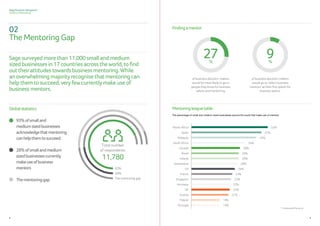
Sagesurveyedmorethan11,000 smallandmedium
sizedbusinessesin17countriesacrosstheworld, to find
outtheirattitudestowardsbusinessmentoring.While
an overwhelmingmajorityrecognisethatmentoringcan
helpthemtosucceed,veryfewcurrentlymakeuseof
businessmentors.
Findingamentor
MentoringleaguetableGlobalstatistics
0808 98
93%ofsmalland
mediumsizedbusinesses
acknowledgethatmentoring
canhelpthemtosucceed.
28%ofsmallandmedium
sizedbusinessescurrently
makeuseofbusiness
mentors
Thementoringgap
The percentage of small and medium sized businesses around the world that make use of mentors.
11
Whattolookfor
in amentor?
Itcanseemlikea
dauntingtaskandit’s
difficultknowingwhoto
turntoandhowbestto
makeanapproach.
03
So your business is growing and you
know that a mentor will significantly
improve your chances of success.
But how do you know who will be
an effective mentor to you and your
business? And how do you establish a
relationship that will help you both to
get the most from the experience.
It can seem like a daunting task and it’s
difficult knowing who to turn to and how
best to make an approach. Start with
the experts, professionals and business
owners you admire and respect and
don’t restrict yourself to one mentor. It’s
unlikely you will find one person who can
help with everything. Different people
bring different areas of expertise that will
be relevant to your business as it passes
through stages of development.
Look for someone who has:
1.	 Experience of your industry
2.	 Is a good listener
3.	 Has the technical skills to advise
4.	Is willing to introduce you to useful
contacts
Establishing the relationship at the outset
is one of the most important things you
can do. The rules that you put in place
at the start will determine what value you
get from the relationship in the long term.
Keep these things in mind to make
sure you get off on the right foot:
•	Clear expectations: Both you and
your mentor should be clear about
your expectations and what you want
to achieve from the relationship
•	Agreed upon rules: Agree some
clear rules so that both parties know
what is expected from them and to
ensure you are both fully committed
to the mentoring relationship and
how it will work
•	 Trust: The point of a mentor is to
push you to do things you might not
have done otherwise. You must have
faith in the guidance you are given
otherwise the whole relationship will
fall down
•	 Honesty: Be open with your mentor
– let them know how you are feeling,
the pressures you are under, what is
working well and what isn’t
10
Sage Business Navigators
Guide to Mentoring
08012 1312
You can find a mentor through the
Association of Business Mentors
associationofbusinessmentors.org
or you could look to one of the following
organisations for support:
National Enterprise Network offers links
to local business support agencies in
your area.
nationalenterprisenetwork.org
NACUE represents enterprise societies
in universities and colleges that could be
your first port of call.
nacue.com
In 2011, the Prince’s Trust helped
almost 13,000 young people through its
Enterprise Programme.
princes-trust.org.uk/enterprise
Reverse mentoring is a great way
for larger businesses or experienced
business owners to gain a fresh
perspective and breathe new life into
your business. It refers to the practice of
senior executives meeting with younger
less experienced mentors, usually
regarding the new technologies and
trends that are shaping the market.
Running a business is pretty all
consuming. Chances are you won’t
have time to explore the burgeoning
technology trends and behaviours
that are likely to shape the market
of tomorrow. A reverse mentor can
provide you with a shortcut that enables
you to keep pace with Gen-Y and the
constantly shifting cultural landscape.
The key to successful reverse mentoring,
is a willingness to learn on the part of the
mentee. Resist the instinctive desire to
impart the wisdom you’ve gathered from
years of experience and simply turn up
ready to listen and learn.
Create a shared list that combines things
that interest you and things your reverse
mentor thinks should be on your radar
- cool campaigns, emerging trends,
new innovations - and take the time
each month or each quarter, to sit down
and talk through them. Maybe explore
ways that they could be relevant to your
business and how it could push your
business forward. While you should try
and put some structure behind these
sessions, don’t make them too rigid. Try
to create a format that lets you share
ideas and discuss them freely.
approach
afresh
03
Reversementoring
03
Whocanhelpyou
tofindamentor?
Sage Business Navigators
Guide to Mentoring
03
Findingareversementor
If you are a part of a large organisation,
look within your business at those
younger employees who are making a
name for themselves. Find someone who
has potential – not least because the
added responsibility and faith you show
in them will encourage their personal
development. Look for someone who is
naturally curious, enthusiastic and au fait
with the latest technologies and trends.
There are many benefits of reverse
mentoring programs. It develops both
parties: for example, older employees
learn more about social media from the
younger person and the younger person
learns business terminology and industry
practices from the older employee. It
also helps to bring different generations
within your business closer together and
creates a greater sense of unity.
Therearemanybenefits
ofreversementoring
programs.
Italsohelpstobring
differentgenerations
withinyourbusiness
closertogetherand
createsagreatersense
ofunity.
Why is mentoring important?
Mentoring doesn’t necessarily need
to be a formal arrangement. From my
experience the best relationships start
informally - two people chatting through
their problems over a cup of tea.
I met one of my mentors at a dinner
and didn’t at any point think, ‘I need
to make him my mentor.’ We never
had that conversation, we just got on
well. I thought that he could be really
helpful and he was excited about my
business and wanted to help. I think a
lot of people like me have had similar
experiences but maybe don’t recognise
that as mentoring.
If you are running your own business,
then there will be times when it is
extremely stressful and having someone
completely unconnected from everything
is incredibly valuable. There are times
when I hate my co-founder and I can’t
stand my husband and I want someone
removed from my day-to-day pressures
who will listen to me.
Sometimes when everything gets on top
of you, you need someone to reassure
you, stop you thinking about the bigger
picture and instead get you to put one
foot in front of the other. Honestly, I
would not be able to function without
my mentors.
What’s holding back mentoring?
For me mentoring is a lot like dating. You
need to kiss a lot of frogs before you find
your prince. And anyone who is running
a small business doesn’t have the time
to spend ages searching for the right
mentor for them.
I also think a fear of being perceived a
failure is holding back businesses from
adopting mentors. British business
owners need to get over their reluctance
to ask for help, because mentoring can
be hugely valuable. Another person’s
vision is, I think, far more effective at
solving problems than simply throwing
money at them.
What should mentors avoid?
Overpromising. One thing that’s
irritated me in the past are people who
get carried away and promise things
they can’t deliver. As the mentee, you
come away from the meeting thinking
great and then two weeks go by and
you don’t hear from them. It’s simple
housekeeping; don’t promise things you
can’t deliver and make sure you follow
up on those you can.
Alex Depledge,
Co-Founder, Hassle.com
Casestudy
014 1514
1716
Sage Business Navigators
Guide to Mentoring
‘Ifyou are runningyour
own business, then
therewill be times
when it is extremely
stressful and having
someone completely
unconnected
from everything is
incrediblyvaluable. Alex Depledge, Hassle.com
There are timeswhen
I hate myco-founder
and I can’t stand my
husband and Iwant
someone removed
from myday-to-day
pressureswhowill
listen to me.’
081918
Whatsortofmentor
isrightforyou?
Introduction
IdeaYour mentor should be
able to break things
down into bite-sized
chunks to prevent
you from being
overwhelmed.
Kerrie Dorman,
Founder, Association of
Business Mentors
04
Every business is unique. In fact, the
desire to do things differently is why
you started your own business. But
it can also make it difficult to work
out what type of mentor will have the
greatest impact on your business
and help you to grow. The challenges
facing an entrepreneur just starting
out, differ greatly from those facing
the director of a business that’s been
operating for eight years.
We put the question to our industry
experts and asked them what
businesses should look for in a mentor,
depending on where they are in the
business lifecycle...
You’ve had a great idea. Or at least you
think you have. But how do you know if
you can turn that idea into a business?
There is no shortage of people saying
you should “go for it!”, but few who can
provide guidance on how you go
about it.
It’s a significant and sometimes terrifying
undertaking, one that will require a
huge amount of commitment just to
encourage others to buy into your idea
and get your business off the ground.
What’s more the foundations you put in
place at the outset will affect whether
you succeed or not.
What keeps you awake at night?
•	 Not knowing whether you are doing
the right thing
•	The amount of money it will take to
get your idea off the ground, and
how to secure it
•	The time it will take before you
actually start making money
•	Accountancy, taxation and
legislation - what happens if you
make a mistake
•	Finding customers who will
pay for the product or service you
are offering
•	Basic operations - how is it all
going to work?
What type of mentor is right for you?
Kerrie Dorman: Look for a mentor who
has started more than one business
from scratch on their own. They should
be practical and specialise in supporting
micro businesses to get off the ground.
It’s important to have someone who
can keep you focused on each area of
the business and keep it simple. Your
mentor should be able to break things
down into bite-sized chunks to prevent
you from being overwhelmed.
Someone from a corporate background
is probably not right for you at the
moment. What you need is someone
who has recent experience of what it
takes to get a business up and running.
Sage Business Navigators
Guide to Mentoring
04
Startingup
It probably feels like you do everything:
marketing the company, managing
stock, selling products, meeting
suppliers,
balancing the books and helping out
wherever you’re needed.
Often it can be hard to distinguish
personal ambitions from career
ambitions, and where your personal
development ends and business
development begins. At this stage of the
business lifecycle they’re intertwined.
In order to get this far you will have
invested a lot of yourself in the company
in terms of money, time and hard work.
It’s likely that there are very few people
who currently work for your business
full time, maybe just two or three
others, and like you they are extremely
time poor. It can, therefore, be difficult
reaching an objective view of a particular
issue, or easy to fall in to the trap of
approaching problems in the same way,
time and again.
What keeps you awake at night?
•	 You’ve invested so much into this
and failure is not an option
•	New clients are critical. You need
to promote your business wherever
possible
•	Until your client base grows, your
cash flow can be unstable. You need
to stay on top of taking payments, of
what money comes in and what bills
need to be paid
•	There are so many legislative
changes that restrict and influence
what you need to do. Staying on top
of this can be very difficult
•	As you expand and hire new workers
you worry about maintaining and
keeping staff for the long term
What type of mentor is right for you?
Kerrie Dorman: Look for a mentor
who can spot strategic flaws and
has experience in rectifying them. It’s
important to be able to get the business
working for you rather than the other
way around and now is the time to make
that transition.
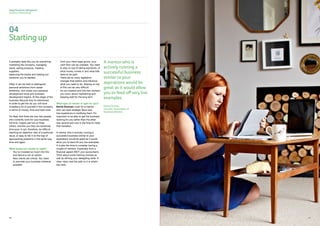
A mentor who is actively running a
successful business similar to your
aspirations would be great as it would
allow you to feed off very live examples.
It is also the time to consider having a
couple of mentors. Especially from a
financial aspect (NOT your accountant).
Think about some training courses as
well as refining your delegating skills. A
clear vision and the path to it is what’s
key here.
A mentorwho is
actively running a
successful business
similar to your
aspirations would be
great as it would allow
you to feed offvery live
examples.
Kerrie Dorman,
Founder, Association of
Business Mentors
02020 0821
Sage Business Navigators
Guide to Mentoring
04
Smallbusiness
You’ve set up and established your
business and things are going well.
You have a number of people working
for you, while you’re responsible for
the day-to-day management of
the business.
You spend a lot of your time thinking
about how to improve processes,
business development and growing your
customer base. One of the toughest
challenges is dealing with the company’s
growing pains and making sure that the
size of your organisation matches the
amount of business coming in.
You want to see the company grow and
for it to become an international venture.
To achieve this you need to define the
strategic direction of the business, help it
to run more economically and effectively,
and ensure the company succeeds.
As the head of the business all
employees ultimately report to you and
look to you for leadership. However,
given the size of your business it can
be difficult staying on top of everything
that happens. When it comes to making
decisions there are senior figures in your
organisation who can advise you, but
few who truly see the bigger picture.
What keeps you awake at night?
•	 Ensuring that the business has
enough for day-to-day operations
•	 Gaining new customers, with
increased competition, but a decline
of disposable customer income
•	Knowing that with the current
economy you run the risk of closure
at a moment’s notice
What type of mentor is right for you?
David Hardstaff: You should, by this
stage be calling upon the expertise of
a wide range of mentors. Where in the
past you may have one or two trusted
advisors who helped you put in place the
fundamentals of your business, now you
need access to a wider range of practical
experience.
The issues you face as a business are
diverse and complex, and it’s unlikely
that you’ll find one, two or even three
people who have first-hand experience
of all of them. As your business grows
larger, you will begin to employ senior
staff into specialist roles within your
business - operational, financial,
marketing. Consider matching these
employees with mentors who have
expertise within these fields and think of
them as your own personal boardroom.
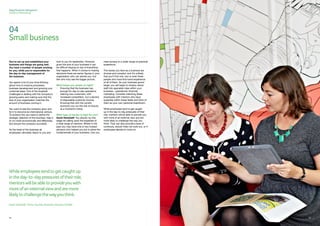
While employees tend to get caught
up in the day-to-day pressures of their
role, mentors will be able to provide you
with more of an external view and are
more likely to challenge the way you
think. They can also provide a level of
continuity, should hires not work out, or if
employees decide to move on.
Whileemployeestendtogetcaughtup
intheday-to-daypressuresoftheirrole,
mentorswillbeabletoprovideyouwith
moreofanexternalviewandaremore
likelytochallengethewayyouthink.
David Hardstaff, Home Counties Business Advisors (HCBA)
02222 23
04
Mid-market
24 25
As the director of a mid-market
business you find yourself dividing
your time between meetings on
planning for the business’s future,
cash flow forecasts, cutting costs
and managing a team that is spread
across multiple countries. You have a
team of people who report directly to
you, but you also regularly meet with
the leads of departments to monitor
revenue, costs and plan for the future.
Your primary objective is to ensure the
business remains competitive across all
markets, while also managing financial
risks and staying accountable. You need
to keep a tight control on costs through
streamlining processes and increasing
efficiency of the business.
What keeps you awake at night?
•	Controlling costs to enable growth
•	The economy. Many customers have
a reduced disposable income
•	The cost and impact of retaining and
training our staff
•	 Staying competitive in a global
market place and working in a
multi-company, multi-currency and
multi-legislation environment
•	 Understanding which customers are 	
	 more profitable than others
What type of mentor is right for you?
David Hardstaff: If you’ve been with
your business since it began, then
you’ve no doubt acquired a fair amount
of experience over the years. You’ll
probably also have a network of people
who have helped or advised you along
the way. Amongst this network you are
likely to find people who are willing to
act as a sounding board for ideas, either
formally or informally.
Chances are you’ll be acting as a mentor
to other younger businesses and sharing
some of the expertise you’ve developed
in your industry. However, there is plenty
that you can learn from others.
Look at the people you mentor or
junior employees within your business
and see who among them has expertise
in areas that are, or could be, relevant
to your business. Consider setting up
a reciprocal relationship, where you
provide them with advice on how to
develop, while they keep you up to
speed with the latest trends
and innovations.
You’llprobablyhavea
networkofpeoplewho
havehelpedoradvised
youalongtheway.
David Hardstaff, Home Counties Business Advisors (HCBA)
2726
Whymentoring
matters
Introduction
Whatdoesmentoring
meantome?
John Webb,
Marketing Director, Startups,
Developers  Investors, Rackspace
05
We’ve invited three of our Business
Navigators to share their thoughts
on what mentoring means to them
and why it should be on every
business’s radar.
One of the most important roles that
a mentor can play is helping mentees
to see the wood for the trees. People
often become so immersed in their own
businesses they are living and breathing
it every single day of the week. I help
them to step back a little bit and provide
them with an external view on their
business and marketing strategies.
Sometimes all people really need is
reassurance. It’s important to put people
at ease and also be very clear on exactly
what it is you can do and what you can
deliver. You have to be honest with the
people you mentor. I don’t see that all
the time. Someone came to me the other
day asking for advice on dealing with
investors and I said, “I’m a marketer.”
I don’t pretend to be anything else. If
someone wants marketing advice I’m
your guy. If they want investment advice
then I direct them elsewhere to people I
know who’ve been there and done it.
Marketing moves so quickly there is no
way, with respect, that someone running
a business can keep up with that.
Whereas that’s my business, that’s
my passion.
In return I get to work with some really
exciting start-ups and small businesses,
who are doing some really challenging
and exciting things. It gives me the
chance to look at things I would not
necessarily look at in my day job and
apply some of that start-up thinking to
my work.
I think mentoring works both ways -
there’s a value exchange. From my side
as the mentor, I provide experience and
knowledge of what paths are open to
businesses. Whereas I get feedback on
my thinking and strategies that I can
apply to my day job.
Ulterior motives
I hear about quite a few people who
mentor with an agenda - people who
go into it purely to try to generate new
business. My mentality is the complete
opposite. I don’t look at it as a sale and
never give a pitch. The value I believe I
can give is in passing on the marketing
knowledge, experience and insights that
I’ve gained. Over time people still come
to me and ask, John, can you help with
my hosting? That’s because I’ve earned
their respect and trust; they want to
work with me and the companies that
I represent. I think we need to look at
educating mentors in terms of what’s
expected of them and the value they
can deliver.
Sage Business Navigators
Guide to Mentoring
082928
Whatdoesmentoring
meantome?
Michael Mercieca,
CEO, Young Enterprise
Whatdoesmentoring
meantome?
Matthew Stafford,
Founder, @Studentupstarts, @9others
05
Whymentoring matters
I think confidence is key. A lot of people
who have started their own businesses
know what they want to achieve, but
don’t necessarily know the best way to
get there. A mentor needs to point them
in the right direction, but also give them
the confidence to continue along that
path until they get to where they want
to be.
I work a lot with younger entrepreneurs,
many of whom are still at school. At
Young Enterprise we help people from
disadvantaged backgrounds to learn
about starting their own businesses.
There are organisations giving out
millions of pounds in loans to help
people to start their own businesses.
However, without significant training
and guidance on how to best use that
money, a lot of it will go to waste. Yes
they need funding to get off the ground,
but what is more valuable is someone
to guide them on how to establish and
manage their business.
The vast majority of the people we help
have never come into contact with
people from the world of business –
executives, board members, investors.
We let them know what to expect and
also give them the confidence to engage
with people who can help their business
to flourish. We also help them to accept
failure and teach them that often you
learn most from your mistakes.
Mentoring needs to be easy
Start-ups and small businesses are
extremely time poor. They are focusing
on getting money through the door
and goods and services out of the
door. Mentoring needs to work at their
convenience. If it takes three months
and miles and miles of paperwork, then
it won’t take off.
If you run your own business, sometimes
you want to talk to someone who is not
your co-founder, not on your board, not
your investor, not your customer and not
your partner at home. But somebody!
Often when things aren’t going well the
tendency is to bury your head a bit and
not have the conversations you ought to
have. This is when a trusted network is
incredibly valuable.
From my personal experience I have
dozens of ‘mentors’ I just don’t refer
to them as mentors. I have a trusted
network of people I regularly talk
to about my businesses and life in
general – people I chat to on Twitter,
email, Skype or best of all in person
and ‘offline’. I find that works better for
me than having one person I meet with
formally each week - life moves far too
fast for that.
Here’s an example of the network at
work - I was working in a café recently
with my co-founder of Student Upstarts
talking about potential investments
and tinkering with our website. I was
on Skype to my co-founder of 9others
organising a dinner in Singapore and
rattling through emails in-between. All of
a sudden, the Student Upstarts website
went down. I couldn’t figure it out
straight away so I sent a Direct Message
(DM) to one of my contacts on Twitter.
I knew he could help and a Twitter DM
was the best way to reach him.
There are no shortcuts to earning trust
though. I have built my network up
over the last four-and-a-half years or
so. It’s hugely important to me and
would be easy to destroy for some
short-term gain. The people within
that network know they can count on
me and each other because we’ve
all given and received help from one
another. A lot of the people within the
network met through social media – by
someone asking for advice on Twitter
and someone else providing them with
an answer. There are no hierarchies on
Twitter and it’s easy to get that ‘social
proof’ of someone. You need to have
a helpful attitude and be transparent,
honest and confident about yourself and
your own abilities. If you go out with that
kind of helpful attitude you get an awful
lot back.
30
The Sage Group plc
North Park
Newcastle Upon Tyne
NE13 9AA
United Kingdom
Tel: 	 +44 (191) 294 3000
Fax: 	 +44 (191) 294 0002
www.sage.com
© The Sage Group plc 2014
All Rights Reserved

Sage Business Navigators Report Guide to Mentoring

  • 1.
  • 2.
    01 Foreword 04 02The mentoring gap 08 03 What to look for in a mentor? 11 Who can help you to find a mentor? 12 Reverse mentoring 13 Finding a reverse mentor 14 04 What sort of mentor is right foryou? 19 Introduction 19 Idea 19 Starting up 20 Small business 22 Mid-market 25 05 Why mentoring matters 26 Introduction 26 What does mentoring mean to me? - John Webb, Marketing Director - Startups, 26 Developers Investors, Rackspace - Michael Mercieca, CEO, Young Enterprise 29 - Matthew Stafford, Co-Founder, 29 @Studentupstarts, @9others 00 Contents We all get prettystuckinwhat I call the inside out mentality.We can be quite buried in the detail ofrunning ourbusinesses. This is where mentors come in. A mentor is someonewho canviewyour business from the perspective of the market orthe customer, from the outside in, and can giveyou a more objective opinion and see things thatyou can't. Brendan Flattery, Sage CEO UK Ireland
  • 3.
    01 Mentoring has alwaysbeen a part of the workplace, even back before the business of business got going. Craftsmen and women learned their trade at the feet of older, wiser experts through apprenticeships. In today’s complex entrepreneurial environment, mentoring is more important than ever. Around the world, business confidence is returning and as trading conditions improve, high growth is the target for small and medium sized businesses. If SMBs are to thrive, they need to look outside their business to get advice to make the next leap. Research has shown that 70 per cent of small businesses that receive mentoring survive for five years or more, which is double the rate compared with non- mentored entrepreneurs. Mentors can help businesses to make the right changes at the right times - it’s an extremely effective way for people to develop new skills, navigate diverse company growth decisions and understand how to deal with people and problems. A recent survey by the UK’s Department for Business, Innovation and Skills found that 94 per cent of SMEs using external support have seen benefits. These firms are more ambitious and have higher relative turnovers. We can be quite buried in the detail of running our businesses. A mentor is someone who can view your business from the perspective of the market or the customer – from the outside in – and they can give you a more objective opinion and see things that you can’t. For example, a mentor to a small business owner might be able to say how the company’s products and services are perceived relative to the competition or give them advice on how to market more effectively. Mentoringhasalwaysbeenapartof theworkplace, evenbackbeforethe businessofbusinessgotgoing. Craftsmenandwomenlearned theirtradeatthefeetofolder,wiser expertsthroughapprenticeships. Sage Business Navigators Guide to Mentoring Brendan Flattery Sage CEO UK Ireland 0504 Foreword 01
  • 4.
    SMBsneedtolookoutside theirbusiness tothrive.Researchhasshown that70 percentofsmallbusinessesthatreceive mentoringsurviveforfiveyearsormore, whichisdoublethe rate comparedwith non-mentoredentrepreneurs. 01 Foreword Sage Business Navigators Guide to Mentoring 0806 0806 The truth is that running a small business can be quite an isolated position. You don’t have the network of business colleagues to brainstorm ideas with or perhaps a wide view of the choices in front of you when it comes to models for growth. But there is a problem with the application of mentoring – a gap between those who understand that mentoring is a good thing and those who actually use one. A recent Sage global survey shows that 93 per cent of SMBs believe that mentors will help them to succeed. But the exclusive research also found that only 28 per cent were actually using any kind of advisor. Many people don’t know how to find a mentor and many also feel uncomfortable about establishing a relationship and reluctance to engage an external advisor. One of the problems is that there is some confusion as to what a business mentor is. I think the definition is a person from outside your immediate business environment with relevant experience who acts as an outside-in advisor on a regular basis. This can be a paid or unpaid relationship. It is different from a business coach or a consultant who provides advice on the general principles of business success, not from a position of personal experience. I am very lucky that I have a formal mentoring relationship through a professional mentoring organisation. I have found that the more regularly you can meet the more you can build the relationship. It is important to get away from the day to day distraction of the business and the space allows you time to think, reflect and to have proper discussions about what you are trying to achieve together. The key for me has been going into the mentoring process with the right attitude. Unless you go into mentoring knowing that the other person is better equipped with the relevant knowledge and that you have to be receptive to that, then things will not work out. Put it another way, you have to check your ego at the door. And that can be hard for some entrepreneurs and some business people who have thrown themselves heart and soul into their business venture and feel they know it inside out. Crucially, mentoring reminds people that we all need help - that we don’t have all the answers. And at its best mentoring can be a natural extension of networking. At Sage we want to work to help entrepreneurs and small business owners find the business advisors and experts that will help them accelerate their business and generate new growth. We recently brought together mentoring experts to discuss the challenges for small businesses when it comes to mentoring and we have launched a Business Navigators campaign to raise awareness. We have produced this guide to help SMBs - please read on for advice and the views of some of the mentoring experts. We believe that mentoring gives SMBs the confidence and control to make the right decisions. Brendan Flattery Sage CEO UK Ireland
  • 5.
    908 of business decision-makers wouldbe most likely to go to people they know for business advice and mentoring. of business decision-makers would go to ‘select business mentors’ as their first option for business advice. Sage Business Navigators Guide to Mentoring 02 TheMentoringGap Sagesurveyedmorethan11,000 smallandmedium sizedbusinessesin17countriesacrosstheworld, to find outtheirattitudestowardsbusinessmentoring.While an overwhelmingmajorityrecognisethatmentoringcan helpthemtosucceed,veryfewcurrentlymakeuseof businessmentors. Findingamentor MentoringleaguetableGlobalstatistics 0808 98 93%ofsmalland mediumsizedbusinesses acknowledgethatmentoring canhelpthemtosucceed. 28%ofsmallandmedium sizedbusinessescurrently makeuseofbusiness mentors Thementoringgap The percentage of small and medium sized businesses around the world that make use of mentors.
  • 6.
    11 Whattolookfor in amentor? Itcanseemlikea dauntingtaskandit’s difficultknowingwhoto turntoandhowbestto makeanapproach. 03 So yourbusiness is growing and you know that a mentor will significantly improve your chances of success. But how do you know who will be an effective mentor to you and your business? And how do you establish a relationship that will help you both to get the most from the experience. It can seem like a daunting task and it’s difficult knowing who to turn to and how best to make an approach. Start with the experts, professionals and business owners you admire and respect and don’t restrict yourself to one mentor. It’s unlikely you will find one person who can help with everything. Different people bring different areas of expertise that will be relevant to your business as it passes through stages of development. Look for someone who has: 1. Experience of your industry 2. Is a good listener 3. Has the technical skills to advise 4. Is willing to introduce you to useful contacts Establishing the relationship at the outset is one of the most important things you can do. The rules that you put in place at the start will determine what value you get from the relationship in the long term. Keep these things in mind to make sure you get off on the right foot: • Clear expectations: Both you and your mentor should be clear about your expectations and what you want to achieve from the relationship • Agreed upon rules: Agree some clear rules so that both parties know what is expected from them and to ensure you are both fully committed to the mentoring relationship and how it will work • Trust: The point of a mentor is to push you to do things you might not have done otherwise. You must have faith in the guidance you are given otherwise the whole relationship will fall down • Honesty: Be open with your mentor – let them know how you are feeling, the pressures you are under, what is working well and what isn’t 10
  • 7.
    Sage Business Navigators Guideto Mentoring 08012 1312 You can find a mentor through the Association of Business Mentors associationofbusinessmentors.org or you could look to one of the following organisations for support: National Enterprise Network offers links to local business support agencies in your area. nationalenterprisenetwork.org NACUE represents enterprise societies in universities and colleges that could be your first port of call. nacue.com In 2011, the Prince’s Trust helped almost 13,000 young people through its Enterprise Programme. princes-trust.org.uk/enterprise Reverse mentoring is a great way for larger businesses or experienced business owners to gain a fresh perspective and breathe new life into your business. It refers to the practice of senior executives meeting with younger less experienced mentors, usually regarding the new technologies and trends that are shaping the market. Running a business is pretty all consuming. Chances are you won’t have time to explore the burgeoning technology trends and behaviours that are likely to shape the market of tomorrow. A reverse mentor can provide you with a shortcut that enables you to keep pace with Gen-Y and the constantly shifting cultural landscape. The key to successful reverse mentoring, is a willingness to learn on the part of the mentee. Resist the instinctive desire to impart the wisdom you’ve gathered from years of experience and simply turn up ready to listen and learn. Create a shared list that combines things that interest you and things your reverse mentor thinks should be on your radar - cool campaigns, emerging trends, new innovations - and take the time each month or each quarter, to sit down and talk through them. Maybe explore ways that they could be relevant to your business and how it could push your business forward. While you should try and put some structure behind these sessions, don’t make them too rigid. Try to create a format that lets you share ideas and discuss them freely. approach afresh 03 Reversementoring 03 Whocanhelpyou tofindamentor?
  • 8.
    Sage Business Navigators Guideto Mentoring 03 Findingareversementor If you are a part of a large organisation, look within your business at those younger employees who are making a name for themselves. Find someone who has potential – not least because the added responsibility and faith you show in them will encourage their personal development. Look for someone who is naturally curious, enthusiastic and au fait with the latest technologies and trends. There are many benefits of reverse mentoring programs. It develops both parties: for example, older employees learn more about social media from the younger person and the younger person learns business terminology and industry practices from the older employee. It also helps to bring different generations within your business closer together and creates a greater sense of unity. Therearemanybenefits ofreversementoring programs. Italsohelpstobring differentgenerations withinyourbusiness closertogetherand createsagreatersense ofunity. Why is mentoring important? Mentoring doesn’t necessarily need to be a formal arrangement. From my experience the best relationships start informally - two people chatting through their problems over a cup of tea. I met one of my mentors at a dinner and didn’t at any point think, ‘I need to make him my mentor.’ We never had that conversation, we just got on well. I thought that he could be really helpful and he was excited about my business and wanted to help. I think a lot of people like me have had similar experiences but maybe don’t recognise that as mentoring. If you are running your own business, then there will be times when it is extremely stressful and having someone completely unconnected from everything is incredibly valuable. There are times when I hate my co-founder and I can’t stand my husband and I want someone removed from my day-to-day pressures who will listen to me. Sometimes when everything gets on top of you, you need someone to reassure you, stop you thinking about the bigger picture and instead get you to put one foot in front of the other. Honestly, I would not be able to function without my mentors. What’s holding back mentoring? For me mentoring is a lot like dating. You need to kiss a lot of frogs before you find your prince. And anyone who is running a small business doesn’t have the time to spend ages searching for the right mentor for them. I also think a fear of being perceived a failure is holding back businesses from adopting mentors. British business owners need to get over their reluctance to ask for help, because mentoring can be hugely valuable. Another person’s vision is, I think, far more effective at solving problems than simply throwing money at them. What should mentors avoid? Overpromising. One thing that’s irritated me in the past are people who get carried away and promise things they can’t deliver. As the mentee, you come away from the meeting thinking great and then two weeks go by and you don’t hear from them. It’s simple housekeeping; don’t promise things you can’t deliver and make sure you follow up on those you can. Alex Depledge, Co-Founder, Hassle.com Casestudy 014 1514
  • 9.
    1716 Sage Business Navigators Guideto Mentoring ‘Ifyou are runningyour own business, then therewill be times when it is extremely stressful and having someone completely unconnected from everything is incrediblyvaluable. Alex Depledge, Hassle.com There are timeswhen I hate myco-founder and I can’t stand my husband and Iwant someone removed from myday-to-day pressureswhowill listen to me.’
  • 10.
    081918 Whatsortofmentor isrightforyou? Introduction IdeaYour mentor shouldbe able to break things down into bite-sized chunks to prevent you from being overwhelmed. Kerrie Dorman, Founder, Association of Business Mentors 04 Every business is unique. In fact, the desire to do things differently is why you started your own business. But it can also make it difficult to work out what type of mentor will have the greatest impact on your business and help you to grow. The challenges facing an entrepreneur just starting out, differ greatly from those facing the director of a business that’s been operating for eight years. We put the question to our industry experts and asked them what businesses should look for in a mentor, depending on where they are in the business lifecycle... You’ve had a great idea. Or at least you think you have. But how do you know if you can turn that idea into a business? There is no shortage of people saying you should “go for it!”, but few who can provide guidance on how you go about it. It’s a significant and sometimes terrifying undertaking, one that will require a huge amount of commitment just to encourage others to buy into your idea and get your business off the ground. What’s more the foundations you put in place at the outset will affect whether you succeed or not. What keeps you awake at night? • Not knowing whether you are doing the right thing • The amount of money it will take to get your idea off the ground, and how to secure it • The time it will take before you actually start making money • Accountancy, taxation and legislation - what happens if you make a mistake • Finding customers who will pay for the product or service you are offering • Basic operations - how is it all going to work? What type of mentor is right for you? Kerrie Dorman: Look for a mentor who has started more than one business from scratch on their own. They should be practical and specialise in supporting micro businesses to get off the ground. It’s important to have someone who can keep you focused on each area of the business and keep it simple. Your mentor should be able to break things down into bite-sized chunks to prevent you from being overwhelmed. Someone from a corporate background is probably not right for you at the moment. What you need is someone who has recent experience of what it takes to get a business up and running.
  • 11.
    Sage Business Navigators Guideto Mentoring 04 Startingup It probably feels like you do everything: marketing the company, managing stock, selling products, meeting suppliers, balancing the books and helping out wherever you’re needed. Often it can be hard to distinguish personal ambitions from career ambitions, and where your personal development ends and business development begins. At this stage of the business lifecycle they’re intertwined. In order to get this far you will have invested a lot of yourself in the company in terms of money, time and hard work. It’s likely that there are very few people who currently work for your business full time, maybe just two or three others, and like you they are extremely time poor. It can, therefore, be difficult reaching an objective view of a particular issue, or easy to fall in to the trap of approaching problems in the same way, time and again. What keeps you awake at night? • You’ve invested so much into this and failure is not an option • New clients are critical. You need to promote your business wherever possible • Until your client base grows, your cash flow can be unstable. You need to stay on top of taking payments, of what money comes in and what bills need to be paid • There are so many legislative changes that restrict and influence what you need to do. Staying on top of this can be very difficult • As you expand and hire new workers you worry about maintaining and keeping staff for the long term What type of mentor is right for you? Kerrie Dorman: Look for a mentor who can spot strategic flaws and has experience in rectifying them. It’s important to be able to get the business working for you rather than the other way around and now is the time to make that transition. A mentor who is actively running a successful business similar to your aspirations would be great as it would allow you to feed off very live examples. It is also the time to consider having a couple of mentors. Especially from a financial aspect (NOT your accountant). Think about some training courses as well as refining your delegating skills. A clear vision and the path to it is what’s key here. A mentorwho is actively running a successful business similar to your aspirations would be great as it would allow you to feed offvery live examples. Kerrie Dorman, Founder, Association of Business Mentors 02020 0821
  • 12.
    Sage Business Navigators Guideto Mentoring 04 Smallbusiness You’ve set up and established your business and things are going well. You have a number of people working for you, while you’re responsible for the day-to-day management of the business. You spend a lot of your time thinking about how to improve processes, business development and growing your customer base. One of the toughest challenges is dealing with the company’s growing pains and making sure that the size of your organisation matches the amount of business coming in. You want to see the company grow and for it to become an international venture. To achieve this you need to define the strategic direction of the business, help it to run more economically and effectively, and ensure the company succeeds. As the head of the business all employees ultimately report to you and look to you for leadership. However, given the size of your business it can be difficult staying on top of everything that happens. When it comes to making decisions there are senior figures in your organisation who can advise you, but few who truly see the bigger picture. What keeps you awake at night? • Ensuring that the business has enough for day-to-day operations • Gaining new customers, with increased competition, but a decline of disposable customer income • Knowing that with the current economy you run the risk of closure at a moment’s notice What type of mentor is right for you? David Hardstaff: You should, by this stage be calling upon the expertise of a wide range of mentors. Where in the past you may have one or two trusted advisors who helped you put in place the fundamentals of your business, now you need access to a wider range of practical experience. The issues you face as a business are diverse and complex, and it’s unlikely that you’ll find one, two or even three people who have first-hand experience of all of them. As your business grows larger, you will begin to employ senior staff into specialist roles within your business - operational, financial, marketing. Consider matching these employees with mentors who have expertise within these fields and think of them as your own personal boardroom. While employees tend to get caught up in the day-to-day pressures of their role, mentors will be able to provide you with more of an external view and are more likely to challenge the way you think. They can also provide a level of continuity, should hires not work out, or if employees decide to move on. Whileemployeestendtogetcaughtup intheday-to-daypressuresoftheirrole, mentorswillbeabletoprovideyouwith moreofanexternalviewandaremore likelytochallengethewayyouthink. David Hardstaff, Home Counties Business Advisors (HCBA) 02222 23
  • 13.
    04 Mid-market 24 25 As thedirector of a mid-market business you find yourself dividing your time between meetings on planning for the business’s future, cash flow forecasts, cutting costs and managing a team that is spread across multiple countries. You have a team of people who report directly to you, but you also regularly meet with the leads of departments to monitor revenue, costs and plan for the future. Your primary objective is to ensure the business remains competitive across all markets, while also managing financial risks and staying accountable. You need to keep a tight control on costs through streamlining processes and increasing efficiency of the business. What keeps you awake at night? • Controlling costs to enable growth • The economy. Many customers have a reduced disposable income • The cost and impact of retaining and training our staff • Staying competitive in a global market place and working in a multi-company, multi-currency and multi-legislation environment • Understanding which customers are more profitable than others What type of mentor is right for you? David Hardstaff: If you’ve been with your business since it began, then you’ve no doubt acquired a fair amount of experience over the years. You’ll probably also have a network of people who have helped or advised you along the way. Amongst this network you are likely to find people who are willing to act as a sounding board for ideas, either formally or informally. Chances are you’ll be acting as a mentor to other younger businesses and sharing some of the expertise you’ve developed in your industry. However, there is plenty that you can learn from others. Look at the people you mentor or junior employees within your business and see who among them has expertise in areas that are, or could be, relevant to your business. Consider setting up a reciprocal relationship, where you provide them with advice on how to develop, while they keep you up to speed with the latest trends and innovations. You’llprobablyhavea networkofpeoplewho havehelpedoradvised youalongtheway. David Hardstaff, Home Counties Business Advisors (HCBA)
  • 14.
    2726 Whymentoring matters Introduction Whatdoesmentoring meantome? John Webb, Marketing Director,Startups, Developers Investors, Rackspace 05 We’ve invited three of our Business Navigators to share their thoughts on what mentoring means to them and why it should be on every business’s radar. One of the most important roles that a mentor can play is helping mentees to see the wood for the trees. People often become so immersed in their own businesses they are living and breathing it every single day of the week. I help them to step back a little bit and provide them with an external view on their business and marketing strategies. Sometimes all people really need is reassurance. It’s important to put people at ease and also be very clear on exactly what it is you can do and what you can deliver. You have to be honest with the people you mentor. I don’t see that all the time. Someone came to me the other day asking for advice on dealing with investors and I said, “I’m a marketer.” I don’t pretend to be anything else. If someone wants marketing advice I’m your guy. If they want investment advice then I direct them elsewhere to people I know who’ve been there and done it. Marketing moves so quickly there is no way, with respect, that someone running a business can keep up with that. Whereas that’s my business, that’s my passion. In return I get to work with some really exciting start-ups and small businesses, who are doing some really challenging and exciting things. It gives me the chance to look at things I would not necessarily look at in my day job and apply some of that start-up thinking to my work. I think mentoring works both ways - there’s a value exchange. From my side as the mentor, I provide experience and knowledge of what paths are open to businesses. Whereas I get feedback on my thinking and strategies that I can apply to my day job. Ulterior motives I hear about quite a few people who mentor with an agenda - people who go into it purely to try to generate new business. My mentality is the complete opposite. I don’t look at it as a sale and never give a pitch. The value I believe I can give is in passing on the marketing knowledge, experience and insights that I’ve gained. Over time people still come to me and ask, John, can you help with my hosting? That’s because I’ve earned their respect and trust; they want to work with me and the companies that I represent. I think we need to look at educating mentors in terms of what’s expected of them and the value they can deliver. Sage Business Navigators Guide to Mentoring
  • 15.
    082928 Whatdoesmentoring meantome? Michael Mercieca, CEO, YoungEnterprise Whatdoesmentoring meantome? Matthew Stafford, Founder, @Studentupstarts, @9others 05 Whymentoring matters I think confidence is key. A lot of people who have started their own businesses know what they want to achieve, but don’t necessarily know the best way to get there. A mentor needs to point them in the right direction, but also give them the confidence to continue along that path until they get to where they want to be. I work a lot with younger entrepreneurs, many of whom are still at school. At Young Enterprise we help people from disadvantaged backgrounds to learn about starting their own businesses. There are organisations giving out millions of pounds in loans to help people to start their own businesses. However, without significant training and guidance on how to best use that money, a lot of it will go to waste. Yes they need funding to get off the ground, but what is more valuable is someone to guide them on how to establish and manage their business. The vast majority of the people we help have never come into contact with people from the world of business – executives, board members, investors. We let them know what to expect and also give them the confidence to engage with people who can help their business to flourish. We also help them to accept failure and teach them that often you learn most from your mistakes. Mentoring needs to be easy Start-ups and small businesses are extremely time poor. They are focusing on getting money through the door and goods and services out of the door. Mentoring needs to work at their convenience. If it takes three months and miles and miles of paperwork, then it won’t take off. If you run your own business, sometimes you want to talk to someone who is not your co-founder, not on your board, not your investor, not your customer and not your partner at home. But somebody! Often when things aren’t going well the tendency is to bury your head a bit and not have the conversations you ought to have. This is when a trusted network is incredibly valuable. From my personal experience I have dozens of ‘mentors’ I just don’t refer to them as mentors. I have a trusted network of people I regularly talk to about my businesses and life in general – people I chat to on Twitter, email, Skype or best of all in person and ‘offline’. I find that works better for me than having one person I meet with formally each week - life moves far too fast for that. Here’s an example of the network at work - I was working in a café recently with my co-founder of Student Upstarts talking about potential investments and tinkering with our website. I was on Skype to my co-founder of 9others organising a dinner in Singapore and rattling through emails in-between. All of a sudden, the Student Upstarts website went down. I couldn’t figure it out straight away so I sent a Direct Message (DM) to one of my contacts on Twitter. I knew he could help and a Twitter DM was the best way to reach him. There are no shortcuts to earning trust though. I have built my network up over the last four-and-a-half years or so. It’s hugely important to me and would be easy to destroy for some short-term gain. The people within that network know they can count on me and each other because we’ve all given and received help from one another. A lot of the people within the network met through social media – by someone asking for advice on Twitter and someone else providing them with an answer. There are no hierarchies on Twitter and it’s easy to get that ‘social proof’ of someone. You need to have a helpful attitude and be transparent, honest and confident about yourself and your own abilities. If you go out with that kind of helpful attitude you get an awful lot back.
  • 16.
  • 17.
    The Sage Groupplc North Park Newcastle Upon Tyne NE13 9AA United Kingdom Tel: +44 (191) 294 3000 Fax: +44 (191) 294 0002 www.sage.com © The Sage Group plc 2014 All Rights Reserved