WHY DID KODAK FAIL
SUBMITTED BY:
IRFANULLAH (REG. NO: MBAEX-F-142812/2021)
USAMA SHABBIR (REG. NO: MBAEX-F-143061/2021)
SUBMITTED TO:
MR. ANAYAT KHUDA BAKSH
ALHAMD ISLAMIC UNIVERSITY, QUETTA
WHY DID KODAK FAIL
A generation ago, a “Kodak moment” meant something that was worth saving and savoring. Today, the term increasingly
serves as a corporate bogeyman that warns executives of the need to stand up and respond when disruptive developments
encroach on their market. Unfortunately, as time marches on the subtleties of what happened to Eastman Kodak are being
forgotten, leading executives to draw the wrong conclusions from its struggles.
Kodak was founded in the late 1880s, became a giant in the photography industry in the 1970s and filed for bankruptcy in
2012.
For almost a hundred years, Kodak was at the forefront of photography with dozens of innovations and inventions, making
this art accessible to the consumer.
image source: wikipedia.com
Short Timeline of Kodak’s Landmarks
1889 — George Eastman founded the Eastman Kodak Company and introduced the first Kodak camera; a few years later the
Kodak camera becomes wildly successful.
1935 — The company introduced Kodachrome, the first successful color materials and was used for both cinematography
and still photography.
1962 — Kodak sales surpassed $1 billion.
1963 — The Kodak Instamatic cameras and cartridge loading films made the process easy for amateurs. The company sold
50 million Instamatic cameras in their first seven years.
1966 — Sales surpassed $2 billion.
1972 — Kodak’s worldwide sales passed $3 billion.
1975 — Steve Sasson, an engineer at Kodak invented the digital camera.
1976 — Kodak became so dominant; they practically pushed their competitors off the market –
Cameras: 85% market share, Film: 90% market share
1981 — Sales top $10 billion.
The late 1980s — The rise of digital photography with analogue cameras sales decreasing and digital camera sales
increasing.
1984 — Customers switched from Kodak to Fuji because the Japanese color film was 20% cheaper than Kodak’s.
1991- Kodak’s first digital camera.
1991–2011- Kodak released various digital products, but sales kept falling.
2012 — Kodak filed for bankruptcy.
image source: imperialleisure.com
Why was Kodak successful?
You press the button, we do therest.
George Eastman
First of all, George Eastman set out to democratize photography.
Eastman believed in making photography available to everyone, by changing the way people took photographs. With the
development of his new and innovative Kodak camera, Eastman made it possible for anyone interested in photography to
take great pictures.
Throughout the following decades, innovations and inventions ensued which supported the company fulfil its founder’s
purpose.
While Kodak’s offer met its clients’ needs, the business model of the Eastman Company brought in the cash. Kodak’s
business strategy followed the razor and blades business model where one item is sold at a low price or given away for free
to increase sales of a complementary good, such as consumable supplies.
How it worked: the clients would take photos with the Kodak camera and then send the camera to the Kodak factory where
the camera’s film was developed, and photos were printed.
The company’s core product was the film and printing photos, not the camera. Kodak’s Kodachrome was the
company’s leading sales item. It was discontinued in 2006 after 74 years of production.
Why did this happen?
An easy explanation is myopia. Kodak was so blinded by its success that it completely missed the rise of digital technologies.
But that doesn’t square with reality. After all, the first prototype of a digital camera was created in 1975 by Steve Sasson, an
engineer working for Kodak. The camera was as big as a toaster, took 20 seconds to take an image, had low quality, and
required complicated connections to a television to view, but it clearly had massive disruptive potential.
Spotting something and doing something about it are very different things. So, another explanation is that Kodak invented
the technology but didn’t invest in it. Sasson himself told The New York Times that management’s response to his digital
camera was “that’s cute – but don’t tell anyone about it.” A good line, but not completely accurate. In fact, Kodak invested
billions to develop a range of digital cameras.
Doing something and doing the right thing are also different things. The next explanation is that Kodak mismanaged its
investment in digital cameras, overshooting the market by trying to match performance of traditional film rather than
embrace the simplicity of digital. That criticism perhaps held in early iterations of Kodak’s digital cameras (the $20,000
DCS-100, for example), but Kodak ultimately embraced simplicity, carving out a strong market position with technologies
that made it easy to move pictures from cameras to computers.
All of that is moot, the next argument goes, because the real disruption occurred when cameras merged with phones, and
people shifted from printing pictures to posting them on social media and mobile phone apps. And Kodak totally missed that.
But it didn’t, entirely.
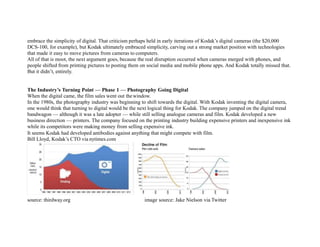
The Industry’s Turning Point — Phase 1 — Photography Going Digital
When the digital came, the film sales went out thewindow.
In the 1980s, the photography industry was beginning to shift towards the digital. With Kodak inventing the digital camera,
one would think that turning to digital would be the next logical thing for Kodak. The company jumped on the digital trend
bandwagon — although it was a late adopter — while still selling analogue cameras and film. Kodak developed a new
business direction — printers. The company focused on the printing industry building expensive printers and inexpensive ink
while its competitors were making money from selling expensive ink.
It seems Kodak had developed antibodies against anything that might compete with film.
Bill Lloyd, Kodak’s CTO via nytimes.com
source: thirdway.org image source: Jake Nielson via Twitter
The Industry’s Turning Point — Phase 2 — Photography Going from Digital to Social
image source: dpreview.com
As it turned out, digital cameras were not the biggest fish in the pond. Smartphones took the world by storm and digital
cameras producers saw their sales quickly spiralling down. People went from printing pictures to storing them on digital
devices or sharing them online on social media platforms.
Many years before Facebook, Kodak made a surprise business move and acquired a photo-sharing site called Ofoto
in 2001. Before Mark Zuckerberg wrote a line of Facebook’s code, Kodak made a prescient purchase, acquiring a photo
sharing site called Ofoto in 2001. It was so close. Imagine if Kodak had truly embraced its historical tagline of “share
memories, share life.” Perhaps it could have rebranded Ofoto as Kodak Moments (instead of EasyShare Gallery), making it
the pioneer of a new category called life networking where people could share pictures, personal updates, and links to news
and information. Maybe in 2010 it would have lured a young engineer from Google named Kevin Systrom to create a mobile
version of the site.
In real life, unfortunately, Kodak used Ofoto to try to get more people to print digital images. It sold the site to Shutterfly as
part of its bankruptcy plan for less than $25 million in April 2012. That same month Facebook plunked down $1 billion to
acquire Instagram, the 13-employee company Systrom had co-founded 18 months earlier.
Instead of going the Instagram way, Kodak used Ofoto to try to get more people to print digital images.
In 2012, when Kodak was filing for bankruptcy, Facebook was acquiring Instagram, the new hot photo-sharing social
network for $1 billion.
There were other ways in which Kodak could have emerged from the digital disruption of its core business. Consider Fuji
Photo Film. As Rita Gunther McGrath describes in her compelling book The End of Competitive Advantage, in the 1980s Fuji
was a distant second in the film business to Kodak. While Kodak stagnated and ultimately stumbled, Fuji aggressively
explored new opportunities, creating products adjacent to its film business, such as magnetic tape optics and videotape, and
branching into copiers and office automation, notably through a joint venture with Xerox. Today the company has annual
revenues above $20 billion, competes in healthcare and electronics operations and derives significant revenues from document
solutions
Kodak acted like a stereotypical change-resistant Japanese firm, while Fujifilm acted like a flexible Americanone.
Here are Reasons for Kodak’s Demise according to Analysts:
1. Failed to reinvent itself
The right lessons from Kodak are subtle. Companies often see the disruptive forces affecting their industry. They frequently
divert sufficient resources to participate in emerging markets. Their failure is usually an inability to truly embrace the new
business models the disruptive change opens up. Kodak created a digital camera, invested in the technology, and even
understood that photos would be shared online. Where they failed was in realizing that online photo sharing was the new
business, not just a way to expand the printingbusiness.
2. Complacency
The organization overflowed with complacency. I saw it, maybe in the late 1980s. Kodak was failing to keep up even before
the digital revolution when Fuji started doing a better job with the old technology, the roll-film business. With the
complacency so rock-solid, and no one at the top even devoting their priorities toward turning that problem into a huge
urgency around a huge opportunity, of course they wentnowhere.
3. Lack of Organizational agility
Kodak’s lack of strategic creativity led it to misinterpret the very line of work and type of industry that it was operating in
which was later devastated with a fundamental shift towards the digital age. Strategic problems were tackled through rigid
means, and as mistakes in the manufacturing process were costly, and profitability was high, Kodak avoided risky decisions,
and instead developed procedures and policies to maintain the quo.
What you can learn from Kodak’s demise:
The right lessons from Kodak are subtle. Companies often see the disruptive forces affecting their industry. They frequently
divert sufficient resources to participate in emerging markets. Their failure is usually an inability to truly embrace the new
business models the disruptive change opens up. Kodak created a digital camera, invested in the technology, and even
understood that photos would be shared online. Where they failed was in realizing that online photo sharing was the new
business, not just a way to expand the printing business.
 So, if your company is beginning to talk about a digital transformation, make sure you ask three questions:
 What business are we in today? Don’t answer the question with technologies, offerings, or categories. Instead, define
the problem you are solving for customers, or, in our parlance “the job you are doing for them.” For Kodak, that’s the
difference between framing itself as a chemical film company vs. an imaging company vs. a moment-sharing
company.
 What new opportunities does the disruption open? Clark Gilbert described more than a decade ago a great irony of
disruption. Perceived as a threat, disruption is a great growth opportunity. Disruption always grows markets, but it
also always transforms business models. Gilbert’s research showed how executives who perceive threats are rigid in
response; those who see opportunities are expansive.
 What capabilities do we need to realize these opportunities? Another great irony is that incumbents are best
positioned to seize disruptive opportunities. After all, they have many capabilities that entrants are racing to replicate,
such as access to markets, technologies, and healthy balance sheets. Of course, these capabilities impose constraints
as well, and are almost always insufficient to compete in new markets in new ways. Approach new growth with
appropriate humility
 Transform the way you view strategy, business models and innovation management.
 Be prepared to shift from protecting your company’s competitive advantages to making change radical and
revolutionary.
 To avoid complacency, ensure that your innovators have a voice with enough volume to be heard (and listened to) at
the top.
 Adopt agility as an organizational strategy for development.
Kodak remains a sad story of potential lost. The American icon had the talent, the money, and even the foresight to make the
transition. Instead, it ended up the victim of the aftershocks of a disruptive change. Learn the right lessons, and you can avoid
its fate.
Teacher’s Remarks:
Marks Detail:
Marks Total Marks Obtained Marks
Numbers
Teacher’s Signature
Coordinator’s Signature

ASSIGNMENT WHY KODAK FAILED-converted.pptx

  • 1.
    WHY DID KODAKFAIL SUBMITTED BY: IRFANULLAH (REG. NO: MBAEX-F-142812/2021) USAMA SHABBIR (REG. NO: MBAEX-F-143061/2021) SUBMITTED TO: MR. ANAYAT KHUDA BAKSH ALHAMD ISLAMIC UNIVERSITY, QUETTA
  • 2.
    WHY DID KODAKFAIL A generation ago, a “Kodak moment” meant something that was worth saving and savoring. Today, the term increasingly serves as a corporate bogeyman that warns executives of the need to stand up and respond when disruptive developments encroach on their market. Unfortunately, as time marches on the subtleties of what happened to Eastman Kodak are being forgotten, leading executives to draw the wrong conclusions from its struggles. Kodak was founded in the late 1880s, became a giant in the photography industry in the 1970s and filed for bankruptcy in 2012. For almost a hundred years, Kodak was at the forefront of photography with dozens of innovations and inventions, making this art accessible to the consumer. image source: wikipedia.com
  • 3.
    Short Timeline ofKodak’s Landmarks 1889 — George Eastman founded the Eastman Kodak Company and introduced the first Kodak camera; a few years later the Kodak camera becomes wildly successful. 1935 — The company introduced Kodachrome, the first successful color materials and was used for both cinematography and still photography. 1962 — Kodak sales surpassed $1 billion. 1963 — The Kodak Instamatic cameras and cartridge loading films made the process easy for amateurs. The company sold 50 million Instamatic cameras in their first seven years. 1966 — Sales surpassed $2 billion. 1972 — Kodak’s worldwide sales passed $3 billion. 1975 — Steve Sasson, an engineer at Kodak invented the digital camera. 1976 — Kodak became so dominant; they practically pushed their competitors off the market – Cameras: 85% market share, Film: 90% market share 1981 — Sales top $10 billion. The late 1980s — The rise of digital photography with analogue cameras sales decreasing and digital camera sales increasing. 1984 — Customers switched from Kodak to Fuji because the Japanese color film was 20% cheaper than Kodak’s. 1991- Kodak’s first digital camera. 1991–2011- Kodak released various digital products, but sales kept falling. 2012 — Kodak filed for bankruptcy.
  • 4.
    image source: imperialleisure.com Whywas Kodak successful? You press the button, we do therest. George Eastman
  • 5.
    First of all,George Eastman set out to democratize photography. Eastman believed in making photography available to everyone, by changing the way people took photographs. With the development of his new and innovative Kodak camera, Eastman made it possible for anyone interested in photography to take great pictures. Throughout the following decades, innovations and inventions ensued which supported the company fulfil its founder’s purpose. While Kodak’s offer met its clients’ needs, the business model of the Eastman Company brought in the cash. Kodak’s business strategy followed the razor and blades business model where one item is sold at a low price or given away for free to increase sales of a complementary good, such as consumable supplies. How it worked: the clients would take photos with the Kodak camera and then send the camera to the Kodak factory where the camera’s film was developed, and photos were printed. The company’s core product was the film and printing photos, not the camera. Kodak’s Kodachrome was the company’s leading sales item. It was discontinued in 2006 after 74 years of production. Why did this happen? An easy explanation is myopia. Kodak was so blinded by its success that it completely missed the rise of digital technologies. But that doesn’t square with reality. After all, the first prototype of a digital camera was created in 1975 by Steve Sasson, an engineer working for Kodak. The camera was as big as a toaster, took 20 seconds to take an image, had low quality, and required complicated connections to a television to view, but it clearly had massive disruptive potential. Spotting something and doing something about it are very different things. So, another explanation is that Kodak invented the technology but didn’t invest in it. Sasson himself told The New York Times that management’s response to his digital camera was “that’s cute – but don’t tell anyone about it.” A good line, but not completely accurate. In fact, Kodak invested billions to develop a range of digital cameras. Doing something and doing the right thing are also different things. The next explanation is that Kodak mismanaged its investment in digital cameras, overshooting the market by trying to match performance of traditional film rather than
  • 6.
    embrace the simplicityof digital. That criticism perhaps held in early iterations of Kodak’s digital cameras (the $20,000 DCS-100, for example), but Kodak ultimately embraced simplicity, carving out a strong market position with technologies that made it easy to move pictures from cameras to computers. All of that is moot, the next argument goes, because the real disruption occurred when cameras merged with phones, and people shifted from printing pictures to posting them on social media and mobile phone apps. And Kodak totally missed that. But it didn’t, entirely. The Industry’s Turning Point — Phase 1 — Photography Going Digital When the digital came, the film sales went out thewindow. In the 1980s, the photography industry was beginning to shift towards the digital. With Kodak inventing the digital camera, one would think that turning to digital would be the next logical thing for Kodak. The company jumped on the digital trend bandwagon — although it was a late adopter — while still selling analogue cameras and film. Kodak developed a new business direction — printers. The company focused on the printing industry building expensive printers and inexpensive ink while its competitors were making money from selling expensive ink. It seems Kodak had developed antibodies against anything that might compete with film. Bill Lloyd, Kodak’s CTO via nytimes.com source: thirdway.org image source: Jake Nielson via Twitter
  • 7.
    The Industry’s TurningPoint — Phase 2 — Photography Going from Digital to Social image source: dpreview.com As it turned out, digital cameras were not the biggest fish in the pond. Smartphones took the world by storm and digital cameras producers saw their sales quickly spiralling down. People went from printing pictures to storing them on digital devices or sharing them online on social media platforms. Many years before Facebook, Kodak made a surprise business move and acquired a photo-sharing site called Ofoto in 2001. Before Mark Zuckerberg wrote a line of Facebook’s code, Kodak made a prescient purchase, acquiring a photo sharing site called Ofoto in 2001. It was so close. Imagine if Kodak had truly embraced its historical tagline of “share
  • 8.
    memories, share life.”Perhaps it could have rebranded Ofoto as Kodak Moments (instead of EasyShare Gallery), making it the pioneer of a new category called life networking where people could share pictures, personal updates, and links to news and information. Maybe in 2010 it would have lured a young engineer from Google named Kevin Systrom to create a mobile version of the site. In real life, unfortunately, Kodak used Ofoto to try to get more people to print digital images. It sold the site to Shutterfly as part of its bankruptcy plan for less than $25 million in April 2012. That same month Facebook plunked down $1 billion to acquire Instagram, the 13-employee company Systrom had co-founded 18 months earlier. Instead of going the Instagram way, Kodak used Ofoto to try to get more people to print digital images. In 2012, when Kodak was filing for bankruptcy, Facebook was acquiring Instagram, the new hot photo-sharing social network for $1 billion. There were other ways in which Kodak could have emerged from the digital disruption of its core business. Consider Fuji Photo Film. As Rita Gunther McGrath describes in her compelling book The End of Competitive Advantage, in the 1980s Fuji was a distant second in the film business to Kodak. While Kodak stagnated and ultimately stumbled, Fuji aggressively explored new opportunities, creating products adjacent to its film business, such as magnetic tape optics and videotape, and branching into copiers and office automation, notably through a joint venture with Xerox. Today the company has annual revenues above $20 billion, competes in healthcare and electronics operations and derives significant revenues from document solutions Kodak acted like a stereotypical change-resistant Japanese firm, while Fujifilm acted like a flexible Americanone. Here are Reasons for Kodak’s Demise according to Analysts: 1. Failed to reinvent itself The right lessons from Kodak are subtle. Companies often see the disruptive forces affecting their industry. They frequently divert sufficient resources to participate in emerging markets. Their failure is usually an inability to truly embrace the new business models the disruptive change opens up. Kodak created a digital camera, invested in the technology, and even
  • 9.
    understood that photoswould be shared online. Where they failed was in realizing that online photo sharing was the new business, not just a way to expand the printingbusiness. 2. Complacency The organization overflowed with complacency. I saw it, maybe in the late 1980s. Kodak was failing to keep up even before the digital revolution when Fuji started doing a better job with the old technology, the roll-film business. With the complacency so rock-solid, and no one at the top even devoting their priorities toward turning that problem into a huge urgency around a huge opportunity, of course they wentnowhere. 3. Lack of Organizational agility Kodak’s lack of strategic creativity led it to misinterpret the very line of work and type of industry that it was operating in which was later devastated with a fundamental shift towards the digital age. Strategic problems were tackled through rigid means, and as mistakes in the manufacturing process were costly, and profitability was high, Kodak avoided risky decisions, and instead developed procedures and policies to maintain the quo. What you can learn from Kodak’s demise: The right lessons from Kodak are subtle. Companies often see the disruptive forces affecting their industry. They frequently divert sufficient resources to participate in emerging markets. Their failure is usually an inability to truly embrace the new business models the disruptive change opens up. Kodak created a digital camera, invested in the technology, and even understood that photos would be shared online. Where they failed was in realizing that online photo sharing was the new business, not just a way to expand the printing business.  So, if your company is beginning to talk about a digital transformation, make sure you ask three questions:  What business are we in today? Don’t answer the question with technologies, offerings, or categories. Instead, define the problem you are solving for customers, or, in our parlance “the job you are doing for them.” For Kodak, that’s the difference between framing itself as a chemical film company vs. an imaging company vs. a moment-sharing company.
  • 10.
     What newopportunities does the disruption open? Clark Gilbert described more than a decade ago a great irony of disruption. Perceived as a threat, disruption is a great growth opportunity. Disruption always grows markets, but it also always transforms business models. Gilbert’s research showed how executives who perceive threats are rigid in response; those who see opportunities are expansive.  What capabilities do we need to realize these opportunities? Another great irony is that incumbents are best positioned to seize disruptive opportunities. After all, they have many capabilities that entrants are racing to replicate, such as access to markets, technologies, and healthy balance sheets. Of course, these capabilities impose constraints as well, and are almost always insufficient to compete in new markets in new ways. Approach new growth with appropriate humility  Transform the way you view strategy, business models and innovation management.  Be prepared to shift from protecting your company’s competitive advantages to making change radical and revolutionary.  To avoid complacency, ensure that your innovators have a voice with enough volume to be heard (and listened to) at the top.  Adopt agility as an organizational strategy for development. Kodak remains a sad story of potential lost. The American icon had the talent, the money, and even the foresight to make the transition. Instead, it ended up the victim of the aftershocks of a disruptive change. Learn the right lessons, and you can avoid its fate.
  • 11.
    Teacher’s Remarks: Marks Detail: MarksTotal Marks Obtained Marks Numbers Teacher’s Signature Coordinator’s Signature