Eastman Kodak
Company
Presented By:-
Akash Mishra
MBA 1ST Year
INTRODUCTION
 The Eastman Kodak Company was
founded in 1880.
 By targeting non photographers, Kodak
created a huge market.
 A multinational corporation & a
diversified manufacturer of
photographic imaging equipment and
supplies, chemicals, health care
products.
HISTORY
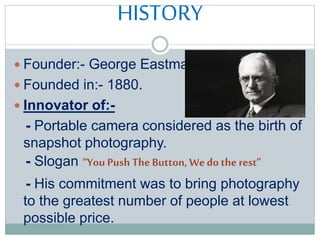
 Founder:- George Eastman
 Founded in:- 1880.
 Innovator of:-
- Portable camera considered as the birth of
snapshot photography.
- Slogan “You Push The Button, Wedothe rest”
- His commitment was to bring photography
to the greatest number of people at lowest
possible price.
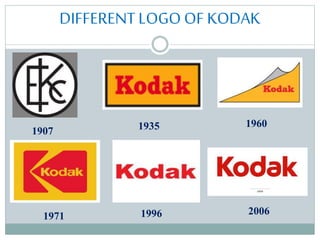
DIFFERENT LOGO OF KODAK
1907 1935 1960
1971 1996 2006
COMPETITORS OF KODAK
 Canon
 Nikon
 Fuji Film
 Olympus
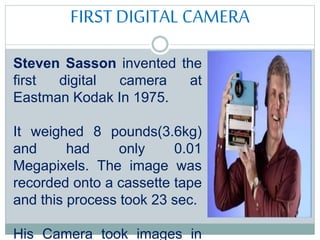
FIRST DIGITAL CAMERA
Steven Sasson invented the
first digital camera at
Eastman Kodak In 1975.
-It weighed 8 pounds(3.6kg)
and had only 0.01
Megapixels. The image was
recorded onto a cassette tape
and this process took 23 sec.
-His Camera took images in
black and white.
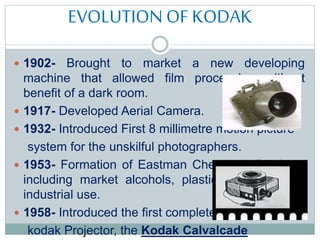
EVOLUTION OF KODAK
 1902- Brought to market a new developing
machine that allowed film processing without
benefit of a dark room.
 1917- Developed Aerial Camera.
 1932- Introduced First 8 millimetre motion picture
system for the unskilful photographers.
 1953- Formation of Eastman Chemicals Products
including market alcohols, plastic and fibers for
industrial use.
 1958- Introduced the first completely automatic
kodak Projector, the Kodak Calvalcade
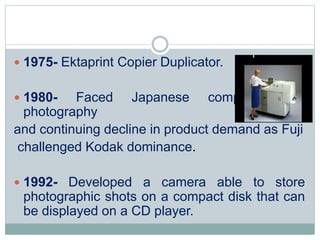
 1975- Ektaprint Copier Duplicator.
 1980- Faced Japanese competition in
photography
and continuing decline in product demand as Fuji
challenged Kodak dominance.
 1992- Developed a camera able to store
photographic shots on a compact disk that can
be displayed on a CD player.
SWOT
ANALYSIS
OF
STRENTHS WEAKNESS
• Existing Brand
equity
• Distribution
Presence
• Competitive
capabilities
• Market advantage
• Acquire many
strategically aligned
 Rapidly decreasing
sales revenue
• EBITDA(Earnings
before interest, tax,
depreciation and
amortization) are
very low.
• Work force has been
cut off
OPPORTUNITY THREATS
• Digital Image
• New alliances
• On line photo sharing
and storage
• Competition in
traditional
• Demise of silver
halide
technology
• Photo capable mobile
phone
• Price sensitive
• Economic health &
terrorism
FALL OF KODAK
REASONS FOR FALL
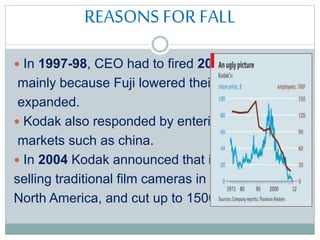
 In 1997-98, CEO had to fired 20000 people
mainly because Fuji lowered their prices and
expanded.
 Kodak also responded by entering emerging
markets such as china.
 In 2004 Kodak announced that it would stop
selling traditional film cameras in Europe and
North America, and cut up to 15000 jobs.
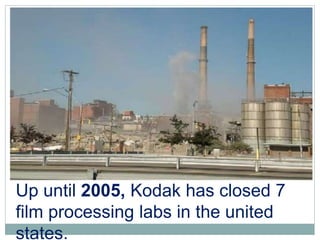
Up until 2005, Kodak has closed 7 film
processing labs in the united states.
 In January 2009, another layoff 3500-4500
workers was announced.
 The stocks has reached new record low levels
almost every year.
 Share holders were angry, Employees were
angry and Management asked for more money.
Standard & Poor’s Equity Research
Analyst Erik Kolb Commented on the
results:
“They were late in the game in their shift to
digital and they have been playing catch up
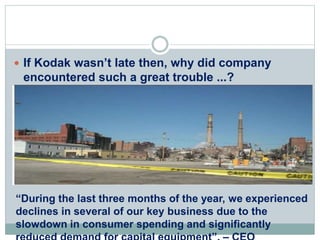
 If Kodak wasn’t late then, why did company
encountered such a great trouble ...?
“During the last three months of the year, we experienced
declines in several of our key business due to the
slowdown in consumer spending and significantly reduced
demand for capital equipment”. – CEO
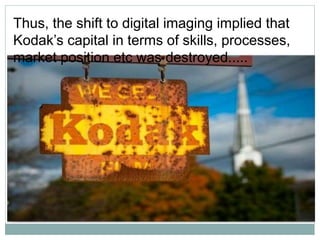
Thus, the shift to digital imaging implied that Kodak’s
capital in terms of skills, processes, market position
etc was destroyed.....
KODAK DILEMMA
 So much investment has been made in the
Chemical, papers, Films industries, it is almost
difficult to suddenly shift into risky digital era .
 It choose slow pace to Digital Photography.
 The result was unavoidable.
In 2012 Kodak filed Bankruptcy
&
Also declared it will quit Photography
Business
CONCLUSION
The lessons that we learnt from this case
study are:-
 Sometimes the greatest strength may
become the weakness.
 Innovation is not always the perfect
solutions.
 Sometimes small changes may lead to great
success but the condition is we have to
adopt some changes time to time.
Thank
You

Kodak

  • 1.
  • 2.
    INTRODUCTION  The EastmanKodak Company was founded in 1880.  By targeting non photographers, Kodak created a huge market.  A multinational corporation & a diversified manufacturer of photographic imaging equipment and supplies, chemicals, health care products.
  • 3.
    HISTORY  Founder:- GeorgeEastman  Founded in:- 1880.  Innovator of:- - Portable camera considered as the birth of snapshot photography. - Slogan “You Push The Button, Wedothe rest” - His commitment was to bring photography to the greatest number of people at lowest possible price.
  • 4.
    DIFFERENT LOGO OFKODAK 1907 1935 1960 1971 1996 2006
  • 5.
    COMPETITORS OF KODAK Canon  Nikon  Fuji Film  Olympus
  • 6.
    FIRST DIGITAL CAMERA StevenSasson invented the first digital camera at Eastman Kodak In 1975. -It weighed 8 pounds(3.6kg) and had only 0.01 Megapixels. The image was recorded onto a cassette tape and this process took 23 sec. -His Camera took images in black and white.
  • 7.
    EVOLUTION OF KODAK 1902- Brought to market a new developing machine that allowed film processing without benefit of a dark room.  1917- Developed Aerial Camera.  1932- Introduced First 8 millimetre motion picture system for the unskilful photographers.  1953- Formation of Eastman Chemicals Products including market alcohols, plastic and fibers for industrial use.  1958- Introduced the first completely automatic kodak Projector, the Kodak Calvalcade
  • 8.
     1975- EktaprintCopier Duplicator.  1980- Faced Japanese competition in photography and continuing decline in product demand as Fuji challenged Kodak dominance.  1992- Developed a camera able to store photographic shots on a compact disk that can be displayed on a CD player.
  • 9.
  • 10.
    STRENTHS WEAKNESS • ExistingBrand equity • Distribution Presence • Competitive capabilities • Market advantage • Acquire many strategically aligned  Rapidly decreasing sales revenue • EBITDA(Earnings before interest, tax, depreciation and amortization) are very low. • Work force has been cut off
  • 11.
    OPPORTUNITY THREATS • DigitalImage • New alliances • On line photo sharing and storage • Competition in traditional • Demise of silver halide technology • Photo capable mobile phone • Price sensitive • Economic health & terrorism
  • 12.
  • 13.
    REASONS FOR FALL In 1997-98, CEO had to fired 20000 people mainly because Fuji lowered their prices and expanded.  Kodak also responded by entering emerging markets such as china.  In 2004 Kodak announced that it would stop selling traditional film cameras in Europe and North America, and cut up to 15000 jobs.
  • 14.
    Up until 2005,Kodak has closed 7 film processing labs in the united states.
  • 15.
     In January2009, another layoff 3500-4500 workers was announced.  The stocks has reached new record low levels almost every year.  Share holders were angry, Employees were angry and Management asked for more money. Standard & Poor’s Equity Research Analyst Erik Kolb Commented on the results: “They were late in the game in their shift to digital and they have been playing catch up
  • 16.
     If Kodakwasn’t late then, why did company encountered such a great trouble ...? “During the last three months of the year, we experienced declines in several of our key business due to the slowdown in consumer spending and significantly reduced demand for capital equipment”. – CEO
  • 17.
    Thus, the shiftto digital imaging implied that Kodak’s capital in terms of skills, processes, market position etc was destroyed.....
  • 18.
    KODAK DILEMMA  Somuch investment has been made in the Chemical, papers, Films industries, it is almost difficult to suddenly shift into risky digital era .  It choose slow pace to Digital Photography.  The result was unavoidable. In 2012 Kodak filed Bankruptcy & Also declared it will quit Photography Business
  • 19.
    CONCLUSION The lessons thatwe learnt from this case study are:-  Sometimes the greatest strength may become the weakness.  Innovation is not always the perfect solutions.  Sometimes small changes may lead to great success but the condition is we have to adopt some changes time to time.
  • 20.