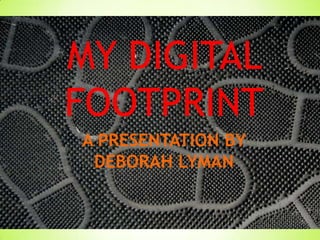
MY DIGITAL
FOOTPRINT
A PRESENTATION BY
 DEBORAH LYMAN
Online portfolios of who we
   are, what we do, and by
association, what we know—
 are becoming increasingly
   woven into the fabric of
 almost every aspect of our
  lives. (Richardson, 2008)
Digital footprints are the online trail
 we leave, for good or for bad. There
  is no escaping them. We can only
embrace them, be aware of them, and
 do everything in our power to ensure
they shed us in the best light possible.
The following slides are ten ways that
    I plan to ensure that my digital
   footprint shows me in a positive,
          professional manner.
By creating a professional blog, I will be
showcasing some of the most important
attributes of an educator and technologist.
These could include research based writing,
products and lessons.


                             *
In order to begin to make my name known
amongst other professionals, I will respond to
and participate in discussions to existing blogs.


  *
I have created a Facebook account that is to be
used for presenting me as a professional and
credible source for information on educational
technology. In addition to professional posts, I
will include some personal experiences and posts
as encourages by Clay Shirky in his book (2008).


                            *
The power of twitter makes it impossible to
ignore. My goal is to be notices by other
educators and to be involved in a network of
educators who are leaders in the current
educational atmosphere. I plan to use Twitter as
the springboard for this goal.


                                *
I have dabbled in using Livebinders, Diigo, and
other resource sharing sites for my personal use.
However, I would like to use these tools in order
to share my resources with other educators.
Part of creating a positive digital footprint is
sharing resources and information (Richardson,
2008).


         *
Using my real name has more than one benefit.
First, it makes it so others can find me online.
Second, it makes me think twice before posting,
as I know it will be traced back to me. Third, I
feel like using my real name gives me more
credibility because I am placing my identity
behind the post rather than using an anonymous
screen name.


          *
I will make all of my professional accounts
public, therefore making them searchable and
accessible for all to see. Twitter, Word Press and
many other sites are searchable using Google
(Yousuf, 2010). By posting professional, credible
information I will be creating a positive footprint
that can be found by those using a search
engine.


             *
While posting, tweeting, blogging and
participating in discussions, I will always ensure
that what I write is thoughtful and professional.
I will refrain from posting frivolous or off-topic
posts that distract from the professional image I
am seeking to create.


  *
I will always seek to ensure that my writing and
discussions are constructive and positive. I will
refrain from responding to, or creating,
inflammatory remarks. This helps to create a
digital footprint that is respected and credible.


                                 *
In order to ensure that I am always maintaining
a positive reputation, it is essential that I am
always seeking to learn about new resource and
finding opportunities to share this information.
Webinars and other online professional
development opportunities will provide a me
with the necessary information to remain up-to-
date.


                  *
Richardson, W. (2008). Footprints in the digital age. Educational
 Leadership, 66(3), 16–19. Retrieved from
 www.ascd.org/publications/educational-
 leadership/nov08/vol66/num03/Footprints-in-the-Digital-Age.aspx
Prensky, M. (2008). Turning on the lights. Educational Leadership, 65(6),
 40–45. Retrieved from http://www.ascd.org/publications/educational-
 leadership/mar08/vol65/num06/Turning-On-the-Lights.aspx
Yousuf, H. (2010, April 14) .Google and library of congress archive
 tweets. Retrieved from
 http://money.cnn.com/2010/04/14/technology/Google_Twitter_archiv
 e/
Shirky, C. (2008). Here comes everybody: The power of organizing
 without organizations. New York: Penguin Press.


                                         *

Digital footprint

  • 1.
  • 2.
    Online portfolios ofwho we are, what we do, and by association, what we know— are becoming increasingly woven into the fabric of almost every aspect of our lives. (Richardson, 2008)
  • 3.
    Digital footprints arethe online trail we leave, for good or for bad. There is no escaping them. We can only embrace them, be aware of them, and do everything in our power to ensure they shed us in the best light possible. The following slides are ten ways that I plan to ensure that my digital footprint shows me in a positive, professional manner.
  • 4.
    By creating aprofessional blog, I will be showcasing some of the most important attributes of an educator and technologist. These could include research based writing, products and lessons. *
  • 5.
    In order tobegin to make my name known amongst other professionals, I will respond to and participate in discussions to existing blogs. *
  • 6.
    I have createda Facebook account that is to be used for presenting me as a professional and credible source for information on educational technology. In addition to professional posts, I will include some personal experiences and posts as encourages by Clay Shirky in his book (2008). *
  • 7.
    The power oftwitter makes it impossible to ignore. My goal is to be notices by other educators and to be involved in a network of educators who are leaders in the current educational atmosphere. I plan to use Twitter as the springboard for this goal. *
  • 8.
    I have dabbledin using Livebinders, Diigo, and other resource sharing sites for my personal use. However, I would like to use these tools in order to share my resources with other educators. Part of creating a positive digital footprint is sharing resources and information (Richardson, 2008). *
  • 9.
    Using my realname has more than one benefit. First, it makes it so others can find me online. Second, it makes me think twice before posting, as I know it will be traced back to me. Third, I feel like using my real name gives me more credibility because I am placing my identity behind the post rather than using an anonymous screen name. *
  • 10.
    I will makeall of my professional accounts public, therefore making them searchable and accessible for all to see. Twitter, Word Press and many other sites are searchable using Google (Yousuf, 2010). By posting professional, credible information I will be creating a positive footprint that can be found by those using a search engine. *
  • 11.
    While posting, tweeting,blogging and participating in discussions, I will always ensure that what I write is thoughtful and professional. I will refrain from posting frivolous or off-topic posts that distract from the professional image I am seeking to create. *
  • 12.
    I will alwaysseek to ensure that my writing and discussions are constructive and positive. I will refrain from responding to, or creating, inflammatory remarks. This helps to create a digital footprint that is respected and credible. *
  • 13.
    In order toensure that I am always maintaining a positive reputation, it is essential that I am always seeking to learn about new resource and finding opportunities to share this information. Webinars and other online professional development opportunities will provide a me with the necessary information to remain up-to- date. *
  • 14.
    Richardson, W. (2008).Footprints in the digital age. Educational Leadership, 66(3), 16–19. Retrieved from www.ascd.org/publications/educational- leadership/nov08/vol66/num03/Footprints-in-the-Digital-Age.aspx Prensky, M. (2008). Turning on the lights. Educational Leadership, 65(6), 40–45. Retrieved from http://www.ascd.org/publications/educational- leadership/mar08/vol65/num06/Turning-On-the-Lights.aspx Yousuf, H. (2010, April 14) .Google and library of congress archive tweets. Retrieved from http://money.cnn.com/2010/04/14/technology/Google_Twitter_archiv e/ Shirky, C. (2008). Here comes everybody: The power of organizing without organizations. New York: Penguin Press. *

Editor's Notes

  • #2 Picture retrieved from Flickr Creative commons and was taken by Liz Jones