www.learningandwork.org.uk
@LearnWorkUK
Family Learning and
Digital Skills
Susan Easton
Head of Digital Learning and Skills
10th
November 2016
Basic Digital Skills
• Use of technology and the internet governs how we
access information and public services, how we interact
with government and with each other.
• 5.3 million people in the UK have never used the Internet
and 12.6 million don’t have Basic Digital Skills, which
everyone needs to fully participate in our digital society
• According to the EC, an estimated 90% of all jobs will
require basic digital skills,
• Yet many disadvantaged people lack these, making them
less likely to be employed, or able to support their
families’ learning
Digital Exclusion
• Digitally excluded less likely to manage finances,
access cheaper products and services
• More likely to suffer from isolation,have lower
incomes, be disenfranchised and have children who
underachieve
• Often furthest from labour market
Digital skills UK
Go On UK, 2015
Basic Digital Skills
Changing attitudes
• Our independent inquiry into Family Learning found that
‘parental engagement in family learning has a large and
positive impact on children’s learning’.
• The desire to support children to achieve is one of the
strongest motivators to learn.
• Our work explores the benefits of digital skills for
disadvantaged families
– Digital families
– Family robotics
Digital Families
• Worked with families in areas of high social and
economic deprivation and those with specific needs
• Learners more likely to have lower than average digital
skills
• Aimed to increase basic digital skills
• 3 family learning providers embedded digital skills into
their courses
• Family learning provides a context for disadvantaged
adults and young people to develop digital skills
Digital Families
Adults took part:
• to support their children with their school and
homework
• to learn new skills
• to develop their own digital skills
• to help them find work
Hull Family Learning
• Worked with families and local school
• Improved basic digital skills and developed digital
Maths resources for adults to use with their
children
• All children moved from Amber to Green in Maths
within 6 weeks (school assessment)
• Families can support other children - fiscal benefits
related to increased school readiness of young
children (value £1,053 per child, per annum)
Manchester Family Learning
• Focused on employability
• Six-week course preparing learners for work placement
• Parents had primary school-aged children and half had
low digital skills.
• Course focused on digital employability skills,
teamwork, presentation and working to deadlines
• Learners improved use of digital technology at home
and in work, have a better understanding of the
technologies their children use in school, are better
able to engage their children in conversation about
technology and are more prepared for employment.
Sheffield Family Learning
• Creative writing
• Used technology to research and plan, create digital
resources and use digital tools and resources for learning.
• Developed skills in digital communication, online content
creation, online research and work searching.
• At the end of the course, participants could better support
their children with digital and English skills
Making a difference
• 3 in 4 adults felt that technology could make
their lives easier
• 4 in 5 helped their children with homework more
frequently
• 2 in 3 plan to learn more about technology
and/or digital making
• 1 in 3 plan to attend other digital technology
courses
• 3 in 5 used technology to bank, shop or pay bills
Making a difference
• Learn new skills, change
attitudes, develop IT
capabilities and help find
work
• Family learning is a key
context in which skills can
and should be addressed
3 in 4 - technology could
make their lives easier
four-fifths stated digital skills
are important to them
3 in 5 applied for jobs
four-fifths reported that digital
skills were important to them11 in 18 - further digital skills
Parent’s views
• ‘I’m more able to use digital technology which I can see myself using in admin jobs.
I can now make a poster, use a spreadsheet and save and upload photos.’
• ‘I understand how to use PowerPoint and Microsoft Word now with confidence.
With this I am able to help my kids with homework. I can also teach my kids what I
learned.’
• ‘I feel more confident to go on the internet and hopefully be able to apply for job’
• ‘I am able to look for jobs online and I was able to practice my typing skills on the
computer’
• “I have learnt new methods of learning. I found coding very interesting and it gave
me another point of view for spending the time with the device – learning through
it”
• “[I have enjoyed] spending time with my daughter in the lessons and I have
actually learnt a few things on how she does her Maths in her year”.
• “I have learned different things on the course and it has helped me to understand
my child’s homework, and she has really improved within the school”.
• “Knowing how my son learns Maths in school, which now enables me to help him
if he is stuck. Also learning new skills myself”.
Adoption
As a result of “Digital Families”, 41 of 73 family
learning providers plan to embed digital skills
in their courses
Barriers
Barriers
• 38 of 73 providers reported barriers to
embedding digital skills in their service offer.
• Limitations in tutor skills and time to develop
resources are key barriers
• Other barriers include hardware, software,
and the technological infrastructure
• Access to hardware, software and technology
infrastructure is an ongoing issue
Discuss
• Would you like to embed basic digital skills in
family learning courses?
• Are there any barriers?
• If so, what are these?
• How can you overcome barriers?
Digital Making
• Allows people to learn about technology through
making things with it e.g. coding, robotics, web
design, digital music
• National survey of young people, their parents and
carers found that 89% of parents / carers thought
digital making was worthwhile
• 74% would encourage young people to pursue a
related career.
• Encouragement depends on families’ Digital Skills
and attitudes to technology
• Need greater access to opportunities for a wider
variety of young people
Digital Making
• “Digital Families” explored how Family
Learning could encourage digital making for
disadvantaged young people
• Partnerships with Technology Organisations
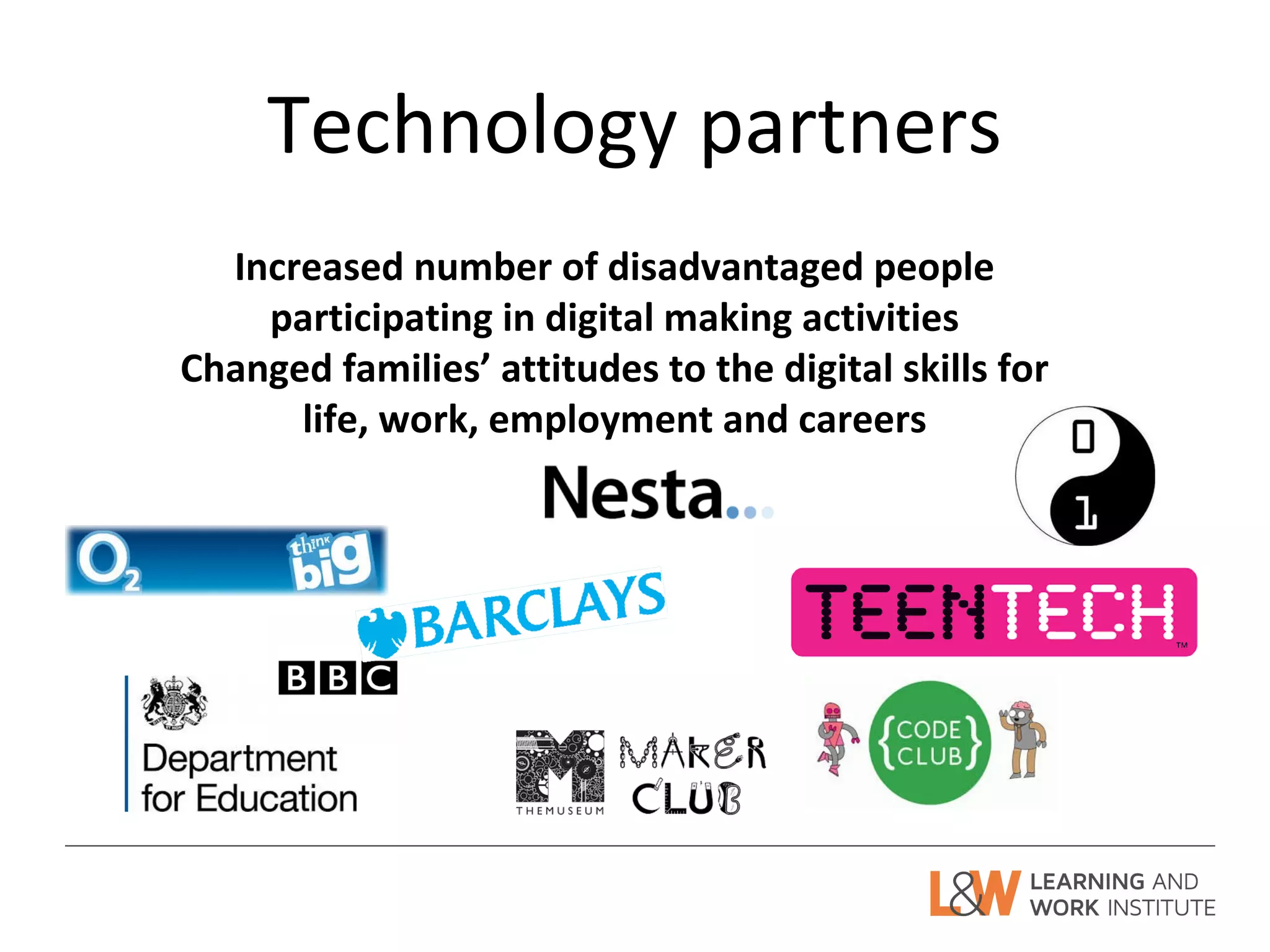
Technology partners
Increased number of disadvantaged people
participating in digital making activities
Changed families’ attitudes to the digital skills for
life, work, employment and careers
Partnerships Requested
Digital skills for employment
• Basic online skills to communicate, find information or
purchase goods/services online (Digital Citizen)
• Uses digital technology as part of working life e.g. using
social media for marketing (Digital Worker )
• Builds digital technology and makes advanced digital
content e.g. Coding (Digital Maker)
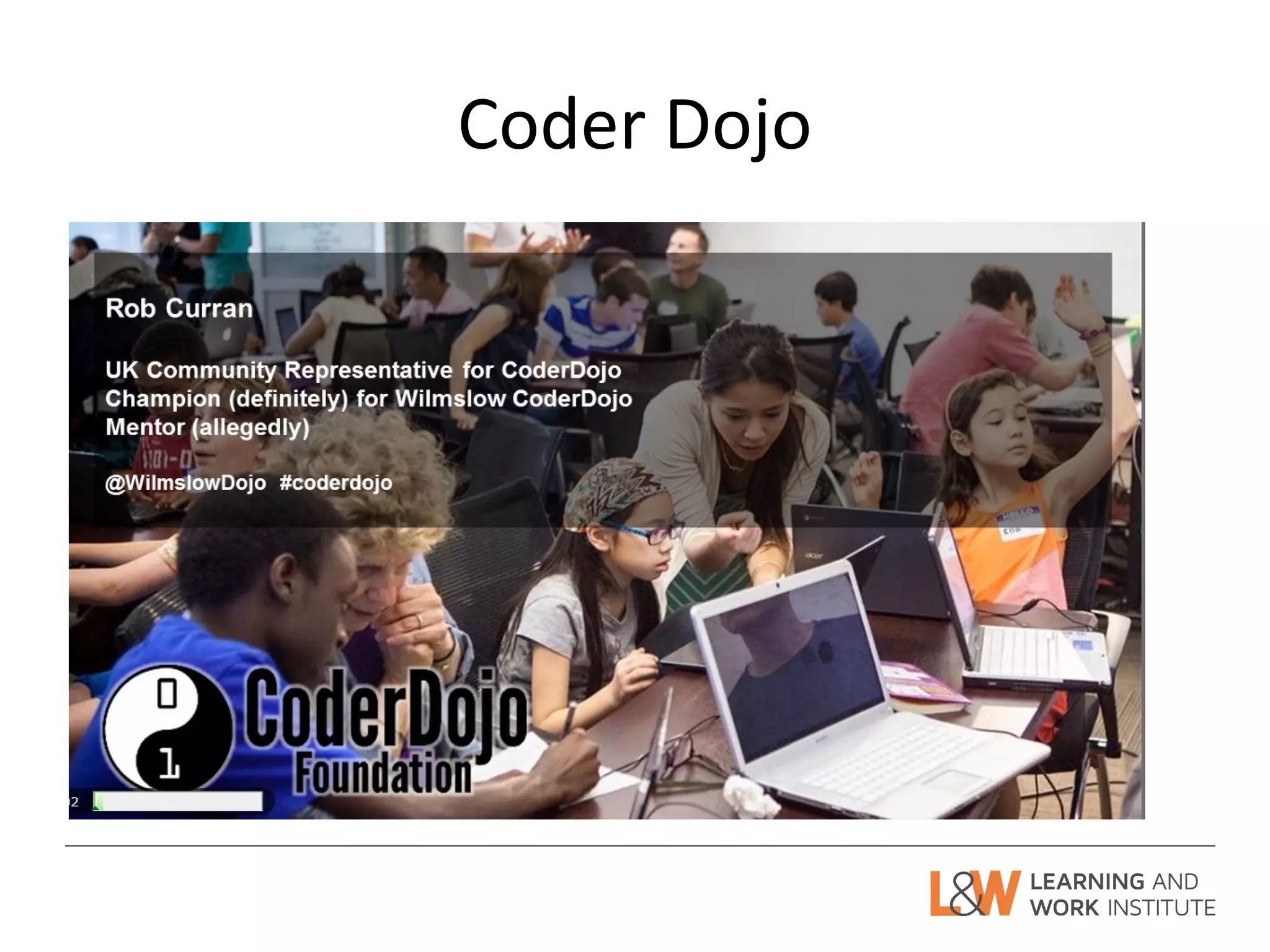
Coder Dojo
Family Robotics
Our work in Family Robotics helped
disadvantaged families to develop advanced
programming and digital making skills
John and Sarah
‘I like programming and I like doing things on the computer no
matter what. I love Science and Physics and one day I want to
be a scientist. I also want to make games that I can play and
share and this is all helping me to do that.’
John
• ‘I came because it’s very important for John to learn about
programming for his future. John has learnt quite a lot and
has a lot of questions. He thinks the sessions are too short!
And I’ve even learnt a little as well! The best thing for me has
been working with John. There’s not enough time at home!
That’s why I like Family Learning!’
• Sarah, John’s Mum
•
•
Family Robotics
https://www.youtube.com/watch?v=Ohuu
Royal Recognition!!
Discuss
• Are you interested in digital making?
• Would you like to make new partnerships?
• If so what type would be most useful?
• Technology organisations
• Schools
L&W Family LearningSusan Easton
Head of Digital Learning and Skills,
Learning and Work Institute
Susan.easton@learningandwork.org.uk
Tw: @susaneaston
Web:
http://www.learningandwork.org.uk/fa
mily-learning
Skype: susanatniace

Digital families2

  • 1.
  • 2.
    Family Learning and DigitalSkills Susan Easton Head of Digital Learning and Skills 10th November 2016
  • 3.
    Basic Digital Skills •Use of technology and the internet governs how we access information and public services, how we interact with government and with each other. • 5.3 million people in the UK have never used the Internet and 12.6 million don’t have Basic Digital Skills, which everyone needs to fully participate in our digital society • According to the EC, an estimated 90% of all jobs will require basic digital skills, • Yet many disadvantaged people lack these, making them less likely to be employed, or able to support their families’ learning
  • 4.
    Digital Exclusion • Digitallyexcluded less likely to manage finances, access cheaper products and services • More likely to suffer from isolation,have lower incomes, be disenfranchised and have children who underachieve • Often furthest from labour market
  • 5.
  • 6.
  • 7.
    Changing attitudes • Ourindependent inquiry into Family Learning found that ‘parental engagement in family learning has a large and positive impact on children’s learning’. • The desire to support children to achieve is one of the strongest motivators to learn. • Our work explores the benefits of digital skills for disadvantaged families – Digital families – Family robotics
  • 8.
    Digital Families • Workedwith families in areas of high social and economic deprivation and those with specific needs • Learners more likely to have lower than average digital skills • Aimed to increase basic digital skills • 3 family learning providers embedded digital skills into their courses • Family learning provides a context for disadvantaged adults and young people to develop digital skills
  • 9.
    Digital Families Adults tookpart: • to support their children with their school and homework • to learn new skills • to develop their own digital skills • to help them find work
  • 10.
    Hull Family Learning •Worked with families and local school • Improved basic digital skills and developed digital Maths resources for adults to use with their children • All children moved from Amber to Green in Maths within 6 weeks (school assessment) • Families can support other children - fiscal benefits related to increased school readiness of young children (value £1,053 per child, per annum)
  • 11.
    Manchester Family Learning •Focused on employability • Six-week course preparing learners for work placement • Parents had primary school-aged children and half had low digital skills. • Course focused on digital employability skills, teamwork, presentation and working to deadlines • Learners improved use of digital technology at home and in work, have a better understanding of the technologies their children use in school, are better able to engage their children in conversation about technology and are more prepared for employment.
  • 12.
    Sheffield Family Learning •Creative writing • Used technology to research and plan, create digital resources and use digital tools and resources for learning. • Developed skills in digital communication, online content creation, online research and work searching. • At the end of the course, participants could better support their children with digital and English skills
  • 13.
    Making a difference •3 in 4 adults felt that technology could make their lives easier • 4 in 5 helped their children with homework more frequently • 2 in 3 plan to learn more about technology and/or digital making • 1 in 3 plan to attend other digital technology courses • 3 in 5 used technology to bank, shop or pay bills
  • 14.
    Making a difference •Learn new skills, change attitudes, develop IT capabilities and help find work • Family learning is a key context in which skills can and should be addressed 3 in 4 - technology could make their lives easier four-fifths stated digital skills are important to them 3 in 5 applied for jobs four-fifths reported that digital skills were important to them11 in 18 - further digital skills
  • 15.
    Parent’s views • ‘I’mmore able to use digital technology which I can see myself using in admin jobs. I can now make a poster, use a spreadsheet and save and upload photos.’ • ‘I understand how to use PowerPoint and Microsoft Word now with confidence. With this I am able to help my kids with homework. I can also teach my kids what I learned.’ • ‘I feel more confident to go on the internet and hopefully be able to apply for job’ • ‘I am able to look for jobs online and I was able to practice my typing skills on the computer’ • “I have learnt new methods of learning. I found coding very interesting and it gave me another point of view for spending the time with the device – learning through it” • “[I have enjoyed] spending time with my daughter in the lessons and I have actually learnt a few things on how she does her Maths in her year”. • “I have learned different things on the course and it has helped me to understand my child’s homework, and she has really improved within the school”. • “Knowing how my son learns Maths in school, which now enables me to help him if he is stuck. Also learning new skills myself”.
  • 16.
    Adoption As a resultof “Digital Families”, 41 of 73 family learning providers plan to embed digital skills in their courses
  • 17.
  • 18.
    Barriers • 38 of73 providers reported barriers to embedding digital skills in their service offer. • Limitations in tutor skills and time to develop resources are key barriers • Other barriers include hardware, software, and the technological infrastructure • Access to hardware, software and technology infrastructure is an ongoing issue
  • 19.
    Discuss • Would youlike to embed basic digital skills in family learning courses? • Are there any barriers? • If so, what are these? • How can you overcome barriers?
  • 20.
    Digital Making • Allowspeople to learn about technology through making things with it e.g. coding, robotics, web design, digital music • National survey of young people, their parents and carers found that 89% of parents / carers thought digital making was worthwhile • 74% would encourage young people to pursue a related career. • Encouragement depends on families’ Digital Skills and attitudes to technology • Need greater access to opportunities for a wider variety of young people
  • 21.
    Digital Making • “DigitalFamilies” explored how Family Learning could encourage digital making for disadvantaged young people • Partnerships with Technology Organisations
  • 22.
    Technology partners Increased numberof disadvantaged people participating in digital making activities Changed families’ attitudes to the digital skills for life, work, employment and careers
  • 23.
  • 24.
    Digital skills foremployment • Basic online skills to communicate, find information or purchase goods/services online (Digital Citizen) • Uses digital technology as part of working life e.g. using social media for marketing (Digital Worker ) • Builds digital technology and makes advanced digital content e.g. Coding (Digital Maker)
  • 25.
  • 26.
    Family Robotics Our workin Family Robotics helped disadvantaged families to develop advanced programming and digital making skills
  • 27.
    John and Sarah ‘Ilike programming and I like doing things on the computer no matter what. I love Science and Physics and one day I want to be a scientist. I also want to make games that I can play and share and this is all helping me to do that.’ John • ‘I came because it’s very important for John to learn about programming for his future. John has learnt quite a lot and has a lot of questions. He thinks the sessions are too short! And I’ve even learnt a little as well! The best thing for me has been working with John. There’s not enough time at home! That’s why I like Family Learning!’ • Sarah, John’s Mum • •
  • 28.
  • 29.
  • 30.
    Discuss • Are youinterested in digital making? • Would you like to make new partnerships? • If so what type would be most useful? • Technology organisations • Schools
  • 31.
    L&W Family LearningSusanEaston Head of Digital Learning and Skills, Learning and Work Institute Susan.easton@learningandwork.org.uk Tw: @susaneaston Web: http://www.learningandwork.org.uk/fa mily-learning Skype: susanatniace