Global Forum
November 7-10, 2011   | Washington, D.C.
Virtual Classroom Tour - VCT
Partners in Learning Global Forum
       November 7 – 10, 2011
          Washington DC
Virtual Classroom Tour – VCT
   Name of Project:
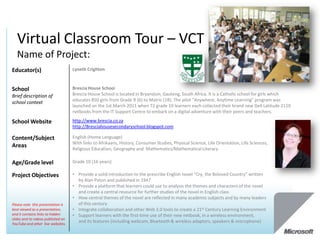
Educator(s)                         Lyneth Crighton


School                              Brescia House School
Brief description of                Brescia House School is located in Bryanston, Gauteng, South Africa. It is a Catholic school for girls which
                                    educates 850 girls from Grade R (6) to Matric (18). The pilot “Anywhere, Anytime Learning” program was
school context
                                    launched on the 1st March 2011 when 72 grade 10 learners each collected their brand new Dell Latitude 2110
                                    netbooks from the IT Support Centre to embark on a digital adventure with their peers and teachers.

School Website                      http://www.brescia.co.za
                                    http://Bresciahousesecondaryschool.blogspot.com

Content/Subject                     English (Home Language)
                                    With links to Afrikaans, History, Consumer Studies, Physical Science, Life Orientation, Life Sciences,
Areas                               Religious Education, Geography and Mathematics/Mathematical Literacy

Age/Grade level                     Grade 10 (16 years)

Project Objectives                  • Provide a solid introduction to the prescribe English novel “Cry, the Beloved Country” written
                                      by Alan Paton and published in 1947
                                    • Provide a platform that learners could use to analysis the themes and characters of the novel
                                      and create a central resource for further studies of the novel in English class
                                    • How central themes of the novel are reflected in many academic subjects and by many leaders
Please note this presentation is      of this century
best viewed as a presentation,      • Integrate collaboration and other Web 2.0 tools to create a 21st Century Learning Environment
and it contains links to hidden     • Support learners with the first-time use of their new netbook, in a wireless environment,
slides and to videos published on
YouTube and other live websites.
                                      and its features (including webcam, Bluetooth & wireless adaptors, speakers & microphone)
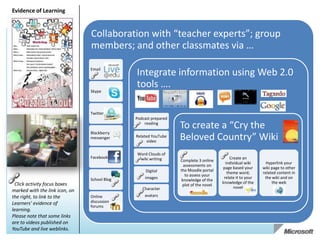
Evidence of Learning


                                Collaboration with “teacher experts”; group
                                members; and other classmates via …

                                Email
                                              Integrate information using Web 2.0
                                              tools ….
                                Skype


                                Twitter
                                              Podcast prepared
                                                  reading
                                                                 To create a “Cry the
                                Blackberry
                                messenger     Related YouTube
                                                    video
                                                                 Beloved Country” Wiki
                                              Word Clouds of
                                Facebook       wiki writing                                Create an
                                                                 Complete 3 online
                                                                                        individual wiki      Hyperlink your
                                                                   assessments on
                                                                                      page based your      wiki page to other
                                                   Digital       the Moodle portal
                                                                                         theme word;       related content in
                                                                    to assess your
                                School Blog       images                               relate it to your    the wiki and on
                                                                  knowledge of the
 Click activity focus boxes                                                           knowledge of the          the web
                                                                  plot of the novel
                                                 Character                                   novel
marked with the link icon, on
the right, to link to the       Online            avatars
Learners’ evidence of           discussion
                                forums
learning.
Please note that some links
are to videos published on
YouTube and live weblinks.
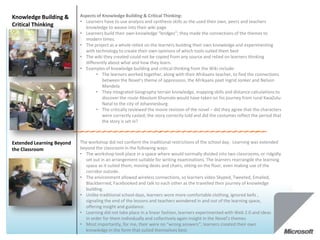
Knowledge Building &       Aspects of Knowledge Building & Critical Thinking:
                           • Learners have to use analysis and synthesis skills as the used their own, peers and teachers
Critical Thinking            knowledge to weave into their wiki page
                           • Learners build their own knowledge “bridges”; they made the connections of the themes to
                             modern times.
                           • The project as a whole relied on the learners building their own knowledge and experimenting
                             with technology to create their own opinions of which tools suited them best
                           • The wiki they created could not be copied from any source and relied on learners thinking
                             differently about what and how they learn.
                           • Examples of knowledge building and critical thinking from the Wiki include:
                                   • The learners worked together, along with their Afrikaans teacher, to find the connections
                                      between the Novel’s theme of oppression, the Afrikaans poet Ingrid Jonker and Nelson
                                      Mandela
                                   • They integrated Geography terrain knowledge, mapping skills and distance calculations to
                                      discover the route Absolum Khumalo would have taken on his journey from rural KwaZulu-
                                      Natal to the city of Johannesburg
                                   • The critically reviewed the movie revision of the novel – did they agree that the characters
                                      were correctly casted; the story correctly told and did the costumes reflect the period that
                                      the story is set in?


Extended Learning Beyond   The workshop did not conform the traditional restrictions of the school day. Learning was extended
the Classroom              beyond the classroom in the following ways:
                           • The workshop took place in a space where would normally divided into two classrooms, or ridgidly
                             set out in an arrangement suitable for writing examinations. The learners rearrangde the learning
                             space as it suited them, moving desks and chairs, sitting on the floor, even making use of the
                             corridor outside.
                           • The environment allowed wireless connections, so learners video Skyped, Tweeted, Emailed,
                             Blackberried, Facebooked and talk to each other as the travelled their journey of knowledge
                             building.
                           • Unlike traditional school days, learners wore more comfortable clothing, ignored bells ,
                             signaling the end of the lessons and teachers wondered in and out of the learning space,
                             offering insight and guidance.
                           • Learning did not take place in a linear fashion, learners experimented with Web 2.0 and ideas
                             in order for them individually and collectively again insight in the Novel’s themes
                           • Most importantly, for me, their were no “wrong answers”; learners created their own
                             knowledge in the form that suited themselves best.
• Before the workshop the girls were required to read the novel “Cry the Beloved
Collaboration     Country” by Alan Paton; in order to assess that the girls were reading and prepare
                  them for the Moodle environment the girls completed 3 online tests and
                  participated in class online discussion forum.
                • At the start of the workshop the 72 grade 10 girls were divided into 9 groups of 8
                  girls, this was done by simply giving each girl a card with her name, a puzzle piece,
                  a coloured peak cap and a word or phrase which somehow related to one of the 9
                  central themes of the novel, and no instructions.
                • Live debate erupted as the girls had to use their thinking caps and workout how
                  puzzle pieces, coloured hats and random phrases related to digital experiences. (It
                  was interesting to watch how different girls used the different clues to form
                  groups)
                • The girls were each given a “press pass” type card where they listed their fields of
                  expertise in relation to software, digital devices and any other skills they thought
                  useful. This served to highlight the idea that each individual has a part to play in
                  creating knowledge and if we pool our expertise we can achieve great things
                • Each group had 2 to 3 staff “experts”, who related to them the thread that the
                  group had to research. The teachers helped guide the girls through the workshop
                  to evaluate, research and present their own phrase and the groups theme in the
                  grade wiki.
                • Groups collaborated on mind maps to steer their research and plan their pathway.
                  These were displayed during the workshop and adapted and changed as the days
                  progressed.
                • As the girl were “creating their own knowledge” the task suggestions were merely
                  suggestions. The staff were there to ensure they kept within the theme but they
                  could find their own way and own associations.
                • Learners collaborated in groups, with their peers and teachers using Skype,
                  Twitter and emails
                • A Wiki by definition is “a Web site developed collaboratively by a community of
                  users, allowing any user to add and edit content” without collaboration the
                  learners would not succeed in producing a meaningful wiki.
                • The project was structured to allow for maximum use of the collaboration tools
                  offered by each learner having the use of her own laptop & the tools of Web 2.0

DigiGirlz puzzle it out

  • 1.
    Global Forum November 7-10,2011 | Washington, D.C.
  • 2.
    Virtual Classroom Tour- VCT Partners in Learning Global Forum November 7 – 10, 2011 Washington DC
  • 3.
    Virtual Classroom Tour– VCT Name of Project: Educator(s) Lyneth Crighton School Brescia House School Brief description of Brescia House School is located in Bryanston, Gauteng, South Africa. It is a Catholic school for girls which educates 850 girls from Grade R (6) to Matric (18). The pilot “Anywhere, Anytime Learning” program was school context launched on the 1st March 2011 when 72 grade 10 learners each collected their brand new Dell Latitude 2110 netbooks from the IT Support Centre to embark on a digital adventure with their peers and teachers. School Website http://www.brescia.co.za http://Bresciahousesecondaryschool.blogspot.com Content/Subject English (Home Language) With links to Afrikaans, History, Consumer Studies, Physical Science, Life Orientation, Life Sciences, Areas Religious Education, Geography and Mathematics/Mathematical Literacy Age/Grade level Grade 10 (16 years) Project Objectives • Provide a solid introduction to the prescribe English novel “Cry, the Beloved Country” written by Alan Paton and published in 1947 • Provide a platform that learners could use to analysis the themes and characters of the novel and create a central resource for further studies of the novel in English class • How central themes of the novel are reflected in many academic subjects and by many leaders Please note this presentation is of this century best viewed as a presentation, • Integrate collaboration and other Web 2.0 tools to create a 21st Century Learning Environment and it contains links to hidden • Support learners with the first-time use of their new netbook, in a wireless environment, slides and to videos published on YouTube and other live websites. and its features (including webcam, Bluetooth & wireless adaptors, speakers & microphone)
  • 5.
    Evidence of Learning Collaboration with “teacher experts”; group members; and other classmates via … Email Integrate information using Web 2.0 tools …. Skype Twitter Podcast prepared reading To create a “Cry the Blackberry messenger Related YouTube video Beloved Country” Wiki Word Clouds of Facebook wiki writing Create an Complete 3 online individual wiki Hyperlink your assessments on page based your wiki page to other Digital the Moodle portal theme word; related content in to assess your School Blog images relate it to your the wiki and on knowledge of the Click activity focus boxes knowledge of the the web plot of the novel Character novel marked with the link icon, on the right, to link to the Online avatars Learners’ evidence of discussion forums learning. Please note that some links are to videos published on YouTube and live weblinks.
  • 6.
    Knowledge Building & Aspects of Knowledge Building & Critical Thinking: • Learners have to use analysis and synthesis skills as the used their own, peers and teachers Critical Thinking knowledge to weave into their wiki page • Learners build their own knowledge “bridges”; they made the connections of the themes to modern times. • The project as a whole relied on the learners building their own knowledge and experimenting with technology to create their own opinions of which tools suited them best • The wiki they created could not be copied from any source and relied on learners thinking differently about what and how they learn. • Examples of knowledge building and critical thinking from the Wiki include: • The learners worked together, along with their Afrikaans teacher, to find the connections between the Novel’s theme of oppression, the Afrikaans poet Ingrid Jonker and Nelson Mandela • They integrated Geography terrain knowledge, mapping skills and distance calculations to discover the route Absolum Khumalo would have taken on his journey from rural KwaZulu- Natal to the city of Johannesburg • The critically reviewed the movie revision of the novel – did they agree that the characters were correctly casted; the story correctly told and did the costumes reflect the period that the story is set in? Extended Learning Beyond The workshop did not conform the traditional restrictions of the school day. Learning was extended the Classroom beyond the classroom in the following ways: • The workshop took place in a space where would normally divided into two classrooms, or ridgidly set out in an arrangement suitable for writing examinations. The learners rearrangde the learning space as it suited them, moving desks and chairs, sitting on the floor, even making use of the corridor outside. • The environment allowed wireless connections, so learners video Skyped, Tweeted, Emailed, Blackberried, Facebooked and talk to each other as the travelled their journey of knowledge building. • Unlike traditional school days, learners wore more comfortable clothing, ignored bells , signaling the end of the lessons and teachers wondered in and out of the learning space, offering insight and guidance. • Learning did not take place in a linear fashion, learners experimented with Web 2.0 and ideas in order for them individually and collectively again insight in the Novel’s themes • Most importantly, for me, their were no “wrong answers”; learners created their own knowledge in the form that suited themselves best.
  • 7.
    • Before theworkshop the girls were required to read the novel “Cry the Beloved Collaboration Country” by Alan Paton; in order to assess that the girls were reading and prepare them for the Moodle environment the girls completed 3 online tests and participated in class online discussion forum. • At the start of the workshop the 72 grade 10 girls were divided into 9 groups of 8 girls, this was done by simply giving each girl a card with her name, a puzzle piece, a coloured peak cap and a word or phrase which somehow related to one of the 9 central themes of the novel, and no instructions. • Live debate erupted as the girls had to use their thinking caps and workout how puzzle pieces, coloured hats and random phrases related to digital experiences. (It was interesting to watch how different girls used the different clues to form groups) • The girls were each given a “press pass” type card where they listed their fields of expertise in relation to software, digital devices and any other skills they thought useful. This served to highlight the idea that each individual has a part to play in creating knowledge and if we pool our expertise we can achieve great things • Each group had 2 to 3 staff “experts”, who related to them the thread that the group had to research. The teachers helped guide the girls through the workshop to evaluate, research and present their own phrase and the groups theme in the grade wiki. • Groups collaborated on mind maps to steer their research and plan their pathway. These were displayed during the workshop and adapted and changed as the days progressed. • As the girl were “creating their own knowledge” the task suggestions were merely suggestions. The staff were there to ensure they kept within the theme but they could find their own way and own associations. • Learners collaborated in groups, with their peers and teachers using Skype, Twitter and emails • A Wiki by definition is “a Web site developed collaboratively by a community of users, allowing any user to add and edit content” without collaboration the learners would not succeed in producing a meaningful wiki. • The project was structured to allow for maximum use of the collaboration tools offered by each learner having the use of her own laptop & the tools of Web 2.0