PRODUCT OF TWO ORTHOGONAL MATRICES AND ITS INVERSE, DESCRIBE THE MEAN OF
ROTATION
DIFFERENTIAL EQUATION AND LINEAR ALGEBRA
 DISHA AGARWALLA
(230301120281)
 KONCHADA BHARGAVI
(230301120289)
 SHRABANEE ROUTRAY
(230301120295)
PRESENTED BY:
B.TECH(CSE)
SEC-F
Guided by:
Dr. Swarnalata Jena
CONTENTS:
 ORTHOGONALMATRIX
 PRODUCTOFTWOORTHOGONAL MATRIX
 INVERSEOFORTHOGONALMATRIX
 MEANOFROTATION
ORTHOGONAL MATRIX:
 We know that a square matrix has an equal number of rows and columns.
 A square matrix with real numbers or elements is said to be an orthogonal matrix, if its transpose is equal to its
inverse matrix.
DEFINITION:
When the product of a square matrix and its transpose gives an identity matrix, then the square matrix is known as an
orthogonal matrix .
Suppose A is a square matrix with real elements and of n x n order and AT is the transpose of A. Then
according to the definition, if, AT = A-1 is satisfied, then, AAT = I Where ‘I’ is the identity matrix, A-1 is the inverse
of matrix A, and ‘n’ denotes the number of rows and columns
PROPERTIES:
•Orthogonal matrices preserve vector lengths, angles, and distances under multiplication.
•The transpose of an orthogonal matrix is its inverse.
•The determinant of an orthogonal matrix is either 1 or -1.
•Orthogonal matrices are used in various applications including rotation, reflection, and scaling
transformations.
APPLICATIONS:
•Computer graphics:
Orthogonal matrices are commonly used to represent 3D rotations and
transformations in computer graphics and gaming.
•Signal processing:
Orthogonal matrices play a crucial role in signal processing applications
such as image compression and filtering.
•Quantum mechanics:
In quantum mechanics, orthogonal matrices are used to represent unitary
transformations that preserve probabilities.
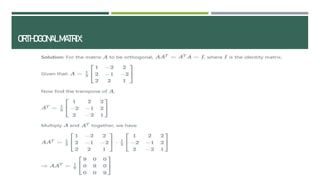
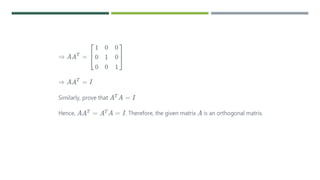
ORTHOGONAL MATRIX:
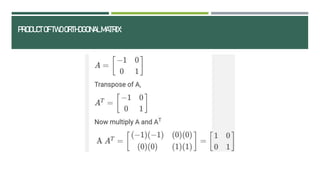
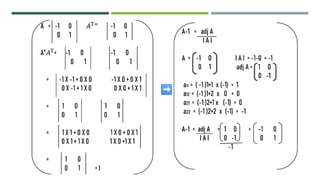
PRODUCTOFTWOORTHOGONALMATRIX:
INVERSEOFORTHOGONALMATRIX:
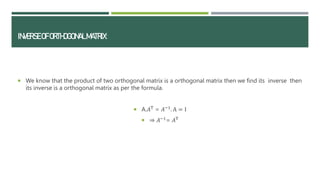
 We know that the product of two orthogonal matrix is a orthogonal matrix then we find its inverse then
its inverse is a orthogonal matrix as per the formula.
 A.𝐴T
= 𝐴−1
. A = I
 ⇒ 𝐴−1
= 𝐴T
THANK YOU!

differential equation and linear algebra presentation

  • 1.
    PRODUCT OF TWOORTHOGONAL MATRICES AND ITS INVERSE, DESCRIBE THE MEAN OF ROTATION DIFFERENTIAL EQUATION AND LINEAR ALGEBRA  DISHA AGARWALLA (230301120281)  KONCHADA BHARGAVI (230301120289)  SHRABANEE ROUTRAY (230301120295) PRESENTED BY: B.TECH(CSE) SEC-F Guided by: Dr. Swarnalata Jena
  • 2.
    CONTENTS:  ORTHOGONALMATRIX  PRODUCTOFTWOORTHOGONALMATRIX  INVERSEOFORTHOGONALMATRIX  MEANOFROTATION
  • 3.
    ORTHOGONAL MATRIX:  Weknow that a square matrix has an equal number of rows and columns.  A square matrix with real numbers or elements is said to be an orthogonal matrix, if its transpose is equal to its inverse matrix. DEFINITION: When the product of a square matrix and its transpose gives an identity matrix, then the square matrix is known as an orthogonal matrix . Suppose A is a square matrix with real elements and of n x n order and AT is the transpose of A. Then according to the definition, if, AT = A-1 is satisfied, then, AAT = I Where ‘I’ is the identity matrix, A-1 is the inverse of matrix A, and ‘n’ denotes the number of rows and columns
  • 4.
    PROPERTIES: •Orthogonal matrices preservevector lengths, angles, and distances under multiplication. •The transpose of an orthogonal matrix is its inverse. •The determinant of an orthogonal matrix is either 1 or -1. •Orthogonal matrices are used in various applications including rotation, reflection, and scaling transformations.
  • 5.
    APPLICATIONS: •Computer graphics: Orthogonal matricesare commonly used to represent 3D rotations and transformations in computer graphics and gaming. •Signal processing: Orthogonal matrices play a crucial role in signal processing applications such as image compression and filtering. •Quantum mechanics: In quantum mechanics, orthogonal matrices are used to represent unitary transformations that preserve probabilities.
  • 6.
  • 8.
  • 10.
    INVERSEOFORTHOGONALMATRIX:  We knowthat the product of two orthogonal matrix is a orthogonal matrix then we find its inverse then its inverse is a orthogonal matrix as per the formula.  A.𝐴T = 𝐴−1 . A = I  ⇒ 𝐴−1 = 𝐴T
  • 11.