NAME : ANUGYA BHARTI
SUBJECT: ZOOLOGY
TOPIC : ENVIRONMENTAL POLLUTION
T.Y.B.Sc.B.Ed.
GUIDE TEACHER: MR. MAHESH MALI
ACID RAIN
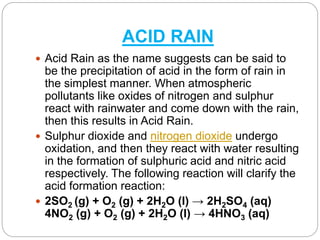
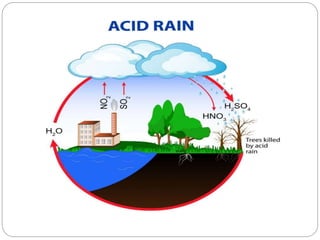
 Acid Rain as the name suggests can be said to
be the precipitation of acid in the form of rain in
the simplest manner. When atmospheric
pollutants like oxides of nitrogen and sulphur
react with rainwater and come down with the rain,
then this results in Acid Rain.
 Sulphur dioxide and nitrogen dioxide undergo
oxidation, and then they react with water resulting
in the formation of sulphuric acid and nitric acid
respectively. The following reaction will clarify the
acid formation reaction:
 2SO2 (g) + O2 (g) + 2H2O (l) → 2H2SO4 (aq)
4NO2 (g) + O2 (g) + 2H2O (l) → 4HNO3 (aq)
Effects of Acid Rain
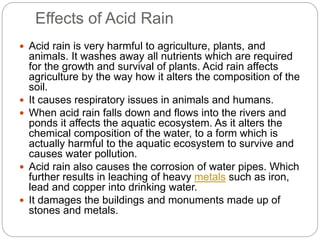
 Acid rain is very harmful to agriculture, plants, and
animals. It washes away all nutrients which are required
for the growth and survival of plants. Acid rain affects
agriculture by the way how it alters the composition of the
soil.
 It causes respiratory issues in animals and humans.
 When acid rain falls down and flows into the rivers and
ponds it affects the aquatic ecosystem. As it alters the
chemical composition of the water, to a form which is
actually harmful to the aquatic ecosystem to survive and
causes water pollution.
 Acid rain also causes the corrosion of water pipes. Which
further results in leaching of heavy metals such as iron,
lead and copper into drinking water.
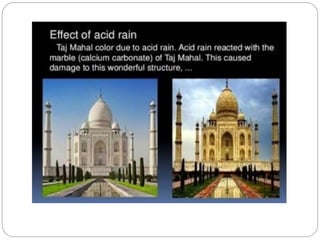
 It damages the buildings and monuments made up of
stones and metals.
OZONE LAYER
 “The ozone layer is a region in the earth’s
stratosphere that contains high
concentrations of ozone and protects the
earth from the harmful ultraviolet radiations of
the sun.”
Ozone Layer Depletion
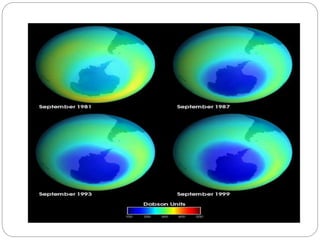
 “Ozone layer depletion is the gradual thinning
of the earth’s ozone layer in the upper
atmosphere caused due to the release
of chemical compounds containing gaseous
bromine or chlorine from industries or other
human activities.”
Causes of Ozone Layer Depletion
 The ozone layer depletion is a major concern and is associated
with a number of factors. The main causes responsible for the
depletion of the ozone layer are listed below:
 Chlorofluorocarbons
 Chlorofluorocarbons or CFCs are the main cause of ozone layer
depletion. These are released by solvents, spray aerosols,
refrigerators, air-conditioners, etc.
 The molecules of chlorofluorocarbons in the stratosphere are
broken down by the ultraviolet radiations and release chlorine
atoms. These atoms react with ozone and destroy it.
Unregulated Rocket Launches
 Researches say that the unregulated launching of rockets result in
much more depletion of ozone layer than the CFCs do. If not
controlled, this might result in a huge loss of the ozone layer by the
year 2050.
Nitrogenous Compounds
 The nitrogenous compounds such as NO2, NO, N2O are highly
responsible for the depletion of the ozone layer.
Effects Of Ozone Layer Depletion
 The depletion of the ozone layer has harmful effects on the
environment. Let us see the major effects of ozone layer depletion on
man and environment.
 Effects on Human Health
 The humans will be directly exposed to the harmful ultraviolet radiations
of the sun due to the depletion of the ozone layer. This might result in
serious health issues among humans, such as skin diseases, cancer,
sunburns, cataract, quick ageing and an weaken immune system.
 Effects on Animals
 Direct exposure to ultraviolet radiations leads to skin and eye cancer in
animals.
 Effects on the Environment
 Strong ultraviolet rays may lead to minimal growth, flowering and
photosynthesis in plants. The forests also have to bear the harmful
effects of the ultraviolet rays.
 Effects on Marine Life
 Planktons are greatly affected by the exposure to harmful ultraviolet
rays. These are higher in the aquatic food chain. If the planktons are
destroyed, the organisms present in the lower food chain are also
affected.
What is the Greenhouse Effect?
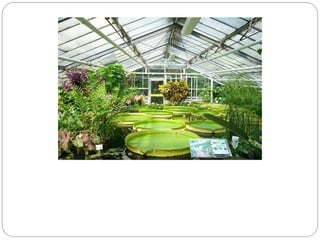
 A greenhouse is a house made of glass that can be used
to grow plants. The sun’s radiations warm the plants and
the air inside the greenhouse. The heat trapped inside
can’t escape out and warms the greenhouse which is
essential for the growth of the plants.
 Same is the case in the earth’s atmosphere. During the
day the sun heats up the earth’s atmosphere. At night,
when the earth cools down the heat is radiated back into
the atmosphere. During this process, the heat is absorbed
by the greenhouse gases in the earth’s atmosphere. This
is what makes the surface of the earth warmer, that makes
the survival of living beings on earth possible.
 However, due to the increased levels of greenhouse
gases, the temperature of the earth has increased
considerably. This has led to several drastic effects.
 Let us have a look at the greenhouse gases and the
causes and consequences of greenhouse effects.
Causes of Greenhouse Effect
 Burning of Fossil Fuels
 Fossil fuels are an important part of our lives. They are widely used in
transportation and to produce electricity. Burning of fossil fuels releases
carbon dioxide. With the increase in population, the utilization of fossil
fuels has increased. This has led to an increase in the release of
greenhouse gases in the atmosphere.
 Deforestation
 Plants and trees take in carbon dioxide and release oxygen. Due to the
cutting of trees, there is a considerable increase in the greenhouse
gases which increases the earth’s temperature.
 Farming
 Nitrous oxide used in fertilizers is one of the contributors to the
greenhouse effect in the atmosphere.
 Industrial Waste and Landfills
 The industries and factories produce harmful gases which are released
in the atmosphere.
 Landfills also release carbon dioxide and methane that adds to the
greenhouse gases.

Effects of Greenhouse Effect
 Global Warming
 It is the phenomenon of a gradual increase in the
average temperature of the Earth’s atmosphere.
The main cause for this environmental issue is
the increased volumes of greenhouse gases such
as carbon dioxide and methane released by the
burning of fossil fuels, emissions from the
vehicles, industries and other human activities.
 Effects on weather and climate
 Rise in sea level
 Effect on flora and fauna.
What is Water Pollution?
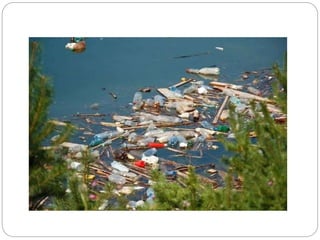
 Water pollution can be defined as the
contamination of water bodies. Water pollution is
caused when water bodies such as rivers, lakes,
oceans, groundwater and aquifers get
contaminated with industrial and agricultural
effluents.
 When water gets polluted, it adversely affects all
lifeforms that directly or indirectly depend on this
source. The effects of water contamination can be
felt for years to come.
Sources Of Water Pollution
 Urbanization.
 Deforestation.
 Industrial effluents.
 Social and Religious Practices.
 Use of Detergents and Fertilizers.
 Agricultural run-offs- Use of insecticides and
pesticides.
Effects of Pollution of Water
 Diseases: In humans, drinking or consuming polluted water in any
way has many disastrous effects on our health. It causes typhoid,
cholera, hepatitis and various other diseases.
 Destruction of Ecosystems: Ecosystems are extremely dynamic and
respond to even small changes in the environment. Water pollution
can cause an entire ecosystem to collapse if left unchecked.
 Eutrophication: Chemicals in a water body, encourage the growth
of algae. These algae form a layer on top of the pond or lake.
Bacteria feed on this algae and this decreases the amount of
oxygen in the water body, severely affecting the aquatic life there.
 Effects the food chain: Disruption in food chains happens when
toxins and pollutants in the water are consumed by aquatic
animals (fish, shellfish etc) which are then consumed by humans.
Definition of Soil Pollution
 Soil pollution refers to anything that causes
contamination of soil and degrades the soil
quality. It occurs when the pollutants causing the
pollution reduce the quality of the soil and convert
the soil inhabitable for microorganisms and macro
organisms living in the soil.

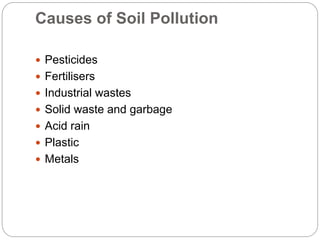
Causes of Soil Pollution
 Pesticides
 Fertilisers
 Industrial wastes
 Solid waste and garbage
 Acid rain
 Plastic
 Metals
How can soil pollution be avoided?
 Many crucial changes must be brought about in order
to control soil contamination and soil pollution without
making huge compromises on the economy. For
example, the use of toxic substances in industrial
activities can be avoided wherever suitable
alternatives exist. Also, the recycling of waste
products will also contribute towards a reduction in
the soil contamination due to landfills. Promoting
healthy agricultural practices such as the use of
organic manure and organic farming methods can
help reduce the amount of chemical fertilizers used on
agricultural soils. Efficient and limited use of chemical
pesticides must also be advocated.
References
 https://byjus.com/chemistry/acid-rain/
 https://www.nrdc.org/stories/global-warming-101
 https://www.britannica.com/science/ozone-
depletion
 https://www.nap.edu/catalog/1193/ozone-
depletion-greenhouse-gases-and-climate-change
 https://www.britannica.com/science/water-
pollution
 https://byjus.com/chemistry/soil-pollution/
Thank
you!!! 😊

Different types of pollution, it's causes and effects.

  • 1.
    NAME : ANUGYABHARTI SUBJECT: ZOOLOGY TOPIC : ENVIRONMENTAL POLLUTION T.Y.B.Sc.B.Ed. GUIDE TEACHER: MR. MAHESH MALI
  • 2.
    ACID RAIN  AcidRain as the name suggests can be said to be the precipitation of acid in the form of rain in the simplest manner. When atmospheric pollutants like oxides of nitrogen and sulphur react with rainwater and come down with the rain, then this results in Acid Rain.  Sulphur dioxide and nitrogen dioxide undergo oxidation, and then they react with water resulting in the formation of sulphuric acid and nitric acid respectively. The following reaction will clarify the acid formation reaction:  2SO2 (g) + O2 (g) + 2H2O (l) → 2H2SO4 (aq) 4NO2 (g) + O2 (g) + 2H2O (l) → 4HNO3 (aq)
  • 4.
    Effects of AcidRain  Acid rain is very harmful to agriculture, plants, and animals. It washes away all nutrients which are required for the growth and survival of plants. Acid rain affects agriculture by the way how it alters the composition of the soil.  It causes respiratory issues in animals and humans.  When acid rain falls down and flows into the rivers and ponds it affects the aquatic ecosystem. As it alters the chemical composition of the water, to a form which is actually harmful to the aquatic ecosystem to survive and causes water pollution.  Acid rain also causes the corrosion of water pipes. Which further results in leaching of heavy metals such as iron, lead and copper into drinking water.  It damages the buildings and monuments made up of stones and metals.
  • 6.
    OZONE LAYER  “Theozone layer is a region in the earth’s stratosphere that contains high concentrations of ozone and protects the earth from the harmful ultraviolet radiations of the sun.” Ozone Layer Depletion  “Ozone layer depletion is the gradual thinning of the earth’s ozone layer in the upper atmosphere caused due to the release of chemical compounds containing gaseous bromine or chlorine from industries or other human activities.”
  • 8.
    Causes of OzoneLayer Depletion  The ozone layer depletion is a major concern and is associated with a number of factors. The main causes responsible for the depletion of the ozone layer are listed below:  Chlorofluorocarbons  Chlorofluorocarbons or CFCs are the main cause of ozone layer depletion. These are released by solvents, spray aerosols, refrigerators, air-conditioners, etc.  The molecules of chlorofluorocarbons in the stratosphere are broken down by the ultraviolet radiations and release chlorine atoms. These atoms react with ozone and destroy it. Unregulated Rocket Launches  Researches say that the unregulated launching of rockets result in much more depletion of ozone layer than the CFCs do. If not controlled, this might result in a huge loss of the ozone layer by the year 2050. Nitrogenous Compounds  The nitrogenous compounds such as NO2, NO, N2O are highly responsible for the depletion of the ozone layer.
  • 9.
    Effects Of OzoneLayer Depletion  The depletion of the ozone layer has harmful effects on the environment. Let us see the major effects of ozone layer depletion on man and environment.  Effects on Human Health  The humans will be directly exposed to the harmful ultraviolet radiations of the sun due to the depletion of the ozone layer. This might result in serious health issues among humans, such as skin diseases, cancer, sunburns, cataract, quick ageing and an weaken immune system.  Effects on Animals  Direct exposure to ultraviolet radiations leads to skin and eye cancer in animals.  Effects on the Environment  Strong ultraviolet rays may lead to minimal growth, flowering and photosynthesis in plants. The forests also have to bear the harmful effects of the ultraviolet rays.  Effects on Marine Life  Planktons are greatly affected by the exposure to harmful ultraviolet rays. These are higher in the aquatic food chain. If the planktons are destroyed, the organisms present in the lower food chain are also affected.
  • 10.
    What is theGreenhouse Effect?  A greenhouse is a house made of glass that can be used to grow plants. The sun’s radiations warm the plants and the air inside the greenhouse. The heat trapped inside can’t escape out and warms the greenhouse which is essential for the growth of the plants.  Same is the case in the earth’s atmosphere. During the day the sun heats up the earth’s atmosphere. At night, when the earth cools down the heat is radiated back into the atmosphere. During this process, the heat is absorbed by the greenhouse gases in the earth’s atmosphere. This is what makes the surface of the earth warmer, that makes the survival of living beings on earth possible.  However, due to the increased levels of greenhouse gases, the temperature of the earth has increased considerably. This has led to several drastic effects.  Let us have a look at the greenhouse gases and the causes and consequences of greenhouse effects.
  • 12.
    Causes of GreenhouseEffect  Burning of Fossil Fuels  Fossil fuels are an important part of our lives. They are widely used in transportation and to produce electricity. Burning of fossil fuels releases carbon dioxide. With the increase in population, the utilization of fossil fuels has increased. This has led to an increase in the release of greenhouse gases in the atmosphere.  Deforestation  Plants and trees take in carbon dioxide and release oxygen. Due to the cutting of trees, there is a considerable increase in the greenhouse gases which increases the earth’s temperature.  Farming  Nitrous oxide used in fertilizers is one of the contributors to the greenhouse effect in the atmosphere.  Industrial Waste and Landfills  The industries and factories produce harmful gases which are released in the atmosphere.  Landfills also release carbon dioxide and methane that adds to the greenhouse gases. 
  • 13.
    Effects of GreenhouseEffect  Global Warming  It is the phenomenon of a gradual increase in the average temperature of the Earth’s atmosphere. The main cause for this environmental issue is the increased volumes of greenhouse gases such as carbon dioxide and methane released by the burning of fossil fuels, emissions from the vehicles, industries and other human activities.  Effects on weather and climate  Rise in sea level  Effect on flora and fauna.
  • 14.
    What is WaterPollution?  Water pollution can be defined as the contamination of water bodies. Water pollution is caused when water bodies such as rivers, lakes, oceans, groundwater and aquifers get contaminated with industrial and agricultural effluents.  When water gets polluted, it adversely affects all lifeforms that directly or indirectly depend on this source. The effects of water contamination can be felt for years to come.
  • 16.
    Sources Of WaterPollution  Urbanization.  Deforestation.  Industrial effluents.  Social and Religious Practices.  Use of Detergents and Fertilizers.  Agricultural run-offs- Use of insecticides and pesticides.
  • 17.
    Effects of Pollutionof Water  Diseases: In humans, drinking or consuming polluted water in any way has many disastrous effects on our health. It causes typhoid, cholera, hepatitis and various other diseases.  Destruction of Ecosystems: Ecosystems are extremely dynamic and respond to even small changes in the environment. Water pollution can cause an entire ecosystem to collapse if left unchecked.  Eutrophication: Chemicals in a water body, encourage the growth of algae. These algae form a layer on top of the pond or lake. Bacteria feed on this algae and this decreases the amount of oxygen in the water body, severely affecting the aquatic life there.  Effects the food chain: Disruption in food chains happens when toxins and pollutants in the water are consumed by aquatic animals (fish, shellfish etc) which are then consumed by humans.
  • 18.
    Definition of SoilPollution  Soil pollution refers to anything that causes contamination of soil and degrades the soil quality. It occurs when the pollutants causing the pollution reduce the quality of the soil and convert the soil inhabitable for microorganisms and macro organisms living in the soil. 
  • 19.
    Causes of SoilPollution  Pesticides  Fertilisers  Industrial wastes  Solid waste and garbage  Acid rain  Plastic  Metals
  • 21.
    How can soilpollution be avoided?  Many crucial changes must be brought about in order to control soil contamination and soil pollution without making huge compromises on the economy. For example, the use of toxic substances in industrial activities can be avoided wherever suitable alternatives exist. Also, the recycling of waste products will also contribute towards a reduction in the soil contamination due to landfills. Promoting healthy agricultural practices such as the use of organic manure and organic farming methods can help reduce the amount of chemical fertilizers used on agricultural soils. Efficient and limited use of chemical pesticides must also be advocated.
  • 22.
    References  https://byjus.com/chemistry/acid-rain/  https://www.nrdc.org/stories/global-warming-101 https://www.britannica.com/science/ozone- depletion  https://www.nap.edu/catalog/1193/ozone- depletion-greenhouse-gases-and-climate-change  https://www.britannica.com/science/water- pollution  https://byjus.com/chemistry/soil-pollution/
  • 23.