AIR POLLUTION
Table of Contents
01
What is Air Pollution? Causes Impacts on Human
Health and Environment
Case Study of Taj
Mahal
Preventive Measures
02 03
04 05
01
What is Air Pollution?
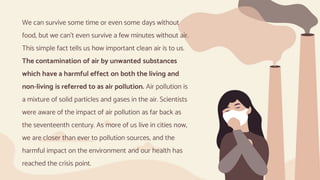
We can survive some time or even some days without
food, but we can’t even survive a few minutes without air.
This simple fact tells us how important clean air is to us.
The contamination of air by unwanted substances
which have a harmful effect on both the living and
non-living is referred to as air pollution. Air pollution is
a mixture of solid particles and gases in the air. Scientists
were aware of the impact of air pollution as far back as
the seventeenth century. As more of us live in cities now,
we are closer than ever to pollution sources, and the
harmful impact on the environment and our health has
reached the crisis point.
02
Causes
● Industrial emission
● Power plants
● Deforestation
● Wildfires
● Automobile exhausts
● Dung cakes
● Burning of plastic products
● Burning of fossil fuels
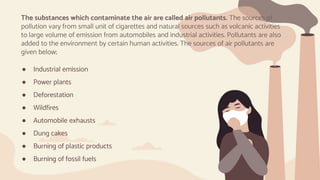
The substances which contaminate the air are called air pollutants. The sources of
pollution vary from small unit of cigarettes and natural sources such as volcanic activities
to large volume of emission from automobiles and industrial activities. Pollutants are also
added to the environment by certain human activities. The sources of air pollutants are
given below;
03
Impacts on Human
Health and Environment
Impacts on human health
● Respiratory diseases
Breathing polluted air increases the risk of getting asthma and other respiratory diseases.
Smog, which is made up of smoke and fog, too, causes respiratory diseases. Sulphur dioxide
can cause permanent lung damage.
● Brain related problems
Brain requires a high amount of energy. Hence there is high demand for oxygen. Decreased
oxygen content in air leads to inadequate energy supply to the brain. It may cause headache,
anxiety, depression etc.
● Eyes, Nose and Throat related problems
Air pollution can cause irritation in eyes, nose and lungs. Carbon monoxide released from
vehicles reduce visibility. Automobiles which run on diesel and petrol produce tiny particles
which remain suspended in air for long periods. They reduce visibility. Such particles are also
produced during industrial processes like steel making and mining.
Impacts on environment
● Climate
Some air pollutants affect climate change and accelerate Arctic warming and glacial
melt.
● Water
Air pollution affects rainfall patterns, storm intensities and regional weather patterns
such as the monsoon.
● Energy
Haze and dust from air pollution can reduce solar yields by as much 25%.
● Food
Air pollution reduces global crop yields; up to 15% for wheat and soy and 5% for maize.
Air pollution is harmful to our health as well as the environment - reducing
visibility, blocking sunlight, greenhouse gas pollution, causing acid rain, harming
forests, wildlife, agriculture, climate change- it affects the entire planet.
Greenhouse effect and Global warming
The increase in the average temperature of the Earth’s surface is known as
global warming. It occurs due to the increased concentration of greenhouse
gases in the atmosphere. Greenhouse gases include methane, CO2, and water
vapour. These gases trap the solar radiation released back by the earth, which
results in keeping our planet warm and helps in human survival. However, an
increase in these gases can lead to an increase in the earth's temperature
resulting in global warming.
04
Case study of Taj Mahal
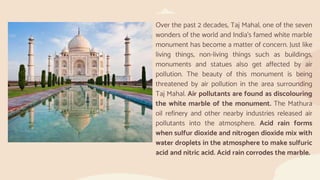
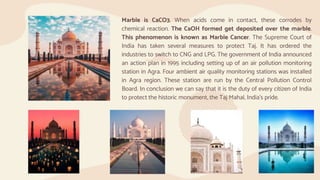
Over the past 2 decades, Taj Mahal, one of the seven
wonders of the world and India’s famed white marble
monument has become a matter of concern. Just like
living things, non-living things such as buildings,
monuments and statues also get affected by air
pollution. The beauty of this monument is being
threatened by air pollution in the area surrounding
Taj Mahal. Air pollutants are found as discolouring
the white marble of the monument. The Mathura
oil refinery and other nearby industries released air
pollutants into the atmosphere. Acid rain forms
when sulfur dioxide and nitrogen dioxide mix with
water droplets in the atmosphere to make sulfuric
acid and nitric acid. Acid rain corrodes the marble.
Marble is CaCO3. When acids come in contact, these corrodes by
chemical reaction. The CaOH formed get deposited over the marble.
This phenomenon is known as Marble Cancer. The Supreme Court of
India has taken several measures to protect Taj. It has ordered the
industries to switch to CNG and LPG. The government of India announced
an action plan in 1995 including setting up of an air pollution monitoring
station in Agra. Four ambient air quality monitoring stations was installed
in Agra region. These station are run by the Central Pollution Control
Board. In conclusion we can say that it is the duty of every citizen of India
to protect the historic monument, the Taj Mahal, India’s pride.
Preventive Measures
05
● Reforestation: The quality of air can be
improved by planting more and more trees as
they clean and filter the air.
● Policy for industries: Strict policy for industries
related to the filter of gases should be
introduced in the countries so that we can
minimize the toxins released from factories.
● Using public transports: This is a short way of
contributing to less air pollution as it provides
with less gas and energy.
Although the level of air pollution has reached a critical point, there are still
ways by which we can reduce the number of air pollutants from the air.
● Use of eco-friendly fuel: We have to adopt the usage of Eco-
friendly fuels such as LPG, CNG, bio gas and other eco-friendly
fuels so that we can reduce the amount of harmful toxic gases.
● Recycle and Reuse: The concept of recycle and reuse is not just
conserve resources and use them judicially but also is helpful for
air pollution as it helps in reducing pollution emissions.
● No to plastic bags: The use of plastic products could be very
harmful to the environment as they take a very long time to
decompose. The use of paper bags instead is a better alternative
as they decompose easily and are recyclable.
Thank you!
Presented by:
Janaki J. Mohan
Jesna Shiju
Gowkrishna B
Godwin Biju
Gregorin Sijo

Air Pollution (grade 8)

  • 1.
  • 2.
    Table of Contents 01 Whatis Air Pollution? Causes Impacts on Human Health and Environment Case Study of Taj Mahal Preventive Measures 02 03 04 05
  • 3.
    01 What is AirPollution?
  • 4.
    We can survivesome time or even some days without food, but we can’t even survive a few minutes without air. This simple fact tells us how important clean air is to us. The contamination of air by unwanted substances which have a harmful effect on both the living and non-living is referred to as air pollution. Air pollution is a mixture of solid particles and gases in the air. Scientists were aware of the impact of air pollution as far back as the seventeenth century. As more of us live in cities now, we are closer than ever to pollution sources, and the harmful impact on the environment and our health has reached the crisis point.
  • 5.
  • 6.
    ● Industrial emission ●Power plants ● Deforestation ● Wildfires ● Automobile exhausts ● Dung cakes ● Burning of plastic products ● Burning of fossil fuels The substances which contaminate the air are called air pollutants. The sources of pollution vary from small unit of cigarettes and natural sources such as volcanic activities to large volume of emission from automobiles and industrial activities. Pollutants are also added to the environment by certain human activities. The sources of air pollutants are given below;
  • 7.
  • 8.
    Impacts on humanhealth ● Respiratory diseases Breathing polluted air increases the risk of getting asthma and other respiratory diseases. Smog, which is made up of smoke and fog, too, causes respiratory diseases. Sulphur dioxide can cause permanent lung damage. ● Brain related problems Brain requires a high amount of energy. Hence there is high demand for oxygen. Decreased oxygen content in air leads to inadequate energy supply to the brain. It may cause headache, anxiety, depression etc. ● Eyes, Nose and Throat related problems Air pollution can cause irritation in eyes, nose and lungs. Carbon monoxide released from vehicles reduce visibility. Automobiles which run on diesel and petrol produce tiny particles which remain suspended in air for long periods. They reduce visibility. Such particles are also produced during industrial processes like steel making and mining.
  • 9.
    Impacts on environment ●Climate Some air pollutants affect climate change and accelerate Arctic warming and glacial melt. ● Water Air pollution affects rainfall patterns, storm intensities and regional weather patterns such as the monsoon. ● Energy Haze and dust from air pollution can reduce solar yields by as much 25%. ● Food Air pollution reduces global crop yields; up to 15% for wheat and soy and 5% for maize. Air pollution is harmful to our health as well as the environment - reducing visibility, blocking sunlight, greenhouse gas pollution, causing acid rain, harming forests, wildlife, agriculture, climate change- it affects the entire planet.
  • 10.
    Greenhouse effect andGlobal warming The increase in the average temperature of the Earth’s surface is known as global warming. It occurs due to the increased concentration of greenhouse gases in the atmosphere. Greenhouse gases include methane, CO2, and water vapour. These gases trap the solar radiation released back by the earth, which results in keeping our planet warm and helps in human survival. However, an increase in these gases can lead to an increase in the earth's temperature resulting in global warming.
  • 11.
  • 12.
    Over the past2 decades, Taj Mahal, one of the seven wonders of the world and India’s famed white marble monument has become a matter of concern. Just like living things, non-living things such as buildings, monuments and statues also get affected by air pollution. The beauty of this monument is being threatened by air pollution in the area surrounding Taj Mahal. Air pollutants are found as discolouring the white marble of the monument. The Mathura oil refinery and other nearby industries released air pollutants into the atmosphere. Acid rain forms when sulfur dioxide and nitrogen dioxide mix with water droplets in the atmosphere to make sulfuric acid and nitric acid. Acid rain corrodes the marble.
  • 13.
    Marble is CaCO3.When acids come in contact, these corrodes by chemical reaction. The CaOH formed get deposited over the marble. This phenomenon is known as Marble Cancer. The Supreme Court of India has taken several measures to protect Taj. It has ordered the industries to switch to CNG and LPG. The government of India announced an action plan in 1995 including setting up of an air pollution monitoring station in Agra. Four ambient air quality monitoring stations was installed in Agra region. These station are run by the Central Pollution Control Board. In conclusion we can say that it is the duty of every citizen of India to protect the historic monument, the Taj Mahal, India’s pride.
  • 14.
  • 15.
    ● Reforestation: Thequality of air can be improved by planting more and more trees as they clean and filter the air. ● Policy for industries: Strict policy for industries related to the filter of gases should be introduced in the countries so that we can minimize the toxins released from factories. ● Using public transports: This is a short way of contributing to less air pollution as it provides with less gas and energy. Although the level of air pollution has reached a critical point, there are still ways by which we can reduce the number of air pollutants from the air.
  • 16.
    ● Use ofeco-friendly fuel: We have to adopt the usage of Eco- friendly fuels such as LPG, CNG, bio gas and other eco-friendly fuels so that we can reduce the amount of harmful toxic gases. ● Recycle and Reuse: The concept of recycle and reuse is not just conserve resources and use them judicially but also is helpful for air pollution as it helps in reducing pollution emissions. ● No to plastic bags: The use of plastic products could be very harmful to the environment as they take a very long time to decompose. The use of paper bags instead is a better alternative as they decompose easily and are recyclable.
  • 17.
    Thank you! Presented by: JanakiJ. Mohan Jesna Shiju Gowkrishna B Godwin Biju Gregorin Sijo