BOOKDESIGNING
Compiled and produced by Sohail Sangi
From the size and shape of the book to elements like type and
layout, you’ll learn what it takes to transform a manuscript into a
professional book.
Parts of a Book: Front Matter, Back Matter and More
Most printed and published books can be divided into three
sections: the front matter, the body, and the back matter.
If you haven’t come across these terms before, don’t be intimidated!
They simply refer to the first and last sections of a book: the bits
that sandwich the main text (body) to make it look put-together and
“official,” rather than like randomly bound pages.
The following sections are commonly found in trade-published
books, in different combinations:
2
Parts
of
a
Book
Compiled and produced by Sohail Sangi
Title Lorem Ipsum
Lorem ipsum
dolor sit amet,
consectetuer
adipiscing elit.
01
Nunc viverra
imperdiet enim.
Fusce est.
Vivamus a
tellus.
02
Pellentesque
habitant morbi
tristique
senectus et
netus.
03
Book
Design
Book design is the art of arranging text, content, formatting, and visual
assets into a single cohesive product that elevates a manuscript, paper
stock, and its cover design into more than the sum of its parts.
Book Cover Design
The age-old proverb that a book is judged by its cover is true. The first thing a reader
will look at the book cover and this is why it is important to create a design that will
communicate the genre and plot details and also appeal to the target audience.
The work combines knowledge of cutting-edge technology in the
modern-day custom booklet printing process.
Designing a book is not just about making covers or images, it is about
understanding what the content of the book is and represent it visually. It helps us
cater to your business and your audience. To top it all off, we will print it for you.
4
Compiled and produced by Sohail Sangi
Here is a list of our services in the field of book design:
•Cover design
•Layout design
•Audio books
•Ebook conversions
•Editing
•Proofreading
•Book trailers
•Author websites
•Publishing
•Social media marketing
•Digital marketing 5
Book
Designs
Compiled and produced by Sohail Sangi
Book
inside
Elements
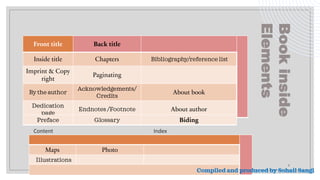
Front title Back title
Inside title Chapters Bibliography/reference list
Imprint & Copy
right
Paginating
By the author
Acknowledgements/
Credits
About book
Dedication
page
Endnotes /Footnote About author
Presentation title 6
Preface Glossary Biding
Content Index
Typography
Maps Photo
Illustrations
Compiled and produced by Sohail Sangi
Also by the author
If the author has published one or more books before the current title,
the front matter might include a page outlining their oeuvre, whether
standalones or part of a series. This page usually goes on the left hand
side, and may replace the frontispiece, for example.
Dedication page
The dedication page is, like the name suggests, a page where the author
names the person or people to whom they dedicate their book, and why.
This typically comes after the copyright and title page on the right
hand page, on a spread of its own.
Also
by
the
author
Dedication
page
Compiled and produced by Sohail Sangi
Publisher and Printer’s Details
Publishers never waste a chance to promote themselves!
You’ll find their details on the copyright page of a
traditionally-published book, which will include the
publisher’s:
Name
Address
Website
If you’re self-publishing, you should know that the publisher
is you (not KDP or IngramSpark, for example.) As for the
address, if you don’t want to make it public, that’s perfectly
fine. Simply provide the URL to your website and give readers
another method of contacting you.
Publisher
and
Printer’s
Details
Compiled and produced by Sohail Sangi
COPYRIGHT
Copy
right
Compiled and produced by Sohail Sangi
Copy Right
“Copyright” and “©”: Since the copyright symbol isn’t recognized in some
countries, it’s best to also write it out so there’s no confusion.
Copyright owner’s name: Assumedly, this will be the author’s name, though it’s
perfectly okay to use a pen name or pseudonym.
Year of publication: Note that this is the year you publish the work (not the year
you first created it).
Together, it will give you this copyright statement. Any configuration will do the
trick:
Copyright © Anthony Hall, 2014
Copyright © 2014 Anthony Hall
Copyright © 2014 by Anthony Hall
10
Copy
right
Compiled and produced by Sohail Sangi
Disclaimer
In a society where lawsuits are commonplace, it’s really no
wonder that disclaimers are popular among authors. Don’t
sweat, though! Before you start sweating over the idea of trips
to the courtroom, there are a few copyright statements that
will cover your bases. Here are some popular examples of
disclaimers:
FOR FICTION: This is a work of fiction. Names, characters,
places, and incidents either are the product of the author’s
imagination or are used fictitiously. Any resemblance to
actual persons, living or dead, events, or locales is entirely
coincidental.
Disclaimer
Compiled and produced by Sohail Sangi
ISBN
Ah, the ISBN. We all (vaguely) know what that is, right?
In case you don’t, ISBN stands for International Standard Book Number. It
contains 13 digits, and you must acquire one if you want to sell print copies of
your book or stock the shelves of brick-and-mortar stores. To find out more
about this oft-misunderstood creature, read our ISBN guide.
Assuming you’ve already obtained your ISBN, just list it on the page. You’ll
get a different ISBN for each edition of your book (i.e., the paperback, the
hardback, etc). For the sake of simplicity, you may wish to record each of
these ISBNs on the page and make a note of its edition in parentheses. For
example:
ISBN 978-1-5011-7321-9 (paperback)
ISBN 978-1-4767-4660-9 (hardcover)
ISBN
Compiled and produced by Sohail Sangi
Introduction (for nonfiction)
An introduction is a few pages that usher the reader into the subject
matter.
The intro goes over early events or information related to the main
narrative, so the reader has a solid footing before they begin.
“What's the difference between a preface and an introduction?
A preface is personal to the author, discussing why they wrote the
book and what their process was.
An introduction relates directly to the subject matter and really kicks
things off — which is why it's part of the body, not the front matter.”
Introduction
Compiled and produced by Sohail Sangi
Table of contents
Some books, mainly anthologies, poetry books, nonfiction,
and ebooks will also contain a table of contents to make
navigation easier.
This is a list of chapter headings and the page numbers
where they begin.
The table of contents should list all major sections that
follow it, both body and back matter.
Table
of
contents
Compiled and produced by Sohail Sangi
Preface
An introductory passage written by the author, a preface
relates how and why the book came into being, or
provides context for the current edition.
Foreword
An introduction written by another person, usually a
friend, family member, or scholar of the author's work to
introduce the wider context of the piece or to set the
reader up for what they’re about to read.
Preface
And
Foreword
Compiled and produced by Sohail Sangi
Chapters
Almost every single book has chapters, or at least sections,
into which the narrative is divided.
These chapters may not be designated by a chapter heading,
or appear in a Table of content some authors start new
chapters just by using page breaks or divide their text by a
blank line.
If you don't use anything to break up your content, the text
can seem impenetrable to the reader.
Chapters
Compiled and produced by Sohail Sangi
Appendix or addendum (nonfiction)
Endnotes
Supplementary notes that relate to specific passages of the
text, and denoted within the body by superscripts.
Almost always used in nonfiction, but occasionally found
in experimental/comedic fiction as well, such as Infinite
Jest by David Foster Wallace.
Appendix
Endnotes
Compiled and produced by Sohail Sangi
Glossary
Definitions of words or other elements that appear in the text.
In works of fiction, the glossary may contain entries about
individual characters or settings, made-up, or foreign words.
The glossary usually appears in alphabetical order.
Index
A list of terms or phrases used in the book, along with the
pages on which they appear, so the reader can find them easily.
The index is also usually in alphabetical order.
Glossary
Index
Compiled and produced by Sohail Sangi
About the author
This is where the author gives a brief summary of their
previous work, education, and personal life (e.g. “She lives
in New York with her husband and two Great Danes”).
Sometimes, this is part of the front matter instead, perhaps
even printed directly onto the backside of the paperback
cover. Or, if it’s a hardback with a dust jacket, this may go
on the back flap.
About
the
author
Compiled and produced by Sohail Sangi

Book Designing.pdf

  • 1.
  • 2.
    From the sizeand shape of the book to elements like type and layout, you’ll learn what it takes to transform a manuscript into a professional book. Parts of a Book: Front Matter, Back Matter and More Most printed and published books can be divided into three sections: the front matter, the body, and the back matter. If you haven’t come across these terms before, don’t be intimidated! They simply refer to the first and last sections of a book: the bits that sandwich the main text (body) to make it look put-together and “official,” rather than like randomly bound pages. The following sections are commonly found in trade-published books, in different combinations: 2 Parts of a Book Compiled and produced by Sohail Sangi
  • 3.
    Title Lorem Ipsum Loremipsum dolor sit amet, consectetuer adipiscing elit. 01 Nunc viverra imperdiet enim. Fusce est. Vivamus a tellus. 02 Pellentesque habitant morbi tristique senectus et netus. 03
  • 4.
    Book Design Book design isthe art of arranging text, content, formatting, and visual assets into a single cohesive product that elevates a manuscript, paper stock, and its cover design into more than the sum of its parts. Book Cover Design The age-old proverb that a book is judged by its cover is true. The first thing a reader will look at the book cover and this is why it is important to create a design that will communicate the genre and plot details and also appeal to the target audience. The work combines knowledge of cutting-edge technology in the modern-day custom booklet printing process. Designing a book is not just about making covers or images, it is about understanding what the content of the book is and represent it visually. It helps us cater to your business and your audience. To top it all off, we will print it for you. 4 Compiled and produced by Sohail Sangi
  • 5.
    Here is alist of our services in the field of book design: •Cover design •Layout design •Audio books •Ebook conversions •Editing •Proofreading •Book trailers •Author websites •Publishing •Social media marketing •Digital marketing 5 Book Designs Compiled and produced by Sohail Sangi
  • 6.
    Book inside Elements Front title Backtitle Inside title Chapters Bibliography/reference list Imprint & Copy right Paginating By the author Acknowledgements/ Credits About book Dedication page Endnotes /Footnote About author Presentation title 6 Preface Glossary Biding Content Index Typography Maps Photo Illustrations Compiled and produced by Sohail Sangi
  • 7.
    Also by theauthor If the author has published one or more books before the current title, the front matter might include a page outlining their oeuvre, whether standalones or part of a series. This page usually goes on the left hand side, and may replace the frontispiece, for example. Dedication page The dedication page is, like the name suggests, a page where the author names the person or people to whom they dedicate their book, and why. This typically comes after the copyright and title page on the right hand page, on a spread of its own. Also by the author Dedication page Compiled and produced by Sohail Sangi
  • 8.
    Publisher and Printer’sDetails Publishers never waste a chance to promote themselves! You’ll find their details on the copyright page of a traditionally-published book, which will include the publisher’s: Name Address Website If you’re self-publishing, you should know that the publisher is you (not KDP or IngramSpark, for example.) As for the address, if you don’t want to make it public, that’s perfectly fine. Simply provide the URL to your website and give readers another method of contacting you. Publisher and Printer’s Details Compiled and produced by Sohail Sangi
  • 9.
  • 10.
    Copy Right “Copyright” and“©”: Since the copyright symbol isn’t recognized in some countries, it’s best to also write it out so there’s no confusion. Copyright owner’s name: Assumedly, this will be the author’s name, though it’s perfectly okay to use a pen name or pseudonym. Year of publication: Note that this is the year you publish the work (not the year you first created it). Together, it will give you this copyright statement. Any configuration will do the trick: Copyright © Anthony Hall, 2014 Copyright © 2014 Anthony Hall Copyright © 2014 by Anthony Hall 10 Copy right Compiled and produced by Sohail Sangi
  • 11.
    Disclaimer In a societywhere lawsuits are commonplace, it’s really no wonder that disclaimers are popular among authors. Don’t sweat, though! Before you start sweating over the idea of trips to the courtroom, there are a few copyright statements that will cover your bases. Here are some popular examples of disclaimers: FOR FICTION: This is a work of fiction. Names, characters, places, and incidents either are the product of the author’s imagination or are used fictitiously. Any resemblance to actual persons, living or dead, events, or locales is entirely coincidental. Disclaimer Compiled and produced by Sohail Sangi
  • 12.
    ISBN Ah, the ISBN.We all (vaguely) know what that is, right? In case you don’t, ISBN stands for International Standard Book Number. It contains 13 digits, and you must acquire one if you want to sell print copies of your book or stock the shelves of brick-and-mortar stores. To find out more about this oft-misunderstood creature, read our ISBN guide. Assuming you’ve already obtained your ISBN, just list it on the page. You’ll get a different ISBN for each edition of your book (i.e., the paperback, the hardback, etc). For the sake of simplicity, you may wish to record each of these ISBNs on the page and make a note of its edition in parentheses. For example: ISBN 978-1-5011-7321-9 (paperback) ISBN 978-1-4767-4660-9 (hardcover) ISBN Compiled and produced by Sohail Sangi
  • 13.
    Introduction (for nonfiction) Anintroduction is a few pages that usher the reader into the subject matter. The intro goes over early events or information related to the main narrative, so the reader has a solid footing before they begin. “What's the difference between a preface and an introduction? A preface is personal to the author, discussing why they wrote the book and what their process was. An introduction relates directly to the subject matter and really kicks things off — which is why it's part of the body, not the front matter.” Introduction Compiled and produced by Sohail Sangi
  • 14.
    Table of contents Somebooks, mainly anthologies, poetry books, nonfiction, and ebooks will also contain a table of contents to make navigation easier. This is a list of chapter headings and the page numbers where they begin. The table of contents should list all major sections that follow it, both body and back matter. Table of contents Compiled and produced by Sohail Sangi
  • 15.
    Preface An introductory passagewritten by the author, a preface relates how and why the book came into being, or provides context for the current edition. Foreword An introduction written by another person, usually a friend, family member, or scholar of the author's work to introduce the wider context of the piece or to set the reader up for what they’re about to read. Preface And Foreword Compiled and produced by Sohail Sangi
  • 16.
    Chapters Almost every singlebook has chapters, or at least sections, into which the narrative is divided. These chapters may not be designated by a chapter heading, or appear in a Table of content some authors start new chapters just by using page breaks or divide their text by a blank line. If you don't use anything to break up your content, the text can seem impenetrable to the reader. Chapters Compiled and produced by Sohail Sangi
  • 17.
    Appendix or addendum(nonfiction) Endnotes Supplementary notes that relate to specific passages of the text, and denoted within the body by superscripts. Almost always used in nonfiction, but occasionally found in experimental/comedic fiction as well, such as Infinite Jest by David Foster Wallace. Appendix Endnotes Compiled and produced by Sohail Sangi
  • 18.
    Glossary Definitions of wordsor other elements that appear in the text. In works of fiction, the glossary may contain entries about individual characters or settings, made-up, or foreign words. The glossary usually appears in alphabetical order. Index A list of terms or phrases used in the book, along with the pages on which they appear, so the reader can find them easily. The index is also usually in alphabetical order. Glossary Index Compiled and produced by Sohail Sangi
  • 19.
    About the author Thisis where the author gives a brief summary of their previous work, education, and personal life (e.g. “She lives in New York with her husband and two Great Danes”). Sometimes, this is part of the front matter instead, perhaps even printed directly onto the backside of the paperback cover. Or, if it’s a hardback with a dust jacket, this may go on the back flap. About the author Compiled and produced by Sohail Sangi