DIFFERENCE BETWEEN MEASUREMENT,
EXAMINATION,ASSESSMENT AND
EVALUATION
PRESENTED BY PRESENTED TO
MR GORAKHA BAHADUR DHAMI DR. USHA ACHARYA (PHD)
STUDENT OF ONEYEAR B.ED ASSISTANT PROFESSOR
ROLL NO: 79127003 NEPAL OPEN UNIVERSITY
MEASUREMENT:
WHAT IS MEASUREMENT?
 Definition: Measurement is the process of
assigning numbers to objects or events according
to specific rules (Smith, 2020).
• Example: Measuring student performance using
test scores.
• Characteristics: Quantitative, objective, and
standardized
EXAMINATION
WHAT IS EXAMINATION?
• Definition: Examination is a formal test of a
person’s knowledge or proficiency in a subject
or skill (Jones, 2018).
• Example: Final exams, midterms.
• Characteristics: Structured, time-bound, and
often high-stakes.
WHAT IS ASSESSMENT?
• Definition: Assessment is the process of
documenting knowledge, skills, attitudes, and
beliefs, usually in measurable terms (Brown,
2019).
• Example: Quizzes, assignments, observations.
• Characteristics: Formative and summative, both
qualitative and quantitative.
WHAT IS EVALUATION?
• Definition: Evaluation is the process of making
judgments based on criteria and evidence
(Williams, 2021).
• Example: Evaluating a student’s overall
performance in a course.
• Characteristics: Holistic, includes value judgments,
and often qualitative.
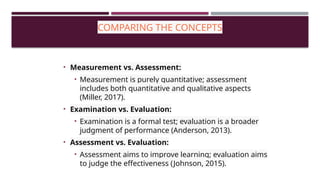
COMPARING THE CONCEPTS
• Measurement vs. Assessment:
• Measurement is purely quantitative; assessment
includes both quantitative and qualitative aspects
(Miller, 2017).
• Examination vs. Evaluation:
• Examination is a formal test; evaluation is a broader
judgment of performance (Anderson, 2013).
• Assessment vs. Evaluation:
• Assessment aims to improve learning; evaluation aims
to judge the effectiveness (Johnson, 2015).
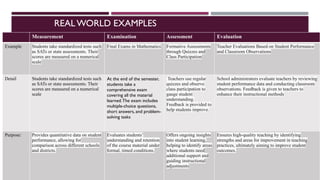
REALWORLD EXAMPLES
Measurement Examination Assessment Evaluation
Example Students take standardized tests such
as SATs or state assessments. Their
scores are measured on a numerical
scale
Final Exams in Mathematics Formative Assessments
through Quizzes and
Class Participation
Teacher Evaluations Based on Student Performance
and Classroom Observations
Detail Students take standardized tests such
as SATs or state assessments. Their
scores are measured on a numerical
scale
At the end of the semester,
students take a
comprehensive exam
covering all the material
learned.The exam includes
multiple-choice questions,
short answers, and problem-
solving tasks
Teachers use regular
quizzes and observe
class participation to
gauge student
understanding.
Feedback is provided to
help students improve.
School administrators evaluate teachers by reviewing
student performance data and conducting classroom
observations. Feedback is given to teachers to
enhance their instructional methods
Purpose: Provides quantitative data on student
performance, allowing for
comparison across different schools
and districts.
Evaluates students’
understanding and retention
of the course material under
formal, timed conditions.
Offers ongoing insights
into student learning,
helping to identify areas
where students need
additional support and
guiding instructional
adjustments
Ensures high-quality teaching by identifying
strengths and areas for improvement in teaching
practices, ultimately aiming to improve student
outcomes.
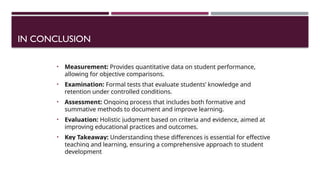
IN CONCLUSION
• Measurement: Provides quantitative data on student performance,
allowing for objective comparisons.
• Examination: Formal tests that evaluate students’ knowledge and
retention under controlled conditions.
• Assessment: Ongoing process that includes both formative and
summative methods to document and improve learning.
• Evaluation: Holistic judgment based on criteria and evidence, aimed at
improving educational practices and outcomes.
• Key Takeaway: Understanding these differences is essential for effective
teaching and learning, ensuring a comprehensive approach to student
development
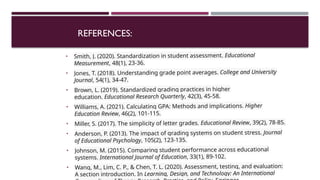
REFERENCES:
• Smith, J. (2020). Standardization in student assessment. Educational
Measurement, 48(1), 23-36.
• Jones, T. (2018). Understanding grade point averages. College and University
Journal, 54(1), 34-47.
• Brown, L. (2019). Standardized grading practices in higher
education. Educational Research Quarterly, 42(3), 45-58.
• Williams, A. (2021). Calculating GPA: Methods and implications. Higher
Education Review, 46(2), 101-115.
• Miller, S. (2017). The simplicity of letter grades. Educational Review, 39(2), 78-85.
• Anderson, P. (2013). The impact of grading systems on student stress. Journal
of Educational Psychology, 105(2), 123-135.
• Johnson, M. (2015). Comparing student performance across educational
systems. International Journal of Education, 33(1), 89-102.
• Wang, M., Lim, C. P., & Chen, T. L. (2020). Assessment, testing, and evaluation:
A section introduction. In Learning, Design, and Technology: An International

Difference between Measurement, Exam, Assessment and Evaluation.pptx

  • 1.
    DIFFERENCE BETWEEN MEASUREMENT, EXAMINATION,ASSESSMENTAND EVALUATION PRESENTED BY PRESENTED TO MR GORAKHA BAHADUR DHAMI DR. USHA ACHARYA (PHD) STUDENT OF ONEYEAR B.ED ASSISTANT PROFESSOR ROLL NO: 79127003 NEPAL OPEN UNIVERSITY
  • 2.
    MEASUREMENT: WHAT IS MEASUREMENT? Definition: Measurement is the process of assigning numbers to objects or events according to specific rules (Smith, 2020). • Example: Measuring student performance using test scores. • Characteristics: Quantitative, objective, and standardized
  • 3.
    EXAMINATION WHAT IS EXAMINATION? •Definition: Examination is a formal test of a person’s knowledge or proficiency in a subject or skill (Jones, 2018). • Example: Final exams, midterms. • Characteristics: Structured, time-bound, and often high-stakes.
  • 4.
    WHAT IS ASSESSMENT? •Definition: Assessment is the process of documenting knowledge, skills, attitudes, and beliefs, usually in measurable terms (Brown, 2019). • Example: Quizzes, assignments, observations. • Characteristics: Formative and summative, both qualitative and quantitative.
  • 5.
    WHAT IS EVALUATION? •Definition: Evaluation is the process of making judgments based on criteria and evidence (Williams, 2021). • Example: Evaluating a student’s overall performance in a course. • Characteristics: Holistic, includes value judgments, and often qualitative.
  • 6.
    COMPARING THE CONCEPTS •Measurement vs. Assessment: • Measurement is purely quantitative; assessment includes both quantitative and qualitative aspects (Miller, 2017). • Examination vs. Evaluation: • Examination is a formal test; evaluation is a broader judgment of performance (Anderson, 2013). • Assessment vs. Evaluation: • Assessment aims to improve learning; evaluation aims to judge the effectiveness (Johnson, 2015).
  • 7.
    REALWORLD EXAMPLES Measurement ExaminationAssessment Evaluation Example Students take standardized tests such as SATs or state assessments. Their scores are measured on a numerical scale Final Exams in Mathematics Formative Assessments through Quizzes and Class Participation Teacher Evaluations Based on Student Performance and Classroom Observations Detail Students take standardized tests such as SATs or state assessments. Their scores are measured on a numerical scale At the end of the semester, students take a comprehensive exam covering all the material learned.The exam includes multiple-choice questions, short answers, and problem- solving tasks Teachers use regular quizzes and observe class participation to gauge student understanding. Feedback is provided to help students improve. School administrators evaluate teachers by reviewing student performance data and conducting classroom observations. Feedback is given to teachers to enhance their instructional methods Purpose: Provides quantitative data on student performance, allowing for comparison across different schools and districts. Evaluates students’ understanding and retention of the course material under formal, timed conditions. Offers ongoing insights into student learning, helping to identify areas where students need additional support and guiding instructional adjustments Ensures high-quality teaching by identifying strengths and areas for improvement in teaching practices, ultimately aiming to improve student outcomes.
  • 8.
    IN CONCLUSION • Measurement:Provides quantitative data on student performance, allowing for objective comparisons. • Examination: Formal tests that evaluate students’ knowledge and retention under controlled conditions. • Assessment: Ongoing process that includes both formative and summative methods to document and improve learning. • Evaluation: Holistic judgment based on criteria and evidence, aimed at improving educational practices and outcomes. • Key Takeaway: Understanding these differences is essential for effective teaching and learning, ensuring a comprehensive approach to student development
  • 9.
    REFERENCES: • Smith, J.(2020). Standardization in student assessment. Educational Measurement, 48(1), 23-36. • Jones, T. (2018). Understanding grade point averages. College and University Journal, 54(1), 34-47. • Brown, L. (2019). Standardized grading practices in higher education. Educational Research Quarterly, 42(3), 45-58. • Williams, A. (2021). Calculating GPA: Methods and implications. Higher Education Review, 46(2), 101-115. • Miller, S. (2017). The simplicity of letter grades. Educational Review, 39(2), 78-85. • Anderson, P. (2013). The impact of grading systems on student stress. Journal of Educational Psychology, 105(2), 123-135. • Johnson, M. (2015). Comparing student performance across educational systems. International Journal of Education, 33(1), 89-102. • Wang, M., Lim, C. P., & Chen, T. L. (2020). Assessment, testing, and evaluation: A section introduction. In Learning, Design, and Technology: An International