DIETA E PREVENÇÃO
 CARDIOVASCULAR !
Pedro Carrera Bastos, 2013!
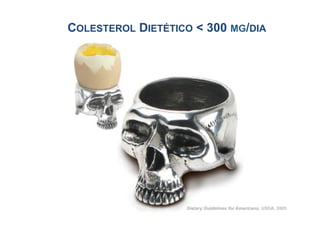
COLESTEROL DIETÉTICO < 300 MG/DIA


                   Dietary Guidelines for Americans, USDA, 2005
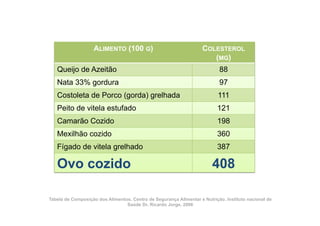
ALIMENTO (100 G)                                 COLESTEROL
                                                                       (MG)
   Queijo de Azeitão                                                       88
   Nata 33% gordura                                                        97
   Costoleta de Porco (gorda) grelhada                                     111
   Peito de vitela estufado                                               121
   Camarão Cozido                                                         198
   Mexilhão cozido                                                        360
   Fígado de vitela grelhado                                              387

   Ovo cozido                                                           408

Tabela de Composição dos Alimentos. Centro de Segurança Alimentar e Nutrição. Instituto nacional de
                                 Saúde Dr. Ricardo Jorge, 2006
Limite o consumo de
   gemas de ovo
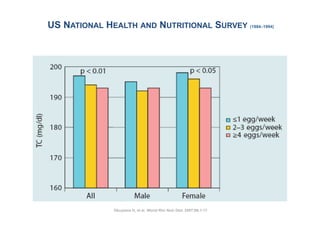
US NATIONAL HEALTH AND NUTRITIONAL SURVEY (1984–1994)


6
                   Okuyama H, et al. World Rev Nutr Diet. 2007;96:1-17.
BMJ 2013;346:e8539 doi: 10.1136/bmj.e8539 (Published 7 January 2013)


             BMJ 2013;346:e8539 doi: 10.1136/bmj.e8539 (Published 7 January 2013)                                                                    Page 1 of 13

             Research


                                                                                                                       RESEARCH


             Egg consumption and risk of coronary heart disease
             and stroke: dose-response meta-analysis of
             prospective cohort studies
                        OPEN ACCESS


                                                        12                                     12                                               12
             Ying Rong doctoral student , Li Chen research fellow , Tingting Zhu research fellow , Yadong
                                   12                        12                          12
             Song research fellow , Miao Yu research fellow , Zhilei Shan research fellow , Amanda Sands
                             3                      3                        12
             doctoral student , Frank B Hu professor , Liegang Liu professor
             1
              Department of Nutrition and Food Hygiene, Hubei Key Laboratory of Food Nutrition and Safety, Tongji Medical College, Huazhong University of
             Science and Technology, 430030 Wuhan, People’s Republic of China; 2Ministry of Education Key Lab of Environment and Health, School of Public
             Health, Tongji Medical College, People’s Republic of China; 3Departments of Nutrition and Epidemiology, Harvard School of Public Health, Boston,
             MA, USA


             Abstract                                                                     Conclusions Higher consumption of eggs (up to one egg per day) is
             Objective To investigate and quantify the potential dose-response            not associated with increased risk of coronary heart disease or stroke.
                                                                                          The increased risk of coronary heart disease among diabetic patients

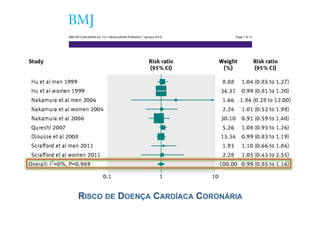
Fig 3 Forest plot of egg consumption and risk of coronary heart disease
             association between egg consumption and risk of coronary heart disease
             and stroke.                                                                  and reduced risk of hemorrhagic stroke associated with higher egg
                                                                                          consumption in subgroup analyses warrant further studies.
             Design Dose-response meta-analysis of prospective cohort studies.

               RISCO DE DOENÇA CARDÍACA CORONÁRIA
                                        Introduction
             Data sources PubMed and Embase prior to June 2012 and references
             of relevant original papers and review articles.
                                                                                          Cardiovascular disease is now a public health crisis, affecting
             Eligibility criteria for selecting studies Prospective cohort studies
                                                                                          millions of people in both developed and developing countries.
             with relative risks and 95% confidence intervals of coronary heart disease
                                                                                          Although the rate of death attributable to the disease has declined
             or stroke for three or more categories of egg consumption.
                                                                                          in developed countries in the past several decades, it is still the
             Results Eight articles with 17 reports (nine for coronary heart disease,     leading cause of death and extorts a heavy social and economic
             eight for stroke) were eligible for inclusion in the meta-analysis (3 081    toll globally.1-3 In low and middle income countries, the
Fig 4 Dose-response analyses of egg consumption and risk of stroke

            BMJ 2013;346:e8539 doi: 10.1136/bmj.e8539 (Published 7 January 2013)                                                                    Page 1 of 13

            Research


                                                                                                                      RESEARCH


            Egg consumption and risk of coronary heart disease
            and stroke: dose-response meta-analysis of
            prospective cohort studies
                       OPEN ACCESS


                                                       12                                     12                                               12
            Ying Rong doctoral student , Li Chen research fellow , Tingting Zhu research fellow , Yadong
                                  12                        12                          12
            Song research fellow , Miao Yu research fellow , Zhilei Shan research fellow , Amanda Sands
                            3                      3                        12
            doctoral student , Frank B Hu professor , Liegang Liu professor
            1
             Department of Nutrition and Food Hygiene, Hubei Key Laboratory of Food Nutrition and Safety, Tongji Medical College, Huazhong University of
            Science and Technology, 430030 Wuhan, People’s Republic of China; 2Ministry of Education Key Lab of Environment and Health, School of Public
            Health, Tongji Medical College, People’s Republic of China; 3Departments of Nutrition and Epidemiology, Harvard School of Public Health, Boston,
            MA, USA


            Abstract                                                                     Conclusions Higher consumption of eggs (up to one egg per day) is

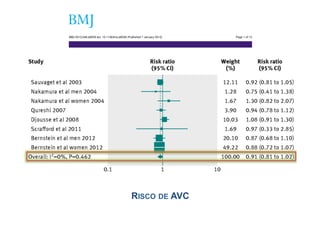
Fig 5 Forest plot of egg consumption and risk of stroke
            Objective To investigate and quantify the potential dose-response
            association between egg consumption and risk of coronary heart disease
                                                                                         not associated with increased risk of coronary heart disease or stroke.
                                                                                         The increased risk of coronary heart disease among diabetic patients
            and stroke.                                                                  and reduced risk of hemorrhagic stroke associated with higher egg
                                                                                         consumption in subgroup analyses warrant further studies.
            Design Dose-response meta-analysis of prospective cohort studies.

                                                                RISCO DE AVC
                                                                       Introduction
            Data sources PubMed and Embase prior to June 2012 and references
            of relevant original papers and review articles.
                                                                                         Cardiovascular disease is now a public health crisis, affecting
            Eligibility criteria for selecting studies Prospective cohort studies
                                                                                         millions of people in both developed and developing countries.
            with relative risks and 95% confidence intervals of coronary heart disease
                                                                                         Although the rate of death attributable to the disease has declined
            or stroke for three or more categories of egg consumption.
                                                                                         in developed countries in the past several decades, it is still the
            Results Eight articles with 17 reports (nine for coronary heart disease,     leading cause of death and extorts a heavy social and economic
            eight for stroke) were eligible for inclusion in the meta-analysis (3 081    toll globally.1-3 In low and middle income countries, the
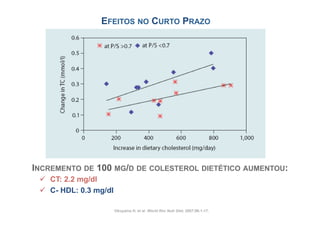
EFEITOS NO CURTO PRAZO


INCREMENTO DE 100 MG/D DE COLESTEROL DIETÉTICO AUMENTOU:
 ü  CT: 2.2 mg/dl
 ü  C- HDL: 0.3 mg/dl
 9
                         Okuyama H, et al. World Rev Nutr Diet. 2007;96:1-17.
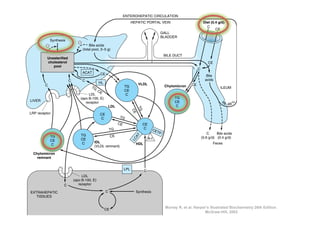
CHOLESTEROL SYNTHESIS, TRANSPORT, & EXCRETION                                            /     225

                                                                          ENTEROHEPATIC CIRCULATION
                                                                                HEPATIC PORTAL VEIN                                Diet (0.4 g/d)
                                                                                                                                     C
                                                                                                                                           CE
                                                                                                      GALL
                                                                                                      BLADDER
               Synthesis
                                  –
           –                               Bile acids
                                      (total pool, 3–5 g)
                                                                                                          BILE DUCT
            Unesterified
            cholesterol                                                                                                               CE
               pool
                                                                                                                              C
                                      ACAT            CE                                                                             Bile
                           C          C                                                                                             acids
                                                  HL                                 VLDL
           C                                                              TG                              Chylomicron    CE
                                            TG                                                                                                ILEUM
                                                 ,C                       CE
                                                   E
                                        LDL                                C
                                   (apo B-100, E)                                                              TG
  LIVER                               receptor                                                                 CE                                8 –9 9


                                                                                                                                                        %
                                                                                                                                              9
                                                               LDL                                              C


                                                                                     TG
                                                                                CE
  LRP receptor                                        CE
                                                      C              TG
                                                                     CE               CE
                                                               TG                     C         CE
                                                                                                     TP
                                                                                                                                      C     Bile acids
               TG                     TG                       CE                AT
                                                                                              A-I                                 (0.6 g/d) (0.4 g/d)
                                      CE
                                                                                LC

               CE                             IDL
                C                      C                                          HDL                                                    Feces
                                              (VLDL remnant)

    Chylomicron
      remnant


                                                                          LPL             C
                                    LDL
                               (apo B-100, E)
                       C          receptor

  EXTRAHEPATIC                                             C                      Synthesis
     TISSUES


                                                       CE
                                                                                                          Murray R, et al. Harper’s Illustrated Biochemistry 26th Edition.
                                                                                                                                 McGraw-Hill, 2003

Figure 26–6. Transport of cholesterol between the tissues in humans. (C, unesterified cholesterol; CE, cho-
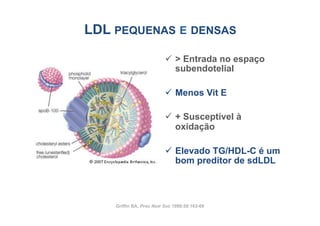
LDL PEQUENAS E DENSAS

                          ü  > Entrada no espaço
                              subendotelial

                          ü  Menos Vit E

                          ü  + Susceptível à
                              oxidação

                          ü  Elevado TG/HDL-C é um
                              bom preditor de sdLDL


    Griffin BA. Proc Nutr Soc 1999;58:163-69
24, 25]. Other cholesterol-containing foods, such as dairy          fed for 4 weeks with a 1-month washout period in between.
products, also contain high concentrations of saturated fat,        The participants were classified as insulin sensitive (n=65),
                             Curr Atheroscler Rep (2010) 12:377–383
which is a confounder for dietary cholesterol effects. This
                             DOI 10.1007/s11883-010-0130-7
                                                                    insulin resistant (n=75), and obese insulin resistant (OIR,
might be the reason why controversial results exist                 n=58). Insulin-resistant and insulin-sensitive individuals had
regarding the effects of dairy products on CHD risk [26].           significant increases in LDL-C of 7.8% and 3.3%, respec-
   Clinical trials conducted in children [27], younger adults       tively, after consuming 4 eggs per day, whereas OIR
                             Revisiting Dietary Cholesterol Recommendations: LDL-C at any intake level.
[24, 25], and the elderly [28, 29] have clearly demonstrated        individuals had no changes in
that although dietary cholesterol provided by eggs signifi-
                             Does the Evidence Support a LimitHDL-C was significantly increased for all groups
                                                                    In contrast,
                                                                                  of 300 mg/d?
cantly increases LDL-C in one third of the population, those        even after the consumption of only 2 eggs per day. These
individuals considered hyper-responders to & a cholesterol
                             Maria Luz Fernandez Mariana Calle      studies suggest that dietary management of OIR individuals
challenge exhibit increases in both LDL-C and HDL-C, with           need not include restrictions on eggs.


Table 2 Changes in LDL-C, HDL-C, LDL size, and HDL size as a response to dietary cholesterol provided by eggs in various populations
                                   Published online: 4 August 2010
                                 # Springer Science+Business Media, LLC 2010
Population                    Duration Additional dietary cholesterol           LDL-C           HDL-C          LDL-C/HDL-C ratio          LDL size      HDL size

Children (n=54) [27]           4   Abstract The mg/d
                                    wk 518 perceived association between Increase                 Introduction No change
                                                                                    dietary cho- Increase                                    Increase     ND
                                   lesterol (DC) and risk for coronary heart disease (CHD) has
Women (n=51) [25]              4   resulted in recommendations of no more than 300 mg/d for Increase
                                    wk 640 mg/d                                    Increase       The AmericanNo change
                                                                                                                  Heart Association (AHA)Increase
                                                                                                                                               recommends ND
                                                                                                                                                           no
Men (n=28) [32••]             12   healthy 640 mg/d the United States. These change Increase 300 Decrease
                                    wk        persons in                           No dietary more than           mg/d of dietary cholesterolIncrease healthy
                                                                                                                                              (DC) for    Increase
                                   recommendations proposed in the 1960s had little scientific
Men/women    (n=42)   [34]    12    wk 215 mg/d                                    No change Increaseto prevent change risk for coronary heart disease
                                                                                                  persons
                                                                                                                 No increased                Increase     Increase
                                   evidence other than the known association between              (CHD) [1]. These recommendations are mostly based on
Men/women    (n=34)   [28]     4   saturated640 and cholesterol and animal studies where Increase
                                    wk         fat mg/d                            Increase                      No change                   Increase     Increase
                                                                                                  the presence of both saturated fat and cholesterol in many
Men/women    (n=56)   [35•]   12    wk 250 mg/d                                    No normal foods and onDecrease
                                   cholesterol was fed in amounts far exceeding change Increase                    data derived from animal studies where
                                                                                                                                             ND           ND
                                   intakes. In contrast, European countries, Asian countries,     supraphysiologic doses of cholesterol, ranging from the
Men/women    (n=45)   [33•]   12   and Canada do not have an upper limit for DC. change No changeof 1,000 mg to 20,000 mg/d for humans, were
                                    wk 400 mg/d                                    No Further, equivalent No change                          ND           ND
                                   current epidemiologic data have clearly demonstrated that      fed in order to produce atherosclerosis [2].
HDL-C high-density lipoprotein     increasing concentrations of DC arelipoprotein cholesterol; ND not determined. that many other countries do not
                                   cholesterol; LDL-C low-density not correlated with                It is important to note
                                   increased risk for CHD. Clinical studies have shown that       have the same guidelines for DC. Canada [3••], Korea [4•],
                                   even if DC may increase plasma low-density lipoprotein         New Zealand [5], and India [6], for example, do not set an
                                   (LDL) cholesterol in certain individuals (hyper-responders),   upper limit for DC, focusing instead on controlling the
                                   this is always accompanied by increases in high-density        intake of saturated fat and trans fat, which are the major
                                   lipoprotein (HDL) cholesterol, so the LDL/HDL cholesterol      determinants of blood cholesterol concentrations. Similarly,
                                   ratio is maintained. More importantly, DC reduces circu-       the European guidelines on cardiovascular disease preven-
                                   lating levels of small, dense LDL particles, a well-defined    tion have the following recommendations regarding healthy
                                   risk factor for CHD. This article presents recent evidence     food choices: “consume a wide variety of foods, adjust
                                   from human studies documenting the lack of effect of DC        energy intake to maintain a healthy weight, encourage
                                   on CHD risk, suggesting that guidelines for DC should be       consumption of fruits and vegetables, replace saturated fat
                                   revisited.                                                     with mono or polyunsaturated fatty acids and reduce salt
                                                                                                  intake” [7]. In contrast to US policies, Europeans have no
                                   Keywords Dietary cholesterol . LDL cholesterol .               dietary guidelines for DC [7]. A summary of the dietary
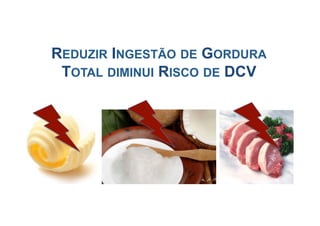
REDUZIR INGESTÃO DE GORDURA
 TOTAL DIMINUI RISCO DE DCV
lly twelve volunteers     composite samples taken from each menu once during the
 s unable to complete     study for both the stabilization diet and intervention diets.
en complete physical      The results for the seven composite samples were averaged
within -10 to +20 per-    to find the actual composition of the diets. No alcohol was in-
 tropolitan Life Insur-
values from the 1983
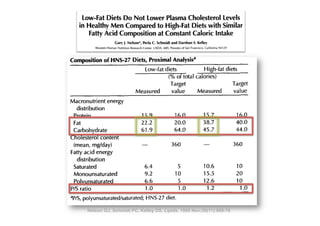
                          TABLE 1
r chronic disease was     Composition of HNS*27 Diets, Proximal Analysis
                                                                       a
  on was not an exclu-                                   Low-fat diets           High-fat diets
cruited tended to have                                            (% of total calories)
 e for men in this age                                             Target                    Target
  nsumption, and evi-                                 Measured      value      Measured      value
sionary.                  Macronutrient energy
eers were confined to       distribution
                           Protein                       15.9           16.0        15.7             16.0
 tern Human Nutrition      Fat                           22.2           20.0        38.7             40.0
 or the duration of the    Carbohydrate                  61.9           64.0        45.7             44.0
  onfines of the Nutri-   Cholesterol content
  sed outings, they had    (mean, mg/day)                --           360            --             360
 cept that provided by    Fatty acid energy
                            distribution
 rotocol was, of neces-    Saturated                      6.4            5           10.6            10
  was monitored, por-      Monounsaturated                9.2           10           15.5            20
  required to consume      Polyunsaturated                6.6            5           12.6            10
heir meals. (A rubber     P/S ratio                       1.0            1.0          1.2             1.0
 ood was scraped from     ap/s, polyunsaturated/saturated; HNS-2 7 diet.

                                 Nelson GJ, Schmidt PC, Kelley DS. Lipids. 1995 Nov;30(11):969-76
dicated an increase in the plasma very low density lipopro-                  factory because the conditions of this experiment were ca
 n (VLDL) level and a decrease in both the plasma HDL and                    fully controlled and the statistical power of the protocol w
DL levels. Thus, the total cholesterol level remained con-                   excellent.
 nt because the increase in plasma VLDL cholesterol com-                        (ii) The average cholesterol level in the subjects was co
nsated for the reduction in HDL-cholesterol and LDL-cho-                     siderably below that in the European and American popu
 terol. Because of individual variations, the standard devia-                tions used to develop the Keys et aL (5) and Hegsted et al.


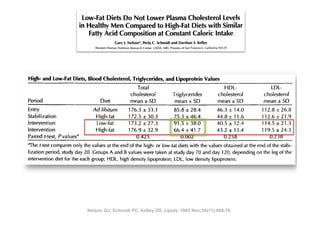
            TABLE 6
            High- and Low-Fat Diets, Blood Cholesterol, Triglycerides, and Lipoprotein Values
                                                                Total                                    HDL-                   LDL-
                                                             cholesterol         Triglycerides         cholesterol           cholesterol
            Period                            Diet           mean + SD            mean _+ SD           mean • SD             mean • SD
            Entry                          A d libitum      176.3 + 33.1          85.8 + 28.4         46.3 _+ 14.0          112.8 • 26.8
            Stabilization                   High-fat        172.5 + 30.3          75.3 • 46.4         44.8 • 11.6           112.6 • 21.9
            Intervention                    Low-fat         173.2 _+27.3          91.5 • 38.0         40.5 • 12.4           114.5 • 21.3
            Intervention                    High-fat        176.9 _+ 32.9         66.4 • 41.7         43.2 + 13.4           119.5 _+24.3
            Paired t-test, Pvalues a                           0.425                 0.002               0.258                 0.238
            ~lhe t-test compares only the values at the end of the high- or low-fat diets with the values obtained at the end of the stabi-
            lization period, study day 20. Groups A and B values were taken at study day 70 and day 120, depending on the leg of the
            intervention diet for the each group; HDL, high density lipoprotein; LDL, low density lipoprotein.


                                                                                                                            Lipids, Vol. 30, no. 11 (19


                                        Nelson GJ, Schmidt PC, Kelley DS. Lipids. 1995 Nov;30(11):969-76
misnomer. The countries around the Mediterranean basin have differe
           differ in the amount of total fat, olive oil, type of meat andamount of total fat, olivemilk vs. cheese;intake;
                                                                                                         differ in the wine intake; oil, type of meat and wine frui
                                                                                                         the rates of coronary heart disease and cancer, with the lower death ra
           the rates of coronary heart disease and cancer, with the lower death rates andof Greece (the diet e
                                                                                                         Greece. Extensive studies on the traditional diet longer life be
       The Greece. Extensive studies on So Special about the ofGreece (the high intake of fruits, vegetables (particularly wildt
           Mediterranean Diets: What Is the traditional diet ofDiet of Greece? before 1960) indicate        Greeks consists of a
                                                                                                                                   diet
                                              1                                                          of sourdough bread rather than pasta; more olive oil and olives; less m
       The Scientific Evidence
           of Greeks consists of a high intake of fruits, vegetables (particularly wild plants), nuts and cer
                                                                                                         and moderate amounts of wine, more so than other Mediterranean coun
                                                                                                         diet of Crete shows a number of protective substances, such as s
           of sourdough bread rather than pasta; more olive oil and olives; less(EFA), high amounts of fiber, antioxid
            Artemis P. Simopoulos2                                                                       (n-6):(n-3) essential fatty acids milk but more cheese
                                                                                                         polyphenols from olive oil), vitamins E and C, some of which have been
           and Center for Genetics, Nutrition and Health, Washington, DCthan othercancer, including cancer ofcountries. Analyses of th
            The moderate amounts of wine, more so                                                          Mediterranean the breast. These findings should serve
                                                                                                         intervention trials that will test the effect of specific dietary patterns in t
           diet of Crete shows a diet,” implying that all Mediterranean people with cancer. J. diet, is131:as selenium, glutathione
            ABSTRACT The term “Mediterranean
                                                           number of protective substances, sucha 3065S–3073S, 2001.
                                                                                                          have the same
                                                                                                                             Nutr.
           (n-6):(n-3) countries around the Mediterranean basin have different diets, religions andWORDS: Their antioxidants (especially resv
            misnomer. The essential fatty acids (EFA), high amounts of fiber, diets
                                                                                                         KEY
                                                                                                                 cultures.
                                                                                                                              diet of Crete      (n-3) fatty acids
                                                                                                                                                    c                 wild plants
                                                                                                                                                                         c            a                                                  c            c
            differ in the amount of total fat, olive oil, type of meat and wine intake; milk vs. cheese; fruits and vegetables; and
           polyphenols from olive oil), vitamins E and C, some of which have been shown to be assoc
            the rates of coronary heart disease and cancer, with the lower death rates and longer life expectancy occurring in
                                                                                                   The health of thedietary pattern the population in general
                                                                                                                       individual and                                      intake and
           cancer, including the traditionalvegetables (particularly wild These indicate that the should serve as aa strong incenti
            of Greeks consists of a high intake of fruits, of the breast. plants),is thefindings
            Greece. Extensive studies on
                                             cancer diet of Greece (the diet before 1960) and cereals mostly in the form genetics and number of diet” is a m
                                                                                                 nuts result of interactions between
           intervention trials that will testoil and olives; less of specificofdietarypattern of the an in the prevention but in facb
            of sourdough bread rather than pasta; more olive the effect milk but environmentalmore fish; less meat;
                                                                                                more cheese; factors. Nutrition is
                                                                                               major importance (1– patterns
                                                                                                                                           environmental factor of
            and moderate amounts of wine, more so than other Mediterranean countries. Analyses the dietary 4). Our genetic profile has not changed
                                                                                                                                                                            and m
                                                                                                                                                                           surprising


                                                                                                                                                                             Downloaded from jn.nutrition.org by on September 27, 2006
           withofcancer. a number of protective substances, such as selenium, glutathione, a balanced ratio energy expenditure and phys- and diets.
            diet      Crete shows     J. Nutr. 131: 3065S–3073S, 2001. our food supply and in  over the past 10,000 y, whereasofmajor changes have taken
                                                                                               place in
                                                                                                                                                                           sin have d
                  (n-6):(n-3) essential fatty acids (EFA), high amounts of fiber, antioxidants (especially resveratrol from wine and
                                                                                                       ical activity (5–17). Today industrialized societies are charac-
                  polyphenols from olive oil), vitamins E and C, some of which have been shown to be associated with lower risk of                                                                                                             Muslims d
                  cancer, including cancer of the breast. These findings should serve as a strong incentivefollowing: 1) an increase in energy intake and
                                                                                                       terized by the for the initiation of                                                                                                    drinks, wh
                KEY WORDS:                                diet of Crete                         (n-3) fatty acids                        wild plants
                  intervention trials that will test the effect of specific dietary patterns in the prevention and management of patientsan c
                                                 c                             c                       decrease in energy expenditure; 2)
                                                                                                                    c                         increase in saturated fat,     antioxidants                                                        canc
                                                                                                                                                                                                                                             c eat meat o
                  with cancer. J. Nutr. 131: 3065S–3073S, 2001.                                        (n-6) fatty acids and trans fatty acids and a decrease in (n-3)                                                                         on. Althou
                                                                                                                    fatty acid intake; 3) a decrease in complex carbohydrates and                                                              usually con
                  KEY WORDS:               diet of Crete        (n-3) fatty acids          wild plants       antioxidants c cancer c (n-6) fattyin cereal grains and a decrease in
                                                                                                                     fiber intake; 4) an increase acids                                                                                         (14.0 –18.0
    The health of the individual and the population infruit andand calcium intakeand 5) a decreasehealth anti-
                                                                                             general intake; (5–17). Furthermore, the ratio of
                                                                                                                    intake and in protein, status. Ther
                                       c                    c                         c                  c
                                                                                                      vegetable                                                                                                                                Crete have
                                                                                           oxidant
is the the result of of the individual and the betweengeneral intakeisand a numberisof fattythe term 16.74:1, whereas during evolutionThere is n
      is
         result of interactions population number of diet” a misnomer. There(n-3) just acidsMediterranean diet
          The health
                      interactions between genetics and a
                                                           in genetics and health (n-6) to status. Therefore,
                                                                                                        not
                                                                                                                    diet” is a misnomer.
                                                                                                                     is “Mediterranean
                                                                                                                oneFig. 1).
                                                                                                                                                                                                                                               1930 (19).
                                                                                                                                                                                                                                               as low a de
                                        Nutrition not changed but in fact manyit Mediterranean 1, butwhich not
      environmental factors. Nutrition is an
      major importance (1– 4). Our            profile has
                                                                                              was 2–1:1 (Table
environmental factors.genetic environmental an environmental factor of diets (18), the in isfact many Mediterran
                                                         is factor of                          Recent investigations of      dietary patterns and health                                                                                       United Na
                                                                                                                                                                                                                                               was 11.3–1
                                                                        surprising becausestatus of the countries surrounding the ba-
                                                                                            the countries along the Mediterranean Mediterranean basin
major importancey,(1– 4). Our genetic profile hasdifferentchanged majorandsurprisingthem in both dietary countrie
      over the past 10,000       whereas major changes have taken       sin have not clearly indicate
                                                                                            religions, economic differences among because the
                                                                                                                     cultural traditions                                                                                                       ;10.6 in 1
      place in our food supply and in energy expenditure and phys-
over ical activity (5–17). Today industrialized societies are charac- changes have pork or drink wine and other alcoholic
        the past 10,000 y, whereas major Muslims do not eat taken       and diets. Diets are influenced by religious habits, that is,
                                                                                                                    sin have different religions, ec
                                                                                                                                                                                                                                               almost thr
                                                                                                                                                                                                                                               United Sta
placedecrease in energy expenditure; 2) an increase inenergy expenditureWednesdays and Fridays but andwine, and so Diets are influence
         in our food supply and in saturated fat, eat meat on
      terized by the following: 1) an increase in energy intake and     drinks, whereasand phys- populations usually do not
                                                                                         Greek Orthodox
                                                                                                                    drink diets.
                                                                                                                        1
                                                                                                                          Presented as part of the 11th Annual Research Conference on Diet, Nutrition
                                                                                                                    and Cancer held in Washington, DC, July 16 –17, 2001. This conference was
                                                                                                                                                                                                                                               the traditio
                                                                                                                                                                                                                                               tries Study
ical activity (5–17). Today industrialized on. Although Greece and the
      (n-6) fatty acids and trans fatty acids and a decrease in (n-3) societies are charac- Mediterranean countries are
      fatty acid intake; 3) a decrease in complex carbohydrates and                                                 Muslims do not eat pork or d
                                                                                                                    sponsored by the American Institute for Cancer Research and was supported by
                                                                                                                    the California Dried Plum Board, The Campbell Soup Company, General Mills,                                                 vascular di
                                                                        usually considered to be areas of medium-high death rates                                                                                                              (United St
terized by thean increase in cereal1) an increase in (14.0 –18.0 per 1000 inhabitants), death rates on the island of
      fiber intake; 4) following: grains and a decrease in                energy intake and                          Lipton, Mead Johnson Nutritionals, Roche Vitamins Inc. and Vitasoy USA. Guest
                                                                                                                    drinks, whereas Greek Orthod
                                                                                                                    editors for this symposium publication were Ritva R. Butrum and Helen A.                                                   goslavia, Ja
      fruit and vegetable intake; and 5) a decrease in protein, anti-                                               Norman, American Institute for Cancer Research, Washington, DC.
decrease in energy expenditure; 2)the ratio of 1930 (19). No other area in the Mediterranean basin has had Wednesdays and
      oxidant and calcium intake (5–17). Furthermore, an increase
                                                                        Cretein saturated fat, continuously since before
                                                                               have been below this level
                                                                                                                    eat meat on
                                                                                                                        2
                                                                                                                          To whom correspondence should be addressed.
                                                                                                                    E-mail: cgnh@bellatlantic.net
                                                                                                                                                                                                                                               order of 5-
                                                                                                                                                                                                                                               the field w
(n-6) fatty acidsacids is 16.74:1, whereas during evolution aasdecrease inCrete, according to data compiled by the
      (n-6) to (n-3) fatty
                             and1).  trans fatty acids and low a death rate as (n-3)
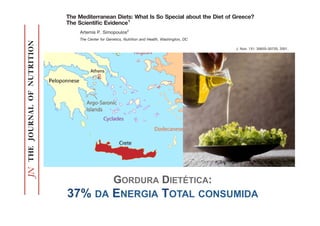
fatty status of intake; 3)ofathe dietary MediterraneanhealthDIETÉTICA:and © beforeusually IIforand
                                      G the patterns and basin United Nationsperin0022-3166/01 $3.00 2001yearbook for 1948. Nutritional Sciences. and th
                                                                                                                    on. Although Greece
       acid the countries surroundingORDURA
      it was 2–1:1 (Table 1, Fig.
                                                                                              their demographic                       It
          Recent investigations        decrease in complex was 11.3–13.7 1000 inhabitants American Society considered to be area
                                                                         carbohydrates                               World War

        37%                                  E                                            T
fiber clearly indicate major differences among in cereal grains;10.6 ina decrease Cancer and heart disease in the per 1000 inhabitan
       intake; 4) an increase them in both dietary almost three times as(19). indeaths proportionally caused
                          DA NERGIA OTALas CONSUMIDA                      and 1946 –1948 many
fruit and vegetable intake; and 5) a decrease in protein,Greece before 1960.Crete have been below this l
                                                                        United States             anti-
                                                                                                                    (14.0 –18.0
                                                                                          in Crete (19). The diet of Crete represents
                                                                        the traditional diet of                      The Seven Coun-
                                                                                                                                                         3065S


oxidant and calcium intake (5–17). Furthermore, was theratio establish credible data on cardio-
                                                                        tries Study the first to of
           1
             Presented as part of the 11th Annual Research Conference on Diet, Nutrition
       and Cancer held in Washington, DC, July 16 –17, 2001. This conference was
       sponsored by the American Institute for Cancer Research and was supported by                                 1930 (19). No other area in th
(n-6) to (n-3) fatty acids is 16.74:1, whereas during evolution in contrasting populations
                                                                        vascular disease prevalence rates
       the California Dried Plum Board, The Campbell Soup Company, General Mills,

                                                                        goslavia, Japan and Greece), with differences low a death rate as Crete, acc
                                                                                                                    as found on the
                                                                        (United States, Finland, The Netherlands, Italy, former Yu-
       Lipton, Mead Johnson Nutritionals, Roche Vitamins Inc. and Vitasoy USA. Guest

it was 2–1:1 (Table 1, Fig. 1).
       editors for this symposium publication were Ritva R. Butrum and Helen A.

                                                                                                                    United Nations in their demo
       Norman, American Institute for Cancer Research, Washington, DC.
           2
             To whom correspondence should be addressed.                order of 5- to 10-fold in coronary heart disease (20). In 1958,
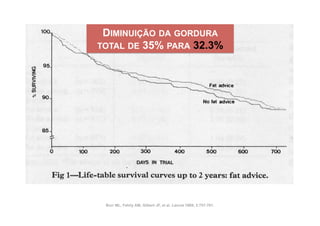
DIMINUIÇÃO DA GORDURA
TOTAL DE 35% PARA 32.3%


 Burr ML, Fehily AM, Gilbert JF, et al. Lancet 1989; 2:757-761.
dification Trial (CVD) prevention, butand some trials have linked diet needed.
       Context Multiple epidemiologic studies
 cation Trial disease
       diovascular                            long-term intervention data are
                                                                              with car-


    Linda     Objective To test the hypothesis that a dietary intervention, intended to be low in
                         Context Multiple epidemiologic some trials some trials have linked diet with risk.
               Context Multiple epidemiologic studies andstudies andhave linked diet with reduce CVD car-
Hsia, MD; fat and high in vegetables, fruits, and grains to reduce cancer, wouldcar-
  .
 D;
               diovascular disease (CVD) prevention, but long-term intervention data are needed. are needed.
                         diovascular disease (CVD) prevention, but long-term intervention data
L. ; L. Design, Setting, and Participants Randomized controlled trial of 48 835 post-
  arcia
  D                      Objective To test the that a dietary intervention, intended to be low in
               Objective To test the hypothesishypothesis that a dietary intervention, intended to be low in
              menopausal women aged 50 tograins to reduce cancer, would reduce CVD risk.
                                                         79 years, of diverse backgrounds and ethnicities, who
               fat and highand high in vegetables, fruits, and grains to reduce cancer, would reduce CVD risk.
 s; H.                   fat in vegetables, fruits, and
     Lewis H. participated in the Women’s Health Initiative Dietary Modification Trial. Women were
  Croix, PhDDesign,Design, Setting, and Participants 541 [40%]) or of 48 835trial of 48 835 post-
  PhD;         ;           Setting, and Participants Randomized controlled trial
                                              an intervention (19 Randomized controlled
                                                                                                        post-
              randomly assigned to 50 to 79 years, of diverse backgrounds and ethnicities, whogroup (29 294
                                                                                             comparison
  L.           menopausal women aged
 orman L. [60%]) menopausal women agedStudy79 years, of diverse backgrounds and ethnicities, who
                          in in the Women’s Health 50 to Dietary Modification Trial. Women 1993 and 1998 in
  ; , MD;      participateda free-living setting.InitiativeenrollmentDietary Modification were Women were
                         participated in the Women’s Health Initiative
                                                                                occurred between
                                                                                                        Trial.
  s           40 US clinical centers;intervention (19 541 in this 541 [40%]) orgroup (29 294 group (29 294
               randomly assigned to an mean follow-up [40%]) analysis was 8.1 years.
                                                                             or comparison
    L.
    Karen L. [60%]) in a free-living setting.to an intervention (19 between 1993 and 1998 in
                         randomly assigned
                                                  Study enrollment occurred
                                                                                               comparison
MD;
D; , MD; InterventioninIntensive behavior Study enrollment group and individual sessions de-
  ysiw
  .            40 US clinical centers; mean follow-up in this analysis wasin occurred between 1993 and 1998 in
                         [60%]) a free-living setting. modification 8.1 years.
  inda M. signed to reduce total fat intake tofollow-up calories and increase intakes of vegetables/
PhD;
                         40 US clinical centers; mean 20% of in this analysis was 8.1 years.
               Intervention Intensive behavior modification in group and individual sessions de-
Perri, PhD;fruits toInterventionand grains behavior modification inintakescomparison group received
               signed to5 servings/d intake to 20% of calories and increase group of vegetables/ sessions de-
                            reduce total fat Intensive to at least 6 servings/d. The and individual
  D; L.
  oss         diet-related educationgrains to at intake servings/d. The comparison group received of vegetables/
               fruits to 5 servings/d and materials.
                         signed to reduce total fat least 6 to 20% of calories and increase intakes
 bins, G. ; Main Outcome Measures grains to at least 6 servings/d. The comparison group received
                         fruits to 5 servings/d and
 nda MD diet-related education materials.
   E.                                                   Fatal and nonfatal coronary heart disease (CHD), fatal
                         diet-related education materials.


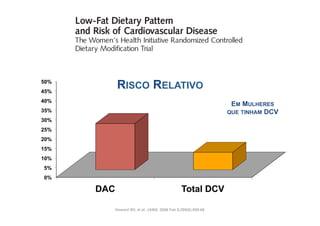
                                                                 RISCO
                                                                 0%
                                                                 5%
                                                                 10%
                                                                 15%
                                                                 20%
                                                                 25%
                                                                 DAC
                                                                 Total
                                                                 DCV
                                                                 RELATIVO
   GloriaG. and nonfatal stroke, and CVD and nonfatal coronary heart disease (CHD), fatal
   Linda E. Main Outcome Measures Fatal (composite of CHD and stroke).
  PhD;
ns, MD; ;Linda G.nonfatal stroke, and CVD (compositeFatal and nonfatal coronary heart disease (CHD), fatal
 z, PhD        and       Main Outcome Measures of CHD and stroke).
              Results By year 6, mean fat intakeintake decreased byenergy intake in the inter- in the inter-
               Resultsand nonfatal stroke, and CVD (composite of CHD and stroke). intake
    Stevens, PhD;             By year 6, mean fat decreased by 8.2% of 8.2% of energy
 PH; ;        ventionvs the comparison group, with small decreases in saturated (2.9%), monoun-
  DrPH
  aurizio      vention Results By year 6, mean fatwith small decreases in saturated (2.9%), monoun-
                          vs the comparison group,
                                                              intake decreased by 8.2% of energy intake in the inter-
se R. ,
ouise R. DrPH;
  tolins      saturated (3.3%),the comparison group, withincreases occurred :in-intakes of veg-intakes of veg-
               saturated (3.3%), and polyunsaturated (1.5%) (1.5%) fat; increases occurred in
                                        and polyunsaturated fat; small decreases in saturated (2.9%), monoun-
                                                                                  TRANS 22%
  D;                     vention vs
 ; Annlouiseetables/fruits (1.1(3.3%), and grains grains (0.5 serving/d). Low-density lipoprotein cholesterol
               etables/fruits (1.1 servings/d)
                R.                                       (0.5 serving/d). Low-density lipoprotein cholesterol
                         saturated servings/d) polyunsaturated (1.5%) fat; increases occurred in intakes of veg-
                                               and and
 y R. MD; levels,diastolic blood pressure, and factor VIIc levels were+11% Low-density lipoprotein cholesterol
enry R.
  ord,;        levels, diastolic blood pressure, and factor VIIc levels were significantly reduced16%
                HORTALIÇAS/FRUTA: +30%                          CEREAIS: significantly reduced by FIBRA: +
                         etables/fruits and 4.29%, respectively; levels of high-density lipoprotein cho-
                                         (1.1 servings/d) and grains (0.5 serving/d).
                                                                                                         3.55  by 3.55
 PhD           mg/dL, 0.31 mm Hg,
 D; ; Henry mg/dL, levels, mm Hg,blood 4.29%, respectively; levels of high-density lipoprotein 3.55
 hD            R.         0.31 diastolic and pressure, and factor VIIc levels were significantly reduced by cho-
               lesterol, triglycerides, glucose, and insulin did not significantly differ in the intervention
unner, PhDlesterol,mg/dL, 0.31 mm numbers who developed CHD,significantly differ in the intervention
  ski, MD; ;vs comparison groups. The Hg, and 4.29%, respectively;stroke, of high-density lipoprotein cho-
                           triglycerides, glucose, and insulin did not levels and CVD (annual-
 ,ette; ; vs comparison groups. 1000glucose, and JAMA.developed CHD, stroke, and CVD (annual-
  MD MD        ized incidence rates) were The (0.63%), et al. insulin didand 1357 (0.86%)differ in the intervention
                         lesterol, triglycerides, numbers who 2006 Feb 8;295(6):655-66
                                                    Howard BV, 434 (0.28%), not significantly in the in-
 hlebowski, ized incidence rates) were 1000 (0.63%), 434 (0.28%),CHD, 1357 (0.86%) in the in-
D;            MD;
               tervention and 1549 (0.65%), 642 (0.27%), and 2088 (0.88%) in the comparison group. CVD (annual-
                         vs comparison groups. The numbers who developed and stroke, and
 ranek, MD; The diet ized no significant effects on incidence of CHD434 (0.28%), and 0.97; 95%
                          had incidence rates) were 1000 (0.63%), (hazard ratio [HR], 1357 (0.86%) in the in-
50%
45%
            RISCO RELATIVO
40%
                                                             EM MULHERES
35%                                                         QUE TINHAM DCV
30%
25%


                               RISCO
                               0%
                               5%
                               10%
                               15%
                               20%
                               25%
                               DAC
                               Total
                               DCV
                               RELATIVO
20%
15%
10%
5%
0%

      DAC                                 Total DCV

       Howard BV, etet al. JAMA. 2006 Feb 8;295(6):655-66
          Howard BV, al. JAMA. 2006 Feb 8;295(6):655-66
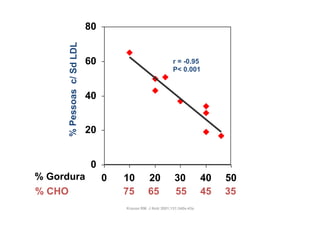
80


     % Pessoas c/ Sd LDL
                           60                               r = -0.95
                                                            P< 0.001


                           40


                           20


                           0
% Gordura                       0   10         20           30            40   50
% CHO                               75         65           55            45   35
                                    Krauss RM. J Nutr 2001;131:340s-43s
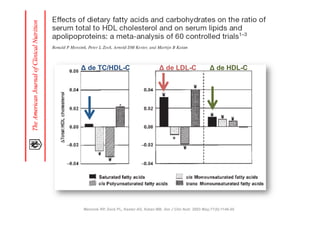
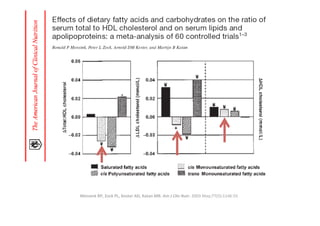
ÁCIDOS GORDOS SATURADOS


USDA, AHA: < 10% DO TOTAL CALÓRICO


         Dietary Guidelines for Americans, USDA, 2010
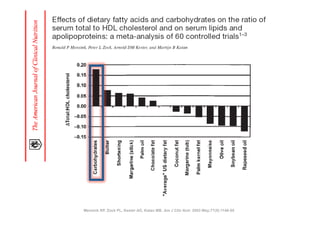
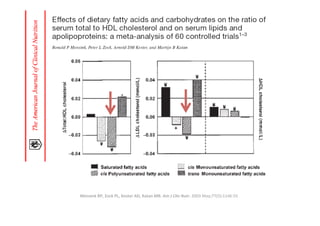
Δ de TC/HDL-C                           Δ de LDL-C                Δ de HDL-C


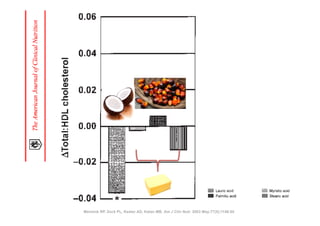
Mensink RP, Zock PL, Kester AD, Katan MB. Am J Clin Nutr. 2003 May;77(5):1146-55
larger effect of changes in the amount and quality of dieta
                                               and carbohydrates on CAD risk (89), and the possible reaso
                                               this were discussed elsewhere (90, 91).

                                               Effects of fatty acids and carbohydrates on serum lipid
                                               lipoproteins
                                                  Our results suggest that isoenergetic replacement of SFA
                                               carbohydrates does not improve the serum total:HDL chole
                                               All natural fats contain both SFAs, which do not change this
                                               and unsaturated fatty acids, which lower it. As a result, ev
                                               replacement of dairy fat and tropical fats with carbohydrate


Mensink RP, Zock PL, Kester AD, Katan MB. Am J Clin Nutr. 2003 May;77(5):1146-55

                                                   FIGURE 3. Predicted changes (⌬) in the ratio of serum total t
Based on Evolutionary, Historical,
   Dietary Fat Quality and Coronary Heart
Global, and Modern ed Theory
   Disease Prevention: A Unifi Perspectives
Christopher E.on Evolutionary, Historical,
      Based Ramsden, MD
      Global, and Modern Perspectives
Keturah R. Faurot, PA, MPH
Pedro ChristopherFaurot, PA, MPH
       Carrera-Bastos, MD
      Keturah R.
                  E. Ramsden, BA

Loren Pedro Carrera-Bastos, BA
      Cordain, PhD
      Loren Cordain, PhD
Michel De De Lorgeril, MD, PhD PhD
      Michel
              Lorgeril, MD,
Laurence S. Sperling, MD
      Laurence S. Sperling, MD
             Corresponding author
Corresponding author
            Christopher E. Ramsden, MD
            Department of Physical Medicine and Rehabilitation, Program on
Christopher E. Ramsden,University of North Carolina–Chapel Hill School
            Integrative Medicine, MD
Department Medicine, CB# 7200, Chapel Hill, and Rehabilitation, Program on
            of of Physical Medicine NC 27599, USA.
            E-mail: cramsden@med.unc.edu
Integrative Current Treatment Options in Cardiovascular Medicine 2009, 11:289–301Hill School
             Medicine, University of North Carolina–Chapel
of Medicine, CB# 7200, Chapel Hill, NC 27599, USA.
            Current Medicine Group LLC ISSN 1092-8464
            Copyright © 2009 by Current Medicine Group LLC
E-mail: cramsden@med.unc.edu
Current Treatmentstatement in Cardiovascular Medicine 2009, 11:289–301
          Opinion Options
Current Medicine and growing body of evidence indicates that dietary fatty acids regulate
           A large Group LLC ISSN 1092-8464
Copyright © 2009 by Current Medicine in the pathogenesis of coronary heart disease
           crucial metabolic processes involved Group LLC
          (CHD). Despite this evidence, optimal dietary fatty acid intakes for CHD preven-
          tion remain unclear. Significant gaps in the modern nutrition literature and contra-
          dictions in its interpretation have precluded broad consensus. These shortcomings
Opinion statement
          can be addressed through the incorporation of evolutionary, historical, and global
          perspectives. The objective of this review is to propose a unified theory of optimal
 A large and growing bodyCHD evidence indicates that dietary fatty acids regulate
          dietary fatty acid intake for of prevention that integrates critical insights from
          evolutionary, historical, global, and modern perspectives. This broad approach may
 crucial metabolic processesmethods to characterize optimal fatty acid intakes. coronary heart disease
          be more likely than previous involved in the pathogenesis of
 (CHD). Despite this evidence, optimal dietary fatty acid intakes for CHD preven-
 tion remain unclear. Significant gaps in the modern nutrition literature and contra-
           Introduction
 dictions Coronaryinterpretation have precluded broad consensus. Thesewith increasing dura-
           in its heart disease (CHD) incidence and mor- resident inhabitants, especially shortcomings
 can be addressed through the incorporation tion of residence [5–7].
          tality reflect complex interactions between genetic of evolutionary, historical, and global
          susceptibilities and environmental factors. Although     For instance, CHD is historically far more common in
 perspectives. CHD susceptibility genesthis review is to the United States unified theory of men of Japa-
          several The objective of have been identified          propose a than in Japan [4]. Among optimal
 dietary fattyrather lines genetics is the main driver environ- nese ancestry,highestriskCaliforniain[8,9]. These differences
          ment
                  acid intake for CHD prevention Hawaii,integrates is lowest Japan, intermediate in
          [1], several
                        than
                             of evidence indicate that
                                                       of CHD
                                                                that and CHD in critical insights from
 evolutionary, historical, global,CHD incidence and appear to reflect This broad of traditional Japanese
          risk [2]. Globally, age-adjusted and modern perspectives. the replacement approach may
 be moremortality vary as previous factors arepopulations cultural traditions with Western acid [8]. Indeed, Japa-
            likely than much as 10-fold across sensitive to nese Americans who maintained habits intakes. and
          [3,4]. CHD incidence and risk
                                         methods to characterize optimal fatty traditional customs
             lifestyle changes. When immigrants from traditionally       habits had a CHD risk similar to that of their counterparts
             low-risk regions adopt the habits of high-risk popula-      residing in Japan, whereas those who adopted Western cul-
             tions, their CHD incidence rises to approach that of        ture had a three- to fivefold excess in CHD prevalence [8].
 Introduction
CHINA RURAL: < 5%      EUA: 11-12%   CRS: 4-18%


KITAVA: 17%         MAASAI: 30-35%   TOKELAU: 40%


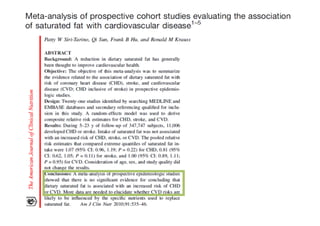
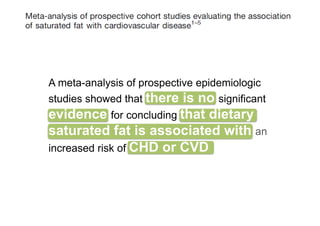
A meta-analysis of prospective epidemiologic
studies showed that there is no significant
evidence for concluding that dietary
saturated fat is associated with an
increased risk of CHD or CVD


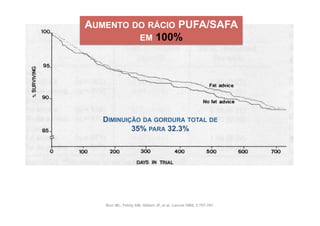
AUMENTO DO RÁCIO PUFA/SAFA
         EM 100%


   DIMINUIÇÃO DA GORDURA TOTAL DE
           35% PARA 32.3%


   Burr ML, Fehily AM, Gilbert JF, et al. Lancet 1989; 2:757-761.
Orange Juice on Inflammation, Endoto
C l li in i icca l l C a rree//EEd uucca t t i o n / N u t r i t oo Expression e of cToll-Like Recept
C n             a Ca              d     a andu the nn / P s y c h o s o c aa l R R s s e a r h h
                                           ion/N tritii             /Psychosoci i l e ear c
 O R I I G I I N A LL
 O R      G     N A
                                           and Suppressor of Cytokine Signaling-
                               A R TT I I CC L L EE
                                A R


                                           RUPALI DEOPURKAR, PHD                             PRIYA MOHANTY, MD                                    vital to the protection fro
Differential Effects of Cream, Glucose, and
Differential Effects of Cream, Glucose, andHUSAM GHANIM, PHD
                                           JAY FRIEDMAN, PHD
                                                                                             PRABHAKAR VISWANATHAN, PHD
                                                                                             AJAY CHAUDHURI, MD
                                                                                                                                                  ins and immunological
                                                                                                                                                  commensal and patho

Orange Juice on Inflammation, Endotoxin,
                                           SANAA ABUAYSHEH, BSC                              PARESH DANDONA, MD, PHD                              bacteria.
                                           CHANG LING SIA, BSC                                                                                         In this context, we w
                                                                                                                                                  which macronutrient wa
and the Expression of Toll-Like Receptor-4
and the Expression of Toll-Like Receptor-4                                                                                                        the induction of oxidati
                                           OBJECTIVE — We have recently shown that a high-fat high-carbohydrate (HFHC) meal flammation, on the one h

and Suppressor of Cytokine Signaling-3
                                           induces an increase in plasma concentrations of endotoxin (lipopolysaccharide [LPS]) and the crease in LPS concent
                                           expression of Toll-like receptor-4 (TLR-4) and suppresser of cytokine signaling-3 (SOCS3) in
                                           mononuclear cells (MNCs) in addition to oxidative stress and cellular inflammation. Saturated
                                                                                                                                                  expression of TLR-4 and
                                           fat and carbohydrates, components of the HFHC meal, known to induce oxidative stress and tokine signaling (SOCS)
RUPALI DEOPURKAR, ,PHD
 RUPALI DEOPURKAR PHD                                 PPRIYA induce an , MD in LPS, TLR-4, and SOCS3. toto the protection from To elucidate this, we inv
                                           inflammation, alsoMOHANTYMD
                                                       RIYA MOHANTY, increase                                 vital the protection from bacterial tox-
                                                                                                                vital                             bacterial tox-
HUSAM GHANIM, ,PHD
 HUSAM GHANIM PHD                                     PPRABHAKAR VISWANATHANPHD
                                                       RABHAKAR VISWANATHAN, , PHD                            ins and immunological responses glucose,
                                                                                                                                                  fect ofto the the most
                                                                                                                ins and immunological responses to the
JJAYFRIEDMAN, ,PHD
 AY FRIEDMAN PHD                           RESEARCH DESIGN AND METHODS — Fasting normal subjects were given 300- hydrate, cream, a sat
                                                      AAJAY CHAUDHURIMD
                                                        JAY CHAUDHURI, , MD                                   commensal and pathogenic intestinal
                                                                                                                commensal and pathogenic intestinal
SANAA ABUAYSHEH, ,BSC
 SANAA ABUAYSHEH BSC                       calorie drinks of either glucose, saturated fat as cream, orange juice, or only water to ingest. Blood orange juice, a carbohy
                                                      PPARESH DANDONAMD, PHD
                                                       ARESH DANDONA, , MD, PHD                               bacteria.
CHANG LING SSIA,BSC                                                                                             bacteria.                         food product, which do
 CHANG LING IA, BSC                        samples were obtained at 0, 1, 3, and 5 h for analysis.
                                                                                                                    InIn this context, we wanted to analyzestress or in
                                                                                                                        this context, we wanted to analyze
                                                                                                                                                  ther oxidative
                                                                                                              which macronutrient was responsible for is a protein
                                           RESULTS — Indexes of inflammation including nuclear factor-␬B (NF-␬B) binding, andwas responsible for
                                                                                                                which macronutrient the                SOCS3
                                                                                                              the induction ofof in MNCs, stress and in-
                                           expression of SOCS3, tumor necrosis factor-␣ (TNF-␣), and interleukin (IL)-1␤ oxidative
                                                                                                                the induction         oxidative stress and in-
                                                                                                                                                  shown to interfere with i
OBJECTIVE — We have recently shown thatsignificantly high-carbohydrate (HFHC) meal TLR-4 expressionon the one LPS signal transduction (2–
 OBJECTIVE — We have recently shown thata ahigh-fat after glucose and cream intake, but flammation, and plasma hand, and the in-
                                           increased       high-fat high-carbohydrate (HFHC) meal flammation, on the one hand, and the in-
induces an increase in plasma concentrations of endotoxin (lipopolysaccharide intake. The intake of orangein LPS water did not work has shown that SO
                                           concentrations increased only after cream [LPS]) and the
 induces an increase in plasma concentrations of endotoxin (lipopolysaccharide [LPS]) and the crease juice LPS concentrations and the
expression of Toll-like receptor-4 (TLR-4) andany change inof cytokineindexes measured.                         crease in or concentrations and the
                                           induce suppresser of of the signaling-3 (SOCS3) in
 expression of Toll-like receptor-4 (TLR-4) and suppresser anycytokine signaling-3 (SOCS3) in expression of TLR-4 and suppresser of cy-
mononuclear cells (MNCs) in addition to oxidative stress and cellular inflammation. Saturated                    expression of TLR-4 and suppressercirculating mo
 mononuclear cells (MNCs) in addition to oxidative stress and cellular inflammation. Saturated tokine signaling (SOCS)-3 on the other. obese hu
                                                                                                                                                  in the of cy-
                                                                                                                                                  (MNCs) of the
fat and carbohydrates, components of the HFHC meal, known toto induce oxidative stress and tokine signalingand an in- on the other.
 fat and carbohydrates, components of CONCLUSIONSknown induce oxidative stress and induce NF-␬B binding (SOCS)-3 increased when compar
                                            the HFHC meal, — Although both glucose and cream
                                                                                                              To elucidate this, we investigated the ef-
 inflammation, also induce an increase in LPS, the expression of SOCS3, TNF-␣, and IL-1␤ in MNCs, onlyelucidate this, increase normalthe ef-
inflammation, also induce an increase in LPS, inTLR-4, and SOCS3.
                                           crease TLR-4, and SOCS3.                                             To cream caused an we investigated subjects
                                                                                                              fectorange juice or watermost important carbo- (6). I
                                           in LPS concentration and TLR-4 expression. Equicaloric amounts of ofof glucose, the did not work carbo-
                                                                                                                fect glucose, the most important demonstrated that
                                                                                                              hydrate, cream, a a saturated fat, and
                                                                                                                hydrate, cream, saturated fat, and
RESEARCH DESIGN AND METHODS — Fasting normal subjects were given 300-are relevant to the pathogenesis of sion in MNCs is inverse
                                           induce a change in any of these indexes. These changes
 RESEARCH DESIGN AND METHODS — Fasting normal subjects were given 300- orange juice, a carbohydrate-containing
calorie drinks of either glucose, saturatedatherosclerosisorange juice,resistance. water to ingest. Blood orange juice, a carbohydrate-containing
                                            fat as cream, and insulin or only water to ingest. Blood
 calorie drinks of either glucose, saturated fat as cream, orange juice, or only                                                                  tyrosine phosphorylatio
samples were obtained at 0, 1, 3, and 55 h for analysis.
 samples were obtained at 0, 1, 3, and     h for analysis.                                                    food product, which does not induce and directly rel
                                                                                                                        product, which does receptor ei-
                                                                                                                foodCare 33:991–997, 2010 not induce ei-
                                                                                                           Diabetes
                                                                                                              ther oxidative stress oror inflammation.
                                                                                                                ther oxidative stress inflammation.insulin resistance (home


                                           O
                                                                                                                    SOCS3 is is a protein that has been
RESULTS — Indexes of inflammation including nuclear factor-␬Bshown thatbinding, and the because the content of LPS sessment of      a protein that has been insulin res
                                                   ur recent work has (NF-␬B) binding, and the shown to interfere with insulin and leptin
 RESULTS — Indexes of inflammation including nuclear factor-␬B (NF-␬B) a great interest                                 SOCS3
expression of SOCS3, tumor necrosis factor-␣ (TNF-␣), and interleukin (IL)-1␤ ininthese meals is not to interfere with insulin and leptin
                                                                                                   MNCs,                                          IR]), consistent with
 expression of SOCS3, tumor necrosis factor-␣ (TNF-␣), and interleukin (IL)-1␤ in MNCs, shown significantly differ-
                                                   high-fat high-cholesterol (HFHC)
increased significantly after glucose and cream intake, but TLR-4 expression and plasma LPS signal transduction (2–5). Our recent of insulin r
 increased significantly after glucose and cream intake, butoxidative and inflam- plasma LPS signal transduction (2–5). Our recent
                                                                                                                                                  pathogenesis
                                                   meal induces TLR-4 expression and ent, and, thus, it would appear that the
concentrations increased only after cream intake. The intake ofof orange juice or water did not work has shown that SOCS3 resistance in human obe
 concentrations increased only after cream intake. The intake orange juice oran inflammatory work has shownmay lead
                                                                                            water did not                                          expression
                                           matory stress in addition to inducing                                 nature of the meal that SOCS3 expression
induce any change in any of the indexes measured.                                                                                                 inability of leptin to ca
(R01-D
                                       Differential Effects of Cream, Gluco                  the Am
                                       Orange Juice on Inflammation,The da                      End
                                                                                             and we
                                       and the Expression of Toll-Likepretatio                 Rec
                                       and Suppressor of Cytokine Signal                     investig
                                                                                             vestiga
                                       RUPALI DEOPURKAR, PHD PRIYA MOHANTY, MD          vitalfor the
                                                                                              to the pro
                                       HUSAM GHANIM, PHD     PRABHAKAR VISWANATHAN, PHD ins and immu
                                       JAY FRIEDMAN, PHD     AJAY CHAUDHURI, MD         commensal p
                                                                                                 No a
                                       SANAA ABUAYSHEH, BSC  PARESH DANDONA, MD, PHD    bacteria. art
                                                                                             this
                                       CHANG LING SIA, BSC                                                                                           In this con
                                                                                                                     Nata                       which macron
                                                                                                                                                the induction
                                       OBJECTIVE — We have recently shown that a high-fat high-carbohydrate (HFHC) meal                         flammation, on
                                       induces an increase in plasma concentrations of endotoxin (lipopolysaccharide [LPS]) and the                  Referen
                                                                                                                                                crease in LPS
                                                                                                                                                expressionGh
                                                                                                                                                       1. of T
                                       expression of Toll-like receptor-4 (TLR-4) and suppresser of cytokine signaling-3 (SOCS3) in
                                       mononuclear cells (MNCs) in addition to oxidative stress and cellular inflammation. Saturated
                                       fat and carbohydrates, components of the HFHC meal, known to induce oxidative stress and                 tokine signalin
                                                                                                                                                            nie
                                       inflammation, also induce an increase in LPS, TLR-4, and SOCS3.                                           To elucidate th
                                                                                                                                                            JM
                                                                                                                                                fect of glucose,
                                       RESEARCH DESIGN AND METHODS — Fasting normal subjects were given 300-                                                tox
                                                                                                                                                hydrate, crea
                                       calorie drinks of either glucose, saturated fat as cream, orange juice, or only water to ingest. Blood   orange juice,
                                       samples were obtained at 0, 1, 3, and 5 h for analysis.                          Sumo de                             of
                                                                                                                                                food product,
                                                                                                                        Laranja                             cyt
                                                                                                                                                ther oxidative
                                       RESULTS — Indexes of inflammation including nuclear factor-␬B (NF-␬B) binding, and the                         SOCS3 is
                                       expression of SOCS3, tumor necrosis factor-␣ (TNF-␣), and interleukin (IL)-1␤ in MNCs,
                                                                                                                                                            fol
                                                                                                                                                shown to inter
                                       increased significantly after glucose and cream intake, but TLR-4 expression and plasma LPS                           me
                                                                                                                                                signal transdu
                                       concentrations increased only after cream intake. The intake of orange juice or water did not            work has show
                                       induce any change in any of the indexes measured.                                                                    Dia
                                                                                                                                                in the circul
                                                                                                                                                (MNCs) ofRu
                                                                                                                                                       2. the
                                       CONCLUSIONS — Although both glucose and cream induce NF-␬B binding and an in-                            increased whe
                                       crease in the expression of SOCS3, TNF-␣, and IL-1␤ in MNCs, only cream caused an increase               normal subje
                                                                                                                                                            Wh
                                       in LPS concentration and TLR-4 expression. Equicaloric amounts of orange juice or water did not          work demonstsul
                                       induce a change in any of these indexes. These changes are relevant to the pathogenesis of               sion in MNCs
                                       atherosclerosis and insulin resistance.                                                                              deg
Figure 3—Change in NF␬B binding activity in MNC (A) and plasma endotoxin concentrations                                                         tyrosine phosp
                                                                               Diabetes Care juice (OJ, ‚),
                                                                                                                                                            Ch
                                                                                                                                                receptor and d
(B) in normal subjects after a 300-calorie drink of cream (E), glucose (Œ), orange 33:991–997, 2010
                                                                                                                                                       3. Sen
                                                                                                                                                insulin resistan
                                         and ؉, P Ͻ 0.05 with a great interest because the content of LPS
or water (F). Data are means Ϯ SEM. *ur recent work has shown thatRMANOVA comparing changes in                                                  sessment of in
                                                                                                                                                            TA
                                                                                                                                                IR]), consiste
relation to baseline after cream and glucose challenges; # andin $, P meals 0.05 significantly differ-
                                        high-fat high-cholesterol (HFHC) these Ͻ is not with two-way
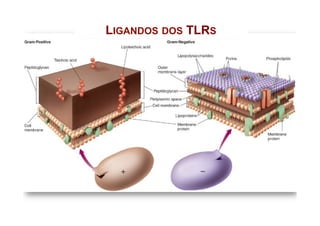
LIGANDOS DOS TLRS
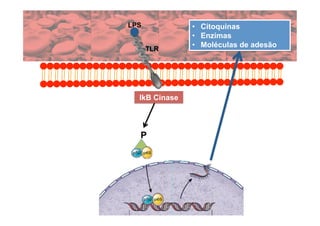
LPS            •  Citoquinas
               •  Enzimas
               •  Moléculas de adesão
      TLR


  IkB Cinase


  P
Macronutrients, oxidative stress, and inflammation
                                  Differential
                                          Effects of Cream, Gluco
                               Orange Juice on Inflammation, Endcytok
                               and the Expression of Toll-Like Rec
                                                               know
                               and Suppressor of Cytokine Signal
                                                               anim
                               RUPALI DEOPURKAR, PHD                               PRIYA MOHANTY, MD
                                                                                                                                              but
                                                                                                                                        vital to the pro
                               HUSAM GHANIM, PHD
                               JAY FRIEDMAN, PHD
                                                                                   PRABHAKAR VISWANATHAN, PHD
                                                                                   AJAY CHAUDHURI, MD
                                                                                                                                              creas
                                                                                                                                        ins and immu
                                                                                                                                        commensal a
                               SANAA ABUAYSHEH, BSC
                               CHANG LING SIA, BSC
                                                                                   PARESH DANDONA, MD, PHD                                    and
                                                                                                                                        bacteria.
                                                                                                                                             In this con
                                                                                                                                              creas
                                                                                                                                        which macron
                                                                                                               Nata                           SOC
                                                                                                                                        the induction
                               OBJECTIVE — We have recently shown that a high-fat high-carbohydrate (HFHC) meal                         flammation, on
                               induces an increase in plasma concentrations of endotoxin (lipopolysaccharide [LPS]) and the
                               expression of Toll-like receptor-4 (TLR-4) and suppresser of cytokine signaling-3 (SOCS3) in
                                                                                                                                              of in
                                                                                                                                        crease in LPS
                                                                                                         Glucose                        expression of T
                               mononuclear cells (MNCs) in addition to oxidative stress and cellular inflammation. Saturated
                               fat and carbohydrates, components of the HFHC meal, known to induce oxidative stress and
                                                                                                                                              juice
                                                                                                                                        tokine signalin
                               inflammation, also induce an increase in LPS, TLR-4, and SOCS3.                                                 stres
                                                                                                                                        To elucidate th
                                                                                                                                        fect of glucose,
                               RESEARCH DESIGN AND METHODS — Fasting normal subjects were given 300-            Sumo de                       an in
                                                                                                                                        hydrate, crea
                                                                                                                                        orange juice,
                               calorie drinks of either glucose, saturated fat as cream, orange juice, or only water to ingest. Blood
                               samples were obtained at 0, 1, 3, and 5 h for analysis.
                                                                                                                Laranja                 food product,
                                                                                                                                        ther oxidative
                               RESULTS — Indexes of inflammation including nuclear factor-␬B (NF-␬B) binding, and the                         SOCS3 is
                               expression of SOCS3, tumor necrosis factor-␣ (TNF-␣), and interleukin (IL)-1␤ in MNCs,                         Ackn
                                                                                                                                        shown to inter
                               increased significantly after glucose and cream intake, but TLR-4 expression and plasma LPS               signal transdu
                               concentrations increased only after cream intake. The intake of orange juice or water did not                  porte
                                                                                                                                        work has show
                               induce any change in any of the indexes measured.                                                              Flori
                                                                                                                                        in the circul
                                                                                                                                        (MNCs) of the
                               CONCLUSIONS — Although both glucose and cream induce NF-␬B binding and an in-                                  supp
                                                                                                                                        increased whe
                               crease in the expression of SOCS3, TNF-␣, and IL-1␤ in MNCs, only cream caused an increase
                               in LPS concentration and TLR-4 expression. Equicaloric amounts of orange juice or water did not                (R01
                                                                                                                                        normal subje
                                                                                                                                        work demonst
                               induce a change in any of these indexes. These changes are relevant to the pathogenesis of
                               atherosclerosis and insulin resistance.
                                                                                                                                              the A
                                                                                                                                        sion in MNCs
                                                                                                                                        tyrosine phosp
                                                                                                                                              The
                                                                                                                                        receptor and d
                                                                                               Diabetes Care 33:991–997, 2010
                                                                                                                                              and w
                                                                                                                                        insulin resistan
                                                                                                                                        sessment of in
                                      ur recent work has shown that a              great interest because the content of LPS                  preta
                                                                                                                                        IR]), consiste
                                      high-fat high-cholesterol (HFHC)             in these meals is not significantly differ-
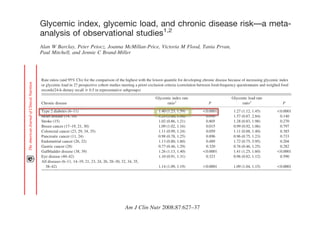
Lipids (2008) 43:65–77
           DOI 10.1007/s11745-007-3132-7

            ARTICLE


           Comparison of Low Fat and Low Carbohydrate Diets
           on Circulating Fatty Acid Composition and Markers
           of Inflammation
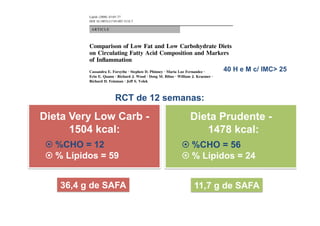
           Cassandra E. Forsythe Æ Stephen D. Phinney Æ Maria Luz Fernandez Æ                               40 H e M c/ IMC> 25
           Erin E. Quann Æ Richard J. Wood Æ Doug M. Bibus Æ William J. Kraemer Æ
           Richard D. Feinman Æ Jeff S. Volek


                             RCT de 12 semanas:
           Received: 5 July 2007 / Revised: 24 October 2007 / Accepted: 25 October 2007 / Published online: 29 November 2007
           Ó AOCS 2007


Dieta Very Low Carb -                                                               Dieta Prudente -
           Abstract Abnormal distribution of plasma fatty acids and              and 16:1n-7 were consistently decreased following the
           increased inflammation are prominent features of meta-                 VLCKD. Both diets significantly decreased the concen-
           bolic syndrome. We tested whether these components of                 tration of several serum inflammatory markers, but there

      1504 kcal:
           metabolic syndrome, like dyslipidemia and glycemia, are
           responsive to carbohydrate restriction. Overweight men
           and women with atherogenic dyslipidemia consumed
                                                                                       1478 kcal:
                                                                                 was an overall greater anti-inflammatory effect associated
                                                                                 with the VLCKD, as evidenced by greater decreases in
                                                                                 TNF-a, IL-6, IL-8, MCP-1, E-selectin, I-CAM, and PAI-1.
           ad libitum diets very low in carbohydrate (VLCKD)                     Increased 20:4n-6 and the ratios of 20:4n-6/20:5n-3 and
 ¤ %CHO = 12
           (1504 kcal:%CHO:fat:protein = 12:59:28) or low in fat
           (LFD) (1478 kcal:%CHO:fat:protein = 56:24:20) for
                                                                             ¤ %CHO = 56
                                                                                 n-6/n-3 are commonly viewed as pro-inflammatory, but
                                                                                 unexpectedly were consistently inversely associated with
 ¤ % Lípidos = 59
           12 weeks. In comparison to the LFD, the VLCKD resulted
           in an increased proportion of serum total n-6 PUFA, mainly
                                                                             ¤ % Lípidos = 24
                                                                                 responses in inflammatory proteins. In summary, a very
                                                                                 low carbohydrate diet resulted in profound alterations in
           attributed to a marked increase in arachidonate (20:4n-6),            fatty acid composition and reduced inflammation compared
           while its biosynthetic metabolic intermediates were                   to a low fat diet.
           decreased. The n-6/n-3 and arachidonic/eicosapentaenoic
           acid ratio also increased sharply. Total saturated fatty acids        Keywords Arachidonic acid Á Palmitoleic acid Á

    36,4 g de SAFA	
                                                                  11,7 g de SAFA	
  
                                                                                 Ketogenic diet Á Saturated fat Á Metabolic syndrome


                                                                                 Abbreviations
                                                                                 VLCKD Very low carbohydrate ketogenic diet
           C. E. Forsythe Á E. E. Quann Á W. J. Kraemer Á J. S. Volek (&)        LFD       Low fat diet
           Department of Kinesiology, University of Connecticut,
           2095 Hillside Road, Unit 1110, Storrs, CT 06269-1110, USA             PL        Phospholipid
           e-mail: jeff.volek@uconn.edu                                          CE        Cholesteryl ester
                                                                                 CVD       Cardiovascular disease
           S. D. Phinney
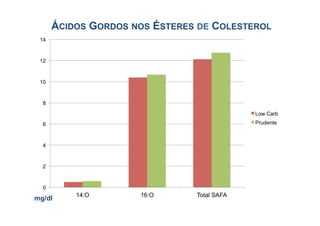
ÁCIDOS GORDOS NOS ÉSTERES DE COLESTEROL
 14


 12


 10


  8
                                            Low Carb
  6                                         Prudente


  4


  2


  0
          14:O       16:O      Total SAFA
mg/dl
Mensink RP, Zock PL, Kester AD, Katan MB. Am J Clin Nutr. 2003 May;77(5):1146-55
See corresponding editorial on page 1541.


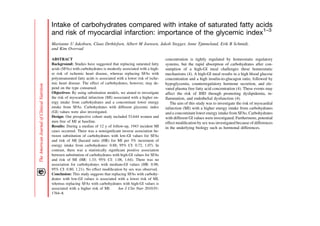
Intake of carbohydrates compared with intake of saturated fatty acids
and risk of myocardial infarction: importance of the glycemic index1–3
Marianne U Jakobsen, Claus Dethlefsen, Albert M Joensen, Jakob Stegger, Anne Tjønneland, Erik B Schmidt,
and Kim Overvad

ABSTRACT                                                                concentration is tightly regulated by homeostatic regulatory
Background: Studies have suggested that replacing saturated fatty       systems, but the rapid absorption of carbohydrates after con-
acids (SFAs) with carbohydrates is modestly associated with a high-     sumption of a high-GI meal challenges these homeostatic
er risk of ischemic heart disease, whereas replacing SFAs with          mechanisms (4). A high-GI meal results in a high blood glucose


                                                                                                                                                   Downloaded from www.ajcn.org at Lund University Libraries on November 5, 2010
polyunsaturated fatty acids is associated with a lower risk of ische-   concentration and a high insulin-to-glucagon ratio, followed by
mic heart disease. The effect of carbohydrates, however, may de-        hypoglycemia, counterregulatory hormone secretion, and ele-
pend on the type consumed.                                              vated plasma free fatty acid concentration (4). These events may
Objectives: By using substitution models, we aimed to investigate       affect the risk of IHD through promoting dyslipidemia, in-
the risk of myocardial infarction (MI) associated with a higher en-     flammation, and endothelial dysfunction (4).
ergy intake from carbohydrates and a concomitant lower energy              The aim of this study was to investigate the risk of myocardial
intake from SFAs. Carbohydrates with different glycemic index           infarction (MI) with a higher energy intake from carbohydrates
(GI) values were also investigated.                                     and a concomitant lower energy intake from SFAs. Carbohydrates
Design: Our prospective cohort study included 53,644 women and          with different GI values were investigated. Furthermore, potential
men free of MI at baseline.                                             effect modification by sex was investigated because of differences
Results: During a median of 12 y of follow-up, 1943 incident MI         in the underlying biology such as hormonal differences.
cases occurred. There was a nonsignificant inverse association be-
tween substitution of carbohydrates with low-GI values for SFAs
and risk of MI [hazard ratio (HR) for MI per 5% increment of            SUBJECTS AND METHODS
energy intake from carbohydrates: 0.88; 95% CI: 0.72, 1.07). In
contrast, there was a statistically significant positive association     Study population
between substitution of carbohydrates with high-GI values for SFAs        Between December 1993 and May 1997, 160,725 women and
and risk of MI (HR: 1.33; 95% CI: 1.08, 1.64). There was no             men were invited by mail to participate in the Danish prospective
association for carbohydrates with medium-GI values (HR: 0.98;          cohort study Diet, Cancer, and Health. The criteria for invitation
95% CI: 0.80, 1.21). No effect modification by sex was observed.         were as follows: age between 50 and 64 y, born in Denmark, and
Conclusion: This study suggests that replacing SFAs with carbohy-       no previous cancer diagnosis registered in the Danish Cancer
drates with low-GI values is associated with a lower risk of MI,        Registry. All persons fulfilling these criteria and living in the
whereas replacing SFAs with carbohydrates with high-GI values is        greater Copenhagen or Aarhus areas were invited. With the in-
associated with a higher risk of MI.      Am J Clin Nutr 2010;91:
1764–8.                                                                   1
                                                                             From the Department of Clinical Epidemiology Aarhus University Hos-
                                                                        pital, Aalborg, Denmark (MUJ); the Department of Cardiology, Center for
                                                                        Cardiovascular Research, Aalborg Hospital, Aarhus University Hospital,
INTRODUCTION                                                            Aalborg, Denmark (MUJ, CD, AMJ, JS, EBS, and KO); the Danish Cancer
                                                                        Society, Institute of Cancer Epidemiology, Copenhagen, Denmark (AT); and
   Epidemiologic prospective cohort studies have suggested that
                                                                        the Department of Epidemiology, School of Public Health, Aarhus Univer-
replacing saturated fatty acids (SFAs) with carbohydrates is            sity, Aarhus, Denmark (KO).
modestly associated with a higher risk of ischemic heart disease          2
0.80, 1.21) (Table 3). As assessed from the 95% CIs, the


                                                                                                                                                                                                                                          Lund University Libraries on November 5, 2010
measures of associations for extreme tertiles of GI were statis-                the measures of associations, and thus residual confounding seems
tically significantly different. The P value for effect modification              unlikely. However, confounding from other IHD risk factors not
                                                                               See corresponding editorial on page 1541.
by tertiles of dietary GI was 0.06 in women, 0.29 in men, and                   taken into account remains a possible explanation for the observed
0.16 in all participants. The P value for effect modification by                 associations.
Intake of carbohydrates compared with intake of saturated fatty acids
sex was 0.86.                                                                      Only 2 epidemiologic studies have investigated the sub-
                                                                                                                                            1–3
                                                                                stitution of carbohydrates for SFAs (1, 18). In the prospective
and risk of myocardial infarction: importance of the glycemic index             cohort study by Hu et al (18), substitution of carbohydrates for
DISCUSSION                                                                      SFAs was nonsignificantly associated with a lower risk of IHD,
 Marianne U Jakobsen, Claus Dethlefsen, Albert M Joensen, Jakob Stegger, Anne Tjønneland, Erik B Schmidt,
    The findings from this study suggest that the effect of sub-                 whereas in the prospective cohort study by Jakobsen et al (1), in
 and Kim Overvad
stitution of carbohydrates for SFAs varies depending on the type of             which data from 11 American and European cohort studies were
carbohydrates. There was a nonsignificant inverse association                    pooled, substitution of carbohydrates for SFAs was modestly
 ABSTRACT                                                                    concentration is tightly regulated by homeostatic regulatory
 Background: Studies have suggested that replacing saturated fatty
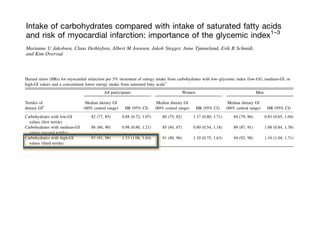
TABLE 3                                                                      systems, but the rapid absorption of carbohydrates after con-
 acids (SFAs) (HRs)carbohydrates is modestly associated with a high- intake from carbohydrates withmeal challenges these homeostatic or
Hazard ratios   with for myocardial infarction per 5% increment of energy sumption of a high-GI low–glycemic index (low-GI), medium-GI,
high-GI values and a concomitant lower energy intake from SFAs with acids1
 er risk of ischemic heart disease, whereas replacing saturated fatty mechanisms (4). A high-GI meal results in a high blood glucose


                                                                                                                                                            Downloaded from www.ajcn.org at Lund University Libraries on November 5, 20
 polyunsaturated fatty acids is associated with a lower risk of ische-       concentration and a high insulin-to-glucagon ratio, followed by
                                              All participants
 mic heart disease. The effect of carbohydrates, however, may de-                           Women                                    Men
                                                                             hypoglycemia, counterregulatory hormone secretion, and ele-
 pend on the type consumed.                                                  vated plasma free fatty acid concentration (4). These events may
Tertiles of                       Median dietary GI                         Median dietary GI                      Median dietary GI
 Objectives: By using substitution models, we aimed to investigate
           2                                                                 affect the range)of HR (95% CI) promoting dyslipidemia, (95% CI)
                                                                                          risk     IHD through (80% central range) HR in-
dietary GI                       (80% central range)       HR (95% CI)     (80% central
 the risk of myocardial infarction (MI) associated with a higher en-         flammation, and endothelial dysfunction (4).
Carbohydratesfrom low-GI
 ergy intake with carbohydrates and a concomitant lower energy
                                      82 (77, 85)        0.88 (0.72, 1.07)      80 (75, 82) this study was to investigate (79, risk of myocardial 1.04)
                                                                                The aim of       1.17 (0.80, 1.71)     84 the 86)        0.83 (0.65,
 intake from SFAs. Carbohydrates with different glycemic index
   values (first tertile)                                                     infarction (MI) with a higher energy intake from carbohydrates
Carbohydrates withalso investigated. 88 (86, 90)
 (GI) values were medium-GI                              0.98 (0.80, 1.21)   and a (84, 87)
                                                                                85 concomitant lower energy intake from SFAs. Carbohydrates 1.38)
                                                                                                 0.80 (0.54, 1.18)     89 (87, 91)       1.08 (0.84,
 Design: (second tertile) cohort study included 53,644 women and
   values Our prospective                                                    with different GI values were investigated. Furthermore, potential
CarbohydratesMI at high-GI
 men free of with baseline.           93 (91, 98)        1.33 (1.08, 1.64)
                                                                             effect(88, 96)
                                                                                91
                                                                                    modification1.10sex was investigated because of differences 1.71)
                                                                                                  by (0.75, 1.63)      94 (92, 98)       1.34 (1.04,
 Results:(third tertile)
   values During a median of 12 y of follow-up, 1943 incident MI
                                                                             in the underlying biology such as hormonal differences.
 cases All models There was a nonsignificant inverse association be-
     1 occurred.
                    included intake of glycemic carbohydrates, proteins, monounsaturated fatty acids, and polyunsaturated fatty acids expressed as percentages
of total substitution total energy intake (kcal/d), an values variable for
 tween energy intake,of carbohydrates with low-GIindicator for SFAs alcohol consumption (0 and .0 g/d), alcohol consumption (g/d), BMI (in kg/m2;
,25, risk of and 30), education (HR) 8–10,MI per 5% increment of (never, former, and currently smoking 1–14, 15–24, or 25 g tobacco/d), physical
 and 25–29, MI [hazard ratio (,8, for and .10 y), smoking status SUBJECTS AND METHODS
activity (,3.5 and 3.5 h/wk), and history of95% CI: 0.72, 1.07). and do not know). HRs with 95% CIs for the incidence of myocardial infarction were
 energy intake from carbohydrates: 0.88; hypertension (yes, no, In
 contrast, there was a statistically significant positive association          Study population
calculated by using Cox proportional hazards regression with age as the time metric. In analyses among all participants, sex was entered into the model.
     2
 between substitution ofGI were based on the high-GI values for SFAsamong cases. n = December 1993 and Mayfor all participantswomen andsecond,
       Tertiles of dietary carbohydrates with distribution of dietary GI         Between 22,144, 17,000, and 14,400 1997, 160,725 in the first,
and third tertiles of(HR: 1.33; respectively; n = 9594, 10,202, and 8699 for women in the first, second, and third tertiles in dietary GI, respectively; and n =
 and risk of MI dietary GI, 95% CI: 1.08, 1.64). There was no                 men were invited by mail to participate of the Danish prospective
8941, 8127, and 8081 for men in withfirst, second, and third (HR: 0.98;
 association for carbohydrates the medium-GI values tertiles of dietary GI, respectively. Cancer, and Health. The criteria for invitation
                                                                              cohort study Diet,
 95% CI: 0.80, 1.21). No effect modification by sex was observed.              were as follows: age between 50 and 64 y, born in Denmark, and
 Conclusion: This study suggests that replacing SFAs with carbohy-            no previous cancer diagnosis registered in the Danish Cancer
 drates with low-GI values is associated with a lower risk of MI,             Registry. All persons fulfilling these criteria and living in the
 whereas replacing SFAs with carbohydrates with high-GI values is             greater Copenhagen or Aarhus areas were invited. With the in-
 associated with a higher risk of MI.          Am J Clin Nutr 2010;91:
 1764–8.                                                                        1
                                                                                  From the Department of Clinical Epidemiology Aarhus University Hos-
with dietary intake cannot be completely adjusted for in ob- 95% CI: 1.25, 1.60), breast cancer (GI RR 2 major
                                                                  GL RR ҃ 1.41, certain chronic diseases with high-GI diets. Specifically, ҃ 1.08,                                                                                                       Mo


                                                                                                                                                                                                                by Custodio Cesar on November 18, 2008
 servational studies. Therefore, a meta-analysis of intervention1.16), and all diseases combined (GI RR ҃ 1.14, 95%
                                                                  95% CI: 1.02,                    pathways have been proposed to explain the association with                                                                                           por
 studies looking at “hard” clinical endpoints, not chronic-                                        type 2 diabetes risk (57). First, the same amount of carbohydrate
 disease risk factors, may be warranted, when                     CI:sufficient data GL RR ҃ 1.09, 95% CI: higher blood glucose concentra-
                                                                         1.09, 1.19; from high-GI foods produces 1.04, 1.15).                                                                                                                            tion
Glycemic index, glycemic load, and chronic disease risk—a meta-
 have accumulated.                                                Conclusions: Low-GI and/or low-GLfor insulin. The chronically increased
                                                                                                   tions and a greater demand diets are independently asso-                                                                                              der
analysis of observational studies
 glycemia, in
                                                                  ciated to chronic insulin demand maymeta- result in pancreatic ␤ cell failure,
     Our findings support the hypothesis that postprandial hyper- 1,2
 Glycemicindividuals glycemic load, and with a reduced risk of certainimpaired glucose tolerance. Second, there
                       index, without diabetes, contributeschronic diseasea consequence, chronic diseases. In diabetes and
                                                                                                   and, as     risk—a
                                                                                                                              eventually
                                                                                                                                                                                                                                                         stud
 disease. Higher observational studies1,2 disease,athe protection ishigh-GI diets may directly increase insulin re-
 analysis of               glucose concentrations areheart to play  thought                        is evidence that comparable with that seen for whole                                                                                                  a th
Alan W Barclay, role in Petocz, Joanna McMillan-Price, Victoria M Flood, Taniaeffect on glycemia,the hypothesis that
 direct pathogenic Peter the disease process. The DECODE fiber intakes. The findings support free fatty acids, and
                                                                  grain and high sistance through their Prvan,
 Alan W Barclay, Peter Petocz, 13 studies involving 25 000 M Flood, Tania Prvan,
 study, a meta-analysis of              Joanna McMillan-Price, Victoria individu-
PaulMitchell, and Jennie Jennie C Brand-Miller
         Mitchell, and C Brand-Miller                                                              counter-regulatory hormone secretion. High glucose and insulin                                                                                           O
 als, found an almost 2-fold increased risk ofhigher postprandial glycemiaare associated with mechanism profiles for
                                                                                                   concentrations is a universal increased risk for disease
 Paul
                                                                   all-cause mortality                                                                                                                                                                   stud
 in individuals
 ABSTRACT                                                         progression.
                                                                           cereal products            cereal products 2008;87:627–37.
                                                                                                  Am J Clin Nutrhave replaced more traditionally processed
ABSTRACT with an elevated 2-h postchallenge blood glucose have replaced more traditionally including decreased concentrations of
                                                                                                   cardiovascular disease, processed
                                                                                                                                                                                                                                                         drat
 Background: Inconsistent findings from observational studies have         grains. Because carbohydrate is the main dietary component
Background: Inconsistent findings from observational studies havesecretion and postprandial glycemia (3), it is is the main dietary component
                                                                                                      grains. Because carbohydrate
 prolonged the controversy over the effects of dietary glycemic index
 TABLE 4
                                                                           affecting insulin
prolonged the controversy over the effects of dietary glycemic index etiology of many chronic diseases. Both the postprandial glycemia (3), it is
 (GI) and glycemic load (GL) on the risk of certain chronic diseases.      implicated in the          affecting insulin secretion and                                                                                                                    hyd
(GI) and glycemic load to evaluate the associationthe KEYwith the and type of carbohydrate consumedindex, glycemicincreasingdietaryindex
                                                                           WORDS
                                                                  highest amount lowest quantile for developing chronic an effect because of load, glycemic carbo-
 Objective: The objectiveCIs) for the on the risk of certain chronic diseases.
 Rate ratios (and 95% was (GL) comparison of between                                                    Glycemic have disease on                                                                                                                         sho


                                                                                                                                          Downloaded from www.ajcn.org by Custodio Cesar on November 18, 2008
 GI,glycemic load disease risk with the use of meta-analysis tech- a priori insulin secretion and postprandialin the food-frequencymany chronic diseases. Both the
                                                                                                      implicated                etiology of
 or GL, and chronic in 27 prospective cohort studies meeting both exclusion criteria (correlation between with differ- questionnaire and weighed food
Objective: The objective was to evaluate the association epidemiology and glycemia, carbohydrate consumed have an effect on
                                                                  hydrates, not explained by amount length (4). In 1981, the
                                                                                    between
                                                                                                      glucose chain type of


                                                                                                                                                                                                                                                         Downloaded from www.ajcn.org by Custodio Cesar on November 18, 2008
 niques.
 records/24-h dietary recall ͧ 0.5 in representative subgroups)ences
GI, GL, and chronic disease riskreports identified a total concept of the glycemic index (GI) was introduced by Jenkins et
 Design: A systematic review of published with the use of meta-analysis tech-                                                                                                                                                                            Ano
                                                                                                      both insulin secretion and postprandial glycemia, with differ-
niques. were cohort studies of GI and GLto thechronic disease al (5) to quantify theindex rate not explained by glucose chain length (4). In 1981, the
 of 37 prospective
 risk. Studies       stratified further according
                                                  and
                                                         validity of the
                                                                                        Glycemic glycemic response to carbohydrates inGlycemic load rate
                                                                                                      ences                                                                                                                                              but
 Chronic A systematic review of published reports                          different a total ratio1                           P                         ratio1
Design:disease dietary intake. Rate ratios (RRs) were estimated identified foods. Glycemic load (GL), the mathematical product (GI) was introduced by Jenkins et             P
 tools used to assess                                                                                 concept of the glycemic index
                                                                           of the GI of a food and its carbohydrate content, has been pro-
of 37 2 diabetes (6–11)
 random-effects model.
                                                                  INTRODUCTION1.59)theto quantify the glycemic (1.12, 1.45) to carbohydrates in
 in a Cox proportional hazards model and of GI and GL and chronic disease
 Type prospective cohort studies combined by using a                       posed as a global (1.23,al of
                                                                                           1.40 indicator (5) glucose response and insulin 1.27 response
                                                                                                                         0.0001                                         0.0001                                                                                                                                               1
risk. Studies (14, 16) follow-up across studies, a total of 40to the validity of1.25by a serving of food (6). 0.050
 Heart disease were stratified further according 129                                        the
                                                                           demand induced (1.00, 1.56)                                            1.57 (0.87, 2.84)        0.140
                                                                       Worldwide,studies that investigated havefood inconsistent. 1.28 (0.83,the content, has0.270 pro-
                                                                               The results of (0.86,different foods.0.805 between
                                                                                                                             Glycemic load (GL), 1.98)            mathematical product
 Results: From 4 to 20 y of
 Stroke casesto assess dietary intake. Rate ratios (RRs) were estimatedchronic diseases such as diabetes, cardiovascular
tools used
 incident (15) were identified. For the comparison between the high-                       1.02        1.21)          the association
                                                                                                                                                                                                                                                         lia (A
 Breast cancer (17–19, GI hazards model and combined by dietary GI, GL, and disease risk a 0.015and its carbohydrate
                                                                           overall                    of the GI of been
in a Cox proportionaland GL, significant positive associa- With stroke, (1.02, a cancer contribute to Ȃ60% 1.06)all deaths, and
 est and lowest quantiles of21, 30)                                                  using a and1.16) association was documented 0.99 (0.92, of
                                                                                           1.09                                                                             been
                                                                                                                                                                           0.797
                                                                  disease,
 tions were found in fully adjusted models of validated studies for               respect to diabetes,posed as a global indicator of the glucose response and insulin
                                                                                                         positive                                                                                                                                        rie U
random-effectsRR ҃ 1.40, 34, 35) 1.23, 1.59; GL RR ҃ 1.27, in 6 large cohort studies (6 –11), but no association was seen in 2 1.11 (0.88, 1.40)
 Colorectal cancer (23, 29,
 type 2 diabetes (GI model. 95% CI:
                                                                                           1.11 (0.99, 1.24)                0.059                                          0.385
 95% CI: 1.12, 1.45), coronaryy of disease (GI RR ҃ 1.25, 95% CI: proportion is predicted to 2 studies
                                                                  the others (12, 129 cardiovascular
 Pancreatic cancer (11, 24)                                                                0.98 (0.78,demanddisease, increase toa75% by the year 2020 (1,
                                                                                                       1.25)      induced by areported 0.96food (6).
                                                                                                                            0.896 serving of (0.75, 1.23)                  0.733                                                                         molo
Results: From 4 to 20 32) follow-up across studies, a total of 4013). In(0.80, 1.60)
                                  heart
 Endometrial cancer (26, (GI RR ҃ 1.26, 95% CI: 1.13, 1.40;                                1.13 (14, 15), whereas 1 foundstudies that investigated the association between
                                                                                                                            0.489                 1.72 (0.75, 3.95)        0.204
incident 1.41, 95% CI: 1.25, 1.60), breast cancercomparison betweenof the studies thatis The results of0.320 have re- 0.76 (0.46, 1.25)                                                                                                                  Wes
                                                                           positive association
 1.00, 1.56), gallbladder disease
 Gastric cancer
 GL RR ҃
                     were                                          1.08,   Most    the high- diet 1.29) majornomodifiable risk factor, and the
            cases(28) identified. For the (GI RR ҃2). Habitual0.77 (0.46, have investigated cancer risk    the                   relation (16).
                                                                                                                                                                           0.282
est and1.02, 1.16),quantiles of combined GL, significant positive no associations (11, 17–29),dietary are notable excep- 1.41 (1.25, 1.60) been inconsistent.
 95% CI: lowest and(38, 39) GI and (GI RR ҃ 1.14, 95%
                                                                                                      overall
                                                                           ported associa- (1.13, 1.40)
                                                                                                                           GI, GL, and disease risk have                                                                                                 PM)
 Gallbladder disease all diseases                                 identificationfor studies that respect to 0.323 a positive association was documented
                                                                                           1.26 simple, but there
                                                                                              of 1.31) cost-effective strategies for prevention
                                                                                                                         0.0001
 CI: 1.09, 1.19; found ҃ fully adjusted models of validated studies1.10 (0.91,With investigated the risk of gallblad- 0.96 (0.82, 1.12)
tionsdisease (40–42)in1.09, 95% CI: 1.04, 1.15).
 Eye were GL RR                                                            tions (30 –37). Two                              diabetes,
                                                                                                                                                                         0.0001
                                                                                                                                                                           0.590                                                                         Unit
 Conclusions: Low-GI and/or low-GL diets are independently asso-
                                                                  and management is association with eye disease, whereas
typediseases (6–11, 14–19,҃ 1.40, 95% CI: 1.23, 1.59; GL RR(40,1.27,
 All                                21, 23, 24, 26, 28–30, 32, 34, 35,
 ciated2 diabetes (GI of certain chronic diseases. In diabetes and
        with a reduced risk RR                                             studies ҃ 41) reported an
                                                                                                      in a matter of urgency.
                                                                           der disease showed positive large cohort studies (6 –11), but no association was seen in 2
                                                                                                          6 associations (38, 39). Finally, 2
                                                                                                                                                                                                                                                                                                                               2
     38–42)1.12,protection is comparable with diseasefor whole ҃ a third found1.14 (1.09,others (12, 13). In cardiovascular disease, 2 studies reported a
                                                                                                       1.19)
95%disease, the 1.45), coronary heart that seen (GI RR 1.25, 95% changes(42). the quantity and quality of fat have re-                            1.09 (1.04, 1.15)
 heart CI:                                                             Although no association in
                                                                                            CI:                          0.0001                                         0.0001
 grain and high fiber intakes. The findings support the hypothesis that
1.00,11.56),fully adjusted models only. RR ҃ 1.26, 95% CI: 1.13, 1.40;
          Final gallbladder disease (GI                                        Of concern, 5 (13%) (22, 25, 27, 31, 33) of the 37 prospective whereas 1 found no relation (16).
                                                                                                      positive association (14, 15),                                                                                                                     Nutr
 higher postprandial glycemia is a universal mechanism for disease
GL RR ҃ 1.41, 95% Nutr 1.25, 1.60), breast cancer (GI
 progression.       Am J Clin CI: 2008;87:627–37.
                                                                  ceived RR that1.08, Most of the studies that have investigated cancer risk have re-
                                                                                considerable attention, dietary carbohy- of carbohydrates is less
                                                                           studies
                                                                                     ҃
                                                                                          investigated the relation between the role
                                                                                                                                                                                                                                                         j.bra
                                                                           drates, GI, GL, and chronic disease risk did not validate carbo-
95% CI: 1.02, 1.16), and all diseases combined (GI RR ҃ 1.14, 95% an additional no associations (11, 17–29), but there areaccompa-
                                                                  clear (2). Increases in refined sugar36, 37) have been notable excep-
                                                                           hydrate intake, and        ported 5 (13%) (12, 13, 20, intake                                                                                                                    R
 KEY WORDS              Glycemic index, glycemic load, dietary carbo-
CI: 1.09, 1.19; GL RR ҃ 1.09, 95% CI: 1.04,nied by more subtle changes instudies that investigated the risk of gallblad-
                                                                           showed correlation coefficients (30total carbohydrate of 0.5.
                                                                                                      tions for –37). Two
                                                                           Another 2 (5%) studies (29, 32) appear to have been starchy foods, eg, processed
 hydrates, epidemiology
                                                                   1.15).                                                                                                                                                                                   A
                                                                                                                                      validated,
Conclusions: Low-GI and/or low-GL diets are independently asso-study has notdisease showedothers (5%) associations (38, 39). Finally, 2
                                                                           but the validation
                                                                                                      der been published, and 2 positive
ciated with a reduced risk of certain chronic diseases. In diabetes and                               studies (40, 41) reported an association with eye disease, whereas
 INTRODUCTION
heart disease, the protection is comparable with that Clinfor whole Nutrition Unit, University of Sydney, Sydney, Austra-(42).© 2008 American Society
                                                                  Am J seen Nutr 2008;87:627–37. no association
                                                                       1
                                                                                From the Human
                                                                                                      a third found Printed in USA.                                                                                                          for Nut
    Worldwide, chronic diseases such as diabetes, cardiovascular           lia (AWB, JM-P, VMF, and JCB-M); the Department of Statistics, Macqua-
grain and high fiber intakes. TheȂ60% of all support the hypothesis Sydney, AustraliaOf and TP); the Department of Ophthal- 27, 31, 33) of the 37 prospective
 disease, stroke, and cancer contribute to findings deaths, and            rie University, that           (PP concern, 5 (13%) (22, 25,
higher postprandial
 the proportion is predictedglycemiato 75%universal2020 (1,
                               to increase is a by the year mechanism for Centre for Vision Research, Westmead Millennium Institute,
                                                                           mology, disease
 2). Habitual diet is the major modifiable risk factor, and the            Westmead Hospital, University of Sydney, Sydney, Australia (VMF and relation between dietary carbohy-
                                                                                                      studies that investigated the
•       Ingerir diariamente 4 a 11 porções de cereais, derivados
•   Ingerir diariamente 4 a 11 porções de cereais, derivados e tubérculos
             segundo as recomendações da Roda dos Alimentos. Estas po
    segundo as recomendações da Roda dos Alimentos. Estas porções devem
    ser distribuídas por 5 a 7 refeições. 5 a 7 refeições.
             ser distribuídas por

             1 Porção de Cereais e derivados, tubérculos
                         1 Porção de Cereais
              representa:                                          e derivados, tubérculos
                  1 pão (50g)                                       Nota: pesar os
                                representa:
                  1 fatia fina de broa (70g)                      alimentos poderá
                                      médio (125g)
                  1 e ½ batata – tamanho 1 pão (50g)             ser uma boa forma
                                                                  de compreender as
                  5 colheres de sopa de cereais de
                                      1 fatia fina de broa (70g)
                   pequeno-almoço (35g)
                                                                       porções.

                                      e e (35g)
                  6 bolachas Maria/água 1 sal ½ batata – tamanho médio (125g)
                                                                                                          s
                  2 colheres de sopa de arroz/massa crus (35g)                                           d
                                      5 colheres de sopa de cereais de
                  4 colheres de sopa de arroz/massa
                   cozinhados (110g)       pequeno-almoço (35g)
                                     6 bolachas Maria/água e sal (35g)
                                     2 colheres de sopa de arroz/massa crus (35g)
                            O número de porções recomendado depende das necessidades energéticas
                                     crianças de 1 a anos devem guiar-se pelos limites inferiores
                           individuais. As 4 colheres3de sopa de arroz/massa
                              e os homens activos e os rapazes adolescentes pelos limites superiores; a
                                         restante população (110g)
                                           cozinhados deve orientar-se pelos valores intermédios.


                                                     O número de porções recomendado depende das ne
                                                    individuais. As crianças de 1 a 3 anos devem guiar-se
                                                       e os homens activos e os rapazes adolescentes pel
ÍNDICE GLICÉMICO E CARGA GLICÉMICA
      Alimento                             IG                      Dose                   Hidratos    CG
                                                                                          Carbono
Pão branco                                 70                     60 grs                     30 grs   21
Baguete francesa                           62                     70 grs                     42 grs   26
Pão centeio                                50                     60 grs                     24 grs   12
Cheerios                                   74                     30 grs                     20 grs   15
Chocapic                                   84                     30 grs                     25 grs   21
CornFlakes                                 92                     30 grs                     26 grs   24
Golden Grahams                             71                     30 grs                     25 grs   18
Special K                                  84                     30 grs                     24 grs   20
Bran Flakes                                74                     30 grs                     16 grs   13
Cream Crackers                             65                     25 grs                     17 grs   11
Alpen Muesli                               55                     30 grs                     19 grs   10
                 Foster-Powell K, Holt SH, Brand-Miller JC. Am J Clin Nutr. 2002 Jul;76(1):5-56.
ÍNDICE GLICÉMICO E CARGA GLICÉMICA
            Alimento                                   IG                  Dose                          HC   CG
Arroz branco Uncle Ben’s 10 min                        68                  150 grs                   37 grs   25
Arroz branco                                           56                  150 grs                   41 grs   23
Arroz branco Basmati                                   58                  150 grs                   38 grs   22
Arroz integral                                         55                  150 grs                   33 grs   18
Esparguete de milho                                    78                  180 grs                   42 grs   32
Fettucine com ovo                                      40                  180 grs                   46 grs   18
Gnocchi                                                68                  180 grs                   48 grs   33
Linguini                                               46                  180 grs                   48 grs   22
Macarroni                                              47                  180 grs                   48 grs   23
Ravioli                                                40                  180 grs                   42 grs   32
Spaghetti, cozido 5 min                                38                  180 grs                   48 grs   18
Spaghetti, cozido 20 min                               61                  180 grs                   44 grs   27
Esparguete integral                                    37                  180 grs                   42 grs   16

                       Foster-Powell K, Holt SH, Brand-Miller JC. Am J Clin Nutr. 2002 Jul;76(1):5-56.
CEREAIS INTEGRAIS
dex diet than in the high–cereal fiber did not alter Mitchell, BASc, RD the as- been associa
                                                      Sandy the significance of
                                                                                            Results
n   Participants With Type 2 Diabetessociation of the change in glycemic in- of diabetes
         diet at week 24. Viscous fibers or diets Completing Either a High–Cereal Fibe
                                                      Azadeh Emam, MSc                      units (95%
           Effect of a Low–Glycemic Index A. Augustin, MSc
                                                         Livia S.                                    compared
                                                                                                     low–glyce
                                                         Tina L. 2 Diabetes Completing Either a High–Cereal Fib
          Figure 3.High–Cereal Fiber Diet on Type 2 Diabetes      Parker, BASc, RD
           or a Mean Study Measurements in Participants With Type A. Leiter, MD
          Index Diet                                     Lawrence
                                                                                                     protein ch
                                                                                                     dL) comp
            A Randomizeddiet (n = 75)
            High–cereal fiber Trial


                                                                                           T
                                                                             Low–glycemic index diet (n = 80)                                                   (95% CI,
                                                                                                         HE
                                                                              High–cereal fiber diet (n = 75)   NEED FOR IMPLEMENTA -
                                                                                                                   Low–glycemic index diet (n = 80)             dietary gly
            David J. A. Jenkins, MD             Context Clinical trials using antihyperglycemic medications to improve glycemicstrate-
                                                                                               tion of effective dietary con-                                   PϽ.001)
            Cyril W. C. Kendall, PhD            trol have not demonstrated the anticipated cardiovascular benefits. Low–glycemic in-
                                                                                                                                                                P=.009).
            Gail McKeown-Eyssen, PhD weight dex diets may improve both glycemic control andin HbA1c
                                    Body
                                                                           HbA                 gies cardiovascular risk factors for pa-
                                                                                                        diabetes prevention and
                 90
            Robert G. Josse, MB, BS
                                                                          1c
                                                tients with type 2 diabetes but debate over their effectiveness continues due to trial
                                                                            7.30               management has been empha-                                        Conclus
                                                                                                                                                                146
                                                limitations.
                        7.30
            Jay Silverberg, MD
                 88                             Objective To test the effectssized by the success glycemic control and
                                                                            7.10 of low–glycemic index diets on of diet and life-
                                                                                                                                     146                        glycemic
                                                                                                                                                                138
                                                cardiovascular risk factors in patients with type 2 diabetes.                                                   cereal fib
                                                                            6.90 style changes in preventing diabetes in
            Gillian L. Booth, MD
                 86
                        7.10


                                                                                                                                                        mg/dL
                                                Design, Setting, and Participants A randomized, parallel study design at a Ca-
                                                nadian university hospital research center of 210 patients. There is also 138
            Edward Vidgen, BSc                                                                                                                                  130
                                                                                                                                                                 Trial   Reg
          kg


                                                                                                              1
                                                                                  high-risk participants with type 2 diabetes treatedcon-


                                                                                 %
                 84
            Andrea R. Josse, MSc                                            6.70
                                                with antihyperglycemic medications who were recruited by antihyperglycemic
                                                                                  cern that use of newspaper advertisement                                       JAMA. 2008
                        6.90                                                                                                                                    122


                                                                                                                                          mg/dL
            Tri H. Nguyen, MSc
                 82                                                         6.50
                                                and randomly assigned to receive 1 of 2 diet treatments each for 6 months between
                                                September 16, 2004, and Maymedications to improve glycemic con-
                                                                                   22, P .001                                                                         P = .0
                        P = .052                                                       2007.
                                                                                                                                     130
                     %


            Sorcha Corrigan, BSc
                 80                                                         6.30                                                                                114
                      0 6.70
            Monica S. Banach, BSc 8
                              4         12   16       20     24                   trol in 4type 8 diabetesadvice.20 always
                                                Intervention High–cereal fiber0 low–glycemic index12
                                                                                     or             2              may not 24
                                                                                                           dietary16                                             control
                                                                                                                                                                    0
            Sophie Ares, MA, RD, CDETime, wk                                      significantly improve cardiovascular
                                                Main Outcome Measures Absolute change in glycated hemoglobin A1c (HbA1c), with
                                                                                                      Time, wk
                                                           fasting blood glucose and cardiovascular disease2-7 factors as secondary measures.
                                                                                                            risk
                                                                                                                                                                density
                                                                             outcomes.                        122                                               (HDL-C
                        6.50
            Sandy Mitchell, BASc, RD
                                                           Results In the intention-to-treat analysis, HbA1c decreased by −0.18% absolute HbA1c
            Azadeh Emam, MSc
                                      P .001                                  One dietary strategy aimed at im-
                                                           units (95% confidence interval [CI], −0.29% to −0.07%) in the high–cereal fiber diet
                                                           compared with −0.50% absolute HbA1c units (95% CI, −0.61% to −0.39%) in the
                                                                                                                                                                ide, plasm
                                                                                                                                                                    P = .0
            Livia S. A. Augustin, MSc HDL-C                                  proving both diabetes control and114Triglycerides
                                                                                                               car-                                             and high
              46.0      6.30
            Tina L. Parker, BASc, RD
                                                           low–glycemic index diet (P Ͻ .001). There was also an increase of high-density lipo-
                                                                                       140                                                                      4.5
     24     Lawrence A. Leiter, MD
                                   0        4                     8    12     16      20       24
                                                                             diovascular risk factors is the use of
                                                           protein cholesterol in the low–glycemic index diet by 1.7 mg/dL (95% CI, 0.8-2.6 mg/
                                                           dL) compared with a decrease of high-density lipoprotein cholesterol by −0.2 mg/dL                   0 (CR
                                                                                                                                                                tein
                                                                                                                                    8-10
                                                                    Time, wk low–glycemic index diets. These diets                                              duce dia
                  44.0                                                                 130                                                                      4.3


            T
                                                           (95% CI, −0.9 to 0.5 mg/dL) in the high–cereal fiber diet (P = .005). The reduction in
                         HE NEED FOR IMPLEMENTA -          dietary glycemic index related positively to the reduction in HbA1c concentration (r=0.35,
                                                                             have been reported to benefit the                                                  cardiova
          mg/dL


                                                                                 mg/dL


                                                                                                                                                        Ratio
                  42.0 tion of effective dietary strate-   PϽ.001) and negatively to120increase in high-density lipoprotein cholesterol (r=−0.19,
                                                                                        the                                                                     4.1
                     gies in diabetes prevention and       P = .009).
              40.0 management has been empha-              Conclusion In patients110 2742 2 diabetes, 6-month treatment with a300, No.
                                                                                       with type JAMA, December 17, 2008—Vol low–                        23 (Reprinted)
                                                                                                                                                             3.9
            sized by the success of dietPand life-
                                            = .01          glycemic index diet resulted in moderately lower HbA1c levels compared with a high–
                                                                                               P = .90
            style changes in preventing diabetes in
              38.0                                         cereal fiber diet.         100                                                                       3.7
dex diet than in the high–cereal fiber                            did notSandy the significance of the as-
                                                                                    alter Mitchell, BASc, RD                                   been associa
                                                                                                                                                   Results
          diet at week 24. Viscous fibers or diets
                                Triglycerides                                      Azadeh Emam, MSc
                                                                            sociation of the change in glycemic in-
                                                                                               Total cholesterol : HDL-C                       of diabetes
                                                                                                                                                   units (95%
                  Effect of a Low–Glycemic Index
                          140                                                               4.5       compared
                                                               Livia S. A. Augustin, MSc
                 130                                            4.3
                                                                                                      low–glyce
                                                               Tina L.2Parker, BASc, RD Either a High–Cereal Fib
                  or a High–Cereal Fiber Diet on Type 2 Diabetes
          Figure 3. Mean Study Measurements in Participants With Type Diabetes Completing             protein ch
                  mg/dL


                                                                                    Ratio
          Index Diet
                 120                                           Lawrence A. Leiter, MD
                                                                4.1                                   dL) comp
                  A Randomized Trial


                                                                                            T
                                                                                                                                                        (95% CI,
                          110                                                              3.9                                                          dietary gly
                                                                          High–cereal fiber diet (n = HE NEED FOR IMPLEMENTA -
                                                                                                      75)       Low–glycemic index diet (n = 80)
                              P = .90
            David J. A. Jenkins, MD                                                                      P = .12
                   100
                                                         Context Clinical trials using antihyperglycemic medications to improve glycemicstrate-
                                                                                           3.7       tion of effective dietary con-                     PϽ.001)
            Cyril W. C. Kendall, PhD                     trol have not demonstrated the anticipated cardiovascular benefits. Low–glycemic in-
0    24                    0        4       8      12      16      20     24                     0        4      8       12     16      20      24      P=.009).
            Gail McKeown-Eyssen,Body weight wk dex diets may improve both glycemic control andinHbA1c
                                        PhD Time,                                                       gies cardiovascular risk factors for pa-
                                                                                                                   diabetes prevention and
                                                                                                                        Time, wk
                                                        tients with type 2 diabetes but debate over their effectiveness continues due to trial
              90
            Robert G. Josse, MB, BS                     limitations.
                                                                                  7.30                  management has been empha- 146                  Conclus
            Jay Silverberg, MD
              88                                        Objective To test the 7.10 sized by the success glycemic control and
                                                                                  effects of low–glycemic index diets on of diet and life-
                                                                                                                                                        glycemic
                                                                                                                                                       138
            Gillian L. Booth, MD
              86 130
                                              Systolic BP                                 style changes in preventing diabetes in cereal fib
                                                        cardiovascular risk factors in patients with type 2 diabetes.
                                                                                  6.90
                                                                                                                       Diastolic BP


                                                                                                                                                mg/dL
            Edward Vidgen, BSc                                                               76
                                                        Design, Setting, and Participants A randomized, parallel study design at a Ca-
                                                                                          high-risk patients.1 There is also con- 130 Reg               Trial
          kg


                                                                            %
              84 128                                    nadian university hospital6.70
                                                                                   research center of 210 participants with type 2 diabetes treated
            Andrea R. Josse, MSc                        with antihyperglycemic medications who were recruited by antihyperglycemic
                                                                                          cern that use of newspaper advertisement
                                                                                             74                                                         JAMA. 2008
                                                                                                                                                       122
            Tri H.126
              82    Nguyen, MSc                         and randomly assigned to receive 1 of 2 diet treatments each for 6 months between
                                                                                  6.50
                                                        September 16, 2004, and Maymedications to improve glycemic con-
                  mm Hg


                                                                                    mm Hg
                                                                                          22, 2007.
                                                                                              P .001                                                          P =.
                   124P = .052
            Sorcha Corrigan, BSc                                                             72
              80                                        Intervention High–cereal trol in type 2 diabetes may
                                                                                  6.30fiber or low–glycemic index dietary advice. not always 114        control
            Monica S. Banach, BSc
                    0
                   122       4        8      12      16    20       24                     0        4       8       12       16      20       24             0
            Sophie Ares, MA, RD, CDE     Time, wk                                         significantly Time, wksecondary measures.
                                                                                             70                  improve cardiovascular density
                                                        Main Outcome Measures Absolute change in glycated hemoglobin A1c (HbA1c), with
                   120                                  fasting blood glucose and cardiovascular disease2-7 factors as
                                                                                                            risk
            Sandy Mitchell,     = .39
                              P BASc, RD                                                              P = .43
                                                                                          outcomes.1c decreased by −0.18% absolute HbA1c                (HDL-C
                   118                                  Results In the intention-to-treat 68 analysis, HbA
0    24     Azadeh Emam, MSc4
                           0                8      12     16       20      24                 One dietary strategy aimed 20 im- ide, plasm
                                                        units (95% confidence interval [CI], −0.29% to4
                                                                                                   0        −0.07%) in the12
                                                                                                                     8               16       at
                                                                                                                             high–cereal fiber diet 24
            Livia S. A. Augustin, MSc HDL-C             compared with −0.50% absolute HbA1c units (95% CI, −0.61% to −0.39%) in the
                                               Time, wk                                                       Triglycerides wk
                                                                                                                        Time,
                                                        low–glycemic index diet (P Ͻ .001). There was also diabetesof high-density lipo-
                                                                                          proving both an increase control and car- and high
            46.0 L. Parker, BASc, RD
            Tina                                        protein cholesterol in the 140 diovascularby 1.7 mg/dL (95% CI, 0.8-2.6use of
                                                                                   low–glycemic index diet risk factors is the mg/                      4.5 (CR
                                                                                                                                                        tein
DL-C, high-density lipoprotein cholesterol; LDL-C, low-density
            Lawrence A. Leiter, MD                      dL) compared with lipoprotein high-density lipoprotein cholesterol by −0.2 mg/dL indi-
                                                                             a decrease of cholesterol; BP, blood pressure. Error bars
                                                                                                                                  8-10
                                                        (95% CI, −0.9 to 0.5 mg/dL) in the high–cereal fiber diet as change reduction diets
                                                                                   130 low–glycemic index diets.                       These in         duce dia


                  T
ach panel indicates the comparison between high–cereal fiber diet vs a low–glycemic index diet (P = .005). Thefrom week 0 to 4.3
            44.0
                      HE NEED FOR IMPLEMENTA -          dietary glycemic index related positively to the reduction in HbA1c concentration (r=0.35,
n-to-treat analysis using an analysis of covariance model. negatively to the increase in been reportedcholesterol (r=−0.19,
                                                                                          have high-density lipoprotein to benefit the cardiova
          mg/dL


                                                                            mg/dL


                                                        PϽ.001) and


                                                                                                                                                Ratio
            42.0
                      tion of effective dietary strate-                            120                                                                  4.1
                      gies in diabetes prevention and P = .009).
                                                                                          2742 JAMA, December 17, 2008—Vol low–
                      management has been empha- Conclusion In patients with type 2 diabetes, 6-month treatment with a300, No. 23 (Reprinted)
            40.0
n. All rights reserved.                                                            110in moderately lower HbA1c levels comparedNo. 23 2751 3.9
            sized by the success of diet and life- glycemic(Reprinted) JAMA, December 17, 2008—Vol 300, with a high–
                                                                  index diet resulted
                                          P = .01
            style changes in preventing diabetes in     cereal fiber diet.                    P = .90
3
     Clinical Nutrition and Metabolism, Department of Public Health and Caring Sciences, Uppsala University, 751 85 Uppsala, Sw
    and 4Department of Food Science,Foods Do Not Affect Insulin (SLU), 750 07 Uppsala, Sweden
                 Whole-Grain the Swedish University of Agriculture Sciences
             Sensitivity or Markers of Lipid Peroxidation
             and Inflammation in Healthy, Moderately
                                  1,2
    Abstract Overweight Subjects
TABLE 5       BMI, blood pressure, and bloodKarlstrom,3 Afaf of all participants beforeSamar Basu,3 6 wk consuming
                Agneta Andersson,3* Siv Tengblad,3 Brita
                                                         chemistry Kamal-Eldin,4 Rikard Landberg,4 and after
                                                            ¨
              whole-grain or refined-grain diets1
    High intakesPer A
                 of whole grain foods
                    ˚ man,4 and Bengt Vessby3 are inversely related to the incidence of coronary heart diseases and type 2 diabete

    the mechanisms remain unclear. Our studyHealth and Caringevaluate the effectsUppsala, diet rich in whole grains compared with
               Clinical Nutrition and Metabolism, Department of Public aimed to Sciences, Uppsala University, 751 85 of a Sweden
                      3

                                                      Whole-grain period                             Refined-grain period
                      and 4Department of Food Science, the Swedish University of Agriculture Sciences (SLU), 750 07 Uppsala, Sweden
    containing the same amount of refined grains on insulin sensitivity and markers of lipid peroxidation and inflammatio
                                                                                                      2
                                                   Before                   After                  Before                   After        P-value treatment effect
    randomized crossover study, 22 women and 8 men (BMI 28 6 2) were given either whole-grain or refined-grain pro
               Abstract
n                                                     30                     30                    30                     30 Sem	
  diferenças	
  entre	
  os	
  grupos	
  
   (3 bread slices, intakes of whole grain foods are inversely related to the incidence of coronaryportion pasta) 2to include in their habitual daily diet for two
                      High
                             2 crisp bread slices, 1 portion muesli, and 1 heart diseases and type diabetes, but


                                                                                                                                                                         Downloaded from jn.nutrition.org by guest on February 9, 2011
BMI, kg/m2                                      28.5 6 2.4             28.8 6 2.5a
                      the mechanisms remain unclear. Our study aimed to evaluate the effects of a6 2.1 in whole grains compared with a diet
                                                                                              28.4 diet rich        28.6 6 2.1                         0.046
Fasting blood glucose, mmol/Linsulin sensitivity was determined5.2 6 of lipid peroxidationhyperinsulinemic 0.28
   periods. Peripheralthe same amount of6 0.8 grains on 5.3 6sensitivity and markers 0.9
                      containing                  5.2 refined            insulin 0.8             by euglycemic 6 0.8   5.2 and inflammation. In a         clamp tests. 8-Iso-prostagland
                      randomized crossover study, 22 women and 8 men (BMI 28 6 2) were given either whole-grain or refined-grain products
Fasting insulin, pmol/L breadF2-isoprostane,22.9 measured in the urine astheirmarker25.7lipid peroxidation, and highly sensitive C-re
   (8-iso PGF2a), an slices, 2 crisp bread slices, was muesli, and 24.3 pasta) to include in a habitual6 of for two 6-wk
                      (3
                                                56.2 6 1 portion 57.6 6 1 portion 60.4 6 30.6                       57.6 daily diet                    0.47
                    3
Insulin sensitivity, Mperiods. Peripheral insulin sensitivity was determined 6 euglycemic hyperinsulinemic clamp tests. 6 2.0
                                                  5.9 6 2.1             5.5 by 1.7             5.7 6 1.9              6.0 8-Iso-prostaglandin F2a      0.24
   protein and IL-6PGF ), an Fanalyzedwas measured in the urine as a marker ofof inflammation. sensitive C-reactiveinsulin sensitivity [mg glucose Á kg
                              were -isoprostane, in plasma as markers lipid peroxidation, and highly Peripheral
   M/I                (8-iso     2a      2        6.8 6 3.0             6.5 6 2.7              6.4 6 2.9              6.9 6 3.2                        0.79
       21           21protein and IL-6 were analyzed in plasma as markers of inflammation. Peripheral insulin sensitivity [mg glucose Á kg body
Total cholesterol, mmol/L unit plasma insulin (mU/L) 3 100] did not improve when0.7
   wt Á min per 21                                5.5 6 0.7             5.5 6 0.7              5.5 6 0.8              5.5 6 subjects consumed whole-grain products (6.8
                                                                                                                                                       0.76
                      wt21 Á min per unit plasma insulin (mU/L) 3 100] did not improve when subjects consumed whole-grain products (6.8 6 3.0
HDL cholesterol, mmol/L6.5 6 2.7 2.7 after 66 wk) or refined 0.32.9 and 6.91.23.2, respectively) and 6 were no3.2, respectively) and there were no differ
   at baseline and    at baseline and 6.5 6 after 6 0.3
                                                  1.3 wk) or refined products6 products (6.4 6 2.9 and there 0.3 differences
                                                                        1.2 (6.4 6              6 6 0.2               1.2 6.9 6                        0.15
LDL cholesterol, mmol/L                           3.7 6 0.8             3.7 6 0.7              3.7 6 0.8              3.6 6 0.7
                      between the 2 periods. Whole-grain consumption also did not affect 8-iso-PGF2a in urine, IL-6 and C-reactive protein in          0.40
   between the 2 periods. Whole-grain consumption also didofnot affect 8-iso-PGF2a in urine, IL-6 and C-reactive prot             c
                      plasma, blood pressure, or serum lipid concentrations. In conclusion, substitution whole grains (mainly based on milled
TG cholesterol, mmol/L                            1.4 6 0.8             1.5 6 0.8              1.3 6 0.6              1.6 6 1.0                        0.19
                      wheat) for refined-grain products in the habitual daily diet of healthy moderately overweight adults for 6-wk did not affect
Free fatty acid,blood pressure,markers of6 0.19
   plasma, mmol/L sensitivity or or0.56 lipid peroxidation and 6 0.18
                      insulin
                                                  serum lipid concentrations. In137: 1401–1407, 2007.substitution of whole grains (mainly based on
                                                                       0.61 inflammation. J. Nutr. conclusion, 0.18
                                                                                              0.63 6 0.17           0.62 6                             0.99
Systolic bloodfor refined-grain products in the 129 6 15 daily diet 16 healthy 6 15
   wheat) pressure, mm Hg                        130 6 17               habitual              130 6 of               130 moderately overweight adults for 6-wk did not
                                                                                                                                                       0.35*
Diastolic blood pressure, mm Hg                    81 6 9                81 6 8                 80 6 10                81 6 9                          0.60
   insulin sensitivity or markers of lipid peroxidation and inflammation. J. Nutr. 137: 1401–1407, 2007.
8-iso-PGF2a, nmol/mmol creatinine
                      Introduction 0.43 6 0.14                         0.43 6 0.14            0.42grain products in many 0.21
                                                                                                   6 0.15           0.44 6 countries including the 0.48 the U.K.,
                                                                                                                                                       U.S.,
a-tocopherol, mmol/mmol lipid products are reported to have several positive effects and Sweden. The claims must, however, be set within the context
                      Whole-grain               4.68 6 0.72            4.78 6 0.61            4.38 6 1.07           4.64 6 0.61                        0.08
                      on human health (1). An inverse, relatively strong correlation              of other lifestyle factors such as exercise and healthy eating habits
g-tocopherol, mmol/mmol lipid intake of0.26 6grain foods 0.24 6 0.07 from in general (1). 0.26 6 0.10
                      between the                whole 0.12            (2–6) and fiber         0.26 6 0.10                                              0.10
CRP, mg/L             grains (7–10), based mainly6 1.62 and the incidence of coro-
                                                2.03    on FFQ         2.38 6 2.29            2.86 6 2.96           2.34 6 1.57                        0.55
                                                                                                     Despite indications that whole grain foods may beneficially
                      nary heart disease, is consistently shown in epidemiological studies        influence glucose and lipid metabolism, knowledge of how
    Introduction
IL-6, ng/L            of both men and women. In6 32.2 recent studies33.2 linked
                                                14.8 addition,         15.2 6 have            15.9biological mechanisms contribute to the health effects of whole
                                                                                                   6 32.4           15.8 6 30.9                        0.79
PAI-1 activity, kU/L cereal fiber and whole-grain foods to a reduced risk of type 2 grain remain weak. Several bioactive components, such asin many countries in
                                                24.7 6 15.8            26.9 6 20.3            24.8 6 19.9           22.1 6 19.5 grain products die-    0.26
                      diabetes (11–16) and of the metabolic syndrome (6,17). These                   tary fiber, vitamins, minerals, antioxidants, and other phyto-
1
   Whole-grain products be most striking among overweightseveral positive effects mayand Sweden. lower the
                    relations seem to are reported to have subjects                        protectants in whole grain         act synergistically to The claims must, howev
  Data are means 6 SD.
  P-values (treatment effect) for differences betweenutr.	
  whole-grainwhole- stress are both adjusted for changes in BMI. Differences within such as exerci
                    (11,18,19). The scientific evidence is considered 37:	
  1401–1407,	
  2007.	
   chronic diseases (20,21). Insulin resistance and oxidative
                                                        J.	
  N the 1 sufficient to permit  risk of
2 on human health (1). An inverse, relatively strong correlation                                                             of other lifestyle factors
                    health claims regarding the cardio-protective effect of and refined-grain diet important factors in the pathogenesis of type 2
                                         a              b              c
                                                                                           diabetes design, only             in general (1).
groups when compared to baseline: P , 0.001; grain foods0.05. *Parallel groupand cardiovascular diseases (22–25) and may poten-
   between the intake of whole P , 0.01; P , (2–6) and fiber from from 1st diet period (because carryover
effect was found).                                                                                   tially be affected by whole-grain intake. Induction of lipid per-
chroni
                                                                                                                                                                                 chroni
                                                                                                                                                                                  wheat
                                                                                                                                                                                 large c
             Effect of Wheat Bran on Glycemic Control                                                                                                                            wheatc
                                                                                                                                                                                 large o
                                                                                                                                                                                  ment
                                                                                                                                                                                 wheat
                                                                                                                                                                                  sociati
             and Risk Factors for Cardiovascular
OBJECTIVE — Cohort studies indicate that cereal fiber reduces the risk of diabetes and                                                                                            ment o
                                                                                                                                                                                 ment o
coronary heart — Cohort studies indicate Diabetesthe effect of the risk of diabetes and
OBJECTIVE disease (CHD).Type 2 we assessedfiber reduces wheat bran on glycemic
             Disease in Therefore, that cereal                                                                                                                                    either
                                                                                                                                                                                 sociatio
OBJECTIVE — risk factors in Therefore, we assessedfiber effect of wheat bran diabetes and
 control and CHDJ. A. J ,(CHD). typeH2 diabetes. cereal the reducesinterest in the possible on glycemic
                            Cohort studies indicate that                                                                                              the risk of                sociati
                                                                                                                                                                                  to con
                                                                                                                                                                                 either
 coronary heart disease
                                                                                                                                       T                                         either
                                                       1,2,3,4                                   7,8
                 D          AVID     ENKINS MD                                  L ,
                                                                                  ERB AU MD                                         here is much
coronary heart diseasefactors in Therefore, we , assessed the effect of wheat bran on glycemic
 control and CHDS.risk (CHD). typeP 2 diabetes.
                 C
                 L
                         W. C. K
                            YRIL
                            A. A
                                            ,
                                       ENDALL PHD
                                          ,
                                                   1,3
                                                  1,3
                                                                    J
                                                                                 W. C
                                                                                 HILIP
                                                                                  T
                                                                                            ONNELLY PHD
                                                                                            ,     7,8
                                                                                                           2,9,10
                                                                                                                                    health benefits of fiber-containing             crease
                                                                                                                                                                                 to con
                                                                                                                                    cereals (1–3). The exact component
                                                                                                                                                                                 to con
                           IVIA      UGUSTIN MSC                                 EROME EITEL MD

 RESEARCHMDESIGN           risk , AND METHODS
control and CHD A C. M,factors in typeW diabetes. —, A total or facet of fiber that is responsible has nottype 2 diabetes
                                                                      2 C. V ,                                                of 23 subjects with                                 source
                                                   5
                 M
                                                                                                                                                                                 creases
                                                                                                    2
                            ARGARET     ARTINI PHD
                                            6
                                                                                       S
                                                                                   ILLIAM INGER MD
                                                                                                                  7,10
                            ETTE XELSEN PHD                         A             RTHUR      ANDENBROUCKE PHD                been clearly defined, and there are indi-
                            V       ,
                                         ,
                            OROTHEA AULKNER RD
                           DWARD IDGEN BSC
                                            1,3
                                                1
 (16 men and E7 postmenopausal METHODS — A total cationsbenefits (4) andphasesrisk of a randomized
 RESEARCHT DESIGN AND women) completed twoabolic23 the whole grain confers met-
                 D            F                                     L
                                                                    R
                                                                                  AWRENCE
                                                                                  G. J
                                                                                  OBERT
                                                                                         A. L
                                                                                              ,
                                                                                                   ,
                                                                                               EITER MD
                                                                                            OSSE MD
                                                                                                          1,2,3,4
                                                                                                     1,2,3,4                    3-month reduces the of
                                                                                                                              of that subjects with type 2 diabetes              creases
                                                                                                                                                                                  cemic
                                                                                                                                                                                 source
RESEARCH 7 In the testAND METHODS — A cereals werestudies have Thewithproducts high in
 crossover and DESIGN phase, bread andcompletedtotal chronic disease (1,5,6). suggested oftype 2 diabetes
                                        1
                        P       ,
 (16 men study. postmenopausal women) breakfast twolarge cohort subjects resultsthat a randomized                             of 23 provided as of                               source
                           INA ARKER RD
                                                                                                                               3-month phases                                     studie
                                                                                                                                                                                 cemic c
(16 men and 7g/day additional cereal fiber).breakfast cereals3-month against the develop- a randomized
                        postmenopausal bread andcompleted twowheatoffiber protects phases of
 cereal fiber (19 In the test phase,
 crossover study.                                             women) In the control phase, supplements products high in           were provided as were low in fiber              cemic
                                                                                                                             ment diabetes (1–3). Many diabetes as-               proved
                                                                                                                                                                                 studies
crossoveradditionalthe testfiber). bread fiber reduces the risk of diabetes and phase,advise glycemic controlintake, low in fiber
 (4 g/day study. In heart additional cereal fiber). breakfast glycemic sociationsimprove increased fiberas were
 cereal fiber (19 g/day — Cohort studies indicate we assessed and Inwheat bran on cereals were provided (7)products high in
                 OBJECTIVE                      phase,
                              cereal(CHD). Therefore, that cereal the effect of the control either to supplements or                                                             studie
                 coronary         disease
cereal fiber (19control and cereal fiber).diabetes. fiber). In the control phase,fiber from a variety of (8). In- low in fiber                                                         (10) an
                                                                                                                                                                                 proved
 (4 g/day additional CHD risk factors in type 2cereal
                    g/day additional                                                                                                       supplements were
                                                                                                                             to confer general health benefits
                                                                                                                                                                                 proved
 RESULTS — Between fiber). completed controlphases oftyperandomized cemic control in type 2 diabetes (9). gly-
                                                                                                                             creases in
(4 g/day additionaland 7DESIGNthe METHODS — A total of 23 subjectstreatments, sources have been shown to improveEarly seen in body
                 RESEARCH    cereal AND test and two 3-month with a 2 diabetes no differences were
                                                                                                                                                                    dietary
                                                                                                                                                                                  subjec
                                                                                                                                                                                 (10) an
                 (16 men           postmenopausal women)
                                                                                                                                                                                 (10)eff
                                                                                                                                                                                  cial an
                                                                                                                                                                                 subject
 RESULTS — blood glucose, test In the,control phase, lipids, apolipoproteins, blood pressure, serum uric
 weight, fastingcereal fiber (19 g/day additional cereal fiber).andserumsupplements were low in fiber proved both glycemic control inwere seen in body
                      Between the HbA1c control treatments, no differences diabetes
                 crossover study. In the test phase, bread and breakfast cereals were provided as products high in studies suggested that cereal fiber im-


RESULTS — blood glucose,test andserum lipids, apolipoproteins, tolerance fornondiabetic seen in body
 acid, clotting factors, homocysteine,, C-reactivetreatments, (10) anddifferences the benefi-                                                                                     subjecC
                                                                                                                                                                                  clear.
                                                                                                                                                                                 cial effe
 weight, fastingRESULTS — Betweenthe and control treatments, no differences protein, magnesium,reason in pressure, serum uric
                     Between                           HbA1c control were seen in body subjects (11). Theblood were           no glucose calcium, iron, or ferritin.
                 (4 g/day additional cereal fiber).

                                              the test
weight, fastingfactors,testglucose, HbAHbAlipids,C-reactivethatapolipoproteins, blood pressure, serum uric
                   blood glucose, serum , serum lipids,iron, or ferritin. clear. control phase the iron, 5.4%, P Ͻ
 LDL oxidationweight,thefactors, homocysteine,,was1cprotein, magnesium,bloodprotein,uric theCereal nonviscous cereal fiber israte Ϯor ferritin.
 acid, clotting acid, clotting blood phase C-reactivehigher than pressure, serum in cial effects of fibers docalcium, not
                   in fasting homocysteine, apolipoproteins, calcium, seen magnesium, not reduce (12.1
                                                                 1c
                                                                                                                                                                                 cialgas
                                                                                                                                                                                  of eff
                                                                                                                                                                                 clear. C
acid, oxidation0.034).the test phasehigher thanhigheroutcontrolstudyprotein,food the controlthe postprandial gly- Ϯ orand food
 0.034). Of theLDL oxidation inhomocysteine, dropped thethanphasefordropped of gastric emptying study intestinal
 LDL clotting factors,subjects originally recruited,recruited, the that seenPin absorption orthe calcium, iron, 5.4%, P Ͻ
                   in Of the the test phase was wasmore C-reactive (12.1 Ϯ 5.4%, Ͻ out of flatten and small for health ferritin.
                    subjects originally that seen in of more health and magnesium, phase (12.1                                                                                   clear. C
                                                                                                                                                                                 of gast
                                                                                                                                                                                  absorp
LDL oxidation preference reasons fromthe controlsubjects) thanthan thatsubjects). in thethe thecontrast, viscous fibers subjects). food
 preference the in the testoriginally recruited,(16phase (11 seen thanmeal (12). Into astudy for health5.4%, P Ͻ
 0.034). Of reasons from phase was higher the more dropped outcontrol phase (11 Ϯ and
                    subjects the control phase (16 phase test subjects) cemic response phase (12.1                           test
                                                                                                                                      of test high-carbohydrate                  of gast
                                                                                                                                                                                 absorp
                                                                                                                                                                                  cemic
0.034). Of the CONCLUSIONSfactors for CHD cereal foods did not improve(16 subjects) are out guar test gastric emptying (13)subjects). food
 preference reasons from the control phase conventional longer studies than the and pectin have been(11health and
                 mic control or risk originally recruited, more dropped to reduce thethe study for
                   subjects — High-fiber in type 2 diabetes over 3 months. Possibly markers of glyce- such as of rate of phase shown                                              absorp
                                                                                                                                                                                 cemic
                                                                                                                                                                                  test m
 CONCLUSIONS another High-fiber cereal foodssubjects) than theconventional(14),
preference reasonstofrom component of of cereal fiber.that imparts(16 advantagesnot improveproviding a phase (11 subjects).
                 a marker for — the control phase health did or a healthy
                 required demonstrate the benefits
                                                        whole grains
                                                                       Alternatively, cereal fiber in the diet may be
                                                                                                                             thereby
                                                                                                                                            test mechanism for po-
                                                                                                                             and small intestinal absorption markers of glyce-
                                                                                                                                                                                 cemic
                                                                                                                                                                                 test me
                                                                                                                                                                                  such a
 CONCLUSIONS — High-fiber in type 2 diabetes over shown to conventional longer studies are
                 lifestyle.
 mic control or risk factors for CHD cereal foods 25:1522–1528, 2002 3tential benefits. These fibers have been
                                                                                  Diabetes Care
                                                                                                                               months. Possibly markers of glyce-
                                                                                                     did not improve reduce postprandial glycemia                                suchm
                                                                                                                                                                                 test as
                                                                                                                                                                                  to redu
CONCLUSIONS — High-fiber cereal foods did not improve conventionalwhenthe diet mayare
 required to demonstrate the benefits of cereal fiber. Alternatively, urinary meals. They alsomarkers of glyce-
 mic control or risk factors for CHD in type 2 diabetes over 3when added cereal fiber in                                        months. Possibly longer studies be
                                                                                                                                             to test                     de-
                                                                                                                                                                                 such a
                                                                                                                                                                                 to redu
                                                                                                                             crease 24-h             glucose losses               and s
mic control oranother component of of cereal fiber.that imparts (15).diets of subjects with type 2the or a may are
 a markerto demonstrate the benefits whole grains Alternatively, cerealadvantages diet healthy
 required for risk factors for CHD in type 2 diabetes over 3added to the Possiblyin
                          ● ● ● ● ● ● ● ● ● ● ● ● ● ● ● ● ● ● ● ● ● ● ● ● ● ● ● ● ● ● ● ● ● ● ● ● ● ● ● ● ● ● ● ● ● ● ● ● ●             health
                                                                                                                               months. fiber longer studies be                    to redu
                                                                                                                             diabetes
                          From the 1Clinical Nutrition and Risk Factor Modification Center, St. Michael’s Hospital, Toronto, Ontario,                                             and sm
                                                                                                                                                                                  thereb
required to demonstrate the benefits of cereal fiber.that imparts health wheat fiber, rathertheor a healthy
 lifestyle. for another component of whole grains Alternatively, cerealadvantages diet may be
 a marker                 Canada; the 2Department of Medicine, Division of Endocrinology and Metabolism, St. Michael’s Hospital,  Furthermore, it is
                                                                                                                                                           fiber in
 lifestyle.
a marker for another component of whole grains that impartsstudies to be associated with a re- or a healthy
                          Toronto, Toronto, Ontario, Canada; the 4Department of Medicine, Faculty of Medicine, University of
                                                                                                                             than viscous fiber, that for more than two
                          Toronto, Ontario, Canada; the 3Department of Nutritional Sciences, Faculty of Medicine, University of

                                                                                                                                        health advantages
                                                                                                                             decades has been shown consistently in
                                                                                                                                                                                 and s
                                                                                                                                                                                 thereb
                                                                                                                                                                                  tential
                          Toronto, Toronto, Ontario, Canada; 5Kraft Foods, Glenview, Illinois; the 6Lundberg Laboratory for Diabetic

lifestyle.
                                                                                                           ¨
                                                                                                                             cohort
                          Research, Department of Internal Medicine, Sahlgrenska University Hospital, Goteborg, Sweden; the 7De-
                                                                                                                       Diabetes heart disease25:1522–1528, 2002
                                                                                                                             duced risk of Care (5,6,16,17).
                          partment of Laboratory Medicine, Division of Clinical Biochemistry, St. Michael’s Hospital, Toronto, On-
                                                                                                                                                                                 thereb
                                                                                                                                                                                 tential
                                                                                                                                                                                  shown
                          tario, Canada; the 8Department of Hematology, St. Michael’s Hospital, Toronto, Ontario, Canada; the
                          9
                                                                                                                             These effects are seen despite the fact that
                                                                                                                             viscous fibers Care 25:1522–1528, 2002
                                                                                                                       Diabetesfromgum have been shown
                            Department of Biochemistry, Faculty of Medicine, University of Toronto, Toronto, Ontario, Canada; and
                                                         Jenkins	
  D,	
  et	
  al.	
  Diabetes	
  Care	
  25:1522–1528,	
  2002	
   and guar
                          the 10Department of Laboratory Medicine and Pathobiology, Faculty of Medicine, University of Toronto,
                                                                                                                                                    oats, barley, psyllium,      tential
                                                                                                                                                                                 shown
                                                                                                                                                                                  when
                                                                                                                             pectins,
                          Toronto, Ontario, Canada.

                                                                                                                             the blood lipid Care 25:1522–1528, 2002
                                                                                                                       Diabetes profile, whereas the insol-
                                                                                                                             to lower serum cholesterol and improve
                             Address correspondence and reprint requests to David J. A. Jenkins, Clinical Nutrition and Risk Factor                                              when a
                                                                                                                                                                                 shown
                                                                                                                                                                                  crease
                          Modification Center, St. Michael’s Hospital, 61 Queen St. East, Toronto, Ontario, Canada, M5C 2T2. E-mail:
                          cyril.kendall@utoronto.ca.                                                                                   uble fibers were largely without effect
AUMENTO DA INGESTÃO DE FIBRA A PARTIR DE CEREAIS
        INTEGRAIS DE 9 PARA 17 GRAMAS


                        AUMENTO NÃO SIGNIFICATIVO DO
                                RISCO RELATIVO EM                           18%


           Burr ML, Fehily AM, Gilbert JF, et al. Lancet 1989; 2:757-761.
MUFAS


52
Mensink	
  RP,	
  Zock	
  PL,	
  Kester	
  AD,	
  Katan	
  MB.	
  Am	
  J	
  Clin	
  Nutr.	
  2003	
  May;77(5):1146-­‐55	
  
The   n e w e ng l a n d j o u r na l                     of   m e dic i n e


                               original article
                                      N	
  Engl	
  J	
  Med	
  2013.	


       Primary Prevention of Cardiovascular
        Disease with a Mediterranean Diet
Ramón Estruch, M.D., Ph.D., Emilio Ros, M.D., Ph.D., Jordi Salas-Salvadó, M.D., Ph.D.,
     Maria-Isabel Covas, D.Pharm., Ph.D., Dolores Corella, D.Pharm., Ph.D.,
         Fernando Arós, M.D., Ph.D., Enrique Gómez-Gracia, M.D., Ph.D.,
Valentina Ruiz-Gutiérrez, Ph.D., Miquel Fiol, M.D., Ph.D., José Lapetra, M.D., Ph.D.,
Rosa Maria Lamuela-Raventos, D.Pharm., Ph.D., Lluís Serra-Majem, M.D., Ph.D.,
Xavier Pintó, M.D., Ph.D., Josep Basora, M.D., Ph.D., Miguel Angel Muñoz, M.D., Ph.D.,
  José V. Sorlí, M.D., Ph.D., José Alfredo Martínez, D.Pharm, M.D., Ph.D., and
Miguel Angel Martínez-González, M.D., Ph.D., for the PREDIMED Study Investigators*

                                     A bs t r ac t
The   n e w e ng l a n d j o u r na l                     of   m e dic i n e


                                 original article
                                        N	
  Engl	
  J	
  Med	
  2013.	


         Primary Prevention of Cardiovascular
          Disease with a Mediterranean Diet
ü  7447 Estruch, M.D., (55-80 años) y M (60-80 años) sem DCV, mas com
  Ramón Pacientes H Ph.D., Emilio Ros, M.D., Ph.D., Jordi Salas-Salvadó, M.D., Ph.D.,
    risco cardiovascular D.Pharm., Ph.D., Dolores Corella,dos siguintes
       Maria-Isabel Covas, aumentado (Diabetes T2 ou 3 D.Pharm., Ph.D.,
    factores: tabaco, HTA, LDL-C aumentado, HDL-C baixo,M.D., Ph.D., peso,
           Fernando Arós, M.D., Ph.D., Enrique Gómez-Gracia, excesso de
  Valentina Ruiz-Gutiérrez, Ph.D., Miquel Fiol, M.D., Ph.D., José Lapetra, M.D., Ph.D.,
    história familiar de doença cardíaca coronária prematura)
ü  3 dietas: Lamuela-Raventos, D.Pharm., Ph.D., Lluís Serra-Majem, M.D., Ph.D.,
  Rosa Maria
  Xavier Pintó, M.D., Ph.D., Josep Basora, M.D., Ph.D., Miguel Angel Muñoz, M.D., Ph.D.,
1)  Dieta c/ restrição Ph.D., José Alfredo Martínez, D.Pharm, M.D., Ph.D., and
     José V. Sorlí, M.D., de gordura
2)  Dieta Med c/ 1L de azeite /semana for the PREDIMED Study Investigators*
  Miguel Angel Martínez-González, M.D., Ph.D.,
3)  Dieta Med c/ 30g de frutos secos/día (15g de nozes+7,5g de avelãs +
     7,5g de amêndoas)                 A bs t r ac t
The   n e w e ng l a n d j o u r na l           of       m e dic i n e

                                                                                                                                                        30%
A Primary End Point (acute myocardial infarction, stroke, or death from cardiovascular causes)
                                                   1.0
                                                                                                                                               Control diet
                                                             Med diet, EVOO: hazard ratio, 0.70      0.06
           Incidence of Composite Cardiovascular

                                                              (95% CI, 0.53–0.91); P=0.009
                                                             Med diet, nuts: hazard ratio, 0.70      0.05                                                 Med diet, nuts
                                                   0.8
                                                              (95% CI, 0.53–0.94); P=0.02
                                                                                                     0.04

                                                                                                     0.03
                                                   0.6                                                                                                  Med diet, EVOO
                         End Point


                                                                                                     0.02

                                                   0.4                                               0.01

                                                                                                     0.00
                                                                                                              0        1          2        3     4        5
                                                   0.2


                                                   0.0
                                                         0               1             2                  3                 4              5
                                                                                                  Years
   No. at Risk
   Control diet                                     2450                2268         2020            1583                  1268        946
   Med diet, EVOO                                   2543                2486         2320            1987                  1687       1310
   Med diet, nuts                                   2454                2343         2093            1657                  1389       1031


B Total Mortality
                                                                                            N Engl J Med 2013.
                                                   1.0                                               0.07
                                                             Med diet, EVOO: hazard ratio, 0.81
                                                                                                                                                              Med diet, nuts
Mediterr anean Diet and Cardiovascular Events


the use of a separate 9-item dietary screener
                                                          Table 1. Summary of Dietary Recommendations to Participants in the
(Table S3 in the Supplementary Appendix).                 Mediterranean-Diet Groups and the Control-Diet Group.
    A general medical questionnaire, a 137-item
validated food-frequency questionnaire,15 and             Food                                                     Goal
the Minnesota Leisure-Time Physical Activity              Mediterranean diet
Questionnaire were administered on a yearly               Recommended
basis.10 Information from the food-frequency                  Olive oil*                                        ≥4 tbsp/day
questionnaire was used to calculate intake of                 Tree nuts and peanuts†                            ≥3 servings/wk
energy and nutrients. Weight, height, and waist               Fresh fruits                                      ≥3 servings/day
circumference were directly measured.16 Bio-
                                                              Vegetables                                        ≥2 servings/day
markers of compliance, including urinary hy-
                                                              Fish (especially fatty fish), seafood             ≥3 servings/wk
droxytyrosol levels (to confirm compliance in
the group receiving extra-virgin olive oil) and               Legumes                                           ≥3 servings/wk
plasma alpha-linolenic acid levels (to confirm                Sofrito‡                                          ≥2 servings/wk
compliance in the group receiving mixed nuts),                White meat                                        Instead of red meat
were measured in random subsamples of par-                    Wine with meals (optionally, only for habitual    ≥7 glasses/wk
ticipants at 1, 3, and 5 years (see the Supplemen-               drinkers)
tary Appendix).                                           Discouraged
                                                              Soda drinks                                       1 drink/day
End Points                                                    Commercial bakery goods, sweets, and pastries§    3 servings/wk
The primary end point was a composite of myo-                 Spread fats                                       1 serving/day
cardial infarction, stroke, and death from cardio-            Red and processed meats                           1 serving/day
vascular causes. Secondary end points were
                                                          Low-fat diet (control)
stroke, myocardial infarction, death from cardio-
                                                          Recommended
vascular causes, and death from any cause. We
used four sources of information to identify end              Low-fat dairy products                            ≥3 servings/day
points: repeated contacts with participants, con-             Bread, potatoes, pasta, rice                      ≥3 servings/day
tacts with family physicians, a yearly review of              Fresh fruits                                      ≥3 servings/day
medical records, and consultation of the Nation-              Vegetables                                        ≥2 servings/wk
al Death Index. All medical records related to                Lean fish and seafood                             ≥3 servings/wk
end points were examined by the end-point adju-           Discouraged
dication committee, whose members were un-                    Vegetable oils (including olive oil)              ≤2 tbsp/day
aware of the study-group assignments. Only end
                                                              Commercial bakery goods, sweets, and pastries§    ≤1 serving/wk
points that were confirmed by the adjudication
                                                              Nuts and fried snacks                             ≤1 serving /wk
committee and that occurred between October 1,
2003, and December 1, 2010, were included in                  Red and processed fatty meats                     ≤1 serving/wk
the analyses. The criteria for adjudicating pri-              Visible fat in meats and soups¶                   Always remove
mary and secondary end points are detailed in                 Fatty fish, seafood canned in oil                 ≤1 serving/wk
the Supplementary Appendix.                                   Spread fats                                       ≤1 serving/wk
                                                              Sofrito‡                                          ≤2 servings/wk
Statistical Analysis
We initially estimated that a sample of 9000 par- * The amount of olive oil includes oil used for cooking and salads and oil con-
                                                                              N Engl J Med 2013.
                                                    sumed in meals eaten outside the home. In the group assigned to the Medi-
ticipants would be required to provide statistical  terranean diet with extra-virgin olive oil, the goal was to consume 50 g (ap-
power of 80% to detect a relative risk reduction proximately 4 tbsp) or more per day of the polyphenol-rich olive oil supplied,
of 20% in each Mediterranean-diet group versus instead of the ordinary refined variety, which is low in polyphenols.
INFLAMAÇÃO E DCV!
                                 CRP                LDL
                        Ridker PM et al. N Engl J Med 2002;347:1557-65.
           2,5

             2

           1,5

             1

           0,5

             0
                    1          2             3             4              5
Quintis de Risco Relativo para todos os Acidentes Cardiovasculares!           58
ac
                                                                               sa
                                                                               in
                                                                               ha
                                                                               op
                                                                               pa
                                                                               na
                                                                               co
                                                                               si
                                                                               R
                                                                               (C
                                                                               tio
                                                                               in
                                                                               th
                                                                               fo
   FIGURE 2. Diagrammatic representation of the movement of leukocytes
through the endothelium and the subsequent generation of inflammatory          an
mediators.          Calder PC. Am J Clin Nutr 2006;83(suppl):1505S–19S)
                                                                        	
  
                                                                               an
De Caterina R. N Engl J Med 2011
EPA/DHA E AA


Calder PC. Am J Clin Nutr 2006;83(suppl):1505S–19S.
Time course relativo à incorporação de EPA e DHA
                            INCORPORAÇÃO DE EPA E DHA NOS
                  em fosfolipídios de membrana de células mononucleares
                                       FOSFOLÍPIDOS DE CÉLULAS MONONUCLEARES


                                                                                              DHA in mononuclear cell PL (%)
  EPA in mononuclear cell PL (%)


                                   4
                                                                                                                               4
                                   3

                                                                                                                               3
                                   2

                                   1                                                                                           2


                                   0                                                                                           1
                                       0     4       8    12           20                                                          0   4       8    12    20
                                                 Time (weeks)                                                                              Time (weeks)

                                       Indivíduos saudáveis: 2,1 g EPA + 1,1 g DHA/dia/12 semanas
                                                           Eur.	
  J.	
  Clin.	
  Invest.	
  30,	
  260-­‐274,	
  2000	
  
Eur. J. Clin. Invest. 30, 260-274, 2000
DHA	


Calder PC. Am J Clin Nutr 2006;83(suppl):1505S–19S)
DHA	


Calder	
  PC.	
  Am	
  J	
  Clin	
  Nutr	
  2006;83(suppl):1505S–19S)	
  
De Caterina R. N Engl J Med 2011
67   Gilroy DW. 2010
Serhan, CN. Annu. Rev. Immunol. 2007. 25:101–37
EPA	
  	
  DHA	


Calder PC. Biochimie. 2009 Feb 3. [Epub ahead of print]
0.86; 9
                                                                                                                                                   added
                                                                                                                                                   double
Figure 3. Schema of Potential Dose Responses and Time Courses for Altering Clinical Events                                                         forme
of Physiologic Effects of Fish or Fish Oil Intake
                                                                                                                                                   reduce
                                                                                                                                                   relativ
                                  TYPICAL DIETARY            TYPICAL SUPPLEMENTAL      Clinical Effect              Time Course To
                                       DOSES                         DOSES
                                                                                                                  Alter Clinical Events            P = .04
                                                                                       Antiarrhythmia                    Weeks                     pared
                                                                                                                                                   tality—
Relative Strength of Effect


                                                                                                                                                   analys
                                                                                                                                                   relativ
                                                                                                                                                   0.92).
                                                                                       Triglyceride-Lowering         Months to Years
                                                                                       Heart Rate–Lowering              Months
                                                                                                                                                      Neu
                                                                                       BP–Lowering                   Months to Years
                                                                                                                                                   prefere
                                                                                                                                                   idly de
                                                                                                                                                   and th
                                                                                       Antithrombosis                       Weeks                  trating
                                                                                                                                                   branes
                              0           500         1000       1500       2000    2500
                                                                                                                                                   chain
                                                    EPA + DHA Intake, mg/d
                                                                                                                                                   is unk
                                                                                                                                                   is adeq
The relative strength of effect is estimated from effects of eicosapentaenoic acid (EPA) ϩdocosahexaenoic acid                                     the ab
(DHA) on each risk factor and Mozaffarian	
  D,	
  Rimm	
  EB.	
  JAMA.	
  2006	
  Oct	
  18;296(15):1885-­‐99.	
   70-72,79-84 For example, dose
                                 on the corresponding impact on cardiovascular risk.
response for antiarrhythmic effects is initially steep with a subsequent plateau, and clinical benefits may occur                                  DHA.2
within weeks, while dose response for triglyceride effects is more gradual and monotonic, and clinical benefits                                       Effe
may require years of intake. At typical Western levels of intake (eg, Ͻ750 mg/d EPAϩ DHA), the physiologic
ÍNDICE Ω3
≥ 8% vs ≤ 4%
     Risco de morte por ECV 90% 


71       von Schacky C, Harris WS. Cardiovasc Res. 2007 Jan 15;73(2):310-5.
BETA-OXIDAÇÃO


ACTIVIDADE LIMITADA


          ACTIVIDADE
            LIMITADA
EPA  DHA POR CADA 100G PEIXE


Fede lacko. n−3 PUFAs—From dietary supplenents to medicines. Pathophysiology 14 (2007) 127–132
ÓLEOS VEGETAIS RICOS EM ÓMEGA-6
    DIMINUEM O RISCO DE DCV
TABLE 12
                                                                             Sources of docosahexaeno


                                                                             Food category

                                                                             Poultry
                                                                             Shellfish
                                                                             Eggs
                                                                             Finfish
                                                                             Beef
                                                                             Game
                                                                             Total
                                                                                 1
                                                                                     NA, not applicable.


                                                                             lipids (37), presumab
                                                                             dietary intakes of LA
                                                                             account for the poten
                                                                             However, because LA
                                                                             effects may be nonlin
                                                                                A randomized trial t
                                                                             with high LA (6.7% of


                          Blasbalg TL, et al. Am J Clin Nutr. 2011
  FIGURE 8. Omega-3 tissue highly unsaturated fatty acid (HUFA)
predictions over the 20th century. Solid arrows indicate the percentage of
DIET AND RED BLOOD CELL n–6 AND n–3 FATTY ACIDS


                                                                             LA diminui DHA
                                                                              na membrana
                                                                              dos eritrócitos


   N= 105
  Mulheres
  (Canadá)
  Grávidas
(36 semanas)
                                                                              LA diminui EPA na
                                                                               membrana dos
                                                                                  eritrócitos


               Friesen RW, Innis SM. Am J Clin Nutr. 2010 Jan;91(1):23-31.
Mensink	
  RP,	
  Zock	
  PL,	
  Kester	
  AD,	
  Katan	
  MB.	
  Am	
  J	
  Clin	
  Nutr.	
  2003	
  May;77(5):1146-­‐55	
  
non-­‐fatal	
  myocardial	
  infarcon	
  (MI)	
  +	
  CHD	
  death.	


n-6 specific PUFA trials non significantly increased the risk of
          non-fatal MI + CHD death by 13%
                   (risk ratio (RR) 1·13; 95% CI 0·84, 1·53; P=0·427)
LYON HEART STUDY


     Okuyama H, Ichikawa Y, Sun Y, Hamazaki T, Lands WE. World Rev Nutr Diet. 2007;96:83-103.
83
RÁCIO N-6 / N-3 DE ALGUNS ALIMENTOS
                   Alimento                                                  ratio Ω6 / Ω3

     Ovo convencional                                                                  19,4

     Ovo de Creta                                                                           1,3

     Carne (músculo) bovina                                                            5,19
       alimentada com cereais


     Carne (músculo) bovina de pasto                                                        2,2


              Simopoulos AP. J Nutr. 2001 Nov;131(11 Suppl):3065S-73S
84
              Cordain L et al. European Journal of Clinical Nutrition 2002; 56:181 – 191.
85
Obrigado

pedro.bastos@nutriscience.pt


     www.nutriscience.pt


Dieta e prevenção cvd versão slideshare

  • 1.
    DIETA E PREVENÇÃO CARDIOVASCULAR ! Pedro Carrera Bastos, 2013!
  • 3.
    COLESTEROL DIETÉTICO <300 MG/DIA Dietary Guidelines for Americans, USDA, 2005
  • 4.
    ALIMENTO (100 G) COLESTEROL (MG) Queijo de Azeitão 88 Nata 33% gordura 97 Costoleta de Porco (gorda) grelhada 111 Peito de vitela estufado 121 Camarão Cozido 198 Mexilhão cozido 360 Fígado de vitela grelhado 387 Ovo cozido 408 Tabela de Composição dos Alimentos. Centro de Segurança Alimentar e Nutrição. Instituto nacional de Saúde Dr. Ricardo Jorge, 2006
  • 5.
    Limite o consumode gemas de ovo
  • 6.
    US NATIONAL HEALTHAND NUTRITIONAL SURVEY (1984–1994) 6 Okuyama H, et al. World Rev Nutr Diet. 2007;96:1-17.
  • 7.
    BMJ 2013;346:e8539 doi:10.1136/bmj.e8539 (Published 7 January 2013) BMJ 2013;346:e8539 doi: 10.1136/bmj.e8539 (Published 7 January 2013) Page 1 of 13 Research RESEARCH Egg consumption and risk of coronary heart disease and stroke: dose-response meta-analysis of prospective cohort studies OPEN ACCESS 12 12 12 Ying Rong doctoral student , Li Chen research fellow , Tingting Zhu research fellow , Yadong 12 12 12 Song research fellow , Miao Yu research fellow , Zhilei Shan research fellow , Amanda Sands 3 3 12 doctoral student , Frank B Hu professor , Liegang Liu professor 1 Department of Nutrition and Food Hygiene, Hubei Key Laboratory of Food Nutrition and Safety, Tongji Medical College, Huazhong University of Science and Technology, 430030 Wuhan, People’s Republic of China; 2Ministry of Education Key Lab of Environment and Health, School of Public Health, Tongji Medical College, People’s Republic of China; 3Departments of Nutrition and Epidemiology, Harvard School of Public Health, Boston, MA, USA Abstract Conclusions Higher consumption of eggs (up to one egg per day) is Objective To investigate and quantify the potential dose-response not associated with increased risk of coronary heart disease or stroke. The increased risk of coronary heart disease among diabetic patients Fig 3 Forest plot of egg consumption and risk of coronary heart disease association between egg consumption and risk of coronary heart disease and stroke. and reduced risk of hemorrhagic stroke associated with higher egg consumption in subgroup analyses warrant further studies. Design Dose-response meta-analysis of prospective cohort studies. RISCO DE DOENÇA CARDÍACA CORONÁRIA Introduction Data sources PubMed and Embase prior to June 2012 and references of relevant original papers and review articles. Cardiovascular disease is now a public health crisis, affecting Eligibility criteria for selecting studies Prospective cohort studies millions of people in both developed and developing countries. with relative risks and 95% confidence intervals of coronary heart disease Although the rate of death attributable to the disease has declined or stroke for three or more categories of egg consumption. in developed countries in the past several decades, it is still the Results Eight articles with 17 reports (nine for coronary heart disease, leading cause of death and extorts a heavy social and economic eight for stroke) were eligible for inclusion in the meta-analysis (3 081 toll globally.1-3 In low and middle income countries, the
  • 8.
    Fig 4 Dose-responseanalyses of egg consumption and risk of stroke BMJ 2013;346:e8539 doi: 10.1136/bmj.e8539 (Published 7 January 2013) Page 1 of 13 Research RESEARCH Egg consumption and risk of coronary heart disease and stroke: dose-response meta-analysis of prospective cohort studies OPEN ACCESS 12 12 12 Ying Rong doctoral student , Li Chen research fellow , Tingting Zhu research fellow , Yadong 12 12 12 Song research fellow , Miao Yu research fellow , Zhilei Shan research fellow , Amanda Sands 3 3 12 doctoral student , Frank B Hu professor , Liegang Liu professor 1 Department of Nutrition and Food Hygiene, Hubei Key Laboratory of Food Nutrition and Safety, Tongji Medical College, Huazhong University of Science and Technology, 430030 Wuhan, People’s Republic of China; 2Ministry of Education Key Lab of Environment and Health, School of Public Health, Tongji Medical College, People’s Republic of China; 3Departments of Nutrition and Epidemiology, Harvard School of Public Health, Boston, MA, USA Abstract Conclusions Higher consumption of eggs (up to one egg per day) is Fig 5 Forest plot of egg consumption and risk of stroke Objective To investigate and quantify the potential dose-response association between egg consumption and risk of coronary heart disease not associated with increased risk of coronary heart disease or stroke. The increased risk of coronary heart disease among diabetic patients and stroke. and reduced risk of hemorrhagic stroke associated with higher egg consumption in subgroup analyses warrant further studies. Design Dose-response meta-analysis of prospective cohort studies. RISCO DE AVC Introduction Data sources PubMed and Embase prior to June 2012 and references of relevant original papers and review articles. Cardiovascular disease is now a public health crisis, affecting Eligibility criteria for selecting studies Prospective cohort studies millions of people in both developed and developing countries. with relative risks and 95% confidence intervals of coronary heart disease Although the rate of death attributable to the disease has declined or stroke for three or more categories of egg consumption. in developed countries in the past several decades, it is still the Results Eight articles with 17 reports (nine for coronary heart disease, leading cause of death and extorts a heavy social and economic eight for stroke) were eligible for inclusion in the meta-analysis (3 081 toll globally.1-3 In low and middle income countries, the
  • 9.
    EFEITOS NO CURTOPRAZO INCREMENTO DE 100 MG/D DE COLESTEROL DIETÉTICO AUMENTOU: ü  CT: 2.2 mg/dl ü  C- HDL: 0.3 mg/dl 9 Okuyama H, et al. World Rev Nutr Diet. 2007;96:1-17.
  • 10.
    CHOLESTEROL SYNTHESIS, TRANSPORT,& EXCRETION / 225 ENTEROHEPATIC CIRCULATION HEPATIC PORTAL VEIN Diet (0.4 g/d) C CE GALL BLADDER Synthesis – – Bile acids (total pool, 3–5 g) BILE DUCT Unesterified cholesterol CE pool C ACAT CE Bile C C acids HL VLDL C TG Chylomicron CE TG ILEUM ,C CE E LDL C (apo B-100, E) TG LIVER receptor CE 8 –9 9 % 9 LDL C TG CE LRP receptor CE C TG CE CE TG C CE TP C Bile acids TG TG CE AT A-I (0.6 g/d) (0.4 g/d) CE LC CE IDL C C HDL Feces (VLDL remnant) Chylomicron remnant LPL C LDL (apo B-100, E) C receptor EXTRAHEPATIC C Synthesis TISSUES CE Murray R, et al. Harper’s Illustrated Biochemistry 26th Edition. McGraw-Hill, 2003 Figure 26–6. Transport of cholesterol between the tissues in humans. (C, unesterified cholesterol; CE, cho-
  • 11.
    LDL PEQUENAS EDENSAS ü  > Entrada no espaço subendotelial ü  Menos Vit E ü  + Susceptível à oxidação ü  Elevado TG/HDL-C é um bom preditor de sdLDL Griffin BA. Proc Nutr Soc 1999;58:163-69
  • 12.
    24, 25]. Othercholesterol-containing foods, such as dairy fed for 4 weeks with a 1-month washout period in between. products, also contain high concentrations of saturated fat, The participants were classified as insulin sensitive (n=65), Curr Atheroscler Rep (2010) 12:377–383 which is a confounder for dietary cholesterol effects. This DOI 10.1007/s11883-010-0130-7 insulin resistant (n=75), and obese insulin resistant (OIR, might be the reason why controversial results exist n=58). Insulin-resistant and insulin-sensitive individuals had regarding the effects of dairy products on CHD risk [26]. significant increases in LDL-C of 7.8% and 3.3%, respec- Clinical trials conducted in children [27], younger adults tively, after consuming 4 eggs per day, whereas OIR Revisiting Dietary Cholesterol Recommendations: LDL-C at any intake level. [24, 25], and the elderly [28, 29] have clearly demonstrated individuals had no changes in that although dietary cholesterol provided by eggs signifi- Does the Evidence Support a LimitHDL-C was significantly increased for all groups In contrast, of 300 mg/d? cantly increases LDL-C in one third of the population, those even after the consumption of only 2 eggs per day. These individuals considered hyper-responders to & a cholesterol Maria Luz Fernandez Mariana Calle studies suggest that dietary management of OIR individuals challenge exhibit increases in both LDL-C and HDL-C, with need not include restrictions on eggs. Table 2 Changes in LDL-C, HDL-C, LDL size, and HDL size as a response to dietary cholesterol provided by eggs in various populations Published online: 4 August 2010 # Springer Science+Business Media, LLC 2010 Population Duration Additional dietary cholesterol LDL-C HDL-C LDL-C/HDL-C ratio LDL size HDL size Children (n=54) [27] 4 Abstract The mg/d wk 518 perceived association between Increase Introduction No change dietary cho- Increase Increase ND lesterol (DC) and risk for coronary heart disease (CHD) has Women (n=51) [25] 4 resulted in recommendations of no more than 300 mg/d for Increase wk 640 mg/d Increase The AmericanNo change Heart Association (AHA)Increase recommends ND no Men (n=28) [32••] 12 healthy 640 mg/d the United States. These change Increase 300 Decrease wk persons in No dietary more than mg/d of dietary cholesterolIncrease healthy (DC) for Increase recommendations proposed in the 1960s had little scientific Men/women (n=42) [34] 12 wk 215 mg/d No change Increaseto prevent change risk for coronary heart disease persons No increased Increase Increase evidence other than the known association between (CHD) [1]. These recommendations are mostly based on Men/women (n=34) [28] 4 saturated640 and cholesterol and animal studies where Increase wk fat mg/d Increase No change Increase Increase the presence of both saturated fat and cholesterol in many Men/women (n=56) [35•] 12 wk 250 mg/d No normal foods and onDecrease cholesterol was fed in amounts far exceeding change Increase data derived from animal studies where ND ND intakes. In contrast, European countries, Asian countries, supraphysiologic doses of cholesterol, ranging from the Men/women (n=45) [33•] 12 and Canada do not have an upper limit for DC. change No changeof 1,000 mg to 20,000 mg/d for humans, were wk 400 mg/d No Further, equivalent No change ND ND current epidemiologic data have clearly demonstrated that fed in order to produce atherosclerosis [2]. HDL-C high-density lipoprotein increasing concentrations of DC arelipoprotein cholesterol; ND not determined. that many other countries do not cholesterol; LDL-C low-density not correlated with It is important to note increased risk for CHD. Clinical studies have shown that have the same guidelines for DC. Canada [3••], Korea [4•], even if DC may increase plasma low-density lipoprotein New Zealand [5], and India [6], for example, do not set an (LDL) cholesterol in certain individuals (hyper-responders), upper limit for DC, focusing instead on controlling the this is always accompanied by increases in high-density intake of saturated fat and trans fat, which are the major lipoprotein (HDL) cholesterol, so the LDL/HDL cholesterol determinants of blood cholesterol concentrations. Similarly, ratio is maintained. More importantly, DC reduces circu- the European guidelines on cardiovascular disease preven- lating levels of small, dense LDL particles, a well-defined tion have the following recommendations regarding healthy risk factor for CHD. This article presents recent evidence food choices: “consume a wide variety of foods, adjust from human studies documenting the lack of effect of DC energy intake to maintain a healthy weight, encourage on CHD risk, suggesting that guidelines for DC should be consumption of fruits and vegetables, replace saturated fat revisited. with mono or polyunsaturated fatty acids and reduce salt intake” [7]. In contrast to US policies, Europeans have no Keywords Dietary cholesterol . LDL cholesterol . dietary guidelines for DC [7]. A summary of the dietary
  • 13.
    REDUZIR INGESTÃO DEGORDURA TOTAL DIMINUI RISCO DE DCV
  • 15.
    lly twelve volunteers composite samples taken from each menu once during the s unable to complete study for both the stabilization diet and intervention diets. en complete physical The results for the seven composite samples were averaged within -10 to +20 per- to find the actual composition of the diets. No alcohol was in- tropolitan Life Insur- values from the 1983 TABLE 1 r chronic disease was Composition of HNS*27 Diets, Proximal Analysis a on was not an exclu- Low-fat diets High-fat diets cruited tended to have (% of total calories) e for men in this age Target Target nsumption, and evi- Measured value Measured value sionary. Macronutrient energy eers were confined to distribution Protein 15.9 16.0 15.7 16.0 tern Human Nutrition Fat 22.2 20.0 38.7 40.0 or the duration of the Carbohydrate 61.9 64.0 45.7 44.0 onfines of the Nutri- Cholesterol content sed outings, they had (mean, mg/day) -- 360 -- 360 cept that provided by Fatty acid energy distribution rotocol was, of neces- Saturated 6.4 5 10.6 10 was monitored, por- Monounsaturated 9.2 10 15.5 20 required to consume Polyunsaturated 6.6 5 12.6 10 heir meals. (A rubber P/S ratio 1.0 1.0 1.2 1.0 ood was scraped from ap/s, polyunsaturated/saturated; HNS-2 7 diet. Nelson GJ, Schmidt PC, Kelley DS. Lipids. 1995 Nov;30(11):969-76
  • 16.
    dicated an increasein the plasma very low density lipopro- factory because the conditions of this experiment were ca n (VLDL) level and a decrease in both the plasma HDL and fully controlled and the statistical power of the protocol w DL levels. Thus, the total cholesterol level remained con- excellent. nt because the increase in plasma VLDL cholesterol com- (ii) The average cholesterol level in the subjects was co nsated for the reduction in HDL-cholesterol and LDL-cho- siderably below that in the European and American popu terol. Because of individual variations, the standard devia- tions used to develop the Keys et aL (5) and Hegsted et al. TABLE 6 High- and Low-Fat Diets, Blood Cholesterol, Triglycerides, and Lipoprotein Values Total HDL- LDL- cholesterol Triglycerides cholesterol cholesterol Period Diet mean + SD mean _+ SD mean • SD mean • SD Entry A d libitum 176.3 + 33.1 85.8 + 28.4 46.3 _+ 14.0 112.8 • 26.8 Stabilization High-fat 172.5 + 30.3 75.3 • 46.4 44.8 • 11.6 112.6 • 21.9 Intervention Low-fat 173.2 _+27.3 91.5 • 38.0 40.5 • 12.4 114.5 • 21.3 Intervention High-fat 176.9 _+ 32.9 66.4 • 41.7 43.2 + 13.4 119.5 _+24.3 Paired t-test, Pvalues a 0.425 0.002 0.258 0.238 ~lhe t-test compares only the values at the end of the high- or low-fat diets with the values obtained at the end of the stabi- lization period, study day 20. Groups A and B values were taken at study day 70 and day 120, depending on the leg of the intervention diet for the each group; HDL, high density lipoprotein; LDL, low density lipoprotein. Lipids, Vol. 30, no. 11 (19 Nelson GJ, Schmidt PC, Kelley DS. Lipids. 1995 Nov;30(11):969-76
  • 17.
    misnomer. The countriesaround the Mediterranean basin have differe differ in the amount of total fat, olive oil, type of meat andamount of total fat, olivemilk vs. cheese;intake; differ in the wine intake; oil, type of meat and wine frui the rates of coronary heart disease and cancer, with the lower death ra the rates of coronary heart disease and cancer, with the lower death rates andof Greece (the diet e Greece. Extensive studies on the traditional diet longer life be The Greece. Extensive studies on So Special about the ofGreece (the high intake of fruits, vegetables (particularly wildt Mediterranean Diets: What Is the traditional diet ofDiet of Greece? before 1960) indicate Greeks consists of a diet 1 of sourdough bread rather than pasta; more olive oil and olives; less m The Scientific Evidence of Greeks consists of a high intake of fruits, vegetables (particularly wild plants), nuts and cer and moderate amounts of wine, more so than other Mediterranean coun diet of Crete shows a number of protective substances, such as s of sourdough bread rather than pasta; more olive oil and olives; less(EFA), high amounts of fiber, antioxid Artemis P. Simopoulos2 (n-6):(n-3) essential fatty acids milk but more cheese polyphenols from olive oil), vitamins E and C, some of which have been and Center for Genetics, Nutrition and Health, Washington, DCthan othercancer, including cancer ofcountries. Analyses of th The moderate amounts of wine, more so Mediterranean the breast. These findings should serve intervention trials that will test the effect of specific dietary patterns in t diet of Crete shows a diet,” implying that all Mediterranean people with cancer. J. diet, is131:as selenium, glutathione ABSTRACT The term “Mediterranean number of protective substances, sucha 3065S–3073S, 2001. have the same Nutr. (n-6):(n-3) countries around the Mediterranean basin have different diets, religions andWORDS: Their antioxidants (especially resv misnomer. The essential fatty acids (EFA), high amounts of fiber, diets KEY cultures. diet of Crete (n-3) fatty acids c wild plants c a c c differ in the amount of total fat, olive oil, type of meat and wine intake; milk vs. cheese; fruits and vegetables; and polyphenols from olive oil), vitamins E and C, some of which have been shown to be assoc the rates of coronary heart disease and cancer, with the lower death rates and longer life expectancy occurring in The health of thedietary pattern the population in general individual and intake and cancer, including the traditionalvegetables (particularly wild These indicate that the should serve as aa strong incenti of Greeks consists of a high intake of fruits, of the breast. plants),is thefindings Greece. Extensive studies on cancer diet of Greece (the diet before 1960) and cereals mostly in the form genetics and number of diet” is a m nuts result of interactions between intervention trials that will testoil and olives; less of specificofdietarypattern of the an in the prevention but in facb of sourdough bread rather than pasta; more olive the effect milk but environmentalmore fish; less meat; more cheese; factors. Nutrition is major importance (1– patterns environmental factor of and moderate amounts of wine, more so than other Mediterranean countries. Analyses the dietary 4). Our genetic profile has not changed and m surprising Downloaded from jn.nutrition.org by on September 27, 2006 withofcancer. a number of protective substances, such as selenium, glutathione, a balanced ratio energy expenditure and phys- and diets. diet Crete shows J. Nutr. 131: 3065S–3073S, 2001. our food supply and in over the past 10,000 y, whereasofmajor changes have taken place in sin have d (n-6):(n-3) essential fatty acids (EFA), high amounts of fiber, antioxidants (especially resveratrol from wine and ical activity (5–17). Today industrialized societies are charac- polyphenols from olive oil), vitamins E and C, some of which have been shown to be associated with lower risk of Muslims d cancer, including cancer of the breast. These findings should serve as a strong incentivefollowing: 1) an increase in energy intake and terized by the for the initiation of drinks, wh KEY WORDS: diet of Crete (n-3) fatty acids wild plants intervention trials that will test the effect of specific dietary patterns in the prevention and management of patientsan c c c decrease in energy expenditure; 2) c increase in saturated fat, antioxidants canc c eat meat o with cancer. J. Nutr. 131: 3065S–3073S, 2001. (n-6) fatty acids and trans fatty acids and a decrease in (n-3) on. Althou fatty acid intake; 3) a decrease in complex carbohydrates and usually con KEY WORDS: diet of Crete (n-3) fatty acids wild plants antioxidants c cancer c (n-6) fattyin cereal grains and a decrease in fiber intake; 4) an increase acids (14.0 –18.0 The health of the individual and the population infruit andand calcium intakeand 5) a decreasehealth anti- general intake; (5–17). Furthermore, the ratio of intake and in protein, status. Ther c c c c vegetable Crete have oxidant is the the result of of the individual and the betweengeneral intakeisand a numberisof fattythe term 16.74:1, whereas during evolutionThere is n is result of interactions population number of diet” a misnomer. There(n-3) just acidsMediterranean diet The health interactions between genetics and a in genetics and health (n-6) to status. Therefore, not diet” is a misnomer. is “Mediterranean oneFig. 1). 1930 (19). as low a de Nutrition not changed but in fact manyit Mediterranean 1, butwhich not environmental factors. Nutrition is an major importance (1– 4). Our profile has was 2–1:1 (Table environmental factors.genetic environmental an environmental factor of diets (18), the in isfact many Mediterran is factor of Recent investigations of dietary patterns and health United Na was 11.3–1 surprising becausestatus of the countries surrounding the ba- the countries along the Mediterranean Mediterranean basin major importancey,(1– 4). Our genetic profile hasdifferentchanged majorandsurprisingthem in both dietary countrie over the past 10,000 whereas major changes have taken sin have not clearly indicate religions, economic differences among because the cultural traditions ;10.6 in 1 place in our food supply and in energy expenditure and phys- over ical activity (5–17). Today industrialized societies are charac- changes have pork or drink wine and other alcoholic the past 10,000 y, whereas major Muslims do not eat taken and diets. Diets are influenced by religious habits, that is, sin have different religions, ec almost thr United Sta placedecrease in energy expenditure; 2) an increase inenergy expenditureWednesdays and Fridays but andwine, and so Diets are influence in our food supply and in saturated fat, eat meat on terized by the following: 1) an increase in energy intake and drinks, whereasand phys- populations usually do not Greek Orthodox drink diets. 1 Presented as part of the 11th Annual Research Conference on Diet, Nutrition and Cancer held in Washington, DC, July 16 –17, 2001. This conference was the traditio tries Study ical activity (5–17). Today industrialized on. Although Greece and the (n-6) fatty acids and trans fatty acids and a decrease in (n-3) societies are charac- Mediterranean countries are fatty acid intake; 3) a decrease in complex carbohydrates and Muslims do not eat pork or d sponsored by the American Institute for Cancer Research and was supported by the California Dried Plum Board, The Campbell Soup Company, General Mills, vascular di usually considered to be areas of medium-high death rates (United St terized by thean increase in cereal1) an increase in (14.0 –18.0 per 1000 inhabitants), death rates on the island of fiber intake; 4) following: grains and a decrease in energy intake and Lipton, Mead Johnson Nutritionals, Roche Vitamins Inc. and Vitasoy USA. Guest drinks, whereas Greek Orthod editors for this symposium publication were Ritva R. Butrum and Helen A. goslavia, Ja fruit and vegetable intake; and 5) a decrease in protein, anti- Norman, American Institute for Cancer Research, Washington, DC. decrease in energy expenditure; 2)the ratio of 1930 (19). No other area in the Mediterranean basin has had Wednesdays and oxidant and calcium intake (5–17). Furthermore, an increase Cretein saturated fat, continuously since before have been below this level eat meat on 2 To whom correspondence should be addressed. E-mail: cgnh@bellatlantic.net order of 5- the field w (n-6) fatty acidsacids is 16.74:1, whereas during evolution aasdecrease inCrete, according to data compiled by the (n-6) to (n-3) fatty and1). trans fatty acids and low a death rate as (n-3) fatty status of intake; 3)ofathe dietary MediterraneanhealthDIETÉTICA:and © beforeusually IIforand G the patterns and basin United Nationsperin0022-3166/01 $3.00 2001yearbook for 1948. Nutritional Sciences. and th on. Although Greece acid the countries surroundingORDURA it was 2–1:1 (Table 1, Fig. their demographic It Recent investigations decrease in complex was 11.3–13.7 1000 inhabitants American Society considered to be area carbohydrates World War 37% E T fiber clearly indicate major differences among in cereal grains;10.6 ina decrease Cancer and heart disease in the per 1000 inhabitan intake; 4) an increase them in both dietary almost three times as(19). indeaths proportionally caused DA NERGIA OTALas CONSUMIDA and 1946 –1948 many fruit and vegetable intake; and 5) a decrease in protein,Greece before 1960.Crete have been below this l United States anti- (14.0 –18.0 in Crete (19). The diet of Crete represents the traditional diet of The Seven Coun- 3065S oxidant and calcium intake (5–17). Furthermore, was theratio establish credible data on cardio- tries Study the first to of 1 Presented as part of the 11th Annual Research Conference on Diet, Nutrition and Cancer held in Washington, DC, July 16 –17, 2001. This conference was sponsored by the American Institute for Cancer Research and was supported by 1930 (19). No other area in th (n-6) to (n-3) fatty acids is 16.74:1, whereas during evolution in contrasting populations vascular disease prevalence rates the California Dried Plum Board, The Campbell Soup Company, General Mills, goslavia, Japan and Greece), with differences low a death rate as Crete, acc as found on the (United States, Finland, The Netherlands, Italy, former Yu- Lipton, Mead Johnson Nutritionals, Roche Vitamins Inc. and Vitasoy USA. Guest it was 2–1:1 (Table 1, Fig. 1). editors for this symposium publication were Ritva R. Butrum and Helen A. United Nations in their demo Norman, American Institute for Cancer Research, Washington, DC. 2 To whom correspondence should be addressed. order of 5- to 10-fold in coronary heart disease (20). In 1958,
  • 18.
    DIMINUIÇÃO DA GORDURA TOTALDE 35% PARA 32.3% Burr ML, Fehily AM, Gilbert JF, et al. Lancet 1989; 2:757-761.
  • 19.
    dification Trial (CVD)prevention, butand some trials have linked diet needed. Context Multiple epidemiologic studies cation Trial disease diovascular long-term intervention data are with car- Linda Objective To test the hypothesis that a dietary intervention, intended to be low in Context Multiple epidemiologic some trials some trials have linked diet with risk. Context Multiple epidemiologic studies andstudies andhave linked diet with reduce CVD car- Hsia, MD; fat and high in vegetables, fruits, and grains to reduce cancer, wouldcar- . D; diovascular disease (CVD) prevention, but long-term intervention data are needed. are needed. diovascular disease (CVD) prevention, but long-term intervention data L. ; L. Design, Setting, and Participants Randomized controlled trial of 48 835 post- arcia D Objective To test the that a dietary intervention, intended to be low in Objective To test the hypothesishypothesis that a dietary intervention, intended to be low in menopausal women aged 50 tograins to reduce cancer, would reduce CVD risk. 79 years, of diverse backgrounds and ethnicities, who fat and highand high in vegetables, fruits, and grains to reduce cancer, would reduce CVD risk. s; H. fat in vegetables, fruits, and Lewis H. participated in the Women’s Health Initiative Dietary Modification Trial. Women were Croix, PhDDesign,Design, Setting, and Participants 541 [40%]) or of 48 835trial of 48 835 post- PhD; ; Setting, and Participants Randomized controlled trial an intervention (19 Randomized controlled post- randomly assigned to 50 to 79 years, of diverse backgrounds and ethnicities, whogroup (29 294 comparison L. menopausal women aged orman L. [60%]) menopausal women agedStudy79 years, of diverse backgrounds and ethnicities, who in in the Women’s Health 50 to Dietary Modification Trial. Women 1993 and 1998 in ; , MD; participateda free-living setting.InitiativeenrollmentDietary Modification were Women were participated in the Women’s Health Initiative occurred between Trial. s 40 US clinical centers;intervention (19 541 in this 541 [40%]) orgroup (29 294 group (29 294 randomly assigned to an mean follow-up [40%]) analysis was 8.1 years. or comparison L. Karen L. [60%]) in a free-living setting.to an intervention (19 between 1993 and 1998 in randomly assigned Study enrollment occurred comparison MD; D; , MD; InterventioninIntensive behavior Study enrollment group and individual sessions de- ysiw . 40 US clinical centers; mean follow-up in this analysis wasin occurred between 1993 and 1998 in [60%]) a free-living setting. modification 8.1 years. inda M. signed to reduce total fat intake tofollow-up calories and increase intakes of vegetables/ PhD; 40 US clinical centers; mean 20% of in this analysis was 8.1 years. Intervention Intensive behavior modification in group and individual sessions de- Perri, PhD;fruits toInterventionand grains behavior modification inintakescomparison group received signed to5 servings/d intake to 20% of calories and increase group of vegetables/ sessions de- reduce total fat Intensive to at least 6 servings/d. The and individual D; L. oss diet-related educationgrains to at intake servings/d. The comparison group received of vegetables/ fruits to 5 servings/d and materials. signed to reduce total fat least 6 to 20% of calories and increase intakes bins, G. ; Main Outcome Measures grains to at least 6 servings/d. The comparison group received fruits to 5 servings/d and nda MD diet-related education materials. E. Fatal and nonfatal coronary heart disease (CHD), fatal diet-related education materials. RISCO 0% 5% 10% 15% 20% 25% DAC Total DCV RELATIVO GloriaG. and nonfatal stroke, and CVD and nonfatal coronary heart disease (CHD), fatal Linda E. Main Outcome Measures Fatal (composite of CHD and stroke). PhD; ns, MD; ;Linda G.nonfatal stroke, and CVD (compositeFatal and nonfatal coronary heart disease (CHD), fatal z, PhD and Main Outcome Measures of CHD and stroke). Results By year 6, mean fat intakeintake decreased byenergy intake in the inter- in the inter- Resultsand nonfatal stroke, and CVD (composite of CHD and stroke). intake Stevens, PhD; By year 6, mean fat decreased by 8.2% of 8.2% of energy PH; ; ventionvs the comparison group, with small decreases in saturated (2.9%), monoun- DrPH aurizio vention Results By year 6, mean fatwith small decreases in saturated (2.9%), monoun- vs the comparison group, intake decreased by 8.2% of energy intake in the inter- se R. , ouise R. DrPH; tolins saturated (3.3%),the comparison group, withincreases occurred :in-intakes of veg-intakes of veg- saturated (3.3%), and polyunsaturated (1.5%) (1.5%) fat; increases occurred in and polyunsaturated fat; small decreases in saturated (2.9%), monoun- TRANS 22% D; vention vs ; Annlouiseetables/fruits (1.1(3.3%), and grains grains (0.5 serving/d). Low-density lipoprotein cholesterol etables/fruits (1.1 servings/d) R. (0.5 serving/d). Low-density lipoprotein cholesterol saturated servings/d) polyunsaturated (1.5%) fat; increases occurred in intakes of veg- and and y R. MD; levels,diastolic blood pressure, and factor VIIc levels were+11% Low-density lipoprotein cholesterol enry R. ord,; levels, diastolic blood pressure, and factor VIIc levels were significantly reduced16% HORTALIÇAS/FRUTA: +30% CEREAIS: significantly reduced by FIBRA: + etables/fruits and 4.29%, respectively; levels of high-density lipoprotein cho- (1.1 servings/d) and grains (0.5 serving/d). 3.55 by 3.55 PhD mg/dL, 0.31 mm Hg, D; ; Henry mg/dL, levels, mm Hg,blood 4.29%, respectively; levels of high-density lipoprotein 3.55 hD R. 0.31 diastolic and pressure, and factor VIIc levels were significantly reduced by cho- lesterol, triglycerides, glucose, and insulin did not significantly differ in the intervention unner, PhDlesterol,mg/dL, 0.31 mm numbers who developed CHD,significantly differ in the intervention ski, MD; ;vs comparison groups. The Hg, and 4.29%, respectively;stroke, of high-density lipoprotein cho- triglycerides, glucose, and insulin did not levels and CVD (annual- ,ette; ; vs comparison groups. 1000glucose, and JAMA.developed CHD, stroke, and CVD (annual- MD MD ized incidence rates) were The (0.63%), et al. insulin didand 1357 (0.86%)differ in the intervention lesterol, triglycerides, numbers who 2006 Feb 8;295(6):655-66 Howard BV, 434 (0.28%), not significantly in the in- hlebowski, ized incidence rates) were 1000 (0.63%), 434 (0.28%),CHD, 1357 (0.86%) in the in- D; MD; tervention and 1549 (0.65%), 642 (0.27%), and 2088 (0.88%) in the comparison group. CVD (annual- vs comparison groups. The numbers who developed and stroke, and ranek, MD; The diet ized no significant effects on incidence of CHD434 (0.28%), and 0.97; 95% had incidence rates) were 1000 (0.63%), (hazard ratio [HR], 1357 (0.86%) in the in-
  • 20.
    50% 45% RISCO RELATIVO 40% EM MULHERES 35% QUE TINHAM DCV 30% 25% RISCO 0% 5% 10% 15% 20% 25% DAC Total DCV RELATIVO 20% 15% 10% 5% 0% DAC Total DCV Howard BV, etet al. JAMA. 2006 Feb 8;295(6):655-66 Howard BV, al. JAMA. 2006 Feb 8;295(6):655-66
  • 21.
    80 % Pessoas c/ Sd LDL 60 r = -0.95 P< 0.001 40 20 0 % Gordura 0 10 20 30 40 50 % CHO 75 65 55 45 35 Krauss RM. J Nutr 2001;131:340s-43s
  • 22.
    ÁCIDOS GORDOS SATURADOS USDA,AHA: < 10% DO TOTAL CALÓRICO Dietary Guidelines for Americans, USDA, 2010
  • 24.
    Δ de TC/HDL-C Δ de LDL-C Δ de HDL-C Mensink RP, Zock PL, Kester AD, Katan MB. Am J Clin Nutr. 2003 May;77(5):1146-55
  • 25.
    larger effect ofchanges in the amount and quality of dieta and carbohydrates on CAD risk (89), and the possible reaso this were discussed elsewhere (90, 91). Effects of fatty acids and carbohydrates on serum lipid lipoproteins Our results suggest that isoenergetic replacement of SFA carbohydrates does not improve the serum total:HDL chole All natural fats contain both SFAs, which do not change this and unsaturated fatty acids, which lower it. As a result, ev replacement of dairy fat and tropical fats with carbohydrate Mensink RP, Zock PL, Kester AD, Katan MB. Am J Clin Nutr. 2003 May;77(5):1146-55 FIGURE 3. Predicted changes (⌬) in the ratio of serum total t
  • 26.
    Based on Evolutionary,Historical, Dietary Fat Quality and Coronary Heart Global, and Modern ed Theory Disease Prevention: A Unifi Perspectives Christopher E.on Evolutionary, Historical, Based Ramsden, MD Global, and Modern Perspectives Keturah R. Faurot, PA, MPH Pedro ChristopherFaurot, PA, MPH Carrera-Bastos, MD Keturah R. E. Ramsden, BA Loren Pedro Carrera-Bastos, BA Cordain, PhD Loren Cordain, PhD Michel De De Lorgeril, MD, PhD PhD Michel Lorgeril, MD, Laurence S. Sperling, MD Laurence S. Sperling, MD Corresponding author Corresponding author Christopher E. Ramsden, MD Department of Physical Medicine and Rehabilitation, Program on Christopher E. Ramsden,University of North Carolina–Chapel Hill School Integrative Medicine, MD Department Medicine, CB# 7200, Chapel Hill, and Rehabilitation, Program on of of Physical Medicine NC 27599, USA. E-mail: cramsden@med.unc.edu Integrative Current Treatment Options in Cardiovascular Medicine 2009, 11:289–301Hill School Medicine, University of North Carolina–Chapel of Medicine, CB# 7200, Chapel Hill, NC 27599, USA. Current Medicine Group LLC ISSN 1092-8464 Copyright © 2009 by Current Medicine Group LLC E-mail: cramsden@med.unc.edu Current Treatmentstatement in Cardiovascular Medicine 2009, 11:289–301 Opinion Options Current Medicine and growing body of evidence indicates that dietary fatty acids regulate A large Group LLC ISSN 1092-8464 Copyright © 2009 by Current Medicine in the pathogenesis of coronary heart disease crucial metabolic processes involved Group LLC (CHD). Despite this evidence, optimal dietary fatty acid intakes for CHD preven- tion remain unclear. Significant gaps in the modern nutrition literature and contra- dictions in its interpretation have precluded broad consensus. These shortcomings Opinion statement can be addressed through the incorporation of evolutionary, historical, and global perspectives. The objective of this review is to propose a unified theory of optimal A large and growing bodyCHD evidence indicates that dietary fatty acids regulate dietary fatty acid intake for of prevention that integrates critical insights from evolutionary, historical, global, and modern perspectives. This broad approach may crucial metabolic processesmethods to characterize optimal fatty acid intakes. coronary heart disease be more likely than previous involved in the pathogenesis of (CHD). Despite this evidence, optimal dietary fatty acid intakes for CHD preven- tion remain unclear. Significant gaps in the modern nutrition literature and contra- Introduction dictions Coronaryinterpretation have precluded broad consensus. Thesewith increasing dura- in its heart disease (CHD) incidence and mor- resident inhabitants, especially shortcomings can be addressed through the incorporation tion of residence [5–7]. tality reflect complex interactions between genetic of evolutionary, historical, and global susceptibilities and environmental factors. Although For instance, CHD is historically far more common in perspectives. CHD susceptibility genesthis review is to the United States unified theory of men of Japa- several The objective of have been identified propose a than in Japan [4]. Among optimal dietary fattyrather lines genetics is the main driver environ- nese ancestry,highestriskCaliforniain[8,9]. These differences ment acid intake for CHD prevention Hawaii,integrates is lowest Japan, intermediate in [1], several than of evidence indicate that of CHD that and CHD in critical insights from evolutionary, historical, global,CHD incidence and appear to reflect This broad of traditional Japanese risk [2]. Globally, age-adjusted and modern perspectives. the replacement approach may be moremortality vary as previous factors arepopulations cultural traditions with Western acid [8]. Indeed, Japa- likely than much as 10-fold across sensitive to nese Americans who maintained habits intakes. and [3,4]. CHD incidence and risk methods to characterize optimal fatty traditional customs lifestyle changes. When immigrants from traditionally habits had a CHD risk similar to that of their counterparts low-risk regions adopt the habits of high-risk popula- residing in Japan, whereas those who adopted Western cul- tions, their CHD incidence rises to approach that of ture had a three- to fivefold excess in CHD prevalence [8]. Introduction
  • 27.
    CHINA RURAL: <5% EUA: 11-12% CRS: 4-18% KITAVA: 17% MAASAI: 30-35% TOKELAU: 40%
  • 29.
          Ameta-analysis of prospective epidemiologic studies showed that there is no significant evidence for concluding that dietary saturated fat is associated with an increased risk of CHD or CVD      
  • 30.
    AUMENTO DO RÁCIOPUFA/SAFA EM 100% DIMINUIÇÃO DA GORDURA TOTAL DE 35% PARA 32.3% Burr ML, Fehily AM, Gilbert JF, et al. Lancet 1989; 2:757-761.
  • 31.
    Orange Juice onInflammation, Endoto C l li in i icca l l C a rree//EEd uucca t t i o n / N u t r i t oo Expression e of cToll-Like Recept C n a Ca d a andu the nn / P s y c h o s o c aa l R R s s e a r h h ion/N tritii /Psychosoci i l e ear c O R I I G I I N A LL O R G N A and Suppressor of Cytokine Signaling- A R TT I I CC L L EE A R RUPALI DEOPURKAR, PHD PRIYA MOHANTY, MD vital to the protection fro Differential Effects of Cream, Glucose, and Differential Effects of Cream, Glucose, andHUSAM GHANIM, PHD JAY FRIEDMAN, PHD PRABHAKAR VISWANATHAN, PHD AJAY CHAUDHURI, MD ins and immunological commensal and patho Orange Juice on Inflammation, Endotoxin, Orange Juice on Inflammation, Endotoxin, SANAA ABUAYSHEH, BSC PARESH DANDONA, MD, PHD bacteria. CHANG LING SIA, BSC In this context, we w which macronutrient wa and the Expression of Toll-Like Receptor-4 and the Expression of Toll-Like Receptor-4 the induction of oxidati OBJECTIVE — We have recently shown that a high-fat high-carbohydrate (HFHC) meal flammation, on the one h and Suppressor of Cytokine Signaling-3 and Suppressor of Cytokine Signaling-3 induces an increase in plasma concentrations of endotoxin (lipopolysaccharide [LPS]) and the crease in LPS concent expression of Toll-like receptor-4 (TLR-4) and suppresser of cytokine signaling-3 (SOCS3) in mononuclear cells (MNCs) in addition to oxidative stress and cellular inflammation. Saturated expression of TLR-4 and fat and carbohydrates, components of the HFHC meal, known to induce oxidative stress and tokine signaling (SOCS) RUPALI DEOPURKAR, ,PHD RUPALI DEOPURKAR PHD PPRIYA induce an , MD in LPS, TLR-4, and SOCS3. toto the protection from To elucidate this, we inv inflammation, alsoMOHANTYMD RIYA MOHANTY, increase vital the protection from bacterial tox- vital bacterial tox- HUSAM GHANIM, ,PHD HUSAM GHANIM PHD PPRABHAKAR VISWANATHANPHD RABHAKAR VISWANATHAN, , PHD ins and immunological responses glucose, fect ofto the the most ins and immunological responses to the JJAYFRIEDMAN, ,PHD AY FRIEDMAN PHD RESEARCH DESIGN AND METHODS — Fasting normal subjects were given 300- hydrate, cream, a sat AAJAY CHAUDHURIMD JAY CHAUDHURI, , MD commensal and pathogenic intestinal commensal and pathogenic intestinal SANAA ABUAYSHEH, ,BSC SANAA ABUAYSHEH BSC calorie drinks of either glucose, saturated fat as cream, orange juice, or only water to ingest. Blood orange juice, a carbohy PPARESH DANDONAMD, PHD ARESH DANDONA, , MD, PHD bacteria. CHANG LING SSIA,BSC bacteria. food product, which do CHANG LING IA, BSC samples were obtained at 0, 1, 3, and 5 h for analysis. InIn this context, we wanted to analyzestress or in this context, we wanted to analyze ther oxidative which macronutrient was responsible for is a protein RESULTS — Indexes of inflammation including nuclear factor-␬B (NF-␬B) binding, andwas responsible for which macronutrient the SOCS3 the induction ofof in MNCs, stress and in- expression of SOCS3, tumor necrosis factor-␣ (TNF-␣), and interleukin (IL)-1␤ oxidative the induction oxidative stress and in- shown to interfere with i OBJECTIVE — We have recently shown thatsignificantly high-carbohydrate (HFHC) meal TLR-4 expressionon the one LPS signal transduction (2– OBJECTIVE — We have recently shown thata ahigh-fat after glucose and cream intake, but flammation, and plasma hand, and the in- increased high-fat high-carbohydrate (HFHC) meal flammation, on the one hand, and the in- induces an increase in plasma concentrations of endotoxin (lipopolysaccharide intake. The intake of orangein LPS water did not work has shown that SO concentrations increased only after cream [LPS]) and the induces an increase in plasma concentrations of endotoxin (lipopolysaccharide [LPS]) and the crease juice LPS concentrations and the expression of Toll-like receptor-4 (TLR-4) andany change inof cytokineindexes measured. crease in or concentrations and the induce suppresser of of the signaling-3 (SOCS3) in expression of Toll-like receptor-4 (TLR-4) and suppresser anycytokine signaling-3 (SOCS3) in expression of TLR-4 and suppresser of cy- mononuclear cells (MNCs) in addition to oxidative stress and cellular inflammation. Saturated expression of TLR-4 and suppressercirculating mo mononuclear cells (MNCs) in addition to oxidative stress and cellular inflammation. Saturated tokine signaling (SOCS)-3 on the other. obese hu in the of cy- (MNCs) of the fat and carbohydrates, components of the HFHC meal, known toto induce oxidative stress and tokine signalingand an in- on the other. fat and carbohydrates, components of CONCLUSIONSknown induce oxidative stress and induce NF-␬B binding (SOCS)-3 increased when compar the HFHC meal, — Although both glucose and cream To elucidate this, we investigated the ef- inflammation, also induce an increase in LPS, the expression of SOCS3, TNF-␣, and IL-1␤ in MNCs, onlyelucidate this, increase normalthe ef- inflammation, also induce an increase in LPS, inTLR-4, and SOCS3. crease TLR-4, and SOCS3. To cream caused an we investigated subjects fectorange juice or watermost important carbo- (6). I in LPS concentration and TLR-4 expression. Equicaloric amounts of ofof glucose, the did not work carbo- fect glucose, the most important demonstrated that hydrate, cream, a a saturated fat, and hydrate, cream, saturated fat, and RESEARCH DESIGN AND METHODS — Fasting normal subjects were given 300-are relevant to the pathogenesis of sion in MNCs is inverse induce a change in any of these indexes. These changes RESEARCH DESIGN AND METHODS — Fasting normal subjects were given 300- orange juice, a carbohydrate-containing calorie drinks of either glucose, saturatedatherosclerosisorange juice,resistance. water to ingest. Blood orange juice, a carbohydrate-containing fat as cream, and insulin or only water to ingest. Blood calorie drinks of either glucose, saturated fat as cream, orange juice, or only tyrosine phosphorylatio samples were obtained at 0, 1, 3, and 55 h for analysis. samples were obtained at 0, 1, 3, and h for analysis. food product, which does not induce and directly rel product, which does receptor ei- foodCare 33:991–997, 2010 not induce ei- Diabetes ther oxidative stress oror inflammation. ther oxidative stress inflammation.insulin resistance (home O SOCS3 is is a protein that has been RESULTS — Indexes of inflammation including nuclear factor-␬Bshown thatbinding, and the because the content of LPS sessment of a protein that has been insulin res ur recent work has (NF-␬B) binding, and the shown to interfere with insulin and leptin RESULTS — Indexes of inflammation including nuclear factor-␬B (NF-␬B) a great interest SOCS3 expression of SOCS3, tumor necrosis factor-␣ (TNF-␣), and interleukin (IL)-1␤ ininthese meals is not to interfere with insulin and leptin MNCs, IR]), consistent with expression of SOCS3, tumor necrosis factor-␣ (TNF-␣), and interleukin (IL)-1␤ in MNCs, shown significantly differ- high-fat high-cholesterol (HFHC) increased significantly after glucose and cream intake, but TLR-4 expression and plasma LPS signal transduction (2–5). Our recent of insulin r increased significantly after glucose and cream intake, butoxidative and inflam- plasma LPS signal transduction (2–5). Our recent pathogenesis meal induces TLR-4 expression and ent, and, thus, it would appear that the concentrations increased only after cream intake. The intake ofof orange juice or water did not work has shown that SOCS3 resistance in human obe concentrations increased only after cream intake. The intake orange juice oran inflammatory work has shownmay lead water did not expression matory stress in addition to inducing nature of the meal that SOCS3 expression induce any change in any of the indexes measured. inability of leptin to ca
  • 32.
    (R01-D Differential Effects of Cream, Gluco the Am Orange Juice on Inflammation,The da End and we and the Expression of Toll-Likepretatio Rec and Suppressor of Cytokine Signal investig vestiga RUPALI DEOPURKAR, PHD PRIYA MOHANTY, MD vitalfor the to the pro HUSAM GHANIM, PHD PRABHAKAR VISWANATHAN, PHD ins and immu JAY FRIEDMAN, PHD AJAY CHAUDHURI, MD commensal p No a SANAA ABUAYSHEH, BSC PARESH DANDONA, MD, PHD bacteria. art this CHANG LING SIA, BSC In this con Nata which macron the induction OBJECTIVE — We have recently shown that a high-fat high-carbohydrate (HFHC) meal flammation, on induces an increase in plasma concentrations of endotoxin (lipopolysaccharide [LPS]) and the Referen crease in LPS expressionGh 1. of T expression of Toll-like receptor-4 (TLR-4) and suppresser of cytokine signaling-3 (SOCS3) in mononuclear cells (MNCs) in addition to oxidative stress and cellular inflammation. Saturated fat and carbohydrates, components of the HFHC meal, known to induce oxidative stress and tokine signalin nie inflammation, also induce an increase in LPS, TLR-4, and SOCS3. To elucidate th JM fect of glucose, RESEARCH DESIGN AND METHODS — Fasting normal subjects were given 300- tox hydrate, crea calorie drinks of either glucose, saturated fat as cream, orange juice, or only water to ingest. Blood orange juice, samples were obtained at 0, 1, 3, and 5 h for analysis. Sumo de of food product, Laranja cyt ther oxidative RESULTS — Indexes of inflammation including nuclear factor-␬B (NF-␬B) binding, and the SOCS3 is expression of SOCS3, tumor necrosis factor-␣ (TNF-␣), and interleukin (IL)-1␤ in MNCs, fol shown to inter increased significantly after glucose and cream intake, but TLR-4 expression and plasma LPS me signal transdu concentrations increased only after cream intake. The intake of orange juice or water did not work has show induce any change in any of the indexes measured. Dia in the circul (MNCs) ofRu 2. the CONCLUSIONS — Although both glucose and cream induce NF-␬B binding and an in- increased whe crease in the expression of SOCS3, TNF-␣, and IL-1␤ in MNCs, only cream caused an increase normal subje Wh in LPS concentration and TLR-4 expression. Equicaloric amounts of orange juice or water did not work demonstsul induce a change in any of these indexes. These changes are relevant to the pathogenesis of sion in MNCs atherosclerosis and insulin resistance. deg Figure 3—Change in NF␬B binding activity in MNC (A) and plasma endotoxin concentrations tyrosine phosp Diabetes Care juice (OJ, ‚), Ch receptor and d (B) in normal subjects after a 300-calorie drink of cream (E), glucose (Œ), orange 33:991–997, 2010 3. Sen insulin resistan and ؉, P Ͻ 0.05 with a great interest because the content of LPS or water (F). Data are means Ϯ SEM. *ur recent work has shown thatRMANOVA comparing changes in sessment of in TA IR]), consiste relation to baseline after cream and glucose challenges; # andin $, P meals 0.05 significantly differ- high-fat high-cholesterol (HFHC) these Ͻ is not with two-way
  • 33.
  • 34.
    LPS •  Citoquinas •  Enzimas •  Moléculas de adesão TLR IkB Cinase P
  • 35.
    Macronutrients, oxidative stress,and inflammation Differential Effects of Cream, Gluco Orange Juice on Inflammation, Endcytok and the Expression of Toll-Like Rec know and Suppressor of Cytokine Signal anim RUPALI DEOPURKAR, PHD PRIYA MOHANTY, MD but vital to the pro HUSAM GHANIM, PHD JAY FRIEDMAN, PHD PRABHAKAR VISWANATHAN, PHD AJAY CHAUDHURI, MD creas ins and immu commensal a SANAA ABUAYSHEH, BSC CHANG LING SIA, BSC PARESH DANDONA, MD, PHD and bacteria. In this con creas which macron Nata SOC the induction OBJECTIVE — We have recently shown that a high-fat high-carbohydrate (HFHC) meal flammation, on induces an increase in plasma concentrations of endotoxin (lipopolysaccharide [LPS]) and the expression of Toll-like receptor-4 (TLR-4) and suppresser of cytokine signaling-3 (SOCS3) in of in crease in LPS Glucose expression of T mononuclear cells (MNCs) in addition to oxidative stress and cellular inflammation. Saturated fat and carbohydrates, components of the HFHC meal, known to induce oxidative stress and juice tokine signalin inflammation, also induce an increase in LPS, TLR-4, and SOCS3. stres To elucidate th fect of glucose, RESEARCH DESIGN AND METHODS — Fasting normal subjects were given 300- Sumo de an in hydrate, crea orange juice, calorie drinks of either glucose, saturated fat as cream, orange juice, or only water to ingest. Blood samples were obtained at 0, 1, 3, and 5 h for analysis. Laranja food product, ther oxidative RESULTS — Indexes of inflammation including nuclear factor-␬B (NF-␬B) binding, and the SOCS3 is expression of SOCS3, tumor necrosis factor-␣ (TNF-␣), and interleukin (IL)-1␤ in MNCs, Ackn shown to inter increased significantly after glucose and cream intake, but TLR-4 expression and plasma LPS signal transdu concentrations increased only after cream intake. The intake of orange juice or water did not porte work has show induce any change in any of the indexes measured. Flori in the circul (MNCs) of the CONCLUSIONS — Although both glucose and cream induce NF-␬B binding and an in- supp increased whe crease in the expression of SOCS3, TNF-␣, and IL-1␤ in MNCs, only cream caused an increase in LPS concentration and TLR-4 expression. Equicaloric amounts of orange juice or water did not (R01 normal subje work demonst induce a change in any of these indexes. These changes are relevant to the pathogenesis of atherosclerosis and insulin resistance. the A sion in MNCs tyrosine phosp The receptor and d Diabetes Care 33:991–997, 2010 and w insulin resistan sessment of in ur recent work has shown that a great interest because the content of LPS preta IR]), consiste high-fat high-cholesterol (HFHC) in these meals is not significantly differ-
  • 36.
    Lipids (2008) 43:65–77 DOI 10.1007/s11745-007-3132-7 ARTICLE Comparison of Low Fat and Low Carbohydrate Diets on Circulating Fatty Acid Composition and Markers of Inflammation Cassandra E. Forsythe Æ Stephen D. Phinney Æ Maria Luz Fernandez Æ 40 H e M c/ IMC> 25 Erin E. Quann Æ Richard J. Wood Æ Doug M. Bibus Æ William J. Kraemer Æ Richard D. Feinman Æ Jeff S. Volek RCT de 12 semanas: Received: 5 July 2007 / Revised: 24 October 2007 / Accepted: 25 October 2007 / Published online: 29 November 2007 Ó AOCS 2007 Dieta Very Low Carb - Dieta Prudente - Abstract Abnormal distribution of plasma fatty acids and and 16:1n-7 were consistently decreased following the increased inflammation are prominent features of meta- VLCKD. Both diets significantly decreased the concen- bolic syndrome. We tested whether these components of tration of several serum inflammatory markers, but there 1504 kcal: metabolic syndrome, like dyslipidemia and glycemia, are responsive to carbohydrate restriction. Overweight men and women with atherogenic dyslipidemia consumed 1478 kcal: was an overall greater anti-inflammatory effect associated with the VLCKD, as evidenced by greater decreases in TNF-a, IL-6, IL-8, MCP-1, E-selectin, I-CAM, and PAI-1. ad libitum diets very low in carbohydrate (VLCKD) Increased 20:4n-6 and the ratios of 20:4n-6/20:5n-3 and ¤ %CHO = 12 (1504 kcal:%CHO:fat:protein = 12:59:28) or low in fat (LFD) (1478 kcal:%CHO:fat:protein = 56:24:20) for ¤ %CHO = 56 n-6/n-3 are commonly viewed as pro-inflammatory, but unexpectedly were consistently inversely associated with ¤ % Lípidos = 59 12 weeks. In comparison to the LFD, the VLCKD resulted in an increased proportion of serum total n-6 PUFA, mainly ¤ % Lípidos = 24 responses in inflammatory proteins. In summary, a very low carbohydrate diet resulted in profound alterations in attributed to a marked increase in arachidonate (20:4n-6), fatty acid composition and reduced inflammation compared while its biosynthetic metabolic intermediates were to a low fat diet. decreased. The n-6/n-3 and arachidonic/eicosapentaenoic acid ratio also increased sharply. Total saturated fatty acids Keywords Arachidonic acid Á Palmitoleic acid Á 36,4 g de SAFA   11,7 g de SAFA   Ketogenic diet Á Saturated fat Á Metabolic syndrome Abbreviations VLCKD Very low carbohydrate ketogenic diet C. E. Forsythe Á E. E. Quann Á W. J. Kraemer Á J. S. Volek (&) LFD Low fat diet Department of Kinesiology, University of Connecticut, 2095 Hillside Road, Unit 1110, Storrs, CT 06269-1110, USA PL Phospholipid e-mail: jeff.volek@uconn.edu CE Cholesteryl ester CVD Cardiovascular disease S. D. Phinney
  • 37.
    ÁCIDOS GORDOS NOSÉSTERES DE COLESTEROL 14 12 10 8 Low Carb 6 Prudente 4 2 0 14:O 16:O Total SAFA mg/dl
  • 38.
    Mensink RP, ZockPL, Kester AD, Katan MB. Am J Clin Nutr. 2003 May;77(5):1146-55
  • 39.
    See corresponding editorialon page 1541. Intake of carbohydrates compared with intake of saturated fatty acids and risk of myocardial infarction: importance of the glycemic index1–3 Marianne U Jakobsen, Claus Dethlefsen, Albert M Joensen, Jakob Stegger, Anne Tjønneland, Erik B Schmidt, and Kim Overvad ABSTRACT concentration is tightly regulated by homeostatic regulatory Background: Studies have suggested that replacing saturated fatty systems, but the rapid absorption of carbohydrates after con- acids (SFAs) with carbohydrates is modestly associated with a high- sumption of a high-GI meal challenges these homeostatic er risk of ischemic heart disease, whereas replacing SFAs with mechanisms (4). A high-GI meal results in a high blood glucose Downloaded from www.ajcn.org at Lund University Libraries on November 5, 2010 polyunsaturated fatty acids is associated with a lower risk of ische- concentration and a high insulin-to-glucagon ratio, followed by mic heart disease. The effect of carbohydrates, however, may de- hypoglycemia, counterregulatory hormone secretion, and ele- pend on the type consumed. vated plasma free fatty acid concentration (4). These events may Objectives: By using substitution models, we aimed to investigate affect the risk of IHD through promoting dyslipidemia, in- the risk of myocardial infarction (MI) associated with a higher en- flammation, and endothelial dysfunction (4). ergy intake from carbohydrates and a concomitant lower energy The aim of this study was to investigate the risk of myocardial intake from SFAs. Carbohydrates with different glycemic index infarction (MI) with a higher energy intake from carbohydrates (GI) values were also investigated. and a concomitant lower energy intake from SFAs. Carbohydrates Design: Our prospective cohort study included 53,644 women and with different GI values were investigated. Furthermore, potential men free of MI at baseline. effect modification by sex was investigated because of differences Results: During a median of 12 y of follow-up, 1943 incident MI in the underlying biology such as hormonal differences. cases occurred. There was a nonsignificant inverse association be- tween substitution of carbohydrates with low-GI values for SFAs and risk of MI [hazard ratio (HR) for MI per 5% increment of SUBJECTS AND METHODS energy intake from carbohydrates: 0.88; 95% CI: 0.72, 1.07). In contrast, there was a statistically significant positive association Study population between substitution of carbohydrates with high-GI values for SFAs Between December 1993 and May 1997, 160,725 women and and risk of MI (HR: 1.33; 95% CI: 1.08, 1.64). There was no men were invited by mail to participate in the Danish prospective association for carbohydrates with medium-GI values (HR: 0.98; cohort study Diet, Cancer, and Health. The criteria for invitation 95% CI: 0.80, 1.21). No effect modification by sex was observed. were as follows: age between 50 and 64 y, born in Denmark, and Conclusion: This study suggests that replacing SFAs with carbohy- no previous cancer diagnosis registered in the Danish Cancer drates with low-GI values is associated with a lower risk of MI, Registry. All persons fulfilling these criteria and living in the whereas replacing SFAs with carbohydrates with high-GI values is greater Copenhagen or Aarhus areas were invited. With the in- associated with a higher risk of MI. Am J Clin Nutr 2010;91: 1764–8. 1 From the Department of Clinical Epidemiology Aarhus University Hos- pital, Aalborg, Denmark (MUJ); the Department of Cardiology, Center for Cardiovascular Research, Aalborg Hospital, Aarhus University Hospital, INTRODUCTION Aalborg, Denmark (MUJ, CD, AMJ, JS, EBS, and KO); the Danish Cancer Society, Institute of Cancer Epidemiology, Copenhagen, Denmark (AT); and Epidemiologic prospective cohort studies have suggested that the Department of Epidemiology, School of Public Health, Aarhus Univer- replacing saturated fatty acids (SFAs) with carbohydrates is sity, Aarhus, Denmark (KO). modestly associated with a higher risk of ischemic heart disease 2
  • 40.
    0.80, 1.21) (Table3). As assessed from the 95% CIs, the Lund University Libraries on November 5, 2010 measures of associations for extreme tertiles of GI were statis- the measures of associations, and thus residual confounding seems tically significantly different. The P value for effect modification unlikely. However, confounding from other IHD risk factors not See corresponding editorial on page 1541. by tertiles of dietary GI was 0.06 in women, 0.29 in men, and taken into account remains a possible explanation for the observed 0.16 in all participants. The P value for effect modification by associations. Intake of carbohydrates compared with intake of saturated fatty acids sex was 0.86. Only 2 epidemiologic studies have investigated the sub- 1–3 stitution of carbohydrates for SFAs (1, 18). In the prospective and risk of myocardial infarction: importance of the glycemic index cohort study by Hu et al (18), substitution of carbohydrates for DISCUSSION SFAs was nonsignificantly associated with a lower risk of IHD, Marianne U Jakobsen, Claus Dethlefsen, Albert M Joensen, Jakob Stegger, Anne Tjønneland, Erik B Schmidt, The findings from this study suggest that the effect of sub- whereas in the prospective cohort study by Jakobsen et al (1), in and Kim Overvad stitution of carbohydrates for SFAs varies depending on the type of which data from 11 American and European cohort studies were carbohydrates. There was a nonsignificant inverse association pooled, substitution of carbohydrates for SFAs was modestly ABSTRACT concentration is tightly regulated by homeostatic regulatory Background: Studies have suggested that replacing saturated fatty TABLE 3 systems, but the rapid absorption of carbohydrates after con- acids (SFAs) (HRs)carbohydrates is modestly associated with a high- intake from carbohydrates withmeal challenges these homeostatic or Hazard ratios with for myocardial infarction per 5% increment of energy sumption of a high-GI low–glycemic index (low-GI), medium-GI, high-GI values and a concomitant lower energy intake from SFAs with acids1 er risk of ischemic heart disease, whereas replacing saturated fatty mechanisms (4). A high-GI meal results in a high blood glucose Downloaded from www.ajcn.org at Lund University Libraries on November 5, 20 polyunsaturated fatty acids is associated with a lower risk of ische- concentration and a high insulin-to-glucagon ratio, followed by All participants mic heart disease. The effect of carbohydrates, however, may de- Women Men hypoglycemia, counterregulatory hormone secretion, and ele- pend on the type consumed. vated plasma free fatty acid concentration (4). These events may Tertiles of Median dietary GI Median dietary GI Median dietary GI Objectives: By using substitution models, we aimed to investigate 2 affect the range)of HR (95% CI) promoting dyslipidemia, (95% CI) risk IHD through (80% central range) HR in- dietary GI (80% central range) HR (95% CI) (80% central the risk of myocardial infarction (MI) associated with a higher en- flammation, and endothelial dysfunction (4). Carbohydratesfrom low-GI ergy intake with carbohydrates and a concomitant lower energy 82 (77, 85) 0.88 (0.72, 1.07) 80 (75, 82) this study was to investigate (79, risk of myocardial 1.04) The aim of 1.17 (0.80, 1.71) 84 the 86) 0.83 (0.65, intake from SFAs. Carbohydrates with different glycemic index values (first tertile) infarction (MI) with a higher energy intake from carbohydrates Carbohydrates withalso investigated. 88 (86, 90) (GI) values were medium-GI 0.98 (0.80, 1.21) and a (84, 87) 85 concomitant lower energy intake from SFAs. Carbohydrates 1.38) 0.80 (0.54, 1.18) 89 (87, 91) 1.08 (0.84, Design: (second tertile) cohort study included 53,644 women and values Our prospective with different GI values were investigated. Furthermore, potential CarbohydratesMI at high-GI men free of with baseline. 93 (91, 98) 1.33 (1.08, 1.64) effect(88, 96) 91 modification1.10sex was investigated because of differences 1.71) by (0.75, 1.63) 94 (92, 98) 1.34 (1.04, Results:(third tertile) values During a median of 12 y of follow-up, 1943 incident MI in the underlying biology such as hormonal differences. cases All models There was a nonsignificant inverse association be- 1 occurred. included intake of glycemic carbohydrates, proteins, monounsaturated fatty acids, and polyunsaturated fatty acids expressed as percentages of total substitution total energy intake (kcal/d), an values variable for tween energy intake,of carbohydrates with low-GIindicator for SFAs alcohol consumption (0 and .0 g/d), alcohol consumption (g/d), BMI (in kg/m2; ,25, risk of and 30), education (HR) 8–10,MI per 5% increment of (never, former, and currently smoking 1–14, 15–24, or 25 g tobacco/d), physical and 25–29, MI [hazard ratio (,8, for and .10 y), smoking status SUBJECTS AND METHODS activity (,3.5 and 3.5 h/wk), and history of95% CI: 0.72, 1.07). and do not know). HRs with 95% CIs for the incidence of myocardial infarction were energy intake from carbohydrates: 0.88; hypertension (yes, no, In contrast, there was a statistically significant positive association Study population calculated by using Cox proportional hazards regression with age as the time metric. In analyses among all participants, sex was entered into the model. 2 between substitution ofGI were based on the high-GI values for SFAsamong cases. n = December 1993 and Mayfor all participantswomen andsecond, Tertiles of dietary carbohydrates with distribution of dietary GI Between 22,144, 17,000, and 14,400 1997, 160,725 in the first, and third tertiles of(HR: 1.33; respectively; n = 9594, 10,202, and 8699 for women in the first, second, and third tertiles in dietary GI, respectively; and n = and risk of MI dietary GI, 95% CI: 1.08, 1.64). There was no men were invited by mail to participate of the Danish prospective 8941, 8127, and 8081 for men in withfirst, second, and third (HR: 0.98; association for carbohydrates the medium-GI values tertiles of dietary GI, respectively. Cancer, and Health. The criteria for invitation cohort study Diet, 95% CI: 0.80, 1.21). No effect modification by sex was observed. were as follows: age between 50 and 64 y, born in Denmark, and Conclusion: This study suggests that replacing SFAs with carbohy- no previous cancer diagnosis registered in the Danish Cancer drates with low-GI values is associated with a lower risk of MI, Registry. All persons fulfilling these criteria and living in the whereas replacing SFAs with carbohydrates with high-GI values is greater Copenhagen or Aarhus areas were invited. With the in- associated with a higher risk of MI. Am J Clin Nutr 2010;91: 1764–8. 1 From the Department of Clinical Epidemiology Aarhus University Hos-
  • 41.
    with dietary intakecannot be completely adjusted for in ob- 95% CI: 1.25, 1.60), breast cancer (GI RR 2 major GL RR ҃ 1.41, certain chronic diseases with high-GI diets. Specifically, ҃ 1.08, Mo by Custodio Cesar on November 18, 2008 servational studies. Therefore, a meta-analysis of intervention1.16), and all diseases combined (GI RR ҃ 1.14, 95% 95% CI: 1.02, pathways have been proposed to explain the association with por studies looking at “hard” clinical endpoints, not chronic- type 2 diabetes risk (57). First, the same amount of carbohydrate disease risk factors, may be warranted, when CI:sufficient data GL RR ҃ 1.09, 95% CI: higher blood glucose concentra- 1.09, 1.19; from high-GI foods produces 1.04, 1.15). tion Glycemic index, glycemic load, and chronic disease risk—a meta- have accumulated. Conclusions: Low-GI and/or low-GLfor insulin. The chronically increased tions and a greater demand diets are independently asso- der analysis of observational studies glycemia, in ciated to chronic insulin demand maymeta- result in pancreatic ␤ cell failure, Our findings support the hypothesis that postprandial hyper- 1,2 Glycemicindividuals glycemic load, and with a reduced risk of certainimpaired glucose tolerance. Second, there index, without diabetes, contributeschronic diseasea consequence, chronic diseases. In diabetes and and, as risk—a eventually stud disease. Higher observational studies1,2 disease,athe protection ishigh-GI diets may directly increase insulin re- analysis of glucose concentrations areheart to play thought is evidence that comparable with that seen for whole a th Alan W Barclay, role in Petocz, Joanna McMillan-Price, Victoria M Flood, Taniaeffect on glycemia,the hypothesis that direct pathogenic Peter the disease process. The DECODE fiber intakes. The findings support free fatty acids, and grain and high sistance through their Prvan, Alan W Barclay, Peter Petocz, 13 studies involving 25 000 M Flood, Tania Prvan, study, a meta-analysis of Joanna McMillan-Price, Victoria individu- PaulMitchell, and Jennie Jennie C Brand-Miller Mitchell, and C Brand-Miller counter-regulatory hormone secretion. High glucose and insulin O als, found an almost 2-fold increased risk ofhigher postprandial glycemiaare associated with mechanism profiles for concentrations is a universal increased risk for disease Paul all-cause mortality stud in individuals ABSTRACT progression. cereal products cereal products 2008;87:627–37. Am J Clin Nutrhave replaced more traditionally processed ABSTRACT with an elevated 2-h postchallenge blood glucose have replaced more traditionally including decreased concentrations of cardiovascular disease, processed drat Background: Inconsistent findings from observational studies have grains. Because carbohydrate is the main dietary component Background: Inconsistent findings from observational studies havesecretion and postprandial glycemia (3), it is is the main dietary component grains. Because carbohydrate prolonged the controversy over the effects of dietary glycemic index TABLE 4 affecting insulin prolonged the controversy over the effects of dietary glycemic index etiology of many chronic diseases. Both the postprandial glycemia (3), it is (GI) and glycemic load (GL) on the risk of certain chronic diseases. implicated in the affecting insulin secretion and hyd (GI) and glycemic load to evaluate the associationthe KEYwith the and type of carbohydrate consumedindex, glycemicincreasingdietaryindex WORDS highest amount lowest quantile for developing chronic an effect because of load, glycemic carbo- Objective: The objectiveCIs) for the on the risk of certain chronic diseases. Rate ratios (and 95% was (GL) comparison of between Glycemic have disease on sho Downloaded from www.ajcn.org by Custodio Cesar on November 18, 2008 GI,glycemic load disease risk with the use of meta-analysis tech- a priori insulin secretion and postprandialin the food-frequencymany chronic diseases. Both the implicated etiology of or GL, and chronic in 27 prospective cohort studies meeting both exclusion criteria (correlation between with differ- questionnaire and weighed food Objective: The objective was to evaluate the association epidemiology and glycemia, carbohydrate consumed have an effect on hydrates, not explained by amount length (4). In 1981, the between glucose chain type of Downloaded from www.ajcn.org by Custodio Cesar on November 18, 2008 niques. records/24-h dietary recall ͧ 0.5 in representative subgroups)ences GI, GL, and chronic disease riskreports identified a total concept of the glycemic index (GI) was introduced by Jenkins et Design: A systematic review of published with the use of meta-analysis tech- Ano both insulin secretion and postprandial glycemia, with differ- niques. were cohort studies of GI and GLto thechronic disease al (5) to quantify theindex rate not explained by glucose chain length (4). In 1981, the of 37 prospective risk. Studies stratified further according and validity of the Glycemic glycemic response to carbohydrates inGlycemic load rate ences but Chronic A systematic review of published reports different a total ratio1 P ratio1 Design:disease dietary intake. Rate ratios (RRs) were estimated identified foods. Glycemic load (GL), the mathematical product (GI) was introduced by Jenkins et P tools used to assess concept of the glycemic index of the GI of a food and its carbohydrate content, has been pro- of 37 2 diabetes (6–11) random-effects model. INTRODUCTION1.59)theto quantify the glycemic (1.12, 1.45) to carbohydrates in in a Cox proportional hazards model and of GI and GL and chronic disease Type prospective cohort studies combined by using a posed as a global (1.23,al of 1.40 indicator (5) glucose response and insulin 1.27 response 0.0001 0.0001 1 risk. Studies (14, 16) follow-up across studies, a total of 40to the validity of1.25by a serving of food (6). 0.050 Heart disease were stratified further according 129 the demand induced (1.00, 1.56) 1.57 (0.87, 2.84) 0.140 Worldwide,studies that investigated havefood inconsistent. 1.28 (0.83,the content, has0.270 pro- The results of (0.86,different foods.0.805 between Glycemic load (GL), 1.98) mathematical product Results: From 4 to 20 y of Stroke casesto assess dietary intake. Rate ratios (RRs) were estimatedchronic diseases such as diabetes, cardiovascular tools used incident (15) were identified. For the comparison between the high- 1.02 1.21) the association lia (A Breast cancer (17–19, GI hazards model and combined by dietary GI, GL, and disease risk a 0.015and its carbohydrate overall of the GI of been in a Cox proportionaland GL, significant positive associa- With stroke, (1.02, a cancer contribute to Ȃ60% 1.06)all deaths, and est and lowest quantiles of21, 30) using a and1.16) association was documented 0.99 (0.92, of 1.09 been 0.797 disease, tions were found in fully adjusted models of validated studies for respect to diabetes,posed as a global indicator of the glucose response and insulin positive rie U random-effectsRR ҃ 1.40, 34, 35) 1.23, 1.59; GL RR ҃ 1.27, in 6 large cohort studies (6 –11), but no association was seen in 2 1.11 (0.88, 1.40) Colorectal cancer (23, 29, type 2 diabetes (GI model. 95% CI: 1.11 (0.99, 1.24) 0.059 0.385 95% CI: 1.12, 1.45), coronaryy of disease (GI RR ҃ 1.25, 95% CI: proportion is predicted to 2 studies the others (12, 129 cardiovascular Pancreatic cancer (11, 24) 0.98 (0.78,demanddisease, increase toa75% by the year 2020 (1, 1.25) induced by areported 0.96food (6). 0.896 serving of (0.75, 1.23) 0.733 molo Results: From 4 to 20 32) follow-up across studies, a total of 4013). In(0.80, 1.60) heart Endometrial cancer (26, (GI RR ҃ 1.26, 95% CI: 1.13, 1.40; 1.13 (14, 15), whereas 1 foundstudies that investigated the association between 0.489 1.72 (0.75, 3.95) 0.204 incident 1.41, 95% CI: 1.25, 1.60), breast cancercomparison betweenof the studies thatis The results of0.320 have re- 0.76 (0.46, 1.25) Wes positive association 1.00, 1.56), gallbladder disease Gastric cancer GL RR ҃ were 1.08, Most the high- diet 1.29) majornomodifiable risk factor, and the cases(28) identified. For the (GI RR ҃2). Habitual0.77 (0.46, have investigated cancer risk the relation (16). 0.282 est and1.02, 1.16),quantiles of combined GL, significant positive no associations (11, 17–29),dietary are notable excep- 1.41 (1.25, 1.60) been inconsistent. 95% CI: lowest and(38, 39) GI and (GI RR ҃ 1.14, 95% overall ported associa- (1.13, 1.40) GI, GL, and disease risk have PM) Gallbladder disease all diseases identificationfor studies that respect to 0.323 a positive association was documented 1.26 simple, but there of 1.31) cost-effective strategies for prevention 0.0001 CI: 1.09, 1.19; found ҃ fully adjusted models of validated studies1.10 (0.91,With investigated the risk of gallblad- 0.96 (0.82, 1.12) tionsdisease (40–42)in1.09, 95% CI: 1.04, 1.15). Eye were GL RR tions (30 –37). Two diabetes, 0.0001 0.590 Unit Conclusions: Low-GI and/or low-GL diets are independently asso- and management is association with eye disease, whereas typediseases (6–11, 14–19,҃ 1.40, 95% CI: 1.23, 1.59; GL RR(40,1.27, All 21, 23, 24, 26, 28–30, 32, 34, 35, ciated2 diabetes (GI of certain chronic diseases. In diabetes and with a reduced risk RR studies ҃ 41) reported an in a matter of urgency. der disease showed positive large cohort studies (6 –11), but no association was seen in 2 6 associations (38, 39). Finally, 2 2 38–42)1.12,protection is comparable with diseasefor whole ҃ a third found1.14 (1.09,others (12, 13). In cardiovascular disease, 2 studies reported a 1.19) 95%disease, the 1.45), coronary heart that seen (GI RR 1.25, 95% changes(42). the quantity and quality of fat have re- 1.09 (1.04, 1.15) heart CI: Although no association in CI: 0.0001 0.0001 grain and high fiber intakes. The findings support the hypothesis that 1.00,11.56),fully adjusted models only. RR ҃ 1.26, 95% CI: 1.13, 1.40; Final gallbladder disease (GI Of concern, 5 (13%) (22, 25, 27, 31, 33) of the 37 prospective whereas 1 found no relation (16). positive association (14, 15), Nutr higher postprandial glycemia is a universal mechanism for disease GL RR ҃ 1.41, 95% Nutr 1.25, 1.60), breast cancer (GI progression. Am J Clin CI: 2008;87:627–37. ceived RR that1.08, Most of the studies that have investigated cancer risk have re- considerable attention, dietary carbohy- of carbohydrates is less studies ҃ investigated the relation between the role j.bra drates, GI, GL, and chronic disease risk did not validate carbo- 95% CI: 1.02, 1.16), and all diseases combined (GI RR ҃ 1.14, 95% an additional no associations (11, 17–29), but there areaccompa- clear (2). Increases in refined sugar36, 37) have been notable excep- hydrate intake, and ported 5 (13%) (12, 13, 20, intake R KEY WORDS Glycemic index, glycemic load, dietary carbo- CI: 1.09, 1.19; GL RR ҃ 1.09, 95% CI: 1.04,nied by more subtle changes instudies that investigated the risk of gallblad- showed correlation coefficients (30total carbohydrate of 0.5. tions for –37). Two Another 2 (5%) studies (29, 32) appear to have been starchy foods, eg, processed hydrates, epidemiology 1.15). A validated, Conclusions: Low-GI and/or low-GL diets are independently asso-study has notdisease showedothers (5%) associations (38, 39). Finally, 2 but the validation der been published, and 2 positive ciated with a reduced risk of certain chronic diseases. In diabetes and studies (40, 41) reported an association with eye disease, whereas INTRODUCTION heart disease, the protection is comparable with that Clinfor whole Nutrition Unit, University of Sydney, Sydney, Austra-(42).© 2008 American Society Am J seen Nutr 2008;87:627–37. no association 1 From the Human a third found Printed in USA. for Nut Worldwide, chronic diseases such as diabetes, cardiovascular lia (AWB, JM-P, VMF, and JCB-M); the Department of Statistics, Macqua- grain and high fiber intakes. TheȂ60% of all support the hypothesis Sydney, AustraliaOf and TP); the Department of Ophthal- 27, 31, 33) of the 37 prospective disease, stroke, and cancer contribute to findings deaths, and rie University, that (PP concern, 5 (13%) (22, 25, higher postprandial the proportion is predictedglycemiato 75%universal2020 (1, to increase is a by the year mechanism for Centre for Vision Research, Westmead Millennium Institute, mology, disease 2). Habitual diet is the major modifiable risk factor, and the Westmead Hospital, University of Sydney, Sydney, Australia (VMF and relation between dietary carbohy- studies that investigated the
  • 42.
    Ingerir diariamente 4 a 11 porções de cereais, derivados • Ingerir diariamente 4 a 11 porções de cereais, derivados e tubérculos segundo as recomendações da Roda dos Alimentos. Estas po segundo as recomendações da Roda dos Alimentos. Estas porções devem ser distribuídas por 5 a 7 refeições. 5 a 7 refeições. ser distribuídas por  1 Porção de Cereais e derivados, tubérculos  1 Porção de Cereais representa: e derivados, tubérculos  1 pão (50g) Nota: pesar os representa:  1 fatia fina de broa (70g) alimentos poderá  médio (125g)  1 e ½ batata – tamanho 1 pão (50g) ser uma boa forma de compreender as  5 colheres de sopa de cereais de  1 fatia fina de broa (70g) pequeno-almoço (35g) porções.  e e (35g)  6 bolachas Maria/água 1 sal ½ batata – tamanho médio (125g) s  2 colheres de sopa de arroz/massa crus (35g) d  5 colheres de sopa de cereais de  4 colheres de sopa de arroz/massa cozinhados (110g) pequeno-almoço (35g)  6 bolachas Maria/água e sal (35g)  2 colheres de sopa de arroz/massa crus (35g) O número de porções recomendado depende das necessidades energéticas  crianças de 1 a anos devem guiar-se pelos limites inferiores individuais. As 4 colheres3de sopa de arroz/massa e os homens activos e os rapazes adolescentes pelos limites superiores; a restante população (110g) cozinhados deve orientar-se pelos valores intermédios. O número de porções recomendado depende das ne individuais. As crianças de 1 a 3 anos devem guiar-se e os homens activos e os rapazes adolescentes pel
  • 43.
    ÍNDICE GLICÉMICO ECARGA GLICÉMICA Alimento IG Dose Hidratos CG Carbono Pão branco 70 60 grs 30 grs 21 Baguete francesa 62 70 grs 42 grs 26 Pão centeio 50 60 grs 24 grs 12 Cheerios 74 30 grs 20 grs 15 Chocapic 84 30 grs 25 grs 21 CornFlakes 92 30 grs 26 grs 24 Golden Grahams 71 30 grs 25 grs 18 Special K 84 30 grs 24 grs 20 Bran Flakes 74 30 grs 16 grs 13 Cream Crackers 65 25 grs 17 grs 11 Alpen Muesli 55 30 grs 19 grs 10 Foster-Powell K, Holt SH, Brand-Miller JC. Am J Clin Nutr. 2002 Jul;76(1):5-56.
  • 44.
    ÍNDICE GLICÉMICO ECARGA GLICÉMICA Alimento IG Dose HC CG Arroz branco Uncle Ben’s 10 min 68 150 grs 37 grs 25 Arroz branco 56 150 grs 41 grs 23 Arroz branco Basmati 58 150 grs 38 grs 22 Arroz integral 55 150 grs 33 grs 18 Esparguete de milho 78 180 grs 42 grs 32 Fettucine com ovo 40 180 grs 46 grs 18 Gnocchi 68 180 grs 48 grs 33 Linguini 46 180 grs 48 grs 22 Macarroni 47 180 grs 48 grs 23 Ravioli 40 180 grs 42 grs 32 Spaghetti, cozido 5 min 38 180 grs 48 grs 18 Spaghetti, cozido 20 min 61 180 grs 44 grs 27 Esparguete integral 37 180 grs 42 grs 16 Foster-Powell K, Holt SH, Brand-Miller JC. Am J Clin Nutr. 2002 Jul;76(1):5-56.
  • 45.
  • 46.
    dex diet thanin the high–cereal fiber did not alter Mitchell, BASc, RD the as- been associa Sandy the significance of Results n Participants With Type 2 Diabetessociation of the change in glycemic in- of diabetes diet at week 24. Viscous fibers or diets Completing Either a High–Cereal Fibe Azadeh Emam, MSc units (95% Effect of a Low–Glycemic Index A. Augustin, MSc Livia S. compared low–glyce Tina L. 2 Diabetes Completing Either a High–Cereal Fib Figure 3.High–Cereal Fiber Diet on Type 2 Diabetes Parker, BASc, RD or a Mean Study Measurements in Participants With Type A. Leiter, MD Index Diet Lawrence protein ch dL) comp A Randomizeddiet (n = 75) High–cereal fiber Trial T Low–glycemic index diet (n = 80) (95% CI, HE High–cereal fiber diet (n = 75) NEED FOR IMPLEMENTA - Low–glycemic index diet (n = 80) dietary gly David J. A. Jenkins, MD Context Clinical trials using antihyperglycemic medications to improve glycemicstrate- tion of effective dietary con- PϽ.001) Cyril W. C. Kendall, PhD trol have not demonstrated the anticipated cardiovascular benefits. Low–glycemic in- P=.009). Gail McKeown-Eyssen, PhD weight dex diets may improve both glycemic control andin HbA1c Body HbA gies cardiovascular risk factors for pa- diabetes prevention and 90 Robert G. Josse, MB, BS 1c tients with type 2 diabetes but debate over their effectiveness continues due to trial 7.30 management has been empha- Conclus 146 limitations. 7.30 Jay Silverberg, MD 88 Objective To test the effectssized by the success glycemic control and 7.10 of low–glycemic index diets on of diet and life- 146 glycemic 138 cardiovascular risk factors in patients with type 2 diabetes. cereal fib 6.90 style changes in preventing diabetes in Gillian L. Booth, MD 86 7.10 mg/dL Design, Setting, and Participants A randomized, parallel study design at a Ca- nadian university hospital research center of 210 patients. There is also 138 Edward Vidgen, BSc 130 Trial Reg kg 1 high-risk participants with type 2 diabetes treatedcon- % 84 Andrea R. Josse, MSc 6.70 with antihyperglycemic medications who were recruited by antihyperglycemic cern that use of newspaper advertisement JAMA. 2008 6.90 122 mg/dL Tri H. Nguyen, MSc 82 6.50 and randomly assigned to receive 1 of 2 diet treatments each for 6 months between September 16, 2004, and Maymedications to improve glycemic con- 22, P .001 P = .0 P = .052 2007. 130 % Sorcha Corrigan, BSc 80 6.30 114 0 6.70 Monica S. Banach, BSc 8 4 12 16 20 24 trol in 4type 8 diabetesadvice.20 always Intervention High–cereal fiber0 low–glycemic index12 or 2 may not 24 dietary16 control 0 Sophie Ares, MA, RD, CDETime, wk significantly improve cardiovascular Main Outcome Measures Absolute change in glycated hemoglobin A1c (HbA1c), with Time, wk fasting blood glucose and cardiovascular disease2-7 factors as secondary measures. risk density outcomes. 122 (HDL-C 6.50 Sandy Mitchell, BASc, RD Results In the intention-to-treat analysis, HbA1c decreased by −0.18% absolute HbA1c Azadeh Emam, MSc P .001 One dietary strategy aimed at im- units (95% confidence interval [CI], −0.29% to −0.07%) in the high–cereal fiber diet compared with −0.50% absolute HbA1c units (95% CI, −0.61% to −0.39%) in the ide, plasm P = .0 Livia S. A. Augustin, MSc HDL-C proving both diabetes control and114Triglycerides car- and high 46.0 6.30 Tina L. Parker, BASc, RD low–glycemic index diet (P Ͻ .001). There was also an increase of high-density lipo- 140 4.5 24 Lawrence A. Leiter, MD 0 4 8 12 16 20 24 diovascular risk factors is the use of protein cholesterol in the low–glycemic index diet by 1.7 mg/dL (95% CI, 0.8-2.6 mg/ dL) compared with a decrease of high-density lipoprotein cholesterol by −0.2 mg/dL 0 (CR tein 8-10 Time, wk low–glycemic index diets. These diets duce dia 44.0 130 4.3 T (95% CI, −0.9 to 0.5 mg/dL) in the high–cereal fiber diet (P = .005). The reduction in HE NEED FOR IMPLEMENTA - dietary glycemic index related positively to the reduction in HbA1c concentration (r=0.35, have been reported to benefit the cardiova mg/dL mg/dL Ratio 42.0 tion of effective dietary strate- PϽ.001) and negatively to120increase in high-density lipoprotein cholesterol (r=−0.19, the 4.1 gies in diabetes prevention and P = .009). 40.0 management has been empha- Conclusion In patients110 2742 2 diabetes, 6-month treatment with a300, No. with type JAMA, December 17, 2008—Vol low– 23 (Reprinted) 3.9 sized by the success of dietPand life- = .01 glycemic index diet resulted in moderately lower HbA1c levels compared with a high– P = .90 style changes in preventing diabetes in 38.0 cereal fiber diet. 100 3.7
  • 47.
    dex diet thanin the high–cereal fiber did notSandy the significance of the as- alter Mitchell, BASc, RD been associa Results diet at week 24. Viscous fibers or diets Triglycerides Azadeh Emam, MSc sociation of the change in glycemic in- Total cholesterol : HDL-C of diabetes units (95% Effect of a Low–Glycemic Index 140 4.5 compared Livia S. A. Augustin, MSc 130 4.3 low–glyce Tina L.2Parker, BASc, RD Either a High–Cereal Fib or a High–Cereal Fiber Diet on Type 2 Diabetes Figure 3. Mean Study Measurements in Participants With Type Diabetes Completing protein ch mg/dL Ratio Index Diet 120 Lawrence A. Leiter, MD 4.1 dL) comp A Randomized Trial T (95% CI, 110 3.9 dietary gly High–cereal fiber diet (n = HE NEED FOR IMPLEMENTA - 75) Low–glycemic index diet (n = 80) P = .90 David J. A. Jenkins, MD P = .12 100 Context Clinical trials using antihyperglycemic medications to improve glycemicstrate- 3.7 tion of effective dietary con- PϽ.001) Cyril W. C. Kendall, PhD trol have not demonstrated the anticipated cardiovascular benefits. Low–glycemic in- 0 24 0 4 8 12 16 20 24 0 4 8 12 16 20 24 P=.009). Gail McKeown-Eyssen,Body weight wk dex diets may improve both glycemic control andinHbA1c PhD Time, gies cardiovascular risk factors for pa- diabetes prevention and Time, wk tients with type 2 diabetes but debate over their effectiveness continues due to trial 90 Robert G. Josse, MB, BS limitations. 7.30 management has been empha- 146 Conclus Jay Silverberg, MD 88 Objective To test the 7.10 sized by the success glycemic control and effects of low–glycemic index diets on of diet and life- glycemic 138 Gillian L. Booth, MD 86 130 Systolic BP style changes in preventing diabetes in cereal fib cardiovascular risk factors in patients with type 2 diabetes. 6.90 Diastolic BP mg/dL Edward Vidgen, BSc 76 Design, Setting, and Participants A randomized, parallel study design at a Ca- high-risk patients.1 There is also con- 130 Reg Trial kg % 84 128 nadian university hospital6.70 research center of 210 participants with type 2 diabetes treated Andrea R. Josse, MSc with antihyperglycemic medications who were recruited by antihyperglycemic cern that use of newspaper advertisement 74 JAMA. 2008 122 Tri H.126 82 Nguyen, MSc and randomly assigned to receive 1 of 2 diet treatments each for 6 months between 6.50 September 16, 2004, and Maymedications to improve glycemic con- mm Hg mm Hg 22, 2007. P .001 P =. 124P = .052 Sorcha Corrigan, BSc 72 80 Intervention High–cereal trol in type 2 diabetes may 6.30fiber or low–glycemic index dietary advice. not always 114 control Monica S. Banach, BSc 0 122 4 8 12 16 20 24 0 4 8 12 16 20 24 0 Sophie Ares, MA, RD, CDE Time, wk significantly Time, wksecondary measures. 70 improve cardiovascular density Main Outcome Measures Absolute change in glycated hemoglobin A1c (HbA1c), with 120 fasting blood glucose and cardiovascular disease2-7 factors as risk Sandy Mitchell, = .39 P BASc, RD P = .43 outcomes.1c decreased by −0.18% absolute HbA1c (HDL-C 118 Results In the intention-to-treat 68 analysis, HbA 0 24 Azadeh Emam, MSc4 0 8 12 16 20 24 One dietary strategy aimed 20 im- ide, plasm units (95% confidence interval [CI], −0.29% to4 0 −0.07%) in the12 8 16 at high–cereal fiber diet 24 Livia S. A. Augustin, MSc HDL-C compared with −0.50% absolute HbA1c units (95% CI, −0.61% to −0.39%) in the Time, wk Triglycerides wk Time, low–glycemic index diet (P Ͻ .001). There was also diabetesof high-density lipo- proving both an increase control and car- and high 46.0 L. Parker, BASc, RD Tina protein cholesterol in the 140 diovascularby 1.7 mg/dL (95% CI, 0.8-2.6use of low–glycemic index diet risk factors is the mg/ 4.5 (CR tein DL-C, high-density lipoprotein cholesterol; LDL-C, low-density Lawrence A. Leiter, MD dL) compared with lipoprotein high-density lipoprotein cholesterol by −0.2 mg/dL indi- a decrease of cholesterol; BP, blood pressure. Error bars 8-10 (95% CI, −0.9 to 0.5 mg/dL) in the high–cereal fiber diet as change reduction diets 130 low–glycemic index diets. These in duce dia T ach panel indicates the comparison between high–cereal fiber diet vs a low–glycemic index diet (P = .005). Thefrom week 0 to 4.3 44.0 HE NEED FOR IMPLEMENTA - dietary glycemic index related positively to the reduction in HbA1c concentration (r=0.35, n-to-treat analysis using an analysis of covariance model. negatively to the increase in been reportedcholesterol (r=−0.19, have high-density lipoprotein to benefit the cardiova mg/dL mg/dL PϽ.001) and Ratio 42.0 tion of effective dietary strate- 120 4.1 gies in diabetes prevention and P = .009). 2742 JAMA, December 17, 2008—Vol low– management has been empha- Conclusion In patients with type 2 diabetes, 6-month treatment with a300, No. 23 (Reprinted) 40.0 n. All rights reserved. 110in moderately lower HbA1c levels comparedNo. 23 2751 3.9 sized by the success of diet and life- glycemic(Reprinted) JAMA, December 17, 2008—Vol 300, with a high– index diet resulted P = .01 style changes in preventing diabetes in cereal fiber diet. P = .90
  • 48.
    3 Clinical Nutrition and Metabolism, Department of Public Health and Caring Sciences, Uppsala University, 751 85 Uppsala, Sw and 4Department of Food Science,Foods Do Not Affect Insulin (SLU), 750 07 Uppsala, Sweden Whole-Grain the Swedish University of Agriculture Sciences Sensitivity or Markers of Lipid Peroxidation and Inflammation in Healthy, Moderately 1,2 Abstract Overweight Subjects TABLE 5 BMI, blood pressure, and bloodKarlstrom,3 Afaf of all participants beforeSamar Basu,3 6 wk consuming Agneta Andersson,3* Siv Tengblad,3 Brita chemistry Kamal-Eldin,4 Rikard Landberg,4 and after ¨ whole-grain or refined-grain diets1 High intakesPer A of whole grain foods ˚ man,4 and Bengt Vessby3 are inversely related to the incidence of coronary heart diseases and type 2 diabete the mechanisms remain unclear. Our studyHealth and Caringevaluate the effectsUppsala, diet rich in whole grains compared with Clinical Nutrition and Metabolism, Department of Public aimed to Sciences, Uppsala University, 751 85 of a Sweden 3 Whole-grain period Refined-grain period and 4Department of Food Science, the Swedish University of Agriculture Sciences (SLU), 750 07 Uppsala, Sweden containing the same amount of refined grains on insulin sensitivity and markers of lipid peroxidation and inflammatio 2 Before After Before After P-value treatment effect randomized crossover study, 22 women and 8 men (BMI 28 6 2) were given either whole-grain or refined-grain pro Abstract n 30 30 30 30 Sem  diferenças  entre  os  grupos   (3 bread slices, intakes of whole grain foods are inversely related to the incidence of coronaryportion pasta) 2to include in their habitual daily diet for two High 2 crisp bread slices, 1 portion muesli, and 1 heart diseases and type diabetes, but Downloaded from jn.nutrition.org by guest on February 9, 2011 BMI, kg/m2 28.5 6 2.4 28.8 6 2.5a the mechanisms remain unclear. Our study aimed to evaluate the effects of a6 2.1 in whole grains compared with a diet 28.4 diet rich 28.6 6 2.1 0.046 Fasting blood glucose, mmol/Linsulin sensitivity was determined5.2 6 of lipid peroxidationhyperinsulinemic 0.28 periods. Peripheralthe same amount of6 0.8 grains on 5.3 6sensitivity and markers 0.9 containing 5.2 refined insulin 0.8 by euglycemic 6 0.8 5.2 and inflammation. In a clamp tests. 8-Iso-prostagland randomized crossover study, 22 women and 8 men (BMI 28 6 2) were given either whole-grain or refined-grain products Fasting insulin, pmol/L breadF2-isoprostane,22.9 measured in the urine astheirmarker25.7lipid peroxidation, and highly sensitive C-re (8-iso PGF2a), an slices, 2 crisp bread slices, was muesli, and 24.3 pasta) to include in a habitual6 of for two 6-wk (3 56.2 6 1 portion 57.6 6 1 portion 60.4 6 30.6 57.6 daily diet 0.47 3 Insulin sensitivity, Mperiods. Peripheral insulin sensitivity was determined 6 euglycemic hyperinsulinemic clamp tests. 6 2.0 5.9 6 2.1 5.5 by 1.7 5.7 6 1.9 6.0 8-Iso-prostaglandin F2a 0.24 protein and IL-6PGF ), an Fanalyzedwas measured in the urine as a marker ofof inflammation. sensitive C-reactiveinsulin sensitivity [mg glucose Á kg were -isoprostane, in plasma as markers lipid peroxidation, and highly Peripheral M/I (8-iso 2a 2 6.8 6 3.0 6.5 6 2.7 6.4 6 2.9 6.9 6 3.2 0.79 21 21protein and IL-6 were analyzed in plasma as markers of inflammation. Peripheral insulin sensitivity [mg glucose Á kg body Total cholesterol, mmol/L unit plasma insulin (mU/L) 3 100] did not improve when0.7 wt Á min per 21 5.5 6 0.7 5.5 6 0.7 5.5 6 0.8 5.5 6 subjects consumed whole-grain products (6.8 0.76 wt21 Á min per unit plasma insulin (mU/L) 3 100] did not improve when subjects consumed whole-grain products (6.8 6 3.0 HDL cholesterol, mmol/L6.5 6 2.7 2.7 after 66 wk) or refined 0.32.9 and 6.91.23.2, respectively) and 6 were no3.2, respectively) and there were no differ at baseline and at baseline and 6.5 6 after 6 0.3 1.3 wk) or refined products6 products (6.4 6 2.9 and there 0.3 differences 1.2 (6.4 6 6 6 0.2 1.2 6.9 6 0.15 LDL cholesterol, mmol/L 3.7 6 0.8 3.7 6 0.7 3.7 6 0.8 3.6 6 0.7 between the 2 periods. Whole-grain consumption also did not affect 8-iso-PGF2a in urine, IL-6 and C-reactive protein in 0.40 between the 2 periods. Whole-grain consumption also didofnot affect 8-iso-PGF2a in urine, IL-6 and C-reactive prot c plasma, blood pressure, or serum lipid concentrations. In conclusion, substitution whole grains (mainly based on milled TG cholesterol, mmol/L 1.4 6 0.8 1.5 6 0.8 1.3 6 0.6 1.6 6 1.0 0.19 wheat) for refined-grain products in the habitual daily diet of healthy moderately overweight adults for 6-wk did not affect Free fatty acid,blood pressure,markers of6 0.19 plasma, mmol/L sensitivity or or0.56 lipid peroxidation and 6 0.18 insulin serum lipid concentrations. In137: 1401–1407, 2007.substitution of whole grains (mainly based on 0.61 inflammation. J. Nutr. conclusion, 0.18 0.63 6 0.17 0.62 6 0.99 Systolic bloodfor refined-grain products in the 129 6 15 daily diet 16 healthy 6 15 wheat) pressure, mm Hg 130 6 17 habitual 130 6 of 130 moderately overweight adults for 6-wk did not 0.35* Diastolic blood pressure, mm Hg 81 6 9 81 6 8 80 6 10 81 6 9 0.60 insulin sensitivity or markers of lipid peroxidation and inflammation. J. Nutr. 137: 1401–1407, 2007. 8-iso-PGF2a, nmol/mmol creatinine Introduction 0.43 6 0.14 0.43 6 0.14 0.42grain products in many 0.21 6 0.15 0.44 6 countries including the 0.48 the U.K., U.S., a-tocopherol, mmol/mmol lipid products are reported to have several positive effects and Sweden. The claims must, however, be set within the context Whole-grain 4.68 6 0.72 4.78 6 0.61 4.38 6 1.07 4.64 6 0.61 0.08 on human health (1). An inverse, relatively strong correlation of other lifestyle factors such as exercise and healthy eating habits g-tocopherol, mmol/mmol lipid intake of0.26 6grain foods 0.24 6 0.07 from in general (1). 0.26 6 0.10 between the whole 0.12 (2–6) and fiber 0.26 6 0.10 0.10 CRP, mg/L grains (7–10), based mainly6 1.62 and the incidence of coro- 2.03 on FFQ 2.38 6 2.29 2.86 6 2.96 2.34 6 1.57 0.55 Despite indications that whole grain foods may beneficially nary heart disease, is consistently shown in epidemiological studies influence glucose and lipid metabolism, knowledge of how Introduction IL-6, ng/L of both men and women. In6 32.2 recent studies33.2 linked 14.8 addition, 15.2 6 have 15.9biological mechanisms contribute to the health effects of whole 6 32.4 15.8 6 30.9 0.79 PAI-1 activity, kU/L cereal fiber and whole-grain foods to a reduced risk of type 2 grain remain weak. Several bioactive components, such asin many countries in 24.7 6 15.8 26.9 6 20.3 24.8 6 19.9 22.1 6 19.5 grain products die- 0.26 diabetes (11–16) and of the metabolic syndrome (6,17). These tary fiber, vitamins, minerals, antioxidants, and other phyto- 1 Whole-grain products be most striking among overweightseveral positive effects mayand Sweden. lower the relations seem to are reported to have subjects protectants in whole grain act synergistically to The claims must, howev Data are means 6 SD. P-values (treatment effect) for differences betweenutr.  whole-grainwhole- stress are both adjusted for changes in BMI. Differences within such as exerci (11,18,19). The scientific evidence is considered 37:  1401–1407,  2007.   chronic diseases (20,21). Insulin resistance and oxidative J.  N the 1 sufficient to permit risk of 2 on human health (1). An inverse, relatively strong correlation of other lifestyle factors health claims regarding the cardio-protective effect of and refined-grain diet important factors in the pathogenesis of type 2 a b c diabetes design, only in general (1). groups when compared to baseline: P , 0.001; grain foods0.05. *Parallel groupand cardiovascular diseases (22–25) and may poten- between the intake of whole P , 0.01; P , (2–6) and fiber from from 1st diet period (because carryover effect was found). tially be affected by whole-grain intake. Induction of lipid per-
  • 49.
    chroni chroni wheat large c Effect of Wheat Bran on Glycemic Control wheatc large o ment wheat sociati and Risk Factors for Cardiovascular OBJECTIVE — Cohort studies indicate that cereal fiber reduces the risk of diabetes and ment o ment o coronary heart — Cohort studies indicate Diabetesthe effect of the risk of diabetes and OBJECTIVE disease (CHD).Type 2 we assessedfiber reduces wheat bran on glycemic Disease in Therefore, that cereal either sociatio OBJECTIVE — risk factors in Therefore, we assessedfiber effect of wheat bran diabetes and control and CHDJ. A. J ,(CHD). typeH2 diabetes. cereal the reducesinterest in the possible on glycemic Cohort studies indicate that the risk of sociati to con either coronary heart disease T either 1,2,3,4 7,8 D AVID ENKINS MD L , ERB AU MD here is much coronary heart diseasefactors in Therefore, we , assessed the effect of wheat bran on glycemic control and CHDS.risk (CHD). typeP 2 diabetes. C L W. C. K YRIL A. A , ENDALL PHD , 1,3 1,3 J W. C HILIP T ONNELLY PHD , 7,8 2,9,10 health benefits of fiber-containing crease to con cereals (1–3). The exact component to con IVIA UGUSTIN MSC EROME EITEL MD RESEARCHMDESIGN risk , AND METHODS control and CHD A C. M,factors in typeW diabetes. —, A total or facet of fiber that is responsible has nottype 2 diabetes 2 C. V , of 23 subjects with source 5 M creases 2 ARGARET ARTINI PHD 6 S ILLIAM INGER MD 7,10 ETTE XELSEN PHD A RTHUR ANDENBROUCKE PHD been clearly defined, and there are indi- V , , OROTHEA AULKNER RD DWARD IDGEN BSC 1,3 1 (16 men and E7 postmenopausal METHODS — A total cationsbenefits (4) andphasesrisk of a randomized RESEARCHT DESIGN AND women) completed twoabolic23 the whole grain confers met- D F L R AWRENCE G. J OBERT A. L , , EITER MD OSSE MD 1,2,3,4 1,2,3,4 3-month reduces the of of that subjects with type 2 diabetes creases cemic source RESEARCH 7 In the testAND METHODS — A cereals werestudies have Thewithproducts high in crossover and DESIGN phase, bread andcompletedtotal chronic disease (1,5,6). suggested oftype 2 diabetes 1 P , (16 men study. postmenopausal women) breakfast twolarge cohort subjects resultsthat a randomized of 23 provided as of source INA ARKER RD 3-month phases studie cemic c (16 men and 7g/day additional cereal fiber).breakfast cereals3-month against the develop- a randomized postmenopausal bread andcompleted twowheatoffiber protects phases of cereal fiber (19 In the test phase, crossover study. women) In the control phase, supplements products high in were provided as were low in fiber cemic ment diabetes (1–3). Many diabetes as- proved studies crossoveradditionalthe testfiber). bread fiber reduces the risk of diabetes and phase,advise glycemic controlintake, low in fiber (4 g/day study. In heart additional cereal fiber). breakfast glycemic sociationsimprove increased fiberas were cereal fiber (19 g/day — Cohort studies indicate we assessed and Inwheat bran on cereals were provided (7)products high in OBJECTIVE phase, cereal(CHD). Therefore, that cereal the effect of the control either to supplements or studie coronary disease cereal fiber (19control and cereal fiber).diabetes. fiber). In the control phase,fiber from a variety of (8). In- low in fiber (10) an proved (4 g/day additional CHD risk factors in type 2cereal g/day additional supplements were to confer general health benefits proved RESULTS — Between fiber). completed controlphases oftyperandomized cemic control in type 2 diabetes (9). gly- creases in (4 g/day additionaland 7DESIGNthe METHODS — A total of 23 subjectstreatments, sources have been shown to improveEarly seen in body RESEARCH cereal AND test and two 3-month with a 2 diabetes no differences were dietary subjec (10) an (16 men postmenopausal women) (10)eff cial an subject RESULTS — blood glucose, test In the,control phase, lipids, apolipoproteins, blood pressure, serum uric weight, fastingcereal fiber (19 g/day additional cereal fiber).andserumsupplements were low in fiber proved both glycemic control inwere seen in body Between the HbA1c control treatments, no differences diabetes crossover study. In the test phase, bread and breakfast cereals were provided as products high in studies suggested that cereal fiber im- RESULTS — blood glucose,test andserum lipids, apolipoproteins, tolerance fornondiabetic seen in body acid, clotting factors, homocysteine,, C-reactivetreatments, (10) anddifferences the benefi- subjecC clear. cial effe weight, fastingRESULTS — Betweenthe and control treatments, no differences protein, magnesium,reason in pressure, serum uric Between HbA1c control were seen in body subjects (11). Theblood were no glucose calcium, iron, or ferritin. (4 g/day additional cereal fiber). the test weight, fastingfactors,testglucose, HbAHbAlipids,C-reactivethatapolipoproteins, blood pressure, serum uric blood glucose, serum , serum lipids,iron, or ferritin. clear. control phase the iron, 5.4%, P Ͻ LDL oxidationweight,thefactors, homocysteine,,was1cprotein, magnesium,bloodprotein,uric theCereal nonviscous cereal fiber israte Ϯor ferritin. acid, clotting acid, clotting blood phase C-reactivehigher than pressure, serum in cial effects of fibers docalcium, not in fasting homocysteine, apolipoproteins, calcium, seen magnesium, not reduce (12.1 1c cialgas of eff clear. C acid, oxidation0.034).the test phasehigher thanhigheroutcontrolstudyprotein,food the controlthe postprandial gly- Ϯ orand food 0.034). Of theLDL oxidation inhomocysteine, dropped thethanphasefordropped of gastric emptying study intestinal LDL clotting factors,subjects originally recruited,recruited, the that seenPin absorption orthe calcium, iron, 5.4%, P Ͻ in Of the the test phase was wasmore C-reactive (12.1 Ϯ 5.4%, Ͻ out of flatten and small for health ferritin. subjects originally that seen in of more health and magnesium, phase (12.1 clear. C of gast absorp LDL oxidation preference reasons fromthe controlsubjects) thanthan thatsubjects). in thethe thecontrast, viscous fibers subjects). food preference the in the testoriginally recruited,(16phase (11 seen thanmeal (12). Into astudy for health5.4%, P Ͻ 0.034). Of reasons from phase was higher the more dropped outcontrol phase (11 Ϯ and subjects the control phase (16 phase test subjects) cemic response phase (12.1 test of test high-carbohydrate of gast absorp cemic 0.034). Of the CONCLUSIONSfactors for CHD cereal foods did not improve(16 subjects) are out guar test gastric emptying (13)subjects). food preference reasons from the control phase conventional longer studies than the and pectin have been(11health and mic control or risk originally recruited, more dropped to reduce thethe study for subjects — High-fiber in type 2 diabetes over 3 months. Possibly markers of glyce- such as of rate of phase shown absorp cemic test m CONCLUSIONS another High-fiber cereal foodssubjects) than theconventional(14), preference reasonstofrom component of of cereal fiber.that imparts(16 advantagesnot improveproviding a phase (11 subjects). a marker for — the control phase health did or a healthy required demonstrate the benefits whole grains Alternatively, cereal fiber in the diet may be thereby test mechanism for po- and small intestinal absorption markers of glyce- cemic test me such a CONCLUSIONS — High-fiber in type 2 diabetes over shown to conventional longer studies are lifestyle. mic control or risk factors for CHD cereal foods 25:1522–1528, 2002 3tential benefits. These fibers have been Diabetes Care months. Possibly markers of glyce- did not improve reduce postprandial glycemia suchm test as to redu CONCLUSIONS — High-fiber cereal foods did not improve conventionalwhenthe diet mayare required to demonstrate the benefits of cereal fiber. Alternatively, urinary meals. They alsomarkers of glyce- mic control or risk factors for CHD in type 2 diabetes over 3when added cereal fiber in months. Possibly longer studies be to test de- such a to redu crease 24-h glucose losses and s mic control oranother component of of cereal fiber.that imparts (15).diets of subjects with type 2the or a may are a markerto demonstrate the benefits whole grains Alternatively, cerealadvantages diet healthy required for risk factors for CHD in type 2 diabetes over 3added to the Possiblyin ● ● ● ● ● ● ● ● ● ● ● ● ● ● ● ● ● ● ● ● ● ● ● ● ● ● ● ● ● ● ● ● ● ● ● ● ● ● ● ● ● ● ● ● ● ● ● ● ● health months. fiber longer studies be to redu diabetes From the 1Clinical Nutrition and Risk Factor Modification Center, St. Michael’s Hospital, Toronto, Ontario, and sm thereb required to demonstrate the benefits of cereal fiber.that imparts health wheat fiber, rathertheor a healthy lifestyle. for another component of whole grains Alternatively, cerealadvantages diet may be a marker Canada; the 2Department of Medicine, Division of Endocrinology and Metabolism, St. Michael’s Hospital, Furthermore, it is fiber in lifestyle. a marker for another component of whole grains that impartsstudies to be associated with a re- or a healthy Toronto, Toronto, Ontario, Canada; the 4Department of Medicine, Faculty of Medicine, University of than viscous fiber, that for more than two Toronto, Ontario, Canada; the 3Department of Nutritional Sciences, Faculty of Medicine, University of health advantages decades has been shown consistently in and s thereb tential Toronto, Toronto, Ontario, Canada; 5Kraft Foods, Glenview, Illinois; the 6Lundberg Laboratory for Diabetic lifestyle. ¨ cohort Research, Department of Internal Medicine, Sahlgrenska University Hospital, Goteborg, Sweden; the 7De- Diabetes heart disease25:1522–1528, 2002 duced risk of Care (5,6,16,17). partment of Laboratory Medicine, Division of Clinical Biochemistry, St. Michael’s Hospital, Toronto, On- thereb tential shown tario, Canada; the 8Department of Hematology, St. Michael’s Hospital, Toronto, Ontario, Canada; the 9 These effects are seen despite the fact that viscous fibers Care 25:1522–1528, 2002 Diabetesfromgum have been shown Department of Biochemistry, Faculty of Medicine, University of Toronto, Toronto, Ontario, Canada; and Jenkins  D,  et  al.  Diabetes  Care  25:1522–1528,  2002   and guar the 10Department of Laboratory Medicine and Pathobiology, Faculty of Medicine, University of Toronto, oats, barley, psyllium, tential shown when pectins, Toronto, Ontario, Canada. the blood lipid Care 25:1522–1528, 2002 Diabetes profile, whereas the insol- to lower serum cholesterol and improve Address correspondence and reprint requests to David J. A. Jenkins, Clinical Nutrition and Risk Factor when a shown crease Modification Center, St. Michael’s Hospital, 61 Queen St. East, Toronto, Ontario, Canada, M5C 2T2. E-mail: cyril.kendall@utoronto.ca. uble fibers were largely without effect
  • 50.
    AUMENTO DA INGESTÃODE FIBRA A PARTIR DE CEREAIS INTEGRAIS DE 9 PARA 17 GRAMAS AUMENTO NÃO SIGNIFICATIVO DO RISCO RELATIVO EM 18% Burr ML, Fehily AM, Gilbert JF, et al. Lancet 1989; 2:757-761.
  • 51.
  • 52.
    Mensink  RP,  Zock  PL,  Kester  AD,  Katan  MB.  Am  J  Clin  Nutr.  2003  May;77(5):1146-­‐55  
  • 53.
    The n e w e ng l a n d j o u r na l of m e dic i n e original article N  Engl  J  Med  2013.   Primary Prevention of Cardiovascular Disease with a Mediterranean Diet Ramón Estruch, M.D., Ph.D., Emilio Ros, M.D., Ph.D., Jordi Salas-Salvadó, M.D., Ph.D., Maria-Isabel Covas, D.Pharm., Ph.D., Dolores Corella, D.Pharm., Ph.D., Fernando Arós, M.D., Ph.D., Enrique Gómez-Gracia, M.D., Ph.D., Valentina Ruiz-Gutiérrez, Ph.D., Miquel Fiol, M.D., Ph.D., José Lapetra, M.D., Ph.D., Rosa Maria Lamuela-Raventos, D.Pharm., Ph.D., Lluís Serra-Majem, M.D., Ph.D., Xavier Pintó, M.D., Ph.D., Josep Basora, M.D., Ph.D., Miguel Angel Muñoz, M.D., Ph.D., José V. Sorlí, M.D., Ph.D., José Alfredo Martínez, D.Pharm, M.D., Ph.D., and Miguel Angel Martínez-González, M.D., Ph.D., for the PREDIMED Study Investigators* A bs t r ac t
  • 54.
    The n e w e ng l a n d j o u r na l of m e dic i n e original article N  Engl  J  Med  2013.   Primary Prevention of Cardiovascular Disease with a Mediterranean Diet ü  7447 Estruch, M.D., (55-80 años) y M (60-80 años) sem DCV, mas com Ramón Pacientes H Ph.D., Emilio Ros, M.D., Ph.D., Jordi Salas-Salvadó, M.D., Ph.D., risco cardiovascular D.Pharm., Ph.D., Dolores Corella,dos siguintes Maria-Isabel Covas, aumentado (Diabetes T2 ou 3 D.Pharm., Ph.D., factores: tabaco, HTA, LDL-C aumentado, HDL-C baixo,M.D., Ph.D., peso, Fernando Arós, M.D., Ph.D., Enrique Gómez-Gracia, excesso de Valentina Ruiz-Gutiérrez, Ph.D., Miquel Fiol, M.D., Ph.D., José Lapetra, M.D., Ph.D., história familiar de doença cardíaca coronária prematura) ü  3 dietas: Lamuela-Raventos, D.Pharm., Ph.D., Lluís Serra-Majem, M.D., Ph.D., Rosa Maria Xavier Pintó, M.D., Ph.D., Josep Basora, M.D., Ph.D., Miguel Angel Muñoz, M.D., Ph.D., 1)  Dieta c/ restrição Ph.D., José Alfredo Martínez, D.Pharm, M.D., Ph.D., and José V. Sorlí, M.D., de gordura 2)  Dieta Med c/ 1L de azeite /semana for the PREDIMED Study Investigators* Miguel Angel Martínez-González, M.D., Ph.D., 3)  Dieta Med c/ 30g de frutos secos/día (15g de nozes+7,5g de avelãs + 7,5g de amêndoas) A bs t r ac t
  • 55.
    The n e w e ng l a n d j o u r na l of m e dic i n e 30% A Primary End Point (acute myocardial infarction, stroke, or death from cardiovascular causes) 1.0 Control diet Med diet, EVOO: hazard ratio, 0.70 0.06 Incidence of Composite Cardiovascular (95% CI, 0.53–0.91); P=0.009 Med diet, nuts: hazard ratio, 0.70 0.05 Med diet, nuts 0.8 (95% CI, 0.53–0.94); P=0.02 0.04 0.03 0.6 Med diet, EVOO End Point 0.02 0.4 0.01 0.00 0 1 2 3 4 5 0.2 0.0 0 1 2 3 4 5 Years No. at Risk Control diet 2450 2268 2020 1583 1268 946 Med diet, EVOO 2543 2486 2320 1987 1687 1310 Med diet, nuts 2454 2343 2093 1657 1389 1031 B Total Mortality N Engl J Med 2013. 1.0 0.07 Med diet, EVOO: hazard ratio, 0.81 Med diet, nuts
  • 56.
    Mediterr anean Dietand Cardiovascular Events the use of a separate 9-item dietary screener Table 1. Summary of Dietary Recommendations to Participants in the (Table S3 in the Supplementary Appendix). Mediterranean-Diet Groups and the Control-Diet Group. A general medical questionnaire, a 137-item validated food-frequency questionnaire,15 and Food Goal the Minnesota Leisure-Time Physical Activity Mediterranean diet Questionnaire were administered on a yearly Recommended basis.10 Information from the food-frequency Olive oil* ≥4 tbsp/day questionnaire was used to calculate intake of Tree nuts and peanuts† ≥3 servings/wk energy and nutrients. Weight, height, and waist Fresh fruits ≥3 servings/day circumference were directly measured.16 Bio- Vegetables ≥2 servings/day markers of compliance, including urinary hy- Fish (especially fatty fish), seafood ≥3 servings/wk droxytyrosol levels (to confirm compliance in the group receiving extra-virgin olive oil) and Legumes ≥3 servings/wk plasma alpha-linolenic acid levels (to confirm Sofrito‡ ≥2 servings/wk compliance in the group receiving mixed nuts), White meat Instead of red meat were measured in random subsamples of par- Wine with meals (optionally, only for habitual ≥7 glasses/wk ticipants at 1, 3, and 5 years (see the Supplemen- drinkers) tary Appendix). Discouraged Soda drinks 1 drink/day End Points Commercial bakery goods, sweets, and pastries§ 3 servings/wk The primary end point was a composite of myo- Spread fats 1 serving/day cardial infarction, stroke, and death from cardio- Red and processed meats 1 serving/day vascular causes. Secondary end points were Low-fat diet (control) stroke, myocardial infarction, death from cardio- Recommended vascular causes, and death from any cause. We used four sources of information to identify end Low-fat dairy products ≥3 servings/day points: repeated contacts with participants, con- Bread, potatoes, pasta, rice ≥3 servings/day tacts with family physicians, a yearly review of Fresh fruits ≥3 servings/day medical records, and consultation of the Nation- Vegetables ≥2 servings/wk al Death Index. All medical records related to Lean fish and seafood ≥3 servings/wk end points were examined by the end-point adju- Discouraged dication committee, whose members were un- Vegetable oils (including olive oil) ≤2 tbsp/day aware of the study-group assignments. Only end Commercial bakery goods, sweets, and pastries§ ≤1 serving/wk points that were confirmed by the adjudication Nuts and fried snacks ≤1 serving /wk committee and that occurred between October 1, 2003, and December 1, 2010, were included in Red and processed fatty meats ≤1 serving/wk the analyses. The criteria for adjudicating pri- Visible fat in meats and soups¶ Always remove mary and secondary end points are detailed in Fatty fish, seafood canned in oil ≤1 serving/wk the Supplementary Appendix. Spread fats ≤1 serving/wk Sofrito‡ ≤2 servings/wk Statistical Analysis We initially estimated that a sample of 9000 par- * The amount of olive oil includes oil used for cooking and salads and oil con- N Engl J Med 2013. sumed in meals eaten outside the home. In the group assigned to the Medi- ticipants would be required to provide statistical terranean diet with extra-virgin olive oil, the goal was to consume 50 g (ap- power of 80% to detect a relative risk reduction proximately 4 tbsp) or more per day of the polyphenol-rich olive oil supplied, of 20% in each Mediterranean-diet group versus instead of the ordinary refined variety, which is low in polyphenols.
  • 57.
    INFLAMAÇÃO E DCV! CRP LDL Ridker PM et al. N Engl J Med 2002;347:1557-65. 2,5 2 1,5 1 0,5 0 1 2 3 4 5 Quintis de Risco Relativo para todos os Acidentes Cardiovasculares! 58
  • 58.
    ac sa in ha op pa na co si R (C tio in th fo FIGURE 2. Diagrammatic representation of the movement of leukocytes through the endothelium and the subsequent generation of inflammatory an mediators. Calder PC. Am J Clin Nutr 2006;83(suppl):1505S–19S)   an
  • 59.
    De Caterina R.N Engl J Med 2011
  • 61.
    EPA/DHA E AA CalderPC. Am J Clin Nutr 2006;83(suppl):1505S–19S.
  • 62.
    Time course relativoà incorporação de EPA e DHA INCORPORAÇÃO DE EPA E DHA NOS em fosfolipídios de membrana de células mononucleares FOSFOLÍPIDOS DE CÉLULAS MONONUCLEARES DHA in mononuclear cell PL (%) EPA in mononuclear cell PL (%) 4 4 3 3 2 1 2 0 1 0 4 8 12 20 0 4 8 12 20 Time (weeks) Time (weeks) Indivíduos saudáveis: 2,1 g EPA + 1,1 g DHA/dia/12 semanas Eur.  J.  Clin.  Invest.  30,  260-­‐274,  2000   Eur. J. Clin. Invest. 30, 260-274, 2000
  • 63.
    DHA     Calder PC. Am J Clin Nutr 2006;83(suppl):1505S–19S)
  • 64.
    DHA     Calder  PC.  Am  J  Clin  Nutr  2006;83(suppl):1505S–19S)  
  • 65.
    De Caterina R.N Engl J Med 2011
  • 66.
    67 Gilroy DW. 2010
  • 67.
    Serhan, CN. Annu.Rev. Immunol. 2007. 25:101–37
  • 68.
    EPA    DHA   Calder PC. Biochimie. 2009 Feb 3. [Epub ahead of print]
  • 69.
    0.86; 9 added double Figure 3. Schema of Potential Dose Responses and Time Courses for Altering Clinical Events forme of Physiologic Effects of Fish or Fish Oil Intake reduce relativ TYPICAL DIETARY TYPICAL SUPPLEMENTAL Clinical Effect Time Course To DOSES DOSES Alter Clinical Events P = .04 Antiarrhythmia Weeks pared tality— Relative Strength of Effect analys relativ 0.92). Triglyceride-Lowering Months to Years Heart Rate–Lowering Months Neu BP–Lowering Months to Years prefere idly de and th Antithrombosis Weeks trating branes 0 500 1000 1500 2000 2500 chain EPA + DHA Intake, mg/d is unk is adeq The relative strength of effect is estimated from effects of eicosapentaenoic acid (EPA) ϩdocosahexaenoic acid the ab (DHA) on each risk factor and Mozaffarian  D,  Rimm  EB.  JAMA.  2006  Oct  18;296(15):1885-­‐99.   70-72,79-84 For example, dose on the corresponding impact on cardiovascular risk. response for antiarrhythmic effects is initially steep with a subsequent plateau, and clinical benefits may occur DHA.2 within weeks, while dose response for triglyceride effects is more gradual and monotonic, and clinical benefits Effe may require years of intake. At typical Western levels of intake (eg, Ͻ750 mg/d EPAϩ DHA), the physiologic
  • 70.
    ÍNDICE Ω3 ≥ 8%vs ≤ 4% Risco de morte por ECV 90% 71 von Schacky C, Harris WS. Cardiovasc Res. 2007 Jan 15;73(2):310-5.
  • 71.
  • 72.
    EPA DHAPOR CADA 100G PEIXE Fede lacko. n−3 PUFAs—From dietary supplenents to medicines. Pathophysiology 14 (2007) 127–132
  • 73.
    ÓLEOS VEGETAIS RICOSEM ÓMEGA-6 DIMINUEM O RISCO DE DCV
  • 78.
    TABLE 12 Sources of docosahexaeno Food category Poultry Shellfish Eggs Finfish Beef Game Total 1 NA, not applicable. lipids (37), presumab dietary intakes of LA account for the poten However, because LA effects may be nonlin A randomized trial t with high LA (6.7% of Blasbalg TL, et al. Am J Clin Nutr. 2011 FIGURE 8. Omega-3 tissue highly unsaturated fatty acid (HUFA) predictions over the 20th century. Solid arrows indicate the percentage of
  • 79.
    DIET AND REDBLOOD CELL n–6 AND n–3 FATTY ACIDS LA diminui DHA na membrana dos eritrócitos N= 105 Mulheres (Canadá) Grávidas (36 semanas) LA diminui EPA na membrana dos eritrócitos Friesen RW, Innis SM. Am J Clin Nutr. 2010 Jan;91(1):23-31.
  • 80.
    Mensink  RP,  Zock  PL,  Kester  AD,  Katan  MB.  Am  J  Clin  Nutr.  2003  May;77(5):1146-­‐55  
  • 81.
    non-­‐fatal  myocardial  infarcon  (MI)  +  CHD  death.   n-6 specific PUFA trials non significantly increased the risk of non-fatal MI + CHD death by 13% (risk ratio (RR) 1·13; 95% CI 0·84, 1·53; P=0·427)
  • 82.
    LYON HEART STUDY Okuyama H, Ichikawa Y, Sun Y, Hamazaki T, Lands WE. World Rev Nutr Diet. 2007;96:83-103. 83
  • 83.
    RÁCIO N-6 /N-3 DE ALGUNS ALIMENTOS Alimento ratio Ω6 / Ω3 Ovo convencional 19,4 Ovo de Creta 1,3 Carne (músculo) bovina 5,19 alimentada com cereais Carne (músculo) bovina de pasto 2,2 Simopoulos AP. J Nutr. 2001 Nov;131(11 Suppl):3065S-73S 84 Cordain L et al. European Journal of Clinical Nutrition 2002; 56:181 – 191.
  • 84.
  • 85.