Prepared & Compiled byPrepared & Compiled byPrepared & Compiled byPrepared & Compiled by
Shamim Hasan
Program Manager
Infrastructure Services Program
Practical Action Bangladesh
Assisted byAssisted byAssisted byAssisted by
Paritosh Kumar Malo
Technician
Metal Work Development Services Centre
Practical Action Bangladesh
Badarpur, Faridpur.
Published bPublished bPublished bPublished byyyy
Infrastructure Services Program
Practical Action Bangladesh
Printed byPrinted byPrinted byPrinted by
Precision Printers
263 Fakirapool, Dhaka-1000.
PublicationPublicationPublicationPublication
May, 2007
Price : Tk. 30Price : Tk. 30Price : Tk. 30Price : Tk. 30
PrefacePrefacePrefacePreface
Proper utilisation of resources for poverty reduction is one of the main objectives of
present government, which has taken up special program to make agriculture
mechanised. To achieve mechanised agriculture, diesel engine has various uses. Diesel
engine can run irrigation pump, power tiller, power thrasher, seed drill machine etc. In
addition diesel can also run vehicle, rice husking machine, break breaker etc.
It is very important to ensure proper and effective use of diesel engine.
Only a skilled person can do so. In Bangladesh, usually diesel engine
operators/mechanics do not have any institutional education. They learn diesel engine
operation and maintenance through the process of "learning by doing". Keeping these
realities in mind, Practical Action Bangladesh is publishing this booklet in a simple
manner. The booklet depicts the details of diesel engine and how it works, with figures
and diagrams. It also describes the "problems and solving" that various parts
of a diesel engine might have. The reader will get knowledge on how to
repair and maintain a diesel engine from this booklet.
Previously, Practical Action Bangladesh has published a booklet on "Diesel engine repair
& maintenance" This booklet is more informative and communicative than the previous
one. We hope this booklet will serve people working with diesel engine.
Veena KhaleVeena KhaleVeena KhaleVeena Khalequequequeque
Country Director
Practical Action Bangladesh
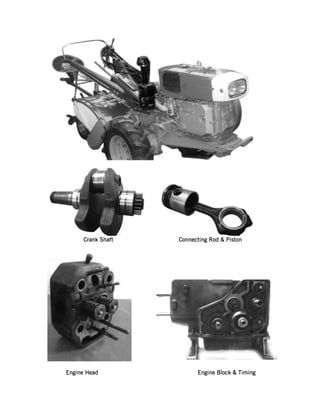
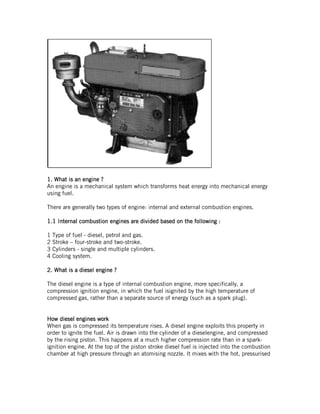
Crank ShaftCrank ShaftCrank ShaftCrank Shaft ConConConConnnnnecting Rod & Pistonecting Rod & Pistonecting Rod & Pistonecting Rod & Piston
Engine HeadEngine HeadEngine HeadEngine Head Engine Block & TimingEngine Block & TimingEngine Block & TimingEngine Block & Timing
1. What is an engine ?1. What is an engine ?1. What is an engine ?1. What is an engine ?
An engine is a mechanical system which transforms heat energy into mechanical energy
using fuel.
There are generally two types of engine: internal and external combustion engines.
1.1 Internal combustion engines are divided based on the1.1 Internal combustion engines are divided based on the1.1 Internal combustion engines are divided based on the1.1 Internal combustion engines are divided based on the followingfollowingfollowingfollowing ::::
1 Type of fuel - diesel, petrol and gas.
2 Stroke – four-stroke and two-stroke.
3 Cylinders - single and multiple cylinders.
4 Cooling system.
2. What is a diesel engine ?2. What is a diesel engine ?2. What is a diesel engine ?2. What is a diesel engine ?
The diesel engine is a type of internal combustion engine, more specifically, a
compression ignition engine, in which the fuel isignited by the high temperature of
compressed gas, rather than a separate source of energy (such as a spark plug).
How diesel engines workHow diesel engines workHow diesel engines workHow diesel engines work
When gas is compressed its temperature rises. A diesel engine exploits this property in
order to ignite the fuel. Air is drawn into the cylinder of a dieselengine, and compressed
by the rising piston. This happens at a much higher compression rate than in a spark-
ignition engine. At the top of the piston stroke diesel fuel is injected into the combustion
chamber at high pressure through an atomising nozzle. It mixes with the hot, pressurised
air. The resulting mixture ignites and burns very rapidly. This contained explosion causes
the gas in the chamber to expand, driving the piston down with considerable force, and
creating power in a vertical direction. The connecting rod transmits this motion to the
crankshaft which is forced to turn, delivering rotary power at the output end of the
crankshaft. ‘Scavenging’ - pushing the exhausted gas-charge out of the cylinder and
drawing in a fresh draught of air - is done through ports or valves.
A vital component of any diesel engine system is the governor, which limits the speed of
the engine by controlling the rate of fuel delivery.
Diesel engine working principlesDiesel engine working principlesDiesel engine working principlesDiesel engine working principles
· Suction stroke
· Compression stroke
· Power stroke
· Exhaust stroke
Fuel and fluid characteristicsFuel and fluid characteristicsFuel and fluid characteristicsFuel and fluid characteristics
Diesel fuel is a product of crude oil, although other oils can be burned inside an adapted
engine. Good quality diesel fuel can be synthesized from vegetable fat and alcohol.
Diesel engines can work on thicker, heavier oil, or oil with higher viscosity, as long as it is
heated in order to ease pumping and injection. These fuels are cheaper but dirtier than
clean, refined diesel oil.
Diesel fuel is more difficult to ignite than gasoline because of its higher flash point, but
once burning, a diesel fire can be extremely fierce.
The use of low-grade fuels can lead to serious maintenance problems.
3. Diesel engine supporting systems3. Diesel engine supporting systems3. Diesel engine supporting systems3. Diesel engine supporting systems
A number of systems are in place for proper operation of an engine
· Intake and exhaust system
· Starting system
· Fuel system
· Cooling system
· Lubricating system
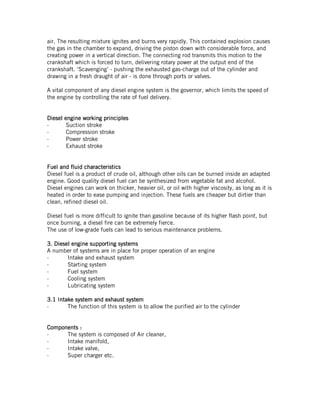
3.1 Intake system and exhaust system3.1 Intake system and exhaust system3.1 Intake system and exhaust system3.1 Intake system and exhaust system
· The function of this system is to allow the purified air to the cylinder
Components :Components :Components :Components :
· The system is composed of Air cleaner,
· Intake manifold,
· Intake valve,
· Super charger etc.
1. Wing nut 7. Air filter body
2. Washer 8. Rubber packing
3. Air filter cover 9. Air filter flange
4. Rubber Packing 10. Air filter sleeve
5. Air filter cartridge 11. Intake pipe
6. Rubber packing
Faults and remediesFaults and remediesFaults and remediesFaults and remedies
FaultFaultFaultFault RemedyRemedyRemedyRemedy
1) Air cleaner jammed with dirt Change
2) Internal manifold cracked Change
3) Cage --- and bent stem of intake valve Repair or change
4) Super charger not working properly Repair or change
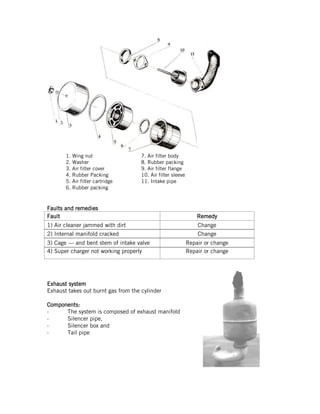
Exhaust systemExhaust systemExhaust systemExhaust system
Exhaust takes out burnt gas from the cylinder
Components:Components:Components:Components:
· The system is composed of exhaust manifold
· Silencer pipe,
· Silencer box and
· Tail pipe
Faults and remediesFaults and remediesFaults and remediesFaults and remedies
FaultsFaultsFaultsFaults RemedyRemedyRemedyRemedy
1) Exhaust manifold broken or cracked Change
2) Silencer pipe cracked Repair or change
3) Silencer box jammed due to burnt or leaked carbon Repair or change
4) Tail pipe leaking or cracked Repair or change
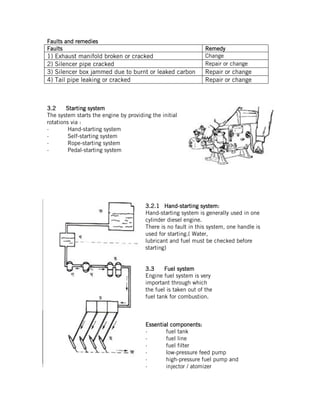
3.23.23.23.2 Starting systemStarting systemStarting systemStarting system
The system starts the engine by providing the initial
rotations via :
· Hand-starting system
· Self-starting system
· Rope-starting system
· Pedal-starting system
3.2.13.2.13.2.13.2.1 HandHandHandHand----starting system:starting system:starting system:starting system:
Hand-starting system is generally used in one
cylinder diesel engine.
There is no fault in this system, one handle is
used for starting.( Water,
lubricant and fuel must be checked before
starting)
3.33.33.33.3 Fuel systemFuel systemFuel systemFuel system
Engine fuel system is very
important through which
the fuel is taken out of the
fuel tank for combustion.
Essential components:Essential components:Essential components:Essential components:
· fuel tank
· fuel line
· fuel filter
· low-pressure feed pump
· high-pressure fuel pump and
· injector / atomizer
Faults and remediesFaults and remediesFaults and remediesFaults and remedies
FaultFaultFaultFault RemedyRemedyRemedyRemedy
1) Fuel tank leaked/cracked Repair or change
2) Fuel line leaked/cracked Change
3) Filter jammed due to dirt Change
4) Low pressure/feed pump faulty Repair or change after checking
5) High pressure fuel pump faulty Repair or change after checking
6) Injector faulty Repair or change after checking
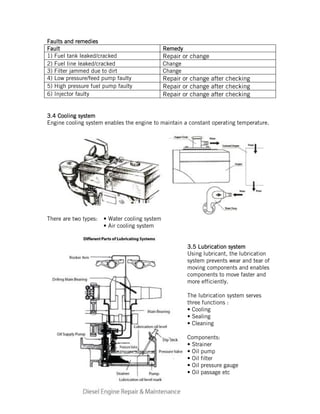
3.4 Cooling system3.4 Cooling system3.4 Cooling system3.4 Cooling system
Engine cooling system enables the engine to maintain a constant operating temperature.
There are two types: • Water cooling system
• Air cooling system
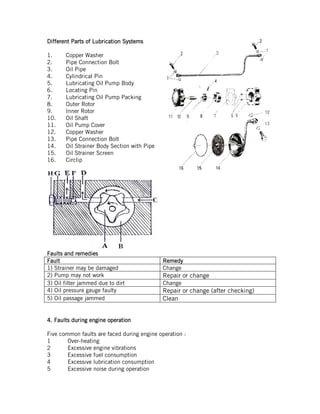
3.5 Lubrication3.5 Lubrication3.5 Lubrication3.5 Lubrication systemsystemsystemsystem
Using lubricant, the lubrication
system prevents wear and tear of
moving components and enables
components to move faster and
more efficiently.
The lubrication system serves
three functions :
• Cooling
• Sealing
• Cleaning
Components:
• Strainer
• Oil pump
• Oil filter
• Oil pressure gauge
• Oil passage etc
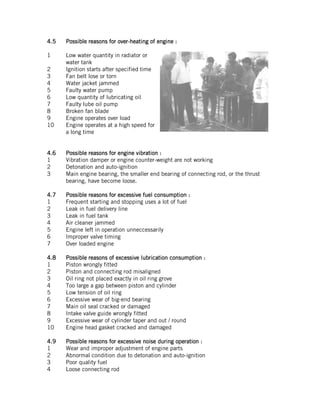
Different Parts of LubricationDifferent Parts of LubricationDifferent Parts of LubricationDifferent Parts of Lubrication SystemsSystemsSystemsSystems
1. Copper Washer
2. Pipe Connection Bolt
3. Oil Pipe
4. Cylindrical Pin
5. Lubricating Oil Pump Body
6. Locating Pin
7. Lubricating Oil Pump Packing
8. Outer Rotor
9. Inner Rotor
10. Oil Shaft
11. Oil Pump Cover
12. Copper Washer
13. Pipe Connection Bolt
14. Oil Strainer Body Section with Pipe
15. Oil Strainer Screen
16. Circlip
Faults and remediesFaults and remediesFaults and remediesFaults and remedies
FaultFaultFaultFault RemedyRemedyRemedyRemedy
1) Strainer may be damaged Change
2) Pump may not work Repair or change
3) Oil filter jammed due to dirt Change
4) Oil pressure gauge faulty Repair or change (after checking)
5) Oil passage jammed Clean
4444.... Faults during engine operationFaults during engine operationFaults during engine operationFaults during engine operation
Five common faults are faced during engine operation :
1 Over-heating
2 Excessive engine vibrations
3 Excessive fuel consumption
4 Excessive lubrication consumption
5 Excessive noise during operation
4.54.54.54.5 PPPPossible reasonsossible reasonsossible reasonsossible reasons forforforfor overoveroverover----heatheatheatheatinginginging of engineof engineof engineof engine ::::
1 Low water quantity in radiator or
water tank
2 Ignition starts after specified time
3 Fan belt lose or torn
4 Water jacket jammed
5 Faulty water pump
6 Low quantity of lubricating oil
7 Faulty lube oil pump
8 Broken fan blade
9 Engine operates over load
10 Engine operates at a high speed for
a long time
4.64.64.64.6 Possible reasons forPossible reasons forPossible reasons forPossible reasons for engine vibrationengine vibrationengine vibrationengine vibration ::::
1 Vibration damper or engine counter-weight are not working
2 Detonation and auto-ignition
3 Main engine bearing, the smaller end bearing of connecting rod, or the thrust
bearing, have become loose.
4.74.74.74.7 PPPPossible reasons forossible reasons forossible reasons forossible reasons for excessive fuel consumptionexcessive fuel consumptionexcessive fuel consumptionexcessive fuel consumption ::::
1 Frequent starting and stopping uses a lot of fuel
2 Leak in fuel delivery line
3 Leak in fuel tank
4 Air cleaner jammed
5 Engine left in operation unneccessarily
6 Improper valve timing
7 Over loaded engine
4.84.84.84.8 Possible reasons of excessive lubrication consumptionPossible reasons of excessive lubrication consumptionPossible reasons of excessive lubrication consumptionPossible reasons of excessive lubrication consumption ::::
1 Piston wrongly fitted
2 Piston and connecting rod misaligned
3 Oil ring not placed exactly in oil ring grove
4 Too large a gap between piston and cylinder
5 Low tension of oil ring
6 Excessive wear of big-end bearing
7 Main oil seal cracked or damaged
8 Intake valve guide wrongly fitted
9 Excessive wear of cylinder taper and out / round
10 Engine head gasket cracked and damaged
4.94.94.94.9 Possible reasons forPossible reasons forPossible reasons forPossible reasons for excessiveexcessiveexcessiveexcessive noisenoisenoisenoise during operationduring operationduring operationduring operation ::::
1 Wear and improper adjustment of engine parts
2 Abnormal condition due to detonation and auto-ignition
3 Poor quality fuel
4 Loose connecting rod
5.5.5.5. What is the function ofWhat is the function ofWhat is the function ofWhat is the function of thethethethe fuelfuelfuelfuel
injection pumpinjection pumpinjection pumpinjection pump????
Fuel injection pump sprays higher
pressure diesel in the cylinder
6. How6. How6. How6. How does fuel enterdoes fuel enterdoes fuel enterdoes fuel enter the fuel pumpthe fuel pumpthe fuel pumpthe fuel pump????
Fuel enters fuel pump via two
methods:
• By gravity feed
• By pressure feed
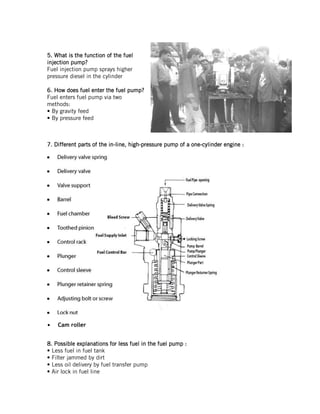
7.7.7.7. DDDDifferent parts ofifferent parts ofifferent parts ofifferent parts of thethethethe inininin----linelinelineline,,,, highhighhighhigh----pressure pumppressure pumppressure pumppressure pump ofofofof aaaa oneoneoneone----cylinder enginecylinder enginecylinder enginecylinder engine ::::
• Cam roller
8. Possible explanations for8. Possible explanations for8. Possible explanations for8. Possible explanations for less fuel in the fuel pumpless fuel in the fuel pumpless fuel in the fuel pumpless fuel in the fuel pump ::::
• Less fuel in fuel tank
• Filter jammed by dirt
• Less oil delivery by fuel transfer pump
• Air lock in fuel line
9999.... What isWhat isWhat isWhat is locatedlocatedlocatedlocated aboveaboveaboveabove thethethethe plungerplungerplungerplunger ????
• Vertical channel or slot
• Helical channel grove
• Annular grove
10101010.... Types of nonTypes of nonTypes of nonTypes of non----return valvereturn valvereturn valvereturn valve :::: • Suction non-return valve
• Delivery non-return valve
11111111.... HowHowHowHow doesdoesdoesdoes aaaa leakleakleakleak in thein thein thein the nonnonnonnon----return valvereturn valvereturn valvereturn valve affectaffectaffectaffect ffffuel pump deliveryuel pump deliveryuel pump deliveryuel pump delivery ????
• A large leak will cause a drop in pressure, and the injector will not spray properly.
• A small leak will not affect the pump pressure; however less fuel will be sprayed
through the injector.
• A small leak will slow the pump, and the fuel spray will be delayed.
12121212.... FFFFuel pumpuel pumpuel pumpuel pump pressure :pressure :pressure :pressure : Fuel pump delivers 240-700 Kg/cm2 (4000-10,000 Psi)
13131313.... Wearable and breakable parts ofWearable and breakable parts ofWearable and breakable parts ofWearable and breakable parts of a fuel pumpa fuel pumpa fuel pumpa fuel pump ::::
• Wear of plunger
• Wear of plunger bush
• Plunger retaining spring can lose tension
• Plunger-retaining spring can break
• Wear of bush and ball bearing
• Wear above tappet and bottom of plunger
• Wear of roller and fan
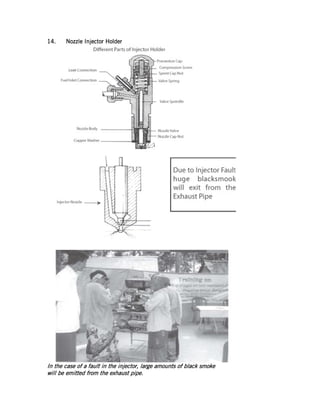
14.14.14.14. Nozzle Injector HoldNozzle Injector HoldNozzle Injector HoldNozzle Injector Holderererer
In the case of a fault in the injector, large amounts of black smokeIn the case of a fault in the injector, large amounts of black smokeIn the case of a fault in the injector, large amounts of black smokeIn the case of a fault in the injector, large amounts of black smoke
willwillwillwill be emittedbe emittedbe emittedbe emitted from thefrom thefrom thefrom the eeeexhaustxhaustxhaustxhaust ppppipeipeipeipe....
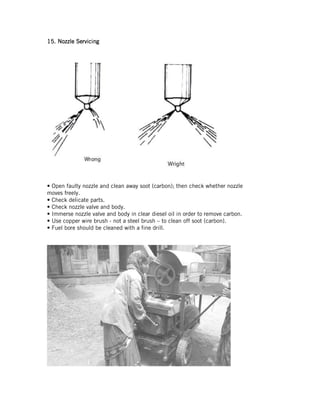
15.15.15.15. Nozzle ServicingNozzle ServicingNozzle ServicingNozzle Servicing
• Open faulty nozzle and clean away soot (carbon); then check whether nozzle
moves freely.
• Check delicate parts.
• Check nozzle valve and body.
• Immerse nozzle valve and body in clear diesel oil in order to remove carbon.
• Use copper wire brush - not a steel brush – to clean off soot (carbon).
• Fuel bore should be cleaned with a fine drill.
11116.6.6.6. Air bleedingAir bleedingAir bleedingAir bleeding aaaa diesel fuel systemdiesel fuel systemdiesel fuel systemdiesel fuel system
The correct method of air bleeding the fuel system :
• Fill up the fuel tank with new diesel oil.
• Open valve of the tank.
• Loosen bleeding plug of the fuel filter and pump till fuel flow is continuous.
• Tighten the plug.
• Loosen injection line nut and crank the engine till fuel is flowing without foam.
• Close the injection line and check for leaks.
Practical Action BangladeshPractical Action BangladeshPractical Action BangladeshPractical Action Bangladesh
House-32, Road-13/A, Dhanmondi, Dhaka
Telephone : 8111934, 9123671
Practical Action BangladeshPractical Action BangladeshPractical Action BangladeshPractical Action Bangladesh
Metal Work Development Services Center
Badarpur, Faridpur.
Telephone : 0631-64827, 66373

Diesel engine repair_2008

  • 2.
    Prepared & CompiledbyPrepared & Compiled byPrepared & Compiled byPrepared & Compiled by Shamim Hasan Program Manager Infrastructure Services Program Practical Action Bangladesh Assisted byAssisted byAssisted byAssisted by Paritosh Kumar Malo Technician Metal Work Development Services Centre Practical Action Bangladesh Badarpur, Faridpur. Published bPublished bPublished bPublished byyyy Infrastructure Services Program Practical Action Bangladesh Printed byPrinted byPrinted byPrinted by Precision Printers 263 Fakirapool, Dhaka-1000. PublicationPublicationPublicationPublication May, 2007 Price : Tk. 30Price : Tk. 30Price : Tk. 30Price : Tk. 30
  • 3.
    PrefacePrefacePrefacePreface Proper utilisation ofresources for poverty reduction is one of the main objectives of present government, which has taken up special program to make agriculture mechanised. To achieve mechanised agriculture, diesel engine has various uses. Diesel engine can run irrigation pump, power tiller, power thrasher, seed drill machine etc. In addition diesel can also run vehicle, rice husking machine, break breaker etc. It is very important to ensure proper and effective use of diesel engine. Only a skilled person can do so. In Bangladesh, usually diesel engine operators/mechanics do not have any institutional education. They learn diesel engine operation and maintenance through the process of "learning by doing". Keeping these realities in mind, Practical Action Bangladesh is publishing this booklet in a simple manner. The booklet depicts the details of diesel engine and how it works, with figures and diagrams. It also describes the "problems and solving" that various parts of a diesel engine might have. The reader will get knowledge on how to repair and maintain a diesel engine from this booklet. Previously, Practical Action Bangladesh has published a booklet on "Diesel engine repair & maintenance" This booklet is more informative and communicative than the previous one. We hope this booklet will serve people working with diesel engine. Veena KhaleVeena KhaleVeena KhaleVeena Khalequequequeque Country Director Practical Action Bangladesh
  • 4.
    Crank ShaftCrank ShaftCrankShaftCrank Shaft ConConConConnnnnecting Rod & Pistonecting Rod & Pistonecting Rod & Pistonecting Rod & Piston Engine HeadEngine HeadEngine HeadEngine Head Engine Block & TimingEngine Block & TimingEngine Block & TimingEngine Block & Timing
  • 5.
    1. What isan engine ?1. What is an engine ?1. What is an engine ?1. What is an engine ? An engine is a mechanical system which transforms heat energy into mechanical energy using fuel. There are generally two types of engine: internal and external combustion engines. 1.1 Internal combustion engines are divided based on the1.1 Internal combustion engines are divided based on the1.1 Internal combustion engines are divided based on the1.1 Internal combustion engines are divided based on the followingfollowingfollowingfollowing :::: 1 Type of fuel - diesel, petrol and gas. 2 Stroke – four-stroke and two-stroke. 3 Cylinders - single and multiple cylinders. 4 Cooling system. 2. What is a diesel engine ?2. What is a diesel engine ?2. What is a diesel engine ?2. What is a diesel engine ? The diesel engine is a type of internal combustion engine, more specifically, a compression ignition engine, in which the fuel isignited by the high temperature of compressed gas, rather than a separate source of energy (such as a spark plug). How diesel engines workHow diesel engines workHow diesel engines workHow diesel engines work When gas is compressed its temperature rises. A diesel engine exploits this property in order to ignite the fuel. Air is drawn into the cylinder of a dieselengine, and compressed by the rising piston. This happens at a much higher compression rate than in a spark- ignition engine. At the top of the piston stroke diesel fuel is injected into the combustion chamber at high pressure through an atomising nozzle. It mixes with the hot, pressurised
  • 6.
    air. The resultingmixture ignites and burns very rapidly. This contained explosion causes the gas in the chamber to expand, driving the piston down with considerable force, and creating power in a vertical direction. The connecting rod transmits this motion to the crankshaft which is forced to turn, delivering rotary power at the output end of the crankshaft. ‘Scavenging’ - pushing the exhausted gas-charge out of the cylinder and drawing in a fresh draught of air - is done through ports or valves. A vital component of any diesel engine system is the governor, which limits the speed of the engine by controlling the rate of fuel delivery. Diesel engine working principlesDiesel engine working principlesDiesel engine working principlesDiesel engine working principles · Suction stroke · Compression stroke · Power stroke · Exhaust stroke Fuel and fluid characteristicsFuel and fluid characteristicsFuel and fluid characteristicsFuel and fluid characteristics Diesel fuel is a product of crude oil, although other oils can be burned inside an adapted engine. Good quality diesel fuel can be synthesized from vegetable fat and alcohol. Diesel engines can work on thicker, heavier oil, or oil with higher viscosity, as long as it is heated in order to ease pumping and injection. These fuels are cheaper but dirtier than clean, refined diesel oil. Diesel fuel is more difficult to ignite than gasoline because of its higher flash point, but once burning, a diesel fire can be extremely fierce. The use of low-grade fuels can lead to serious maintenance problems. 3. Diesel engine supporting systems3. Diesel engine supporting systems3. Diesel engine supporting systems3. Diesel engine supporting systems A number of systems are in place for proper operation of an engine · Intake and exhaust system · Starting system · Fuel system · Cooling system · Lubricating system 3.1 Intake system and exhaust system3.1 Intake system and exhaust system3.1 Intake system and exhaust system3.1 Intake system and exhaust system · The function of this system is to allow the purified air to the cylinder Components :Components :Components :Components : · The system is composed of Air cleaner, · Intake manifold, · Intake valve, · Super charger etc.
  • 7.
    1. Wing nut7. Air filter body 2. Washer 8. Rubber packing 3. Air filter cover 9. Air filter flange 4. Rubber Packing 10. Air filter sleeve 5. Air filter cartridge 11. Intake pipe 6. Rubber packing Faults and remediesFaults and remediesFaults and remediesFaults and remedies FaultFaultFaultFault RemedyRemedyRemedyRemedy 1) Air cleaner jammed with dirt Change 2) Internal manifold cracked Change 3) Cage --- and bent stem of intake valve Repair or change 4) Super charger not working properly Repair or change Exhaust systemExhaust systemExhaust systemExhaust system Exhaust takes out burnt gas from the cylinder Components:Components:Components:Components: · The system is composed of exhaust manifold · Silencer pipe, · Silencer box and · Tail pipe
  • 8.
    Faults and remediesFaultsand remediesFaults and remediesFaults and remedies FaultsFaultsFaultsFaults RemedyRemedyRemedyRemedy 1) Exhaust manifold broken or cracked Change 2) Silencer pipe cracked Repair or change 3) Silencer box jammed due to burnt or leaked carbon Repair or change 4) Tail pipe leaking or cracked Repair or change 3.23.23.23.2 Starting systemStarting systemStarting systemStarting system The system starts the engine by providing the initial rotations via : · Hand-starting system · Self-starting system · Rope-starting system · Pedal-starting system 3.2.13.2.13.2.13.2.1 HandHandHandHand----starting system:starting system:starting system:starting system: Hand-starting system is generally used in one cylinder diesel engine. There is no fault in this system, one handle is used for starting.( Water, lubricant and fuel must be checked before starting) 3.33.33.33.3 Fuel systemFuel systemFuel systemFuel system Engine fuel system is very important through which the fuel is taken out of the fuel tank for combustion. Essential components:Essential components:Essential components:Essential components: · fuel tank · fuel line · fuel filter · low-pressure feed pump · high-pressure fuel pump and · injector / atomizer
  • 9.
    Faults and remediesFaultsand remediesFaults and remediesFaults and remedies FaultFaultFaultFault RemedyRemedyRemedyRemedy 1) Fuel tank leaked/cracked Repair or change 2) Fuel line leaked/cracked Change 3) Filter jammed due to dirt Change 4) Low pressure/feed pump faulty Repair or change after checking 5) High pressure fuel pump faulty Repair or change after checking 6) Injector faulty Repair or change after checking 3.4 Cooling system3.4 Cooling system3.4 Cooling system3.4 Cooling system Engine cooling system enables the engine to maintain a constant operating temperature. There are two types: • Water cooling system • Air cooling system 3.5 Lubrication3.5 Lubrication3.5 Lubrication3.5 Lubrication systemsystemsystemsystem Using lubricant, the lubrication system prevents wear and tear of moving components and enables components to move faster and more efficiently. The lubrication system serves three functions : • Cooling • Sealing • Cleaning Components: • Strainer • Oil pump • Oil filter • Oil pressure gauge • Oil passage etc
  • 10.
    Different Parts ofLubricationDifferent Parts of LubricationDifferent Parts of LubricationDifferent Parts of Lubrication SystemsSystemsSystemsSystems 1. Copper Washer 2. Pipe Connection Bolt 3. Oil Pipe 4. Cylindrical Pin 5. Lubricating Oil Pump Body 6. Locating Pin 7. Lubricating Oil Pump Packing 8. Outer Rotor 9. Inner Rotor 10. Oil Shaft 11. Oil Pump Cover 12. Copper Washer 13. Pipe Connection Bolt 14. Oil Strainer Body Section with Pipe 15. Oil Strainer Screen 16. Circlip Faults and remediesFaults and remediesFaults and remediesFaults and remedies FaultFaultFaultFault RemedyRemedyRemedyRemedy 1) Strainer may be damaged Change 2) Pump may not work Repair or change 3) Oil filter jammed due to dirt Change 4) Oil pressure gauge faulty Repair or change (after checking) 5) Oil passage jammed Clean 4444.... Faults during engine operationFaults during engine operationFaults during engine operationFaults during engine operation Five common faults are faced during engine operation : 1 Over-heating 2 Excessive engine vibrations 3 Excessive fuel consumption 4 Excessive lubrication consumption 5 Excessive noise during operation
  • 11.
    4.54.54.54.5 PPPPossible reasonsossiblereasonsossible reasonsossible reasons forforforfor overoveroverover----heatheatheatheatinginginging of engineof engineof engineof engine :::: 1 Low water quantity in radiator or water tank 2 Ignition starts after specified time 3 Fan belt lose or torn 4 Water jacket jammed 5 Faulty water pump 6 Low quantity of lubricating oil 7 Faulty lube oil pump 8 Broken fan blade 9 Engine operates over load 10 Engine operates at a high speed for a long time 4.64.64.64.6 Possible reasons forPossible reasons forPossible reasons forPossible reasons for engine vibrationengine vibrationengine vibrationengine vibration :::: 1 Vibration damper or engine counter-weight are not working 2 Detonation and auto-ignition 3 Main engine bearing, the smaller end bearing of connecting rod, or the thrust bearing, have become loose. 4.74.74.74.7 PPPPossible reasons forossible reasons forossible reasons forossible reasons for excessive fuel consumptionexcessive fuel consumptionexcessive fuel consumptionexcessive fuel consumption :::: 1 Frequent starting and stopping uses a lot of fuel 2 Leak in fuel delivery line 3 Leak in fuel tank 4 Air cleaner jammed 5 Engine left in operation unneccessarily 6 Improper valve timing 7 Over loaded engine 4.84.84.84.8 Possible reasons of excessive lubrication consumptionPossible reasons of excessive lubrication consumptionPossible reasons of excessive lubrication consumptionPossible reasons of excessive lubrication consumption :::: 1 Piston wrongly fitted 2 Piston and connecting rod misaligned 3 Oil ring not placed exactly in oil ring grove 4 Too large a gap between piston and cylinder 5 Low tension of oil ring 6 Excessive wear of big-end bearing 7 Main oil seal cracked or damaged 8 Intake valve guide wrongly fitted 9 Excessive wear of cylinder taper and out / round 10 Engine head gasket cracked and damaged 4.94.94.94.9 Possible reasons forPossible reasons forPossible reasons forPossible reasons for excessiveexcessiveexcessiveexcessive noisenoisenoisenoise during operationduring operationduring operationduring operation :::: 1 Wear and improper adjustment of engine parts 2 Abnormal condition due to detonation and auto-ignition 3 Poor quality fuel 4 Loose connecting rod
  • 12.
    5.5.5.5. What isthe function ofWhat is the function ofWhat is the function ofWhat is the function of thethethethe fuelfuelfuelfuel injection pumpinjection pumpinjection pumpinjection pump???? Fuel injection pump sprays higher pressure diesel in the cylinder 6. How6. How6. How6. How does fuel enterdoes fuel enterdoes fuel enterdoes fuel enter the fuel pumpthe fuel pumpthe fuel pumpthe fuel pump???? Fuel enters fuel pump via two methods: • By gravity feed • By pressure feed 7.7.7.7. DDDDifferent parts ofifferent parts ofifferent parts ofifferent parts of thethethethe inininin----linelinelineline,,,, highhighhighhigh----pressure pumppressure pumppressure pumppressure pump ofofofof aaaa oneoneoneone----cylinder enginecylinder enginecylinder enginecylinder engine :::: • Cam roller 8. Possible explanations for8. Possible explanations for8. Possible explanations for8. Possible explanations for less fuel in the fuel pumpless fuel in the fuel pumpless fuel in the fuel pumpless fuel in the fuel pump :::: • Less fuel in fuel tank • Filter jammed by dirt • Less oil delivery by fuel transfer pump • Air lock in fuel line
  • 13.
    9999.... What isWhatisWhat isWhat is locatedlocatedlocatedlocated aboveaboveaboveabove thethethethe plungerplungerplungerplunger ???? • Vertical channel or slot • Helical channel grove • Annular grove 10101010.... Types of nonTypes of nonTypes of nonTypes of non----return valvereturn valvereturn valvereturn valve :::: • Suction non-return valve • Delivery non-return valve 11111111.... HowHowHowHow doesdoesdoesdoes aaaa leakleakleakleak in thein thein thein the nonnonnonnon----return valvereturn valvereturn valvereturn valve affectaffectaffectaffect ffffuel pump deliveryuel pump deliveryuel pump deliveryuel pump delivery ???? • A large leak will cause a drop in pressure, and the injector will not spray properly. • A small leak will not affect the pump pressure; however less fuel will be sprayed through the injector. • A small leak will slow the pump, and the fuel spray will be delayed. 12121212.... FFFFuel pumpuel pumpuel pumpuel pump pressure :pressure :pressure :pressure : Fuel pump delivers 240-700 Kg/cm2 (4000-10,000 Psi) 13131313.... Wearable and breakable parts ofWearable and breakable parts ofWearable and breakable parts ofWearable and breakable parts of a fuel pumpa fuel pumpa fuel pumpa fuel pump :::: • Wear of plunger • Wear of plunger bush • Plunger retaining spring can lose tension • Plunger-retaining spring can break • Wear of bush and ball bearing • Wear above tappet and bottom of plunger • Wear of roller and fan
  • 14.
    14.14.14.14. Nozzle InjectorHoldNozzle Injector HoldNozzle Injector HoldNozzle Injector Holderererer In the case of a fault in the injector, large amounts of black smokeIn the case of a fault in the injector, large amounts of black smokeIn the case of a fault in the injector, large amounts of black smokeIn the case of a fault in the injector, large amounts of black smoke willwillwillwill be emittedbe emittedbe emittedbe emitted from thefrom thefrom thefrom the eeeexhaustxhaustxhaustxhaust ppppipeipeipeipe....
  • 15.
    15.15.15.15. Nozzle ServicingNozzleServicingNozzle ServicingNozzle Servicing • Open faulty nozzle and clean away soot (carbon); then check whether nozzle moves freely. • Check delicate parts. • Check nozzle valve and body. • Immerse nozzle valve and body in clear diesel oil in order to remove carbon. • Use copper wire brush - not a steel brush – to clean off soot (carbon). • Fuel bore should be cleaned with a fine drill.
  • 16.
    11116.6.6.6. Air bleedingAirbleedingAir bleedingAir bleeding aaaa diesel fuel systemdiesel fuel systemdiesel fuel systemdiesel fuel system The correct method of air bleeding the fuel system : • Fill up the fuel tank with new diesel oil. • Open valve of the tank. • Loosen bleeding plug of the fuel filter and pump till fuel flow is continuous. • Tighten the plug. • Loosen injection line nut and crank the engine till fuel is flowing without foam. • Close the injection line and check for leaks. Practical Action BangladeshPractical Action BangladeshPractical Action BangladeshPractical Action Bangladesh House-32, Road-13/A, Dhanmondi, Dhaka Telephone : 8111934, 9123671 Practical Action BangladeshPractical Action BangladeshPractical Action BangladeshPractical Action Bangladesh Metal Work Development Services Center Badarpur, Faridpur. Telephone : 0631-64827, 66373