Max-Planck-Institut für Eisenforschung, DüsseldorfCoupling Density Functional Theory with Continuum Mechanics forAlloy DesignD. Ma*, M. Friák, W. Counts, D. Raabe, J. NeugebauerMax Planck Institute for Iron Research, Düsseldorf, Germany
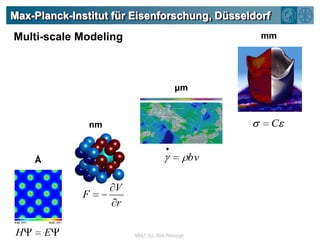
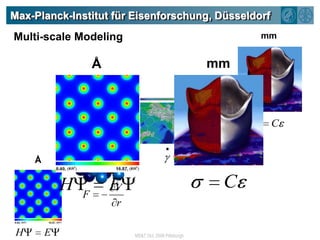
Max-Planck-Institut für Eisenforschung, DüsseldorfMulti-scale ModelingmmμmnmÅ
Max-Planck-Institut für Eisenforschung, DüsseldorfMulti-scale ModelingmmmmÅμmnmÅ
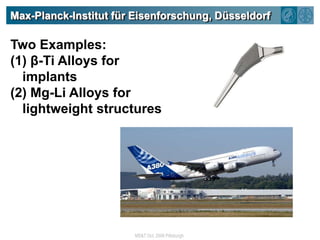
Max-Planck-Institut für Eisenforschung, DüsseldorfTwo Examples:(1) β-Ti Alloys for implants(2) Mg-Li Alloys for lightweight structures
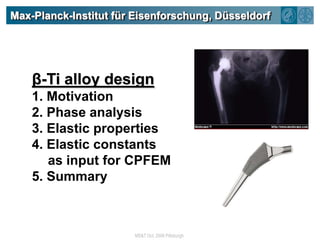
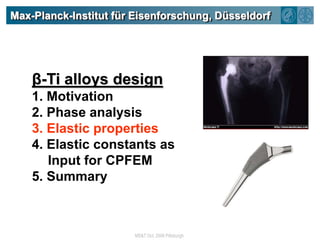
Max-Planck-Institut für Eisenforschung, Düsseldorfβ-Ti alloy design1. Motivation2. Phase analysis3. Elastic properties4. Elastic constants as input for CPFEM5. Summary
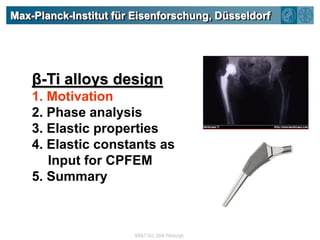
Max-Planck-Institut für Eisenforschung, Düsseldorfβ-Ti alloys design1. Motivation2. Phase analysis3. Elastic properties4. Elastic constants as Input for CPFEM5. Summary
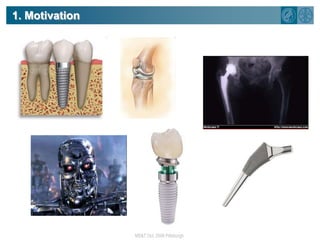
1. Motivation
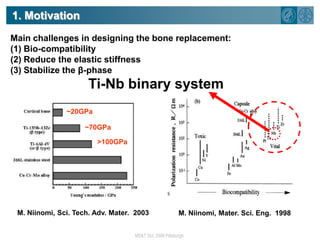
1. MotivationMain challenges in designing the bone replacement:(1) Bio-compatibility(2) Reduce the elastic stiffness(3) Stabilize the β-phaseTi-Nb binary system~20GPa~70GPa>100GPaM. Niinomi, Sci. Tech. Adv. Mater.  2003M. Niinomi, Mater. Sci. Eng.  1998
Max-Planck-Institut für Eisenforschung, Düsseldorfβ-Ti alloys design1. Motivation2. Phase analysis3. Elastic properties4. Elastic constants as Input for CPFEM5. Summary
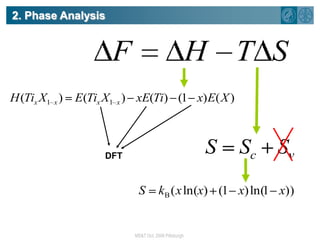
2. Phase AnalysisDFT
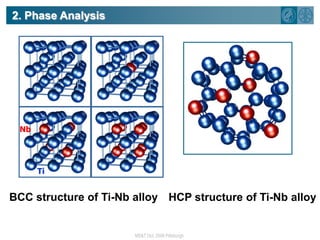
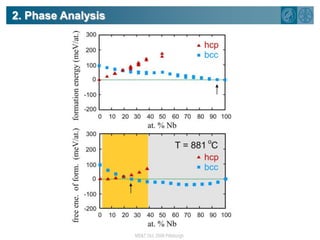
NbTiunwanted hcp-based phasethat is stiffer and stable2. Phase Analysiswanted bcc-based phase that is softer but metastableBCC structure of Ti-Nb alloyHCP structure of Ti-Nb alloy
2. Phase Analysis
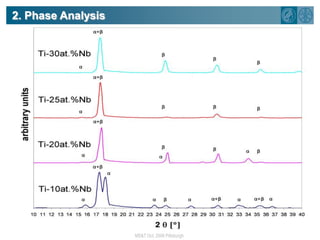
2. Phase Analysis
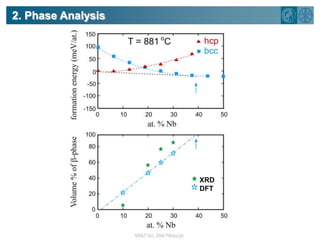
2. Phase AnalysisXRDDFT
Max-Planck-Institut für Eisenforschung, Düsseldorfβ-Ti alloys design1. Motivation2. Phase analysis3. Elastic properties4. Elastic constants as Input for CPFEM5. Summary
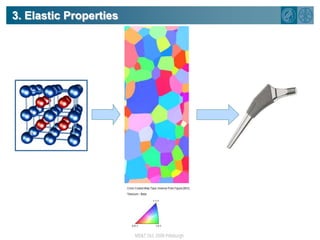
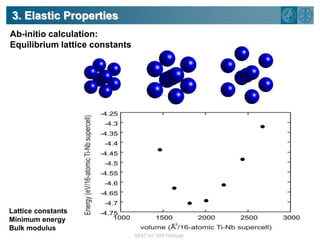
3. Elastic PropertiesAb-initio calculation:Equilibrium lattice constantsLattice constantsMinimum energyBulk modulus
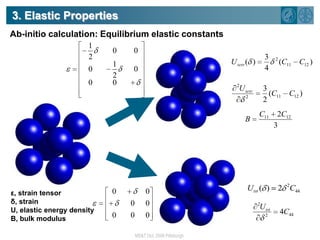
3. Elastic PropertiesAb-initio calculation: Equilibrium elastic constantsε, strain tensorδ, strainU, elastic energy densityB, bulk modulus
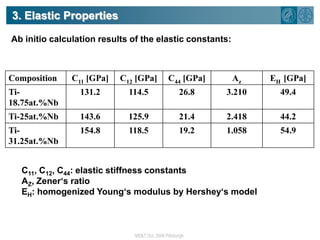
3. Elastic PropertiesAb initio calculation results of the elastic constants:C11, C12, C44: elastic stiffness constantsAZ, Zener‘s ratioEH: homogenized Young‘s modulus by Hershey‘s model
3. Elastic PropertiesYoung‘s modulus surface plotsPure NbTi-25at.%NbTi-31.25at.%NbTi-18.75at.%Nb[001][100][010]Az=3.210Az=1.058Az=0.5027Az=2.418    The elastic properties of the Ti-Nb binary alloys become isotropic as the Nb content increases
3. Elastic Properties
single-crystallineC11, C12, C44, B0micro-scalemacro-scalepolycrystallineYoung modulus3. Elastic Properties64μ H4 + 16(4C11 + 5C12)μ H3 + [3(C11+ 2C12) × (5C11+ 4C12) -8(7C11 – 4C12)C44]μ H2-(29C11 – 20C12)(C11+2C12)C44 μ H–3(C11 + 2C12)2(C11 – C12)C44 = 0 “scale-jumping”(across the meso-scale)
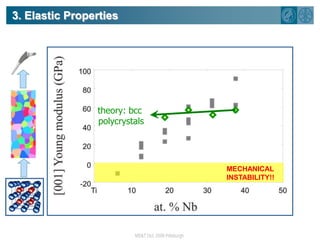
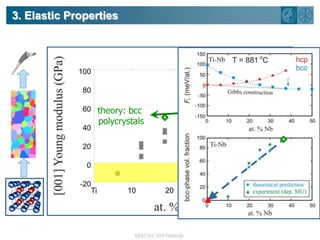
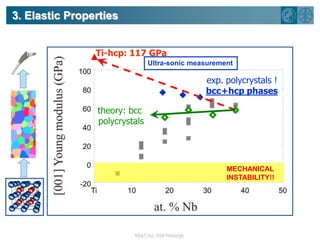
3. Elastic Propertiestheory: bcc polycrystalsMECHANICALINSTABILITY!!
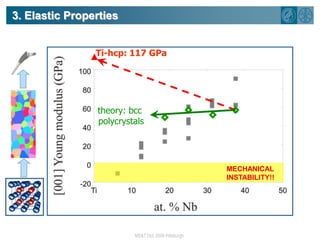
3. Elastic PropertiesTi-hcp: 117 GPatheory: bcc polycrystalsMECHANICALINSTABILITY!!
Ultra-sonic measurementexp. polycrystals !bcc+hcp phases3. Elastic PropertiesTi-hcp: 117 GPatheory: bcc polycrystalsMECHANICALINSTABILITY!!
Max-Planck-Institut für Eisenforschung, Düsseldorfβ-Ti alloys design1. Motivation2. Phase analysis3. Elastic properties4. Elastic constants as input for CPFEM5. Summary
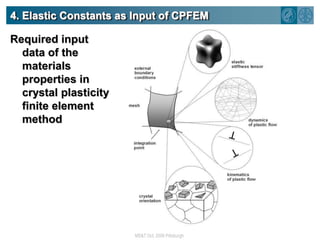
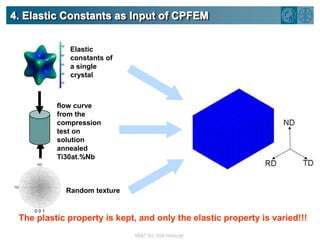
4. Elastic Constants as Input of CPFEMRequired input data of the materials properties in crystal plasticity finite element method
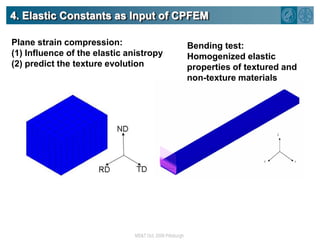
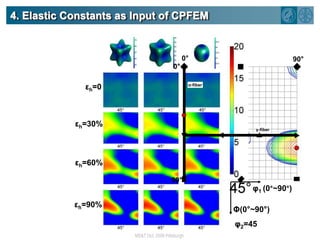
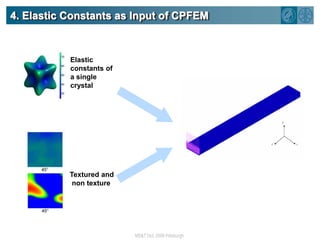
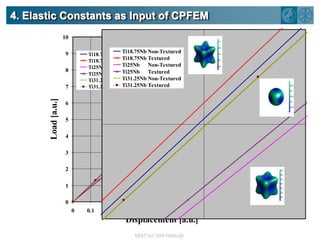
4. Elastic Constants as Input of CPFEM Plane strain compression: (1) Influence of the elastic anistropy  (2) predict the texture evolution     Bending test:     Homogenized elastic properties of textured and non-texture materials
4. Elastic Constants as Input of CPFEM      Elastic constants of a single crystal      flow curve from the compression test on solution annealed Ti30at.%NbRandom textureThe plastic property is kept, and only the elastic property is varied!!!
4. Elastic Constants as Input of CPFEM0°90°0°εh=0α-fiberεh=30%γ-fiberεh=60%90°φ1 (0°~90°)εh=90%Φ(0°~90°)φ2=45°
4. Elastic Constants as Input of CPFEM      Elastic constants of a single crystal     Textured and non texture
4. Elastic Constants as Input of CPFEM
Max-Planck-Institut für Eisenforschung, Düsseldorfβ-Ti alloys design1. Motivation2. Phase analysis3. Elastic properties4. Elastic Constants as Input of CPFEM5. Summary
5. SummaryThermodynamic stability of hcp- and bcc-Ti was studiedConfigurational entropy at finite temperature stabilizes bcc Ti-NbphaseVolume fractions have been calculated using the Gibbs construction Polycrystalline two-phase Young’s modulus has been theoretically predicted employing the Hershey and CPFEM homogenization methods Very good agreement between theoretical prediction and experimentThe calculated elastic constants (DFT) can be used as input for CPFEM Nb SHOULD BE THE PRIMARY ALLOYING ELEMENTS IN Ti FOR HUMAN IMPLANT MATERIALS
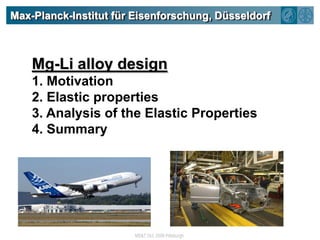
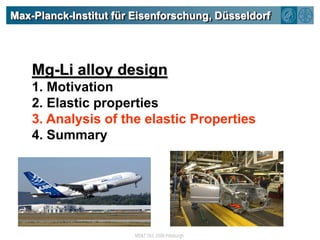
Max-Planck-Institut für Eisenforschung, DüsseldorfMg-Li alloy design1. Motivation2. Elastic properties3. Analysis of the Elastic Properties4. Summary
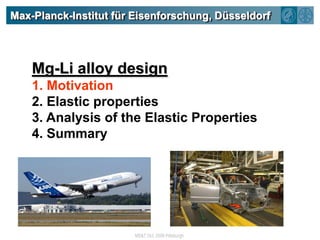
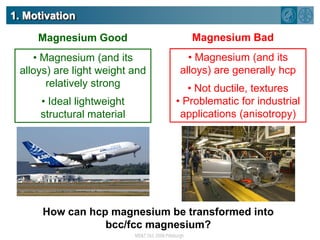
1. MotivationMagnesium BadMagnesium Good Magnesium (and its alloys) are generally hcp
 Not ductile, textures
 Problematic for industrial applications (anisotropy)
 Magnesium (and its alloys) are light weight and relatively strong
 Ideal lightweight structural materialHow can hcp magnesium be transformed into bcc/fcc magnesium?
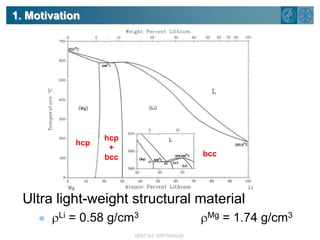
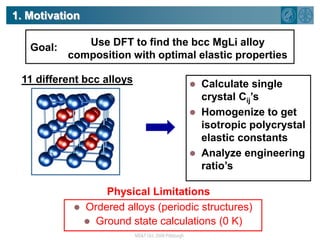
1. Motivationhcp+bcchcpbccUltra light-weight structural materialrLi = 0.58 g/cm3rMg = 1.74 g/cm31. MotivationUse DFT to find the bcc MgLi alloy composition with optimal elastic propertiesGoal:11 different bcc alloysCalculate single crystal Cij’s
Homogenize to get isotropic polycrystal elastic constants
Analyze engineering ratio’sPhysical LimitationsOrdered alloys (periodic structures)
Ground state calculations (0 K)Max-Planck-Institut für Eisenforschung, DüsseldorfMg-Li alloy design1. Motivation2. Elastic properties3. Analysis of the elastic Properties4. Summary
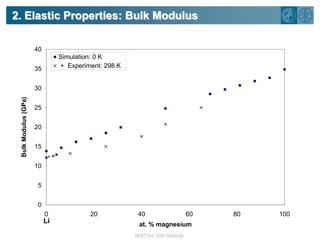
2. Elastic Properties: Bulk ModulusLi
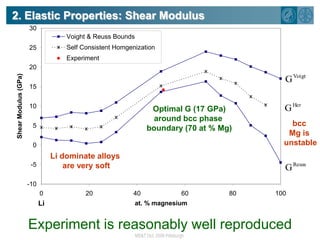
2. Elastic Properties: Shear ModulusOptimal G (17 GPa)around bcc phase boundary (70 at % Mg)bcc Mg is unstableLi dominate alloys are very softLiExperiment is reasonably well reproduced
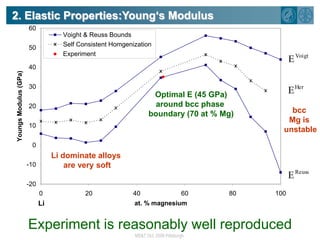
2. Elastic Properties:Young‘s ModulusOptimal E (45 GPa)around bcc phase boundary (70 at % Mg)bcc Mg is unstableLi dominate alloys are very softLiExperiment is reasonably well reproduced
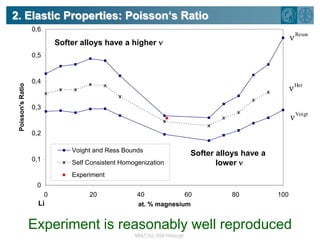
2. Elastic Properties: Poisson‘s RatioSofter alloys have a higher nSofter alloys have a lower nLiExperiment is reasonably well reproduced
Max-Planck-Institut für Eisenforschung, DüsseldorfMg-Li alloy design1. Motivation2. Elastic properties3. Analysis of the elastic Properties4. Summary
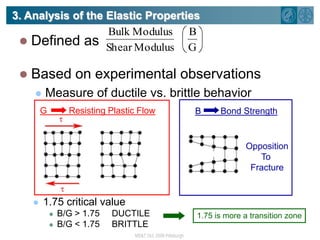
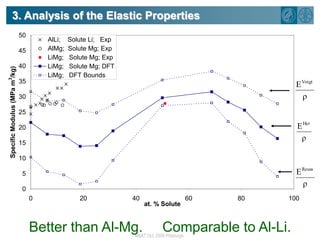
3. Analysis of the Elastic PropertiesDefined as
Based on experimental observations
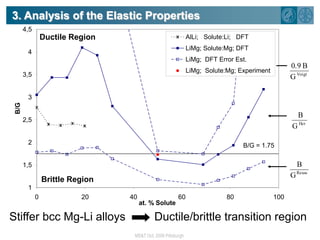
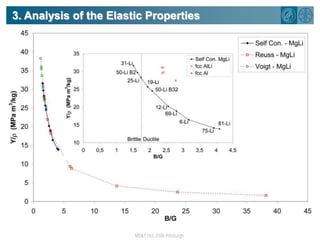
Measure of ductile vs. brittle behaviorG         Resisting Plastic FlowB        Bond StrengthOppositionTo Fracture1.75 critical value

Dierk Raabe Ab Initio Simulations In Metallurgy