Dielectric Materials
Dielectric properties
• Dielectric: Ability to transmit electric force without conduction.
• Non-dielectric materials- Metals and semiconductors: E is transferred
by conduction of charge carriers
• Dielectric materials – Insulators: No charge carriers, no conduction, E
transferred by electrical polarization
Electric flux
• Application of external E to dielectric forms electric lines flowing
inside material from +ve to –ve, know as Electric flux.
• Gauss’s theorem: Total electric flux emanating from a closed surface
is equal to total charge enclosed by that surface.
ϕ =
𝑖=1
𝑛
𝑄𝑖 = 𝐷. 𝑑𝑆
Electric flux density
• ϕ – total electric flux under influence of external E
• Qi (Coulombs) = Q1, Q2, Q3, ………………, Qn= Charges enclosed by the
surface Q can be +ve or –ve
• D is the electric flux density (Coulombs/m2) at center of surface
element represented by the outwardly directed vector dS.
Electric field strength
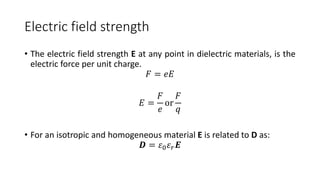
• The electric field strength E at any point in dielectric materials, is the
electric force per unit charge.
𝐹 = 𝑒𝐸
𝐸 =
𝐹
𝑒
or
𝐹
𝑞
• For an isotropic and homogeneous material E is related to D as:
𝑫 = 𝜀0𝜀𝑟𝑬
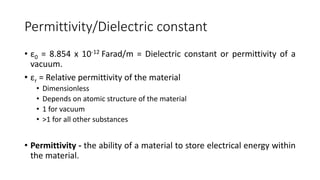
Permittivity/Dielectric constant
• ε0 = 8.854 x 10⁻¹² Farad/m = Dielectric constant or permittivity of a
vacuum.
• εr = Relative permittivity of the material
• Dimensionless
• Depends on atomic structure of the material
• 1 for vacuum
• >1 for all other substances
• Permittivity - the ability of a material to store electrical energy within
the material.
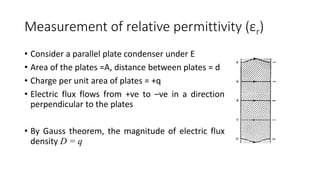
Measurement of relative permittivity (εr)
• Consider a parallel plate condenser under E
• Area of the plates =A, distance between plates = d
• Charge per unit area of plates = +q
• Electric flux flows from +ve to –ve in a direction
perpendicular to the plates
• By Gauss theorem, the magnitude of electric flux
density D = q
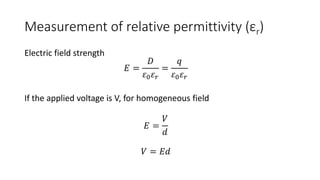
Measurement of relative permittivity (εr)
Electric field strength
𝐸 =
𝐷
𝜀0𝜀𝑟
=
𝑞
𝜀0𝜀𝑟
If the applied voltage is V, for homogeneous field
𝐸 =
𝑉
𝑑
𝑉 = 𝐸𝑑
Measurement of relative permittivity (εr)
The Capacitance C of the condenser:
𝐶 =
𝑄
𝑉
Q = total charge enclosed by parallel plates (Coulombs) = qA
V = Applied voltage (Volts)
C = Capcitance (Farad)
“1 Farad is the capacitance which stores a one-coulomb charge
across a potential difference of one volt.”
Measurement of relative permittivity (εr)
Therefore,
𝐶 =
𝑞𝐴
𝐸𝑑
= 𝜀0𝜀𝑟
𝐴
𝑑
For vacuum εr=1, So
𝐶𝑣𝑎𝑐 = 𝜀0
𝐴
𝑑
Measurement of relative permittivity (εr)
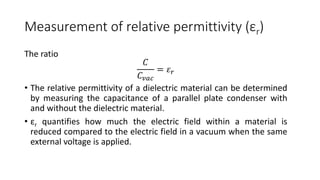
The ratio
𝐶
𝐶𝑣𝑎𝑐
= 𝜀𝑟
• The relative permittivity of a dielectric material can be determined
by measuring the capacitance of a parallel plate condenser with
and without the dielectric material.
• εr quantifies how much the electric field within a material is
reduced compared to the electric field in a vacuum when the same
external voltage is applied.
Q- relative permittivity (εr)
• What is the relative permittivity of metals? And Why?
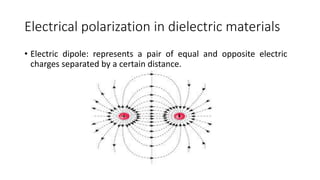
Electrical polarization in dielectric materials
• Electric dipole: represents a pair of equal and opposite electric
charges separated by a certain distance.
Electrical dipole moment
• The electric dipole moment of a neutral system of charges Qi is
defined as:
𝜇 =
𝑖
𝑄𝑖𝑟𝑖
where 𝑟𝑖 is the position vector drawn from origin of a coordinate
system to the position of the charge 𝑄𝑖 (+ve or –ve).
• Unit – Coulomb-m
Electrical dipole moment
• Simple form:
Choosing the –Q at origin of the coordinate system, the magnitude of
electric dipole moment is = Qd in the direction from –Q to +Q.
Electrical polarization
• When an external electric field is applied to a dielectric material, it
carries dipole moment per unit volume, which is called as
polarization of that dielectric material.
• “Electrical polarization is a measure of dipole moment carried by a
unit volume of dielectric under the influence of electric field.”
• It is directly proportional to relative permittivity of the material and
applied field strength and is measured in Coulomb/m2.
Electrical polarization
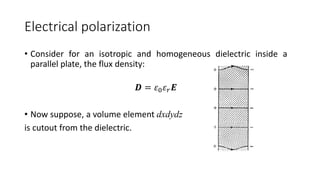
• Consider for an isotropic and homogeneous dielectric inside a
parallel plate, the flux density:
𝑫 = 𝜀0𝜀𝑟𝑬
• Now suppose, a volume element dxdydz
is cutout from the dielectric.
Electrical polarization
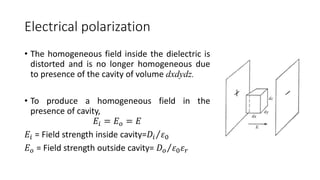
• The homogeneous field inside the dielectric is
distorted and is no longer homogeneous due
to presence of the cavity of volume dxdydz.
• To produce a homogeneous field in the
presence of cavity,
𝐸𝑖 = 𝐸𝑜 = 𝐸
𝐸𝑖 = Field strength inside cavity=𝐷𝑖 𝜀0
𝐸𝑜 = Field strength outside cavity= 𝐷𝑜 𝜀0𝜀𝑟
Electrical polarization
• The flux densities,
𝐷𝑖 𝜀0 = 𝐷𝑜 𝜀0𝜀𝑟 = 𝐷 𝜀0𝜀𝑟
𝐷𝑜 𝐷𝑖 = 𝜀𝑟 or 𝐷𝑖 = 𝐷𝑜 𝜀𝑟
• Hence, if the flux density inside the cavity is made 𝜀𝑟 times as small
as flux density outside the cavity, we can get a homogeneous field
in the presence of the cavity.
Electrical polarization
• Gauss theorem: 𝑖=1
𝑛
𝑄𝑖 = 𝐷. 𝑑𝑆
“A change in flux density can at a surface can only be
achieved if the surface carries an electric charge.”
• To reduce 𝐷𝑜 to 𝐷𝑖 after crossing the
surface, a charge density of –( 𝐷𝑜 - 𝐷𝑖 )
Coulomb/m2 should be provided
Electrical polarization
• So, we place –(𝐷𝑜-𝐷𝑖)dydz on left side and
+(𝐷𝑜-𝐷𝑖)dydz on right side of the cavity.
• The dipole moment becomes
𝜇 = 𝐷𝑜 − 𝐷𝑖 𝑑𝑥𝑑𝑦𝑑𝑧
• Since, 𝐷𝑜 𝐷𝑖 = 𝜀𝑟 , the dipole moment
becomes,
𝜇 = 𝐷𝑖 𝜀𝑟 − 1 𝑑𝑥𝑑𝑦𝑑𝑧
𝜇 = 𝜀𝑜 𝜀𝑟 − 1 𝐸𝑑𝑥𝑑𝑦𝑑𝑧
Electrical polarization
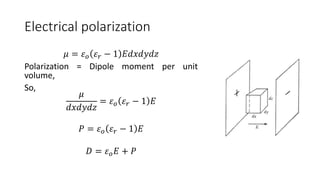
𝜇 = 𝜀𝑜 𝜀𝑟 − 1 𝐸𝑑𝑥𝑑𝑦𝑑𝑧
Polarization = Dipole moment per unit
volume,
So,
𝜇
𝑑𝑥𝑑𝑦𝑑𝑧
= 𝜀𝑜 𝜀𝑟 − 1 𝐸
𝑃 = 𝜀𝑜 𝜀𝑟 − 1 𝐸
𝐷 = 𝜀𝑜𝐸 + 𝑃
Electrical polarization
Q - How can we measure the electrical polarization of a dielectric
material?
Electrical polarization
Q - Calculate the electrical polarization of a barium titanate crystal
subject to a voltage of 10mV, which, when inserted in a parallel plate
condenser of area 10mm x 10mm and distance of separation of 2
mm, gives a capacitance of 1nF.
Types of Electrical polarization
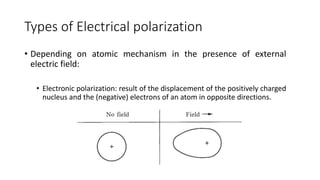
• Depending on atomic mechanism in the presence of external
electric field:
• Electronic polarization: result of the displacement of the positively charged
nucleus and the (negative) electrons of an atom in opposite directions.
Electronic polarization
• On applying a field, the electron cloud around the nucleus readily shifts
towards the positive end of the field.
• Such a shift results in a dipole moment within the atom, as a certain distance
now separates the nucleus and the centre of the electron cloud.
• The extent of this shift is proportional to the field strength.
• As the dipole moment is defined as the product of the charge and the shift
distance, it is also proportional to the field strength.
• The constant of proportionality is called the electronic polarizability αe of the
atom.
• 𝑃 = 𝑁𝛼𝑒𝐸, where N = atoms/m3,E = Applied field
• For the inert gases, this polarizability increases with increasing volume of the
atom.
• Electronic polarizability is independent of temperature.
• Monoatomic gases exhibit only this kind of polarization.
Ionic polarization
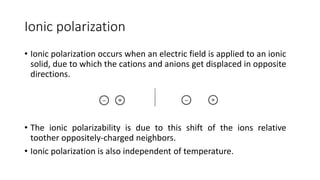
• Ionic polarization occurs when an electric field is applied to an ionic
solid, due to which the cations and anions get displaced in opposite
directions.
• The ionic polarizability is due to this shift of the ions relative
toother oppositely-charged neighbors.
• Ionic polarization is also independent of temperature.
Orientational polarization
• Occurs in chemical compounds in which positive and negative charges
do not coincide with each other such as CH3Cl.
• These molecules carry a dipole moment even in the absence of an
electric field.
• When an electric field is applied on such molecules, they tend to align
themselves in the applied field.
• The polarization due to this alignment is called orientation polarization
• It is dependent on temperature. With increasing temperature, the
thermal energy tends to randomize the alignment.
Space charge polarization
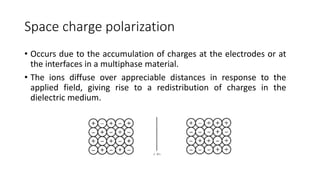
• Occurs due to the accumulation of charges at the electrodes or at
the interfaces in a multiphase material.
• The ions diffuse over appreciable distances in response to the
applied field, giving rise to a redistribution of charges in the
dielectric medium.
Total polarization
• The total polarization of a material is the sum of the contributions
from the various sources described above:
𝑃𝑡𝑜𝑡𝑎𝑙 = 𝑃𝑒 + 𝑃𝑖 + 𝑃𝑜 + 𝑃𝑠

Dielectric materials-3.pptx

  • 1.
  • 2.
    Dielectric properties • Dielectric:Ability to transmit electric force without conduction. • Non-dielectric materials- Metals and semiconductors: E is transferred by conduction of charge carriers • Dielectric materials – Insulators: No charge carriers, no conduction, E transferred by electrical polarization
  • 3.
    Electric flux • Applicationof external E to dielectric forms electric lines flowing inside material from +ve to –ve, know as Electric flux. • Gauss’s theorem: Total electric flux emanating from a closed surface is equal to total charge enclosed by that surface. ϕ = 𝑖=1 𝑛 𝑄𝑖 = 𝐷. 𝑑𝑆
  • 4.
    Electric flux density •ϕ – total electric flux under influence of external E • Qi (Coulombs) = Q1, Q2, Q3, ………………, Qn= Charges enclosed by the surface Q can be +ve or –ve • D is the electric flux density (Coulombs/m2) at center of surface element represented by the outwardly directed vector dS.
  • 5.
    Electric field strength •The electric field strength E at any point in dielectric materials, is the electric force per unit charge. 𝐹 = 𝑒𝐸 𝐸 = 𝐹 𝑒 or 𝐹 𝑞 • For an isotropic and homogeneous material E is related to D as: 𝑫 = 𝜀0𝜀𝑟𝑬
  • 6.
    Permittivity/Dielectric constant • ε0= 8.854 x 10⁻¹² Farad/m = Dielectric constant or permittivity of a vacuum. • εr = Relative permittivity of the material • Dimensionless • Depends on atomic structure of the material • 1 for vacuum • >1 for all other substances • Permittivity - the ability of a material to store electrical energy within the material.
  • 7.
    Measurement of relativepermittivity (εr) • Consider a parallel plate condenser under E • Area of the plates =A, distance between plates = d • Charge per unit area of plates = +q • Electric flux flows from +ve to –ve in a direction perpendicular to the plates • By Gauss theorem, the magnitude of electric flux density D = q
  • 8.
    Measurement of relativepermittivity (εr) Electric field strength 𝐸 = 𝐷 𝜀0𝜀𝑟 = 𝑞 𝜀0𝜀𝑟 If the applied voltage is V, for homogeneous field 𝐸 = 𝑉 𝑑 𝑉 = 𝐸𝑑
  • 9.
    Measurement of relativepermittivity (εr) The Capacitance C of the condenser: 𝐶 = 𝑄 𝑉 Q = total charge enclosed by parallel plates (Coulombs) = qA V = Applied voltage (Volts) C = Capcitance (Farad) “1 Farad is the capacitance which stores a one-coulomb charge across a potential difference of one volt.”
  • 10.
    Measurement of relativepermittivity (εr) Therefore, 𝐶 = 𝑞𝐴 𝐸𝑑 = 𝜀0𝜀𝑟 𝐴 𝑑 For vacuum εr=1, So 𝐶𝑣𝑎𝑐 = 𝜀0 𝐴 𝑑
  • 11.
    Measurement of relativepermittivity (εr) The ratio 𝐶 𝐶𝑣𝑎𝑐 = 𝜀𝑟 • The relative permittivity of a dielectric material can be determined by measuring the capacitance of a parallel plate condenser with and without the dielectric material. • εr quantifies how much the electric field within a material is reduced compared to the electric field in a vacuum when the same external voltage is applied.
  • 12.
    Q- relative permittivity(εr) • What is the relative permittivity of metals? And Why?
  • 13.
    Electrical polarization indielectric materials • Electric dipole: represents a pair of equal and opposite electric charges separated by a certain distance.
  • 14.
    Electrical dipole moment •The electric dipole moment of a neutral system of charges Qi is defined as: 𝜇 = 𝑖 𝑄𝑖𝑟𝑖 where 𝑟𝑖 is the position vector drawn from origin of a coordinate system to the position of the charge 𝑄𝑖 (+ve or –ve). • Unit – Coulomb-m
  • 15.
    Electrical dipole moment •Simple form: Choosing the –Q at origin of the coordinate system, the magnitude of electric dipole moment is = Qd in the direction from –Q to +Q.
  • 16.
    Electrical polarization • Whenan external electric field is applied to a dielectric material, it carries dipole moment per unit volume, which is called as polarization of that dielectric material. • “Electrical polarization is a measure of dipole moment carried by a unit volume of dielectric under the influence of electric field.” • It is directly proportional to relative permittivity of the material and applied field strength and is measured in Coulomb/m2.
  • 17.
    Electrical polarization • Considerfor an isotropic and homogeneous dielectric inside a parallel plate, the flux density: 𝑫 = 𝜀0𝜀𝑟𝑬 • Now suppose, a volume element dxdydz is cutout from the dielectric.
  • 18.
    Electrical polarization • Thehomogeneous field inside the dielectric is distorted and is no longer homogeneous due to presence of the cavity of volume dxdydz. • To produce a homogeneous field in the presence of cavity, 𝐸𝑖 = 𝐸𝑜 = 𝐸 𝐸𝑖 = Field strength inside cavity=𝐷𝑖 𝜀0 𝐸𝑜 = Field strength outside cavity= 𝐷𝑜 𝜀0𝜀𝑟
  • 19.
    Electrical polarization • Theflux densities, 𝐷𝑖 𝜀0 = 𝐷𝑜 𝜀0𝜀𝑟 = 𝐷 𝜀0𝜀𝑟 𝐷𝑜 𝐷𝑖 = 𝜀𝑟 or 𝐷𝑖 = 𝐷𝑜 𝜀𝑟 • Hence, if the flux density inside the cavity is made 𝜀𝑟 times as small as flux density outside the cavity, we can get a homogeneous field in the presence of the cavity.
  • 20.
    Electrical polarization • Gausstheorem: 𝑖=1 𝑛 𝑄𝑖 = 𝐷. 𝑑𝑆 “A change in flux density can at a surface can only be achieved if the surface carries an electric charge.” • To reduce 𝐷𝑜 to 𝐷𝑖 after crossing the surface, a charge density of –( 𝐷𝑜 - 𝐷𝑖 ) Coulomb/m2 should be provided
  • 21.
    Electrical polarization • So,we place –(𝐷𝑜-𝐷𝑖)dydz on left side and +(𝐷𝑜-𝐷𝑖)dydz on right side of the cavity. • The dipole moment becomes 𝜇 = 𝐷𝑜 − 𝐷𝑖 𝑑𝑥𝑑𝑦𝑑𝑧 • Since, 𝐷𝑜 𝐷𝑖 = 𝜀𝑟 , the dipole moment becomes, 𝜇 = 𝐷𝑖 𝜀𝑟 − 1 𝑑𝑥𝑑𝑦𝑑𝑧 𝜇 = 𝜀𝑜 𝜀𝑟 − 1 𝐸𝑑𝑥𝑑𝑦𝑑𝑧
  • 22.
    Electrical polarization 𝜇 =𝜀𝑜 𝜀𝑟 − 1 𝐸𝑑𝑥𝑑𝑦𝑑𝑧 Polarization = Dipole moment per unit volume, So, 𝜇 𝑑𝑥𝑑𝑦𝑑𝑧 = 𝜀𝑜 𝜀𝑟 − 1 𝐸 𝑃 = 𝜀𝑜 𝜀𝑟 − 1 𝐸 𝐷 = 𝜀𝑜𝐸 + 𝑃
  • 23.
    Electrical polarization Q -How can we measure the electrical polarization of a dielectric material?
  • 24.
    Electrical polarization Q -Calculate the electrical polarization of a barium titanate crystal subject to a voltage of 10mV, which, when inserted in a parallel plate condenser of area 10mm x 10mm and distance of separation of 2 mm, gives a capacitance of 1nF.
  • 25.
    Types of Electricalpolarization • Depending on atomic mechanism in the presence of external electric field: • Electronic polarization: result of the displacement of the positively charged nucleus and the (negative) electrons of an atom in opposite directions.
  • 26.
    Electronic polarization • Onapplying a field, the electron cloud around the nucleus readily shifts towards the positive end of the field. • Such a shift results in a dipole moment within the atom, as a certain distance now separates the nucleus and the centre of the electron cloud. • The extent of this shift is proportional to the field strength. • As the dipole moment is defined as the product of the charge and the shift distance, it is also proportional to the field strength. • The constant of proportionality is called the electronic polarizability αe of the atom. • 𝑃 = 𝑁𝛼𝑒𝐸, where N = atoms/m3,E = Applied field • For the inert gases, this polarizability increases with increasing volume of the atom. • Electronic polarizability is independent of temperature. • Monoatomic gases exhibit only this kind of polarization.
  • 27.
    Ionic polarization • Ionicpolarization occurs when an electric field is applied to an ionic solid, due to which the cations and anions get displaced in opposite directions. • The ionic polarizability is due to this shift of the ions relative toother oppositely-charged neighbors. • Ionic polarization is also independent of temperature.
  • 28.
    Orientational polarization • Occursin chemical compounds in which positive and negative charges do not coincide with each other such as CH3Cl. • These molecules carry a dipole moment even in the absence of an electric field. • When an electric field is applied on such molecules, they tend to align themselves in the applied field. • The polarization due to this alignment is called orientation polarization • It is dependent on temperature. With increasing temperature, the thermal energy tends to randomize the alignment.
  • 29.
    Space charge polarization •Occurs due to the accumulation of charges at the electrodes or at the interfaces in a multiphase material. • The ions diffuse over appreciable distances in response to the applied field, giving rise to a redistribution of charges in the dielectric medium.
  • 30.
    Total polarization • Thetotal polarization of a material is the sum of the contributions from the various sources described above: 𝑃𝑡𝑜𝑡𝑎𝑙 = 𝑃𝑒 + 𝑃𝑖 + 𝑃𝑜 + 𝑃𝑠