Dichotomous Keys
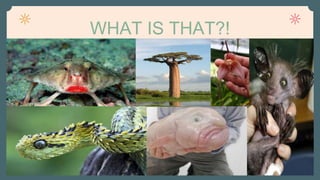
WHAT IS THAT?!
Ever seen an organism and want
to know what it is?
Then this unit is for you!
Dichotomous Keys are used to
identify unknown organisms.
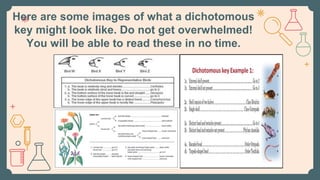
Here are some images of what a dichotomous
key might look like. Do not get overwhelmed!
You will be able to read these in no time.
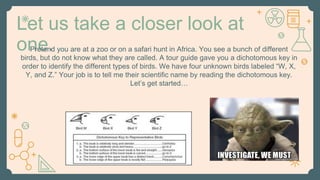
Let us take a closer look at
one.Pretend you are at a zoo or on a safari hunt in Africa. You see a bunch of different
birds, but do not know what they are called. A tour guide gave you a dichotomous key in
order to identify the different types of birds. We have four unknown birds labeled “W, X,
Y, and Z.” Your job is to tell me their scientific name by reading the dichotomous key.
Let’s get started…
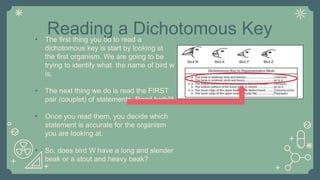
Reading a Dichotomous Key• The first thing you do to read a
dichotomous key is start by looking at
the first organism. We are going to be
trying to identify what the name of bird w
is.
• The next thing we do is read the FIRST
pair (couplet) of statements. Read both!!!
• Once you read them, you decide which
statement is accurate for the organism
you are looking at.
• So, does bird W have a long and slender
beak or a stout and heavy beak?
• After studying the picture, we should
determine that bird W has a stout and
heavy beak. We then look at what it says
to do.
• It tells us to go to number two. Now, we
read the couplet under number 2 (circled
in teal). Determine which statement is
accurate for bird W.
• We should come to the conclusion that
the bottom of the lower beak is flat and
straight so it is a Geospiza!
Reading a Dichotomous Key
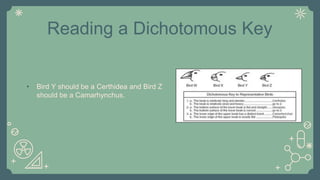
• That is it! Now we do it for the rest of the
birds. Let’s identify bird x together.
• We start by reading couplet number 1. It
has a stout and heavy beak so we go to
2. It has a lower beak that is curved so
we go to 3. The lower edge of the upper
beak is mostly flat so it is a Platyspiza.
• You try! On your own, try to identify bird
y and bird z. Go to the next slide to find
out the answer.
Reading a Dichotomous Key
• Bird Y should be a Certhidea and Bird Z
should be a Camarhynchus.
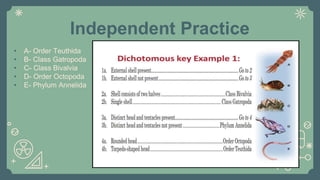
Independent Practice
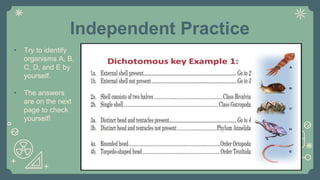
• Try to identify
organisms A, B,
C, D, and E by
yourself.
• The answers
are on the next
page to check
yourself!
Independent Practice
• A- Order Teuthida
• B- Class Gatropoda
• C- Class Bivalvia
• D- Order Octopoda
• E- Phylum Annelida
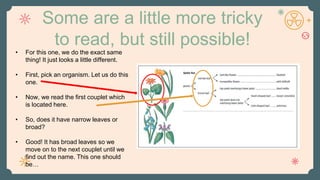
Some are a little more tricky
to read, but still possible!
• For this one, we do the exact same
thing! It just looks a little different.
• First, pick an organism. Let us do this
one.
• Now, we read the first couplet which
is located here.
• So, does it have narrow leaves or
broad?
• Good! It has broad leaves so we
move on to the next couplet until we
find out the name. This one should
be…
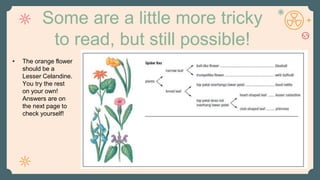
Some are a little more tricky
to read, but still possible!
• The orange flower
should be a
Lesser Celandine.
You try the rest
on your own!
Answers are on
the next page to
check yourself!
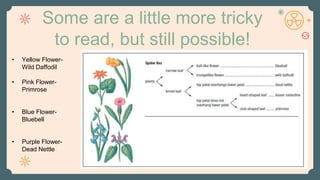
Some are a little more tricky
to read, but still possible!
• Yellow Flower-
Wild Daffodil
• Pink Flower-
Primrose
• Blue Flower-
Bluebell
• Purple Flower-
Dead Nettle
Important things to remember!
• ALWAYS start with the first couplet then go from there.
• A couplet must be two statements that are not the same such as
• has 4 legs vs. has 2 legs
• Has broad leaves vs. has skinny leaves
• Read BOTH statements in a couplet before picking one.
• Do a quick double check at the end to make sure you did not miss anything!
Dichotomous keys lesson

Dichotomous keys lesson

  • 1.
  • 2.
  • 3.
    Ever seen anorganism and want to know what it is? Then this unit is for you! Dichotomous Keys are used to identify unknown organisms.
  • 4.
    Here are someimages of what a dichotomous key might look like. Do not get overwhelmed! You will be able to read these in no time.
  • 5.
    Let us takea closer look at one.Pretend you are at a zoo or on a safari hunt in Africa. You see a bunch of different birds, but do not know what they are called. A tour guide gave you a dichotomous key in order to identify the different types of birds. We have four unknown birds labeled “W, X, Y, and Z.” Your job is to tell me their scientific name by reading the dichotomous key. Let’s get started…
  • 6.
    Reading a DichotomousKey• The first thing you do to read a dichotomous key is start by looking at the first organism. We are going to be trying to identify what the name of bird w is. • The next thing we do is read the FIRST pair (couplet) of statements. Read both!!! • Once you read them, you decide which statement is accurate for the organism you are looking at. • So, does bird W have a long and slender beak or a stout and heavy beak?
  • 7.
    • After studyingthe picture, we should determine that bird W has a stout and heavy beak. We then look at what it says to do. • It tells us to go to number two. Now, we read the couplet under number 2 (circled in teal). Determine which statement is accurate for bird W. • We should come to the conclusion that the bottom of the lower beak is flat and straight so it is a Geospiza! Reading a Dichotomous Key
  • 8.
    Reading a DichotomousKey • That is it! Now we do it for the rest of the birds. Let’s identify bird x together. • We start by reading couplet number 1. It has a stout and heavy beak so we go to 2. It has a lower beak that is curved so we go to 3. The lower edge of the upper beak is mostly flat so it is a Platyspiza. • You try! On your own, try to identify bird y and bird z. Go to the next slide to find out the answer.
  • 9.
    Reading a DichotomousKey • Bird Y should be a Certhidea and Bird Z should be a Camarhynchus.
  • 10.
    Independent Practice • Tryto identify organisms A, B, C, D, and E by yourself. • The answers are on the next page to check yourself!
  • 11.
    Independent Practice • A-Order Teuthida • B- Class Gatropoda • C- Class Bivalvia • D- Order Octopoda • E- Phylum Annelida
  • 12.
    Some are alittle more tricky to read, but still possible! • For this one, we do the exact same thing! It just looks a little different. • First, pick an organism. Let us do this one. • Now, we read the first couplet which is located here. • So, does it have narrow leaves or broad? • Good! It has broad leaves so we move on to the next couplet until we find out the name. This one should be…
  • 13.
    Some are alittle more tricky to read, but still possible! • The orange flower should be a Lesser Celandine. You try the rest on your own! Answers are on the next page to check yourself!
  • 14.
    Some are alittle more tricky to read, but still possible! • Yellow Flower- Wild Daffodil • Pink Flower- Primrose • Blue Flower- Bluebell • Purple Flower- Dead Nettle
  • 15.
    Important things toremember! • ALWAYS start with the first couplet then go from there. • A couplet must be two statements that are not the same such as • has 4 legs vs. has 2 legs • Has broad leaves vs. has skinny leaves • Read BOTH statements in a couplet before picking one. • Do a quick double check at the end to make sure you did not miss anything!