GLO ARBY ARGUELLES, DMD
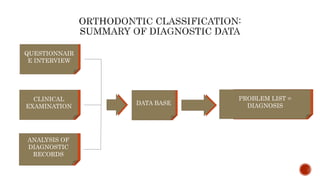
QUESTIONNAIR
E INTERVIEW
CLINICAL
EXAMINATION
ANALYSIS OF
DIAGNOSTIC
RECORDS
DATA BASE
PROBLEM LIST =
DIAGNOSIS
QUESTIONNAIR
E INTERVIEW
CLINICAL
EXAMINATION
ANALYSIS OF
DIAGNOSTIC
RECORDS
DATA BASE
PROBLEM LIST =
DIAGNOSIS
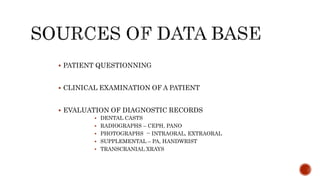
 PATIENT QUESTIONNING
 CLINICAL EXAMINATION OF A PATIENT
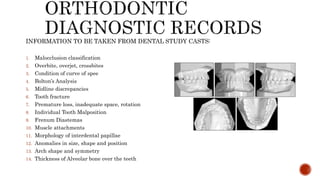
 EVALUATION OF DIAGNOSTIC RECORDS
 DENTAL CASTS
 RADIOGRAPHS – CEPH, PANO
 PHOTOGRAPHS -- INTRAORAL, EXTRAORAL
 SUPPLEMENTAL – PA, HANDWRIST
 TRANSCRANIAL XRAYS
1. CHIEF COMPLAINT
“Tell me what bothers you about your teeth”.
a. Impaired dentofacial esthetics leading to psychosocial problems.
2. MEDICAL AND DENTAL HISTORY
a. Facial asymmetry due to trauma
b. Condylar fractures
c. Controlled Diabetes – periodontal breakdown
d. Arthritis – high doses of Prostaglandin inhibitors may impede orthodontic movement
e. Rheumatic Fever or Cardiac Anomalies – antibiotic coverage
f. Any manipulation that would cause gingival bleeding
g. Rheumatoid Arthritis –
avoid functional appliances, elastics, TMJ manipulation and mandibular
advancement
3. PHYSICAL GROWTH EVALUATION
a. Rapid growth during adolescent growth spurt facilities tooth movement.
b. Significant growth modification
- may not be possible in a child who is beyond the peak of growth spurt.
c. Normal youths approaching puberty
4. SOCIAL AND BEHAVIORAL EVALUATION
Patients motivation for treatment.
 Internal
 External
GOALS:
To document and evaluate facial, occlusal and functional characteristics
To decide which diagnostic records are required
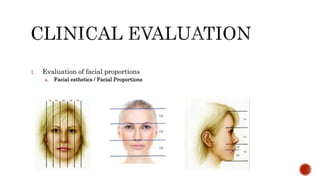
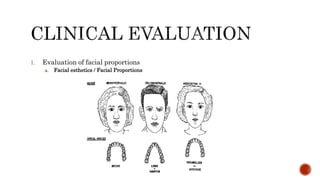
1. Evaluation of facial proportions
a. Facial esthetics / Facial Proportions
1. Evaluation of facial proportions
a. Facial esthetics / Facial Proportions
1. Evaluation of facial proportions
a. Facial esthetics / Facial Proportions
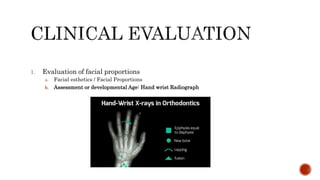
b. Assessment or developmental Age: Hand wrist Radiograph
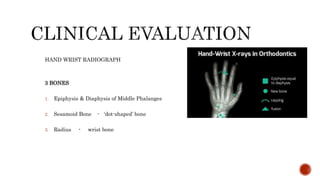
HAND WRIST RADIOGRAPH
3 BONES
1. Epiphysis & Diaphysis of Middle Phalanges
2. Sesamoid Bone - ‘dot-shaped’ bone
3. Radius - wrist bone
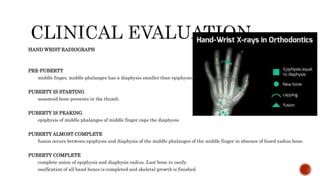
HAND WRIST RADIOGRAPH
PRE-PUBERTY
middle finger, middle phalanges has a diaphysis smaller than epiphysis.
PUBERTY IS STARTING
sesamoid bone presents in the thumb.
PUBERTY IS PEAKING
epiphysis of middle phalanges of middle finger caps the diaphysis
PUBERTY ALMOST COMPLETE
fusion occurs between epiphysis and diaphysis of the middle phalanges of the middle finger in absence of fused radius bone.
PUBERTY COMPLETE
complete union of epiphysis and diaphysis radius. Last bone to ossify.
ossification of all hand bones is completed and skeletal growth is finished.
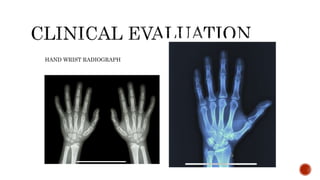
HAND WRIST RADIOGRAPH
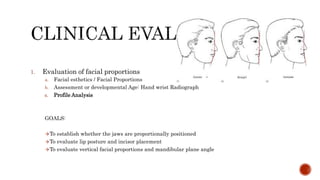
1. Evaluation of facial proportions
a. Facial esthetics / Facial Proportions
b. Assessment or developmental Age: Hand wrist Radiograph
c. Profile Analysis
GOALS:
To establish whether the jaws are proportionally positioned
To evaluate lip posture and incisor placement
To evaluate vertical facial proportions and mandibular plane angle
1. Evaluation of facial proportions
a. Facial esthetics / Facial Proportions
b. Assessment or developmental Age: Handwrist Radiograph
c. Profile Analysis
2. Evaluation of Oral Health
3. Evaluation of Jaw and Occlusal Function
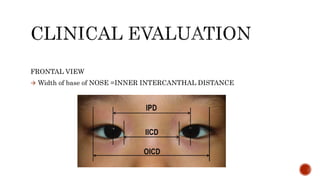
FRONTAL VIEW
 Width of base of NOSE =INNER INTERCANTHAL DISTANCE
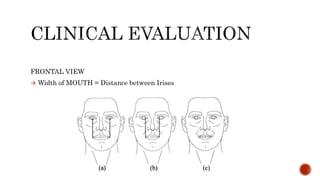
FRONTAL VIEW
 Width of MOUTH = Distance between Irises
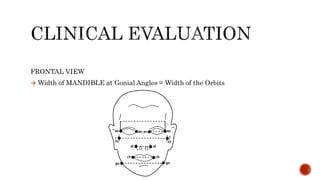
FRONTAL VIEW
 Width of MANDIBLE at Gonial Angles = Width of the Orbits
TWO PURPOSES:
1. To document the starting point for orthodontic treatment.
2. To add the information gathered from the interview and clinical examination.
3 MAJOR CATEGORIES:
1. Records for the evaluation of teeth and oral structures
2. Records for the evaluation of occlusion
3. Records for evaluation of facial and jaw proportions
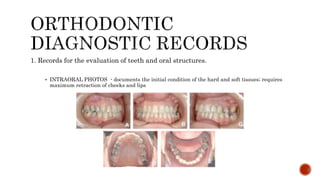
1. Records for the evaluation of teeth and oral structures.
 INTRAORAL PHOTOS - documents the initial condition of the hard and soft tissues; requires
maximum retraction of cheeks and lips
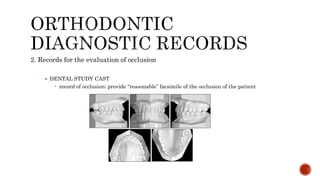
2. Records for the evaluation of occlusion
 DENTAL STUDY CAST
- record of occlusion; provide “reasonable” facsimile of the occlusion of the patient
INFORMATION TO BE TAKEN FROM DENTAL STUDY CASTS:
1. Malocclusion classification
2. Overbite, overjet, crossbites
3. Condition of curve of spee
4. Bolton’s Analysis
5. Midline discrepancies
6. Tooth fracture
7. Premature loss, inadequate space, rotation
8. Individual Tooth Malposition
9. Frenum Diastemas
10. Muscle attachments
11. Morphology of interdental papillae
12. Anomalies in size, shape and position
13. Arch shape and symmetry
14. Thickness of Alveolar bone over the teeth
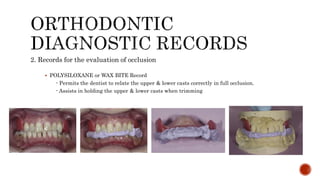
2. Records for the evaluation of occlusion
 POLYSILOXANE or WAX BITE Record
- Permits the dentist to relate the upper & lower casts correctly in full occlusion.
- Assists in holding the upper & lower casts when trimming
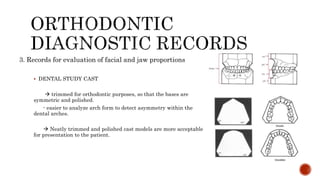
3. Records for evaluation of facial and jaw proportions
 DENTAL STUDY CAST
 trimmed for orthodontic purposes, so that the bases are
symmetric and polished.
- easier to analyze arch form to detect asymmetry within the
dental arches.
 Neatly trimmed and polished cast models are more acceptable
for presentation to the patient.
1. Can measure more easily.
2. Objectivity is greater.
3. Drifting can be appreciated better.
4. Tipping can be observed better.
5. Over- eruption can be seen more clearly.
6. Under eruption can be seen more clearly.
7. Abnormal curve of spee is appreciated better.
8. Prematurities seen more clearly.
9. Palatal breadth, depth and figuration are observed better.

Diagnostic records

  • 1.
  • 2.
    QUESTIONNAIR E INTERVIEW CLINICAL EXAMINATION ANALYSIS OF DIAGNOSTIC RECORDS DATABASE PROBLEM LIST = DIAGNOSIS QUESTIONNAIR E INTERVIEW CLINICAL EXAMINATION ANALYSIS OF DIAGNOSTIC RECORDS DATA BASE PROBLEM LIST = DIAGNOSIS
  • 3.
     PATIENT QUESTIONNING CLINICAL EXAMINATION OF A PATIENT  EVALUATION OF DIAGNOSTIC RECORDS  DENTAL CASTS  RADIOGRAPHS – CEPH, PANO  PHOTOGRAPHS -- INTRAORAL, EXTRAORAL  SUPPLEMENTAL – PA, HANDWRIST  TRANSCRANIAL XRAYS
  • 4.
    1. CHIEF COMPLAINT “Tellme what bothers you about your teeth”. a. Impaired dentofacial esthetics leading to psychosocial problems.
  • 5.
    2. MEDICAL ANDDENTAL HISTORY a. Facial asymmetry due to trauma b. Condylar fractures c. Controlled Diabetes – periodontal breakdown d. Arthritis – high doses of Prostaglandin inhibitors may impede orthodontic movement e. Rheumatic Fever or Cardiac Anomalies – antibiotic coverage f. Any manipulation that would cause gingival bleeding g. Rheumatoid Arthritis – avoid functional appliances, elastics, TMJ manipulation and mandibular advancement
  • 6.
    3. PHYSICAL GROWTHEVALUATION a. Rapid growth during adolescent growth spurt facilities tooth movement. b. Significant growth modification - may not be possible in a child who is beyond the peak of growth spurt. c. Normal youths approaching puberty
  • 7.
    4. SOCIAL ANDBEHAVIORAL EVALUATION Patients motivation for treatment.  Internal  External
  • 8.
    GOALS: To document andevaluate facial, occlusal and functional characteristics To decide which diagnostic records are required
  • 9.
    1. Evaluation offacial proportions a. Facial esthetics / Facial Proportions
  • 10.
    1. Evaluation offacial proportions a. Facial esthetics / Facial Proportions
  • 11.
    1. Evaluation offacial proportions a. Facial esthetics / Facial Proportions b. Assessment or developmental Age: Hand wrist Radiograph
  • 12.
    HAND WRIST RADIOGRAPH 3BONES 1. Epiphysis & Diaphysis of Middle Phalanges 2. Sesamoid Bone - ‘dot-shaped’ bone 3. Radius - wrist bone
  • 13.
    HAND WRIST RADIOGRAPH PRE-PUBERTY middlefinger, middle phalanges has a diaphysis smaller than epiphysis. PUBERTY IS STARTING sesamoid bone presents in the thumb. PUBERTY IS PEAKING epiphysis of middle phalanges of middle finger caps the diaphysis PUBERTY ALMOST COMPLETE fusion occurs between epiphysis and diaphysis of the middle phalanges of the middle finger in absence of fused radius bone. PUBERTY COMPLETE complete union of epiphysis and diaphysis radius. Last bone to ossify. ossification of all hand bones is completed and skeletal growth is finished.
  • 14.
  • 15.
    1. Evaluation offacial proportions a. Facial esthetics / Facial Proportions b. Assessment or developmental Age: Hand wrist Radiograph c. Profile Analysis GOALS: To establish whether the jaws are proportionally positioned To evaluate lip posture and incisor placement To evaluate vertical facial proportions and mandibular plane angle
  • 16.
    1. Evaluation offacial proportions a. Facial esthetics / Facial Proportions b. Assessment or developmental Age: Handwrist Radiograph c. Profile Analysis 2. Evaluation of Oral Health 3. Evaluation of Jaw and Occlusal Function
  • 17.
    FRONTAL VIEW  Widthof base of NOSE =INNER INTERCANTHAL DISTANCE
  • 18.
    FRONTAL VIEW  Widthof MOUTH = Distance between Irises
  • 19.
    FRONTAL VIEW  Widthof MANDIBLE at Gonial Angles = Width of the Orbits
  • 20.
    TWO PURPOSES: 1. Todocument the starting point for orthodontic treatment. 2. To add the information gathered from the interview and clinical examination.
  • 21.
    3 MAJOR CATEGORIES: 1.Records for the evaluation of teeth and oral structures 2. Records for the evaluation of occlusion 3. Records for evaluation of facial and jaw proportions
  • 22.
    1. Records forthe evaluation of teeth and oral structures.  INTRAORAL PHOTOS - documents the initial condition of the hard and soft tissues; requires maximum retraction of cheeks and lips
  • 23.
    2. Records forthe evaluation of occlusion  DENTAL STUDY CAST - record of occlusion; provide “reasonable” facsimile of the occlusion of the patient
  • 24.
    INFORMATION TO BETAKEN FROM DENTAL STUDY CASTS: 1. Malocclusion classification 2. Overbite, overjet, crossbites 3. Condition of curve of spee 4. Bolton’s Analysis 5. Midline discrepancies 6. Tooth fracture 7. Premature loss, inadequate space, rotation 8. Individual Tooth Malposition 9. Frenum Diastemas 10. Muscle attachments 11. Morphology of interdental papillae 12. Anomalies in size, shape and position 13. Arch shape and symmetry 14. Thickness of Alveolar bone over the teeth
  • 25.
    2. Records forthe evaluation of occlusion  POLYSILOXANE or WAX BITE Record - Permits the dentist to relate the upper & lower casts correctly in full occlusion. - Assists in holding the upper & lower casts when trimming
  • 26.
    3. Records forevaluation of facial and jaw proportions  DENTAL STUDY CAST  trimmed for orthodontic purposes, so that the bases are symmetric and polished. - easier to analyze arch form to detect asymmetry within the dental arches.  Neatly trimmed and polished cast models are more acceptable for presentation to the patient.
  • 27.
    1. Can measuremore easily. 2. Objectivity is greater. 3. Drifting can be appreciated better. 4. Tipping can be observed better. 5. Over- eruption can be seen more clearly. 6. Under eruption can be seen more clearly. 7. Abnormal curve of spee is appreciated better. 8. Prematurities seen more clearly. 9. Palatal breadth, depth and figuration are observed better.