DIABETIC
RETINOPATHY
O P H T H A L M O LO G Y D E PA R T M E N T
H O S P I TA L S E G A M AT
OBJECTIVES
• Differentiate clinical stage/grading of Diabetic
Retinopathy
• Criteria for referral
• Discuss regarding management approach:
–Proper examination schedule in DR patient
–Treatment modalities
Number of people with diabetes worldwide in 2017&2045 (20-79 years)
International Diabetes Federation; Diabetes Atlas - 8th Edition,
PREVALANCE OF DIABETES MELLITUS IN MALAYSIA
NATIONAL HEALTH & MORBIDITY SURVEY 2015
Highest:
Kedah:~25%
Perlis~20.6%
Johor ~19.8%
Lowest:
Sabah and WP
Labuan~14.2%
Sarawak~14.8%
DIABETES MELLITUS
• Highest among Indians (22.1%) followed by Malay(14.6%)
and Chinese (12.0%) (NHMS 2015)
• WHO estimates that in year 2030, Malaysia would have
2.48 million people with DM (NHMS 2015)
Prevalance of Diabetes Mellitus
Ethnic Groups
National Health & Morbidity Survey 2015
H O W D O W E C O M P A R E T O O U R N E I G H B O U R I N G C O U N T R I E S ?
DIABETIC RETINOPATHY
INTRODUCTION
• All DM patients are at risk of developing DR- prevalence
of DR worldwide ranges from 6.8 to 44.4% in patients
with diabetes mellitus
– the commonest cause of blindness and visual
disability in adults
DIABETIC RETINOPATHY
DEFINITION
Is a chronic progressive sight-threatening disease of
retinal microvasculature associated with prolonged
hyperglycemia.
RISK FACTORS
RISK
FACTOR
Obesity /
inactive
lifestyle
Duration of DM –
the longer
duration, higher
risk
Other medical
illnesses - HPT,
CKD, CVA, CVD,
hyperlipidemia,
anemia
Pregnancy
Smoking
Poor control of
DM - HbA1c/FBS
SIGNS AND SYMPTOMS
• Early stage – ASYMPTOMATIC
• ‘Floaters’- black spots / web-like spots in the visual
field
• Metamorphopsia (distortion of straight lines)
• Gradual or sudden blurring of vision
PATHOGENESIS OF DR
PATHOGENESIS OF DR
MICROVASCULAR LEAKAGE
Decompensation of endothelial blood
barrier function leads to leakage :
edema and exudates
NORMAL FUNDUS
FEATURES OF DIABETIC RETINOPATHY
SOURCE: WILKINSON CP, FERRIS FL III, KLEIN RE, ET AL . PROPOSED I NTERNATIONAL CLINICAL DIABETIC
RETINOPATHY AND DIABETIC MACUL AR EDEMA DISEASE SEVERIT Y SCALES. OPHTHALMOLOGY 2003;
110:1679-80
Diabetic Retinopathy Grading
MILD NPDR
• Microaneurysms only
MODERATE NPDR
• More than just microaneurysms but
less than severe NPDR
SEVERE NPDR
1. More than 20 intraretinal
hemorrhages in each of 4 quadrants
2. Definite venous beading in 2 or more
quadrants
3. Prominent Intraretinal Microvascular
Abnormalities (IRMA) in 1 or more
quadrants AND no signs of
proliferative retinopathy
PROLIFERATIVE DR
PDR with vireous Hemorrhage PDR with pre-retinal hemorrahge
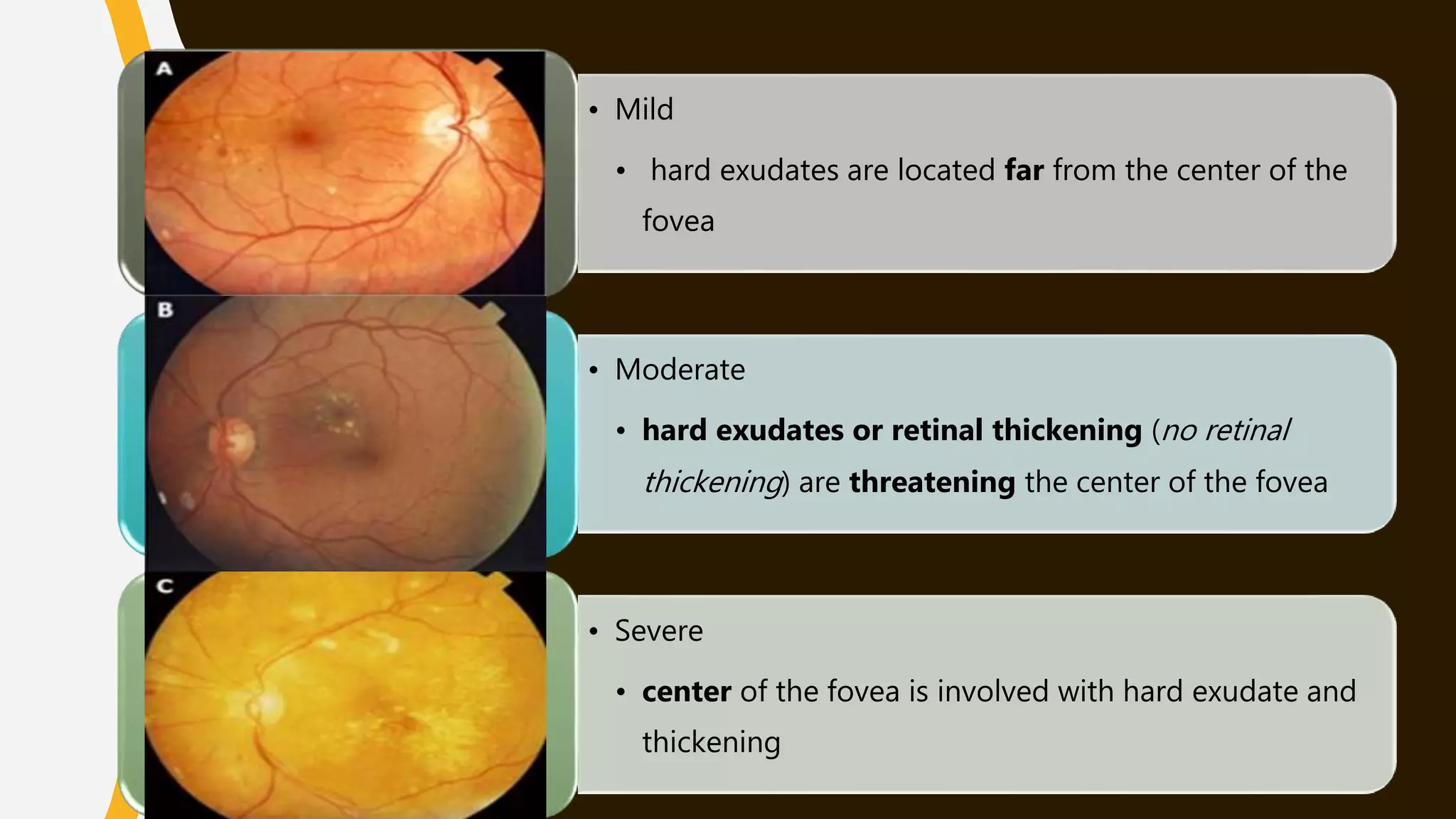
• Mild
• hard exudates are located far from the center of the
fovea
• Moderate
• hard exudates or retinal thickening (no retinal
thickening) are threatening the center of the fovea
• Severe
• center of the fovea is involved with hard exudate and
thickening
EXAMINATION SCEDULE
Timing of first schedule
Recommendation: First for diabetic retinopathy (DR) should be done at:
ALGORITHM FOR SCREENING
WHEN TO REFER???
•Criteria for referral:
–Any level of diabetic maculopathy
–Severe NPDR
–Any PDR
–Unexplained visual loss
–If screening cannot be performed including ungradable
fundus photo
RECOMMENDED FOLLOW UP
SCHEDULE
CRITERIA FOR URGENT REFERRAL
URGENCY OF REFERRAL OCULAR FEATURES
Emergency (same day referral) • Sudden severe visual loss
• Symptoms or signs of acute retinal
detachment
Within 1 week • Presence of retinal new vessels
• Preretinal haemorrhages
• Vitreous haemorrhage
• Rubeosis iridis
Within 4 weeks • Unexplained drop in visual acuity
• Any form of maculopathy
• Severe NPDR
• Worsening retinopathy
TREATMENT FOR DIABETIC
RETINOPATHY
STAGE OF DR MODE OF TREATMENT
DME • Laser - focal/ grid
• Intraocular steroids
• Intraocular anti-vascular endothelial growth
factor (anti-VEGF)
Severe NPDR • No treatment, gm control
• Laser - scattered pan-retinal photocoagulation
(PRP)
PDR • Laser - PRP
ADED • Intraocular steroids
• Intraocular anti-vascular endothelial growth
factor (anti- VEGF)
• Vitrectomy
REFERENCE
• International Diabetes Federation; Diabetes Atlas - 8th Edition, 2017
• CPG Guideline Screening of Diabetic Retinopathy, 2011
• National Health & Morbidity Survey 2015
Diabetic retinopathy

Diabetic retinopathy

  • 1.
    DIABETIC RETINOPATHY O P HT H A L M O LO G Y D E PA R T M E N T H O S P I TA L S E G A M AT
  • 2.
    OBJECTIVES • Differentiate clinicalstage/grading of Diabetic Retinopathy • Criteria for referral • Discuss regarding management approach: –Proper examination schedule in DR patient –Treatment modalities
  • 3.
    Number of peoplewith diabetes worldwide in 2017&2045 (20-79 years) International Diabetes Federation; Diabetes Atlas - 8th Edition,
  • 4.
    PREVALANCE OF DIABETESMELLITUS IN MALAYSIA NATIONAL HEALTH & MORBIDITY SURVEY 2015 Highest: Kedah:~25% Perlis~20.6% Johor ~19.8% Lowest: Sabah and WP Labuan~14.2% Sarawak~14.8%
  • 5.
    DIABETES MELLITUS • Highestamong Indians (22.1%) followed by Malay(14.6%) and Chinese (12.0%) (NHMS 2015) • WHO estimates that in year 2030, Malaysia would have 2.48 million people with DM (NHMS 2015) Prevalance of Diabetes Mellitus Ethnic Groups National Health & Morbidity Survey 2015
  • 8.
    H O WD O W E C O M P A R E T O O U R N E I G H B O U R I N G C O U N T R I E S ?
  • 9.
    DIABETIC RETINOPATHY INTRODUCTION • AllDM patients are at risk of developing DR- prevalence of DR worldwide ranges from 6.8 to 44.4% in patients with diabetes mellitus – the commonest cause of blindness and visual disability in adults
  • 10.
    DIABETIC RETINOPATHY DEFINITION Is achronic progressive sight-threatening disease of retinal microvasculature associated with prolonged hyperglycemia.
  • 11.
    RISK FACTORS RISK FACTOR Obesity / inactive lifestyle Durationof DM – the longer duration, higher risk Other medical illnesses - HPT, CKD, CVA, CVD, hyperlipidemia, anemia Pregnancy Smoking Poor control of DM - HbA1c/FBS
  • 12.
    SIGNS AND SYMPTOMS •Early stage – ASYMPTOMATIC • ‘Floaters’- black spots / web-like spots in the visual field • Metamorphopsia (distortion of straight lines) • Gradual or sudden blurring of vision
  • 13.
  • 14.
  • 16.
    MICROVASCULAR LEAKAGE Decompensation ofendothelial blood barrier function leads to leakage : edema and exudates
  • 17.
  • 18.
  • 20.
    SOURCE: WILKINSON CP,FERRIS FL III, KLEIN RE, ET AL . PROPOSED I NTERNATIONAL CLINICAL DIABETIC RETINOPATHY AND DIABETIC MACUL AR EDEMA DISEASE SEVERIT Y SCALES. OPHTHALMOLOGY 2003; 110:1679-80 Diabetic Retinopathy Grading
  • 21.
  • 22.
    MODERATE NPDR • Morethan just microaneurysms but less than severe NPDR
  • 23.
    SEVERE NPDR 1. Morethan 20 intraretinal hemorrhages in each of 4 quadrants 2. Definite venous beading in 2 or more quadrants 3. Prominent Intraretinal Microvascular Abnormalities (IRMA) in 1 or more quadrants AND no signs of proliferative retinopathy
  • 24.
  • 25.
    PDR with vireousHemorrhage PDR with pre-retinal hemorrahge
  • 28.
    • Mild • hardexudates are located far from the center of the fovea • Moderate • hard exudates or retinal thickening (no retinal thickening) are threatening the center of the fovea • Severe • center of the fovea is involved with hard exudate and thickening
  • 29.
    EXAMINATION SCEDULE Timing offirst schedule Recommendation: First for diabetic retinopathy (DR) should be done at:
  • 30.
  • 31.
    WHEN TO REFER??? •Criteriafor referral: –Any level of diabetic maculopathy –Severe NPDR –Any PDR –Unexplained visual loss –If screening cannot be performed including ungradable fundus photo
  • 32.
  • 33.
    CRITERIA FOR URGENTREFERRAL URGENCY OF REFERRAL OCULAR FEATURES Emergency (same day referral) • Sudden severe visual loss • Symptoms or signs of acute retinal detachment Within 1 week • Presence of retinal new vessels • Preretinal haemorrhages • Vitreous haemorrhage • Rubeosis iridis Within 4 weeks • Unexplained drop in visual acuity • Any form of maculopathy • Severe NPDR • Worsening retinopathy
  • 34.
    TREATMENT FOR DIABETIC RETINOPATHY STAGEOF DR MODE OF TREATMENT DME • Laser - focal/ grid • Intraocular steroids • Intraocular anti-vascular endothelial growth factor (anti-VEGF) Severe NPDR • No treatment, gm control • Laser - scattered pan-retinal photocoagulation (PRP) PDR • Laser - PRP ADED • Intraocular steroids • Intraocular anti-vascular endothelial growth factor (anti- VEGF) • Vitrectomy
  • 35.
    REFERENCE • International DiabetesFederation; Diabetes Atlas - 8th Edition, 2017 • CPG Guideline Screening of Diabetic Retinopathy, 2011 • National Health & Morbidity Survey 2015