Diabetic ketoacidosis
Dr.Sunil Kumar
Master in emergency Medicine
OBJECTIVE
Introduction
Pathaphysiology
Clinical findingDiagnosis
Treatment
Complication
INTRODUCTION
Diabetic ketoacidosis ( DKA ) is acute,life
threatining complication of diabetes
mellitus.
DKA Occurs in Predominantly in Type 1
DM
10% to 30 % in Newly diagnosed Type 2
DM.
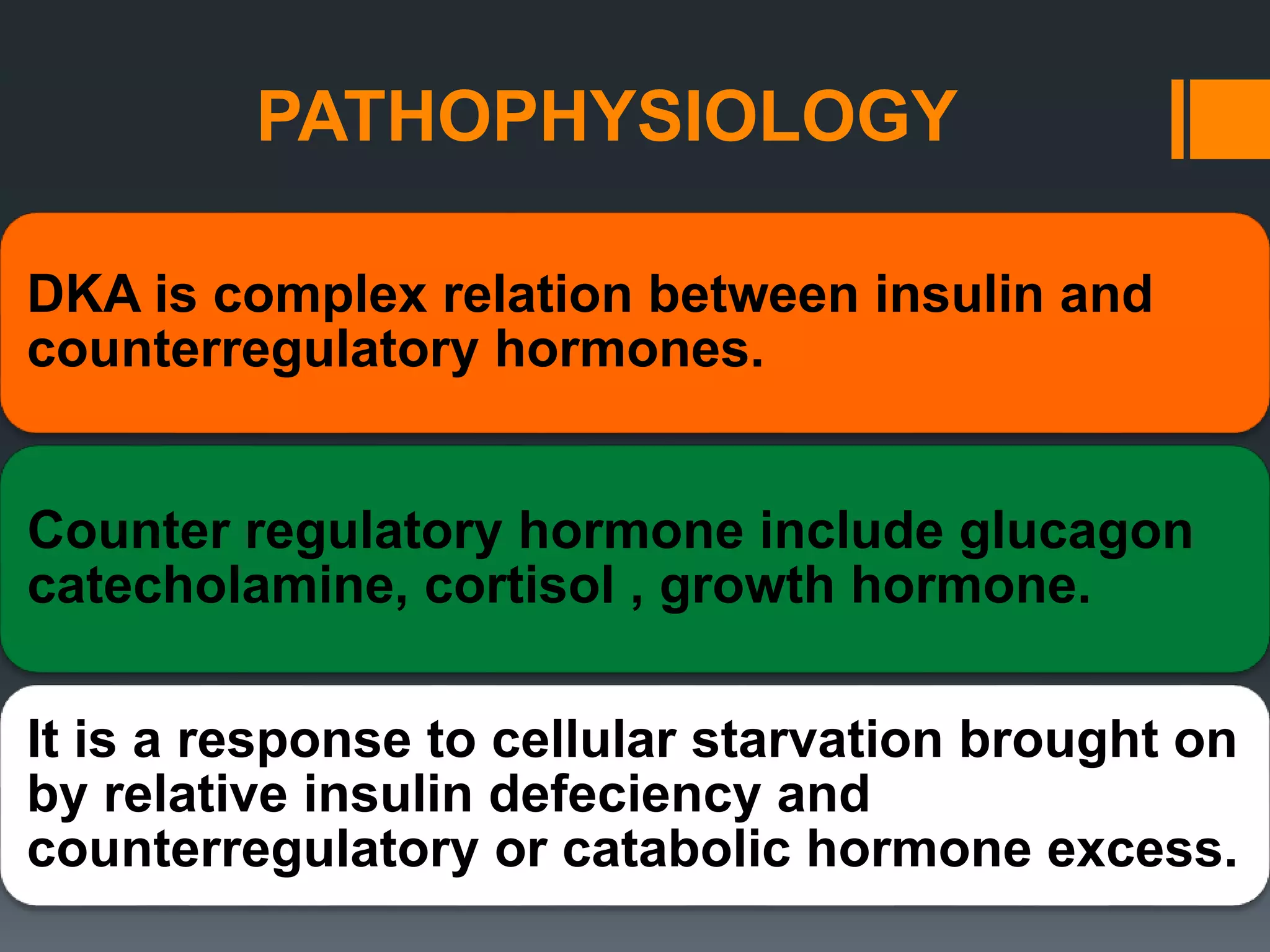
PATHOPHYSIOLOGY
DKA is complex relation between insulin and
counterregulatory hormones.
Counter regulatory hormone include glucagon
catecholamine, cortisol , growth hormone.
It is a response to cellular starvation brought on
by relative insulin defeciency and
counterregulatory or catabolic hormone excess.
INSULIN Glucagon,catachola
mine,cortosol,gorth
hormone
Glucagon,catachol
amine,cortisol,gro
wth hormone
INSULIN
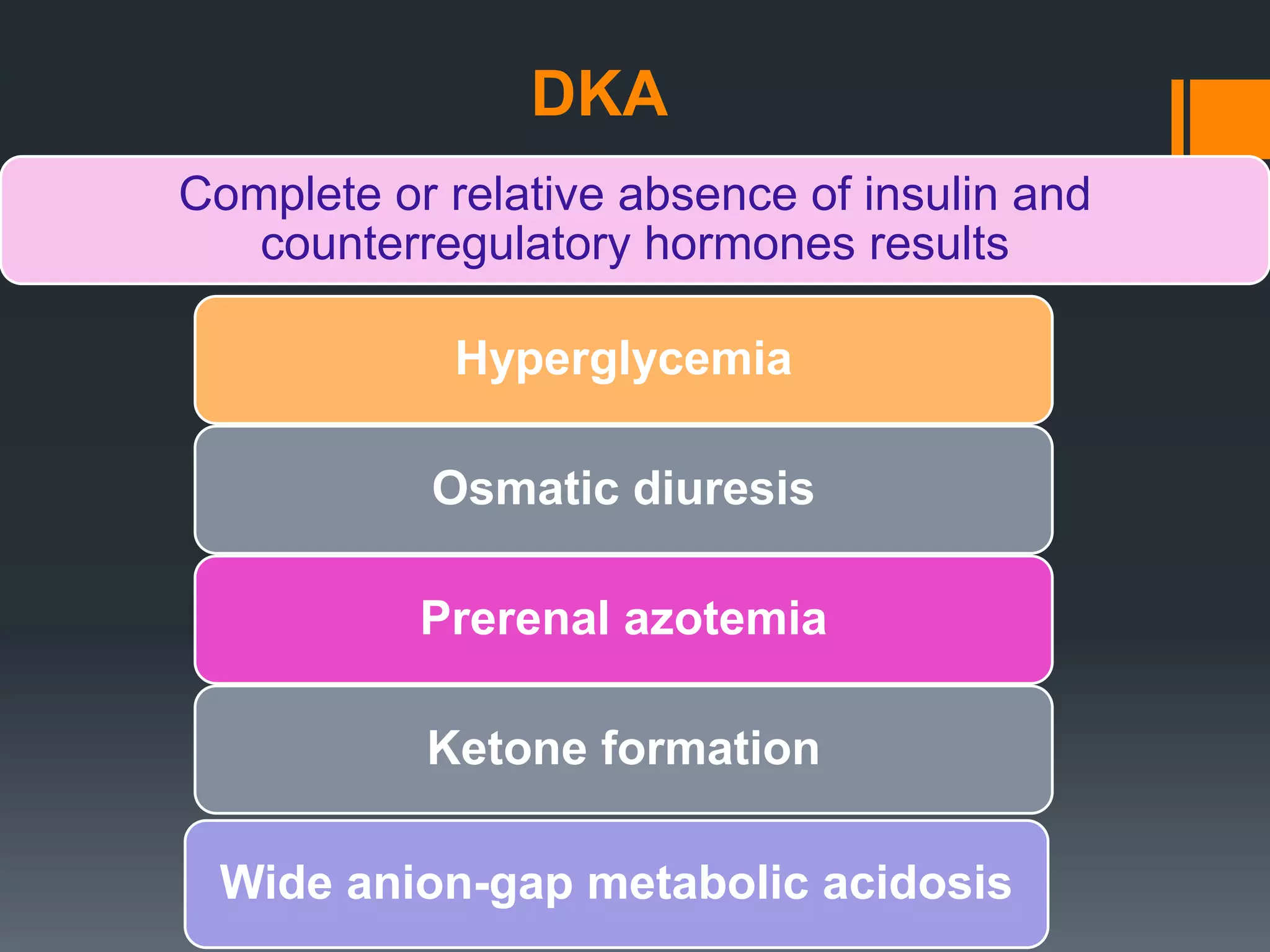
DKA
Complete or relative absence of insulin and
counterregulatory hormones results
Hyperglycemia
Osmatic diuresis
Prerenal azotemia
Ketone formation
Wide anion-gap metabolic acidosis
Pathophysiology
IMPORTANT CAUSES
 Omission or reduced daily insulin injections
 Infection
 Pregnancy
 Hyperthyroidism
 Substance abuse
 Medication-steroids , thiazides , antipsychotics
 Heat related illness
 Cerebrovascular accident
 GI Hemorrhage
 MI
 Pulmonary embolism
 Pancretitis
 Major trauma
 Surgery
CLINICAL FINDING
The clinical manifestations of DKA are
related directly to :-
Hyperglysemia
Volume deplation
Acidosis.
Symptoms of hyperglycemia
POLYURIA MALAISE POLYPHAGIA POLYDIPSIA LETHARGY ,
Volume Depletion
Tachycardia Hypotension
Poor skin
turgor
Dry mucous
membrane
Sunkan eye
ACIDOSIS
NAUSEA VOMITING ABOMINAL
PAIN
ALTERED
MENTAL
STATUS
CONFUSION RESPIRATORY CARDIAC MUSCULAR
Diagnosis
Diagnostic criteria
Blood glucose
level > 250 mg/dl
Anion-gap > 10
mEq / L
Bicarbonate < 15
meq / L
Ph < 7.3
With ketonuria or
ketonemia
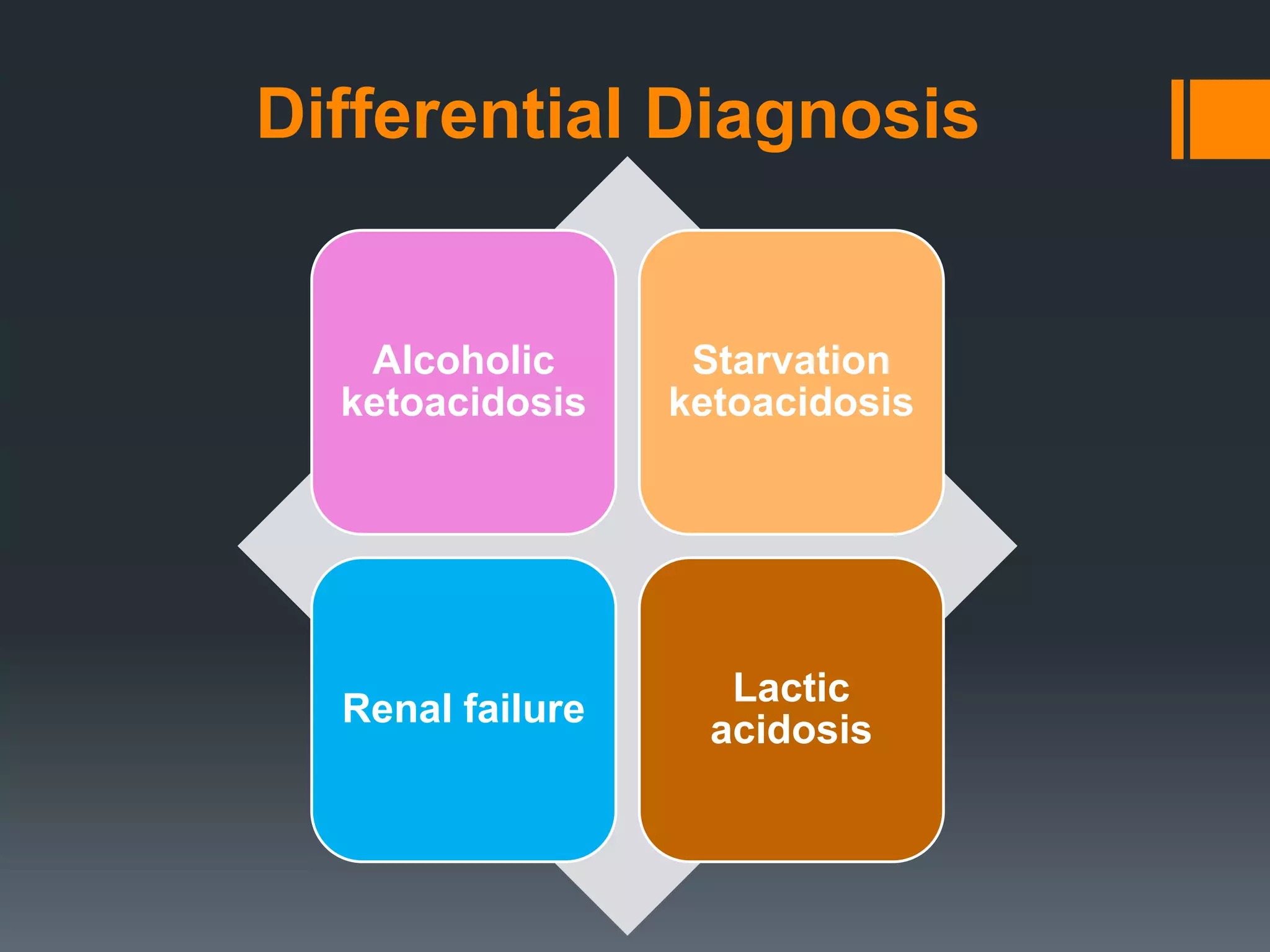
Differential Diagnosis
Alcoholic
ketoacidosis
Starvation
ketoacidosis
Renal failure
Lactic
acidosis
Laboratory Testing
Rapid bedside glucose determination - For hyperglycemia
Urine test strip - For ketone
ECG - For hyperkalemia
CBC - For Hb
Serum electrolytes - For electolytes imbalance
BUN and creatinine – For kidney function
Urine analysis - For osmolarity and ph , infection
Venous blood gas - For acid base disoder
Calculate anion gap - For electolyte imbalance
Blood cultures - For infection managment
ABG - For acid base balance
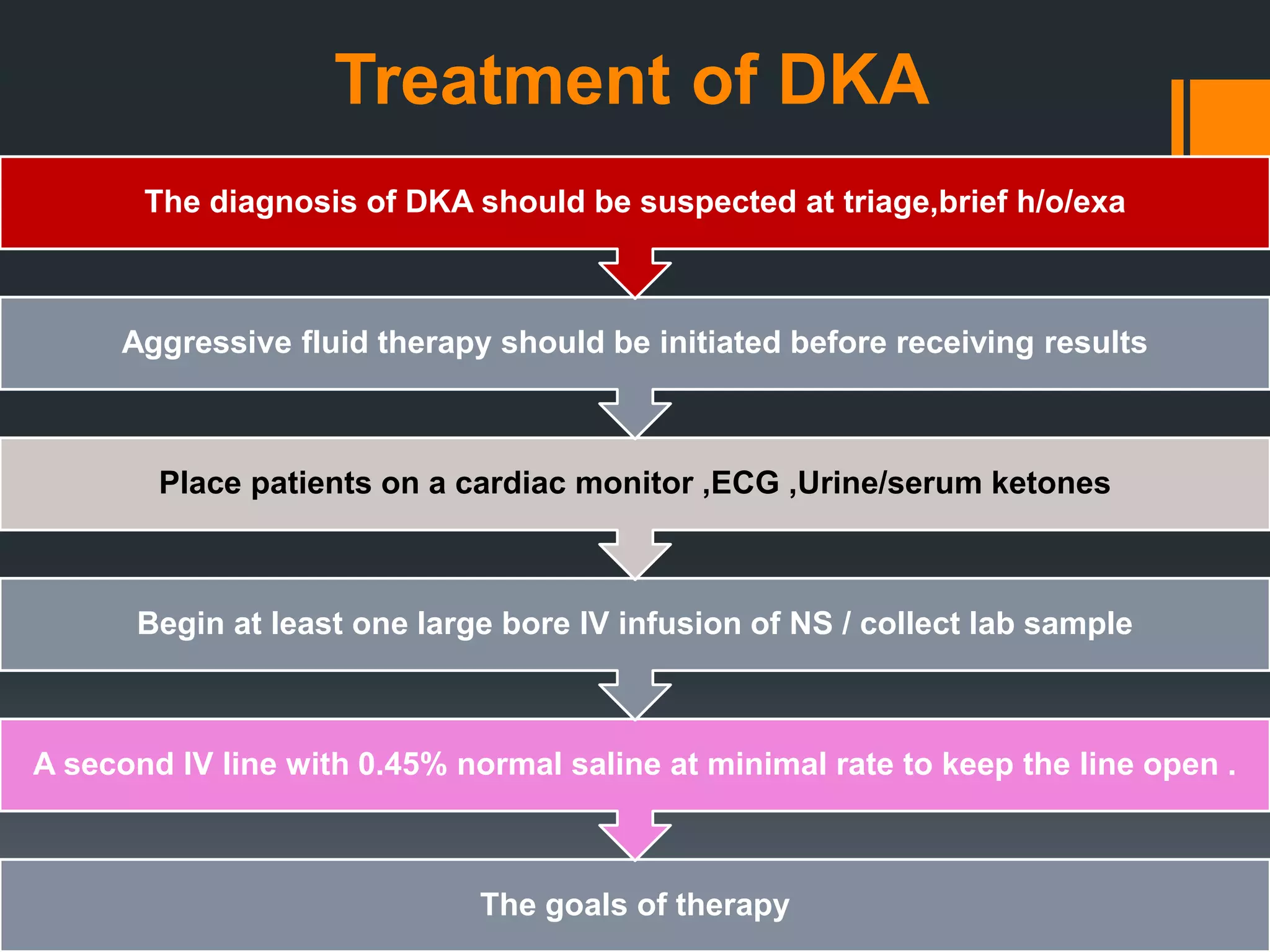
Treatment of DKA
The goals of therapy
A second IV line with 0.45% normal saline at minimal rate to keep the line open .
Begin at least one large bore IV infusion of NS / collect lab sample
Place patients on a cardiac monitor ,ECG ,Urine/serum ketones
Aggressive fluid therapy should be initiated before receiving results
The diagnosis of DKA should be suspected at triage,brief h/o/exa
The goals of therapy
1. Volume replacement
2. Correction of hyperglycemia
3. Correction if electrolyte and
acid-base imbalances
4. Recognition and treatment of
causes
5. Avoidance of complication
In order correction
Volume first
Potassium
correction
Insulin
administration
Time line
management
for DKA in ER
DR.SUNIL KUMAR
0 to 1 hour
Brief history / examination
Monitor , glucose,ECG,Urine/serum
ketones
iv #1 NS 15-20 ml/kg/h for first hour
# 2 0.5 NS to keep vein open
send electrolytes,VBG, blood/urine
culture
Comments
if glucose >
250,urine +
ketones assume
DKA search for
precipitant,
infection
Check ECG for
hyperkalemia ,
infraction
Foly
catheter as
needed
Begin flow
sheet of vital
signs mental
Status , BS
lytes , AG
venous ,Ph,i/o
.
1 hour to 2 hour
If initial [k+] > 5.2 initial IV infusion of
regular insulin at 0.1-0.14 units/kg/hr
if initial [k+] >3.3to <5.2 and urine outout
add 20-30 mEq of k+ to each liter of fluid
and insulin drip as above
if initial [k+]<3.3 hold insulin drip and give
k+ @ 20-30 mEq/h until [k+]>3.3 than
insulin drip as above
Comments
Initial lytes;-check
osmolarity,AG,BS,
corrected
[Na+],potassium
Initial [k+]
determinee further
therapy adequate
urine output is
essential before
initial K+ therapy
Repet glu,lytes AG -
If AG > 25 OR
GLUCOSE >800 OR
Significants
comorbidity
,consider ICU
disposition
2 hours to 3 hours
After NS bolus give 0.45 NS @
25-500ml/h with k+ supplement
as above if hyponatremia
continue NS 250-500 ml
if ph <6.9 may give NaHCO3
Comments
Rate of hydration
depends on
hemodynamics,hy
dration status ,
urine output
If ph > 6.9
do not
require
NaHCO3
Check glu ,
lytes , ABG
,VBG ,mental
status, urine
o/p
3 to 4 hours
Active -- adequate fluid infusion
Goal -- insulin infusion
-maintain [k+] 3.3-5.2
-lower glu by 75 mg/dl/h
-maintain adequate lytes.
When CBG apporaches 200 change iv
D5 NS WITH 20-40 mEq kcl / L and
decrease insulin rate to 0.2-0.05
units/kg/h
Comments
If blood sugar does
not decrease by 10%
after 1 hour insulin
therapy,give 0.14
units/kg bolus then
resume previos rate
If blood sugar
decreased faster
than 50-75 mg/dl/h
,decreased insulin
drip
Check glucose
hourly
4-12 hours to 12-24 hours
maintains serum glu 180-200 and
continue insulin drip for at least 12
hours or until DKA resolves : glu < 200
and AG normal ph > 7.3 and HCO3 >15
Patient able to eat give sc short and
long acting insulin.
Comments
In young and new
onset diabetes avoid
excess free water ,
monitor carefully for
devlopments of
cerebral edema and
have manitol bedside
Recheck lytes , glu ,
AG , repet 4 hourls
Complications-
Refractory acidosis
,cerebral
edema,vascular
thrombosis,ARDS
Related to acute disease Related to therapy
Complication
Loss of
airway
Sepsis
Myocardial
infraction
Hypovolemic
shock
Hypokalemia
Hypophosp
hatemia
Acute
respiratory
distress
syndrome
Cerebral
edema
Hypoglyce
mia
Later complication
Recurrent anion
gap metabolic
acidosis
Non-anion
gap
metabolic
acidosis
Mucormycosis
Vascular
thrombosis
REFERNCES

Diabetic ketoacidosis

  • 1.
  • 2.
  • 3.
    INTRODUCTION Diabetic ketoacidosis (DKA ) is acute,life threatining complication of diabetes mellitus. DKA Occurs in Predominantly in Type 1 DM 10% to 30 % in Newly diagnosed Type 2 DM.
  • 4.
    PATHOPHYSIOLOGY DKA is complexrelation between insulin and counterregulatory hormones. Counter regulatory hormone include glucagon catecholamine, cortisol , growth hormone. It is a response to cellular starvation brought on by relative insulin defeciency and counterregulatory or catabolic hormone excess.
  • 5.
  • 6.
  • 7.
    DKA Complete or relativeabsence of insulin and counterregulatory hormones results Hyperglycemia Osmatic diuresis Prerenal azotemia Ketone formation Wide anion-gap metabolic acidosis
  • 8.
  • 9.
    IMPORTANT CAUSES  Omissionor reduced daily insulin injections  Infection  Pregnancy  Hyperthyroidism  Substance abuse  Medication-steroids , thiazides , antipsychotics  Heat related illness  Cerebrovascular accident  GI Hemorrhage  MI  Pulmonary embolism  Pancretitis  Major trauma  Surgery
  • 10.
    CLINICAL FINDING The clinicalmanifestations of DKA are related directly to :- Hyperglysemia Volume deplation Acidosis.
  • 11.
    Symptoms of hyperglycemia POLYURIAMALAISE POLYPHAGIA POLYDIPSIA LETHARGY ,
  • 12.
    Volume Depletion Tachycardia Hypotension Poorskin turgor Dry mucous membrane Sunkan eye
  • 13.
  • 14.
    Diagnosis Diagnostic criteria Blood glucose level> 250 mg/dl Anion-gap > 10 mEq / L Bicarbonate < 15 meq / L Ph < 7.3 With ketonuria or ketonemia
  • 15.
  • 16.
    Laboratory Testing Rapid bedsideglucose determination - For hyperglycemia Urine test strip - For ketone ECG - For hyperkalemia CBC - For Hb Serum electrolytes - For electolytes imbalance BUN and creatinine – For kidney function Urine analysis - For osmolarity and ph , infection Venous blood gas - For acid base disoder Calculate anion gap - For electolyte imbalance Blood cultures - For infection managment ABG - For acid base balance
  • 17.
    Treatment of DKA Thegoals of therapy A second IV line with 0.45% normal saline at minimal rate to keep the line open . Begin at least one large bore IV infusion of NS / collect lab sample Place patients on a cardiac monitor ,ECG ,Urine/serum ketones Aggressive fluid therapy should be initiated before receiving results The diagnosis of DKA should be suspected at triage,brief h/o/exa
  • 18.
    The goals oftherapy 1. Volume replacement 2. Correction of hyperglycemia 3. Correction if electrolyte and acid-base imbalances 4. Recognition and treatment of causes 5. Avoidance of complication
  • 19.
    In order correction Volumefirst Potassium correction Insulin administration
  • 20.
    Time line management for DKAin ER DR.SUNIL KUMAR
  • 21.
    0 to 1hour Brief history / examination Monitor , glucose,ECG,Urine/serum ketones iv #1 NS 15-20 ml/kg/h for first hour # 2 0.5 NS to keep vein open send electrolytes,VBG, blood/urine culture Comments if glucose > 250,urine + ketones assume DKA search for precipitant, infection Check ECG for hyperkalemia , infraction Foly catheter as needed Begin flow sheet of vital signs mental Status , BS lytes , AG venous ,Ph,i/o .
  • 22.
    1 hour to2 hour If initial [k+] > 5.2 initial IV infusion of regular insulin at 0.1-0.14 units/kg/hr if initial [k+] >3.3to <5.2 and urine outout add 20-30 mEq of k+ to each liter of fluid and insulin drip as above if initial [k+]<3.3 hold insulin drip and give k+ @ 20-30 mEq/h until [k+]>3.3 than insulin drip as above Comments Initial lytes;-check osmolarity,AG,BS, corrected [Na+],potassium Initial [k+] determinee further therapy adequate urine output is essential before initial K+ therapy Repet glu,lytes AG - If AG > 25 OR GLUCOSE >800 OR Significants comorbidity ,consider ICU disposition
  • 23.
    2 hours to3 hours After NS bolus give 0.45 NS @ 25-500ml/h with k+ supplement as above if hyponatremia continue NS 250-500 ml if ph <6.9 may give NaHCO3 Comments Rate of hydration depends on hemodynamics,hy dration status , urine output If ph > 6.9 do not require NaHCO3 Check glu , lytes , ABG ,VBG ,mental status, urine o/p
  • 24.
    3 to 4hours Active -- adequate fluid infusion Goal -- insulin infusion -maintain [k+] 3.3-5.2 -lower glu by 75 mg/dl/h -maintain adequate lytes. When CBG apporaches 200 change iv D5 NS WITH 20-40 mEq kcl / L and decrease insulin rate to 0.2-0.05 units/kg/h Comments If blood sugar does not decrease by 10% after 1 hour insulin therapy,give 0.14 units/kg bolus then resume previos rate If blood sugar decreased faster than 50-75 mg/dl/h ,decreased insulin drip Check glucose hourly
  • 25.
    4-12 hours to12-24 hours maintains serum glu 180-200 and continue insulin drip for at least 12 hours or until DKA resolves : glu < 200 and AG normal ph > 7.3 and HCO3 >15 Patient able to eat give sc short and long acting insulin. Comments In young and new onset diabetes avoid excess free water , monitor carefully for devlopments of cerebral edema and have manitol bedside Recheck lytes , glu , AG , repet 4 hourls Complications- Refractory acidosis ,cerebral edema,vascular thrombosis,ARDS
  • 26.
    Related to acutedisease Related to therapy Complication Loss of airway Sepsis Myocardial infraction Hypovolemic shock Hypokalemia Hypophosp hatemia Acute respiratory distress syndrome Cerebral edema Hypoglyce mia
  • 27.
    Later complication Recurrent anion gapmetabolic acidosis Non-anion gap metabolic acidosis Mucormycosis Vascular thrombosis
  • 28.

Editor's Notes

  • #8 OSMATIC DIAURSIS –increased the urination rate caused by the presence of certain substance in the small tubes of the kidney such as glucose enter in tubules and cannot be reabsorbed. Prerenal azotemia –is the most common cause of renal failure due to lack of blood flow to the each kidney Anion gap – difference b/n cation and anion in the serum , plasma or urine ( na+k)-(cl+hco3) normal
  • #22 Normal saline is the most frequently recommended fluid Fluid helps restore intravascular volume and normal tonicity , perfuse ,vital organ , improve GFR and lower serum glucose and ketone level. Normal saline does not provides “free water to correct intracellular fluid loss but it does prevent the rapid fall in extracellular osmolarity. After initial NS replacement change the fluids to 0.45% NS once the corrected serum Na is normal. Based on clincal finding and before electrilyte results give the iv bolus of isotonic saline -15 to 20 ml / kg / h during first hour.