DIABETIC KETOACIDOSIS
IN ICU
PRESENTED BY:
DR. ZEENAT YASMEEN
ICU RESIDENT
Diabetic Ketoacidosis (DKA)
• A state of absolute or relative insulin deficiency
aggravated and followed by
• hyperglycemia, dehydration, and acidosis-producing
derangements in metabolism, including production
of serum acetone.
• Can occur in both Type I Diabetes and Type II
Diabetes
 In type II diabetics with insulin deficiency/dependence
• It is the presenting symptom for ~ 25% of Type I
Diabetics.
Hyperglycemia
Ketosis
Acidosis
*
Definition of Diabetic Ketoacidosis*
3
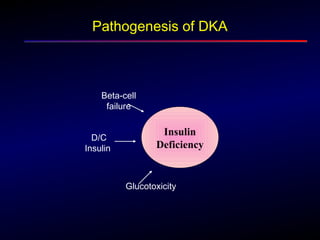
Pathogenesis of DKA
Insulin
Deficiency
Beta-cell
failure
D/C
Insulin
Glucotoxicity
Insulin
deficiency
Increased
glucagon
GH
cortisol
catecholamines
Pathogenesis of DKA
Carbohydrate Metabolism in DKA
Relative or absolute insulin deficiency
glucose output
glycogenolysis
liver
glucose uptake
muscle
Increased Glucose Production in DKA
Gluconeogenesis Glucose
Protein breakdownLipolysis
Glycerol Amino acids
Lactate
TG
Activity of gluconeogenic
enzymes
(PEPCK, PC, PFK)
Increased Production of Ketones in DKA
Lipolysis
FFA Glycerol
Ketogenesis
B-OH-B
Acetoacetate
TG
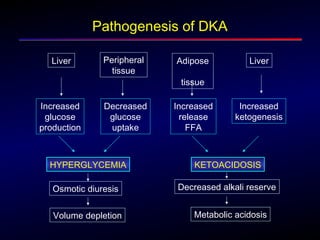
Pathogenesis of DKA
Liver
Increased
glucose
production
Decreased
glucose
uptake
Peripheral
tissue
HYPERGLYCEMIA
Increased
release
FFA
Increased
ketogenesis
Adipose
tissue
Liver
KETOACIDOSIS
Osmotic diuresis
Volume depletion Metabolic acidosis
Decreased alkali reserve
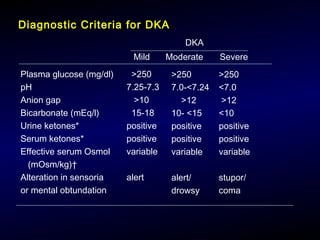
Diagnostic Criteria for DKA
DKA
Mild Moderate Severe
Plasma glucose (mg/dl)
pH
Anion gap
Bicarbonate (mEq/l)
Urine ketones*
Serum ketones*
Effective serum Osmol
(mOsm/kg)†
Alteration in sensoria
or mental obtundation
>250
7.25-7.3
>10
15-18
positive
positive
variable
alert
>250
7.0-<7.24
>12
10- <15
positive
positive
variable
alert/
drowsy
>250
<7.0
>12
<10
positive
positive
variable
stupor/
coma
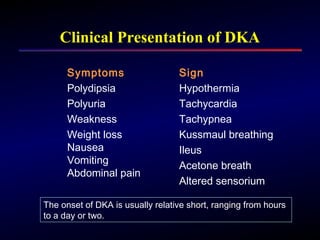
Clinical Presentation of DKA
Sign
Hypothermia
Tachycardia
Tachypnea
Kussmaul breathing
Ileus
Acetone breath
Altered sensorium
Symptoms
Polydipsia
Polyuria
Weakness
Weight loss
Nausea
Vomiting
Abdominal pain
The onset of DKA is usually relative short, ranging from hours
to a day or two.
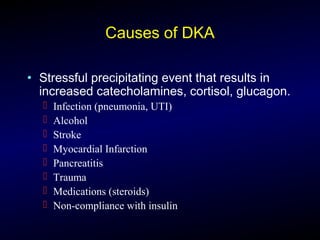
Causes of DKA
• Stressful precipitating event that results in
increased catecholamines, cortisol, glucagon.
 Infection (pneumonia, UTI)
 Alcohol
 Stroke
 Myocardial Infarction
 Pancreatitis
 Trauma
 Medications (steroids)
 Non-compliance with insulin
Initial Clinical Evaluation
• History and physical examination
 Secure patient’s ABC
 Mental status
 Cardiovascular-renal status
 Source of infection
• Evaluation of volume and hydration status
• Laboratory studies
• Immediate determination of blood glucose by finger
stick, and serum ketones (3-BH) by finger stick or
urinary ketones.
• Laboratory studies:
 ABG’s
 CBC with differential
 CMP (glucose, electrolytes, bicarbonate, BUN, creatinine)
 Serum ketones
 Urinalysis
 Bacterial cultures*
 Cardiac enzymes*
Initial Laboratory Studies
* If clinically indicated
Serum Sodium
 Hyponatremia is common in patients with DKA
H2O
H2O
H2O
Serum glucose
Na+
H2O
Correction of Serum sodium:
Corrected Na+
= [Na+
] 1.6 x glucose (mg/dl) – 100
100
Serum Potassium
 Admission serum potassium is frequently elevated (due to a
shift of K-
from the intracellular to the extracellular space)
K+
Osmolality
Acidosis
K+
Insulin
regulates
Activity of
Na+
/K+
pump
Na+
K-
K+
K+
K+
Anion Gap Formula
• Anion gap can be measured as
• AG=[(Na)-(Hco3+CL)]
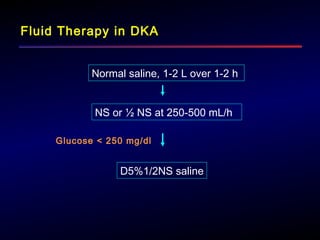
Fluid Therapy in DKA
Normal saline, 1-2 L over 1-2 h
NS or ½ NS at 250-500 mL/h
Glucose < 250 mg/dl
D5%1/2NS saline
Caution during fluid management
• Fluid should be replace over 12-24hr
• patients are generally depleted 3-6lit in DKA.
• Monitor urine output,heart rate,blood
pressure and respiratory status.
• CARE must b taken in patient with CCF and
kidney disease.
Blood Glucose monitoring in DKA
• Check initial blood glucose q1h.Goal
decrease in blood glucose is 50-75mg/dl/hr
• Once stable(3consecutie values decrease in
target range)change blood glucose
monitoringq2h.Resume q1h blood glucose
monitoring for each change in the insulin
infusion rate.
• Add dextrose5% to IV fluid when blood
glucose <250mg/dl.
• For DKA goal blood glucose 150-200mg/dl
until anion gap close.
Intravenous Insulin Therapy in DKA
I.V. Bolus: 0.1 U/kg
I.V. drip: 0.1 U/kg/h
Glucose < 250 mg/dl and
HCO3 > 15 mmol/l, then,
I.V. drip: 0.05 – 0.1 U/kg/h
Until c0rrection of anion gap
CHANGING THE INSULIN
INFUSION RATE
• Decrease IV insulin by 50%if blood glucose
decrease by >100mg/dl/hr in any 1hr period
• Increase insulin drip by 50%/hr if change in
blood glucose is <50mg/dl/hr
• When blood glucose decrease to 250mg/dl
insulin infusion may need to be decrease
50% to maintain glucose at target levels(150-
200mg/dl).
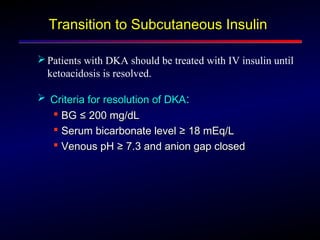
Transition to Subcutaneous Insulin
Patients with DKA should be treated with IV insulin until
ketoacidosis is resolved.
 Criteria for resolution of DKACriteria for resolution of DKA::
 BGBG ≤≤ 200 mg/dL200 mg/dL
 Serum bicarbonate level ≥ 18 mEq/LSerum bicarbonate level ≥ 18 mEq/L
 Venous pH ≥ 7.3 and anion gap closedVenous pH ≥ 7.3 and anion gap closed
WHEN TO STOP IV INSULIN
• Give short acting insulin SC at twice the
hourly IV rate(if iv rate 5u/hr give 10u)
• Failure to give SC insulin may result in
rebound hyperglycemia and ketosis due to its
short acting effect.
• ENSURE pt has a meal and is eating and
awake.
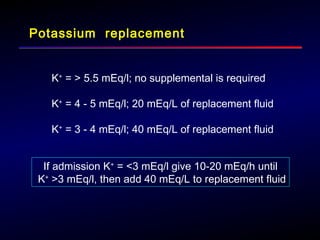
Potassium replacement
K+
= > 5.5 mEq/l; no supplemental is required
K+
= 4 - 5 mEq/l; 20 mEq/L of replacement fluid
K+
= 3 - 4 mEq/l; 40 mEq/L of replacement fluid
If admission K+
= <3 mEq/l give 10-20 mEq/h until
K+
>3 mEq/l, then add 40 mEq/L to replacement fluid
pH > 7.0 → no bicarbonate
pH < 7.0 and bicarbonate < 5 mEq/l → 44.6 mEq
in 500 ml 0.45% saline over 1 h until pH > 7.0
Bicarbonate administration
Complications of DKA
1-Complications of associated illnesses e.g. sepsis
or MI.
2-Adult respiratory distress syndrome.
3-Thromboembolism (elderly).
4-Complications of treatment:
a-Hypokalemia: Which may lead to:
-Cardiac arrhythmias.
-Cardiac arrest.
-Respiratory muscle weakness.
b-Hypoglycemia.
c-Overhydration and acute pulmonary edema: particularly
in:
-Treating children with DKA.
-Adults with compromised renal or cardiac function.
-Elderly with incipient CHF.
d-Neurological complications: Cerebral Edema.
-It occurs mostly in children with DKA.
-Very dangerous and increases mortality.
-The risk is related to the severity, duration and rapid
correction of DKA.
 
Mechanism: The brain adapts by producing intracellular
osmoles (idiogenic osmoles) which stabilize the brain
cells from shrinking while the DKA was developing.
When the hyperosmolarity is rapidly corrected, the brain
becomes hypertonic towards the extracellular fluids →
water flows into the cells → cerebral edema
 Diabetic Ketoacidosis is a common, serious
and expensive complication in patients with
type 1 and type 2 diabetes
 Prevention of metabolic decompensation
through patient education, strict surveillance of
glucose homeostasis and aggressive diabetes
management might reduce the high morbidity
and mortality associated with diabetic
ketoacidosis
Summary
THANK YOU

Dka pathphysiologymanagement2014-copy-140202235658-phpapp02

  • 1.
    DIABETIC KETOACIDOSIS IN ICU PRESENTEDBY: DR. ZEENAT YASMEEN ICU RESIDENT
  • 2.
    Diabetic Ketoacidosis (DKA) •A state of absolute or relative insulin deficiency aggravated and followed by • hyperglycemia, dehydration, and acidosis-producing derangements in metabolism, including production of serum acetone. • Can occur in both Type I Diabetes and Type II Diabetes  In type II diabetics with insulin deficiency/dependence • It is the presenting symptom for ~ 25% of Type I Diabetics.
  • 3.
  • 4.
  • 5.
  • 6.
    Carbohydrate Metabolism inDKA Relative or absolute insulin deficiency glucose output glycogenolysis liver glucose uptake muscle
  • 7.
    Increased Glucose Productionin DKA Gluconeogenesis Glucose Protein breakdownLipolysis Glycerol Amino acids Lactate TG Activity of gluconeogenic enzymes (PEPCK, PC, PFK)
  • 8.
    Increased Production ofKetones in DKA Lipolysis FFA Glycerol Ketogenesis B-OH-B Acetoacetate TG
  • 9.
  • 10.
    Diagnostic Criteria forDKA DKA Mild Moderate Severe Plasma glucose (mg/dl) pH Anion gap Bicarbonate (mEq/l) Urine ketones* Serum ketones* Effective serum Osmol (mOsm/kg)† Alteration in sensoria or mental obtundation >250 7.25-7.3 >10 15-18 positive positive variable alert >250 7.0-<7.24 >12 10- <15 positive positive variable alert/ drowsy >250 <7.0 >12 <10 positive positive variable stupor/ coma
  • 11.
    Clinical Presentation ofDKA Sign Hypothermia Tachycardia Tachypnea Kussmaul breathing Ileus Acetone breath Altered sensorium Symptoms Polydipsia Polyuria Weakness Weight loss Nausea Vomiting Abdominal pain The onset of DKA is usually relative short, ranging from hours to a day or two.
  • 12.
    Causes of DKA •Stressful precipitating event that results in increased catecholamines, cortisol, glucagon.  Infection (pneumonia, UTI)  Alcohol  Stroke  Myocardial Infarction  Pancreatitis  Trauma  Medications (steroids)  Non-compliance with insulin
  • 13.
    Initial Clinical Evaluation •History and physical examination  Secure patient’s ABC  Mental status  Cardiovascular-renal status  Source of infection • Evaluation of volume and hydration status • Laboratory studies
  • 14.
    • Immediate determinationof blood glucose by finger stick, and serum ketones (3-BH) by finger stick or urinary ketones. • Laboratory studies:  ABG’s  CBC with differential  CMP (glucose, electrolytes, bicarbonate, BUN, creatinine)  Serum ketones  Urinalysis  Bacterial cultures*  Cardiac enzymes* Initial Laboratory Studies * If clinically indicated
  • 15.
    Serum Sodium  Hyponatremiais common in patients with DKA H2O H2O H2O Serum glucose Na+ H2O Correction of Serum sodium: Corrected Na+ = [Na+ ] 1.6 x glucose (mg/dl) – 100 100
  • 16.
    Serum Potassium  Admissionserum potassium is frequently elevated (due to a shift of K- from the intracellular to the extracellular space) K+ Osmolality Acidosis K+ Insulin regulates Activity of Na+ /K+ pump Na+ K- K+ K+ K+
  • 17.
    Anion Gap Formula •Anion gap can be measured as • AG=[(Na)-(Hco3+CL)]
  • 18.
    Fluid Therapy inDKA Normal saline, 1-2 L over 1-2 h NS or ½ NS at 250-500 mL/h Glucose < 250 mg/dl D5%1/2NS saline
  • 19.
    Caution during fluidmanagement • Fluid should be replace over 12-24hr • patients are generally depleted 3-6lit in DKA. • Monitor urine output,heart rate,blood pressure and respiratory status. • CARE must b taken in patient with CCF and kidney disease.
  • 20.
    Blood Glucose monitoringin DKA • Check initial blood glucose q1h.Goal decrease in blood glucose is 50-75mg/dl/hr • Once stable(3consecutie values decrease in target range)change blood glucose monitoringq2h.Resume q1h blood glucose monitoring for each change in the insulin infusion rate. • Add dextrose5% to IV fluid when blood glucose <250mg/dl. • For DKA goal blood glucose 150-200mg/dl until anion gap close.
  • 21.
    Intravenous Insulin Therapyin DKA I.V. Bolus: 0.1 U/kg I.V. drip: 0.1 U/kg/h Glucose < 250 mg/dl and HCO3 > 15 mmol/l, then, I.V. drip: 0.05 – 0.1 U/kg/h Until c0rrection of anion gap
  • 22.
    CHANGING THE INSULIN INFUSIONRATE • Decrease IV insulin by 50%if blood glucose decrease by >100mg/dl/hr in any 1hr period • Increase insulin drip by 50%/hr if change in blood glucose is <50mg/dl/hr • When blood glucose decrease to 250mg/dl insulin infusion may need to be decrease 50% to maintain glucose at target levels(150- 200mg/dl).
  • 23.
    Transition to SubcutaneousInsulin Patients with DKA should be treated with IV insulin until ketoacidosis is resolved.  Criteria for resolution of DKACriteria for resolution of DKA::  BGBG ≤≤ 200 mg/dL200 mg/dL  Serum bicarbonate level ≥ 18 mEq/LSerum bicarbonate level ≥ 18 mEq/L  Venous pH ≥ 7.3 and anion gap closedVenous pH ≥ 7.3 and anion gap closed
  • 24.
    WHEN TO STOPIV INSULIN • Give short acting insulin SC at twice the hourly IV rate(if iv rate 5u/hr give 10u) • Failure to give SC insulin may result in rebound hyperglycemia and ketosis due to its short acting effect. • ENSURE pt has a meal and is eating and awake.
  • 25.
    Potassium replacement K+ = >5.5 mEq/l; no supplemental is required K+ = 4 - 5 mEq/l; 20 mEq/L of replacement fluid K+ = 3 - 4 mEq/l; 40 mEq/L of replacement fluid If admission K+ = <3 mEq/l give 10-20 mEq/h until K+ >3 mEq/l, then add 40 mEq/L to replacement fluid
  • 26.
    pH > 7.0→ no bicarbonate pH < 7.0 and bicarbonate < 5 mEq/l → 44.6 mEq in 500 ml 0.45% saline over 1 h until pH > 7.0 Bicarbonate administration
  • 27.
    Complications of DKA 1-Complicationsof associated illnesses e.g. sepsis or MI. 2-Adult respiratory distress syndrome. 3-Thromboembolism (elderly). 4-Complications of treatment: a-Hypokalemia: Which may lead to: -Cardiac arrhythmias. -Cardiac arrest. -Respiratory muscle weakness.
  • 28.
    b-Hypoglycemia. c-Overhydration and acutepulmonary edema: particularly in: -Treating children with DKA. -Adults with compromised renal or cardiac function. -Elderly with incipient CHF.
  • 29.
    d-Neurological complications: CerebralEdema. -It occurs mostly in children with DKA. -Very dangerous and increases mortality. -The risk is related to the severity, duration and rapid correction of DKA.   Mechanism: The brain adapts by producing intracellular osmoles (idiogenic osmoles) which stabilize the brain cells from shrinking while the DKA was developing. When the hyperosmolarity is rapidly corrected, the brain becomes hypertonic towards the extracellular fluids → water flows into the cells → cerebral edema
  • 30.
     Diabetic Ketoacidosisis a common, serious and expensive complication in patients with type 1 and type 2 diabetes  Prevention of metabolic decompensation through patient education, strict surveillance of glucose homeostasis and aggressive diabetes management might reduce the high morbidity and mortality associated with diabetic ketoacidosis Summary
  • 31.