




Diabetes is a chronic (lifelong) disease marked by high
levels of sugar in the blood.
sugar disease.
The defect in this condition is that either the pancreas
does not produce enough insulin or it produces
sufficient insulin, but the cells of the body are unable
to use the insulin properly.
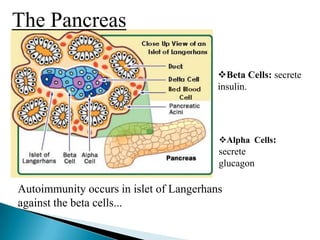
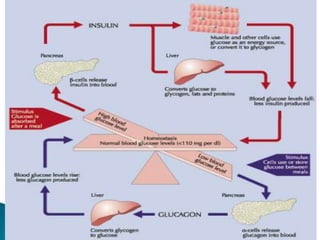
The Pancreas
Beta Cells: secrete
insulin.

Alpha Cells:

secrete
glucagon

Autoimmunity occurs in islet of Langerhans
against the beta cells...


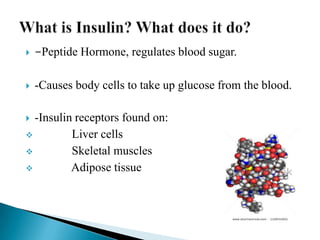
-Peptide Hormone, regulates blood sugar.



-Causes body cells to take up glucose from the blood.

-Insulin receptors found on:

Liver cells

Skeletal muscles

Adipose tissue



Without insulin, too much glucose stays in your blood.



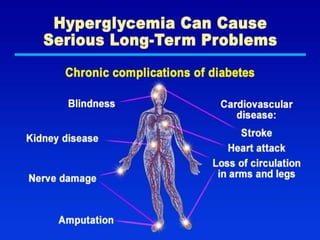
Over time, high blood glucose can lead to serious
problems with your heart, eyes, kidneys, nerves, and
gums and teeth.
4 major types:
1) Type 1 Diabetes
2) Type 2 Diabetes
3) Gestational Diabetes
4) Pre-diabetes








Diabetes is becoming a world pandemic.
Incidence prevalence are increasing dramatically,
with an estimated
171 million diabetics in 2000
and a projected increase to 366 million by 2030
Type 1 diabetes causes an estimated 5–10% of all
diabetes








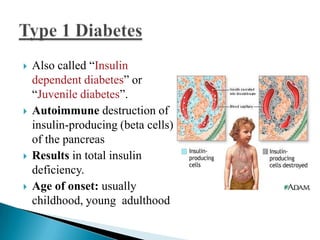
Also called ―Insulin
dependent diabetes‖ or
―Juvenile diabetes‖.
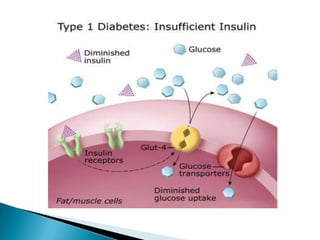
Autoimmune destruction of
insulin-producing (beta cells)
of the pancreas
Results in total insulin
deficiency.
Age of onset: usually
childhood, young adulthood


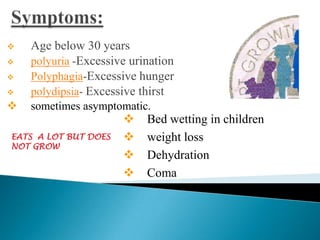
Age below 30 years
polyuria -Excessive urination
Polyphagia-Excessive hunger
polydipsia- Excessive thirst



sometimes asymptomatic.





EATS A LOT BUT DOES
NOT GROW






Bed wetting in children
weight loss
Dehydration
Coma
Triggers:
 -Poorly understood, plenty of theories.
 -Molecular mimicry…
 -Injury to islets…
 -Random failure of tolerance…



Cell mediated response:
-Type 1 diabetes is caused by a T cell–mediated
autoimmune destruction of the pancreatic beta

cells.


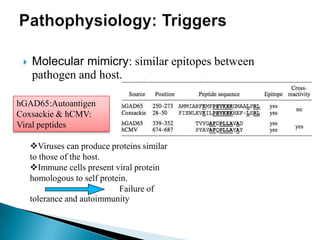
Molecular mimicry: similar epitopes between
pathogen and host.

hGAD65:Autoantigen
Coxsackie & hCMV:
Viral peptides
Viruses can produce proteins similar
to those of the host.
Immune cells present viral protein
homologous to self protein.
Failure of
tolerance and autoimmunity
The exact cause of type 1 diabetes is unknown.
 In most people with type 1 diabetes, the body's own
immune system — which normally fights harmful
bacteria and viruses — mistakenly destroys the insulinproducing (islet) cells in the pancreas.
 Genetics
 Environmental
 Viruses
 Diet

Several alleles of HLA-DQB1 are associated
with an increased risk of developing type 1
diabetes.
 The locus also has the genetic name IDDM1
as it is the highest genetic risk for type 1
diabetes.
 The strongest gene, IDDM1, is located in
the HLA Class II region on chromosome
6, at staining region 6p21.
 Certain variants of this gene increase the risk
for decreased histocompatibility
characteristic of type 1.
 Such variants include DRB1 0401, DRB1
0402 etc.


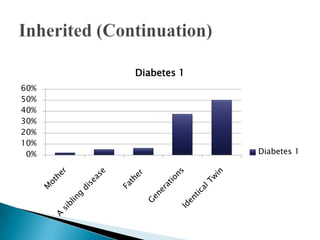
Race. White people
have a greater risk for
developing type 1
diabetes than black,
Asian, or Hispanic
people.
Diabetes 1
60%
50%
40%
30%
20%
10%
0%

Diabetes 1
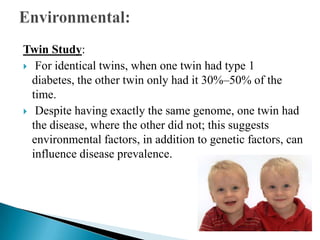
Twin Study:
 For identical twins, when one twin had type 1
diabetes, the other twin only had it 30%–50% of the
time.
 Despite having exactly the same genome, one twin had
the disease, where the other did not; this suggests
environmental factors, in addition to genetic factors, can
influence disease prevalence.

o
o
o

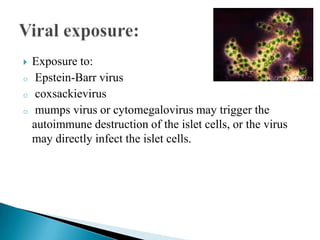
Exposure to:
Epstein-Barr virus
coxsackievirus
mumps virus or cytomegalovirus may trigger the
autoimmune destruction of the islet cells, or the virus
may directly infect the islet cells.


Research suggests that vitamin D may be protective
against type 1 diabetes.



However, early drinking of cow's milk — a common
source of vitamin D — may increase infants' risk of the
disease
Complications in Type 1 Diabetes


Hypoglycemia



Hyperglycemia



Ketoacidosis


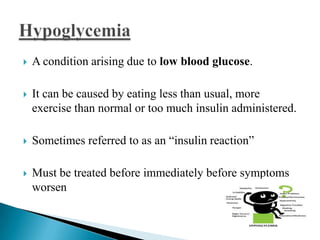
A condition arising due to low blood glucose.



It can be caused by eating less than usual, more
exercise than normal or too much insulin administered.



Sometimes referred to as an ―insulin reaction‖



Must be treated before immediately before symptoms
worsen









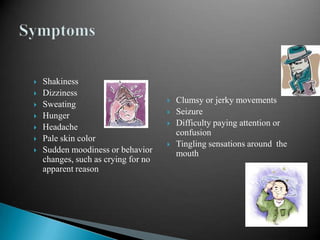
Shakiness
Dizziness
Sweating
Hunger
Headache
Pale skin color
Sudden moodiness or behavior
changes, such as crying for no
apparent reason






Clumsy or jerky movements
Seizure
Difficulty paying attention or
confusion
Tingling sensations around the
mouth


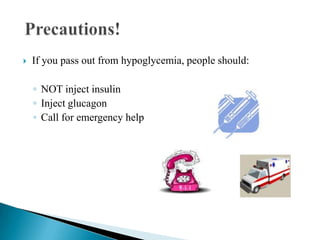
If you pass out from hypoglycemia, people should:
◦ NOT inject insulin
◦ Inject glucagon
◦ Call for emergency help


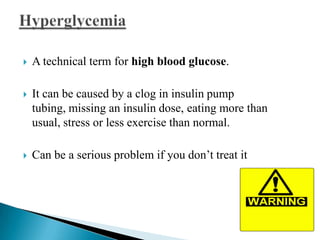
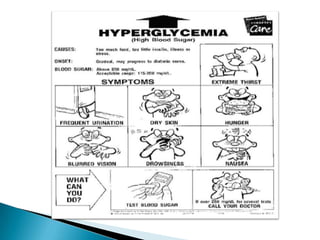
A technical term for high blood glucose.



It can be caused by a clog in insulin pump
tubing, missing an insulin dose, eating more than
usual, stress or less exercise than normal.



Can be a serious problem if you don’t treat it








Ketones are acids that build up in the blood.
They appear in the urine when the body doesn’t have
enough insulin.
They can poison the body.
They are also an indicator that your diabetes is getting out
of control or that you are getting sick.
They are present in high amounts in a condition known as:
Ketoacidosis.
Ketoacidosis









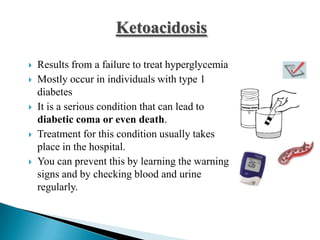
Results from a failure to treat hyperglycemia
Mostly occur in individuals with type 1
diabetes
It is a serious condition that can lead to
diabetic coma or even death.
Treatment for this condition usually takes
place in the hospital.
You can prevent this by learning the warning
signs and by checking blood and urine
regularly.






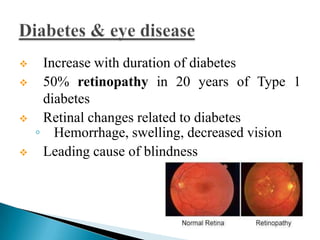
Increase with duration of diabetes
50% retinopathy in 20 years of Type 1
diabetes
Retinal changes related to diabetes
◦ Hemorrhage, swelling, decreased vision
Leading cause of blindness
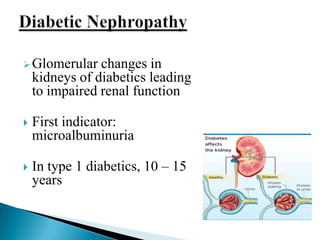
 Glomerular

changes in
kidneys of diabetics leading
to impaired renal function



First indicator:
microalbuminuria



In type 1 diabetics, 10 – 15
years


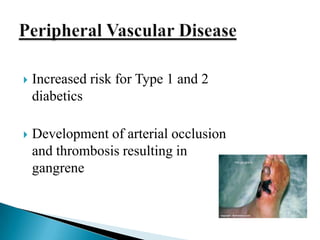
Increased risk for Type 1 and 2
diabetics



Development of arterial occlusion
and thrombosis resulting in
gangrene


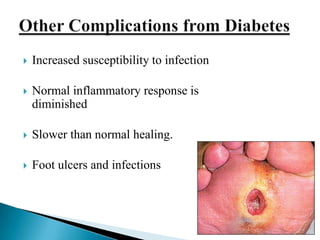
Increased susceptibility to infection



Normal inflammatory response is
diminished



Slower than normal healing.



Foot ulcers and infections






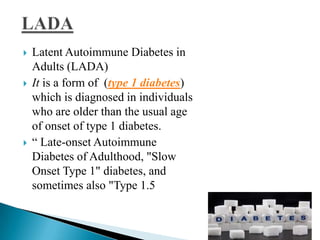
Latent Autoimmune Diabetes in
Adults (LADA)
It is a form of (type 1 diabetes)
which is diagnosed in individuals
who are older than the usual age
of onset of type 1 diabetes.
― Late-onset Autoimmune
Diabetes of Adulthood, "Slow
Onset Type 1" diabetes, and
sometimes also "Type 1.5
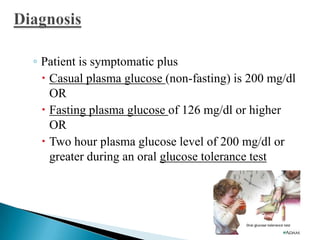
◦ Patient is symptomatic plus
 Casual plasma glucose (non-fasting) is 200 mg/dl
OR
 Fasting plasma glucose of 126 mg/dl or higher
OR
 Two hour plasma glucose level of 200 mg/dl or
greater during an oral glucose tolerance test
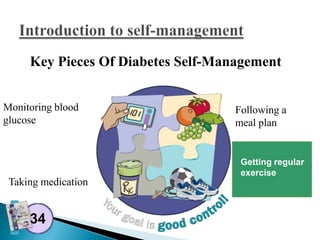
Key Pieces Of Diabetes Self-Management
Monitoring blood
glucose

Following a
meal plan

Getting regular
exercise

Taking medication

34








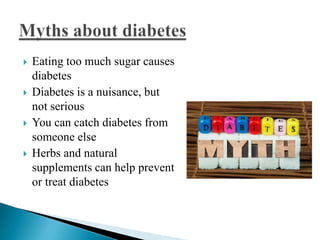
Eating too much sugar causes
diabetes
Diabetes is a nuisance, but
not serious
You can catch diabetes from
someone else
Herbs and natural
supplements can help prevent
or treat diabetes


Diabetes can be kept under check by proper
care and treatment



Once diabetes is established it cannot be
cured, so stop running after magical cures!!.


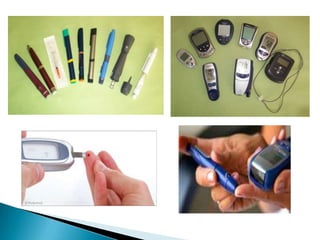
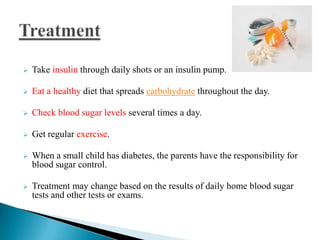
Take insulin through daily shots or an insulin pump.



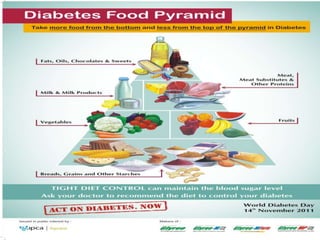
Eat a healthy diet that spreads carbohydrate throughout the day.



Check blood sugar levels several times a day.


Get regular exercise.



When a small child has diabetes, the parents have the responsibility for
blood sugar control.



Treatment may change based on the results of daily home blood sugar
tests and other tests or exams.
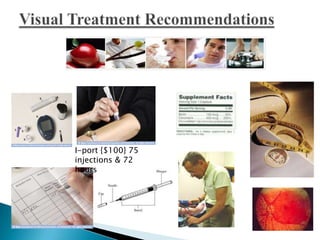
I-port {$100} 75
injections & 72
hours





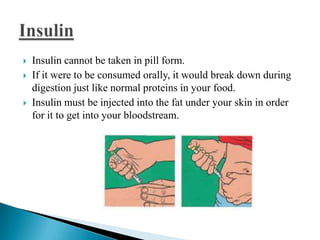
Insulin cannot be taken in pill form.
If it were to be consumed orally, it would break down during
digestion just like normal proteins in your food.
Insulin must be injected into the fat under your skin in order
for it to get into your bloodstream.
Treatment
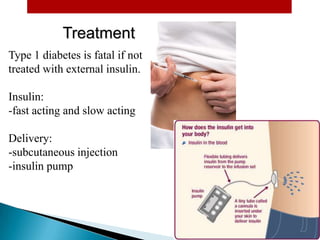
Type 1 diabetes is fatal if not
treated with external insulin.
Insulin:
-fast acting and slow acting
Delivery:
-subcutaneous injection
-insulin pump
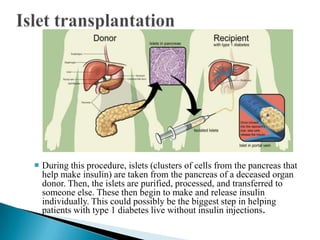
 During this procedure, islets (clusters of cells from the pancreas that
help make insulin) are taken from the pancreas of a deceased organ
donor. Then, the islets are purified, processed, and transferred to
someone else. These then begin to make and release insulin
individually. This could possibly be the biggest step in helping
patients with type 1 diabetes live without insulin injections.













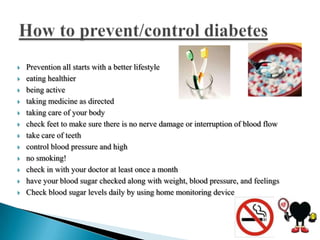
Prevention all starts with a better lifestyle
eating healthier
being active
taking medicine as directed
taking care of your body
check feet to make sure there is no nerve damage or interruption of blood flow
take care of teeth
control blood pressure and high
no smoking!
check in with your doctor at least once a month
have your blood sugar checked along with weight, blood pressure, and feelings
Check blood sugar levels daily by using home monitoring device
Diabetes mellitus Type 1

Diabetes mellitus Type 1

  • 2.
       Diabetes is achronic (lifelong) disease marked by high levels of sugar in the blood. sugar disease. The defect in this condition is that either the pancreas does not produce enough insulin or it produces sufficient insulin, but the cells of the body are unable to use the insulin properly.
  • 3.
    The Pancreas Beta Cells:secrete insulin. Alpha Cells: secrete glucagon Autoimmunity occurs in islet of Langerhans against the beta cells...
  • 5.
     -Peptide Hormone, regulatesblood sugar.  -Causes body cells to take up glucose from the blood. -Insulin receptors found on:  Liver cells  Skeletal muscles  Adipose tissue 
  • 6.
     Without insulin, toomuch glucose stays in your blood.  Over time, high blood glucose can lead to serious problems with your heart, eyes, kidneys, nerves, and gums and teeth.
  • 7.
    4 major types: 1)Type 1 Diabetes 2) Type 2 Diabetes 3) Gestational Diabetes 4) Pre-diabetes
  • 8.
         Diabetes is becominga world pandemic. Incidence prevalence are increasing dramatically, with an estimated 171 million diabetics in 2000 and a projected increase to 366 million by 2030 Type 1 diabetes causes an estimated 5–10% of all diabetes
  • 9.
        Also called ―Insulin dependentdiabetes‖ or ―Juvenile diabetes‖. Autoimmune destruction of insulin-producing (beta cells) of the pancreas Results in total insulin deficiency. Age of onset: usually childhood, young adulthood
  • 11.
     Age below 30years polyuria -Excessive urination Polyphagia-Excessive hunger polydipsia- Excessive thirst  sometimes asymptomatic.    EATS A LOT BUT DOES NOT GROW     Bed wetting in children weight loss Dehydration Coma
  • 12.
    Triggers:  -Poorly understood,plenty of theories.  -Molecular mimicry…  -Injury to islets…  -Random failure of tolerance…   Cell mediated response: -Type 1 diabetes is caused by a T cell–mediated autoimmune destruction of the pancreatic beta cells.
  • 13.
     Molecular mimicry: similarepitopes between pathogen and host. hGAD65:Autoantigen Coxsackie & hCMV: Viral peptides Viruses can produce proteins similar to those of the host. Immune cells present viral protein homologous to self protein. Failure of tolerance and autoimmunity
  • 14.
    The exact causeof type 1 diabetes is unknown.  In most people with type 1 diabetes, the body's own immune system — which normally fights harmful bacteria and viruses — mistakenly destroys the insulinproducing (islet) cells in the pancreas.  Genetics  Environmental  Viruses  Diet 
  • 15.
    Several alleles ofHLA-DQB1 are associated with an increased risk of developing type 1 diabetes.  The locus also has the genetic name IDDM1 as it is the highest genetic risk for type 1 diabetes.  The strongest gene, IDDM1, is located in the HLA Class II region on chromosome 6, at staining region 6p21.  Certain variants of this gene increase the risk for decreased histocompatibility characteristic of type 1.  Such variants include DRB1 0401, DRB1 0402 etc.  Race. White people have a greater risk for developing type 1 diabetes than black, Asian, or Hispanic people.
  • 16.
  • 17.
    Twin Study:  Foridentical twins, when one twin had type 1 diabetes, the other twin only had it 30%–50% of the time.  Despite having exactly the same genome, one twin had the disease, where the other did not; this suggests environmental factors, in addition to genetic factors, can influence disease prevalence.
  • 18.
     o o o Exposure to: Epstein-Barr virus coxsackievirus mumpsvirus or cytomegalovirus may trigger the autoimmune destruction of the islet cells, or the virus may directly infect the islet cells.
  • 19.
     Research suggests thatvitamin D may be protective against type 1 diabetes.  However, early drinking of cow's milk — a common source of vitamin D — may increase infants' risk of the disease
  • 20.
    Complications in Type1 Diabetes  Hypoglycemia  Hyperglycemia  Ketoacidosis
  • 21.
     A condition arisingdue to low blood glucose.  It can be caused by eating less than usual, more exercise than normal or too much insulin administered.  Sometimes referred to as an ―insulin reaction‖  Must be treated before immediately before symptoms worsen
  • 22.
           Shakiness Dizziness Sweating Hunger Headache Pale skin color Suddenmoodiness or behavior changes, such as crying for no apparent reason     Clumsy or jerky movements Seizure Difficulty paying attention or confusion Tingling sensations around the mouth
  • 23.
     If you passout from hypoglycemia, people should: ◦ NOT inject insulin ◦ Inject glucagon ◦ Call for emergency help
  • 24.
     A technical termfor high blood glucose.  It can be caused by a clog in insulin pump tubing, missing an insulin dose, eating more than usual, stress or less exercise than normal.  Can be a serious problem if you don’t treat it
  • 27.
         Ketones are acidsthat build up in the blood. They appear in the urine when the body doesn’t have enough insulin. They can poison the body. They are also an indicator that your diabetes is getting out of control or that you are getting sick. They are present in high amounts in a condition known as: Ketoacidosis.
  • 28.
    Ketoacidosis      Results from afailure to treat hyperglycemia Mostly occur in individuals with type 1 diabetes It is a serious condition that can lead to diabetic coma or even death. Treatment for this condition usually takes place in the hospital. You can prevent this by learning the warning signs and by checking blood and urine regularly.
  • 29.
        Increase with durationof diabetes 50% retinopathy in 20 years of Type 1 diabetes Retinal changes related to diabetes ◦ Hemorrhage, swelling, decreased vision Leading cause of blindness
  • 30.
     Glomerular changes in kidneysof diabetics leading to impaired renal function  First indicator: microalbuminuria  In type 1 diabetics, 10 – 15 years
  • 31.
     Increased risk forType 1 and 2 diabetics  Development of arterial occlusion and thrombosis resulting in gangrene
  • 32.
     Increased susceptibility toinfection  Normal inflammatory response is diminished  Slower than normal healing.  Foot ulcers and infections
  • 33.
       Latent Autoimmune Diabetesin Adults (LADA) It is a form of (type 1 diabetes) which is diagnosed in individuals who are older than the usual age of onset of type 1 diabetes. ― Late-onset Autoimmune Diabetes of Adulthood, "Slow Onset Type 1" diabetes, and sometimes also "Type 1.5
  • 34.
    ◦ Patient issymptomatic plus  Casual plasma glucose (non-fasting) is 200 mg/dl OR  Fasting plasma glucose of 126 mg/dl or higher OR  Two hour plasma glucose level of 200 mg/dl or greater during an oral glucose tolerance test
  • 35.
    Key Pieces OfDiabetes Self-Management Monitoring blood glucose Following a meal plan Getting regular exercise Taking medication 34
  • 36.
        Eating too muchsugar causes diabetes Diabetes is a nuisance, but not serious You can catch diabetes from someone else Herbs and natural supplements can help prevent or treat diabetes
  • 37.
     Diabetes can bekept under check by proper care and treatment  Once diabetes is established it cannot be cured, so stop running after magical cures!!.
  • 38.
     Take insulin throughdaily shots or an insulin pump.  Eat a healthy diet that spreads carbohydrate throughout the day.  Check blood sugar levels several times a day.  Get regular exercise.  When a small child has diabetes, the parents have the responsibility for blood sugar control.  Treatment may change based on the results of daily home blood sugar tests and other tests or exams.
  • 39.
  • 40.
       Insulin cannot betaken in pill form. If it were to be consumed orally, it would break down during digestion just like normal proteins in your food. Insulin must be injected into the fat under your skin in order for it to get into your bloodstream.
  • 41.
    Treatment Type 1 diabetesis fatal if not treated with external insulin. Insulin: -fast acting and slow acting Delivery: -subcutaneous injection -insulin pump
  • 43.
     During thisprocedure, islets (clusters of cells from the pancreas that help make insulin) are taken from the pancreas of a deceased organ donor. Then, the islets are purified, processed, and transferred to someone else. These then begin to make and release insulin individually. This could possibly be the biggest step in helping patients with type 1 diabetes live without insulin injections.
  • 45.
                Prevention all startswith a better lifestyle eating healthier being active taking medicine as directed taking care of your body check feet to make sure there is no nerve damage or interruption of blood flow take care of teeth control blood pressure and high no smoking! check in with your doctor at least once a month have your blood sugar checked along with weight, blood pressure, and feelings Check blood sugar levels daily by using home monitoring device