Occupational Safety & Health in Construction Industry (Management)
Design for Safety (DfS)
INTRODUCTION ON
CONCEPT
2
Occupational Safety & Health in Construction Industry (Management) – OSHCI(M)
Dr. Lina
SAFETY is everyone’s right!
https://sites.google.com/view/drmazlinazaira/home
ABOUT
DR. LINA
PhD in Construction, Engineering & Infrastructure Management [2013-2017]
DR. MAZLINA ZAIRA MOHAMMAD
? YEARS YOUNG
DIPLOMA IN CIVIL ENGINEERING [2008]
BACHELOR IN CIVIL ENGINEERING [2011]
MBA [2012]
ERASMUS+MOBILITY [2016]
SAFETY & HEALTH OFFICER [2018]
SENIOR LECTURER [2018 – CURRENT]
CONSTRUCTION BUSINESS & PROJECT MANAGEMENT
CIVIL ENGINEERING
SAFETY EXECUTIVE TRAINEE [2018]
JOHOR PORT SAFETY DEPARTMENT
ENGINEER EXECUTIVE [2013]
SPECIAL PROJECT & TECHNOLOGY
TRAINEE ENGINEER [2010]
WATER TREATMENT PLANT
4
AGENDA
INTRODUCTION ON DESIGN FOR SAFETY (DfS) CONCEPT
Occupational Safety & Health in Construction Industry (Management) – OSHCI(M)
• OSH Statistic
• Global Construction
Industry Accident Statistic
• Accident causes statistic
Occupational Safety & Health (OSH)
in Construction industry
• What is DfS?
• Lifecycle of building structure
• DfS principles
• Benefits of DfS implementation
Overview on
Design for Safety (DfS)
• Real examples
• Urban design concept
• Singapore practices
• Video related to DfS
concept
DfS Concept Examples
1st 2nd 3rd
5
OCCUPATIONAL SAFETY & HEALTH
IN CONSTRUCTION
1 INDUSTRY
Occupational Safety & Health in Construction Industry (Management) – OSHCI(M)
6
WORKPLACE FATAL ACCIDENTS BY SECTOR
MALAYSIA STATISTIC [Until Dec 2019]
Sources: Department of Occupational Safety and Health (DOSH) Malaysia,
October 2017
84
Construction
2019
WORKPLACE
FATAL
ACCIDENTS
259
OSH STATISTIC
16
Business service
& Retail Trades
21
Logistic
&
Transport
17
Others
73
Manufacturing
48
Agriculture
& Mining
Occupational Safety & Health in Construction Industry (Management) – OSHCI(M)
7
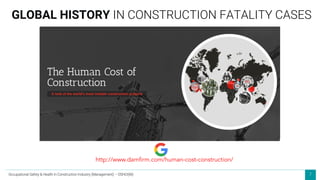
http://www.damfirm.com/human-cost-construction/
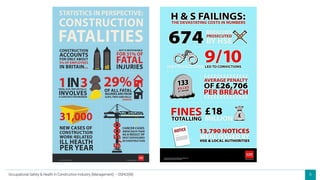
GLOBAL HISTORY IN CONSTRUCTION FATALITY CASES
Occupational Safety & Health in Construction Industry (Management) – OSHCI(M)
8
Occupational Safety & Health in Construction Industry (Management) – OSHCI(M)
9
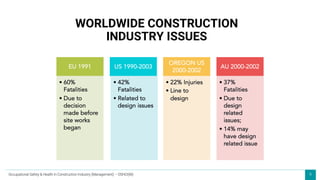
EU 1991
• 60%
Fatalities
• Due to
decision
made before
site works
began
US 1990-2003
• 42%
Fatalities
• Related to
design issues
OREGON US
2000-2002
• 22% Injuries
• Line to
design
AU 2000-2002
• 37%
Fatalities
• Due to
design
related
issues;
• 14% may
have design
related issue
WORLDWIDE CONSTRUCTION
INDUSTRY ISSUES
Occupational Safety & Health in Construction Industry (Management) – OSHCI(M)
10
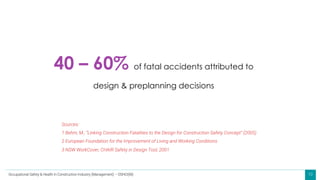
40 – 60% of fatal accidents attributed to
design & preplanning decisions
Sources:
1 Behm, M., “Linking Construction Fatalities to the Design for Construction Safety Concept” (2005)
2 European Foundation for the Improvement of Living and Working Conditions
3 NSW WorkCover, CHAIR Safety in Design Tool, 2001
Occupational Safety & Health in Construction Industry (Management) – OSHCI(M)
11
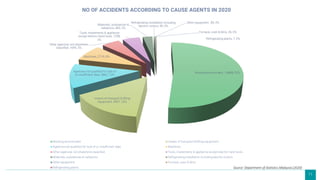
Working environment , 16888, 52%
means of transport & lifting
equipment, 4907, 15%
Agencies not qualified for lack of
or insufficient data, 3862, 12%
Machines, 2719, 8%
Other agencies not elsewhere
classified, 1645, 5%
Tools, implements & appliance
except electric hand tools, 1558,
5%
Materials, substances &
radiations, 883, 3%
Refrigerating installation including
electric motors, 90, 0%
Other equipment , 89, 0%
Furnace, oven & kilns, 26, 0%
Refrigerating plants, 7, 0%
Working environment means of transport & lifting equipment
Agencies not qualified for lack of or insufficient data Machines
Other agencies not elsewhereclassified Tools, implements & appliance except electric hand tools
Materials,substances & radiations Refrigerating installation including electric motors
Other equipment Furnace, oven & kilns
Refrigerating plants
NO OF ACCIDENTS ACCORDING TO CAUSE AGENTS IN 2020
Source: Department of Statistics Malaysia (2020)
12
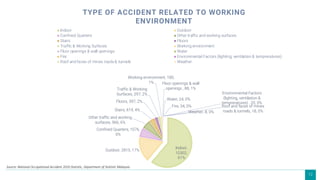
Indoor,
10302,
61%
Outdoor, 2815, 17%
Confined Quarters, 1076,
6%
Other traffic and working
surfaces, 966, 6%
Stairs, 619, 4%
Floors, 397, 2%
Traffic & Working
Surfaces, 297, 2%
Working environment, 180,
1% Floor openings & wall
openings , 88, 1%
Water, 24, 0%
Fire, 34, 0%
Environmental Factors
(lighting, ventilation &
tempreratures) , 20, 0%
Roof and faces of mines
roads & tunnels, 18, 0%
Weather, 8, 0%
TYPE OF ACCIDENT RELATED TO WORKING
ENVIRONMENT
Indoor Outdoor
Confined Quarters Other traffic and working surfaces
Stairs Floors
Traffic & Working Surfaces Working environment
Floor openings & wall openings Water
Fire Environmental Factors (lighting, ventilation & tempreratures)
Roof and faces of mines roads & tunnels Weather
Source: National Occupational Accident 2020 Statistic, Department of Statistic Malaysia
13
Occupational Safety & Health in Construction Industry (Management) – OSHCI(M)
OVERVIEW ON
DESIGN FOR SAFETY
2
CONCEPT
14
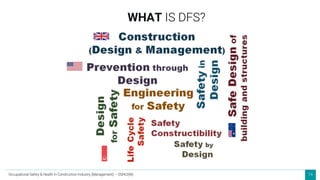
WHAT IS DFS?
Occupational Safety & Health in Construction Industry (Management) – OSHCI(M)
15
in the United States
is a major contributor and promoter of PtD policy and guidelines.
In Europe started later and
usually called as a safety by design
WHERE IS DFS STARTED?
However…
The
Occupational Safety & Health in Construction Industry (Management) – OSHCI(M)
16
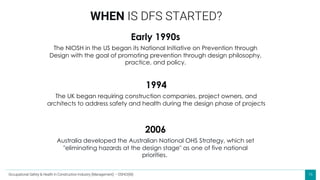
Early 1990s
The NIOSH in the US began its National Initiative on Prevention through
Design with the goal of promoting prevention through design philosophy,
practice, and policy.
WHEN IS DFS STARTED?
1994
The UK began requiring construction companies, project owners, and
architects to address safety and health during the design phase of projects
2006
Australia developed the Australian National OHS Strategy, which set
"eliminating hazards at the design stage" as one of five national
priorities.
Occupational Safety & Health in Construction Industry (Management) – OSHCI(M)
17
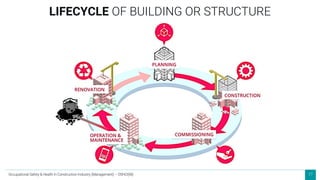
LIFECYCLE OF BUILDING OR STRUCTURE
Occupational Safety & Health in Construction Industry (Management) – OSHCI(M)
18
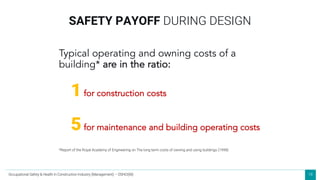
Typical operating and owning costs of a
building* are in the ratio:
1for construction costs
5for maintenance and building operating costs
SAFETY PAYOFF DURING DESIGN
*Report of the Royal Academy of Engineering on The long term costs of owning and using buildings (1998)
Occupational Safety & Health in Construction Industry (Management) – OSHCI(M)
19
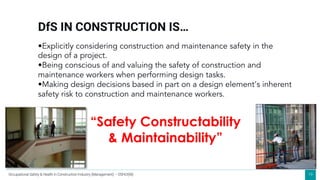
DfS IN CONSTRUCTION IS…
•Explicitly considering construction and maintenance safety in the
design of a project.
•Being conscious of and valuing the safety of construction and
maintenance workers when performing design tasks.
•Making design decisions based in part on a design element's inherent
safety risk to construction and maintenance workers.
“Safety Constructability
& Maintainability”
Occupational Safety & Health in Construction Industry (Management) – OSHCI(M)
20
21
22
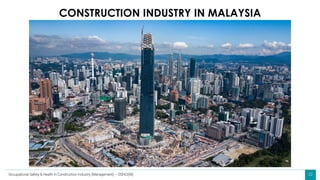
CONSTRUCTION INDUSTRY IN MALAYSIA
Occupational Safety & Health in Construction Industry (Management) – OSHCI(M)
23
Occupational Safety & Health in Construction Industry (Management) – OSHCI(M)
24
Occupational Safety & Health in Construction Industry (Management) – OSHCI(M)
25
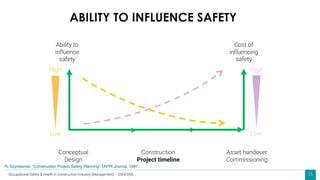
Ability to
influence
safety
Cost of
influencing
safety
Conceptual
Design
Construction
Project timeline
Asset handover
Commissioning
High High
Low Low
R. Szymberski, “Construction Project Safety Planning” TAPPI Journal, 1997.
ABILITY TO INFLUENCE SAFETY
Occupational Safety & Health in Construction Industry (Management) – OSHCI(M)
26
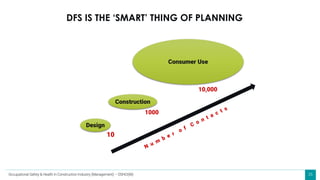
Design
Construction
Consumer Use
10
1000
10,000
N
u m
b e r
o f
C o n t a c t s
DFS IS THE ‘SMART’ THING OF PLANNING
Occupational Safety & Health in Construction Industry (Management) – OSHCI(M)
27
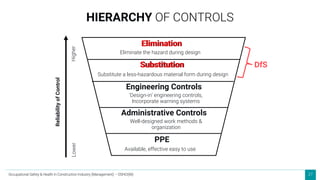
Elimination
Substitution
Engineering Controls
Administrative Controls
PPE
Eliminate the hazard during design
Substitute a less-hazardous material form during design
‘Design-in’ engineering controls,
Incorporate warning systems
Well-designed work methods &
organization
Available, effective easy to use
Higher
Lower
Reliability
of
Control
DfS
HIERARCHY OF CONTROLS
Elimination
Substitution
Occupational Safety & Health in Construction Industry (Management) – OSHCI(M)
28
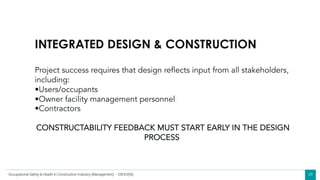
INTEGRATED DESIGN & CONSTRUCTION
Project success requires that design reflects input from all stakeholders,
including:
•Users/occupants
•Owner facility management personnel
•Contractors
CONSTRUCTABILITY FEEDBACK MUST START EARLY IN THE DESIGN
PROCESS
Occupational Safety & Health in Construction Industry (Management) – OSHCI(M)
29
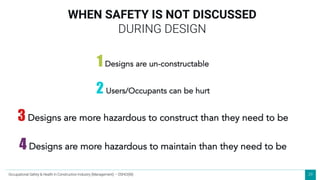
WHEN SAFETY IS NOT DISCUSSED
DURING DESIGN
1 Designs are un-constructable
2 Users/Occupants can be hurt
3 Designs are more hazardous to construct than they need to be
4 Designs are more hazardous to maintain than they need to be
Occupational Safety & Health in Construction Industry (Management) – OSHCI(M)
30
31
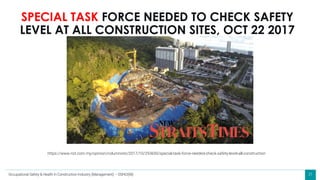
SPECIAL TASK FORCE NEEDED TO CHECK SAFETY
LEVEL AT ALL CONSTRUCTION SITES, OCT 22 2017
https://www.nst.com.my/opinion/columnists/2017/10/293650/special-task-force-needed-check-safety-level-all-construction
Occupational Safety & Health in Construction Industry (Management) – OSHCI(M)
32
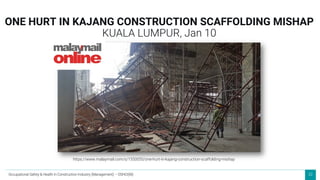
ONE HURT IN KAJANG CONSTRUCTION SCAFFOLDING MISHAP
KUALA LUMPUR, Jan 10
https://www.malaymail.com/s/1550055/one-hurt-in-kajang-construction-scaffolding-mishap
Occupational Safety & Health in Construction Industry (Management) – OSHCI(M)
33
Occupational Safety & Health in Construction Industry (Management) – OSHCI(M)
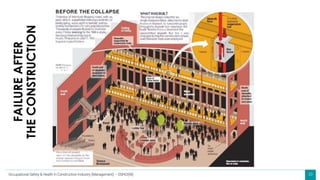
FAILURE
AFTER
THE
CONSTRUCTION
34
35
Occupational Safety & Health in Construction Industry (Management) – OSHCI(M)
36
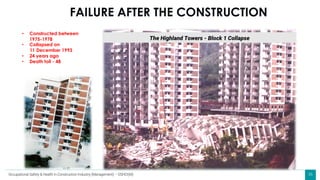
• Constructed between
1975-1978
• Collapsed on
11 December 1993
• 24 years ago
• Death toll - 48
The Highland Towers - Block 1 Collapse
FAILURE AFTER THE CONSTRUCTION
Occupational Safety & Health in Construction Industry (Management) – OSHCI(M)
37
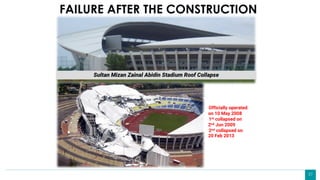
Sultan Mizan Zainal Abidin Stadium Roof Collapse
• Officially operated
on 10 May 2008
• 1st collapsed on
2nd Jun 2009
• 2nd collapsed on
20 Feb 2013
FAILURE AFTER THE CONSTRUCTION
38
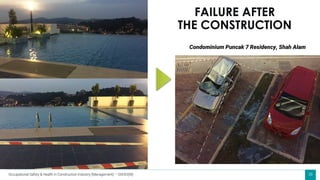
FAILURE AFTER
THE CONSTRUCTION
Condominium Puncak 7 Residency, Shah Alam
Occupational Safety & Health in Construction Industry (Management) – OSHCI(M)
39
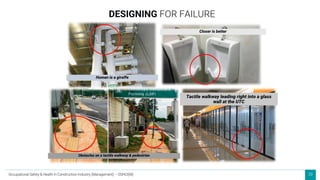
Human is a giraffe
Obstacles on a tactile walkway & pedestrian
Tactile walkway leading right into a glass
wall at the UTC
DESIGNING FOR FAILURE
Closer is better
Occupational Safety & Health in Construction Industry (Management) – OSHCI(M)
40
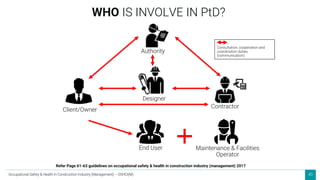
Designer
Contractor
Authority
Client/Owner
WHO IS INVOLVE IN PtD?
Refer Page 61-63 guidelines on occupational safety & health in construction industry (management) 2017
Consultation, cooperation and
coordination duties
(communication)
End User Maintenance & Facilities
Operator
Occupational Safety & Health in Construction Industry (Management) – OSHCI(M)
41
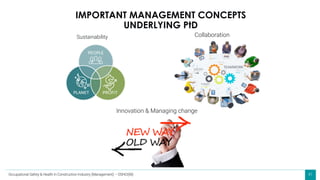
Sustainability
Innovation & Managing change
Collaboration
IMPORTANT MANAGEMENT CONCEPTS
UNDERLYING PtD
Occupational Safety & Health in Construction Industry (Management) – OSHCI(M)
42
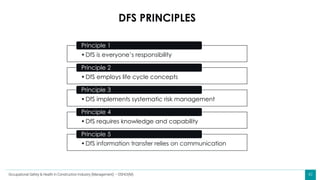
•DfS is everyone’s responsibility
Principle 1
•DfS employs life cycle concepts
Principle 2
•DfS implements systematic risk management
Principle 3
•DfS requires knowledge and capability
Principle 4
•DfS information transfer relies on communication
Principle 5
DFS PRINCIPLES
Occupational Safety & Health in Construction Industry (Management) – OSHCI(M)
43
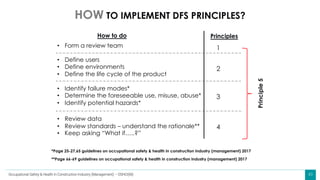
*Page 25-27,65 guidelines on occupational safety & health in construction industry (management) 2017
• Form a review team
Principles
How to do
1
2
3
4
Principle
5
HOW TO IMPLEMENT DFS PRINCIPLES?
**Page 66-69 guidelines on occupational safety & health in construction industry (management) 2017
• Define users
• Define environments
• Define the life cycle of the product
• Identify failure modes*
• Determine the foreseeable use, misuse, abuse*
• Identify potential hazards*
• Review data
• Review standards – understand the rationale**
• Keep asking “What if…..?”
Occupational Safety & Health in Construction Industry (Management) – OSHCI(M)
44
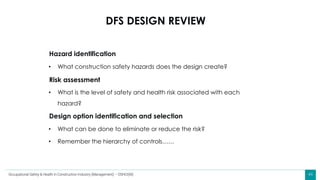
Hazard identification
• What construction safety hazards does the design create?
Risk assessment
• What is the level of safety and health risk associated with each
hazard?
Design option identification and selection
• What can be done to eliminate or reduce the risk?
• Remember the hierarchy of controls……
DFS DESIGN REVIEW
Occupational Safety & Health in Construction Industry (Management) – OSHCI(M)
45
• Reduced site hazard
• Fewer delays due to accidents
• Increased productivity and quality
• Reduced costs
• Better prediction and management of production and operational
costs over the lifecycle of a structure
• Encourages designer-constructor collaboration
• Innovation, in that safe design demands new thinking
• Improved operations and maintenance safety
• Improved usability of structures
• Compliance with legislation
Tangible benefits
WHY DFS?
Occupational Safety & Health in Construction Industry (Management) – OSHCI(M)
46
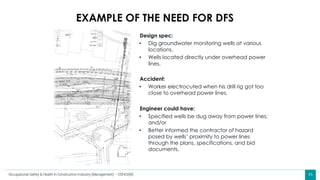
Design spec:
• Dig groundwater monitoring wells at various
locations.
• Wells located directly under overhead power
lines.
Accident:
• Worker electrocuted when his drill rig got too
close to overhead power lines.
Engineer could have:
• Specified wells be dug away from power lines;
and/or
• Better informed the contractor of hazard
posed by wells’ proximity to power lines
through the plans, specifications, and bid
documents.
EXAMPLE OF THE NEED FOR DFS
Occupational Safety & Health in Construction Industry (Management) – OSHCI(M)
47
EXAMPLE OF THE NEED FOR DFS
[ELIMINATION & SUBSTITUTION]
Occupational Safety & Health in Construction Industry (Management) – OSHCI(M)
48
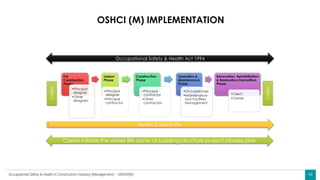
OSHCI (M) IMPLEMENTATION
Pre
Construction
Phase
•Principal
designer
•Other
designers
Liaison
Phase
•Principal
designer
•Principal
contractor
Construction
Phase
•Principal
contractor
•Other
contractors
Operation &
Maintenance
Phase
•Occupier/user
•Maintenance
and Facilities
Management
Renovation, Rehabilitation
& Restoration/Demolition
Phase
•Client
•Owner
Occupational Safety & Health Act 1994
Clients initiate the whole life cycle of building/structure project phases plan
Health & Safety File
CLIENT
CLIENT
Occupational Safety & Health in Construction Industry (Management) – OSHCI(M)
49
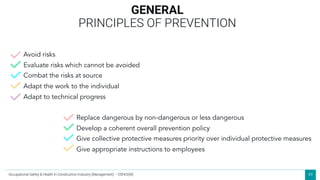
GENERAL
PRINCIPLES OF PREVENTION
Avoid risks
Evaluate risks which cannot be avoided
Combat the risks at source
Adapt the work to the individual
Adapt to technical progress
Replace dangerous by non-dangerous or less dangerous
Develop a coherent overall prevention policy
Give collective protective measures priority over individual protective measures
Give appropriate instructions to employees
Occupational Safety & Health in Construction Industry (Management) – OSHCI(M)
50
Multipurpose Powerpoint Template
BEST SOLUTION CONCEPT
Think earlier before it is too late
DfS CONCEPT
EXAMPLES
3
51
Occupational Safety & Health in Construction Industry (Management) – OSHCI(M)
52
Occupational Safety & Health in Construction Industry (Management) – OSHCI(M)
53
Occupational Safety & Health in Construction Industry (Management) – OSHCI(M)
54
Occupational Safety & Health in Construction Industry (Management) – OSHCI(M)
55
Occupational Safety & Health in Construction Industry (Management) – OSHCI(M)
56
Occupational Safety & Health in Construction Industry (Management) – OSHCI(M)
57
Occupational Safety & Health in Construction Industry (Management) – OSHCI(M)
58
Occupational Safety & Health in Construction Industry (Management) – OSHCI(M)
59
Occupational Safety & Health in Construction Industry (Management) – OSHCI(M)
60
Occupational Safety & Health in Construction Industry (Management) – OSHCI(M)
61
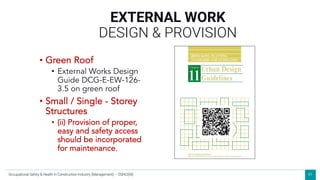
EXTERNAL WORK
DESIGN & PROVISION
• Green Roof
• External Works Design
Guide DCG-E-EW-126-
3.5 on green roof
• Small / Single - Storey
Structures
• (ii) Provision of proper,
easy and safety access
should be incorporated
for maintenance.
Occupational Safety & Health in Construction Industry (Management) – OSHCI(M)
62
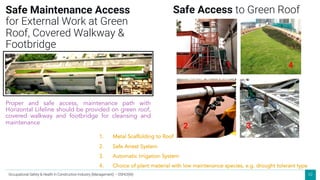
Safe Maintenance Access
for External Work at Green
Roof, Covered Walkway &
Footbridge
Proper and safe access, maintenance path with
Horizontal Lifeline should be provided on green roof,
covered walkway and footbridge for cleansing and
maintenance
Safe Access to Green Roof
2 3
1 4
1. Metal Scaffolding to Roof
2. Safe Arrest System
3. Automatic Irrigation System
4. Choice of plant material with low maintenance species, e.g. drought tolerant type
Occupational Safety & Health in Construction Industry (Management) – OSHCI(M)
63
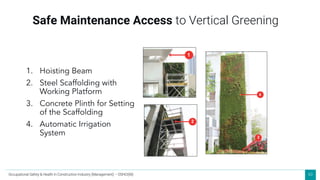
Safe Maintenance Access to Vertical Greening
1. Hoisting Beam
2. Steel Scaffolding with
Working Platform
3. Concrete Plinth for Setting
of the Scaffolding
4. Automatic Irrigation
System
Occupational Safety & Health in Construction Industry (Management) – OSHCI(M)
64
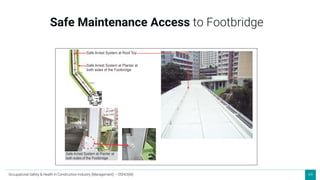
Safe Maintenance Access to Footbridge
Occupational Safety & Health in Construction Industry (Management) – OSHCI(M)
65
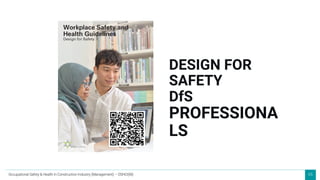
DESIGN FOR
SAFETY
DfS
PROFESSIONA
LS
Occupational Safety & Health in Construction Industry (Management) – OSHCI(M)
66
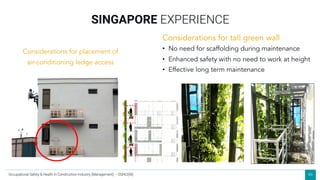
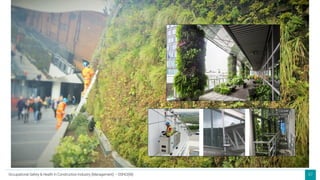
SINGAPORE EXPERIENCE
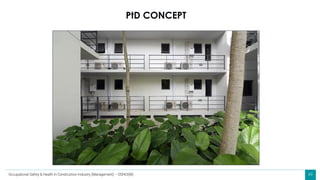
Considerations for placement of
air-conditioning ledge access
Considerations for tall green wall
• No need for scaffolding during maintenance
• Enhanced safety with no need to work at height
• Effective long term maintenance
Occupational Safety & Health in Construction Industry (Management) – OSHCI(M)
67
Occupational Safety & Health in Construction Industry (Management) – OSHCI(M)
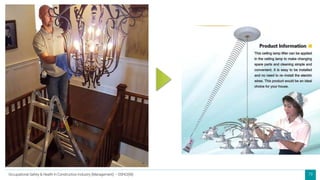
68
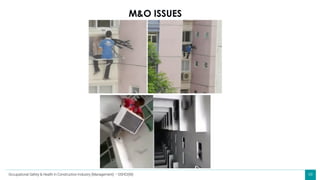
M&O ISSUES
Occupational Safety & Health in Construction Industry (Management) – OSHCI(M)
69
PtD CONCEPT
Occupational Safety & Health in Construction Industry (Management) – OSHCI(M)
70
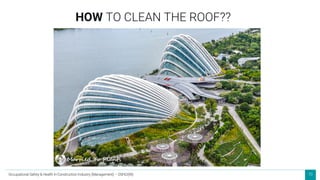
HOW TO CLEAN THE ROOF??
Occupational Safety & Health in Construction Industry (Management) – OSHCI(M)
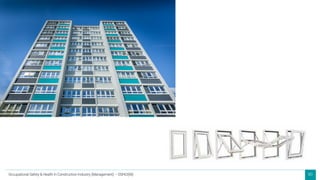
71
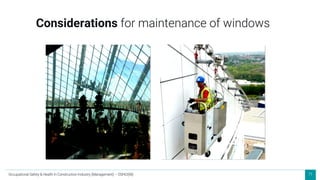
Considerations for maintenance of windows
Occupational Safety & Health in Construction Industry (Management) – OSHCI(M)
72
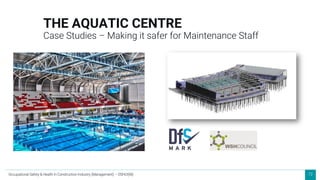
THE AQUATIC CENTRE
Case Studies – Making it safer for Maintenance Staff
Occupational Safety & Health in Construction Industry (Management) – OSHCI(M)
73
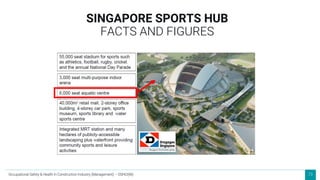
SINGAPORE SPORTS HUB
FACTS AND FIGURES
Occupational Safety & Health in Construction Industry (Management) – OSHCI(M)
74
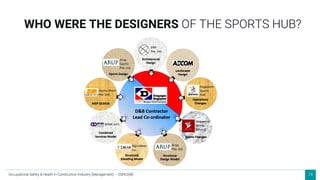
WHO WERE THE DESIGNERS OF THE SPORTS HUB?
Occupational Safety & Health in Construction Industry (Management) – OSHCI(M)
75
The Aquatic Centre
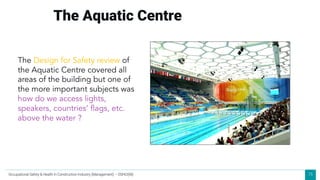
The Design for Safety review of
the Aquatic Centre covered all
areas of the building but one of
the more important subjects was
how do we access lights,
speakers, countries’ flags, etc.
above the water ?
Occupational Safety & Health in Construction Industry (Management) – OSHCI(M)
76
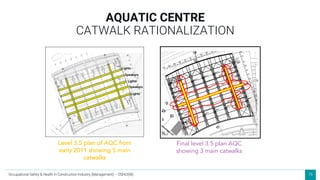
AQUATIC CENTRE
CATWALK RATIONALIZATION
Level 3.5 plan of AQC from
early 2011 showing 5 main
catwalks
Final level 3.5 plan AQC
showing 3 main catwalks
Occupational Safety & Health in Construction Industry (Management) – OSHCI(M)
77
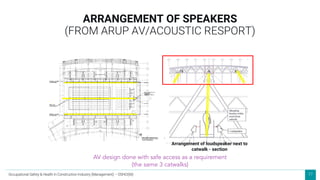
ARRANGEMENT OF SPEAKERS
(FROM ARUP AV/ACOUSTIC RESPORT)
AV design done with safe access as a requirement
(the same 3 catwalks)
Arrangement of loudspeaker next to
catwalk - section
Occupational Safety & Health in Construction Industry (Management) – OSHCI(M)
78
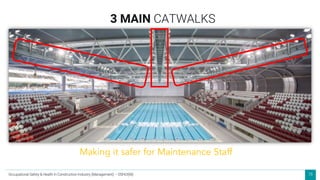
3 MAIN CATWALKS
Making it safer for Maintenance Staff
Occupational Safety & Health in Construction Industry (Management) – OSHCI(M)
79
Occupational Safety & Health in Construction Industry (Management) – OSHCI(M)
80
Occupational Safety & Health in Construction Industry (Management) – OSHCI(M)
81
82
83
THANK YOU
FOR JOIN US

DfS SLIDE .pdf

  • 1.
    Occupational Safety &Health in Construction Industry (Management) Design for Safety (DfS) INTRODUCTION ON CONCEPT
  • 2.
    2 Occupational Safety &Health in Construction Industry (Management) – OSHCI(M) Dr. Lina SAFETY is everyone’s right! https://sites.google.com/view/drmazlinazaira/home
  • 3.
    ABOUT DR. LINA PhD inConstruction, Engineering & Infrastructure Management [2013-2017] DR. MAZLINA ZAIRA MOHAMMAD ? YEARS YOUNG DIPLOMA IN CIVIL ENGINEERING [2008] BACHELOR IN CIVIL ENGINEERING [2011] MBA [2012] ERASMUS+MOBILITY [2016] SAFETY & HEALTH OFFICER [2018] SENIOR LECTURER [2018 – CURRENT] CONSTRUCTION BUSINESS & PROJECT MANAGEMENT CIVIL ENGINEERING SAFETY EXECUTIVE TRAINEE [2018] JOHOR PORT SAFETY DEPARTMENT ENGINEER EXECUTIVE [2013] SPECIAL PROJECT & TECHNOLOGY TRAINEE ENGINEER [2010] WATER TREATMENT PLANT
  • 4.
    4 AGENDA INTRODUCTION ON DESIGNFOR SAFETY (DfS) CONCEPT Occupational Safety & Health in Construction Industry (Management) – OSHCI(M) • OSH Statistic • Global Construction Industry Accident Statistic • Accident causes statistic Occupational Safety & Health (OSH) in Construction industry • What is DfS? • Lifecycle of building structure • DfS principles • Benefits of DfS implementation Overview on Design for Safety (DfS) • Real examples • Urban design concept • Singapore practices • Video related to DfS concept DfS Concept Examples 1st 2nd 3rd
  • 5.
    5 OCCUPATIONAL SAFETY &HEALTH IN CONSTRUCTION 1 INDUSTRY Occupational Safety & Health in Construction Industry (Management) – OSHCI(M)
  • 6.
    6 WORKPLACE FATAL ACCIDENTSBY SECTOR MALAYSIA STATISTIC [Until Dec 2019] Sources: Department of Occupational Safety and Health (DOSH) Malaysia, October 2017 84 Construction 2019 WORKPLACE FATAL ACCIDENTS 259 OSH STATISTIC 16 Business service & Retail Trades 21 Logistic & Transport 17 Others 73 Manufacturing 48 Agriculture & Mining Occupational Safety & Health in Construction Industry (Management) – OSHCI(M)
  • 7.
    7 http://www.damfirm.com/human-cost-construction/ GLOBAL HISTORY INCONSTRUCTION FATALITY CASES Occupational Safety & Health in Construction Industry (Management) – OSHCI(M)
  • 8.
    8 Occupational Safety &Health in Construction Industry (Management) – OSHCI(M)
  • 9.
    9 EU 1991 • 60% Fatalities •Due to decision made before site works began US 1990-2003 • 42% Fatalities • Related to design issues OREGON US 2000-2002 • 22% Injuries • Line to design AU 2000-2002 • 37% Fatalities • Due to design related issues; • 14% may have design related issue WORLDWIDE CONSTRUCTION INDUSTRY ISSUES Occupational Safety & Health in Construction Industry (Management) – OSHCI(M)
  • 10.
    10 40 – 60%of fatal accidents attributed to design & preplanning decisions Sources: 1 Behm, M., “Linking Construction Fatalities to the Design for Construction Safety Concept” (2005) 2 European Foundation for the Improvement of Living and Working Conditions 3 NSW WorkCover, CHAIR Safety in Design Tool, 2001 Occupational Safety & Health in Construction Industry (Management) – OSHCI(M)
  • 11.
    11 Working environment ,16888, 52% means of transport & lifting equipment, 4907, 15% Agencies not qualified for lack of or insufficient data, 3862, 12% Machines, 2719, 8% Other agencies not elsewhere classified, 1645, 5% Tools, implements & appliance except electric hand tools, 1558, 5% Materials, substances & radiations, 883, 3% Refrigerating installation including electric motors, 90, 0% Other equipment , 89, 0% Furnace, oven & kilns, 26, 0% Refrigerating plants, 7, 0% Working environment means of transport & lifting equipment Agencies not qualified for lack of or insufficient data Machines Other agencies not elsewhereclassified Tools, implements & appliance except electric hand tools Materials,substances & radiations Refrigerating installation including electric motors Other equipment Furnace, oven & kilns Refrigerating plants NO OF ACCIDENTS ACCORDING TO CAUSE AGENTS IN 2020 Source: Department of Statistics Malaysia (2020)
  • 12.
    12 Indoor, 10302, 61% Outdoor, 2815, 17% ConfinedQuarters, 1076, 6% Other traffic and working surfaces, 966, 6% Stairs, 619, 4% Floors, 397, 2% Traffic & Working Surfaces, 297, 2% Working environment, 180, 1% Floor openings & wall openings , 88, 1% Water, 24, 0% Fire, 34, 0% Environmental Factors (lighting, ventilation & tempreratures) , 20, 0% Roof and faces of mines roads & tunnels, 18, 0% Weather, 8, 0% TYPE OF ACCIDENT RELATED TO WORKING ENVIRONMENT Indoor Outdoor Confined Quarters Other traffic and working surfaces Stairs Floors Traffic & Working Surfaces Working environment Floor openings & wall openings Water Fire Environmental Factors (lighting, ventilation & tempreratures) Roof and faces of mines roads & tunnels Weather Source: National Occupational Accident 2020 Statistic, Department of Statistic Malaysia
  • 13.
    13 Occupational Safety &Health in Construction Industry (Management) – OSHCI(M) OVERVIEW ON DESIGN FOR SAFETY 2 CONCEPT
  • 14.
    14 WHAT IS DFS? OccupationalSafety & Health in Construction Industry (Management) – OSHCI(M)
  • 15.
    15 in the UnitedStates is a major contributor and promoter of PtD policy and guidelines. In Europe started later and usually called as a safety by design WHERE IS DFS STARTED? However… The Occupational Safety & Health in Construction Industry (Management) – OSHCI(M)
  • 16.
    16 Early 1990s The NIOSHin the US began its National Initiative on Prevention through Design with the goal of promoting prevention through design philosophy, practice, and policy. WHEN IS DFS STARTED? 1994 The UK began requiring construction companies, project owners, and architects to address safety and health during the design phase of projects 2006 Australia developed the Australian National OHS Strategy, which set "eliminating hazards at the design stage" as one of five national priorities. Occupational Safety & Health in Construction Industry (Management) – OSHCI(M)
  • 17.
    17 LIFECYCLE OF BUILDINGOR STRUCTURE Occupational Safety & Health in Construction Industry (Management) – OSHCI(M)
  • 18.
    18 Typical operating andowning costs of a building* are in the ratio: 1for construction costs 5for maintenance and building operating costs SAFETY PAYOFF DURING DESIGN *Report of the Royal Academy of Engineering on The long term costs of owning and using buildings (1998) Occupational Safety & Health in Construction Industry (Management) – OSHCI(M)
  • 19.
    19 DfS IN CONSTRUCTIONIS… •Explicitly considering construction and maintenance safety in the design of a project. •Being conscious of and valuing the safety of construction and maintenance workers when performing design tasks. •Making design decisions based in part on a design element's inherent safety risk to construction and maintenance workers. “Safety Constructability & Maintainability” Occupational Safety & Health in Construction Industry (Management) – OSHCI(M)
  • 20.
  • 21.
  • 22.
    22 CONSTRUCTION INDUSTRY INMALAYSIA Occupational Safety & Health in Construction Industry (Management) – OSHCI(M)
  • 23.
    23 Occupational Safety &Health in Construction Industry (Management) – OSHCI(M)
  • 24.
    24 Occupational Safety &Health in Construction Industry (Management) – OSHCI(M)
  • 25.
    25 Ability to influence safety Cost of influencing safety Conceptual Design Construction Projecttimeline Asset handover Commissioning High High Low Low R. Szymberski, “Construction Project Safety Planning” TAPPI Journal, 1997. ABILITY TO INFLUENCE SAFETY Occupational Safety & Health in Construction Industry (Management) – OSHCI(M)
  • 26.
    26 Design Construction Consumer Use 10 1000 10,000 N u m be r o f C o n t a c t s DFS IS THE ‘SMART’ THING OF PLANNING Occupational Safety & Health in Construction Industry (Management) – OSHCI(M)
  • 27.
    27 Elimination Substitution Engineering Controls Administrative Controls PPE Eliminatethe hazard during design Substitute a less-hazardous material form during design ‘Design-in’ engineering controls, Incorporate warning systems Well-designed work methods & organization Available, effective easy to use Higher Lower Reliability of Control DfS HIERARCHY OF CONTROLS Elimination Substitution Occupational Safety & Health in Construction Industry (Management) – OSHCI(M)
  • 28.
    28 INTEGRATED DESIGN &CONSTRUCTION Project success requires that design reflects input from all stakeholders, including: •Users/occupants •Owner facility management personnel •Contractors CONSTRUCTABILITY FEEDBACK MUST START EARLY IN THE DESIGN PROCESS Occupational Safety & Health in Construction Industry (Management) – OSHCI(M)
  • 29.
    29 WHEN SAFETY ISNOT DISCUSSED DURING DESIGN 1 Designs are un-constructable 2 Users/Occupants can be hurt 3 Designs are more hazardous to construct than they need to be 4 Designs are more hazardous to maintain than they need to be Occupational Safety & Health in Construction Industry (Management) – OSHCI(M)
  • 30.
  • 31.
    31 SPECIAL TASK FORCENEEDED TO CHECK SAFETY LEVEL AT ALL CONSTRUCTION SITES, OCT 22 2017 https://www.nst.com.my/opinion/columnists/2017/10/293650/special-task-force-needed-check-safety-level-all-construction Occupational Safety & Health in Construction Industry (Management) – OSHCI(M)
  • 32.
    32 ONE HURT INKAJANG CONSTRUCTION SCAFFOLDING MISHAP KUALA LUMPUR, Jan 10 https://www.malaymail.com/s/1550055/one-hurt-in-kajang-construction-scaffolding-mishap Occupational Safety & Health in Construction Industry (Management) – OSHCI(M)
  • 33.
    33 Occupational Safety &Health in Construction Industry (Management) – OSHCI(M) FAILURE AFTER THE CONSTRUCTION
  • 34.
  • 35.
    35 Occupational Safety &Health in Construction Industry (Management) – OSHCI(M)
  • 36.
    36 • Constructed between 1975-1978 •Collapsed on 11 December 1993 • 24 years ago • Death toll - 48 The Highland Towers - Block 1 Collapse FAILURE AFTER THE CONSTRUCTION Occupational Safety & Health in Construction Industry (Management) – OSHCI(M)
  • 37.
    37 Sultan Mizan ZainalAbidin Stadium Roof Collapse • Officially operated on 10 May 2008 • 1st collapsed on 2nd Jun 2009 • 2nd collapsed on 20 Feb 2013 FAILURE AFTER THE CONSTRUCTION
  • 38.
    38 FAILURE AFTER THE CONSTRUCTION CondominiumPuncak 7 Residency, Shah Alam Occupational Safety & Health in Construction Industry (Management) – OSHCI(M)
  • 39.
    39 Human is agiraffe Obstacles on a tactile walkway & pedestrian Tactile walkway leading right into a glass wall at the UTC DESIGNING FOR FAILURE Closer is better Occupational Safety & Health in Construction Industry (Management) – OSHCI(M)
  • 40.
    40 Designer Contractor Authority Client/Owner WHO IS INVOLVEIN PtD? Refer Page 61-63 guidelines on occupational safety & health in construction industry (management) 2017 Consultation, cooperation and coordination duties (communication) End User Maintenance & Facilities Operator Occupational Safety & Health in Construction Industry (Management) – OSHCI(M)
  • 41.
    41 Sustainability Innovation & Managingchange Collaboration IMPORTANT MANAGEMENT CONCEPTS UNDERLYING PtD Occupational Safety & Health in Construction Industry (Management) – OSHCI(M)
  • 42.
    42 •DfS is everyone’sresponsibility Principle 1 •DfS employs life cycle concepts Principle 2 •DfS implements systematic risk management Principle 3 •DfS requires knowledge and capability Principle 4 •DfS information transfer relies on communication Principle 5 DFS PRINCIPLES Occupational Safety & Health in Construction Industry (Management) – OSHCI(M)
  • 43.
    43 *Page 25-27,65 guidelineson occupational safety & health in construction industry (management) 2017 • Form a review team Principles How to do 1 2 3 4 Principle 5 HOW TO IMPLEMENT DFS PRINCIPLES? **Page 66-69 guidelines on occupational safety & health in construction industry (management) 2017 • Define users • Define environments • Define the life cycle of the product • Identify failure modes* • Determine the foreseeable use, misuse, abuse* • Identify potential hazards* • Review data • Review standards – understand the rationale** • Keep asking “What if…..?” Occupational Safety & Health in Construction Industry (Management) – OSHCI(M)
  • 44.
    44 Hazard identification • Whatconstruction safety hazards does the design create? Risk assessment • What is the level of safety and health risk associated with each hazard? Design option identification and selection • What can be done to eliminate or reduce the risk? • Remember the hierarchy of controls…… DFS DESIGN REVIEW Occupational Safety & Health in Construction Industry (Management) – OSHCI(M)
  • 45.
    45 • Reduced sitehazard • Fewer delays due to accidents • Increased productivity and quality • Reduced costs • Better prediction and management of production and operational costs over the lifecycle of a structure • Encourages designer-constructor collaboration • Innovation, in that safe design demands new thinking • Improved operations and maintenance safety • Improved usability of structures • Compliance with legislation Tangible benefits WHY DFS? Occupational Safety & Health in Construction Industry (Management) – OSHCI(M)
  • 46.
    46 Design spec: • Diggroundwater monitoring wells at various locations. • Wells located directly under overhead power lines. Accident: • Worker electrocuted when his drill rig got too close to overhead power lines. Engineer could have: • Specified wells be dug away from power lines; and/or • Better informed the contractor of hazard posed by wells’ proximity to power lines through the plans, specifications, and bid documents. EXAMPLE OF THE NEED FOR DFS Occupational Safety & Health in Construction Industry (Management) – OSHCI(M)
  • 47.
    47 EXAMPLE OF THENEED FOR DFS [ELIMINATION & SUBSTITUTION] Occupational Safety & Health in Construction Industry (Management) – OSHCI(M)
  • 48.
    48 OSHCI (M) IMPLEMENTATION Pre Construction Phase •Principal designer •Other designers Liaison Phase •Principal designer •Principal contractor Construction Phase •Principal contractor •Other contractors Operation& Maintenance Phase •Occupier/user •Maintenance and Facilities Management Renovation, Rehabilitation & Restoration/Demolition Phase •Client •Owner Occupational Safety & Health Act 1994 Clients initiate the whole life cycle of building/structure project phases plan Health & Safety File CLIENT CLIENT Occupational Safety & Health in Construction Industry (Management) – OSHCI(M)
  • 49.
    49 GENERAL PRINCIPLES OF PREVENTION Avoidrisks Evaluate risks which cannot be avoided Combat the risks at source Adapt the work to the individual Adapt to technical progress Replace dangerous by non-dangerous or less dangerous Develop a coherent overall prevention policy Give collective protective measures priority over individual protective measures Give appropriate instructions to employees Occupational Safety & Health in Construction Industry (Management) – OSHCI(M)
  • 50.
    50 Multipurpose Powerpoint Template BESTSOLUTION CONCEPT Think earlier before it is too late DfS CONCEPT EXAMPLES 3
  • 51.
    51 Occupational Safety &Health in Construction Industry (Management) – OSHCI(M)
  • 52.
    52 Occupational Safety &Health in Construction Industry (Management) – OSHCI(M)
  • 53.
    53 Occupational Safety &Health in Construction Industry (Management) – OSHCI(M)
  • 54.
    54 Occupational Safety &Health in Construction Industry (Management) – OSHCI(M)
  • 55.
    55 Occupational Safety &Health in Construction Industry (Management) – OSHCI(M)
  • 56.
    56 Occupational Safety &Health in Construction Industry (Management) – OSHCI(M)
  • 57.
    57 Occupational Safety &Health in Construction Industry (Management) – OSHCI(M)
  • 58.
    58 Occupational Safety &Health in Construction Industry (Management) – OSHCI(M)
  • 59.
    59 Occupational Safety &Health in Construction Industry (Management) – OSHCI(M)
  • 60.
    60 Occupational Safety &Health in Construction Industry (Management) – OSHCI(M)
  • 61.
    61 EXTERNAL WORK DESIGN &PROVISION • Green Roof • External Works Design Guide DCG-E-EW-126- 3.5 on green roof • Small / Single - Storey Structures • (ii) Provision of proper, easy and safety access should be incorporated for maintenance. Occupational Safety & Health in Construction Industry (Management) – OSHCI(M)
  • 62.
    62 Safe Maintenance Access forExternal Work at Green Roof, Covered Walkway & Footbridge Proper and safe access, maintenance path with Horizontal Lifeline should be provided on green roof, covered walkway and footbridge for cleansing and maintenance Safe Access to Green Roof 2 3 1 4 1. Metal Scaffolding to Roof 2. Safe Arrest System 3. Automatic Irrigation System 4. Choice of plant material with low maintenance species, e.g. drought tolerant type Occupational Safety & Health in Construction Industry (Management) – OSHCI(M)
  • 63.
    63 Safe Maintenance Accessto Vertical Greening 1. Hoisting Beam 2. Steel Scaffolding with Working Platform 3. Concrete Plinth for Setting of the Scaffolding 4. Automatic Irrigation System Occupational Safety & Health in Construction Industry (Management) – OSHCI(M)
  • 64.
    64 Safe Maintenance Accessto Footbridge Occupational Safety & Health in Construction Industry (Management) – OSHCI(M)
  • 65.
    65 DESIGN FOR SAFETY DfS PROFESSIONA LS Occupational Safety& Health in Construction Industry (Management) – OSHCI(M)
  • 66.
    66 SINGAPORE EXPERIENCE Considerations forplacement of air-conditioning ledge access Considerations for tall green wall • No need for scaffolding during maintenance • Enhanced safety with no need to work at height • Effective long term maintenance Occupational Safety & Health in Construction Industry (Management) – OSHCI(M)
  • 67.
    67 Occupational Safety &Health in Construction Industry (Management) – OSHCI(M)
  • 68.
    68 M&O ISSUES Occupational Safety& Health in Construction Industry (Management) – OSHCI(M)
  • 69.
    69 PtD CONCEPT Occupational Safety& Health in Construction Industry (Management) – OSHCI(M)
  • 70.
    70 HOW TO CLEANTHE ROOF?? Occupational Safety & Health in Construction Industry (Management) – OSHCI(M)
  • 71.
    71 Considerations for maintenanceof windows Occupational Safety & Health in Construction Industry (Management) – OSHCI(M)
  • 72.
    72 THE AQUATIC CENTRE CaseStudies – Making it safer for Maintenance Staff Occupational Safety & Health in Construction Industry (Management) – OSHCI(M)
  • 73.
    73 SINGAPORE SPORTS HUB FACTSAND FIGURES Occupational Safety & Health in Construction Industry (Management) – OSHCI(M)
  • 74.
    74 WHO WERE THEDESIGNERS OF THE SPORTS HUB? Occupational Safety & Health in Construction Industry (Management) – OSHCI(M)
  • 75.
    75 The Aquatic Centre TheDesign for Safety review of the Aquatic Centre covered all areas of the building but one of the more important subjects was how do we access lights, speakers, countries’ flags, etc. above the water ? Occupational Safety & Health in Construction Industry (Management) – OSHCI(M)
  • 76.
    76 AQUATIC CENTRE CATWALK RATIONALIZATION Level3.5 plan of AQC from early 2011 showing 5 main catwalks Final level 3.5 plan AQC showing 3 main catwalks Occupational Safety & Health in Construction Industry (Management) – OSHCI(M)
  • 77.
    77 ARRANGEMENT OF SPEAKERS (FROMARUP AV/ACOUSTIC RESPORT) AV design done with safe access as a requirement (the same 3 catwalks) Arrangement of loudspeaker next to catwalk - section Occupational Safety & Health in Construction Industry (Management) – OSHCI(M)
  • 78.
    78 3 MAIN CATWALKS Makingit safer for Maintenance Staff Occupational Safety & Health in Construction Industry (Management) – OSHCI(M)
  • 79.
    79 Occupational Safety &Health in Construction Industry (Management) – OSHCI(M)
  • 80.
    80 Occupational Safety &Health in Construction Industry (Management) – OSHCI(M)
  • 81.
  • 82.
  • 83.
  • 84.