Download to read offline
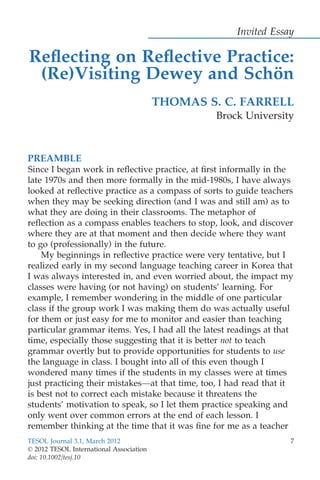
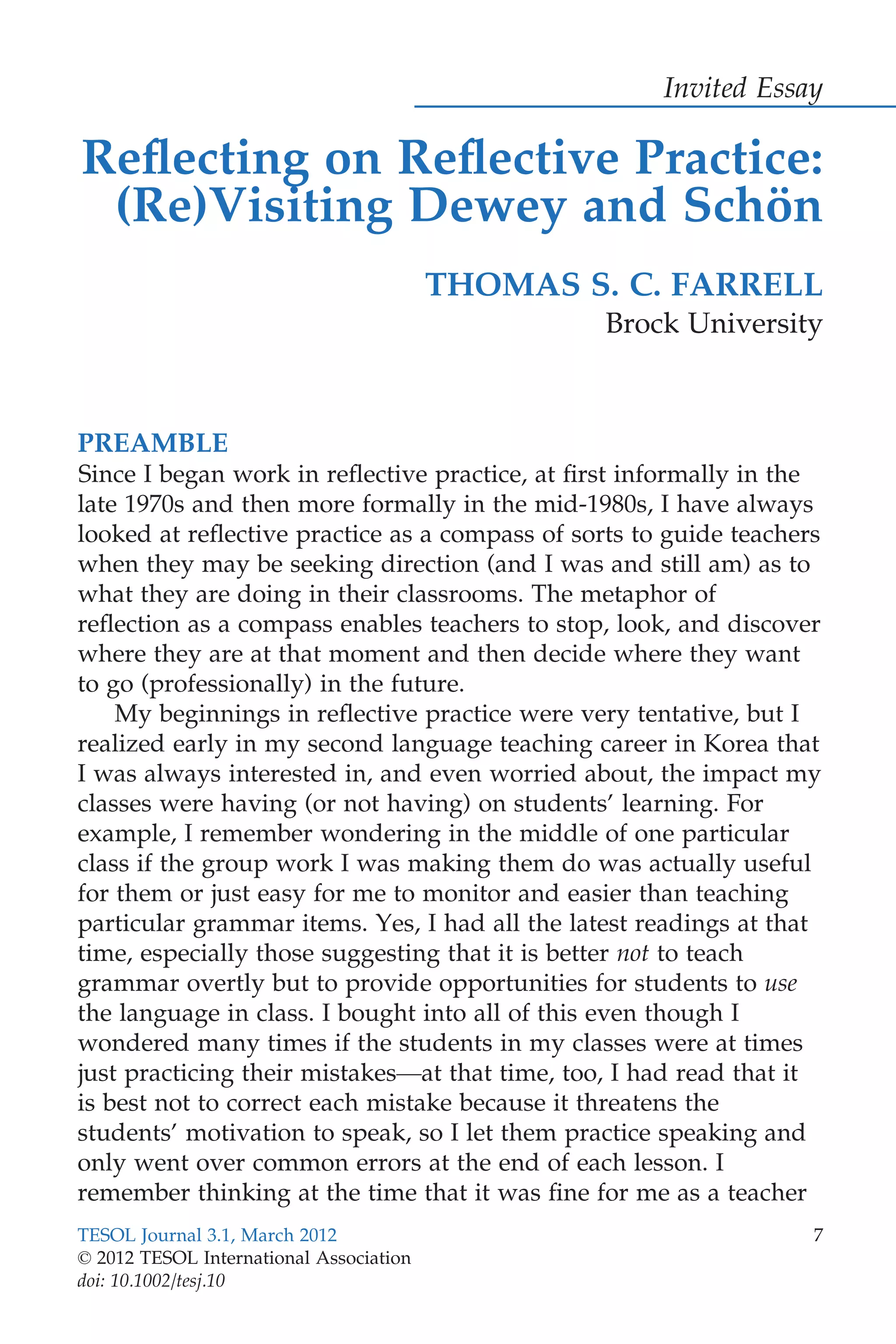
![inquiry from John Dewey’s (1933) original perspective and then
look at how Donald Scho¨n (1983, 1987) interpreted Dewey’s
conceptions of reflection in his work. My main reason for doing
this is that interested readers will be able to better critique many
of the current manifestations of reflective practice in the sense of
how it has been operationalized so that they can see where the
concept originated and what its roots really are. This is thus a
reflective conversation (Scho¨n, 1983, 1987) about reflective practice
that I hope you will join so that you can draw your own
conclusions on how it should be operationalized for your own
needs.
JOHN DEWEY
Early in the 20th century the great American educator John Dewey
(I take most of the following ideas from his wonderful book How
We Think, published in 1933) suggested that one main aim of
education is to help people acquire habits of reflection so they can
engage in intelligent thought and action rather than routine
thought and action. Dewey’s work was situated in the post–Great
Depression U.S. society, and he felt the need for a thinking
citizenry in a democratic society. For him, this was the larger
purpose of reflective inquiry. Dewey (1933) first outlined what
reflective inquiry was not (and this is useful given today’s lack of
clarity and definitional problems associated with the concept of
reflective practice): it is not just mulling things over that interests
us, which unfortunately seems to be a wide interpretation of
reflective thinking today. Dewey viewed reflective inquiry as
“active, persistent, and careful consideration of any belief or
supposed form of knowledge in the light of the grounds that
support it and the further conclusions to which it tends [that]
constitutes reflective thought” (p. 16). Dewey was concerned
about routine thinking whereby actions are guided by impulse,
tradition, or authority. I wonder today, too, about how people in
so-called democratic countries are trapped by their own routine
thinking within political debates (see the record lows in voter
turnout, for example, or the polarization of cable television
stations that side with one group over the other while stating they
are reporting the news objectively).
Reflecting on Reflective Practice 9](https://image.slidesharecdn.com/dewey-shon-131004122054-phpapp02/85/Dewey-Shon-3-320.jpg)
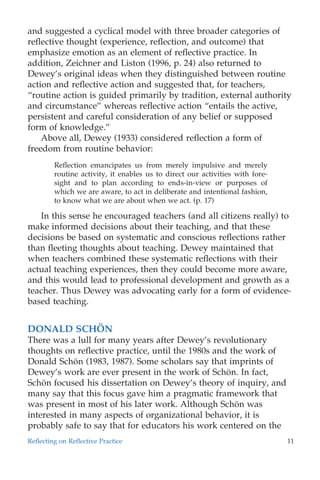
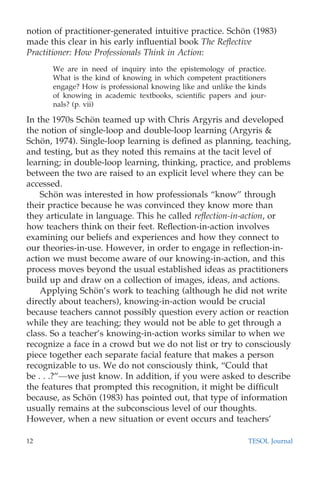
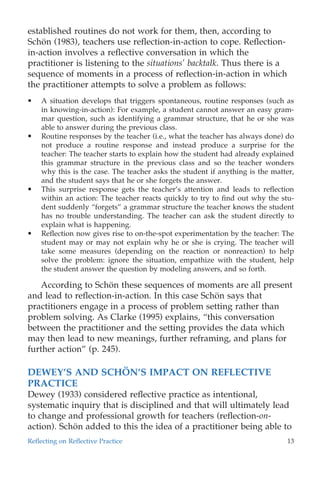
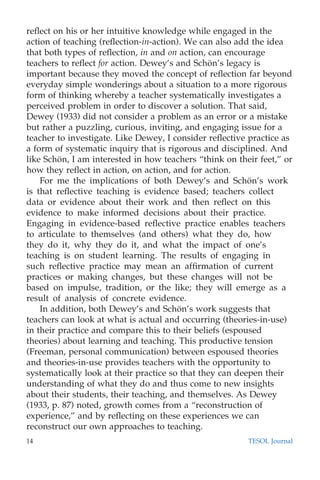

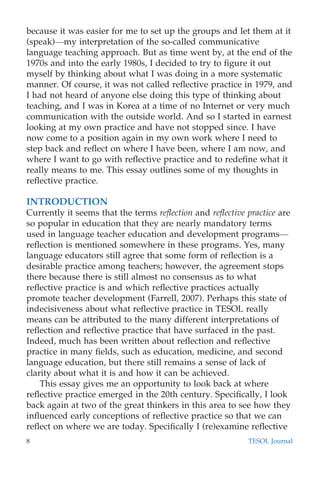
1. The document discusses John Dewey's early 20th century conception of reflective practice, which he saw as a way to help people develop habits of thoughtful action rather than routine behavior. 2. Dewey viewed reflective thinking as the "active, persistent, and careful consideration of any belief or supposed form of knowledge in the light of the grounds that support it." He outlined five phases of reflective thought: suggestion, intellectualization, guiding idea, reasoning, and hypothesis testing. 3. For Dewey, reflection allowed teachers to direct their activities deliberately based on conscious reflection rather than routine, helping them avoid becoming "slaves to routine." He saw reflection as a form of freedom from merely impulsive behavior.


