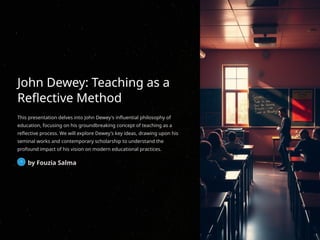
John Dewey: Teaching as a
Reflective Method
This presentation delves into John Dewey's influential philosophy of
education, focusing on his groundbreaking concept of teaching as a
reflective process. We will explore Dewey's key ideas, drawing upon his
seminal works and contemporary scholarship to understand the
profound impact of his vision on modern educational practices.
FS
by Fouzia Salma
Dewey's Experiential Learning
The Centrality of Experience
Dewey believed that learning is rooted in experience, not
passive absorption of knowledge. He advocated for active
engagement in the world through hands-on activities,
problem-solving, and collaborative learning.
The Role of Reflection
Dewey emphasized the importance of reflection as an
integral part of the learning process. He argued that
learners must critically examine their experiences to make
meaning and connect them to existing knowledge.
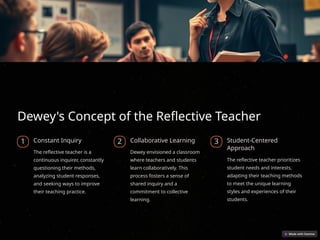
Dewey's Concept of the Reflective Teacher
1 Constant Inquiry
The reflective teacher is a
continuous inquirer, constantly
questioning their methods,
analyzing student responses,
and seeking ways to improve
their teaching practice.
2 Collaborative Learning
Dewey envisioned a classroom
where teachers and students
learn collaboratively. This
process fosters a sense of
shared inquiry and a
commitment to collective
learning.
3 Student-Centered
Approach
The reflective teacher prioritizes
student needs and interests,
adapting their teaching methods
to meet the unique learning
styles and experiences of their
students.
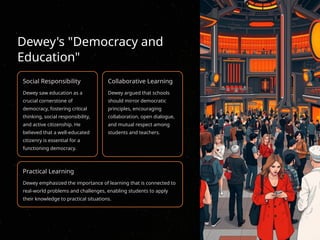
Dewey's "Democracy and
Education"
Social Responsibility
Dewey saw education as a
crucial cornerstone of
democracy, fostering critical
thinking, social responsibility,
and active citizenship. He
believed that a well-educated
citizenry is essential for a
functioning democracy.
Collaborative Learning
Dewey argued that schools
should mirror democratic
principles, encouraging
collaboration, open dialogue,
and mutual respect among
students and teachers.
Practical Learning
Dewey emphasized the importance of learning that is connected to
real-world problems and challenges, enabling students to apply
their knowledge to practical situations.
Dewey's Legacy in Modern
Education
Curriculum Development
Dewey's ideas influenced
curriculum development,
emphasizing project-based
learning, inquiry-based
approaches, and interdisciplinary
connections.
Teacher Education
Dewey's emphasis on reflective
practice has become a
cornerstone of teacher education
programs, equipping teachers
with the skills to continuously
improve their practice.
Assessment Practices
Dewey's focus on learning as a
process rather than a product has
influenced the development of
assessment tools that measure
student progress and growth.
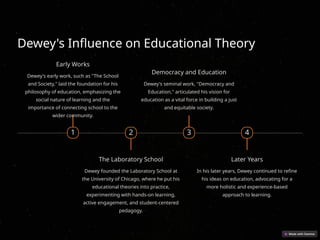
Dewey's Influence on Educational Theory
1
Early Works
Dewey's early work, such as "The School
and Society," laid the foundation for his
philosophy of education, emphasizing the
social nature of learning and the
importance of connecting school to the
wider community.
2
The Laboratory School
Dewey founded the Laboratory School at
the University of Chicago, where he put his
educational theories into practice,
experimenting with hands-on learning,
active engagement, and student-centered
pedagogy.
3
Democracy and Education
Dewey's seminal work, "Democracy and
Education," articulated his vision for
education as a vital force in building a just
and equitable society.
4
Later Years
In his later years, Dewey continued to refine
his ideas on education, advocating for a
more holistic and experience-based
approach to learning.
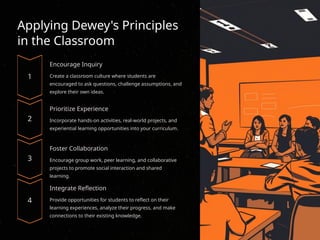
Applying Dewey's Principles
in the Classroom
Encourage Inquiry
Create a classroom culture where students are
encouraged to ask questions, challenge assumptions, and
explore their own ideas.
Prioritize Experience
Incorporate hands-on activities, real-world projects, and
experiential learning opportunities into your curriculum.
Foster Collaboration
Encourage group work, peer learning, and collaborative
projects to promote social interaction and shared
learning.
Integrate Reflection
Provide opportunities for students to reflect on their
learning experiences, analyze their progress, and make
connections to their existing knowledge.
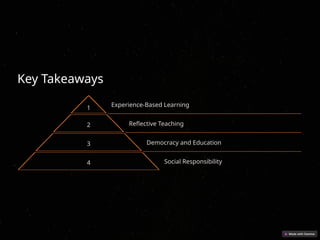
Key Takeaways
1 Experience-Based Learning
2 Reflective Teaching
3 Democracy and Education
4 Social Responsibility
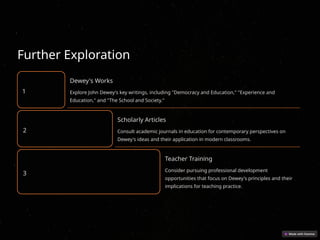
Further Exploration
1
Dewey's Works
Explore John Dewey's key writings, including "Democracy and Education," "Experience and
Education," and "The School and Society."
2
Scholarly Articles
Consult academic journals in education for contemporary perspectives on
Dewey's ideas and their application in modern classrooms.
3
Teacher Training
Consider pursuing professional development
opportunities that focus on Dewey's principles and their
implications for teaching practice.

John-Dewey-Teaching-as-a-Reflective-Method ppt.pptx

  • 1.
    John Dewey: Teachingas a Reflective Method This presentation delves into John Dewey's influential philosophy of education, focusing on his groundbreaking concept of teaching as a reflective process. We will explore Dewey's key ideas, drawing upon his seminal works and contemporary scholarship to understand the profound impact of his vision on modern educational practices. FS by Fouzia Salma
  • 2.
    Dewey's Experiential Learning TheCentrality of Experience Dewey believed that learning is rooted in experience, not passive absorption of knowledge. He advocated for active engagement in the world through hands-on activities, problem-solving, and collaborative learning. The Role of Reflection Dewey emphasized the importance of reflection as an integral part of the learning process. He argued that learners must critically examine their experiences to make meaning and connect them to existing knowledge.
  • 3.
    Dewey's Concept ofthe Reflective Teacher 1 Constant Inquiry The reflective teacher is a continuous inquirer, constantly questioning their methods, analyzing student responses, and seeking ways to improve their teaching practice. 2 Collaborative Learning Dewey envisioned a classroom where teachers and students learn collaboratively. This process fosters a sense of shared inquiry and a commitment to collective learning. 3 Student-Centered Approach The reflective teacher prioritizes student needs and interests, adapting their teaching methods to meet the unique learning styles and experiences of their students.
  • 4.
    Dewey's "Democracy and Education" SocialResponsibility Dewey saw education as a crucial cornerstone of democracy, fostering critical thinking, social responsibility, and active citizenship. He believed that a well-educated citizenry is essential for a functioning democracy. Collaborative Learning Dewey argued that schools should mirror democratic principles, encouraging collaboration, open dialogue, and mutual respect among students and teachers. Practical Learning Dewey emphasized the importance of learning that is connected to real-world problems and challenges, enabling students to apply their knowledge to practical situations.
  • 5.
    Dewey's Legacy inModern Education Curriculum Development Dewey's ideas influenced curriculum development, emphasizing project-based learning, inquiry-based approaches, and interdisciplinary connections. Teacher Education Dewey's emphasis on reflective practice has become a cornerstone of teacher education programs, equipping teachers with the skills to continuously improve their practice. Assessment Practices Dewey's focus on learning as a process rather than a product has influenced the development of assessment tools that measure student progress and growth.
  • 6.
    Dewey's Influence onEducational Theory 1 Early Works Dewey's early work, such as "The School and Society," laid the foundation for his philosophy of education, emphasizing the social nature of learning and the importance of connecting school to the wider community. 2 The Laboratory School Dewey founded the Laboratory School at the University of Chicago, where he put his educational theories into practice, experimenting with hands-on learning, active engagement, and student-centered pedagogy. 3 Democracy and Education Dewey's seminal work, "Democracy and Education," articulated his vision for education as a vital force in building a just and equitable society. 4 Later Years In his later years, Dewey continued to refine his ideas on education, advocating for a more holistic and experience-based approach to learning.
  • 7.
    Applying Dewey's Principles inthe Classroom Encourage Inquiry Create a classroom culture where students are encouraged to ask questions, challenge assumptions, and explore their own ideas. Prioritize Experience Incorporate hands-on activities, real-world projects, and experiential learning opportunities into your curriculum. Foster Collaboration Encourage group work, peer learning, and collaborative projects to promote social interaction and shared learning. Integrate Reflection Provide opportunities for students to reflect on their learning experiences, analyze their progress, and make connections to their existing knowledge.
  • 8.
    Key Takeaways 1 Experience-BasedLearning 2 Reflective Teaching 3 Democracy and Education 4 Social Responsibility
  • 9.
    Further Exploration 1 Dewey's Works ExploreJohn Dewey's key writings, including "Democracy and Education," "Experience and Education," and "The School and Society." 2 Scholarly Articles Consult academic journals in education for contemporary perspectives on Dewey's ideas and their application in modern classrooms. 3 Teacher Training Consider pursuing professional development opportunities that focus on Dewey's principles and their implications for teaching practice.