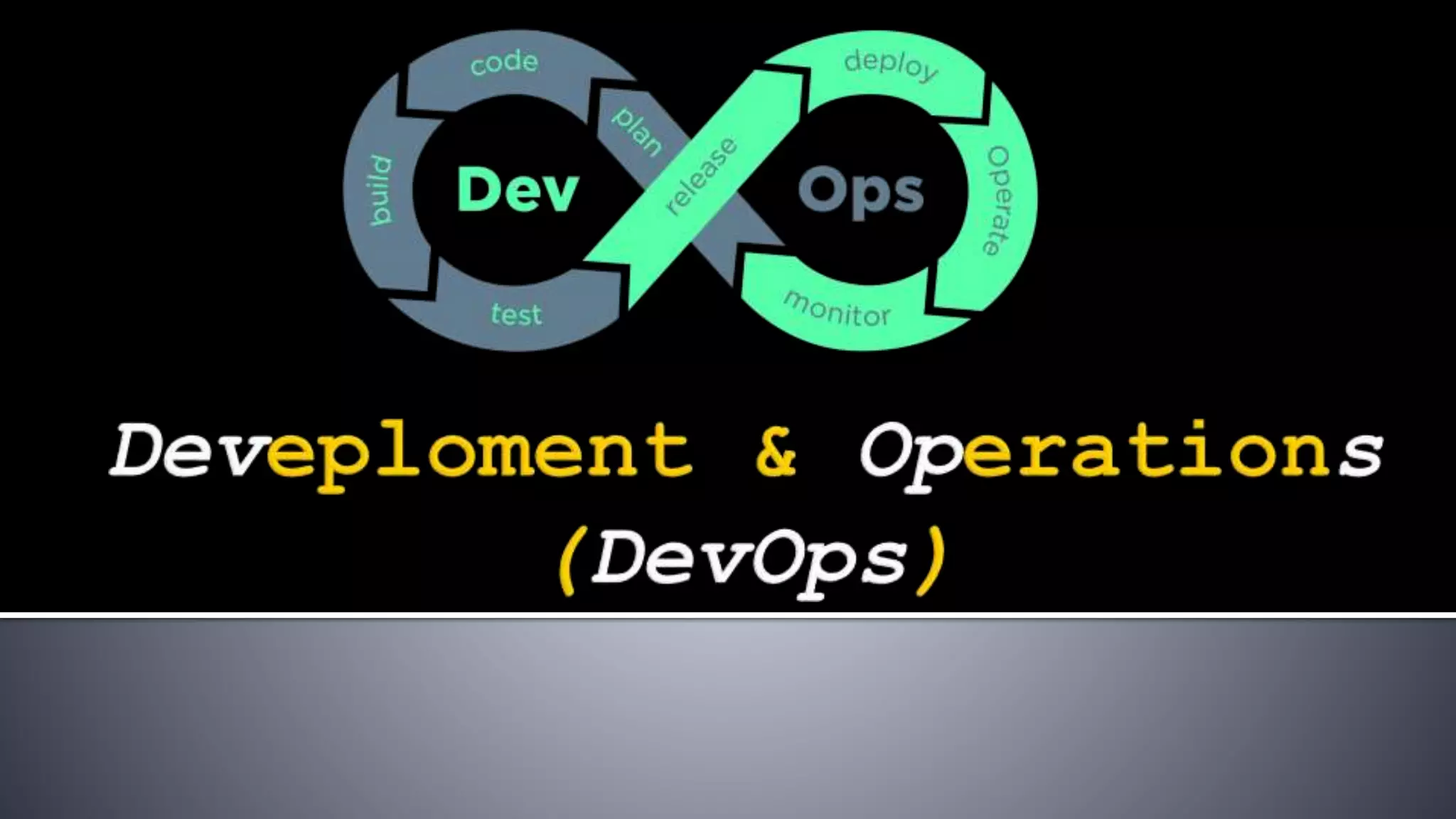
 The DevOps is a combination of two words, one is
software Development, and second is Operations.
 This allows a single team to handle the entire
application lifecycle, from development to testing,
deployment, and operations.
 DevOps helps you to reduce the disconnection
between software developers, quality assurance (QA)
engineers, and system administrators.
Automation
 Automation can reduce time consumption, especially during the testing
and deployment phase. The productivity increases, and releases are made
quicker by automation. This will lead in catching bugs quickly so that it
can be fixed easily. For contiguous delivery, each code is defined through
automated tests, cloud-based services, and builds. This promotes
production using automated deploys.
Collaboration
 The Development and Operations team collaborates as a DevOps team,
the teams share their responsibilities and work closely in sync, which in
turn makes the deployment to production faster.
Integration
 Applications need to be integrated with other components in the
environment. The integration phase is where the existing code is
combined with new functionality and then tested. Continuous integration
and testing enable continuous development. The frequency in the releases
and micro-services leads to significant operational challenges. To
overcome such problems, continuous integration and delivery are
implemented to deliver in a quicker, safer, and reliable manner.
Configuration management
 The configuration file can be written during deployment, or they can be
loaded at the run time, depending on the environment in which it is
running.
 DevOps transformations don't happen overnight. Many companies start
with a pilot project - a simple application where they can get a feel for
new practices and tools. For large-scale DevOps adoption, try moving in
stages.
 Organizations can use the DevOps maturity model as a guide to adoption:
 Initial
 Defined
 Managed
 Measured
 Optimized
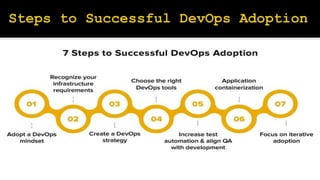
 Adopt a DevOps mindset - everyone involved in the
delivery cycle is more flexible and has an innovative
mentality.
 Recognize your infrastructure requirements -
There is no “one size fits all” DevOps solution. Your
DevOps adoption won’t be successful without
integrating Continuous Integration and Continuous
Delivery (CI/CD) pipelines into your workflow.
 Create a DevOps strategy - strategy should be
focused on two objectives: helping the team as a
whole do its work to the best of its ability and
facilitating the continuous deployment of
processes that are ready for production.
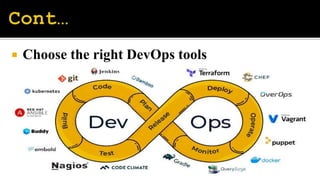
 Choose the right DevOps tools
 Increase test automation and align QA with
development - DevOps requires appropriate automated
testing in order to achieve faster delivery. Not all testing
types need to be automated.
 Application containerization - containerizing enables
DevOps teams to quickly manage the application and make
any adjustments required for a specific microservice.
 Focus on iterative adoption - Measure your success and
growth, then repeat the process.

DevOps.pptx

  • 2.
     The DevOpsis a combination of two words, one is software Development, and second is Operations.  This allows a single team to handle the entire application lifecycle, from development to testing, deployment, and operations.  DevOps helps you to reduce the disconnection between software developers, quality assurance (QA) engineers, and system administrators.
  • 3.
    Automation  Automation canreduce time consumption, especially during the testing and deployment phase. The productivity increases, and releases are made quicker by automation. This will lead in catching bugs quickly so that it can be fixed easily. For contiguous delivery, each code is defined through automated tests, cloud-based services, and builds. This promotes production using automated deploys. Collaboration  The Development and Operations team collaborates as a DevOps team, the teams share their responsibilities and work closely in sync, which in turn makes the deployment to production faster.
  • 4.
    Integration  Applications needto be integrated with other components in the environment. The integration phase is where the existing code is combined with new functionality and then tested. Continuous integration and testing enable continuous development. The frequency in the releases and micro-services leads to significant operational challenges. To overcome such problems, continuous integration and delivery are implemented to deliver in a quicker, safer, and reliable manner. Configuration management  The configuration file can be written during deployment, or they can be loaded at the run time, depending on the environment in which it is running.
  • 5.
     DevOps transformationsdon't happen overnight. Many companies start with a pilot project - a simple application where they can get a feel for new practices and tools. For large-scale DevOps adoption, try moving in stages.  Organizations can use the DevOps maturity model as a guide to adoption:  Initial  Defined  Managed  Measured  Optimized
  • 7.
     Adopt aDevOps mindset - everyone involved in the delivery cycle is more flexible and has an innovative mentality.  Recognize your infrastructure requirements - There is no “one size fits all” DevOps solution. Your DevOps adoption won’t be successful without integrating Continuous Integration and Continuous Delivery (CI/CD) pipelines into your workflow.
  • 8.
     Create aDevOps strategy - strategy should be focused on two objectives: helping the team as a whole do its work to the best of its ability and facilitating the continuous deployment of processes that are ready for production.
  • 9.
     Choose theright DevOps tools
  • 10.
     Increase testautomation and align QA with development - DevOps requires appropriate automated testing in order to achieve faster delivery. Not all testing types need to be automated.  Application containerization - containerizing enables DevOps teams to quickly manage the application and make any adjustments required for a specific microservice.  Focus on iterative adoption - Measure your success and growth, then repeat the process.