DevOPS – Day 1
Thursday, May 20th 2016
About me
Vincent Mercier
vincemercier
System Architect
Integrate voice applications to your professional tools. Our
features include: managing calls in real time, Call Tracking,
Call Controlling, Push SMS, Click-To-Call, real time
statistics, audio conferences, …
Smart Voice Services
What about you?
Basics of DevOPS
What you should know…
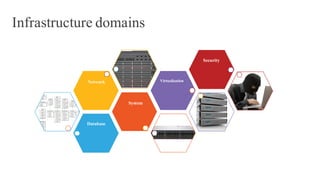
Infrastructure domains
Network
Database
System
Virtualization
Security
Anna
Creative Director
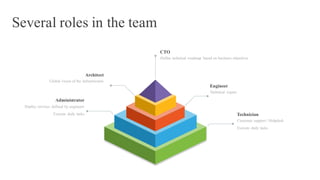
Several roles in the team
Engineer
Technical expert
Architect
Global vision of the infrastructure
Administrator
Deploy services defined by engineers
Execute daily tasks
CTO
Define technical roadmap based on business objectives
Technician
Customer support / Helpdesk
Execute daily tasks
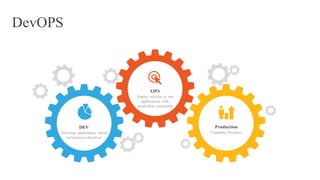
DevOPS
DEV
Develops applications based
on business objectives
OPS
Deploy services to run
applications with
production constraints
Production
Company business
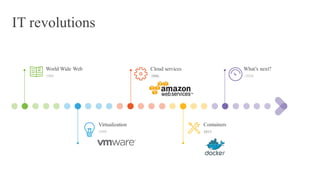
IT revolutions
World Wide Web
1989
Cloud services
2006
What’s next?
~2020
Virtualization
1999
Containers
2013
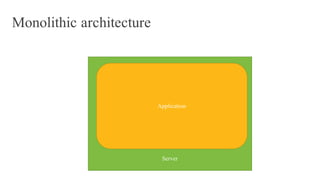
Monolithic architecture
Server
Application
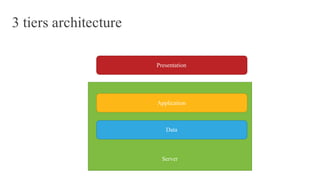
3 tiers architecture
Server
Presentation
Application
Data
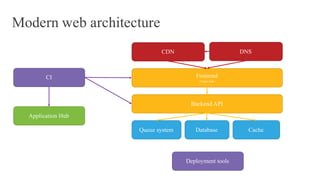
Modern web architecture
Frontend
Client side
Backend API
CDN
Application Hub
CI
Deployment tools
Queue system
DNS
Database Cache
Server
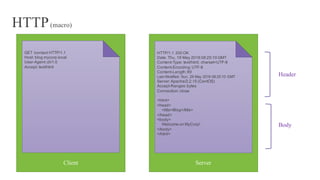
HTTP(macro)
Body
Client
HTTP/1.1 200 OK
Date: Thu, 19 May 2016 08:25:10 GMT
Content-Type: text/html; charset=UTF-8
Content-Encoding:UTF-8
Content-Length:89
Last-Modified: Sun, 29 May 2016 08:25:10 GMT
Server:Apache/2.2.15 (CentOS)
Accept-Ranges:bytes
Connection:close
<html>
<head>
<title>Blog</title>
</head>
<body>
Welcome on MyCorp!
</body>
</html>
GET /contact HTTP/1.1
Host: blog.mycorp.local
User-Agent:cli/1.0
Accept: text/html
Header
Virtual hosting
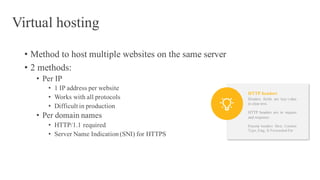
• Method to host multiple websites on the same server
• 2 methods:
• Per IP
• 1 IP address per website
• Works with all protocols
• Difficult in production
• Per domain names
• HTTP/1.1 required
• Server Name Indication(SNI) for HTTPS
Headers fields are key-value
in clear-text.
HTTP headers are in request
and response.
Popular headers: Host, Content-
Type, Etag, X-Forwarded-For
HTTP headers
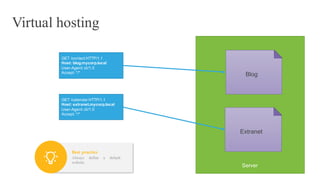
Virtual hosting
Server
Blog
Extranet
Always define a default
website.
Best practice
GET /contact HTTP/1.1
Host: blog.mycorp.local
User-Agent:cli/1.0
Accept: */*
GET /calendar HTTP/1.1
Host: extranet.mycorp.local
User-Agent:cli/1.0
Accept: */*
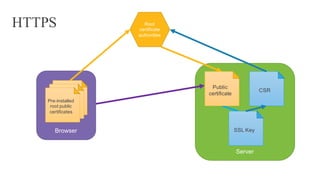
HTTPS
• Create a secure channel over network
• Not a protocol, just HTTP with a secure layer (TLS or SSL)
• Certificates must be signed by a certificate authority
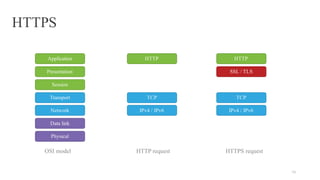
HTTPS
16
Application
Presentation
Session
Transport
Network
Data link
Physical
OSI model
HTTP
HTTP request
TCP
IPv4 / IPv6
HTTP
HTTPS request
TCP
IPv4 / IPv6
SSL / TLS
HTTPS
Browser
Server
Root
certificate
authorities
Public
certificate
CSR
SSL Key
Root
certificate
public
keys
Root
certificate
public
keys
Pre-installed
root public
certificates
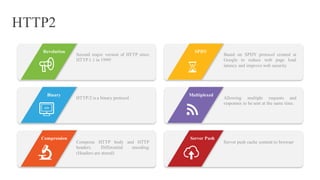
HTTP2
Second major version of HTTP since
HTTP 1.1 in 1999!
Revolution
Server Push
Server push cache content to browser
Compression
Compress HTTP body and HTTP
headers. Differential encoding
(Headers are stored)
Multiplexed
Allowing multiple requests and
responses to be sent at the same time.
Binary
HTTP/2 is a binary protocol
SPDY
Based on SPDY protocol created at
Google to reduce web page load
latency and improve web security
Request 2
HTTP1
GET /contact HTTP/1.1
Host: blog.mycorp.local
Referer: http://blog.mycorp.local/
Date: Tue, 17 May 2016 20:16:21 GMT
Via: 1.1 varnish
Cache-Control: max-age=600
Expires: Mon, 16 May 2016 08:57:14 GMT
X-Served-By: cache-fra1238-FRA
X-Cache: HIT
X-Cache-Hits: 1
Server: Apache/2.2.15 (CentOS)
Vary: Accept-Encoding,Country-Code
X-Fastly-Request-ID:
2cfe9ab75a31cf355f59f0ab2491932398432831
X-Powered-By: PHP/5.3.3
Server: Apache/2.2.15 (CentOS)
[Body]
HTTP1 vs HTTP2
02
Request 1
HTTP1
GET /home HTTP/1.1
Host: blog.mycorp.local
Referer: http://blog.mycorp.local/
Date: Tue, 17 May 2016 20:16:06 GMT
Via: 1.1 varnish
Cache-Control: max-age=600
Expires: Mon, 16 May 2016 08:57:14 GMT
X-Served-By: cache-fra1238-FRA
X-Cache: HIT
X-Cache-Hits: 1
Server: Apache/2.2.15 (CentOS)
Vary: Accept-Encoding,Country-Code
X-Fastly-Request-ID:
2cfe9ab75a31cf355f59f0ab2491932398432831
X-Powered-By: PHP/5.3.3
Server: Apache/2.2.15 (CentOS)
[Body]
Request 2
HTTP2
:method: GET
:scheme: http
:host: blog.mycorp.local
:path: /home
Via: 1.1 varnish
Cache-Control: max-age=600
Expires: Mon, 16 May 2016 08:57:14 GMT
Connection: keep-alive
X-Served-By: cache-fra1238-FRA
X-Cache: HIT
X-Cache-Hits: 1
Server: Apache/2.2.15 (CentOS)
Vary: Accept-Encoding,Country-Code
X-Fastly-Request-ID: 2cfe9ab75a31cf355f59f0ab2491932398432831
X-Powered-By: PHP/5.3.3
Server: Apache/2.2.15 (CentOS)
[Body]
Request 2
HTTP2
:path: /contact
referer: http://blog.mycorp.local/home
X-Fastly-Request-ID: 2cfe9ab75a31cf355f59f0ab2491932398434234
Expires: Mon, 16 May 2016 09:43:23 GMT
[Body]
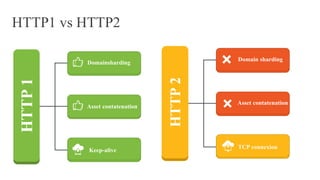
HTTP1 vs HTTP2HTTP1
HTTP2
Domainsharding
Asset contatenation
Keep-alive
Domain sharding
Asset contatenation
TCP connexion
Let’s go for HTTP2?
• Clients and servers libraries are quiet new…
• HTTP2 is implemented only with TLS in most of browsers
• http://caniuse.com/#feat=http2
• https://github.com/http2/http2-spec/wiki/Implementations
• Next step?
• QUIC!
• Built on top of UDP
• https://www.chromium.org/quic
Resources for DevOPS
• MAN…
• Helpful websites
• https://www.howtoforge.com
• http://highscalability.com
• French mailing list
• http://www.frsag.com
• Meetup
Lunch break!
23
Workshop
Webhosting for a Symphony application
24
Goals
• Install a webserver
• Linux
• MariaDB
• PHP
• Nginx
• Running a Symphony application
• Backup and restore the website
Technical details
• Server
• Virtual machine (Virtualbox + Vagrant)
• IP: 192.168.42.42
• Linux / Nginx / PHP / MariaDB
• Website
• Domain: blog.mycorp.local
• SSL
• Symphony application
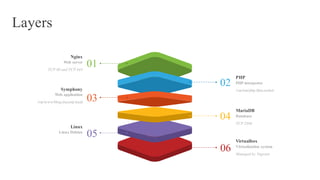
Layers
PHP interpreter
/var/run/php-fpm.socket
Database
TCP 3306
Virtualization system
Managed by Vagrant
Web server
TCP 80 and TCP 443
Web application
/var/www/blog.mycorp.local
Linux Debian
Nginx
Symphony
Linux
PHP
MariaDB
Virtualbox
01
03
05
02
04
06
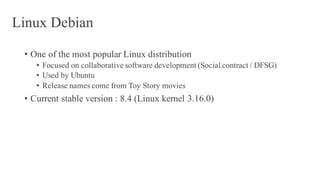
Linux Debian
• One of the most popular Linux distribution
• Focused on collaborative software development (Social contract / DFSG)
• Used by Ubuntu
• Release names come from Toy Story movies
• Current stable version : 8.4 (Linux kernel 3.16.0)
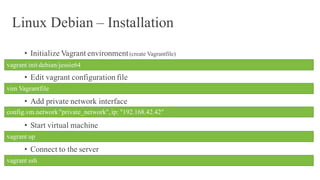
Linux Debian – Installation
• Initialize Vagrant environment(create Vagrantfile)
• Edit vagrant configuration file
• Add private network interface
• Start virtual machine
• Connect to the server
vagrant init debian/jessie64
vim Vagrantfile
config.vm.network"private_network",ip: "192.168.42.42"
vagrant up
vagrant ssh
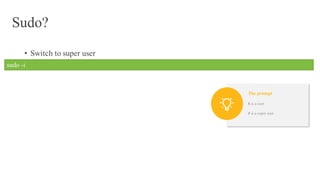
Sudo?
• Switch to super user
• Edit vagrant filesudo -i
$ is a user
# is a super user
The prompt
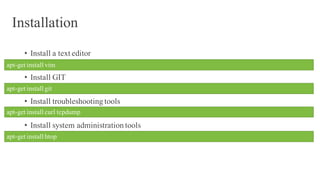
Installation
• Install a text editor
• Install GIT
• Install troubleshooting tools
• Install system administration tools
apt-get install vim
apt-get install git
apt-get install curl tcpdump
apt-get install htop
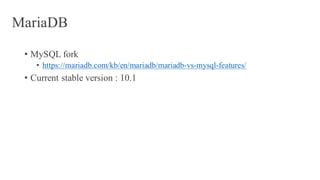
MariaDB
• MySQL fork
• https://mariadb.com/kb/en/mariadb/mariadb-vs-mysql-features/
• Current stable version : 10.1
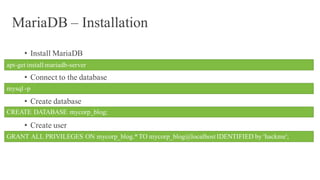
MariaDB – Installation
• Install MariaDB
• Connect to the database
• Create database
• Create user
apt-get install mariadb-server
mysql -p
CREATE DATABASE mycorp_blog;
GRANT ALL PRIVILEGES ON mycorp_blog.*TO mycorp_blog@localhost IDENTIFIED by 'hackme';
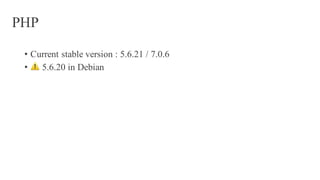
PHP
• Current stable version : 5.6.21 / 7.0.6
• ⚠️ 5.6.20 in Debian
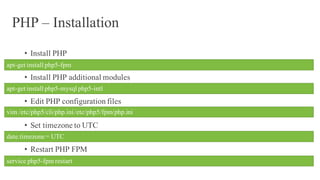
PHP – Installation
• Install PHP
• Install PHP additional modules
• Edit PHP configuration files
• Set timezone to UTC
• Restart PHP FPM
apt-get install php5-fpm
apt-get install php5-mysql php5-intl
vim /etc/php5/cli/php.ini/etc/php5/fpm/php.ini
date.timezone = UTC
service php5-fpm restart
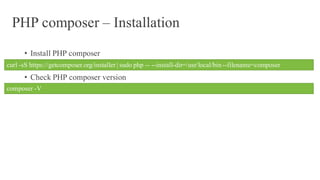
PHP composer – Installation
• Install PHP composer
• Check PHP composer version
curl -sS https://getcomposer.org/installer | sudo php -- --install-dir=/usr/local/bin--filename=composer
composer -V
Nginx
• Current stable version : 1.9.15
• ⚠️ 1.6.2 in Debian
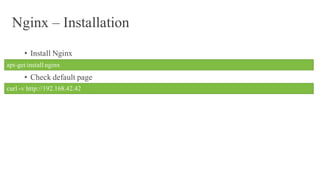
Nginx – Installation
• Install Nginx
• Check default page
apt-get install nginx
curl -v http://192.168.42.42
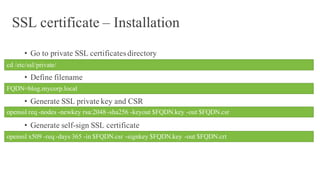
SSL certificate – Installation
• Go to private SSL certificates directory
• Define filename
• Generate SSL private key and CSR
• Generate self-sign SSL certificate
cd /etc/ssl/private/
FQDN=blog.mycorp.local
openssl req -nodes -newkey rsa:2048-sha256 -keyout $FQDN.key -out $FQDN.csr
openssl x509 -req -days 365 -in $FQDN.csr -signkey $FQDN.key -out $FQDN.crt
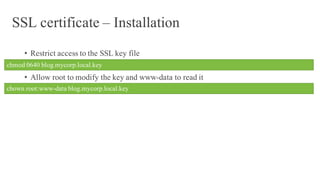
SSL certificate – Installation
• Restrict access to the SSL key file
• Allow root to modify the key and www-data to read it
chmod 0640 blog.mycorp.local.key
chown root:www-data blog.mycorp.local.key
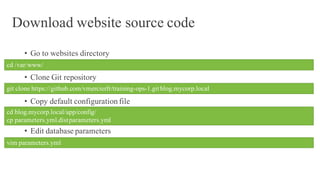
Download website source code
• Go to websites directory
• Clone Git repository
• Copy default configuration file
• Edit database parameters
cd /var/www/
git clone https://github.com/vmercierfr/training-ops-1.gitblog.mycorp.local
cd blog.mycorp.local/app/config/
cp parameters.yml.distparameters.yml
vim parameters.yml
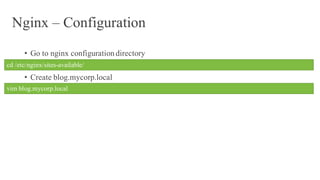
Nginx – Configuration
• Go to nginx configuration directory
• Create blog.mycorp.local
cd /etc/nginx/sites-available/
vim blog.mycorp.local
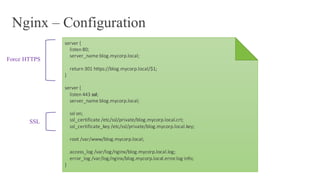
Nginx – Configuration
server	{
listen	80;
server_name blog.mycorp.local;
return	301	https://blog.mycorp.local/$1;
}
server	{
listen	443	ssl;
server_name blog.mycorp.local;
ssl on;
ssl_certificate /etc/ssl/private/blog.mycorp.local.crt;
ssl_certificate_key /etc/ssl/private/blog.mycorp.local.key;
root	/var/www/blog.mycorp.local;
access_log /var/log/nginx/blog.mycorp.local.log;
error_log /var/log/nginx/blog.mycorp.local.error.log info;
}
Force HTTPS
SSL
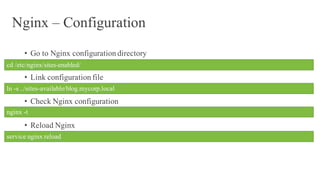
Nginx – Configuration
• Go to Nginx configuration directory
• Link configuration file
• Check Nginx configuration
• Reload Nginx
cd /etc/nginx/sites-enabled/
ln -s ../sites-available/blog.mycorp.local
nginx -t
service nginx reload
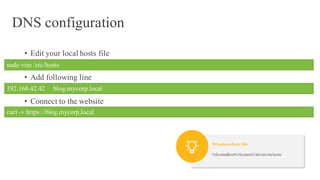
DNS configuration
• Edit your local hosts file
• Add following line
• Connect to the website
sudo vim /etc/hosts
192.168.42.42 blog.mycorp.local
curl -v https://blog.mycorp.local
%SystemRoot%System32driversetchosts
Windows host file
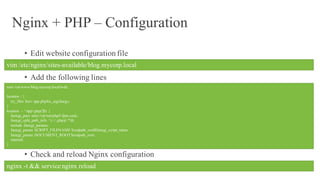
Nginx + PHP – Configuration
• Edit website configuration file
• Add the following lines
• Check and reload Nginx configuration
vim /etc/nginx/sites-available/blog.mycorp.local
root /var/www/blog.mycorp.local/web;
location / {
try_files $uri /app.php$is_args$args;
}
location ~ ^/app.php(/|$) {
fastcgi_pass unix:/var/run/php5-fpm.sock;
fastcgi_split_path_info ^(.+.php)(/.*)$;
include fastcgi_params;
fastcgi_param SCRIPT_FILENAME $realpath_root$fastcgi_script_name;
fastcgi_param DOCUMENT_ROOT$realpath_root;
internal;
}
nginx -t && service nginx reload
PHP errors
• Check the errors log file
tail -f /var/log/nginx/blog.mycorp.local.error.log
2016/05/18 23:02:12 [error] 8885#0: *119 FastCGI sent in stderr: "PHP message: PHP Warning: require(/var/www/blog.mycorp.local/app/../vendor/autoload.php): failed to open stream: No
such file or directory in /var/www/blog.mycorp.local/app/autoload.php on line 11
PHP message: PHP Fatal error: require(): Failed opening required '/var/www/blog.mycorp.local/app/../vendor/autoload.php' (include_path='.:/usr/share/php:/usr/share/pear') in
/var/www/blog.mycorp.local/app/autoload.php on line 11" while reading response header from upstream, client: 192.168.42.1, server: blog.mycorp.local, request: "GET /en/blog/
HTTP/1.1", upstream: "fastcgi://unix:/var/run/php5-fpm.sock:", host: "blog.mycorp.local", referrer: "https://blog.mycorp.local/"
2016/05/18 23:03:07 [error] 8885#0: *119 FastCGI sent in stderr: "PHP message: PHP Warning: require(/var/www/blog.mycorp.local/app/../vendor/autoload.php): failed to open stream: No
such file or directory in /var/www/blog.mycorp.local/app/autoload.php on line 11
PHP message: PHP Fatal error: require(): Failed opening required '/var/www/blog.mycorp.local/app/../vendor/autoload.php' (include_path='.:/usr/share/php:/usr/share/pear') in
/var/www/blog.mycorp.local/app/autoload.php on line 11" while reading response header from upstream, client: 192.168.42.1, server: blog.mycorp.local, request: "GET /en/blog/
HTTP/1.1", upstream: "fastcgi://unix:/var/run/php5-fpm.sock:", host: "blog.mycorp.local"
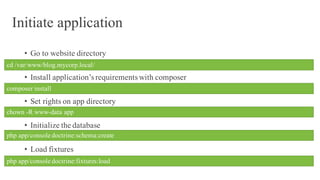
Initiate application
• Go to website directory
• Install application’s requirements with composer
• Set rights on app directory
• Initialize the database
• Load fixtures
cd /var/www/blog.mycorp.local/
composer install
chown -R www-data app
php app/console doctrine:schema:create
php app/console doctrine:fixtures:load
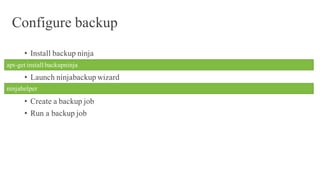
Configure backup
• Install backup ninja
• Launch ninjabackup wizard
• Create a backup job
• Run a backup job
apt-get install backupninja
ninjahelper
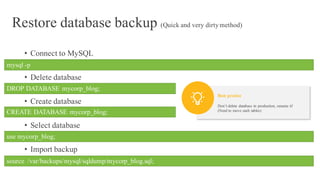
Restore database backup (Quick and very dirtymethod)
• Connect to MySQL
• Delete database
• Create database
• Select database
• Import backup
mysql -p
DROP DATABASE mycorp_blog;
CREATE DATABASE mycorp_blog;
use mycorp_blog;
source /var/backups/mysql/sqldump/mycorp_blog.sql;
Don’t delete database in production, rename it!
(Need to move each tables)
Best pratice
Q&A

DevOPS training - Day 1/2

  • 1.
    DevOPS – Day1 Thursday, May 20th 2016
  • 2.
    About me Vincent Mercier vincemercier SystemArchitect Integrate voice applications to your professional tools. Our features include: managing calls in real time, Call Tracking, Call Controlling, Push SMS, Click-To-Call, real time statistics, audio conferences, … Smart Voice Services
  • 3.
  • 4.
    Basics of DevOPS Whatyou should know…
  • 5.
  • 6.
    Several roles inthe team Engineer Technical expert Architect Global vision of the infrastructure Administrator Deploy services defined by engineers Execute daily tasks CTO Define technical roadmap based on business objectives Technician Customer support / Helpdesk Execute daily tasks
  • 7.
    DevOPS DEV Develops applications based onbusiness objectives OPS Deploy services to run applications with production constraints Production Company business
  • 8.
    IT revolutions World WideWeb 1989 Cloud services 2006 What’s next? ~2020 Virtualization 1999 Containers 2013
  • 9.
  • 10.
  • 11.
    Modern web architecture Frontend Clientside Backend API CDN Application Hub CI Deployment tools Queue system DNS Database Cache
  • 12.
    Server HTTP(macro) Body Client HTTP/1.1 200 OK Date:Thu, 19 May 2016 08:25:10 GMT Content-Type: text/html; charset=UTF-8 Content-Encoding:UTF-8 Content-Length:89 Last-Modified: Sun, 29 May 2016 08:25:10 GMT Server:Apache/2.2.15 (CentOS) Accept-Ranges:bytes Connection:close <html> <head> <title>Blog</title> </head> <body> Welcome on MyCorp! </body> </html> GET /contact HTTP/1.1 Host: blog.mycorp.local User-Agent:cli/1.0 Accept: text/html Header
  • 13.
    Virtual hosting • Methodto host multiple websites on the same server • 2 methods: • Per IP • 1 IP address per website • Works with all protocols • Difficult in production • Per domain names • HTTP/1.1 required • Server Name Indication(SNI) for HTTPS Headers fields are key-value in clear-text. HTTP headers are in request and response. Popular headers: Host, Content- Type, Etag, X-Forwarded-For HTTP headers
  • 14.
    Virtual hosting Server Blog Extranet Always definea default website. Best practice GET /contact HTTP/1.1 Host: blog.mycorp.local User-Agent:cli/1.0 Accept: */* GET /calendar HTTP/1.1 Host: extranet.mycorp.local User-Agent:cli/1.0 Accept: */*
  • 15.
    HTTPS • Create asecure channel over network • Not a protocol, just HTTP with a secure layer (TLS or SSL) • Certificates must be signed by a certificate authority
  • 16.
    HTTPS 16 Application Presentation Session Transport Network Data link Physical OSI model HTTP HTTPrequest TCP IPv4 / IPv6 HTTP HTTPS request TCP IPv4 / IPv6 SSL / TLS
  • 17.
  • 18.
    HTTP2 Second major versionof HTTP since HTTP 1.1 in 1999! Revolution Server Push Server push cache content to browser Compression Compress HTTP body and HTTP headers. Differential encoding (Headers are stored) Multiplexed Allowing multiple requests and responses to be sent at the same time. Binary HTTP/2 is a binary protocol SPDY Based on SPDY protocol created at Google to reduce web page load latency and improve web security
  • 19.
    Request 2 HTTP1 GET /contactHTTP/1.1 Host: blog.mycorp.local Referer: http://blog.mycorp.local/ Date: Tue, 17 May 2016 20:16:21 GMT Via: 1.1 varnish Cache-Control: max-age=600 Expires: Mon, 16 May 2016 08:57:14 GMT X-Served-By: cache-fra1238-FRA X-Cache: HIT X-Cache-Hits: 1 Server: Apache/2.2.15 (CentOS) Vary: Accept-Encoding,Country-Code X-Fastly-Request-ID: 2cfe9ab75a31cf355f59f0ab2491932398432831 X-Powered-By: PHP/5.3.3 Server: Apache/2.2.15 (CentOS) [Body] HTTP1 vs HTTP2 02 Request 1 HTTP1 GET /home HTTP/1.1 Host: blog.mycorp.local Referer: http://blog.mycorp.local/ Date: Tue, 17 May 2016 20:16:06 GMT Via: 1.1 varnish Cache-Control: max-age=600 Expires: Mon, 16 May 2016 08:57:14 GMT X-Served-By: cache-fra1238-FRA X-Cache: HIT X-Cache-Hits: 1 Server: Apache/2.2.15 (CentOS) Vary: Accept-Encoding,Country-Code X-Fastly-Request-ID: 2cfe9ab75a31cf355f59f0ab2491932398432831 X-Powered-By: PHP/5.3.3 Server: Apache/2.2.15 (CentOS) [Body] Request 2 HTTP2 :method: GET :scheme: http :host: blog.mycorp.local :path: /home Via: 1.1 varnish Cache-Control: max-age=600 Expires: Mon, 16 May 2016 08:57:14 GMT Connection: keep-alive X-Served-By: cache-fra1238-FRA X-Cache: HIT X-Cache-Hits: 1 Server: Apache/2.2.15 (CentOS) Vary: Accept-Encoding,Country-Code X-Fastly-Request-ID: 2cfe9ab75a31cf355f59f0ab2491932398432831 X-Powered-By: PHP/5.3.3 Server: Apache/2.2.15 (CentOS) [Body] Request 2 HTTP2 :path: /contact referer: http://blog.mycorp.local/home X-Fastly-Request-ID: 2cfe9ab75a31cf355f59f0ab2491932398434234 Expires: Mon, 16 May 2016 09:43:23 GMT [Body]
  • 20.
    HTTP1 vs HTTP2HTTP1 HTTP2 Domainsharding Assetcontatenation Keep-alive Domain sharding Asset contatenation TCP connexion
  • 21.
    Let’s go forHTTP2? • Clients and servers libraries are quiet new… • HTTP2 is implemented only with TLS in most of browsers • http://caniuse.com/#feat=http2 • https://github.com/http2/http2-spec/wiki/Implementations • Next step? • QUIC! • Built on top of UDP • https://www.chromium.org/quic
  • 22.
    Resources for DevOPS •MAN… • Helpful websites • https://www.howtoforge.com • http://highscalability.com • French mailing list • http://www.frsag.com • Meetup
  • 23.
  • 24.
    Workshop Webhosting for aSymphony application 24
  • 25.
    Goals • Install awebserver • Linux • MariaDB • PHP • Nginx • Running a Symphony application • Backup and restore the website
  • 26.
    Technical details • Server •Virtual machine (Virtualbox + Vagrant) • IP: 192.168.42.42 • Linux / Nginx / PHP / MariaDB • Website • Domain: blog.mycorp.local • SSL • Symphony application
  • 27.
    Layers PHP interpreter /var/run/php-fpm.socket Database TCP 3306 Virtualizationsystem Managed by Vagrant Web server TCP 80 and TCP 443 Web application /var/www/blog.mycorp.local Linux Debian Nginx Symphony Linux PHP MariaDB Virtualbox 01 03 05 02 04 06
  • 28.
    Linux Debian • Oneof the most popular Linux distribution • Focused on collaborative software development (Social contract / DFSG) • Used by Ubuntu • Release names come from Toy Story movies • Current stable version : 8.4 (Linux kernel 3.16.0)
  • 29.
    Linux Debian –Installation • Initialize Vagrant environment(create Vagrantfile) • Edit vagrant configuration file • Add private network interface • Start virtual machine • Connect to the server vagrant init debian/jessie64 vim Vagrantfile config.vm.network"private_network",ip: "192.168.42.42" vagrant up vagrant ssh
  • 30.
    Sudo? • Switch tosuper user • Edit vagrant filesudo -i $ is a user # is a super user The prompt
  • 31.
    Installation • Install atext editor • Install GIT • Install troubleshooting tools • Install system administration tools apt-get install vim apt-get install git apt-get install curl tcpdump apt-get install htop
  • 32.
    MariaDB • MySQL fork •https://mariadb.com/kb/en/mariadb/mariadb-vs-mysql-features/ • Current stable version : 10.1
  • 33.
    MariaDB – Installation •Install MariaDB • Connect to the database • Create database • Create user apt-get install mariadb-server mysql -p CREATE DATABASE mycorp_blog; GRANT ALL PRIVILEGES ON mycorp_blog.*TO mycorp_blog@localhost IDENTIFIED by 'hackme';
  • 34.
    PHP • Current stableversion : 5.6.21 / 7.0.6 • ⚠️ 5.6.20 in Debian
  • 35.
    PHP – Installation •Install PHP • Install PHP additional modules • Edit PHP configuration files • Set timezone to UTC • Restart PHP FPM apt-get install php5-fpm apt-get install php5-mysql php5-intl vim /etc/php5/cli/php.ini/etc/php5/fpm/php.ini date.timezone = UTC service php5-fpm restart
  • 36.
    PHP composer –Installation • Install PHP composer • Check PHP composer version curl -sS https://getcomposer.org/installer | sudo php -- --install-dir=/usr/local/bin--filename=composer composer -V
  • 37.
    Nginx • Current stableversion : 1.9.15 • ⚠️ 1.6.2 in Debian
  • 38.
    Nginx – Installation •Install Nginx • Check default page apt-get install nginx curl -v http://192.168.42.42
  • 39.
    SSL certificate –Installation • Go to private SSL certificates directory • Define filename • Generate SSL private key and CSR • Generate self-sign SSL certificate cd /etc/ssl/private/ FQDN=blog.mycorp.local openssl req -nodes -newkey rsa:2048-sha256 -keyout $FQDN.key -out $FQDN.csr openssl x509 -req -days 365 -in $FQDN.csr -signkey $FQDN.key -out $FQDN.crt
  • 40.
    SSL certificate –Installation • Restrict access to the SSL key file • Allow root to modify the key and www-data to read it chmod 0640 blog.mycorp.local.key chown root:www-data blog.mycorp.local.key
  • 41.
    Download website sourcecode • Go to websites directory • Clone Git repository • Copy default configuration file • Edit database parameters cd /var/www/ git clone https://github.com/vmercierfr/training-ops-1.gitblog.mycorp.local cd blog.mycorp.local/app/config/ cp parameters.yml.distparameters.yml vim parameters.yml
  • 42.
    Nginx – Configuration •Go to nginx configuration directory • Create blog.mycorp.local cd /etc/nginx/sites-available/ vim blog.mycorp.local
  • 43.
    Nginx – Configuration server { listen 80; server_nameblog.mycorp.local; return 301 https://blog.mycorp.local/$1; } server { listen 443 ssl; server_name blog.mycorp.local; ssl on; ssl_certificate /etc/ssl/private/blog.mycorp.local.crt; ssl_certificate_key /etc/ssl/private/blog.mycorp.local.key; root /var/www/blog.mycorp.local; access_log /var/log/nginx/blog.mycorp.local.log; error_log /var/log/nginx/blog.mycorp.local.error.log info; } Force HTTPS SSL
  • 44.
    Nginx – Configuration •Go to Nginx configuration directory • Link configuration file • Check Nginx configuration • Reload Nginx cd /etc/nginx/sites-enabled/ ln -s ../sites-available/blog.mycorp.local nginx -t service nginx reload
  • 45.
    DNS configuration • Edityour local hosts file • Add following line • Connect to the website sudo vim /etc/hosts 192.168.42.42 blog.mycorp.local curl -v https://blog.mycorp.local %SystemRoot%System32driversetchosts Windows host file
  • 46.
    Nginx + PHP– Configuration • Edit website configuration file • Add the following lines • Check and reload Nginx configuration vim /etc/nginx/sites-available/blog.mycorp.local root /var/www/blog.mycorp.local/web; location / { try_files $uri /app.php$is_args$args; } location ~ ^/app.php(/|$) { fastcgi_pass unix:/var/run/php5-fpm.sock; fastcgi_split_path_info ^(.+.php)(/.*)$; include fastcgi_params; fastcgi_param SCRIPT_FILENAME $realpath_root$fastcgi_script_name; fastcgi_param DOCUMENT_ROOT$realpath_root; internal; } nginx -t && service nginx reload
  • 47.
    PHP errors • Checkthe errors log file tail -f /var/log/nginx/blog.mycorp.local.error.log 2016/05/18 23:02:12 [error] 8885#0: *119 FastCGI sent in stderr: "PHP message: PHP Warning: require(/var/www/blog.mycorp.local/app/../vendor/autoload.php): failed to open stream: No such file or directory in /var/www/blog.mycorp.local/app/autoload.php on line 11 PHP message: PHP Fatal error: require(): Failed opening required '/var/www/blog.mycorp.local/app/../vendor/autoload.php' (include_path='.:/usr/share/php:/usr/share/pear') in /var/www/blog.mycorp.local/app/autoload.php on line 11" while reading response header from upstream, client: 192.168.42.1, server: blog.mycorp.local, request: "GET /en/blog/ HTTP/1.1", upstream: "fastcgi://unix:/var/run/php5-fpm.sock:", host: "blog.mycorp.local", referrer: "https://blog.mycorp.local/" 2016/05/18 23:03:07 [error] 8885#0: *119 FastCGI sent in stderr: "PHP message: PHP Warning: require(/var/www/blog.mycorp.local/app/../vendor/autoload.php): failed to open stream: No such file or directory in /var/www/blog.mycorp.local/app/autoload.php on line 11 PHP message: PHP Fatal error: require(): Failed opening required '/var/www/blog.mycorp.local/app/../vendor/autoload.php' (include_path='.:/usr/share/php:/usr/share/pear') in /var/www/blog.mycorp.local/app/autoload.php on line 11" while reading response header from upstream, client: 192.168.42.1, server: blog.mycorp.local, request: "GET /en/blog/ HTTP/1.1", upstream: "fastcgi://unix:/var/run/php5-fpm.sock:", host: "blog.mycorp.local"
  • 48.
    Initiate application • Goto website directory • Install application’s requirements with composer • Set rights on app directory • Initialize the database • Load fixtures cd /var/www/blog.mycorp.local/ composer install chown -R www-data app php app/console doctrine:schema:create php app/console doctrine:fixtures:load
  • 49.
    Configure backup • Installbackup ninja • Launch ninjabackup wizard • Create a backup job • Run a backup job apt-get install backupninja ninjahelper
  • 50.
    Restore database backup(Quick and very dirtymethod) • Connect to MySQL • Delete database • Create database • Select database • Import backup mysql -p DROP DATABASE mycorp_blog; CREATE DATABASE mycorp_blog; use mycorp_blog; source /var/backups/mysql/sqldump/mycorp_blog.sql; Don’t delete database in production, rename it! (Need to move each tables) Best pratice
  • 51.