Indian Banking System BBA (Banking & Insurance) Paper Code: 112
Unit-I Development Banking
Development Banking National Bank for Agriculture and Rural Development (NABARD) Industrial Financial Corporation of India (IFCI) Industrial Development Bank of India (IDBI) Small Industrial Development Bank of India (SIDBI)
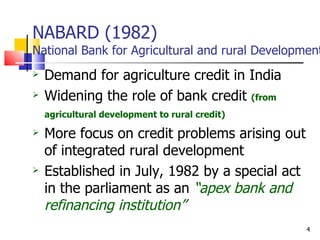
NABARD (1982) National Bank for Agricultural and rural Development Demand for agriculture credit in India Widening the role of bank credit  (from agricultural development to rural credit)   More focus on credit problems arising out of integrated rural development Established in July, 1982 by a special act in the parliament as an   “apex bank and refinancing institution”
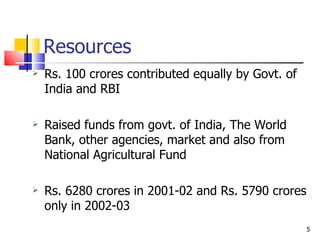
Resources Rs. 100 crores contributed equally by Govt. of India and RBI Raised funds from govt. of India, The World Bank, other agencies, market and also from National Agricultural Fund Rs. 6280 crores in 2001-02 and Rs. 5790 crores only in 2002-03
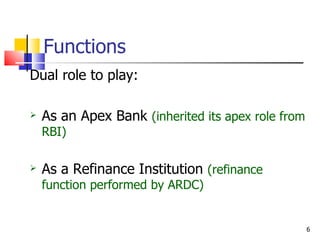
Functions Dual role to play: As an Apex Bank  (inherited its apex role from RBI) As a Refinance Institution  (refinance function performed by ARDC)
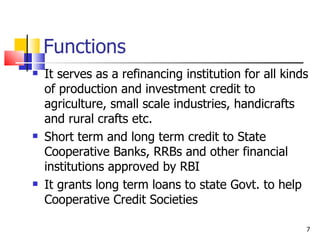
Functions It serves as a refinancing institution for all kinds of production and investment credit to agriculture, small scale industries, handicrafts and rural crafts etc. Short term and long term credit to State Cooperative Banks, RRBs and other financial institutions approved by RBI It grants long term loans to state Govt. to help Cooperative Credit Societies
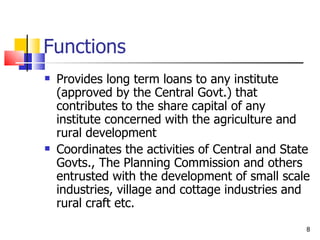
Functions  Provides long term loans to any institute (approved by the Central Govt.) that contributes to the share capital of any institute concerned with the agriculture and rural development Coordinates the activities of Central and State Govts., The Planning Commission and others entrusted with the development of small scale industries, village and cottage industries and rural craft etc.
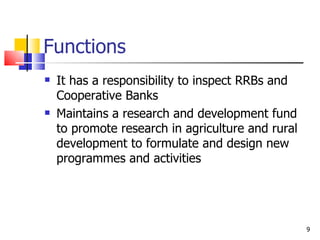
Functions  It has a responsibility to inspect RRBs and Cooperative Banks Maintains a research and development fund to promote research in agriculture and rural development to formulate and design new programmes and activities
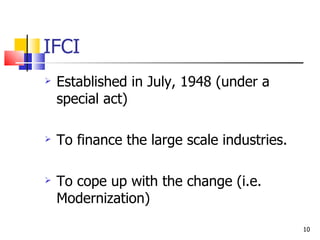
IFCI Established in July, 1948 (under a special act) To finance the large scale industries. To cope up with the change (i.e. Modernization)
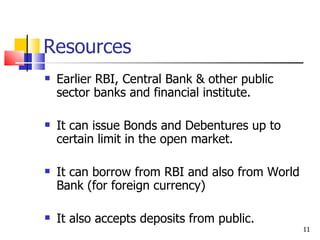
Resources Earlier RBI, Central Bank & other public sector banks and financial institute. It can issue Bonds and Debentures up to certain limit in the open market. It can borrow from RBI and also from World Bank (for foreign currency) It also accepts deposits from public.
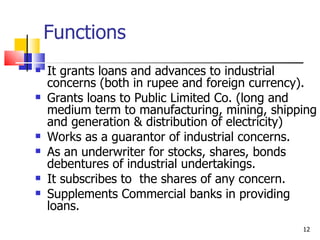
Functions It grants loans and advances to industrial concerns (both in rupee and foreign currency). Grants loans to Public Limited Co. (long and medium term to manufacturing, mining, shipping and generation & distribution of electricity) Works as a guarantor of industrial concerns. As an underwriter for stocks, shares, bonds debentures of industrial undertakings. It subscribes to  the shares of any concern. Supplements Commercial banks in providing loans.
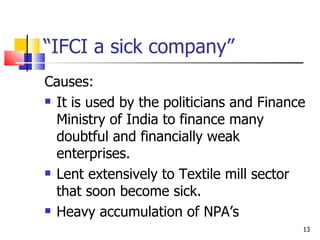
“IFCI a sick company” Causes: It is used by the politicians and Finance Ministry of India to finance many doubtful and financially weak enterprises. Lent extensively to Textile mill sector that soon become sick. Heavy accumulation of NPA’s
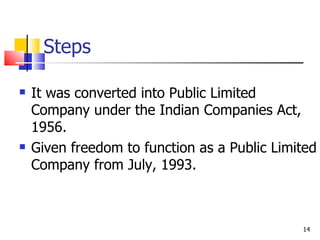
Steps It was converted into Public Limited Company under the Indian Companies Act, 1956. Given freedom to function as a Public Limited Company from July, 1993.
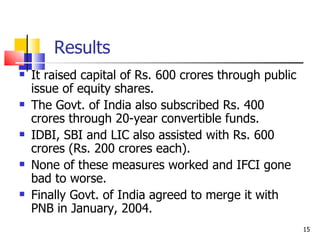
  Results It raised capital of Rs. 600 crores through public issue of equity shares. The Govt. of India also subscribed Rs. 400 crores through 20-year convertible funds.  IDBI, SBI and LIC also assisted with Rs. 600 crores (Rs. 200 crores each). None of these measures worked and IFCI gone bad to worse. Finally Govt. of India agreed to merge it with PNB in January, 2004.
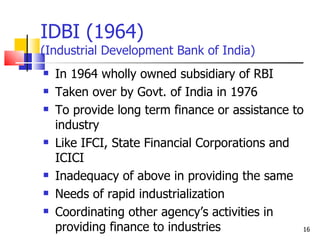
IDBI (1964)  (Industrial Development Bank of India) In 1964 wholly owned subsidiary of RBI Taken over by Govt. of India in 1976 To provide long term finance or assistance to industry Like IFCI, State Financial Corporations and ICICI Inadequacy of above in providing the same Needs of rapid industrialization  Coordinating other agency’s activities in providing finance to industries
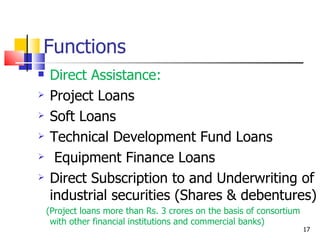
Functions Direct Assistance: Project Loans Soft Loans Technical Development Fund Loans Equipment Finance Loans  Direct Subscription to and Underwriting of industrial securities (Shares & debentures)  (Project loans more than Rs. 3 crores on the basis of consortium with other financial institutions and commercial banks)
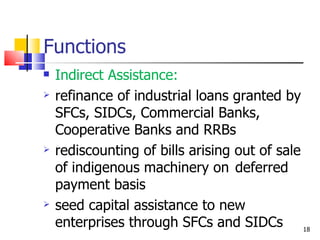
Functions Indirect Assistance: refinance of industrial loans granted by SFCs, SIDCs, Commercial Banks, Cooperative Banks and RRBs rediscounting of bills arising out of sale of indigenous machinery on  deferred payment basis seed capital assistance to new enterprises through SFCs and SIDCs
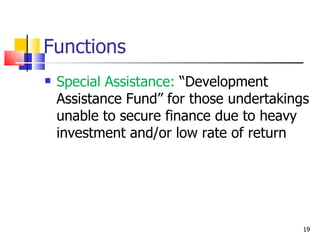
Functions Special Assistance:  “Development Assistance Fund” for those undertakings unable to secure finance due to heavy investment and/or low rate of return
Functions General Assistance: Promotional Activities  (like research, surveys and techno-economic studies) Technical and administration assistance for promotion, management and expansion Helping industrialization by planning, promoting & developing new industries
Functioning of IDBI Direct Assistance Assistance to backward areas Refinance of Industrial Loans Assistance to small scale units Balanced Regional Development Soft loan Schemes Foreign Currency Requirement
Reconstructing the IDBI Bureaucrats in Finance Ministry wanted direct control on IDBI To make IDBI independent Not an effective development bank Unable to accelerate the process of industrialization RBI and IDBI having common BoDs Govt. and Dy. Governors were incapable of shouldering the responsibilities cast on them The management of RBI and IDBI made them slaves of procedures
SIDBI (1990) (Small Industries Development Bank of India) Wholly owned subsidiary of IDBI To promote, finance and develop small scale industries Coordinates existing institutions engaged in similar activities Taken over the responsibility of Small Industries Development Fund and National Equity Fund It uses the existing institutions  (SFCs, SIDCs, Commercial Banks, Cooperative Banks and RRBs)  to extend its help to small scale industries throughout the nation
Functions Refinancing of loans and advances by primary lending institutions Discounting and rediscounting of bills Extension of seed capital/ soft loans  Granting direct assistance for exporting products manufactured by small scale industries
Functions Providing services like leasing and factoring to industrial concerns Extending financial support to State Small Industries Development Corporations  (for raw materials and marketing finished products) Financial support to National Small Industries Corporations  (leasing, hire-purchase and marketing support)

Bba(bi) 112

  • 1.
    Indian Banking SystemBBA (Banking & Insurance) Paper Code: 112
  • 2.
  • 3.
    Development Banking NationalBank for Agriculture and Rural Development (NABARD) Industrial Financial Corporation of India (IFCI) Industrial Development Bank of India (IDBI) Small Industrial Development Bank of India (SIDBI)
  • 4.
    NABARD (1982) NationalBank for Agricultural and rural Development Demand for agriculture credit in India Widening the role of bank credit (from agricultural development to rural credit) More focus on credit problems arising out of integrated rural development Established in July, 1982 by a special act in the parliament as an “apex bank and refinancing institution”
  • 5.
    Resources Rs. 100crores contributed equally by Govt. of India and RBI Raised funds from govt. of India, The World Bank, other agencies, market and also from National Agricultural Fund Rs. 6280 crores in 2001-02 and Rs. 5790 crores only in 2002-03
  • 6.
    Functions Dual roleto play: As an Apex Bank (inherited its apex role from RBI) As a Refinance Institution (refinance function performed by ARDC)
  • 7.
    Functions It servesas a refinancing institution for all kinds of production and investment credit to agriculture, small scale industries, handicrafts and rural crafts etc. Short term and long term credit to State Cooperative Banks, RRBs and other financial institutions approved by RBI It grants long term loans to state Govt. to help Cooperative Credit Societies
  • 8.
    Functions Provideslong term loans to any institute (approved by the Central Govt.) that contributes to the share capital of any institute concerned with the agriculture and rural development Coordinates the activities of Central and State Govts., The Planning Commission and others entrusted with the development of small scale industries, village and cottage industries and rural craft etc.
  • 9.
    Functions Ithas a responsibility to inspect RRBs and Cooperative Banks Maintains a research and development fund to promote research in agriculture and rural development to formulate and design new programmes and activities
  • 10.
    IFCI Established inJuly, 1948 (under a special act) To finance the large scale industries. To cope up with the change (i.e. Modernization)
  • 11.
    Resources Earlier RBI,Central Bank & other public sector banks and financial institute. It can issue Bonds and Debentures up to certain limit in the open market. It can borrow from RBI and also from World Bank (for foreign currency) It also accepts deposits from public.
  • 12.
    Functions It grantsloans and advances to industrial concerns (both in rupee and foreign currency). Grants loans to Public Limited Co. (long and medium term to manufacturing, mining, shipping and generation & distribution of electricity) Works as a guarantor of industrial concerns. As an underwriter for stocks, shares, bonds debentures of industrial undertakings. It subscribes to the shares of any concern. Supplements Commercial banks in providing loans.
  • 13.
    “IFCI a sickcompany” Causes: It is used by the politicians and Finance Ministry of India to finance many doubtful and financially weak enterprises. Lent extensively to Textile mill sector that soon become sick. Heavy accumulation of NPA’s
  • 14.
    Steps It wasconverted into Public Limited Company under the Indian Companies Act, 1956. Given freedom to function as a Public Limited Company from July, 1993.
  • 15.
    ResultsIt raised capital of Rs. 600 crores through public issue of equity shares. The Govt. of India also subscribed Rs. 400 crores through 20-year convertible funds. IDBI, SBI and LIC also assisted with Rs. 600 crores (Rs. 200 crores each). None of these measures worked and IFCI gone bad to worse. Finally Govt. of India agreed to merge it with PNB in January, 2004.
  • 16.
    IDBI (1964) (Industrial Development Bank of India) In 1964 wholly owned subsidiary of RBI Taken over by Govt. of India in 1976 To provide long term finance or assistance to industry Like IFCI, State Financial Corporations and ICICI Inadequacy of above in providing the same Needs of rapid industrialization Coordinating other agency’s activities in providing finance to industries
  • 17.
    Functions Direct Assistance:Project Loans Soft Loans Technical Development Fund Loans Equipment Finance Loans Direct Subscription to and Underwriting of industrial securities (Shares & debentures) (Project loans more than Rs. 3 crores on the basis of consortium with other financial institutions and commercial banks)
  • 18.
    Functions Indirect Assistance:refinance of industrial loans granted by SFCs, SIDCs, Commercial Banks, Cooperative Banks and RRBs rediscounting of bills arising out of sale of indigenous machinery on deferred payment basis seed capital assistance to new enterprises through SFCs and SIDCs
  • 19.
    Functions Special Assistance: “Development Assistance Fund” for those undertakings unable to secure finance due to heavy investment and/or low rate of return
  • 20.
    Functions General Assistance:Promotional Activities (like research, surveys and techno-economic studies) Technical and administration assistance for promotion, management and expansion Helping industrialization by planning, promoting & developing new industries
  • 21.
    Functioning of IDBIDirect Assistance Assistance to backward areas Refinance of Industrial Loans Assistance to small scale units Balanced Regional Development Soft loan Schemes Foreign Currency Requirement
  • 22.
    Reconstructing the IDBIBureaucrats in Finance Ministry wanted direct control on IDBI To make IDBI independent Not an effective development bank Unable to accelerate the process of industrialization RBI and IDBI having common BoDs Govt. and Dy. Governors were incapable of shouldering the responsibilities cast on them The management of RBI and IDBI made them slaves of procedures
  • 23.
    SIDBI (1990) (SmallIndustries Development Bank of India) Wholly owned subsidiary of IDBI To promote, finance and develop small scale industries Coordinates existing institutions engaged in similar activities Taken over the responsibility of Small Industries Development Fund and National Equity Fund It uses the existing institutions (SFCs, SIDCs, Commercial Banks, Cooperative Banks and RRBs) to extend its help to small scale industries throughout the nation
  • 24.
    Functions Refinancing ofloans and advances by primary lending institutions Discounting and rediscounting of bills Extension of seed capital/ soft loans Granting direct assistance for exporting products manufactured by small scale industries
  • 25.
    Functions Providing serviceslike leasing and factoring to industrial concerns Extending financial support to State Small Industries Development Corporations (for raw materials and marketing finished products) Financial support to National Small Industries Corporations (leasing, hire-purchase and marketing support)