Developing Winning Program Proposals Presented by Substance Abuse and Mental Health  Services Administration U.S. Department of Health and Human Services   Interdepartmental Tribal Justice., Safety & Wellness Training Anchorage, AK – Dec 3, 2009
Workshop Topics Basic Structure of a Grant Application The Pre-Proposal Phase Strategies for Managing the Grant Writing Process Beginning Your Research Five Basic Components of a Proposal  Common Problems Writing to Win
Basic Structure of a Grant Application Federal Forms – PHS 5161 (Need DUNS #) Table of Contents Abstract Narrative Section  Literature Citations  Budget and Budget Narrative  Resumes and Job Descriptions  Seven Participant Protection Provisions Appendices (include such things as letters of support, data collection instruments for the evaluation, and an evaluation consent form.)
The Pre-proposal Phase – Building A Pro-active Infrastructure for Program Development Organize a team. Brainstorming new ideas. Build a shared vision.  Routinely skim the literature and newsletters  for successful projects. Seek out potential partners. Create an advisory board or stakeholder group for program development. Recruit representatives from various disciplines  including school officials, law enforcement, health care, public health, university faculty, and consumers.
The Pre-proposal Phase – Building A Pro-active Infrastructure for Program Development Create program development files that include:     Local data from many sources.     Copies of needs assessments, state and    county grant applications and plans,      articles from newspapers and newsletters,    results of focus groups, minutes of      brainstorming sessions, and pages from    web sites.     Descriptions of grant programs previously    funded through the same grant program.
The Pre-proposal Phase – Building A Pro-active Infrastructure for Program Development Organize your information into proposal development notebooks or files. Divide notebooks into sections or a separate file  for every task involved in developing a full scale proposal.  Continue to add data, articles, resumes, job descriptions, etc., as you work on the proposal. Saves time in putting final package together.
The Pre-proposal Phase – Assessment of Your Ideas What has been the experience of other organizations that use or have used the approach? What does the existing literature show? Does this approach match the funder’s goals for the specific announcement you are considering? Is the approach “state of the art?” How many grants are expected to be awarded? Has this grant been awarded in your state?
The Pre-proposal Phase – Assessment of Your Ideas Have you discussed the idea with the TA providers or other knowledgeable resources including the person listed I the RFA as a program contact? In a study of 10,000 federal proposals, one of the most important variables that was statistically significant in separating the funded and rejected proposals was pre-proposal contact with the project director of the grant program.
The Pre-proposal Phase – Assessment of Your Ideas Does the organization have the experience and expertise to carry out the approach? Can it manage another program at this time? What about partnering with another agency? Is staffing adequate and can you recruit the talent needed to implement if funded?  Is match funding required and do you meet the match – if in-kind, can you document the match?
The Pre-proposal Phase – Assessment of Your Ideas What does the target population have to say about the proposed approach?  Who are other stakeholders (those that gain or lose from the result of this program) and what do they think about this proposal? How can you obtain input from the  community where the project will be implemented?
Strategies for Managing the Grant Writing Process Organize a grant writing team  (roles) A proposal coordinator  Draft writer Editor Evaluator Literature review/data person Fiscal person Letters of support/collaboration person Proofreader Clerical support
Strategies for Managing the Grant Writing Process Create two checklists. Use the first checklist to maintain control of the work and track critical requirements in the RFA. Review and mark up the entire grant announcement. Create a master checklist of critical components, especially any licensure or accreditation requirements, review criteria, including all sub-bullets within criteria, the 5161, and all required appendices.
Strategies for Managing the Grant Writing Process Create a second checklist to help evaluate your first draft. Create the list using the headings and sub-bullets in the Review Criteria section of the grant announcement.  Give this checklist and a copy of your first draft to someone who will give you honest feedback and a critique your first draft. This person should NOT be a member of your team. (Reviewers don’t know about your idea – it has to sell itself - find someone who doesn’t know about what your organization does).
Section I of the narrative –  The Problem Statement
Tips on How to Prepare a Problem Statement Literature Review Establishes the theoretical or conceptual basis for  your project. Assists you in determining the best strategy for carrying out your project. Helps demonstrate the relevance of your topic and how your project will add to the body of knowledge in this area. Helps you determine the “state of the art.”
A good rule of thumb is to review literature that has been published within the past five years. Find the authors  whose work is cited the most frequently (these are the seminal works). Use an index of citations. Does the literature reference gaps in knowledge? Does your project address any of the gaps? Make sure you include the literature on the cultural dimensions of the problem. Tips on How to Prepare a Problem Statement
Beginning Your Research Start by getting some advice on the phone or on-line Include: grant contact person, technical assistance centers, existing grantees, CDC, and university centers for alcohol and drug studies.
NCADI  1-800-729-6686  www.health.org KEN  1-800-789-2647  www.mentalhealth.org  NIDA  www.drugabuse.gov NIAAA Research Library  703-312-5220  Ext. 7147  http://etoh.niaaa.nih.gov  CAPTS  www.captus.org National Criminal Justice Reference System  1-800-851-3420  www.ncjrs.org HUD’s Public and Indian Housing Information Resource Center 1-800-955-2232 www.Huduser.org Office of Minority Health  1-800-444-6472 www.omhrc.gov Resources
Beginning Your   Research Locate web sites with multiple links to both organizations and information about the grant topic  Become familiar with searchable databases such as     SAMHSA’s National Registry of Programs   and Practices (NREPP)    Find Youth Info (multi-agency database)    OJJDP Model Program Guide    CDC National Prevention Information  Network
Tips on How to Prepare the Problem Statement Target Population Identify the target population. What is your rationale for choosing this population? Document the local need, not the national need. Pay attention to any specific requirements of the NOFA for specific epidemiological data. Provide comparison data-it will add contrast and depth to your needs statement. Use both tables and narrative. Clearly explain and provide citations for all tables.
Describe the  service gaps that exist. Have there been cuts in services due to funding cutbacks?  Indicate how your proposed program will serve to fill those gaps. If your proposing to expand a pre-existing program, indicate how many people you are currently serving. Tips on How to Prepare the Problem Statement
Sources of Local Data: United Ways Hospitals State Child Welfare agencies State Block grant applications State and County Boards of Ed State and County Health Departments Community health assessments Federal sources –Census, CDC,  SAMHSA, IHS Tips on How to Prepare the Problem Statement
Once your problem statement is clearly developed, the next logical step in writing your proposal is to identify the solution to your problem. You express your solution in terms of goals, objectives and methods. They flow logically from your problem statement. Tips on How to Prepare the Problem Statement
Section II. Goals, Objectives, and Methods
Tips on How to Prepare Logic Models Start by creating a Logic Model for your program. A Logic Model: Logic models use table and flow chart formats to show the connectedness between problems, theories, strategies, activities, and outcomes. In other words, they help you to connect the dots. They describe the  Results  you are aiming for in terms of specific, measurable, and timed  Outcomes .
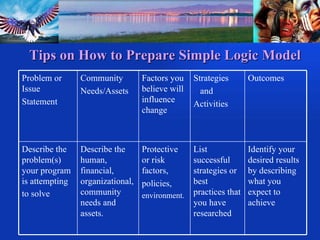
Tips on How to Prepare Simple Logic Model Identify your desired results by describing what you expect to achieve List successful strategies or best practices that you have researched Protective or risk factors, policies, environment. Describe the human, financial, organizational, community needs and assets. Describe the problem(s) your program is attempting to solve   Outcomes Strategies and Activities Factors you believe will influence change Community Needs/Assets Problem or Issue Statement
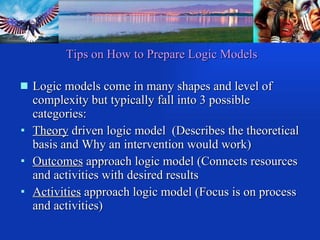
Tips on How to Prepare Logic Models Logic models come in many shapes and level of complexity but typically fall into 3 possible categories: Theory  driven logic model  (Describes the theoretical basis and Why an intervention would work) Outcomes  approach logic model (Connects resources and activities with desired results Activities  approach logic model (Focus is on process and activities)
Tips on How to Prepare Logic Models For more information about Logic Models: Juvenile Justice Evaluation Center: www.jrsa.org/jjec/resources/logic-model.html  Office of Minority Health – Strategic Framework htttp://minorityhealth.hhs.gov W. K. Kellogg Foundation: Logic Model Development Guide   www.wkkf.org  1-800-819-9997
Tips on How to Prepare the Program Plan A goal is a broad-based statement of the ultimate result of the change being undertaken. Well written goals lead toward an ambitious but achievable future. Goals contain an action verb  Example: To enable people suffering from addiction to return to physical, spiritual and emotional health
Objectives: S pecific- M easurable- A chievable- R ealistic- T ime- L imited Guidelines for writing measurable objectives: Contains an action verb Contains a single measurable result Contains a target date Objectives specify the Who, the What, the When, the How much, and How will it be measured. Are feasible and attainable Tips on How to Prepare the Program Plan
Objectives logically flow from your goals. Objectives are more specific than goals.  Objectives are the intellectual heart of your proposal . Here you indicate to your funding source precisely what you intend to change through your project and what you would accept as proof of the project’s success. Objectives become the criteria by which you judge the effectiveness of your program. Write your objectives using one to three sentences. List them in order of importance. Tips on How to Prepare the Program Plan
Example: Given the goal of “Improving the quality of life of homeless individuals in our city,” our proposal objective might be: Our Homeless Shelter Agency will reduce the number of homeless (Specific) during the next 24 months (Timeframe) by 15 percent (Evaluative) as noted in the Department of Social Welfare Homeless Survey Report (Measureable). Tips on How to Prepare the Program Plan
Examples: Outcome Objectives : The objective of our ABC parenting skills program is to reduce the incidence of child abuse and neglect among 50 families. At the conclusion of the program, at least 20 families will show a gain in parenting skills proficiency as demonstrated by improvement in the domains of the parenting stress index. Process Objectives : During the first six months of the grant period, five consumers will identified and recruited to serve on the steering committee of the project.  Product Objectives : During the third year of the grant period, a training course and manual will be developed to upgrade the skills of  hospital staff that treat mentally ill substance abusers. Tips on How to Prepare the Program Plan
Our proposed out-patient program has two primary objectives:  Seventy-five drug and alcohol abusers will be provided with comprehensive out-patient substance treatment services. Sixty percent of those treated will retain their sobriety for at least six months after treatment. Vocational rehabilitation services will be provided to every patient over the course of the grant period.  Seventy-five percent of patients will be job ready upon completion of their treatment. Tips on How to Prepare the Program Plan
Methods --The How or the Means by which your goals and objectives are carried out. “ There are many paths through the forest.” Methods logically flow from objectives. Directly underneath the objectives, describe the precise steps you will follow in carrying out the objective. How will it be done? Who will do it? When will it be done? Keep asking yourself:  what’s next? Tips on How to Prepare the Program Plan
Make a diagram to help you visualize the steps. Clearly state your reasons for selecting the methods. Invite consumers to give you feedback on the methods.  Address steps to ensure culturally competency. Address how participants will be recruited and retained. This is critical. Tips on How to Prepare the Program Plan
Section III  Evaluation
Tips on How to Prepare the Evaluation Section Evaluation requirements vary by announcement. Pay close attention to the specific requirements of the announcement you are interested in.  Obtain some basic understanding of evaluation concepts and terminology.  Develop a long term relationship with an evaluator you can trust and feel comfortable working with. Bring the evaluator to the table early in the grant development process. Have the evaluator review the program plan to ensure that the objectives are measurable .
Put together a list of questions to go over with your evaluator. Include: What type of evaluation design does the announcement require? What information is needed to conduct the evaluation? What data collection instruments will be needed? How will data be collected? Tips on How to Prepare the Evaluation Section
Will additional staff be needed to conduct the evaluation? How will you involve the target population in the evaluation design and implementation? How will you ensure that the evaluation design is culturally competent? How will GPRA data be collected? Tips on How to Prepare the Evaluation Section
Project Newsletters Interim Papers presented at Conferences Articles for Publication in Peer Reviewed Journals Manuals Displays Production of Audio-Visual Materials Site Visits Websites and List-Serves Workshops Tips on How to Prepare the Evaluation Dissemination Plan
Section IV The Management Plan
Tips on How to Prepare the Management Plan Sell your organization’s capability, its uniqueness, its niche. Detail the roles and responsibilities of key staff. Show that staff are superbly qualified, especially your project director. Detail the amount of time each person will work on the project. Develop a PERT chart or timeline – make it feasible. Indicate that your staff is reflective of the target population and is multi-culturally competent if you serve multiple populations.
If you intend to use consultants, indicate why they are necessary.  Do not propose to turn your entire project over to outside consultants. Revise and update CVs, resumes, and job descriptions. Pay close attention to the issue of cultural competence when writing job descriptions. Tips on How to Prepare the Management Plan
What is your organization’s experience or track record of involvement with the community you plan to serve? Does your staff have the expertise to work with ethnic, racial, cultural, linguistic, sexual orientation populations in your community? Do you have diverse community representation on your board? If your serve a multilinguistic population, are there multilingusitic resources available? Tips on How to Prepare the Management Plan
Sustainability asks the question-Do you want this project to exist after the grant has expired? What steps are you taking to ensure the project will continue? Describe these steps in the Management Plan. Sustainability involves making a commitment to leaving no stone unturned to ensure the future of your program. Sustainability requires research, advance planning, and lots of hard work. Tips on How to Prepare the Management Plan
Know your funding source databases, including: www.www.grants.gov (for federal grants). Sign up for e-mail notification of grant announcements. www.fdncenter.org  (for foundation grants) on-line access at various fee levels.  The Foundation Directory (hard copy or CD-Rom $295/$215)  Tips on How to Prepare the Management Plan
Tips on Sustainability Sustainability should be woven into each section throughout the proposal. Sustainability is not just about funding and staffing – it is also about the outcomes produced by this limited investment of funding. Fully addressing sustainability throughout the proposal demonstrates good stewardship of resources, planning for the future and commitment to the cause. Think of grant funds as “risk investment” to demonstrate a good idea that others will “buy” once you demonstrate results.
Tips on Sustainability Sustainability considerations: How will the results of the project be continued after the grant funds end? How will the outcomes produced by this grant continue to be sustained after the grant funding is gone – will partner organizations pick up the project?  What resources are actually required to sustain the effort – staffing, volunteers, time, money? How will these be replaced after grant funding ends?
Resources on Sustainability Free weekly e-newsletters from The Foundation Center ( www.fdncenter.org)  Join Together (www.jointogether.org) PNN Online (www.pnnonline.org) Federal Assistance Monitor  (www.cdpublications.com ) National Directory of Foundation Grants for Native Americans 1-800-268-2059  CRC Publications
Cultural Competence
Cultural Competence Cultural competence is invariably  linked to the quality of service or  care you provide. Culture should be considered in every  phase of the project from assessment to  evaluation Evidence of Cultural Competence must be  described throughout the proposal
Cultural Competence Materials - It should be demonstrated that materials and products such as audio-visual materials, psa’s, training guides and print materials are gender, age, culturally appropriate. Community representation- The population targeted to receive services should be a planned participant in all phases of the program design. Implementation- There should be objective evidence that the applicant understands the cultural aspects of the community that will contribute to the program’s success.
Cultural Competence Sources of Information on Cultural Competence: PsycInfo CSAP Cultural Competence Series  (NCADI) University of Washington Alcohol and Drug Abuse Institute Library  (Bibliographies) Journals:  Journal of Cultural Diversity Cultural Medicine and Psychiatry Cultural Diversity and Mental Health
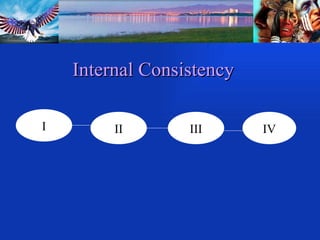
Internal Consistency I II III IV
Common Problems With Statement of Need Application’s background and rationale are poorly referenced. Application’s literature review is dated. References are weak – no scientific evidence of effectiveness. Application’s statement of need contains only national data – local is missing. Description and/or rationale for choosing target population is missing.
Common Problems With the Program Plan Section The application’s goals and objectives are unclear or confusing. Means and ends are confused. Objectives are not tied to the statement of need. The application’s project plan is not “state of the art.” The application’s project methods are not well detailed.
Common Problems With the Program Plan Section The application’s project methods are inappropriately matched to the goals of the announcement. The application does not include evidence of participatory planning. The application does not address cultural, ethnic, sexual orientation or disability issues.
Common Problems With the Evaluation Section The application’s evaluation section is not tied to the application’s goals and objectives. It is unclear as to what is being evaluated. The application does not contain any strategies for data management, data processing and clean-up, quality control, and data retention.
Common Problems With the Evaluation Section The application does not contain information on how program participants will be recruited and retained. The application doe not contain any literature on the instruments that are proposed for the evaluation. The application does not contain any discussion on how GPRA data will be collected and reported.
Common Problems With the Management Section The application does not include a timeline or Pert chart. The application’s budget is inadequate. The application is missing a budget narrative. The qualifications and experience of the project staff are missing. It is unclear whether the project staff are representative of the target population. Letters of agreement are weak or all say the same thing. Applicant is unlicensed and has little previous experience providing this service.
Common Presentation Mistakes Reviewers had to search for material. Application is not organized in the same manner as the announcement and NOFA. Applicant ignored both page limitation and font size requirements. The grammar in the application was poor. Appendices are not labeled or missing entirely. The application’s abstract is missing. Pages are missing or out of order.
Summary Create a vision for your organization. Organize a team and engage team members in regular dialogue. Be Proactive not Reactive. Seek out Partners. Create Program Development files. Learn how to find information fast. Use a checklist to help you keep track of the work.  TQI. Create a second checklist and give your draft to someone else to critique. Then revise, revise, and revise some more.
Summary Always use local data and recent citations. Write logically by connecting one section of your proposal with each previous section. Make sure objectives are measurable. Ensure that the program plan, methods, evaluation design, and staffing are culturally competent. Pay attention to internal consistency. Watch out for common mistakes. Sustain your program by diversifying your funding.
Writing to Win Don’t let the competition beat you to a grant because you decide you can’t afford the time to give the grantsmanship. Give proposal preparation your strongest effort. Get ahead of the competition by building in time to have your proposal critiqued. Don’t send in a proposal that has never been proofread. Better to allow lead time in order to obtain feedback than to send in something that the review committee will find fault with, with the net result-a low or unscored application.
Writing to Win Don’t put the work off until the final days before the proposal is due. Don’t say, “I love to write but hate to get to work.” Don’t procrastinate, get started! Don’t wait until you feel like writing.  There can be no second paragraph until you have a first paragraph. Learn how to BEGIN writing.
Writing to Win Convince yourself that you are an artist working in clay, not marble, on paper, not bronze. Start by getting the first sentence down on paper.  No one will rush out and print it as it stands.  Just put it down.  Then another.  Your first sentence or whole first paragraph may be eliminated later. There can be no second paragraph without a first.
Writing to Win Write strategically. You are writing for points. Begin organizing and preparing an outline that includes each  heading and sub-heading under the Review Criteria sections of both the standard grant funding announcement and any additional bullets contained within the NOFA. View each review criterion as if it were a question.  Pay close attention to the relative weight given to each of the Review Criteria, then estimate the page length for each section. Focus on Who, What, Where, When Why, and How.
Writing to Win Make effective use of white space and bold sub-headings. Write deductively – Writing deductively establishes expectations in the reader. Relate all sentences in a paragraph to the topic sentence. Make the paragraph the unit of composition. Build your case for funding like a fine lawyer argues a case in court.  Sprinkle citations throughout your narrative. Make sure one section of your proposal builds upon a previous section in a logical progression.
Writing to Win Break up your copy.  Enormous blocks of print look formidable to the reader. Therefore, breaking long paragraphs into two, even if it is not necessary to do so,  is often a visual help to the reader. Make extensive use of action verbs. Include tables, especially in Section I. Use definitive, specific, concrete language. Put statements in positive form.  Example:  It is not time to go.  There is still time left.
Writing to Win Revise and rewrite.  This is a fundamental principle in all writing and among the best writers. Build this into you timeline – it takes a lot of time and you usually have 30-60 days from RFA publication to receipt date
Final words of advice … Pay Attention to the details. You Can Win –  Good Luck .
References Bauer, David G.,  The “How To” Grants Manual: Successful Grantseeking Techniques for Obtaining Public and Private Grants . Fourth Edition. American Council on Education/Oryx Press, 1999. Carlson, Mim.,  Winning Grants Step by Step . Support Centers of America’s Complete Workbook for Planning, Developing, and Writing Successful Proposals. Jossey-Bass, 1995. The Foundation Center,  Guide to Proposal Writing . Revised Edition, 1997 Meador, Roy.,  Guidelines for Preparing Proposals . Second Edition. Lewis Publishers, 1991. Miner, Lynn E., Miner, Jeremy T., and Jerry Griffith,  Proposal Planning and Writing , Second Edition. Oryx Press, 1998. Strunk, W. and White, E.B.,  The Elements of Style . With Revisions,  an Intro., and a New Chapter on Writing. Macmillian, 1959. Michael Koscinski, SAMHSA Public Health Advisor, (michael.koscinski@samhsa.hhs.gov)   Creator of this presentation.

Developing Winning Program Proposals

  • 1.
    Developing Winning ProgramProposals Presented by Substance Abuse and Mental Health Services Administration U.S. Department of Health and Human Services Interdepartmental Tribal Justice., Safety & Wellness Training Anchorage, AK – Dec 3, 2009
  • 2.
    Workshop Topics BasicStructure of a Grant Application The Pre-Proposal Phase Strategies for Managing the Grant Writing Process Beginning Your Research Five Basic Components of a Proposal Common Problems Writing to Win
  • 3.
    Basic Structure ofa Grant Application Federal Forms – PHS 5161 (Need DUNS #) Table of Contents Abstract Narrative Section Literature Citations Budget and Budget Narrative Resumes and Job Descriptions Seven Participant Protection Provisions Appendices (include such things as letters of support, data collection instruments for the evaluation, and an evaluation consent form.)
  • 4.
    The Pre-proposal Phase– Building A Pro-active Infrastructure for Program Development Organize a team. Brainstorming new ideas. Build a shared vision. Routinely skim the literature and newsletters for successful projects. Seek out potential partners. Create an advisory board or stakeholder group for program development. Recruit representatives from various disciplines including school officials, law enforcement, health care, public health, university faculty, and consumers.
  • 5.
    The Pre-proposal Phase– Building A Pro-active Infrastructure for Program Development Create program development files that include:  Local data from many sources.  Copies of needs assessments, state and county grant applications and plans, articles from newspapers and newsletters, results of focus groups, minutes of brainstorming sessions, and pages from web sites.  Descriptions of grant programs previously funded through the same grant program.
  • 6.
    The Pre-proposal Phase– Building A Pro-active Infrastructure for Program Development Organize your information into proposal development notebooks or files. Divide notebooks into sections or a separate file for every task involved in developing a full scale proposal. Continue to add data, articles, resumes, job descriptions, etc., as you work on the proposal. Saves time in putting final package together.
  • 7.
    The Pre-proposal Phase– Assessment of Your Ideas What has been the experience of other organizations that use or have used the approach? What does the existing literature show? Does this approach match the funder’s goals for the specific announcement you are considering? Is the approach “state of the art?” How many grants are expected to be awarded? Has this grant been awarded in your state?
  • 8.
    The Pre-proposal Phase– Assessment of Your Ideas Have you discussed the idea with the TA providers or other knowledgeable resources including the person listed I the RFA as a program contact? In a study of 10,000 federal proposals, one of the most important variables that was statistically significant in separating the funded and rejected proposals was pre-proposal contact with the project director of the grant program.
  • 9.
    The Pre-proposal Phase– Assessment of Your Ideas Does the organization have the experience and expertise to carry out the approach? Can it manage another program at this time? What about partnering with another agency? Is staffing adequate and can you recruit the talent needed to implement if funded? Is match funding required and do you meet the match – if in-kind, can you document the match?
  • 10.
    The Pre-proposal Phase– Assessment of Your Ideas What does the target population have to say about the proposed approach? Who are other stakeholders (those that gain or lose from the result of this program) and what do they think about this proposal? How can you obtain input from the community where the project will be implemented?
  • 11.
    Strategies for Managingthe Grant Writing Process Organize a grant writing team (roles) A proposal coordinator Draft writer Editor Evaluator Literature review/data person Fiscal person Letters of support/collaboration person Proofreader Clerical support
  • 12.
    Strategies for Managingthe Grant Writing Process Create two checklists. Use the first checklist to maintain control of the work and track critical requirements in the RFA. Review and mark up the entire grant announcement. Create a master checklist of critical components, especially any licensure or accreditation requirements, review criteria, including all sub-bullets within criteria, the 5161, and all required appendices.
  • 13.
    Strategies for Managingthe Grant Writing Process Create a second checklist to help evaluate your first draft. Create the list using the headings and sub-bullets in the Review Criteria section of the grant announcement. Give this checklist and a copy of your first draft to someone who will give you honest feedback and a critique your first draft. This person should NOT be a member of your team. (Reviewers don’t know about your idea – it has to sell itself - find someone who doesn’t know about what your organization does).
  • 14.
    Section I ofthe narrative – The Problem Statement
  • 15.
    Tips on Howto Prepare a Problem Statement Literature Review Establishes the theoretical or conceptual basis for your project. Assists you in determining the best strategy for carrying out your project. Helps demonstrate the relevance of your topic and how your project will add to the body of knowledge in this area. Helps you determine the “state of the art.”
  • 16.
    A good ruleof thumb is to review literature that has been published within the past five years. Find the authors whose work is cited the most frequently (these are the seminal works). Use an index of citations. Does the literature reference gaps in knowledge? Does your project address any of the gaps? Make sure you include the literature on the cultural dimensions of the problem. Tips on How to Prepare a Problem Statement
  • 17.
    Beginning Your ResearchStart by getting some advice on the phone or on-line Include: grant contact person, technical assistance centers, existing grantees, CDC, and university centers for alcohol and drug studies.
  • 18.
    NCADI 1-800-729-6686 www.health.org KEN 1-800-789-2647 www.mentalhealth.org NIDA www.drugabuse.gov NIAAA Research Library 703-312-5220 Ext. 7147 http://etoh.niaaa.nih.gov CAPTS www.captus.org National Criminal Justice Reference System 1-800-851-3420 www.ncjrs.org HUD’s Public and Indian Housing Information Resource Center 1-800-955-2232 www.Huduser.org Office of Minority Health 1-800-444-6472 www.omhrc.gov Resources
  • 19.
    Beginning Your Research Locate web sites with multiple links to both organizations and information about the grant topic Become familiar with searchable databases such as  SAMHSA’s National Registry of Programs and Practices (NREPP)  Find Youth Info (multi-agency database)  OJJDP Model Program Guide  CDC National Prevention Information Network
  • 20.
    Tips on Howto Prepare the Problem Statement Target Population Identify the target population. What is your rationale for choosing this population? Document the local need, not the national need. Pay attention to any specific requirements of the NOFA for specific epidemiological data. Provide comparison data-it will add contrast and depth to your needs statement. Use both tables and narrative. Clearly explain and provide citations for all tables.
  • 21.
    Describe the service gaps that exist. Have there been cuts in services due to funding cutbacks? Indicate how your proposed program will serve to fill those gaps. If your proposing to expand a pre-existing program, indicate how many people you are currently serving. Tips on How to Prepare the Problem Statement
  • 22.
    Sources of LocalData: United Ways Hospitals State Child Welfare agencies State Block grant applications State and County Boards of Ed State and County Health Departments Community health assessments Federal sources –Census, CDC, SAMHSA, IHS Tips on How to Prepare the Problem Statement
  • 23.
    Once your problemstatement is clearly developed, the next logical step in writing your proposal is to identify the solution to your problem. You express your solution in terms of goals, objectives and methods. They flow logically from your problem statement. Tips on How to Prepare the Problem Statement
  • 24.
    Section II. Goals,Objectives, and Methods
  • 25.
    Tips on Howto Prepare Logic Models Start by creating a Logic Model for your program. A Logic Model: Logic models use table and flow chart formats to show the connectedness between problems, theories, strategies, activities, and outcomes. In other words, they help you to connect the dots. They describe the Results you are aiming for in terms of specific, measurable, and timed Outcomes .
  • 26.
    Tips on Howto Prepare Simple Logic Model Identify your desired results by describing what you expect to achieve List successful strategies or best practices that you have researched Protective or risk factors, policies, environment. Describe the human, financial, organizational, community needs and assets. Describe the problem(s) your program is attempting to solve Outcomes Strategies and Activities Factors you believe will influence change Community Needs/Assets Problem or Issue Statement
  • 27.
    Tips on Howto Prepare Logic Models Logic models come in many shapes and level of complexity but typically fall into 3 possible categories: Theory driven logic model (Describes the theoretical basis and Why an intervention would work) Outcomes approach logic model (Connects resources and activities with desired results Activities approach logic model (Focus is on process and activities)
  • 28.
    Tips on Howto Prepare Logic Models For more information about Logic Models: Juvenile Justice Evaluation Center: www.jrsa.org/jjec/resources/logic-model.html Office of Minority Health – Strategic Framework htttp://minorityhealth.hhs.gov W. K. Kellogg Foundation: Logic Model Development Guide www.wkkf.org 1-800-819-9997
  • 29.
    Tips on Howto Prepare the Program Plan A goal is a broad-based statement of the ultimate result of the change being undertaken. Well written goals lead toward an ambitious but achievable future. Goals contain an action verb Example: To enable people suffering from addiction to return to physical, spiritual and emotional health
  • 30.
    Objectives: S pecific-M easurable- A chievable- R ealistic- T ime- L imited Guidelines for writing measurable objectives: Contains an action verb Contains a single measurable result Contains a target date Objectives specify the Who, the What, the When, the How much, and How will it be measured. Are feasible and attainable Tips on How to Prepare the Program Plan
  • 31.
    Objectives logically flowfrom your goals. Objectives are more specific than goals. Objectives are the intellectual heart of your proposal . Here you indicate to your funding source precisely what you intend to change through your project and what you would accept as proof of the project’s success. Objectives become the criteria by which you judge the effectiveness of your program. Write your objectives using one to three sentences. List them in order of importance. Tips on How to Prepare the Program Plan
  • 32.
    Example: Given thegoal of “Improving the quality of life of homeless individuals in our city,” our proposal objective might be: Our Homeless Shelter Agency will reduce the number of homeless (Specific) during the next 24 months (Timeframe) by 15 percent (Evaluative) as noted in the Department of Social Welfare Homeless Survey Report (Measureable). Tips on How to Prepare the Program Plan
  • 33.
    Examples: Outcome Objectives: The objective of our ABC parenting skills program is to reduce the incidence of child abuse and neglect among 50 families. At the conclusion of the program, at least 20 families will show a gain in parenting skills proficiency as demonstrated by improvement in the domains of the parenting stress index. Process Objectives : During the first six months of the grant period, five consumers will identified and recruited to serve on the steering committee of the project. Product Objectives : During the third year of the grant period, a training course and manual will be developed to upgrade the skills of hospital staff that treat mentally ill substance abusers. Tips on How to Prepare the Program Plan
  • 34.
    Our proposed out-patientprogram has two primary objectives: Seventy-five drug and alcohol abusers will be provided with comprehensive out-patient substance treatment services. Sixty percent of those treated will retain their sobriety for at least six months after treatment. Vocational rehabilitation services will be provided to every patient over the course of the grant period. Seventy-five percent of patients will be job ready upon completion of their treatment. Tips on How to Prepare the Program Plan
  • 35.
    Methods --The Howor the Means by which your goals and objectives are carried out. “ There are many paths through the forest.” Methods logically flow from objectives. Directly underneath the objectives, describe the precise steps you will follow in carrying out the objective. How will it be done? Who will do it? When will it be done? Keep asking yourself: what’s next? Tips on How to Prepare the Program Plan
  • 36.
    Make a diagramto help you visualize the steps. Clearly state your reasons for selecting the methods. Invite consumers to give you feedback on the methods. Address steps to ensure culturally competency. Address how participants will be recruited and retained. This is critical. Tips on How to Prepare the Program Plan
  • 37.
    Section III Evaluation
  • 38.
    Tips on Howto Prepare the Evaluation Section Evaluation requirements vary by announcement. Pay close attention to the specific requirements of the announcement you are interested in. Obtain some basic understanding of evaluation concepts and terminology. Develop a long term relationship with an evaluator you can trust and feel comfortable working with. Bring the evaluator to the table early in the grant development process. Have the evaluator review the program plan to ensure that the objectives are measurable .
  • 39.
    Put together alist of questions to go over with your evaluator. Include: What type of evaluation design does the announcement require? What information is needed to conduct the evaluation? What data collection instruments will be needed? How will data be collected? Tips on How to Prepare the Evaluation Section
  • 40.
    Will additional staffbe needed to conduct the evaluation? How will you involve the target population in the evaluation design and implementation? How will you ensure that the evaluation design is culturally competent? How will GPRA data be collected? Tips on How to Prepare the Evaluation Section
  • 41.
    Project Newsletters InterimPapers presented at Conferences Articles for Publication in Peer Reviewed Journals Manuals Displays Production of Audio-Visual Materials Site Visits Websites and List-Serves Workshops Tips on How to Prepare the Evaluation Dissemination Plan
  • 42.
    Section IV TheManagement Plan
  • 43.
    Tips on Howto Prepare the Management Plan Sell your organization’s capability, its uniqueness, its niche. Detail the roles and responsibilities of key staff. Show that staff are superbly qualified, especially your project director. Detail the amount of time each person will work on the project. Develop a PERT chart or timeline – make it feasible. Indicate that your staff is reflective of the target population and is multi-culturally competent if you serve multiple populations.
  • 44.
    If you intendto use consultants, indicate why they are necessary. Do not propose to turn your entire project over to outside consultants. Revise and update CVs, resumes, and job descriptions. Pay close attention to the issue of cultural competence when writing job descriptions. Tips on How to Prepare the Management Plan
  • 45.
    What is yourorganization’s experience or track record of involvement with the community you plan to serve? Does your staff have the expertise to work with ethnic, racial, cultural, linguistic, sexual orientation populations in your community? Do you have diverse community representation on your board? If your serve a multilinguistic population, are there multilingusitic resources available? Tips on How to Prepare the Management Plan
  • 46.
    Sustainability asks thequestion-Do you want this project to exist after the grant has expired? What steps are you taking to ensure the project will continue? Describe these steps in the Management Plan. Sustainability involves making a commitment to leaving no stone unturned to ensure the future of your program. Sustainability requires research, advance planning, and lots of hard work. Tips on How to Prepare the Management Plan
  • 47.
    Know your fundingsource databases, including: www.www.grants.gov (for federal grants). Sign up for e-mail notification of grant announcements. www.fdncenter.org (for foundation grants) on-line access at various fee levels. The Foundation Directory (hard copy or CD-Rom $295/$215) Tips on How to Prepare the Management Plan
  • 48.
    Tips on SustainabilitySustainability should be woven into each section throughout the proposal. Sustainability is not just about funding and staffing – it is also about the outcomes produced by this limited investment of funding. Fully addressing sustainability throughout the proposal demonstrates good stewardship of resources, planning for the future and commitment to the cause. Think of grant funds as “risk investment” to demonstrate a good idea that others will “buy” once you demonstrate results.
  • 49.
    Tips on SustainabilitySustainability considerations: How will the results of the project be continued after the grant funds end? How will the outcomes produced by this grant continue to be sustained after the grant funding is gone – will partner organizations pick up the project? What resources are actually required to sustain the effort – staffing, volunteers, time, money? How will these be replaced after grant funding ends?
  • 50.
    Resources on SustainabilityFree weekly e-newsletters from The Foundation Center ( www.fdncenter.org) Join Together (www.jointogether.org) PNN Online (www.pnnonline.org) Federal Assistance Monitor (www.cdpublications.com ) National Directory of Foundation Grants for Native Americans 1-800-268-2059 CRC Publications
  • 51.
  • 52.
    Cultural Competence Culturalcompetence is invariably linked to the quality of service or care you provide. Culture should be considered in every phase of the project from assessment to evaluation Evidence of Cultural Competence must be described throughout the proposal
  • 53.
    Cultural Competence Materials- It should be demonstrated that materials and products such as audio-visual materials, psa’s, training guides and print materials are gender, age, culturally appropriate. Community representation- The population targeted to receive services should be a planned participant in all phases of the program design. Implementation- There should be objective evidence that the applicant understands the cultural aspects of the community that will contribute to the program’s success.
  • 54.
    Cultural Competence Sourcesof Information on Cultural Competence: PsycInfo CSAP Cultural Competence Series (NCADI) University of Washington Alcohol and Drug Abuse Institute Library (Bibliographies) Journals: Journal of Cultural Diversity Cultural Medicine and Psychiatry Cultural Diversity and Mental Health
  • 55.
  • 56.
    Common Problems WithStatement of Need Application’s background and rationale are poorly referenced. Application’s literature review is dated. References are weak – no scientific evidence of effectiveness. Application’s statement of need contains only national data – local is missing. Description and/or rationale for choosing target population is missing.
  • 57.
    Common Problems Withthe Program Plan Section The application’s goals and objectives are unclear or confusing. Means and ends are confused. Objectives are not tied to the statement of need. The application’s project plan is not “state of the art.” The application’s project methods are not well detailed.
  • 58.
    Common Problems Withthe Program Plan Section The application’s project methods are inappropriately matched to the goals of the announcement. The application does not include evidence of participatory planning. The application does not address cultural, ethnic, sexual orientation or disability issues.
  • 59.
    Common Problems Withthe Evaluation Section The application’s evaluation section is not tied to the application’s goals and objectives. It is unclear as to what is being evaluated. The application does not contain any strategies for data management, data processing and clean-up, quality control, and data retention.
  • 60.
    Common Problems Withthe Evaluation Section The application does not contain information on how program participants will be recruited and retained. The application doe not contain any literature on the instruments that are proposed for the evaluation. The application does not contain any discussion on how GPRA data will be collected and reported.
  • 61.
    Common Problems Withthe Management Section The application does not include a timeline or Pert chart. The application’s budget is inadequate. The application is missing a budget narrative. The qualifications and experience of the project staff are missing. It is unclear whether the project staff are representative of the target population. Letters of agreement are weak or all say the same thing. Applicant is unlicensed and has little previous experience providing this service.
  • 62.
    Common Presentation MistakesReviewers had to search for material. Application is not organized in the same manner as the announcement and NOFA. Applicant ignored both page limitation and font size requirements. The grammar in the application was poor. Appendices are not labeled or missing entirely. The application’s abstract is missing. Pages are missing or out of order.
  • 63.
    Summary Create avision for your organization. Organize a team and engage team members in regular dialogue. Be Proactive not Reactive. Seek out Partners. Create Program Development files. Learn how to find information fast. Use a checklist to help you keep track of the work. TQI. Create a second checklist and give your draft to someone else to critique. Then revise, revise, and revise some more.
  • 64.
    Summary Always uselocal data and recent citations. Write logically by connecting one section of your proposal with each previous section. Make sure objectives are measurable. Ensure that the program plan, methods, evaluation design, and staffing are culturally competent. Pay attention to internal consistency. Watch out for common mistakes. Sustain your program by diversifying your funding.
  • 65.
    Writing to WinDon’t let the competition beat you to a grant because you decide you can’t afford the time to give the grantsmanship. Give proposal preparation your strongest effort. Get ahead of the competition by building in time to have your proposal critiqued. Don’t send in a proposal that has never been proofread. Better to allow lead time in order to obtain feedback than to send in something that the review committee will find fault with, with the net result-a low or unscored application.
  • 66.
    Writing to WinDon’t put the work off until the final days before the proposal is due. Don’t say, “I love to write but hate to get to work.” Don’t procrastinate, get started! Don’t wait until you feel like writing. There can be no second paragraph until you have a first paragraph. Learn how to BEGIN writing.
  • 67.
    Writing to WinConvince yourself that you are an artist working in clay, not marble, on paper, not bronze. Start by getting the first sentence down on paper. No one will rush out and print it as it stands. Just put it down. Then another. Your first sentence or whole first paragraph may be eliminated later. There can be no second paragraph without a first.
  • 68.
    Writing to WinWrite strategically. You are writing for points. Begin organizing and preparing an outline that includes each heading and sub-heading under the Review Criteria sections of both the standard grant funding announcement and any additional bullets contained within the NOFA. View each review criterion as if it were a question. Pay close attention to the relative weight given to each of the Review Criteria, then estimate the page length for each section. Focus on Who, What, Where, When Why, and How.
  • 69.
    Writing to WinMake effective use of white space and bold sub-headings. Write deductively – Writing deductively establishes expectations in the reader. Relate all sentences in a paragraph to the topic sentence. Make the paragraph the unit of composition. Build your case for funding like a fine lawyer argues a case in court. Sprinkle citations throughout your narrative. Make sure one section of your proposal builds upon a previous section in a logical progression.
  • 70.
    Writing to WinBreak up your copy. Enormous blocks of print look formidable to the reader. Therefore, breaking long paragraphs into two, even if it is not necessary to do so, is often a visual help to the reader. Make extensive use of action verbs. Include tables, especially in Section I. Use definitive, specific, concrete language. Put statements in positive form. Example: It is not time to go. There is still time left.
  • 71.
    Writing to WinRevise and rewrite. This is a fundamental principle in all writing and among the best writers. Build this into you timeline – it takes a lot of time and you usually have 30-60 days from RFA publication to receipt date
  • 72.
    Final words ofadvice … Pay Attention to the details. You Can Win – Good Luck .
  • 73.
    References Bauer, DavidG., The “How To” Grants Manual: Successful Grantseeking Techniques for Obtaining Public and Private Grants . Fourth Edition. American Council on Education/Oryx Press, 1999. Carlson, Mim., Winning Grants Step by Step . Support Centers of America’s Complete Workbook for Planning, Developing, and Writing Successful Proposals. Jossey-Bass, 1995. The Foundation Center, Guide to Proposal Writing . Revised Edition, 1997 Meador, Roy., Guidelines for Preparing Proposals . Second Edition. Lewis Publishers, 1991. Miner, Lynn E., Miner, Jeremy T., and Jerry Griffith, Proposal Planning and Writing , Second Edition. Oryx Press, 1998. Strunk, W. and White, E.B., The Elements of Style . With Revisions, an Intro., and a New Chapter on Writing. Macmillian, 1959. Michael Koscinski, SAMHSA Public Health Advisor, (michael.koscinski@samhsa.hhs.gov) Creator of this presentation.