
Developing a stone testing program Why, How, When & What For? Jim Mann Dimension Stone Specialist Principal Stone Initiatives www.stonemtg.biz
Whether you are a quarry owner, processor, architect, engineer, developer or owner a  systematic and targeted testing program  will  add value  to your product.
Answering the question –  WHY TEST? To ensure the extraction, processing, supply, procurement or use of a  quality product  that will meet the relevant specification. A quality product combines  “fit for purpose”  with “value for money”.   Testing is a means of  adding value  to a product as it allows evaluation of its performance by the end-user thereby building confidence.
To correctly determine HOW to test, we need to understand what the tests can tell us…
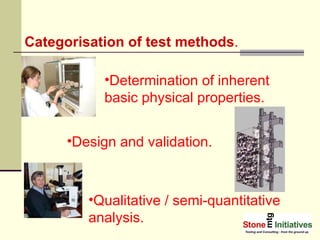
Categorisation of test methods . Determination of inherent basic physical properties. Design and validation. Qualitative / semi-quantitative analysis.
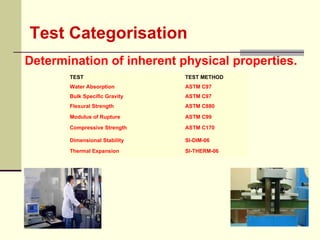
Test Categorisation Determination of inherent physical properties. TEST METHOD TEST ASTM C97 Water Absorption SI-THERM-06 Thermal Expansion SI-DIM-06 Dimensional Stability ASTM C170 Compressive Strength ASTM C99 Modulus of Rupture ASTM C880  Flexural Strength ASTM C97 Bulk Specific Gravity
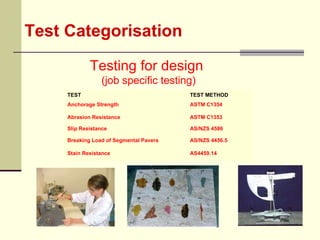
Test Categorisation Testing for design  (job specific testing) AS/NZS 4456.5 Breaking Load of Segmental Pavers AS4459.14 Stain Resistance AS/NZS 4586 Slip Resistance ASTM C1353 Abrasion Resistance ASTM C1354 Anchorage Strength TEST METHOD TEST
Test Categorisation Qualitative / semi-quantitative analysis Freeze-Thaw Cycling Dye Penetrant Testing Durability (Resistance to Salt Attack) - AS/NZS 4456.10-A Petrography Schmidt Hammer Rebound Hardness Ultrasonic Pulse Velocity Chemical / X-Ray Diffraction Analysis (XRD) TEST
The “Life Cycle” of Dimension Stone   Exploration Quarry Development Processing Design & Fabrication Project Quality Control Heritage and Restoration
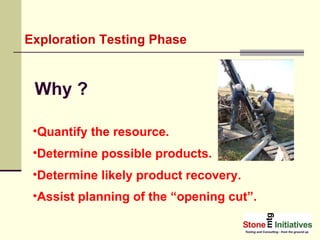
Exploration Testing Phase Why ? Quantify the resource.   Determine possible products. Determine likely product recovery. Assist planning of the “opening cut”.
Exploration Testing Phase Exploration drill core can be used to provide information about many properties. Petrology Water Absorption Bulk Specific Gravity Compressive Strength Durability Dimensional Stability Thermal Expansion XRD analysis of clays
Exploration Testing Phase water absorption / density compressive strength petrography / XRD durability dimensional stability Selection of drill core representative of the range exploitable .
Exploration Testing Phase Comparison of results with those of an established sandstone to determine the likely performance. (Sandstone X has historically been found to perform well as ashlar, paving and façade curtain wall cladding) -0.02 -0.06 Dimensional Stability (%) 0.8 0.6 (1.0 – 0.4) Resistance to Salt Attack (Wt%) 45 / 32 102 / 75 (150 – 50) Compressive Strength (MPa) 2.30 2.43 (2.45 – 2.35) Bulk Specific Gravity (t.m-3) 3.8 2.3 (3.8 – 2.0) Water Absorption (Wt%) Sandstone X New Sandstone Property
Processing Testing Phase Why ? Produce a material with consistent physical and/or aesthetic properties. Maximise output by grading of blocks and identifying the material with the lowest wastage factor (highest recovery).
Processing Testing Phase The adopted testing or inspection regime must be relevant to the intended use/s of the stone and not unnecessarily interfere with production – it should be considered as an  integral   part  of the processing procedure. How ?
Processing Testing Phase Ultrasonic Pulse Velocity Dye/Water Penetrant Testing Scratch Testing Schmidt Hammer Rebound Hardness Tests can be “low tech” and structured with a pass/fail criteria or “high tech” and in need of detailed evaluation.
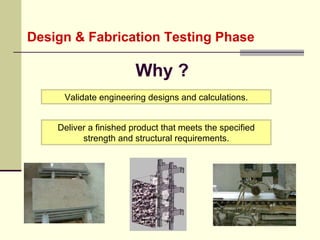
Design & Fabrication Testing Phase Why ? Deliver a finished product that meets the specified strength and structural requirements. Validate engineering designs and calculations.
Design & Fabrication Testing Phase How ? Proof loading of panels – in-house methods Crack testing of anchor points – dye penetrant Anchorage Strength – ASTM C1354 Soft/hard body impact – BS 8200   Impact drop tests –   BS EN14158 Use of destructive and non-destructive tests that are important and relevant to the performance of the stone structure. Freeze/Thaw Cycling – DIN 52104
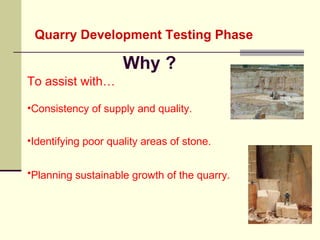
Quarry Development Testing Phase Why ? Planning sustainable growth of the quarry.   Consistency of supply and quality. To assist with… Identifying poor quality areas of stone.
Quarry Development Testing Phase How ? By using historical data gathered from QA testing and tender documents and identifying the basic physical properties that are reliable indicators of the performance of the stone. The example below gives data collected over time for a sandstone…  60 10.3 / 7.0 2.35 2.9 S1 49 7.6 / 5.4 2.29 3.9 S2 58 9.1 / 6.2 2.35 3.1 S3 32 3.8 / 1.1 2.28 4.7 S4 56 42 Compressive Strength (wet) 10.6 / 8.1 8.9 / 5.8 Flexural Strength W / D 2.34 2.33 Bulk Specific Gravity 3.1 3.2 Water Absorption S6 S5 Property
Quarry Development Testing Phase We can see a relationship here between flexural strength and bulk specific gravity.  If our aim is to produce stone with a minimum flexural strength of 6 MPa, we should target stone from the region where the drill core has an SG of at least 2.3; this can be used as a basic criterion.
Quarry Development Testing Phase Hand samples or drill core can be used to determine the physical property that has been found to be a performance indicator.  These results can be used to interpolate approximate physical properties of the material remaining within the different regions of the quarry.
Project Testing Phase Why ? The specification can represent a contractual procedure that monitors the quality of the material supplied to site. To ensure you get what you paid for ! Confirm the properties of stone required for the project.
Project Testing Phase Setting the   Specification Can be based on: Published standard specifications such as: ASTM C615 – Granite Dimension Stone ASTM C616 – Quartz-based Dimension Stone ASTM C568 – Limestone Dimension Stone ASTM C503 – Marble Dimension Stone Research of the historical performance of dimension stone. Engineering data specifically related to the project.
Project Testing Phase Pre-tender Testing Acceptance Testing Production Quality Control Testing Tender Testing Depending on the size and complexity of the project the specification may be composed of up to four major components.
Project Testing Phase Pre-tender Testing AIM Setting the standard Presentation of the important physical properties for possible short-listing of specific stone types. For example… For an exterior paving project, testing may include : Water Absorption Bulk Specific Gravity Flexural Strength Abrasion Resistance Durability These results may be “on file” and represent material “typically supplied” but should be dated and traceable to original certificates.
Project Testing Phase Tender Testing AIM Confirm the properties of the stone that may be supplied. Confirm that the stone conforms to the design properties required by the project.  For example… For an exterior paving project, testing may include : Slip Resistance Stain Resistance Breaking Load Abrasion Resistance These results need to be traceable, current and performed on material in stock or currently in production.
Project Testing Phase AIM Confirm the uniformity and conformity of the properties of the stone that has been offered for supply. Usually involves the confirmation of the important basic physical properties. For example… For an exterior paving project,  testing may include : Water Absorption Flexural Strength Durability These results need to be traceable to specific blocks or regions of the quarry and performed on material that is offered for supply.  Acceptance Testing
Project Testing Phase Production Quality Control Testing AIM Monitor the uniformity and conformity of the properties of the stone that is being supplied. May include the determination of physical properties that act as performance indicators. For example… For an exterior paving project, testing may include : Breaking load of segmental pavers Water Absorption Flexural Strength Durability The results need to be traceable to specific blocks and performed on material that is to be supplied to site.
Project Testing Phase Production Quality Control Testing To be effective and useful the testing specification must be systematic and enforceable - it needs teeth! Should include: The standardized testing to be carried out. A traceability procedure.  How much and how often. Clear Pass/fail criteria. A procedure to deal definitively with failures. Possibly   a mediation or review process .
Project Testing Phase Production Quality Control Testing The volume and frequency of testing may vary depending on the variation in the test results gathered during the previous testing stages. For example: For an exterior paving project, the quality control testing specification may include statements such as …
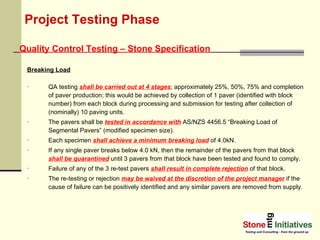
Project Testing Phase Breaking Load QA testing  shall be carried out at 4 stages ; approximately 25%, 50%, 75% and completion of paver production; this would be achieved by collection of 1 paver (identified with block number) from each block during processing and submission for testing after collection of (nominally) 10 paving units.  The pavers shall be  tested in accordance with  AS/NZS 4456.5 “Breaking Load of Segmental Pavers” (modified specimen size).  Each specimen  shall achieve a minimum breaking load  of 4.0kN. If any single paver breaks below 4.0 kN, then the remainder of the pavers from that block  shall be quarantined  until 3 pavers from that block have been tested and found to comply. Failure of any of the 3 re-test pavers  shall result in complete rejection  of that block.  The re-testing or rejection  may be waived at the discretion of the project manager  if the cause of failure can be positively identified and any similar pavers are removed from supply. Quality Control Testing – Stone Specification
Project Testing Phase Quality Control Testing – Specification cont. Water Absorption From each batch of pavers tested, the three units  with the lowest breaking load  shall be tested in accordance with ASTMC97-02 “Absorption and Bulk Specific Gravity of Dimension Stone” (modified specimen number).  Three specimens  shall be prepared and tested from each of the three pavers.  Each set of three specimens  shall have a maximum mean water absorption  value of 0.30% by weight with no single specimen having a water absorption greater than 0.40% by weight. If any set of specimens  fails to meet the requirements , then the pavers from that block  shall be quarantined  until  3 pavers from that block have been tested and found to comply .   Failure of any of the 3 re-test pavers  shall result in  complete rejection of that block .   The re-testing or  rejection may be waived if the Project Manager considers  the pavers from that block can be laid in an area that has a low risk of staining occurring. NOTE :  The success of this QA Testing schedule lies in the availability of sufficient lag time between processing and laying to allow time for testing.
Project Testing Phase A testing specification can set the benchmark monitor the quality of the material being delivered to site. A testing specification can monitor the quality of the material being delivered to site. A systematic specification will minimise delays and unnecessary costs by providing an established procedure for dealing with non-conformances. Correct compliance with a testing specification can protect you as a supplier or producer by documenting that you have provided a quality product and that is fit-for-purpose according to the specification. Summarising…
In Review… Ensures the extraction, processing, supply, procurement or use of a  quality product  that will meet the relevant specification. A quality product combines  “fit for purpose”  with “value for money”.   A means of  adding value  to a product at all stages; it allows evaluation of its performance thereby building confidence. The benefits of a targeted testing program: quality product fit for purpose adding value
www.stonemtg.biz

Developing Stone Test Programmes

  • 1.
    Developing a stonetesting program Why, How, When & What For? Jim Mann Dimension Stone Specialist Principal Stone Initiatives www.stonemtg.biz
  • 2.
    Whether you area quarry owner, processor, architect, engineer, developer or owner a systematic and targeted testing program will add value to your product.
  • 3.
    Answering the question– WHY TEST? To ensure the extraction, processing, supply, procurement or use of a quality product that will meet the relevant specification. A quality product combines “fit for purpose” with “value for money”. Testing is a means of adding value to a product as it allows evaluation of its performance by the end-user thereby building confidence.
  • 4.
    To correctly determineHOW to test, we need to understand what the tests can tell us…
  • 5.
    Categorisation of testmethods . Determination of inherent basic physical properties. Design and validation. Qualitative / semi-quantitative analysis.
  • 6.
    Test Categorisation Determinationof inherent physical properties. TEST METHOD TEST ASTM C97 Water Absorption SI-THERM-06 Thermal Expansion SI-DIM-06 Dimensional Stability ASTM C170 Compressive Strength ASTM C99 Modulus of Rupture ASTM C880 Flexural Strength ASTM C97 Bulk Specific Gravity
  • 7.
    Test Categorisation Testingfor design (job specific testing) AS/NZS 4456.5 Breaking Load of Segmental Pavers AS4459.14 Stain Resistance AS/NZS 4586 Slip Resistance ASTM C1353 Abrasion Resistance ASTM C1354 Anchorage Strength TEST METHOD TEST
  • 8.
    Test Categorisation Qualitative/ semi-quantitative analysis Freeze-Thaw Cycling Dye Penetrant Testing Durability (Resistance to Salt Attack) - AS/NZS 4456.10-A Petrography Schmidt Hammer Rebound Hardness Ultrasonic Pulse Velocity Chemical / X-Ray Diffraction Analysis (XRD) TEST
  • 9.
    The “Life Cycle”of Dimension Stone Exploration Quarry Development Processing Design & Fabrication Project Quality Control Heritage and Restoration
  • 10.
    Exploration Testing PhaseWhy ? Quantify the resource. Determine possible products. Determine likely product recovery. Assist planning of the “opening cut”.
  • 11.
    Exploration Testing PhaseExploration drill core can be used to provide information about many properties. Petrology Water Absorption Bulk Specific Gravity Compressive Strength Durability Dimensional Stability Thermal Expansion XRD analysis of clays
  • 12.
    Exploration Testing Phasewater absorption / density compressive strength petrography / XRD durability dimensional stability Selection of drill core representative of the range exploitable .
  • 13.
    Exploration Testing PhaseComparison of results with those of an established sandstone to determine the likely performance. (Sandstone X has historically been found to perform well as ashlar, paving and façade curtain wall cladding) -0.02 -0.06 Dimensional Stability (%) 0.8 0.6 (1.0 – 0.4) Resistance to Salt Attack (Wt%) 45 / 32 102 / 75 (150 – 50) Compressive Strength (MPa) 2.30 2.43 (2.45 – 2.35) Bulk Specific Gravity (t.m-3) 3.8 2.3 (3.8 – 2.0) Water Absorption (Wt%) Sandstone X New Sandstone Property
  • 14.
    Processing Testing PhaseWhy ? Produce a material with consistent physical and/or aesthetic properties. Maximise output by grading of blocks and identifying the material with the lowest wastage factor (highest recovery).
  • 15.
    Processing Testing PhaseThe adopted testing or inspection regime must be relevant to the intended use/s of the stone and not unnecessarily interfere with production – it should be considered as an integral part of the processing procedure. How ?
  • 16.
    Processing Testing PhaseUltrasonic Pulse Velocity Dye/Water Penetrant Testing Scratch Testing Schmidt Hammer Rebound Hardness Tests can be “low tech” and structured with a pass/fail criteria or “high tech” and in need of detailed evaluation.
  • 17.
    Design & FabricationTesting Phase Why ? Deliver a finished product that meets the specified strength and structural requirements. Validate engineering designs and calculations.
  • 18.
    Design & FabricationTesting Phase How ? Proof loading of panels – in-house methods Crack testing of anchor points – dye penetrant Anchorage Strength – ASTM C1354 Soft/hard body impact – BS 8200 Impact drop tests – BS EN14158 Use of destructive and non-destructive tests that are important and relevant to the performance of the stone structure. Freeze/Thaw Cycling – DIN 52104
  • 19.
    Quarry Development TestingPhase Why ? Planning sustainable growth of the quarry. Consistency of supply and quality. To assist with… Identifying poor quality areas of stone.
  • 20.
    Quarry Development TestingPhase How ? By using historical data gathered from QA testing and tender documents and identifying the basic physical properties that are reliable indicators of the performance of the stone. The example below gives data collected over time for a sandstone… 60 10.3 / 7.0 2.35 2.9 S1 49 7.6 / 5.4 2.29 3.9 S2 58 9.1 / 6.2 2.35 3.1 S3 32 3.8 / 1.1 2.28 4.7 S4 56 42 Compressive Strength (wet) 10.6 / 8.1 8.9 / 5.8 Flexural Strength W / D 2.34 2.33 Bulk Specific Gravity 3.1 3.2 Water Absorption S6 S5 Property
  • 21.
    Quarry Development TestingPhase We can see a relationship here between flexural strength and bulk specific gravity. If our aim is to produce stone with a minimum flexural strength of 6 MPa, we should target stone from the region where the drill core has an SG of at least 2.3; this can be used as a basic criterion.
  • 22.
    Quarry Development TestingPhase Hand samples or drill core can be used to determine the physical property that has been found to be a performance indicator. These results can be used to interpolate approximate physical properties of the material remaining within the different regions of the quarry.
  • 23.
    Project Testing PhaseWhy ? The specification can represent a contractual procedure that monitors the quality of the material supplied to site. To ensure you get what you paid for ! Confirm the properties of stone required for the project.
  • 24.
    Project Testing PhaseSetting the Specification Can be based on: Published standard specifications such as: ASTM C615 – Granite Dimension Stone ASTM C616 – Quartz-based Dimension Stone ASTM C568 – Limestone Dimension Stone ASTM C503 – Marble Dimension Stone Research of the historical performance of dimension stone. Engineering data specifically related to the project.
  • 25.
    Project Testing PhasePre-tender Testing Acceptance Testing Production Quality Control Testing Tender Testing Depending on the size and complexity of the project the specification may be composed of up to four major components.
  • 26.
    Project Testing PhasePre-tender Testing AIM Setting the standard Presentation of the important physical properties for possible short-listing of specific stone types. For example… For an exterior paving project, testing may include : Water Absorption Bulk Specific Gravity Flexural Strength Abrasion Resistance Durability These results may be “on file” and represent material “typically supplied” but should be dated and traceable to original certificates.
  • 27.
    Project Testing PhaseTender Testing AIM Confirm the properties of the stone that may be supplied. Confirm that the stone conforms to the design properties required by the project. For example… For an exterior paving project, testing may include : Slip Resistance Stain Resistance Breaking Load Abrasion Resistance These results need to be traceable, current and performed on material in stock or currently in production.
  • 28.
    Project Testing PhaseAIM Confirm the uniformity and conformity of the properties of the stone that has been offered for supply. Usually involves the confirmation of the important basic physical properties. For example… For an exterior paving project, testing may include : Water Absorption Flexural Strength Durability These results need to be traceable to specific blocks or regions of the quarry and performed on material that is offered for supply. Acceptance Testing
  • 29.
    Project Testing PhaseProduction Quality Control Testing AIM Monitor the uniformity and conformity of the properties of the stone that is being supplied. May include the determination of physical properties that act as performance indicators. For example… For an exterior paving project, testing may include : Breaking load of segmental pavers Water Absorption Flexural Strength Durability The results need to be traceable to specific blocks and performed on material that is to be supplied to site.
  • 30.
    Project Testing PhaseProduction Quality Control Testing To be effective and useful the testing specification must be systematic and enforceable - it needs teeth! Should include: The standardized testing to be carried out. A traceability procedure. How much and how often. Clear Pass/fail criteria. A procedure to deal definitively with failures. Possibly a mediation or review process .
  • 31.
    Project Testing PhaseProduction Quality Control Testing The volume and frequency of testing may vary depending on the variation in the test results gathered during the previous testing stages. For example: For an exterior paving project, the quality control testing specification may include statements such as …
  • 32.
    Project Testing PhaseBreaking Load QA testing shall be carried out at 4 stages ; approximately 25%, 50%, 75% and completion of paver production; this would be achieved by collection of 1 paver (identified with block number) from each block during processing and submission for testing after collection of (nominally) 10 paving units. The pavers shall be tested in accordance with AS/NZS 4456.5 “Breaking Load of Segmental Pavers” (modified specimen size). Each specimen shall achieve a minimum breaking load of 4.0kN. If any single paver breaks below 4.0 kN, then the remainder of the pavers from that block shall be quarantined until 3 pavers from that block have been tested and found to comply. Failure of any of the 3 re-test pavers shall result in complete rejection of that block. The re-testing or rejection may be waived at the discretion of the project manager if the cause of failure can be positively identified and any similar pavers are removed from supply. Quality Control Testing – Stone Specification
  • 33.
    Project Testing PhaseQuality Control Testing – Specification cont. Water Absorption From each batch of pavers tested, the three units with the lowest breaking load shall be tested in accordance with ASTMC97-02 “Absorption and Bulk Specific Gravity of Dimension Stone” (modified specimen number). Three specimens shall be prepared and tested from each of the three pavers. Each set of three specimens shall have a maximum mean water absorption value of 0.30% by weight with no single specimen having a water absorption greater than 0.40% by weight. If any set of specimens fails to meet the requirements , then the pavers from that block shall be quarantined until 3 pavers from that block have been tested and found to comply . Failure of any of the 3 re-test pavers shall result in complete rejection of that block . The re-testing or rejection may be waived if the Project Manager considers the pavers from that block can be laid in an area that has a low risk of staining occurring. NOTE : The success of this QA Testing schedule lies in the availability of sufficient lag time between processing and laying to allow time for testing.
  • 34.
    Project Testing PhaseA testing specification can set the benchmark monitor the quality of the material being delivered to site. A testing specification can monitor the quality of the material being delivered to site. A systematic specification will minimise delays and unnecessary costs by providing an established procedure for dealing with non-conformances. Correct compliance with a testing specification can protect you as a supplier or producer by documenting that you have provided a quality product and that is fit-for-purpose according to the specification. Summarising…
  • 35.
    In Review… Ensuresthe extraction, processing, supply, procurement or use of a quality product that will meet the relevant specification. A quality product combines “fit for purpose” with “value for money”. A means of adding value to a product at all stages; it allows evaluation of its performance thereby building confidence. The benefits of a targeted testing program: quality product fit for purpose adding value
  • 36.