Developing Sense of
Responsibility
Explain the slogan above. Do you agree or
disagree?
You have the RIGHT to education.
You have the RESPONSIBILITY to study well.
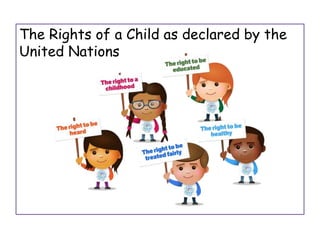
The Rights of a Child as declared by the
United Nations
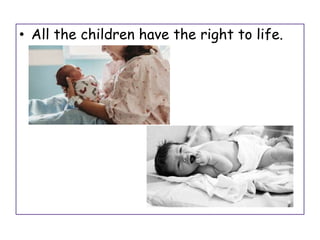
• All the children have the right to life.
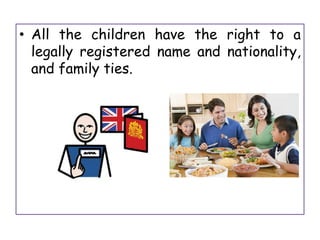
• All the children have the right to a
legally registered name and nationality,
and family ties.
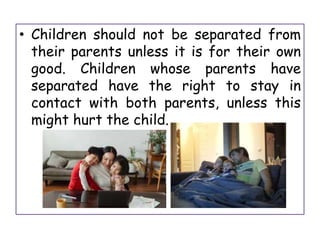
• Children should not be separated from
their parents unless it is for their own
good. Children whose parents have
separated have the right to stay in
contact with both parents, unless this
might hurt the child.
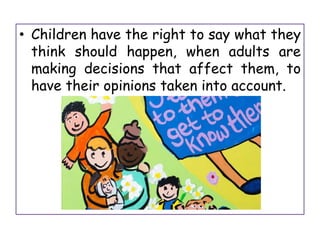
• Children have the right to say what they
think should happen, when adults are
making decisions that affect them, to
have their opinions taken into account.
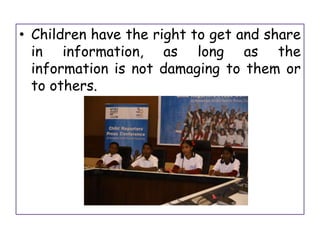
• Children have the right to get and share
in information, as long as the
information is not damaging to them or
to others.
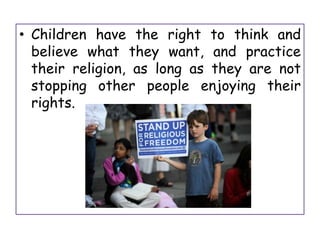
• Children have the right to think and
believe what they want, and practice
their religion, as long as they are not
stopping other people enjoying their
rights.
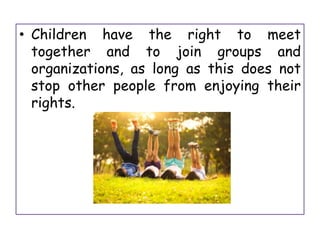
• Children have the right to meet
together and to join groups and
organizations, as long as this does not
stop other people from enjoying their
rights.
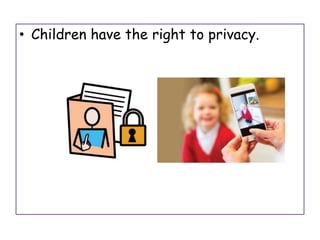
• Children have the right to privacy.
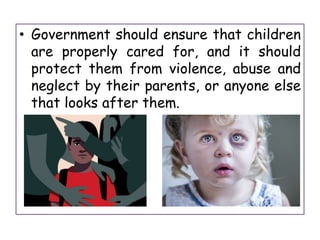
• Government should ensure that children
are properly cared for, and it should
protect them from violence, abuse and
neglect by their parents, or anyone else
that looks after them.
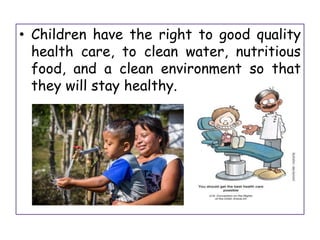
• Children have the right to good quality
health care, to clean water, nutritious
food, and a clean environment so that
they will stay healthy.
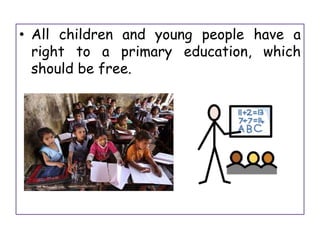
• All children and young people have a
right to a primary education, which
should be free.
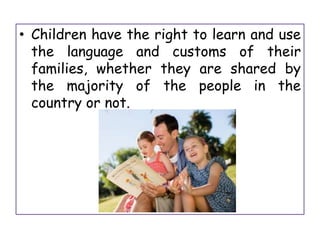
• Children have the right to learn and use
the language and customs of their
families, whether they are shared by
the majority of the people in the
country or not.
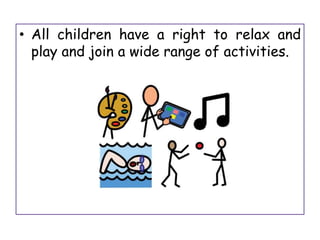
• All children have a right to relax and
play and join a wide range of activities.
Responsibilities that accompany
children’s rights:
1. If every child, regardless of sex and
ethnic origin, social status, language, age,
nationality, or religion has these rights,
then they have the responsibility to
respect each other in a humane way.
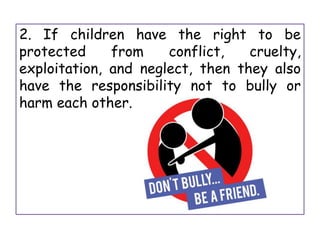
2. If children have the right to be
protected from conflict, cruelty,
exploitation, and neglect, then they also
have the responsibility not to bully or
harm each other.
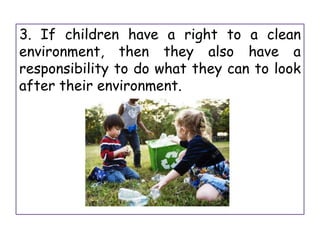
3. If children have a right to a clean
environment, then they also have a
responsibility to do what they can to look
after their environment.
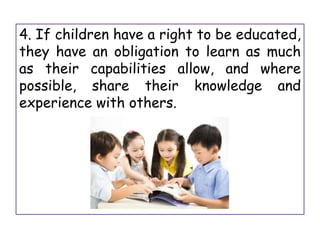
4. If children have a right to be educated,
they have an obligation to learn as much
as their capabilities allow, and where
possible, share their knowledge and
experience with others.
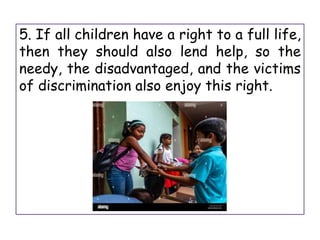
5. If all children have a right to a full life,
then they should also lend help, so the
needy, the disadvantaged, and the victims
of discrimination also enjoy this right.
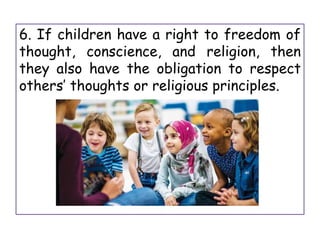
6. If children have a right to freedom of
thought, conscience, and religion, then
they also have the obligation to respect
others’ thoughts or religious principles.
Developing sense of responsibility

Developing sense of responsibility

  • 1.
  • 2.
    Explain the sloganabove. Do you agree or disagree? You have the RIGHT to education. You have the RESPONSIBILITY to study well.
  • 3.
    The Rights ofa Child as declared by the United Nations
  • 4.
    • All thechildren have the right to life.
  • 5.
    • All thechildren have the right to a legally registered name and nationality, and family ties.
  • 6.
    • Children shouldnot be separated from their parents unless it is for their own good. Children whose parents have separated have the right to stay in contact with both parents, unless this might hurt the child.
  • 7.
    • Children havethe right to say what they think should happen, when adults are making decisions that affect them, to have their opinions taken into account.
  • 8.
    • Children havethe right to get and share in information, as long as the information is not damaging to them or to others.
  • 9.
    • Children havethe right to think and believe what they want, and practice their religion, as long as they are not stopping other people enjoying their rights.
  • 10.
    • Children havethe right to meet together and to join groups and organizations, as long as this does not stop other people from enjoying their rights.
  • 11.
    • Children havethe right to privacy.
  • 12.
    • Government shouldensure that children are properly cared for, and it should protect them from violence, abuse and neglect by their parents, or anyone else that looks after them.
  • 13.
    • Children havethe right to good quality health care, to clean water, nutritious food, and a clean environment so that they will stay healthy.
  • 14.
    • All childrenand young people have a right to a primary education, which should be free.
  • 15.
    • Children havethe right to learn and use the language and customs of their families, whether they are shared by the majority of the people in the country or not.
  • 16.
    • All childrenhave a right to relax and play and join a wide range of activities.
  • 17.
    Responsibilities that accompany children’srights: 1. If every child, regardless of sex and ethnic origin, social status, language, age, nationality, or religion has these rights, then they have the responsibility to respect each other in a humane way.
  • 18.
    2. If childrenhave the right to be protected from conflict, cruelty, exploitation, and neglect, then they also have the responsibility not to bully or harm each other.
  • 19.
    3. If childrenhave a right to a clean environment, then they also have a responsibility to do what they can to look after their environment.
  • 20.
    4. If childrenhave a right to be educated, they have an obligation to learn as much as their capabilities allow, and where possible, share their knowledge and experience with others.
  • 21.
    5. If allchildren have a right to a full life, then they should also lend help, so the needy, the disadvantaged, and the victims of discrimination also enjoy this right.
  • 22.
    6. If childrenhave a right to freedom of thought, conscience, and religion, then they also have the obligation to respect others’ thoughts or religious principles.