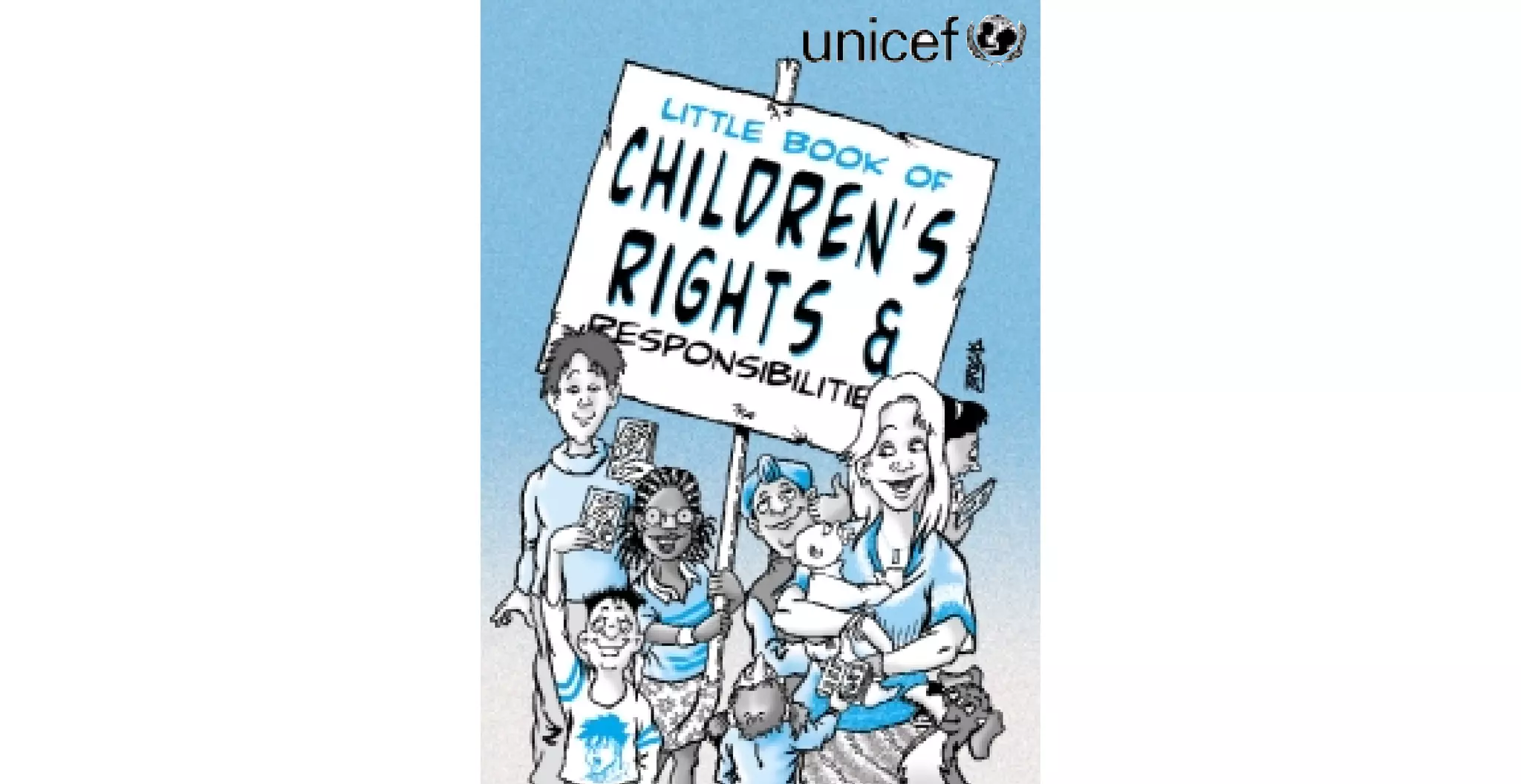
This little book contains a sum−
mary of the United Nations
Convention on the Rights of
the Child.
“A convention is an agreement between
countries to obey the same law. The
United Kingdom of Great Britain and
Northern Ireland agreed to obey
(ratified) the Convention on the Rights
of the Child on 16 December, 1991. That
means our government
now has to make sure
that every child has all
the rights in the conven−
tion, except the two
they have ‘reservations’
about
(Articles 10
and 37).”
Article 1
Everyone under 18 years of
age has all the rights in this
Convention.
Article 2
The Convention applies to
everyone, whatever their race,
religion, abilities; whatever they
think or say, whatever type of
family they come from.
1
Article 6
All children have the right
to life. Governments should
ensure that children survive
and develop healthily.
Article 3
All organisations concerned
with children should work
towards what is best for each
child.
Article 4
Governments should make
these rights available to
children.
Article 5
Governments
should respect
the rights and
responsibilities of
families to direct
and guide their
children so that,
as they grow, they
learn to use their
rights properly.
2 3
Article 9
Children should not be
separated from their parents
unless it is for their own
good. For example, if a parent
is mistreating or neglecting a
child. Children whose parents
have separated have the
right to stay in contact
with both parents,
unless this might
hurt the child.
Article 10
Families who live in
different countries should
be allowed to move between
those countries so that
parents and children can
stay in contact, or get
back together as a family.
Article 7
All children have the right
to a legally registered name,
and nationality. Also the right
to know and, as far as
possible, to be cared for
by their parents.
Article 8
Governments should respect
children's right to a name, a
nationality and family ties.
4 5
Article 13
Children have the right to
get and to share information,
as long as the information is
not damaging to them or to
others.
Article 14
Children have the right to
think and believe what they
want, and to practise their
religion, as long as they are
not stopping other people
from enjoying their rights.
Parents should guide their
children on these matters.
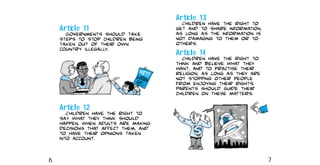
Article 11
Governments should take
steps to stop children being
taken out of their own
country illegally.
Article 12
Children have the right to
say what they think should
happen, when adults are making
decisions that affect them, and
to have their opinions taken
into account.
6 7
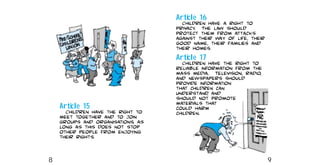
Article 16
Children have a right to
privacy. The law should
protect them from attacks
against their way of life, their
good name, their families and
their homes.
Article 17
Children have the right to
reliable information from the
mass media. Television, radio,
and newspapers should
provide information
that children can
understand, and
should not promote
materials that
could harm
children.
Article 15
Children have the right to
meet together and to join
groups and organisations, as
long as this does not stop
other people from enjoying
their rights.
8 9
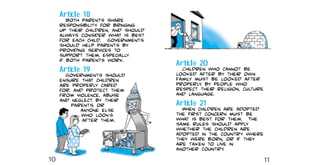
Article 20
Children who cannot be
looked after by their own
family must be looked after
properly, by people who
respect their religion, culture
and language.
Article 21
When children are adopted
the first concern must be
what is best for them. The
same rules should apply
whether the children are
adopted in the country where
they were born, or if they
are taken to live in
another country.
Article 18
Both parents share
responsibility for bringing
up their children, and should
always consider what is best
for each child. Governments
should help parents by
providing services to
support them, especially
if both parents work.
Article 19
Governments should
ensure that children
are properly cared
for, and protect them
from violence, abuse
and neglect by their
parents, or
anyone else
who looks
after them.
10 11
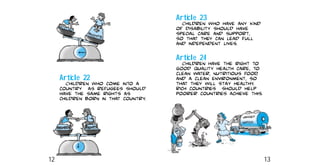
Article 23
Children who have any kind
of disability should have
special care and support,
so that they can lead full
and independent lives.
Article 24
Children have the right to
good quality health care, to
clean water, nutritious food,
and a clean environment, so
that they will stay healthy.
Rich countries should help
poorer countries achieve this.
Article 22
Children who come into a
country as refugees should
have the same rights as
children born in that country.
12 13
Article 28
Children have a right to an
education. Discipline in schools
should respect children’s
human dignity. Primary
education should be free.
Wealthy countries should
help poorer countries
achieve this.
Article 29
Education should develop
each child's personality and
talents to the full. It
should encourage children
to respect their parents,
and their own and other
cultures.
Article 30
Children have a right to
learn and use the language
and customs of their families,
whether these are shared by
the majority of people in the
country or not.
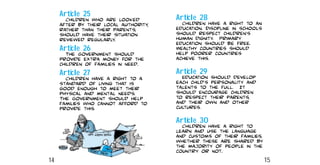
Article 25
Children who are looked
after by their local authority,
rather than their parents,
should have their situation
reviewed regularly.
Article 26
The Government should
provide extra money for the
children of families in need.
Article 27
Children have a right to a
standard of living that is
good enough to meet their
physical and mental needs.
The Government should help
families who cannot afford to
provide this.
14 15
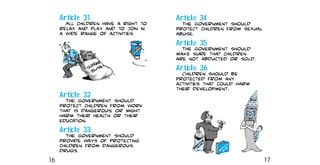
Article 32
The Government should
protect children from work
that is dangerous, or might
harm their health or their
education.
Article 33
The Government should
provide ways of protecting
children from dangerous
drugs.
Article 34
The Government should
protect children from sexual
abuse.
Article 35
The Government should
make sure that children
are not abducted or sold.
Article 36
Children should be
protected from any
activities that could harm
their development.
Article 31
All children have a right to
relax and play, and to join in
a wide range of activities.
16 17
Article 38
Governments should not
allow children under 16 to
join the army. Children in war
zones should receive special
protection.
Article 39
Children who have been
neglected or abused should
receive special help to
restore their self−respect.
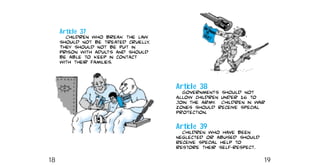
Article 37
Children who break the law
should not be treated cruelly.
They should not be put in
prison with adults and should
be able to keep in contact
with their families.
18 19
Article 42
The Government should
make the Convention known to
parents and children.
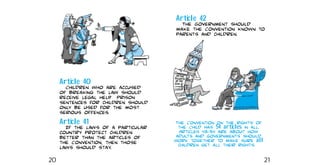
Article 40
Children who are accused
of breaking the law should
receive legal help. Prison
sentences for children should
only be used for the most
serious offences.
Article 41
If the laws of a particular
country protect children
better than the articles of
the Convention, then those
laws should stay.
The Convention on the Rights of
the Child has 54 articles in all.
Articles 43−54 are about how
adults and governments should
work together to make sure all
children get all their rights.
10
20 21
** IF every child, regardless
of their sex, ethnic origin,
social status, language, age,
nationality or religion has
these rights, then they also
have a responsibility to respect
each other in a humane way.
** IF children have a right to
be protected from conflict,
cruelty, exploitation and neg−
lect, then they also have a
responsibility not to bully or
harm each other.
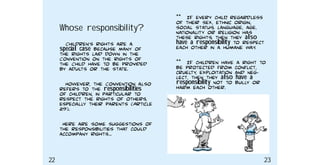
Whose responsibility?
Children’s rights are a
special case because many of
the rights laid down in the
Convention on the Rights of
the Child have to be provided
by adults or the state.
However, the Convention also
refers to the responsibilities
of children, in particular to
respect the rights of others,
especially their parents (Article
29).
Here are some suggestions of
the responsibilities that could
accompany rights…
22 23
You can probably think
of many more.
Derived from a Universal Declaration of Human
Responsibilities, by an organisation called World
Goodwill, composed of ex−heads of state.
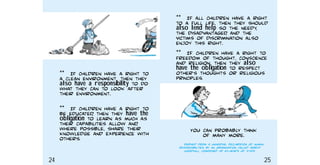
** If all children have a right
to a full life, then they should
also lend help so the needy,
the disadvantaged, and the
victims of discrimination also
enjoy this right.
** IF children have a right to
freedom of thought, conscience
and religion, then they also
have the obligation to respect
other’s thoughts or religious
principles.
** If children have a right to
a clean environment, then they
also have a responsibility to do
what they can to look after
their environment.
** If children have a right to
be educated, then they have the
obligation to learn as much as
their capabilities allow and,
where possible, share their
knowledge and experience with
others.
24 25
Check out UNICEF UK’s website
for children & young people
www.therightssite.org.uk
For further free copies of this booklet
call the UNICEF Helpdesk:
0870 606 3377
Quote code: 32014
The UK Committee for UNICEF is a Company Limited by Guarantee,
registered in England and Wales, No: 3663181.
Registered Charity No. 1072612.
UNICEF website:
www.unicef.org.uk
Devised & Drawn by
www.brickbats.co.uk

Little book rights

  • 2.
    This little bookcontains a sum− mary of the United Nations Convention on the Rights of the Child. “A convention is an agreement between countries to obey the same law. The United Kingdom of Great Britain and Northern Ireland agreed to obey (ratified) the Convention on the Rights of the Child on 16 December, 1991. That means our government now has to make sure that every child has all the rights in the conven− tion, except the two they have ‘reservations’ about (Articles 10 and 37).” Article 1 Everyone under 18 years of age has all the rights in this Convention. Article 2 The Convention applies to everyone, whatever their race, religion, abilities; whatever they think or say, whatever type of family they come from. 1
  • 3.
    Article 6 All childrenhave the right to life. Governments should ensure that children survive and develop healthily. Article 3 All organisations concerned with children should work towards what is best for each child. Article 4 Governments should make these rights available to children. Article 5 Governments should respect the rights and responsibilities of families to direct and guide their children so that, as they grow, they learn to use their rights properly. 2 3
  • 4.
    Article 9 Children shouldnot be separated from their parents unless it is for their own good. For example, if a parent is mistreating or neglecting a child. Children whose parents have separated have the right to stay in contact with both parents, unless this might hurt the child. Article 10 Families who live in different countries should be allowed to move between those countries so that parents and children can stay in contact, or get back together as a family. Article 7 All children have the right to a legally registered name, and nationality. Also the right to know and, as far as possible, to be cared for by their parents. Article 8 Governments should respect children's right to a name, a nationality and family ties. 4 5
  • 5.
    Article 13 Children havethe right to get and to share information, as long as the information is not damaging to them or to others. Article 14 Children have the right to think and believe what they want, and to practise their religion, as long as they are not stopping other people from enjoying their rights. Parents should guide their children on these matters. Article 11 Governments should take steps to stop children being taken out of their own country illegally. Article 12 Children have the right to say what they think should happen, when adults are making decisions that affect them, and to have their opinions taken into account. 6 7
  • 6.
    Article 16 Children havea right to privacy. The law should protect them from attacks against their way of life, their good name, their families and their homes. Article 17 Children have the right to reliable information from the mass media. Television, radio, and newspapers should provide information that children can understand, and should not promote materials that could harm children. Article 15 Children have the right to meet together and to join groups and organisations, as long as this does not stop other people from enjoying their rights. 8 9
  • 7.
    Article 20 Children whocannot be looked after by their own family must be looked after properly, by people who respect their religion, culture and language. Article 21 When children are adopted the first concern must be what is best for them. The same rules should apply whether the children are adopted in the country where they were born, or if they are taken to live in another country. Article 18 Both parents share responsibility for bringing up their children, and should always consider what is best for each child. Governments should help parents by providing services to support them, especially if both parents work. Article 19 Governments should ensure that children are properly cared for, and protect them from violence, abuse and neglect by their parents, or anyone else who looks after them. 10 11
  • 8.
    Article 23 Children whohave any kind of disability should have special care and support, so that they can lead full and independent lives. Article 24 Children have the right to good quality health care, to clean water, nutritious food, and a clean environment, so that they will stay healthy. Rich countries should help poorer countries achieve this. Article 22 Children who come into a country as refugees should have the same rights as children born in that country. 12 13
  • 9.
    Article 28 Children havea right to an education. Discipline in schools should respect children’s human dignity. Primary education should be free. Wealthy countries should help poorer countries achieve this. Article 29 Education should develop each child's personality and talents to the full. It should encourage children to respect their parents, and their own and other cultures. Article 30 Children have a right to learn and use the language and customs of their families, whether these are shared by the majority of people in the country or not. Article 25 Children who are looked after by their local authority, rather than their parents, should have their situation reviewed regularly. Article 26 The Government should provide extra money for the children of families in need. Article 27 Children have a right to a standard of living that is good enough to meet their physical and mental needs. The Government should help families who cannot afford to provide this. 14 15
  • 10.
    Article 32 The Governmentshould protect children from work that is dangerous, or might harm their health or their education. Article 33 The Government should provide ways of protecting children from dangerous drugs. Article 34 The Government should protect children from sexual abuse. Article 35 The Government should make sure that children are not abducted or sold. Article 36 Children should be protected from any activities that could harm their development. Article 31 All children have a right to relax and play, and to join in a wide range of activities. 16 17
  • 11.
    Article 38 Governments shouldnot allow children under 16 to join the army. Children in war zones should receive special protection. Article 39 Children who have been neglected or abused should receive special help to restore their self−respect. Article 37 Children who break the law should not be treated cruelly. They should not be put in prison with adults and should be able to keep in contact with their families. 18 19
  • 12.
    Article 42 The Governmentshould make the Convention known to parents and children. Article 40 Children who are accused of breaking the law should receive legal help. Prison sentences for children should only be used for the most serious offences. Article 41 If the laws of a particular country protect children better than the articles of the Convention, then those laws should stay. The Convention on the Rights of the Child has 54 articles in all. Articles 43−54 are about how adults and governments should work together to make sure all children get all their rights. 10 20 21
  • 13.
    ** IF everychild, regardless of their sex, ethnic origin, social status, language, age, nationality or religion has these rights, then they also have a responsibility to respect each other in a humane way. ** IF children have a right to be protected from conflict, cruelty, exploitation and neg− lect, then they also have a responsibility not to bully or harm each other. Whose responsibility? Children’s rights are a special case because many of the rights laid down in the Convention on the Rights of the Child have to be provided by adults or the state. However, the Convention also refers to the responsibilities of children, in particular to respect the rights of others, especially their parents (Article 29). Here are some suggestions of the responsibilities that could accompany rights… 22 23
  • 14.
    You can probablythink of many more. Derived from a Universal Declaration of Human Responsibilities, by an organisation called World Goodwill, composed of ex−heads of state. ** If all children have a right to a full life, then they should also lend help so the needy, the disadvantaged, and the victims of discrimination also enjoy this right. ** IF children have a right to freedom of thought, conscience and religion, then they also have the obligation to respect other’s thoughts or religious principles. ** If children have a right to a clean environment, then they also have a responsibility to do what they can to look after their environment. ** If children have a right to be educated, then they have the obligation to learn as much as their capabilities allow and, where possible, share their knowledge and experience with others. 24 25
  • 15.
    Check out UNICEFUK’s website for children & young people www.therightssite.org.uk For further free copies of this booklet call the UNICEF Helpdesk: 0870 606 3377 Quote code: 32014 The UK Committee for UNICEF is a Company Limited by Guarantee, registered in England and Wales, No: 3663181. Registered Charity No. 1072612. UNICEF website: www.unicef.org.uk Devised & Drawn by www.brickbats.co.uk