Lesson 8:
Developing
lesson plans for
Social Studies
Manda, Nezriyn A.
Develop a lesson plan
for one grade level
based on the K to 12
curriculum guide for
social studies
Differentiate
comprehensive and
abbreviated lesson
plans and discuss how
they are used in the
Philippines
Explain the different
components of the Daily
Lesson Plan and the
Daily Lesson Log
03
OBJECTIVES
General format
of a Lesson Plan
Comprehensiv
e Lesson Plan
Abbreviated
Lesson Plan
CONTAINS A DETAILED
DESCRIPTION OF THE
STEPS IN THE TEACHING
AND LEARNING
PROCESS.
Comprehensive Lesson
Plan
Comprehensive Lesson
Plan
In the Philippines, an example of this format is the Detailed Lesson Plan (DLP),
which is mandated through DepEd Order No. 42, s. 2016. The DLP is considered
as a teacher’s roadmap for a specific lesson, containing a detailed description of
the processes he or she will use to teach a particular topic. According to the
DepEd Order, the following are required to prepare DLPs:
 Newly-hired teachers without professional teaching experience: They are
required to accomplish DLPs during their first year. If they receive a rating of
‘Very Satisfactory’ at the end of the year, they will not be required to create
DLPs in their second year onwards. However, if they receive a ‘Satisfactory’
rating, they must continue preparing DLPs until they achieve a ‘Very
Satisfactory’ rating.
 Teacher applicants
 Master teachers who will conduct demonstration teaching
 All teachers handling a subject integrated with new content
General format
of a Lesson Plan
Comprehensiv
e Lesson Plan
Abbreviated
Lesson Plan
Abbreviat
ed Lesson
Plan
Contains less
details.
Usually
utilized by
more
experienced
teacher.
In the Philippines, an example of this format is the
Daily Lesson Log (DLL), which is mandated through
DepEd Order No. 42, s. 2016. The DLL serves as a grid
template where teachers input the different parts of
the lesson. The template provided by the Department
of Education covers a week’s worth of lessons.
Teachers who have been in the education service for
at least one year are instructed to write DLLs instead
of the Detailed Lesson Plan.
Abbreviated Lesson Plan
The Daily Lesson Plan (DLP) and the Detailed
Lesson Log (DLL) share the same six
components: Objectives, Content, Learning
Resources, Procedures, Remarks, and
Reflection. The key difference lies in their
preparation mode: DLPs are created daily, while
DLLs are submitted weekly. Public school
teachers in the Philippines use a template
provided by the Department of Education for
DLLs.
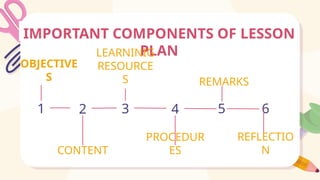
IMPORTANT COMPONENTS OF LESSON
PLAN
OBJECTIVE
S
CONTENT
LEARNINIG
RESOURCE
S
PROCEDUR
ES
1 2 3 4 5 6
REFLECTIO
N
REMARKS
1
OBJECTIVE
S
IN WRITING OBJECTIVES, THEY
SHOULD BE SPECIFIC AND
MEASURABLE AND DESCRIBES
WHAT THE STUDENT SHOULD
KNOW OR BE ABLE TO DO.
OBJECTIVES SHOULD ALSO TAP
NOT ONLY ROTE MEMORIZATION
AND BASIC UNDERSTANDING BUT
ALSO CRITICAL AND CREATIVE
THINKING.
Develop a lesson plan
for one grade level
based on the K to 12
curriculum guide for
social studies
Differentiate
comprehensive and
abbreviated lesson
plans and discuss how
they are used in the
Philippines
Explain the different
components of the Daily
Lesson Plan and the
Daily Lesson Log
03
OBJECTIVES
IMPORTANT COMPONENTS OF LESSON
PLAN
OBJECTIVE
S
CONTENT
LEARNINI
G
RESOURCE
S
PROCEDUR
ES
1 2 3 4 5 6
REFLECTIO
N
REMARKS
STATES THE ACTUAL TOPIC OR
SUBJECT THAT WILL BE
DISCUSSED FOR THE DAY OR
THE FOLLOWING DAYS.
CONTEN
T
2
Lesson 8:
Developing
lesson plans for
Social Studies
IMPORTANT COMPONENTS OF LESSON
PLAN
OBJECTIVE
S
CONTENT
LEARNING
RESOURCE
S
PROCEDUR
ES
1 2 3 4 5 6
REFLECTIO
N
REMARKS
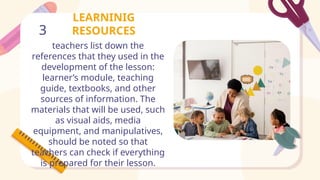
teachers list down the
references that they used in the
development of the lesson:
learner’s module, teaching
guide, textbooks, and other
sources of information. The
materials that will be used, such
as visual aids, media
equipment, and manipulatives,
should be noted so that
teachers can check if everything
is prepared for their lesson.
LEARNINIG
RESOURCES
3
IMPORTANT COMPONENTS OF LESSON
PLAN
OBJECTIVE
S
CONTENT
LEARNINI
G
RESOURCE
S
PROCEDUR
ES
1 2 3 4 5 6
REFLECTIO
N
REMARKS
The procedures portion is the
longest part of the lesson plan. It
contains the steps and activities
that will be done to achieve the
objectives. In preparing a DLP,
teachers divide the procedures
portion into three parts:
4
PROCEDURES
Before the Lesson
During the Lesson
After the Lesson
Before the Lesson
This includes the activities that will be done at the beginning
of the lesson. In this part, teachers may do any of the
following:
i) Review of the previous lesson.
ii) Introduction of the new lesson.
iii) Presentation of the connection between the previous and
the new lesson.
iv) Statement of the learning objectives.
It is also important for teachers to conduct a diagnostic
assessment to find out what students already know about
the topic.
As such, teachers should implement start-up or warm-up
activities that capture the students’ interests and attention
at the beginning of the lesson.
The procedures portion is the
longest part of the lesson plan. It
contains the steps and activities
that will be done to achieve the
objectives. In preparing a DLP,
teachers divide the procedures
portion into three parts:
4
PROCEDURES
Before the Lesson
During the Lesson
After the Lesson
During the Lesson
This is the main part the new topic is
presented. Aside from direct
instruction, teacher should provide
various activities that will help students
attain mastery and understanding. This
ongoing process of activities, feedback
is known as formative assessment.
(check-up quiz, practice work, and
journal entry)
The procedures portion is the
longest part of the lesson plan. It
contains the steps and activities
that will be done to achieve the
objectives. In preparing a DLP,
teachers divide the procedures
portion into three parts:
4
PROCEDURES
Before the Lesson
During the Lesson
After the Lesson
After the Lesson
After the Lesson. This serves as the closure of the lesson. Teachers and
students wrap up the discussion by doing any of the following:
I. Application of the lesson to real-life situations.
II. Summary, generalizations, and conclusion.
III. Summative assessment.
IV. Homework.
To ensure that the instructional objectives are attained, it is important for
teachers to conduct a summative assessment at the end of the lesson. This
may come in the form of a Chapter Test, Performance Exam, Homework,
and other assessment strategies.
In the Daily Lesson Log (DLL) template, the Department of Education outlined
10 steps under the Procedures, which can also be categorized under the
three parts of the lesson. It’s important to note that these steps are mere
suggestions; flexibility is allowed in the delivery of the procedures.
Teachers don’t need to go through all the steps, but they have to ensure
that the instructional objectives are successfully attained.
The procedures portion is the
longest part of the lesson plan. It
contains the steps and activities
that will be done to achieve the
objectives. In preparing a DLP,
teachers divide the procedures
portion into three parts:
4
PROCEDURES
Before the Lesson
During the Lesson
After the Lesson
IMPORTANT COMPONENTS OF LESSON
PLAN
OBJECTIVE
S
CONTENT
LEARNINI
G
RESOURCE
S
PROCEDUR
ES
1 2 3 4 5 6
REFLECTIO
N
REMARKS
In this part, teachers indicate
whether they have finished the
lesson or not within the given
time frame. If the lesson will be
continued for the next
meeting, they write specific
reasons such as re-teaching,
insufficient time, class
suspension, and other
instances.
REMARKS
5
IMPORTANT COMPONENTS OF LESSON
PLAN
OBJECTIVE
S
CONTENT
LEARNINI
G
RESOURCE
S
PROCEDUR
ES
1 2 3 4 5 6
REFLECTIO
N
REMARKS
As reflective practitioners, teachers should assess their
instruction, filling out this portion right after the
delivery of the lesson. They may use the following
questions as a guide in their self-evaluation:
a. How many learners earned 80% in the evaluation?
b. How many require additional activities for remediation?
Did the remedial lessons work? How many were able to
catch up with the lesson? How many require continuous
remediation?
c. Which of my teaching strategies worked well? Why did
these work?
d. What difficulties did I encounter which my principal or
supervisor can help me solve?
e. What innovation or localized materials did I use/discover
which I wish to share with other teachers?
REFLECTIO
N
6
IMPORTANT COMPONENTS OF LESSON
PLAN
OBJECTIVE
S
CONTENT
LEARNING
RESOURCE
S
PROCEDUR
ES
1 2 3 4 5 6
REFLECTIO
N
REMARKS
As an experienced teacher, you are preparing lesson plans for your
upcoming semester. How do you differentiate between a comprehensive
lesson plan (CLP) and an abbreviated lesson plan (ALP)?
a. CLP includes detailed objectives, materials, and assessment
methods, while ALP provides a brief overview of the lesson.
b. CLP is used for elementary students, while ALP is for high school
students.
c. CLP focuses on morning lessons, while ALP is for afternoon sessions.
d. CLP emphasizes weekly planning, while ALP is for daily
instruction.
As an experienced teacher, you are preparing lesson plans for your
upcoming semester. How do you differentiate between a comprehensive
lesson plan (CLP) and an abbreviated lesson plan (ALP)?
a. CLP includes detailed objectives, materials, and assessment
methods, while ALP provides a brief overview of the lesson.
b. CLP is used for elementary students, while ALP is for high school
students.
c. CLP focuses on morning lessons, while ALP is for afternoon sessions.
d. CLP emphasizes weekly planning, while ALP is for daily
instruction.
Ms. Gwen is an experienced teacher who have been teaching for 7 years.
Is Ms. Gwen required to make a Detailed Lesson Plan (DLP)?
a. Yes, because according to DepEd Order No. 42, s.2016. every teacher
is required to make a Detailed Lesson Plan.
b. Yes, because every teacher should have an equal treatment whether
they are an experienced teacher or a newly-hired teacher.
c. No, because according to DepEd Order No. 42, s.2016. only the
newly-hired teachers are required to make DLP until they receive a very
satisfactory rating.
d. None of the above.
Ms. Gwen is an experienced teacher who have been teaching for 7 years.
Is Ms. Gwen required to make a Detailed Lesson Plan (DLP)?
a. Yes, because according to DepEd Order No. 42, s.2016. every teacher
is required to make a Detailed Lesson Plan.
b. Yes, because every teacher should have an equal treatment whether
they are an experienced teacher or a newly-hired teacher.
c. No, because according to DepEd Order No. 42, s.2016. only the
newly-hired teachers are required to make DLP until they receive a very
satisfactory rating.
d. None of the above.
As an elementary school social studies teacher, you’re preparing a
lesson on community helpers. The goal is for students to understand the
roles and responsibilities of different community members. You’ve
already covered basic concepts like police officers, firefighters, and
doctors. To engage your young students, which approach would be most
effective for achieving your lesson objective?
a. Organizing the “Community Helper Show and Tell” where students share
information about different community helpers in a fun and
interactive way.
b. Providing a lecture summarizing the roles of community helpers, followed
by assigning students to write short essays about their favorite
helper.
c. Showing a video about community helpers, followed by a class discussion.
d. Distributing a handout with a list of community helper names and asking
students to match each helper with their role.
As an elementary school social studies teacher, you’re preparing a
lesson on community helpers. The goal is for students to understand the
roles and responsibilities of different community members. You’ve
already covered basic concepts like police officers, firefighters, and
doctors. To engage your young students, which approach would be most
effective for achieving your lesson objective?
a. Organizing the “Community Helper Show and Tell” where students
share information about different community helpers in a fun
and interactive way.
b. Providing a lecture summarizing the roles of community helpers, followed
by assigning students to write short essays about their favorite
helper.
c. Showing a video about community helpers, followed by a class discussion.
d. Distributing a handout with a list of community helper names and asking
students to match each helper with their role.
Ms. Stacey didn’t finish her discussion due to lack of time.
Which part of the six important components of Lesson Plan
that indicate whether Ms. Stacey have finished her lesson or
not within the given time frame?
a. Reflection
b. Content
c. Procedures
d. Remarks
Ms. Stacey didn’t finish her discussion due to lack of time.
Which part of the six important components of Lesson Plan
that indicate whether Ms. Stacey have finished her lesson or
not within the given time frame?
a. Reflection
b. Content
c. Procedures
d. Remarks
Teacher Colet is a master teacher who will conduct a
demonstrating teaching. What format of Lesson Plan should
Teacher Colet should be using?
a. Comprehensive Lesson Plan
b. Abbreviated Lesson Plan
c. Both Comprehensive and Abbreviated Lesson Plan can be used
in demonstrating teaching.
d. None of the above
Teacher Colet is a master teacher who will conduct a
demonstrating teaching. What format of Lesson Plan should
Teacher Colet should be using?
a. Comprehensive Lesson Plan
b. Abbreviated Lesson Plan
c. Both Comprehensive and Abbreviated Lesson Plan can be used
in demonstrating teaching.
d. None of the above
Thank you for
your
participation!!

DEVELOPING LESSON PLAN FOR SOCIAL STUDIES

  • 1.
    Lesson 8: Developing lesson plansfor Social Studies Manda, Nezriyn A.
  • 2.
    Develop a lessonplan for one grade level based on the K to 12 curriculum guide for social studies Differentiate comprehensive and abbreviated lesson plans and discuss how they are used in the Philippines Explain the different components of the Daily Lesson Plan and the Daily Lesson Log 03 OBJECTIVES
  • 3.
    General format of aLesson Plan Comprehensiv e Lesson Plan Abbreviated Lesson Plan
  • 4.
    CONTAINS A DETAILED DESCRIPTIONOF THE STEPS IN THE TEACHING AND LEARNING PROCESS. Comprehensive Lesson Plan
  • 5.
    Comprehensive Lesson Plan In thePhilippines, an example of this format is the Detailed Lesson Plan (DLP), which is mandated through DepEd Order No. 42, s. 2016. The DLP is considered as a teacher’s roadmap for a specific lesson, containing a detailed description of the processes he or she will use to teach a particular topic. According to the DepEd Order, the following are required to prepare DLPs:  Newly-hired teachers without professional teaching experience: They are required to accomplish DLPs during their first year. If they receive a rating of ‘Very Satisfactory’ at the end of the year, they will not be required to create DLPs in their second year onwards. However, if they receive a ‘Satisfactory’ rating, they must continue preparing DLPs until they achieve a ‘Very Satisfactory’ rating.  Teacher applicants  Master teachers who will conduct demonstration teaching  All teachers handling a subject integrated with new content
  • 6.
    General format of aLesson Plan Comprehensiv e Lesson Plan Abbreviated Lesson Plan
  • 7.
  • 8.
    In the Philippines,an example of this format is the Daily Lesson Log (DLL), which is mandated through DepEd Order No. 42, s. 2016. The DLL serves as a grid template where teachers input the different parts of the lesson. The template provided by the Department of Education covers a week’s worth of lessons. Teachers who have been in the education service for at least one year are instructed to write DLLs instead of the Detailed Lesson Plan. Abbreviated Lesson Plan
  • 9.
    The Daily LessonPlan (DLP) and the Detailed Lesson Log (DLL) share the same six components: Objectives, Content, Learning Resources, Procedures, Remarks, and Reflection. The key difference lies in their preparation mode: DLPs are created daily, while DLLs are submitted weekly. Public school teachers in the Philippines use a template provided by the Department of Education for DLLs.
  • 10.
    IMPORTANT COMPONENTS OFLESSON PLAN OBJECTIVE S CONTENT LEARNINIG RESOURCE S PROCEDUR ES 1 2 3 4 5 6 REFLECTIO N REMARKS
  • 11.
    1 OBJECTIVE S IN WRITING OBJECTIVES,THEY SHOULD BE SPECIFIC AND MEASURABLE AND DESCRIBES WHAT THE STUDENT SHOULD KNOW OR BE ABLE TO DO. OBJECTIVES SHOULD ALSO TAP NOT ONLY ROTE MEMORIZATION AND BASIC UNDERSTANDING BUT ALSO CRITICAL AND CREATIVE THINKING.
  • 12.
    Develop a lessonplan for one grade level based on the K to 12 curriculum guide for social studies Differentiate comprehensive and abbreviated lesson plans and discuss how they are used in the Philippines Explain the different components of the Daily Lesson Plan and the Daily Lesson Log 03 OBJECTIVES
  • 13.
    IMPORTANT COMPONENTS OFLESSON PLAN OBJECTIVE S CONTENT LEARNINI G RESOURCE S PROCEDUR ES 1 2 3 4 5 6 REFLECTIO N REMARKS
  • 14.
    STATES THE ACTUALTOPIC OR SUBJECT THAT WILL BE DISCUSSED FOR THE DAY OR THE FOLLOWING DAYS. CONTEN T 2
  • 15.
  • 16.
    IMPORTANT COMPONENTS OFLESSON PLAN OBJECTIVE S CONTENT LEARNING RESOURCE S PROCEDUR ES 1 2 3 4 5 6 REFLECTIO N REMARKS
  • 17.
    teachers list downthe references that they used in the development of the lesson: learner’s module, teaching guide, textbooks, and other sources of information. The materials that will be used, such as visual aids, media equipment, and manipulatives, should be noted so that teachers can check if everything is prepared for their lesson. LEARNINIG RESOURCES 3
  • 18.
    IMPORTANT COMPONENTS OFLESSON PLAN OBJECTIVE S CONTENT LEARNINI G RESOURCE S PROCEDUR ES 1 2 3 4 5 6 REFLECTIO N REMARKS
  • 19.
    The procedures portionis the longest part of the lesson plan. It contains the steps and activities that will be done to achieve the objectives. In preparing a DLP, teachers divide the procedures portion into three parts: 4 PROCEDURES Before the Lesson During the Lesson After the Lesson
  • 20.
    Before the Lesson Thisincludes the activities that will be done at the beginning of the lesson. In this part, teachers may do any of the following: i) Review of the previous lesson. ii) Introduction of the new lesson. iii) Presentation of the connection between the previous and the new lesson. iv) Statement of the learning objectives. It is also important for teachers to conduct a diagnostic assessment to find out what students already know about the topic. As such, teachers should implement start-up or warm-up activities that capture the students’ interests and attention at the beginning of the lesson.
  • 21.
    The procedures portionis the longest part of the lesson plan. It contains the steps and activities that will be done to achieve the objectives. In preparing a DLP, teachers divide the procedures portion into three parts: 4 PROCEDURES Before the Lesson During the Lesson After the Lesson
  • 22.
    During the Lesson Thisis the main part the new topic is presented. Aside from direct instruction, teacher should provide various activities that will help students attain mastery and understanding. This ongoing process of activities, feedback is known as formative assessment. (check-up quiz, practice work, and journal entry)
  • 23.
    The procedures portionis the longest part of the lesson plan. It contains the steps and activities that will be done to achieve the objectives. In preparing a DLP, teachers divide the procedures portion into three parts: 4 PROCEDURES Before the Lesson During the Lesson After the Lesson
  • 24.
    After the Lesson Afterthe Lesson. This serves as the closure of the lesson. Teachers and students wrap up the discussion by doing any of the following: I. Application of the lesson to real-life situations. II. Summary, generalizations, and conclusion. III. Summative assessment. IV. Homework. To ensure that the instructional objectives are attained, it is important for teachers to conduct a summative assessment at the end of the lesson. This may come in the form of a Chapter Test, Performance Exam, Homework, and other assessment strategies. In the Daily Lesson Log (DLL) template, the Department of Education outlined 10 steps under the Procedures, which can also be categorized under the three parts of the lesson. It’s important to note that these steps are mere suggestions; flexibility is allowed in the delivery of the procedures. Teachers don’t need to go through all the steps, but they have to ensure that the instructional objectives are successfully attained.
  • 25.
    The procedures portionis the longest part of the lesson plan. It contains the steps and activities that will be done to achieve the objectives. In preparing a DLP, teachers divide the procedures portion into three parts: 4 PROCEDURES Before the Lesson During the Lesson After the Lesson
  • 26.
    IMPORTANT COMPONENTS OFLESSON PLAN OBJECTIVE S CONTENT LEARNINI G RESOURCE S PROCEDUR ES 1 2 3 4 5 6 REFLECTIO N REMARKS
  • 27.
    In this part,teachers indicate whether they have finished the lesson or not within the given time frame. If the lesson will be continued for the next meeting, they write specific reasons such as re-teaching, insufficient time, class suspension, and other instances. REMARKS 5
  • 28.
    IMPORTANT COMPONENTS OFLESSON PLAN OBJECTIVE S CONTENT LEARNINI G RESOURCE S PROCEDUR ES 1 2 3 4 5 6 REFLECTIO N REMARKS
  • 29.
    As reflective practitioners,teachers should assess their instruction, filling out this portion right after the delivery of the lesson. They may use the following questions as a guide in their self-evaluation: a. How many learners earned 80% in the evaluation? b. How many require additional activities for remediation? Did the remedial lessons work? How many were able to catch up with the lesson? How many require continuous remediation? c. Which of my teaching strategies worked well? Why did these work? d. What difficulties did I encounter which my principal or supervisor can help me solve? e. What innovation or localized materials did I use/discover which I wish to share with other teachers? REFLECTIO N 6
  • 30.
    IMPORTANT COMPONENTS OFLESSON PLAN OBJECTIVE S CONTENT LEARNING RESOURCE S PROCEDUR ES 1 2 3 4 5 6 REFLECTIO N REMARKS
  • 31.
    As an experiencedteacher, you are preparing lesson plans for your upcoming semester. How do you differentiate between a comprehensive lesson plan (CLP) and an abbreviated lesson plan (ALP)? a. CLP includes detailed objectives, materials, and assessment methods, while ALP provides a brief overview of the lesson. b. CLP is used for elementary students, while ALP is for high school students. c. CLP focuses on morning lessons, while ALP is for afternoon sessions. d. CLP emphasizes weekly planning, while ALP is for daily instruction.
  • 32.
    As an experiencedteacher, you are preparing lesson plans for your upcoming semester. How do you differentiate between a comprehensive lesson plan (CLP) and an abbreviated lesson plan (ALP)? a. CLP includes detailed objectives, materials, and assessment methods, while ALP provides a brief overview of the lesson. b. CLP is used for elementary students, while ALP is for high school students. c. CLP focuses on morning lessons, while ALP is for afternoon sessions. d. CLP emphasizes weekly planning, while ALP is for daily instruction.
  • 33.
    Ms. Gwen isan experienced teacher who have been teaching for 7 years. Is Ms. Gwen required to make a Detailed Lesson Plan (DLP)? a. Yes, because according to DepEd Order No. 42, s.2016. every teacher is required to make a Detailed Lesson Plan. b. Yes, because every teacher should have an equal treatment whether they are an experienced teacher or a newly-hired teacher. c. No, because according to DepEd Order No. 42, s.2016. only the newly-hired teachers are required to make DLP until they receive a very satisfactory rating. d. None of the above.
  • 34.
    Ms. Gwen isan experienced teacher who have been teaching for 7 years. Is Ms. Gwen required to make a Detailed Lesson Plan (DLP)? a. Yes, because according to DepEd Order No. 42, s.2016. every teacher is required to make a Detailed Lesson Plan. b. Yes, because every teacher should have an equal treatment whether they are an experienced teacher or a newly-hired teacher. c. No, because according to DepEd Order No. 42, s.2016. only the newly-hired teachers are required to make DLP until they receive a very satisfactory rating. d. None of the above.
  • 35.
    As an elementaryschool social studies teacher, you’re preparing a lesson on community helpers. The goal is for students to understand the roles and responsibilities of different community members. You’ve already covered basic concepts like police officers, firefighters, and doctors. To engage your young students, which approach would be most effective for achieving your lesson objective? a. Organizing the “Community Helper Show and Tell” where students share information about different community helpers in a fun and interactive way. b. Providing a lecture summarizing the roles of community helpers, followed by assigning students to write short essays about their favorite helper. c. Showing a video about community helpers, followed by a class discussion. d. Distributing a handout with a list of community helper names and asking students to match each helper with their role.
  • 36.
    As an elementaryschool social studies teacher, you’re preparing a lesson on community helpers. The goal is for students to understand the roles and responsibilities of different community members. You’ve already covered basic concepts like police officers, firefighters, and doctors. To engage your young students, which approach would be most effective for achieving your lesson objective? a. Organizing the “Community Helper Show and Tell” where students share information about different community helpers in a fun and interactive way. b. Providing a lecture summarizing the roles of community helpers, followed by assigning students to write short essays about their favorite helper. c. Showing a video about community helpers, followed by a class discussion. d. Distributing a handout with a list of community helper names and asking students to match each helper with their role.
  • 37.
    Ms. Stacey didn’tfinish her discussion due to lack of time. Which part of the six important components of Lesson Plan that indicate whether Ms. Stacey have finished her lesson or not within the given time frame? a. Reflection b. Content c. Procedures d. Remarks
  • 38.
    Ms. Stacey didn’tfinish her discussion due to lack of time. Which part of the six important components of Lesson Plan that indicate whether Ms. Stacey have finished her lesson or not within the given time frame? a. Reflection b. Content c. Procedures d. Remarks
  • 39.
    Teacher Colet isa master teacher who will conduct a demonstrating teaching. What format of Lesson Plan should Teacher Colet should be using? a. Comprehensive Lesson Plan b. Abbreviated Lesson Plan c. Both Comprehensive and Abbreviated Lesson Plan can be used in demonstrating teaching. d. None of the above
  • 40.
    Teacher Colet isa master teacher who will conduct a demonstrating teaching. What format of Lesson Plan should Teacher Colet should be using? a. Comprehensive Lesson Plan b. Abbreviated Lesson Plan c. Both Comprehensive and Abbreviated Lesson Plan can be used in demonstrating teaching. d. None of the above
  • 41.