The document discusses the Lagom framework for developing microservices, emphasizing its developer experience, inter-service communication, and persistence API principles. It describes essential concepts like event sourcing and CQRS, includes code examples for service definitions and enhancements, and mentions tools for production deployment. It also outlines the framework's current version, future developments, and resources for further exploration.


![Lagom - [lah-gome]
Adequate, sufficient, just right](https://image.slidesharecdn.com/lightbendlagom-microservicesjustright-160510190312/85/Lightbend-Lagom-Microservices-Just-Right-2-320.jpg)
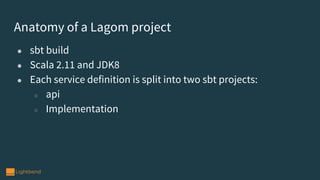
![Service definition
trait HelloService extends Service {
override def descriptor(): Descriptor = {
named("helloservice").`with`(
namedCall("/hello", sayHello _)
)
}
def sayHello(): ServiceCall[String, String]
}
// this source is placed in your api project](https://image.slidesharecdn.com/lightbendlagom-microservicesjustright-160510190312/85/Lightbend-Lagom-Microservices-Just-Right-9-320.jpg)
![ServiceCall explained
● ServiceCall can be invoked when consuming a service:
○ Request: type of incoming request message (e.g. String)
○ Response: type of outgoing response message (e.g. String)
● JSON is the default serialization format for request/response messages
● There are two kinds of request/response messages:
○ Strict
○ Streamed
trait ServiceCall[Request, Response] {
def invoke(request: Request): Future[Response]
}](https://image.slidesharecdn.com/lightbendlagom-microservicesjustright-160510190312/85/Lightbend-Lagom-Microservices-Just-Right-10-320.jpg)
![Strict Messages
Strict messages are fully buffered into memory
override def descriptor(): Descriptor = {
named("friendservice").`with`(
pathCall("/users/:userId/friends", addFriend _)
)
}
def addFriend(userId: String): ServiceCall[FriendId, NotUsed]](https://image.slidesharecdn.com/lightbendlagom-microservicesjustright-160510190312/85/Lightbend-Lagom-Microservices-Just-Right-11-320.jpg)
![Streamed Messages
override def descriptor(): Descriptor = {
named("clock").`with`(
pathCall("/tick/:interval", tick())
)
}
def tick(): ServiceCall[String, Source[String, _]]
● A streamed message is of type Source (an Akka streams API)
● It allows asynchronous streaming and handling of messages
● Lagom will select transport protocol (currently WebSockets)](https://image.slidesharecdn.com/lightbendlagom-microservicesjustright-160510190312/85/Lightbend-Lagom-Microservices-Just-Right-12-320.jpg)
![Remember the Service definition?
trait HelloService extends Service {
override def descriptor(): Descriptor = {
named("helloservice").`with`(
namedCall(sayHello _)
)
}
def sayHello(): ServiceCall[String, String]
}
// this source is placed in your api project](https://image.slidesharecdn.com/lightbendlagom-microservicesjustright-160510190312/85/Lightbend-Lagom-Microservices-Just-Right-13-320.jpg)
![Here is the Service implementation
class HelloServiceImpl extends HelloService {
override def sayHello(): ServiceCall[String, String] {
name => Future.successful(s"Hello, $name!")
}
}
// this source is placed in your implementation project](https://image.slidesharecdn.com/lightbendlagom-microservicesjustright-160510190312/85/Lightbend-Lagom-Microservices-Just-Right-14-320.jpg)
![Inter-service communication
class MyServiceImpl @Inject()(helloService: HelloService)
(implicit ec: ExecutionContext) extends MyService {
override def sayHelloLagom(): ServiceCall[NotUsed, String] = unused => {
val response = helloService.sayHello().invoke("Lagom")
response.map(answer => s"Hello service said: $answer")
}
}](https://image.slidesharecdn.com/lightbendlagom-microservicesjustright-160510190312/85/Lightbend-Lagom-Microservices-Just-Right-15-320.jpg)
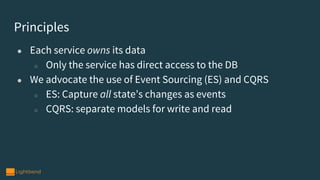
![Event Sourcing: Example
Create the Command classes
sealed trait FriendCommand extends Jsonable
case class AddFriend(friendUserId: String) extends
PersistentEntity.ReplyType[Done] with FriendCommand
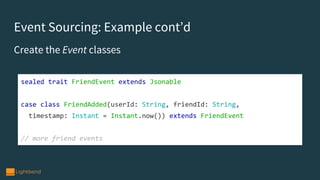
// more friend commands](https://image.slidesharecdn.com/lightbendlagom-microservicesjustright-160510190312/85/Lightbend-Lagom-Microservices-Just-Right-20-320.jpg)
![Event Sourcing: Example cont’d
class FriendEntity extends
PersistentEntity[FriendCommand, FriendEvent, FriendState] {
def initialBehavior(snapshotState: Optional[FriendState]): Behavior =
// TODO: define command and event handlers
}
Create a subclass of PersistentEntity](https://image.slidesharecdn.com/lightbendlagom-microservicesjustright-160510190312/85/Lightbend-Lagom-Microservices-Just-Right-22-320.jpg)
![Event Sourcing: Example cont’d
val b: Behavior = newBehaviorBuilder(/*...*/)
b.setCommandHandler(classOf[AddFriend],
(cmd: AddFriend, ctx: CommandContext[Done]) => state.user match {
case None =>
ctx.invalidCommand(s"User ${entityId} is not created")
ctx.done()
case Some(user) =>
ctx.thenPersist(FriendAdded(user.userId, cmd.friendUserId),
(evt: FriendAdded) => ctx.reply(Done))
})](https://image.slidesharecdn.com/lightbendlagom-microservicesjustright-160510190312/85/Lightbend-Lagom-Microservices-Just-Right-23-320.jpg)
![b.setEventHandler(classOf[FriendAdded],
(evt: FriendAdded) => state.addFriend(evt.friendId))
Event Sourcing: Example cont’d
No side-effects in the event handler!](https://image.slidesharecdn.com/lightbendlagom-microservicesjustright-160510190312/85/Lightbend-Lagom-Microservices-Just-Right-24-320.jpg)
![Event Sourcing: Example cont’d
Create the State class
case class FriendState(user: Option[User]) extends Jsonable {
def addFriend(friendUserId: String): FriendState = user match {
case None => throw new IllegalStateException(
"friend can't be added before user is created")
case Some(user) =>
val newFriends = user.friends :+ friendUserId
FriendState(Some(user.copy(friends = newFriends)))
}
}](https://image.slidesharecdn.com/lightbendlagom-microservicesjustright-160510190312/85/Lightbend-Lagom-Microservices-Just-Right-25-320.jpg)
![class FriendServiceImpl @Inject() (persistentEntities: PersistentEntityRegistry)
(implicit ec: ExecutionContext) extends FriendService {
// at service startup we must register the needed entities
persistentEntities.register(classOf[FriendEntity])
def addFriend(userId: String): ServiceCall[FriendId, NotUsed] = request => {
val ref = persistentEntities.refFor(classOf[FriendEntity], userId)
ref.ask[Done, AddFriend](AddFriend(request.friendId))
}
// ...
}
Event Sourcing: Example cont’d](https://image.slidesharecdn.com/lightbendlagom-microservicesjustright-160510190312/85/Lightbend-Lagom-Microservices-Just-Right-26-320.jpg)

![Current[Lagom]
● Current version is 1.0.0-M2
○ 1.0 soon
● Java API, but no Scala API yet
○ We are working on the Scala API
○ But using Scala with the Java API works well! https:
//github.com/dotta/activator-lagom-scala-chirper](https://image.slidesharecdn.com/lightbendlagom-microservicesjustright-160510190312/85/Lightbend-Lagom-Microservices-Just-Right-29-320.jpg)
![Future[Lagom]
● Maven support
● Message broker integration
● Scala API
● Support for other cluster orchestration tools
● Support for writing integration tests
● Swagger integration
○ Which also removes binary coupling!](https://image.slidesharecdn.com/lightbendlagom-microservicesjustright-160510190312/85/Lightbend-Lagom-Microservices-Just-Right-30-320.jpg)
![Next: Seq[Step]
● Try Lagom yourself
○ https://lightbend.com/lagom
● Using Scala with Lagom
○ https://github.com/dotta/activator-lagom-scala-chirper
● Lagom on Github
○ https://github.com/lagom/lagom
● Read Jonas Bonér's free book Reactive Services Architecture
○ https://lightbend.com/reactive-microservices-architecture
● Great presentation by Greg Young on why you should use ES
○ https://www.youtube.com/watch?v=JHGkaShoyNs](https://image.slidesharecdn.com/lightbendlagom-microservicesjustright-160510190312/85/Lightbend-Lagom-Microservices-Just-Right-31-320.jpg)
![override def descriptor(): Descriptor = {
named("friendservice").`with`(
namedCall("/users", createUser _),
pathCall("/users/:id", getUser _),
restCall(Method.POST, "/users/:userId/friends", addFriend _)
)
}
def createUser(): ServiceCall[User, NotUsed]
def getUser(id: String): ServiceCall[NotUsed, User]
def addFriend(userId: String): ServiceCall[FriendId, NotUsed]
Different kinds of service call descriptors](https://image.slidesharecdn.com/lightbendlagom-microservicesjustright-160510190312/85/Lightbend-Lagom-Microservices-Just-Right-33-320.jpg)


