Building Stateful Microservices With Akka
Yaroslav Tkachenko
Senior Software Engineer at Demonware (Activision)
1 / 40
Java, Scala, Python, Node
Microservices
Event-driven Systems
Distributed Systems
DevOps
... and more
About me
Yaroslav (Slava) Tkachenko, Vancouver, Canada
Demonware (Activision), 2017
Senior Software Engineer [Data Pipeline]
Mobify, 2016 - 2017
Senior Software Engineer, Lead [Platform]
Bench Accounting, 2011 - 2016
Director of Engineering [Platform]
Engineering Lead
Software Engineer
Freelance, 2007 - 2011
Web Developer
2 / 40
https://sap1ens.com/slides/stateful-services/
3 / 40
Agenda
Microservices: stateless vs stateful
Actor systems
Akka
Akka Cluster and Persistence
Real-world applications
4 / 40
Microservices: stateless vs stateful
5 / 40
Microservices: stateless vs stateful
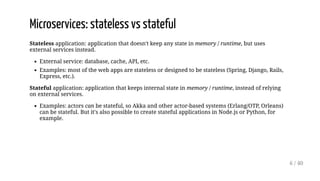
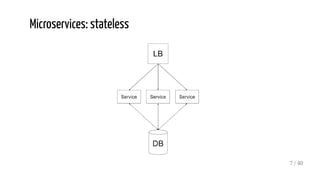
Stateless application: application that doesn't keep any state in memory / runtime, but uses
external services instead.
External service: database, cache, API, etc.
Examples: most of the web apps are stateless or designed to be stateless (Spring, Django, Rails,
Express, etc.).
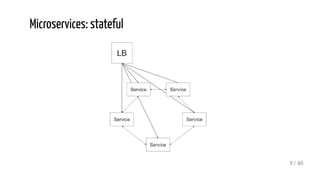
Stateful application: application that keeps internal state in memory / runtime, instead of relying
on external services.
Examples: actors can be stateful, so Akka and other actor-based systems (Erlang/OTP, Orleans)
can be stateful. But it's also possible to create stateful applications in Node.js or Python, for
example.
6 / 40
Microservices: stateless
7 / 40
Microservices: stateless
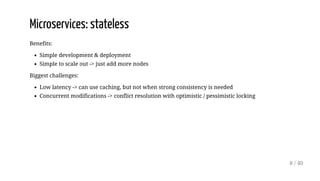
Benefits:
Simple development & deployment
Simple to scale out -> just add more nodes
Biggest challenges:
Low latency -> can use caching, but not when strong consistency is needed
Concurrent modifications -> conflict resolution with optimistic / pessimistic locking
8 / 40
Microservices: stateful
9 / 40
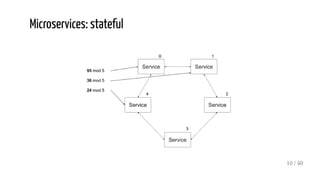
Microservices: stateful
10 / 40
Microservices: stateful
Benefits:
Data locality -> low latency, fast processing
Sticky consistency -> "simple" and "cheap" consistency without using consensus protocols
Biggest challenges:
High availability
Scaling out
11 / 40
Actor systems
12 / 40
Actor systems
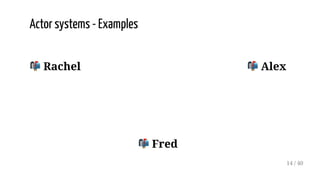
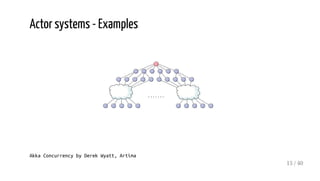
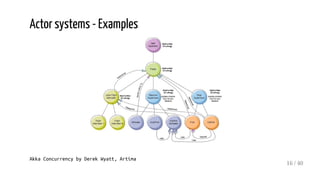
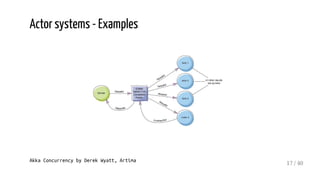
An actor is a computational entity that, in response to a message it receives, can concurrently:
send a finite number of messages to other actors;
create a finite number of new actors;
designate the behavior to be used for the next message it receives.
There is no assumed sequence to the above actions and they could be carried out in parallel.
Every actor has:
A mailbox
A supervisor
Some state [optionally]
13 / 40
Rachel Alex
Actor systems - Examples


Fred
14 / 40
Actor systems - Examples
Akka Concurrency by Derek Wyatt, Artima
15 / 40
Actor systems - Examples
Akka Concurrency by Derek Wyatt, Artima
16 / 40
Actor systems - Examples
Akka Concurrency by Derek Wyatt, Artima
17 / 40
Akka
18 / 40
Akka
Akka is an open-source toolkit and runtime simplifying the construction of concurrent and
distributed applications on the JVM.
Akka supports multiple programming models for concurrency, but it emphasizes actor-based
concurrency, with inspiration drawn from Erlang.
19 / 40
Akka - Actors
case class Greeting(who: String)
class GreetingActor extends Actor with ActorLogging {
def receive = {
case Greeting(who) => log.info("Hello " + who)
}
}
val system = ActorSystem("MySystem")
val greeter = system.actorOf(Props[GreetingActor], name = "greeter")
greeter ! Greeting("Charlie Parker")
 
Messages are handled one by one
Immutability of messages
20 / 40
Akka - Communication
class HelloActor extends Actor with ActorLogging {
def receive = {
case who => sender() ! "Hello, " + who
}
}
object ConversationActor {
def props(fellowActor: ActorRef): Props = Props(classOf[ConversationActor], fellowActor)
}
class ConversationActor(fellowActor: ActorRef) extends Actor with ActorLogging {
def receive = {
case "start" => fellowActor ! "it's me!"
case message => log.info(message)
}
}
val system = ActorSystem("MySystem")
val helloActor = system.actorOf(Props[HelloActor])
val conversationActor = ConversationActor.props(helloActor)
conversationActor ! "start"
21 / 40
Actor systems and Akka - Why?
So, why actors?
Simple concurrency
Clean asynchronous programming model
Great fit for event-driven systems
Resilience
Scalability
22 / 40
Akka Persistence
23 / 40
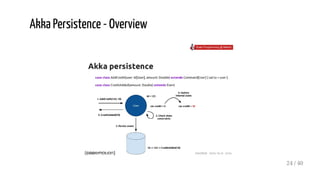
Akka Persistence - Overview
24 / 40
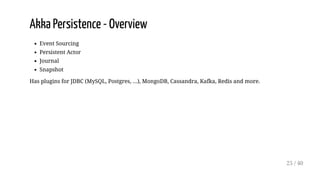
Akka Persistence - Overview
Event Sourcing
Persistent Actor
Journal
Snapshot
Has plugins for JDBC (MySQL, Postgres, ...), MongoDB, Cassandra, Kafka, Redis and more.
25 / 40
Akka Persistence - Example
case class Cmd(data: String)
case class Evt(data: String)
case class ExampleState(events: List[String] = Nil) {
def updated(evt: Evt): ExampleState = copy(evt.data :: events)
override def toString: String = events.reverse.toString
}
class ExamplePersistentActor extends PersistentActor {
override def persistenceId = "sample-id-1"
var state = ExampleState()
def updateState(event: Evt): Unit =
state = state.updated(event)
val receiveRecover: Receive = {
case evt: Evt => updateState(evt)
case SnapshotOffer(_, snapshot: ExampleState) => state = snapshot
}
val receiveCommand: Receive = {
case Cmd(data) => persist(Evt(data))(updateState)
case "snap" => saveSnapshot(state)
case "print" => println(state)
}
}
26 / 40
Akka Cluster
27 / 40
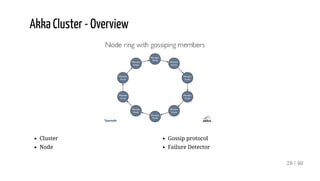
Cluster
Node
Gossip protocol
Failure Detector
Akka Cluster - Overview
28 / 40
Akka Cluster - Sharding
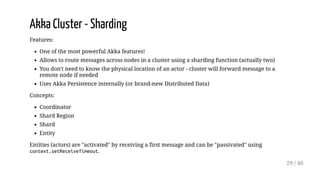
Features:
One of the most powerful Akka features!
Allows to route messages across nodes in a cluster using a sharding function (actually two)
You don't need to know the physical location of an actor - cluster will forward message to a
remote node if needed
Uses Akka Persistence internally (or brand-new Distributed Data)
Concepts:
Coordinator
Shard Region
Shard
Entity
Entities (actors) are "activated" by receiving a first message and can be "passivated" using
context.setReceiveTimeout.
29 / 40
Akka Cluster - Sharding
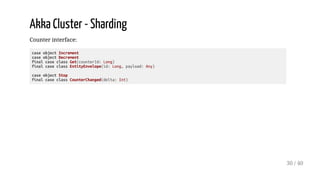
Counter interface:
case object Increment
case object Decrement
final case class Get(counterId: Long)
final case class EntityEnvelope(id: Long, payload: Any)
case object Stop
final case class CounterChanged(delta: Int)
30 / 40
Akka Cluster - Sharding
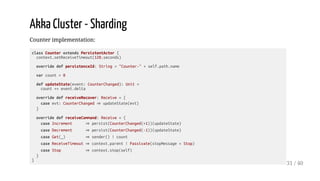
Counter implementation:
class Counter extends PersistentActor {
context.setReceiveTimeout(120.seconds)
override def persistenceId: String = "Counter-" + self.path.name
var count = 0
def updateState(event: CounterChanged): Unit =
count += event.delta
override def receiveRecover: Receive = {
case evt: CounterChanged ⇒ updateState(evt)
}
override def receiveCommand: Receive = {
case Increment ⇒ persist(CounterChanged(+1))(updateState)
case Decrement ⇒ persist(CounterChanged(-1))(updateState)
case Get(_) ⇒ sender() ! count
case ReceiveTimeout ⇒ context.parent ! Passivate(stopMessage = Stop)
case Stop ⇒ context.stop(self)
}
}
31 / 40
Akka Cluster - Sharding
Create a region on every node:
val counterRegion: ActorRef = ClusterSharding(system).start(
typeName = "Counter",
entityProps = Props[Counter],
settings = ClusterShardingSettings(system),
extractEntityId = extractEntityId,
extractShardId = extractShardId)
Sharding functions:
val extractEntityId: ShardRegion.ExtractEntityId = {
case EntityEnvelope(id, payload) ⇒ (id.toString, payload)
case msg @ Get(id) ⇒ (id.toString, msg)
}
val numberOfShards = 100
val extractShardId: ShardRegion.ExtractShardId = {
case EntityEnvelope(id, _) ⇒ (id % numberOfShards).toString
case Get(id) ⇒ (id % numberOfShards).toString
}
32 / 40
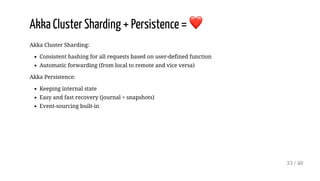
Akka Cluster Sharding + Persistence = ❤
Akka Cluster Sharding:
Consistent hashing for all requests based on user-defined function
Automatic forwarding (from local to remote and vice versa)
Akka Persistence:
Keeping internal state
Easy and fast recovery (journal + snapshots)
Event-sourcing built-in
33 / 40
Real-world applications
34 / 40
Real-world applications
Complex event-driven state machine with low latency API (aka The Tracker)
More (online gaming, data aggregation, trading, complex domains, ...)
35 / 40
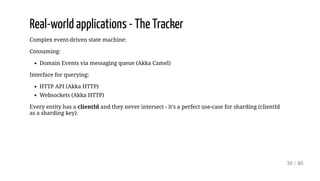
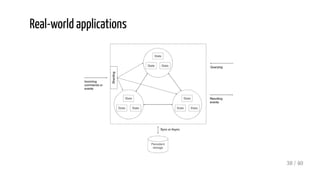
Real-world applications - The Tracker
Complex event-driven state machine:
Consuming:
Domain Events via messaging queue (Akka Camel)
Interface for querying:
HTTP API (Akka HTTP)
Websockets (Akka HTTP)
Every entity has a clientId and they never intersect - it's a perfect use-case for sharding (clientId
as a sharding key).
36 / 40
Real-world applications - The Tracker
object TrackerService {
case class TrackerData(
accounts: Map[String, BankAccount] = Map[String, BankAccount]()
)
}
class TrackerService extends PersistentActor {
private var state = TrackerData()
private def handleMessage(message: EventMessage) {
val maybeUpdatedState = message match {
case b: BankAccountMessage => handleBankMessage(b)
case c: ClientMessage => handleClientMessage(c)
case _ => None
}
maybeUpdatedState.foreach { updatedState =>
updateState(updatedState)
}
}
private def updateState(updatedState: TrackerData) = {
state = state.copy(
accounts = (state.accounts ++ updatedState.accounts).filterNot(_._2.deleted)
)
}
}
37 / 40
Real-world applications
38 / 40
Summary
Actor-based programming simplifies building highly scalable and reliable systems
It's not easy to build & maintain a stateful application, but you never know when it's going to
be needed
Don't try to write abstractions for distributed programming from scratch (unless you're an
expert)
Akka has a few great abstractions already, use them!
It's easier to build a stateful application as a microservice - smaller state size, more flexibility
and great separation of concerns
39 / 40
Questions?
@sap1ens
40 / 40

Building Stateful Microservices With Akka

  • 1.
    Building Stateful MicroservicesWith Akka Yaroslav Tkachenko Senior Software Engineer at Demonware (Activision) 1 / 40
  • 2.
    Java, Scala, Python,Node Microservices Event-driven Systems Distributed Systems DevOps ... and more About me Yaroslav (Slava) Tkachenko, Vancouver, Canada Demonware (Activision), 2017 Senior Software Engineer [Data Pipeline] Mobify, 2016 - 2017 Senior Software Engineer, Lead [Platform] Bench Accounting, 2011 - 2016 Director of Engineering [Platform] Engineering Lead Software Engineer Freelance, 2007 - 2011 Web Developer 2 / 40
  • 3.
  • 4.
    Agenda Microservices: stateless vsstateful Actor systems Akka Akka Cluster and Persistence Real-world applications 4 / 40
  • 5.
  • 6.
    Microservices: stateless vsstateful Stateless application: application that doesn't keep any state in memory / runtime, but uses external services instead. External service: database, cache, API, etc. Examples: most of the web apps are stateless or designed to be stateless (Spring, Django, Rails, Express, etc.). Stateful application: application that keeps internal state in memory / runtime, instead of relying on external services. Examples: actors can be stateful, so Akka and other actor-based systems (Erlang/OTP, Orleans) can be stateful. But it's also possible to create stateful applications in Node.js or Python, for example. 6 / 40
  • 7.
  • 8.
    Microservices: stateless Benefits: Simple development& deployment Simple to scale out -> just add more nodes Biggest challenges: Low latency -> can use caching, but not when strong consistency is needed Concurrent modifications -> conflict resolution with optimistic / pessimistic locking 8 / 40
  • 9.
  • 10.
  • 11.
    Microservices: stateful Benefits: Data locality-> low latency, fast processing Sticky consistency -> "simple" and "cheap" consistency without using consensus protocols Biggest challenges: High availability Scaling out 11 / 40
  • 12.
  • 13.
    Actor systems An actoris a computational entity that, in response to a message it receives, can concurrently: send a finite number of messages to other actors; create a finite number of new actors; designate the behavior to be used for the next message it receives. There is no assumed sequence to the above actions and they could be carried out in parallel. Every actor has: A mailbox A supervisor Some state [optionally] 13 / 40
  • 14.
    Rachel Alex Actor systems- Examples           Fred 14 / 40
  • 15.
    Actor systems -Examples Akka Concurrency by Derek Wyatt, Artima 15 / 40
  • 16.
    Actor systems -Examples Akka Concurrency by Derek Wyatt, Artima 16 / 40
  • 17.
    Actor systems -Examples Akka Concurrency by Derek Wyatt, Artima 17 / 40
  • 18.
  • 19.
    Akka Akka is anopen-source toolkit and runtime simplifying the construction of concurrent and distributed applications on the JVM. Akka supports multiple programming models for concurrency, but it emphasizes actor-based concurrency, with inspiration drawn from Erlang. 19 / 40
  • 20.
    Akka - Actors caseclass Greeting(who: String) class GreetingActor extends Actor with ActorLogging { def receive = { case Greeting(who) => log.info("Hello " + who) } } val system = ActorSystem("MySystem") val greeter = system.actorOf(Props[GreetingActor], name = "greeter") greeter ! Greeting("Charlie Parker")   Messages are handled one by one Immutability of messages 20 / 40
  • 21.
    Akka - Communication classHelloActor extends Actor with ActorLogging { def receive = { case who => sender() ! "Hello, " + who } } object ConversationActor { def props(fellowActor: ActorRef): Props = Props(classOf[ConversationActor], fellowActor) } class ConversationActor(fellowActor: ActorRef) extends Actor with ActorLogging { def receive = { case "start" => fellowActor ! "it's me!" case message => log.info(message) } } val system = ActorSystem("MySystem") val helloActor = system.actorOf(Props[HelloActor]) val conversationActor = ConversationActor.props(helloActor) conversationActor ! "start" 21 / 40
  • 22.
    Actor systems andAkka - Why? So, why actors? Simple concurrency Clean asynchronous programming model Great fit for event-driven systems Resilience Scalability 22 / 40
  • 23.
  • 24.
    Akka Persistence -Overview 24 / 40
  • 25.
    Akka Persistence -Overview Event Sourcing Persistent Actor Journal Snapshot Has plugins for JDBC (MySQL, Postgres, ...), MongoDB, Cassandra, Kafka, Redis and more. 25 / 40
  • 26.
    Akka Persistence -Example case class Cmd(data: String) case class Evt(data: String) case class ExampleState(events: List[String] = Nil) { def updated(evt: Evt): ExampleState = copy(evt.data :: events) override def toString: String = events.reverse.toString } class ExamplePersistentActor extends PersistentActor { override def persistenceId = "sample-id-1" var state = ExampleState() def updateState(event: Evt): Unit = state = state.updated(event) val receiveRecover: Receive = { case evt: Evt => updateState(evt) case SnapshotOffer(_, snapshot: ExampleState) => state = snapshot } val receiveCommand: Receive = { case Cmd(data) => persist(Evt(data))(updateState) case "snap" => saveSnapshot(state) case "print" => println(state) } } 26 / 40
  • 27.
  • 28.
  • 29.
    Akka Cluster -Sharding Features: One of the most powerful Akka features! Allows to route messages across nodes in a cluster using a sharding function (actually two) You don't need to know the physical location of an actor - cluster will forward message to a remote node if needed Uses Akka Persistence internally (or brand-new Distributed Data) Concepts: Coordinator Shard Region Shard Entity Entities (actors) are "activated" by receiving a first message and can be "passivated" using context.setReceiveTimeout. 29 / 40
  • 30.
    Akka Cluster -Sharding Counter interface: case object Increment case object Decrement final case class Get(counterId: Long) final case class EntityEnvelope(id: Long, payload: Any) case object Stop final case class CounterChanged(delta: Int) 30 / 40
  • 31.
    Akka Cluster -Sharding Counter implementation: class Counter extends PersistentActor { context.setReceiveTimeout(120.seconds) override def persistenceId: String = "Counter-" + self.path.name var count = 0 def updateState(event: CounterChanged): Unit = count += event.delta override def receiveRecover: Receive = { case evt: CounterChanged ⇒ updateState(evt) } override def receiveCommand: Receive = { case Increment ⇒ persist(CounterChanged(+1))(updateState) case Decrement ⇒ persist(CounterChanged(-1))(updateState) case Get(_) ⇒ sender() ! count case ReceiveTimeout ⇒ context.parent ! Passivate(stopMessage = Stop) case Stop ⇒ context.stop(self) } } 31 / 40
  • 32.
    Akka Cluster -Sharding Create a region on every node: val counterRegion: ActorRef = ClusterSharding(system).start( typeName = "Counter", entityProps = Props[Counter], settings = ClusterShardingSettings(system), extractEntityId = extractEntityId, extractShardId = extractShardId) Sharding functions: val extractEntityId: ShardRegion.ExtractEntityId = { case EntityEnvelope(id, payload) ⇒ (id.toString, payload) case msg @ Get(id) ⇒ (id.toString, msg) } val numberOfShards = 100 val extractShardId: ShardRegion.ExtractShardId = { case EntityEnvelope(id, _) ⇒ (id % numberOfShards).toString case Get(id) ⇒ (id % numberOfShards).toString } 32 / 40
  • 33.
    Akka Cluster Sharding+ Persistence = ❤ Akka Cluster Sharding: Consistent hashing for all requests based on user-defined function Automatic forwarding (from local to remote and vice versa) Akka Persistence: Keeping internal state Easy and fast recovery (journal + snapshots) Event-sourcing built-in 33 / 40
  • 34.
  • 35.
    Real-world applications Complex event-drivenstate machine with low latency API (aka The Tracker) More (online gaming, data aggregation, trading, complex domains, ...) 35 / 40
  • 36.
    Real-world applications -The Tracker Complex event-driven state machine: Consuming: Domain Events via messaging queue (Akka Camel) Interface for querying: HTTP API (Akka HTTP) Websockets (Akka HTTP) Every entity has a clientId and they never intersect - it's a perfect use-case for sharding (clientId as a sharding key). 36 / 40
  • 37.
    Real-world applications -The Tracker object TrackerService { case class TrackerData( accounts: Map[String, BankAccount] = Map[String, BankAccount]() ) } class TrackerService extends PersistentActor { private var state = TrackerData() private def handleMessage(message: EventMessage) { val maybeUpdatedState = message match { case b: BankAccountMessage => handleBankMessage(b) case c: ClientMessage => handleClientMessage(c) case _ => None } maybeUpdatedState.foreach { updatedState => updateState(updatedState) } } private def updateState(updatedState: TrackerData) = { state = state.copy( accounts = (state.accounts ++ updatedState.accounts).filterNot(_._2.deleted) ) } } 37 / 40
  • 38.
  • 39.
    Summary Actor-based programming simplifiesbuilding highly scalable and reliable systems It's not easy to build & maintain a stateful application, but you never know when it's going to be needed Don't try to write abstractions for distributed programming from scratch (unless you're an expert) Akka has a few great abstractions already, use them! It's easier to build a stateful application as a microservice - smaller state size, more flexibility and great separation of concerns 39 / 40
  • 40.